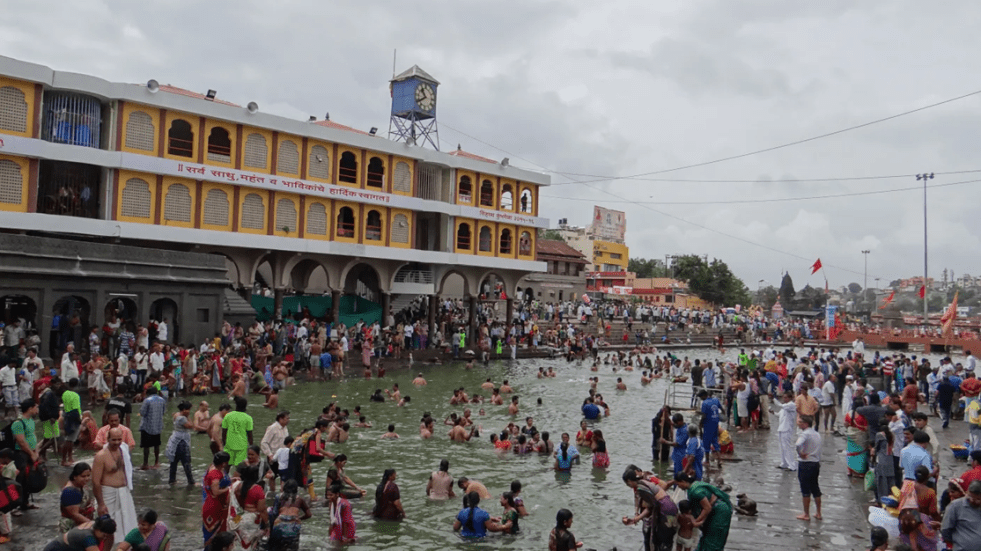
(Feature Image: Godavari river in Nashik. Source: SANDRP Guest blog by Shilpa Dahake in Dec. 2017)
This week, the Question of Cities (QofC) has, with their focus on Godavari River in Nashik city in view of the 2027 Simhastha Kumbha Mela, once again sought to bring the question to centre stage: Can Kumbh Mela help improve the state of Godavari River rather than worsen it as seems to be the case currently? QofC has gone into depth related to various aspects that are worsening the state of Godavari River in Nashik, including concretization of the river bed and river banks, cutting down of large number of trees, destruction of kunds and generally worsening the water quality in the river. Currently, each Kumbh Mela seems to leave the river in worsening state, rather than improve it.
QofC asks the question, why the Kumbh Mela cannot play a role in improving the state of the river in long term manner and tries to look for answer to the question. Celebration of the River seems to be at the centre of the Kumbh Melas, so naturally one would see this to be a legitimate question and concern.
The question is, who will take the initiative to ensure that Kumbh each time help improve the state of the river? The government, in the state or centre, driven by the vote bank politics, is not likely to take this up, though it is its duty to do that. That is also apparent from its track record. The Judiciary which has taken up some aspects of this issue, thanks to petitions by civil society groups, can also take up, but it does not seem to be the case. Media and civil society groups can raise these issues, but will that achieve the objective? That leaves one agency that seems completely out of picture. The religious groups and institutions and people that are organizing and participating in the Kumbh are possibly the most appropriate ones to take up this cause. Will they?
Nashik Kumbh: Why Godavari cannot be revived as a River? As Nashik, and the Godavari river that has defined the city for centuries, prepare to host the Simhastha Kumbh Mela in less than six months, the Godavari is struggling to flow in places and stagnant in others, human-caused pollution and policy-driven concretisation impeding its flow. Like it asked the poet VV Shirwadkar Kusumagraj ‘how to endure a blow and stream forward,’ it now asks the question of the Maharashtra government, the authorities in Nashik, and the people of the ancient city. Worshipped and neglected from one Kumbh Mela to the next 12 years apart, the Godavari is asking to be heard, respected and restored beyond the event. Question of Cities journeys to Nashik, walks along the river banks, takes in Panchvati and Ramkund, and asks why the Godavari cannot be revived in ecologically sustainable ways. The QofC story provides basic facts about the Godavari river in Nashik.
The area with 17 kunds (reservoirs or bathing tanks) is seeing demolitions and constructions for the forthcoming Kumbh Mela, that’s expected to draw 10-12 crore pilgrims. The authorities are undertaking riverfront development, reconstructing the ghats, concretising them further, and building huge retaining walls along the river, while the construction boom ignores the red and blue flood lines. What will remain of the Godavari?
Prajakta Barse suggests respecting the river, understand how it moves, restore its natural conditions, protect its tributaries – while allowing groundwater to be recharged and not taking away the river’s land by Development Plans or policy.
Devang Jani, a Nashik-based environmentalist who filed a PIL in the Bombay High Court in 2012 to de-concretise the kunds (reservoirs or tanks) along the Godavari river, writes about the continuing work. The 17 ancient kunds filled naturally with water even in summer till wanton concretisation cut off the water sources; during the 2003-2004 Kumbh Mela preparations, the Aruna River, a tributary, was concretised and, eventually, a road built on it. The HC judgment paved the way for de-concretisation. Five of the 17 ancient kunds were brought back to life by 2020 by removing a staggering 3.5 lakh kilos or 165 dumpers of cement concrete; his group is working with the authorities to de-concretise the rest, he writes.
The Maharashtra government has sanctioned Rs 35,000 crore to boost urban infrastructure for Kumbh and beyond, and Rs 44 crore for river ghats. But if the river is channelised and ghats constructed randomly, “you are inviting disaster,” says Rajesh Pandit, president of the Namami Goda Foundation. “Urban lifestyles and changing cultural priorities have reduced people’s direct engagement with the river…water is increasingly viewed as a utilitarian resource rather than a living cultural entity,” says architect and archaeologist Dhanashree Nigudkar.
Real estate over ecological restoration, multiplicity of agencies, and Kumbh Mela-driven deadlines are three faultlines of Nashik’s Godavari riverfront development, based on the Sabarmati model, writes Nashik-based multimedia journalist Naitri Kale. The Rs 2,800-crore Namami Goda project, that started with axing around 1,500 trees—and may fell thousands more by the time the city prepares for the 2027 Kumbh Mela.
Cleaning Godavari a challenge ahead of 2027 Pushkarams The waters of the sacred river of Akhanda Godavari have been declared unsuitable either for drinking or a holy dip due to contamination with effluents being released from industries and untreated sewage water, threatening the survival of the river ecosystem and forcing four lakh residents of the city to drink, while traditional fisherfolk abandoned the river for drinking, bathing on the Eastern bank.
HYDRO POWER PROJECTS
June 2026: Flash Flood Disaster at NEEPCO’s HEP Site The episode raises serious questions about disaster preparedness and risk management in one of India’s most climatically and geologically fragile regions. The available evidence suggests significant gaps in forecasting, monitoring, preparedness, communication and mitigation.
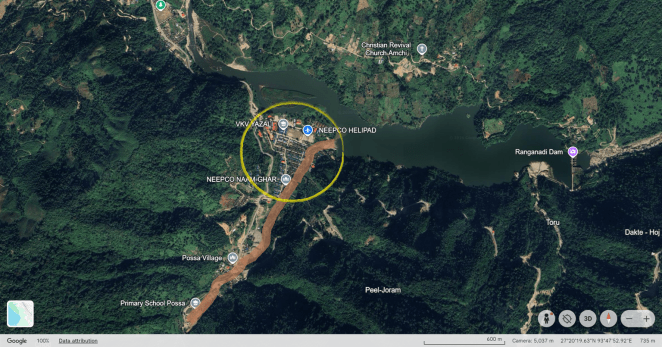
Search intensifies for four missing According to preliminary assessment, around 30 houses were completely damaged or washed away at NEEPCO Colony, while 10 houses were completely damaged and 14 partially, at Possa and Pitapool areas due to the flood. Officials said rescue efforts have been hampered by the absence of mobile network connectivity in the area, with information from the site reaching authorities only intermittently through people travelling to locations with network coverage.
A medical team from Papum Pare district and a NDRF rescue team were deployed to provide emergency treatment and, if required, evacuate four labourers injured in a landslide near a stone crusher plant close to the Keyi Panyor welcome gate on June 25 evening. The labourers were injured after a landslide struck their campsite while they were asleep.
Nyishi Elite Society (NES) urged the govt for a long-term disaster management strategy using modern geo-meteorological technology and AI for hazard mapping, early warning, and better inter-agency coordination to prevent or reduce future losses.
The impact of the floods extended into neighbouring Assam with the floodwaters affecting more than 20,000 people in Dhemaji district, submerging agricultural land, damaging roads, and disrupting normal life. The flooding has once again drawn attention to concerns surrounding hydroelectric projects in the region.
Notably, the Ranganadi dam has been a concerning issue for Assam, especially for its impact in Lakhimpur district. Keshab Krishna Chatradhara, a prominent river activist based in Assam also says that the opening of dam gates cannot be attributed as being behind the incident. Chatradhara also thinks that the small channel was blocked in the upper reaches, which later opened due to heavy rain. “As the devastation site is upstream of the dam elevation, it is not likely that the dam has caused the devastation of that scale. Moreover, had the dam got broken it would have caused severe problems in Assam.”
The event has also raised a wider set of technical and scientific questions about the cause of the flood. Questions are also being raised about whether other hydrological or geological factors may have contributed, including slope saturation, seepage concentration, local aquifer behaviour or the sudden mobilisation of debris in the catchment.
The incident has renewed calls for stronger upstream monitoring systems in dam-linked catchments, including automatic weather stations, real-time hydrological monitoring and independent forecasting systems that do not rely solely on information from project authorities.
According to a NEEPCO press release issued on 26 June 2026, the flash flood was caused by highly localised and intense rainfall, and was not related to the operation of the project’s reservoir or powerhouse. NEEPCO said heavy rainfall began around 3:00 am on 24 June over a small catchment surrounding the project. The rainfall caused two small streams near the administrative and dam-site colony to overflow, washing away 24 residential buildings and damaging several others. The flood struck the colony at around 6:30 am, resulting in one death and four missing persons.
NEEPCO further stated that its Early Warning System (EWS), installed for rainfall and reservoir inflow forecasting, did not record unusually high rainfall or abnormal reservoir inflows during the incident. Based on its preliminary assessment, the corporation concluded that the disaster resulted from localised heavy rainfall rather than any sudden increase in river flow from upstream. It also clarified that no downstream areas were affected due to reservoir or powerhouse operations and that the flood had no connection with dam water releases.
NEEPCO said it is yet to complete an assessment of the damage caused to its hydropower infrastructure and power generation facilities. Officials said a detailed report will be released once the situation stabilises.
Of the 5 people initially reported missing, 3 have now been confirmed dead while two remain missing. The body of a third victim was recovered on June 28, around 10 kilometres downstream from the site. The floods and landslides have affected nine districts, damaged houses, disrupted roads and displaced several families. The IMD has warned of heavy to extremely heavy rainfall, with over 200 mm of rain likely in parts of the state, raising the risk of further flash floods, landslides and waterlogging.
624 Mw Kiru HEP The 624 Mw Kiru Hydroelectric Project on the Chenab River in Kishtwar has achieved 83.46% physical progress, with ₹3,733.26 crore spent so far. According to the latest review by the Ministry of Power, the project’s completion deadline has been extended to Dec 2026, nearly 39 months beyond its original target of September 2023. Approved by the Union Cabinet in 2016, the project’s foundation stone was laid in March 2019, while formal approval was granted in January 2022. The estimated project cost has been revised from ₹4,287.59 crore to ₹5,409 crore, an increase of over ₹1,121 crore, mainly due to difficult geological conditions, challenging terrain, adverse weather and logistical constraints in the Himalayan region. The project features a 135-metre-high concrete gravity dam, and is located between the Kirthai-II and Kwar hydropower projects as part of the Chenab basin hydropower cascade.
2026 World Hydropower Outlook Global hydropower capacity grew by 28 GW in 2025, including 11.7 GW of pumped storage. Pumped storage capacity surpassed 200 GW worldwide for the first time, cementing its position as the world’s largest form of energy storage. India is targeting 100 GW of pumped storage hydropower capacity by 2035-36, but it is nowhere near what China is pursuing, the 2026 Global Hydropower Outlook said. The International Hydropower Association (IHA) released the outlook on June 24, 2026, highlighting China-led East Asia’s continued leadership in global hydropower development.
DAMS
Guj clears Rs 1700 Cr Mahi Bridge Cum Barrage project The Gujarat govt on June 25 granted in-principle approval for a Rs 1,700-crore bridge-cum-barrage project across the Mahi river at Badalpur near Dhuvaran in Anand district. The survey work will begin shortly. It will connect Charotar region and Bharuch. The barrage with about 70 gates will store about 183 MCM water.
Maharashtra to Hold Joint Meeting on Kalu and Shai Dam Projects During a Janata Darbar held in Thane on 16 April 2026, Forest Minister Ganesh Naik announced that a joint meeting at Mantralaya would soon be convened with Water Conservation Minister Girish Mahajan to resolve the technical and administrative hurdles delaying the Kalu and Shai dam projects. The projects have remained stalled since 2002 due to land acquisition issues and strong opposition from project-affected villagers. A BJP delegation highlighted the region’s acute water scarcity and suggested a rehabilitation package similar to the Barvi Dam model, including housing or lump-sum compensation for affected families. The minister assured efforts to expedite the long-pending projects while addressing concerns of project-affected persons.
Mullaperiyar Dam Safety Panel: The National Dam Safety Authority (NDSA) has directed the Kerala govt to nominate a new representative to the Independent Panel of Experts tasked with conducting the Comprehensive Dam Safety Evaluation of the Mullaperiyar dam.
Decisions of MoEF’s Expert Appraisal Committee meeting on River Valley Projects held on June 8 2025 1. Indirasagar-Omkareshwar Open loop Pumped Storage Project (8×80= 640 MW) at VillageNarmada Nagar, Tahasil Punasa, District- Khandwa, Madhya Pradesh by M/s NHDC Limited– Environmental Clearance: APPROVED
2. Munjari Irrigation Project (CCA: 11575 Ha) in Sub District Badoda and Karahal, Sheopur, Madhya Pradesh – Environmental Clearance: APPROVED
3. Dikchu Hydroelectric Power Project (96 MW) in Dist Gangtok & Mangan, Sikkim by Sneha Kinetic Power Projects Pvt Ltd (erstwhile Greenko Energies Pvt Ltd)- Environmental Clearance for Expansion of Capacity (from 96 MW to 110 MW): APPROVED
4. Pinnapuram Integrated RESP-Storage project (1200 MW) in Sub Dist Gadivemula, Orvakal, Panyam, Dist Nandyal and Kurnool, Andhra Pradesh by Greenko AP01 IREP Pvt Ltd -Environmental Clearance for Expansion of Capacity (from 1200 MW to 1680 MW): PP absent, deferred
5. Formation of reservoir across Koraiyar river in Vickramasingapuram village of Ambasamudram Taluk in Tirunelveli District, Tamil Nadu by Water Resources Dept, Government of Tamil Nadu- Terms of Reference: More Info Sought, Deferred
Agenda of MoEF’s Expert Appraisal Committee meeting on River Valley Projects to be held on June 29-30, 2026 1. Upper Indravati Pumped Storage Project 600 MW (4×150 MW) in 164 Ha at Sub dist Thuamul Rampur and Jayapatna, Dist Kalahandi Odisha by Odisha Hydro Power Corp Ltd- Environmental Clearance
2. Naying Hydro Electric Project (1000 MW) in 470.8 Ha at Sub Dist Tato, Payum Circle, Dist Shi Yomi and Siang, Arunachal Pradesh by North Eastern Electric Power Corp Ltd – Environmental Clearance
3. Kalu Patti Close Pumped Storage Project (1000 MW) in 385.43 Ha at Sub Dist Lalganj, Dist Mirzapur, Uttar Pradesh by Renew Hydro Power Pvt Ltd– Terms of Reference
4. Alleri Close loop Pumped Storage Project (1800 MW) in 337.452 Ha at Sub Dist Anaicut, Dist Vellore, Tamil Nadu by Adani Hydro Energy Fourteen Ltd – Terms of Reference
5. Ambapani Closed-loop pumped storage project (1000 MW) in 346.48 Ha at Sub-dist Bagli, Dist Dewas, Madhya Pradesh by Adani Hydro Energy Two Ltd – Terms of Reference
6. Pimpalpada Savale Close Loop Pumped Storage Project (2100 MW) in 249.23 Ha at Sub Dist Karjat & Mawal, Dist Raigarh and Pune by Chambery Power pvt ltd– Terms of Reference
7. Ghosla Close Loop Pumped Storage Hydro Electric Project (2000 MW) in 350 Ha at Sub Dist Pachora, Sillod and Soegaon, Dist Jalgaon and Aurangabad by Megha Engineering & infrastructures Limited – Amendment in Terms of Reference
8. Wainganga–Nalganga River Link Project (Link-0 and Link-1) [CCA: 177931 Ha] in 14467.95 Ha at Sub-dist Kuhi, Hingna, Seloo, etc., Dist Nagpur and Wardha, Mah: TOR
9. Wainganga–Nalganga River Link Project (Link-II) [145039 Ha] in 10150.68 Ha at Sub-dist Akola, Amravati, Barshitakli etc, Dist Akola, Amravati and Washim, Mah-Terms of Reference
10. Wainganga–Nalganga River Link Project (Link-III) [CCA: 81311 Ha] in 6875.58 Ha at Sub-dist Akola, Barshitakli, Patur, etc, Dist Akola and Buldana, Mah- Terms of Reference
11. Dangurli High-Level Barrage Project [ CCA: 8635.2 Ha] in 342.24 Ha at Sub-dist Kirnapur, Khairlanji and Gondiya, Dist Balaghat and Gondiya, Madhya Pradesh and Mah: TOR
12. Formation of Reservoir across Vallimalai Odai [CCA: 2910 Ha] in 285.961 Ha at Sub-dist Cheranmahadevi, Dist Tirunelveli, Tamil Nadu – Terms of Reference
13. Damanganga (Ekdare) – Godavari intrastate link project (CCA: 12998 Ha ) in 257.85 Ha at Village Ekdare, Gonde, Shinde, etc., Sub Dist Peth and Dindori, Dist Nashik, Mah by Minor Irrigation Division – Amendment in Terms of Reference
14. Parbati Complex Major Micro Irrigation Project [CCA of 18,500 Ha] in 1981.998 Ha at Sub-dist Huzur, Sehore, Shyampu and Kalapipal Dist Bhopal, Sehore, Shajapur, Madhya Pradesh – Terms of Reference
Relevant decisions of MoEF’s Forest Advisory Committee meeting held on June 10 2026
1. Diversion of 197.27 ha. of Reserved Forest for Kirthai- II Hydro Electric Project (820 MW) on Chenab river in District Kishtwar in Jammu & Kashmir: APPROVED
2. Diversion of 82.029 ha Forest land for Chhindwara Irrigation Complex – Sangam Dam 1 in Chhindwara District of Madhya Pradesh: APPROVED
INTERSTATE WATER DISPUTES
Punjab, Haryana, HP divided over River Water Sharing The distribution of waters from BBMB-controlled projects is governed primarily by two agreements. Under the Bhakra Nangal Agreement of 1966, the share of Sutlej waters was fixed with Punjab getting 57.88 per cent, Haryana 32.31per cent and Rajasthan 9.81per cent. Similarly, the Ravi-Beas Agreement of 1981-82 allocated Ravi and Beas waters as Rajasthan 49 per cent, Punjab 30 per cent and Haryana 21 per cent. The BBMB is responsible for implementing these allocations and managing the operation of major reservoirs, dams and canal systems connected to the Sutlej and Beas.
The latest chapter in the dispute has emerged around the proposed Kishau Dam project on the Tons river. Several Punjab-based groups and intellectuals have questioned why the state was not formally involved in discussions regarding the project. They argue that Punjab, being a riparian state to the Yamuna before the division of the erstwhile Punjab, should have been consulted and granted a share in Yamuna waters. The issue has revived Punjab’s long-standing contention that it has been denied its rightful claim over Yamuna waters. While Haryana continues to press for completion of the Sutlej-Yamuna Link (SYL) canal to secure additional water supplies, Punjab maintains that the question of its share in Yamuna waters must first be settled.
Since the completion of the Bhakra canal system in the 1960s and the British-era UBDC network, only a few major canal projects have been undertaken in the region. Despite repeated debates over water shortages and interstate allocations, successive governments have largely failed to create new canal systems capable of optimising river flows. Another major concern is the absence of long-term flood management projects on the Swan and Sirsa rivers, the two largest tributaries contributing to the Sutlej basin. During the monsoon season, both rivers can contribute nearly one lakh cusecs of water each to the Sutlej floodplains. Despite recurring floods and heavy expenditure on relief and embankment repairs, no comprehensive programme has been implemented to harness, store or regulate these seasonal flows.
Telangana wants end to water-sharing row Telangana CM described the meeting of the chief ministers of Telangana, Andhra Pradesh, and Karnataka on the Tungabhadra issue as a “historic” step towards resolving long-standing inter-state water disputes. Speaking at the inauguration of the newly modernised 33 spillway gates of the Tungabhadra dam, he said cooperation among states, rather than political confrontation, was essential for ensuring water security and protecting farmers’ interests.
Revanth Reddy highlighted that Telangana receives only about 5–6 tmc ft of water against its allocation of 17.9 tmc ft under the Rajolibanda Diversion Scheme (RDS), affecting farmers in Gadwal, Alampur, and Palamuru regions. He urged the Centre to facilitate a permanent solution to the Tungabhadra water-sharing dispute and address issues such as silt accumulation and inadequate water flows.
URBAN RIVERS
How is the World Restoring Its Rivers by Parineeta Dandekar A journey through river restoration projects across the world. Explore real-world examples of floodplain recovery, habitat restoration, daylighting, and urban river revival through site visits and conversations with experts. Understand the stories of successful and not-so-successful restoration.
PMC to redesign 9-km RFD stretch The decision follows concerns raised by environmentalists, citizen groups, and experts regarding the ecological impacts of the project. The revised design aims to preserve heritage trees, protect natural streams flowing into the river, and conserve biodiversity-rich areas along the riverbanks. PMC officials stated that environmental experts and consultants will conduct fresh surveys before preparing a new plan, and construction work on the remaining stretch will remain suspended until the redesign is finalized.
The move comes after site visits by civic officials, environmental experts, and members of the Pune River Revival group, who highlighted concerns over tree loss, wetland destruction, and the narrowing of the river channel. Activists have argued that the project has already reduced the river’s flood-carrying capacity and stressed that improving sewage treatment should be prioritized before riverfront beautification. Pune reportedly generates around 1,500 MLD of sewage, while only about 477 MLD is treated.
On June 25, BJP Rajya Sabha MP Medha Kulkarni urged the PMC and PCMC to develop the Mula–Mutha RFD without felling trees or damaging natural river ecosystems. During a site visit with civic officials, environmental experts and citizen groups, she called for protecting riverside forests, wetlands and biodiversity by creating low-impact river trails and public spaces.
CM sets Musi RFD project in motion The Singapore-based engineering firm Meinhardt, part of a global consortium with Cushman & Wakefield and RIOS, submitted the draft DPR for the first phase of the project on May 30. The CM reviewed the project at a meeting late on June 26 and decided to place the DPR before the Cabinet for approval on July 02. Following the Cabinet’s clearance, technical sanction and approval of the notice inviting tenders (NIT) will be issued by July 9. The govt plans to finalise tenders and award contracts by August 19, paving the way for the commencement of Phase-I works. The Phase-I DPR envisages ₹7,055-crore worth developmental activity along a 21-km river corridor converging at Bapu Ghat. The development will take place on two stretches leading to the proposed Gandhi Sarovar at Bapu Ghat. Stretch-A extends from Himayatsagar to Bapu Ghat over 9.2 km, while Stretch-B runs from Osmansagar (Gandipet) for 11.8 km.
Illegal Mining, Waste Push Ghaggar into Distress June 23 report highlighted the worsening condition of the Ghaggar River in Panchkula due to rampant illegal mining, dumping of solid and liquid waste, and weak enforcement of environmental laws despite repeated directions from the NGT. Illegal extraction of sand and gravel has altered the river’s natural course, weakened its banks, and increased flood risks during the monsoon. The river is also polluted by untreated and partially treated sewage discharged through multiple drains, with an NGT-appointed committee previously finding water samples from 16 locations across Chandigarh, Panchkula and Mohali unfit for bathing because of high BOD.
Environmental activists have flagged widespread dumping of household garbage, plastic, construction and demolition waste, medical waste, e-waste, and religious offerings into the river. They have demanded stricter enforcement of the Solid Waste Management Rules, 2026, protection of river stretches from encroachment and dumping, regular river health monitoring, and stronger action against illegal mining and polluters. Authorities acknowledged instances of illegal mining, particularly by operators entering from Punjab, and said enforcement efforts are ongoing.
RIVERS
Human-Induced ET in Indian Subcontinental River Basins Evapotranspiration (ET), the process by which water evaporates and is used by plants, plays a key role in water availability. In India, human activities such as irrigation and groundwater pumping significantly increase ET, but most hydrological models overlook these effects. In this study, we estimated H-ET in 12 major Indian river basins using satellite observations from GRACE and outputs from five hydrological models. By comparing GRACE-based total ET with model-based natural ET, we isolated the additional water loss caused by human activities. We found that H-ET is especially high during the dry, non-monsoon months and leads to a significant reduction in annual available water of more than 50% in some basins. Groundwater is the main source of irrigation water in basins like the Ganga and Indus, while others rely more on rainfall and surface water. Our findings stress on the need for integrating satellites with models to improve water management.
The study found that actual evapotranspiration, measured by GRACE satellites, is significantly higher than natural evapotranspiration predicted by the computer models. The actual average annual water loss is about 726.5 mm/year, compared to the 560.5 mm/year predicted by the models. This gap represents Human-induced Evapotranspiration (H-ET), primarily caused by farming and irrigation. They show that available water is overestimated by more than 50% in the Indus, Mahi, and Pennar basins, and by 30% to 40% in the Ganga, Godavari, Krishna, Mahanadi, Narmada, Tapi, and Brahmani basins.
Reviving Rivers, Lakes and Forests Key to India’s Sustainable Future In this opinion piece, Sudhansu R. Das argues that India’s long-term economic prosperity depends on restoring its natural ecosystems rather than pursuing resource-intensive development. He highlights the country’s rich network of rivers, lakes, forests, wetlands and traditional knowledge systems as vital assets for livelihoods, agriculture, water security and biodiversity. The author warns that pollution, damming, deforestation, encroachments, mining and unplanned urbanisation have severely degraded these ecosystems, weakening climate resilience and local economies.
Reviving Mountain Springs in North East India All eight north-eastern states have launched a joint platform to map, monitor and revive mountain springs across the eastern Himalayas. The Himalayan Water Partnership, launched in Guwahati on June 17 2026, aims to bring together science, policy & community action to strengthen spring-shed management. The platform is facilitated by the Centre for Microfinance & Livelihood (CML), an initiative of Tata Trust.
Springs remain a crucial source of drinking water, irrigation and domestic use for many hill communities, but several are under pressure from erratic rainfall, deforestation and land degradation. Tripura has already begun a springshed management programme in Dhalai and North Tripura districts. A total of 76 (36 in N Tripura and 40 in Dhalai districts) springs have been treated and rejuvenated, and the project will complete in September 2026. Tripura’s early spring revival work has shown increased water discharge, offering one model for wider regional action.
CML has also signed an agreement with Tripura’s Public Works Department, Water Resources, to create a Spring Atlas for the state. So far, 1,028 springs have been identified in Tripura, with 80 per cent of them in North Tripura, Dhalai and Khowai districts.
A national spring atlas is under preparation and is expected to be completed by 2027, said Tapan Chakraborty, regional director for the north-eastern region at the Central Ground Water Board. India’s first spring census was launched by the Ministry of Jal Shakti in April 2025. Some states have already compiled spring data. Ladakh has enumerated 1,512 springs and Sikkim 2,535. Several institutions, including the Govind Ballabh Pant National Institute of Himalayan Environment, TERI, the North Eastern Spatial Data Repository and Himmotthan Society, are also building spring datasets for different Himalayan states.
Kashmir Group Seeks Water Security Commission A civil society group has proposed the creation of a Water Security Commission headed by the Chief Minister to address the growing water crisis in the Kashmir Valley. The proposal comes amid concerns over shrinking lakes, wetlands, glaciers, and declining river flows, which experts say are threatening the region’s long-term water security.
The proposed commission would bring together government departments, scientists, and civil society representatives to prepare a comprehensive water security strategy, improve coordination among agencies, and ensure the conservation and restoration of Kashmir’s water resources. The group also called for stronger protection of wetlands, better urban planning, and measures to address climate-related impacts on the region’s hydrology.
Ravi Basin facing Env Pressure Today the Ravi is facing growing environmental pressure. Expanding infrastructure, increasing human intervention and changing development patterns are gradually altering the river’s natural character. What was once viewed primarily as an environmental concern has now evolved into a broader challenge involving sustainable development, livelihood security and the long-term ecological future of the Himalayan region. The Hydropower’s ecological impacts are becoming increasingly visible across different stretches of the basin.
Hydropower infrastructure has also affected one of the river’s most important natural functions—sediment transport. Himalayan rivers naturally carry sediments, minerals and organic matter from upper catchments to downstream ecosystems. This process helps maintain river depth, replenishes fertile soils and supports habitat diversity. However, reservoirs and dams interrupt this cycle by trapping sediments that would otherwise continue downstream. Over time, such disruptions alter river behaviour, affect channel stability and reduce habitat quality for aquatic species.
One of the most debated impacts of hydropower development in Chamba is the emergence of dry or partially dewatered stretches of the Ravi. Traditional fishing activities that once existed in parts of the basin have gradually declined. Habitat disturbance, fluctuating water levels and reduced ecological flow have affected fish populations and other aquatic organisms.
Sutlej running dry beyond Ropar headworks The shrinking flow of the Sutlej River downstream of the Ropar Headworks has raised concerns among environmentalists and water experts, who argue that Punjab’s river management continues to prioritise irrigation and hydropower over the river’s ecological needs. During its 95th meeting in February 2020, the Bhakra Beas Management Board (BBMB) Irrigation Sub-Committee recommended a minimum environmental flow of 640 cusecs downstream of the Ropar Headworks on the Sutlej and 370 cusecs below the Harike Headworks on the Beas, based on 15% of the average lean-season flow, in line with NGT directions.
However, any additional water released into the Sutlej’s natural channel is deducted from Punjab’s BBMB water allocation, discouraging higher releases. Experts say the prescribed flow is grossly inadequate, particularly as Ludhiana alone discharges 200–300 cusecs of sewage into the river, leaving insufficient water for dilution and contributing to groundwater contamination. Environmentalist Col Jasjit Singh Gill argued that the Sutlej requires at least 2,000–3,000 cusecs in its natural channel to sustain its ecology. Experts also criticised the official classification of downstream flows as “Waste Sutlej Water”, saying it reflects an outdated.
Concerns over illegal muck dumping in Gomti river, Bageshwar On 10 March 2026, residents and environmental activists in Bageshwar, Uttarakhand, alleged widespread violations of environmental norms and NGT guidelines during road construction, with excavated muck being dumped into rivers, water sources and agricultural land. A key complaint relates to the ₹7.5 crore, 190-metre road from Amsarkot Motor Road to Nadigaon along the Gomti River, where debris from hill cutting is reportedly being dumped directly into the river despite the absence of an authorised dumping site.
Residents also highlighted unresolved cases where road construction debris polluted the Jhatkwali Pati drinking water source, affecting water supply to three villages, and buried nearly 200 nali of fertile farmland in Kathani without compensation. Environmentalists blamed weak monitoring and warned of long-term ecological damage, while the District Magistrate said strict action would be taken against agencies found violating environmental norms.
Pollution remains high in Yamuna Water quality in the Yamuna showed marginal improvement at some locations in May when compared with April, but the pollution still was alarmingly high across the heavily contaminated stretch flowing through Delhi, according to the latest monitoring report of the Delhi Pollution Control Committee (DPCC). The report, shared on Thursday, is based on water samples collected on May 5. DPCC analyses the samples collected from eight locations of the Yamuna every month.
Bhim Singh Rawat of South Asia Network on Dams, Rivers and People (SANDRP), said DPCC’s latest Yamuna water quality report presents a familiar picture of the river’s continuous degradation. “The Yamuna usually gets some relief only during the flood season, when higher flows dilute pollution. This year, however, forecasts of a weak monsoon due to the emerging El Niño conditions may further worsen the river’s water quality in the coming months,” said Rawat.
He added that successive monthly reports make one fact abundantly clear — without adequate environmental flows, the Yamuna cannot be restored. “While govt continues to focus on river cleaning infrastructure through new projects, budgets and action plans, the most critical requirement of ensuring sufficient environmental flows remains largely ignored. Rather than competing to extract more water from the Yamuna, the central and the basin states, including Delhi, now must priorities restoring environmental flows in the river,” Rawat said.
Experts called for greater efforts to revive the river. Bhim Singh Rawat, of SANDRP said the river resembles a cesspool of sewage during summer with hardly any fresh water left in it. “Governments are not making any realistic efforts to improve the environmental flow in Yamuna,” he said.
Yamuna Bazar demolition leaves families in limbo On 25 June 2026, the Delhi Development Authority (DDA) carried out a demolition drive in Yamuna Bazar after issuing eviction notices to clear settlements on the protected Yamuna floodplain in compliance with National Green Tribunal (NGT) directions. The action displaced families who have lived along the river for generations and depend on it for their livelihoods as boat operators, priests, flower sellers and workers conducting religious rites. Residents said they were given little time to vacate and raised concerns over the lack of adequate rehabilitation, with many unwilling to move to temporary shelter homes due to safety and livelihood concerns. The demolition is part of the DDA’s plan to restore the Yamuna floodplain and develop the Yamuna Bazar area as a heritage and public space, but affected families fear the loss of both their homes and their long-standing cultural and economic ties with the river.
UPPCB to crack down on illegal polluting units On 20 June 2026, the Uttar Pradesh Pollution Control Board (UPPCB) announced a joint inspection drive to identify and act against illegal industrial units operating in residential areas and polluting the Yamuna and Hindon rivers. Around 3,500 industrial units, mainly in Loni and near Sahibabad, have been identified for inspection in coordination with the electricity department. Officials said units found illegally discharging untreated effluents into drains or rivers, particularly those engaged in dyeing and chemical processing, will have their electricity connections disconnected and be sealed.
Over the past three months, UPPCB has already sealed about 250 illegal units for directly discharging waste into the Shahdara drain, Yamuna and Hindon. Environmentalists welcomed the move but stressed that delayed enforcement has allowed polluting industries to flourish. An NGT petition on Hindon River pollution has been pending since 2022, while the state has also acknowledged a 285.43 MLD gap between sewage generation and treatment capacity across seven districts.
Noida’s twin rivers too much polluted Despite being flanked by the Yamuna and Hindon rivers, Noida faces growing water scarcity because both rivers are heavily polluted and unsuitable for drinking, irrigation or even sustaining aquatic life. Environmentalists attribute the crisis to untreated sewage and industrial effluents, warning that heavy metal contamination in the Hindon could also degrade groundwater quality. As a result, Noida increasingly depends on Ganga water and groundwater to meet its drinking water needs.
Illegal Farmhouses in Floodplain Thousands of houses, farmhouses, and unauthorized colonies have reportedly been built along the Yamuna and Hindon rivers, including in around 16 villages in Ghaziabad. Surveys have identified extensive illegal construction in several villages of Noida and Greater Noida, with more than 5,000 farmhouses estimated to exist in the Yamuna floodplain. Officials warn that such developments increase flood risks and damage river ecosystems, while residents argue that developers should also be held accountable for selling plots in restricted areas. The court order has renewed pressure on local authorities to take action against these encroachments and prevent further construction in notified floodplains.
Noida Cracks Down on Floodplain Encroachments The Noida Authority has ordered the demolition of illegal farmhouses, permanent houses, resorts, and other structures built in the Yamuna and Harnandi floodplains by June 20, 2026. Authority CEO Krishna Karunesh directed officials to remove all unauthorized constructions and warned of action against officials who fail to comply. The authority stated that the notified floodplain areas prohibit permanent construction, but extensive encroachments have developed over the years. Officials also noted that these illegal settlements increase flood risks and complicate rescue operations during periods of high water, particularly along the Yamuna and Harnandi rivers.
Harnandi River Turns into ‘Dead River’ June 15 report mentions that Harnandi River in Ghaziabad is facing severe pollution due to the discharge of untreated sewage, drain water, and solid waste from the city and 13 surrounding villages. Several stretches of the river have recorded zero dissolved oxygen levels, threatening aquatic life and further degrading water quality. Although authorities proposed measures such as phytoremediation, silt catchers, and filter chambers to restore the river, most projects remain unimplemented. The Central Pollution Control Board (CPCB) had classified Harnandi as a ‘dead river’ in 2015, with water quality suitable only for irrigation and industrial use. Environmentalists stress that complete sewage treatment, improved village sewerage systems, and better waste management are essential to revive the river.
Toxic Harnandi Raises Cancer Fears As per this March 01, 2026 report, the industrial effluents discharged into the Harnandi (Hindon/Krishna) River have severely polluted the river and contaminated groundwater in villages along its banks in Saharanpur. According to the report, groundwater up to a depth of 120 feet has become unsafe for drinking, affecting more than 20 villages. Residents have reported rising cases of cancer, skin diseases, liver ailments, and other serious health problems, with over 350 deaths linked to pollution-related illnesses in recent years. Several villages, including Shabbirpur, Shimlana, Maheshpur, and Haroda, have witnessed a growing number of cancer cases. Despite repeated protests, legislative interventions, and government assurances, effective measures to control industrial pollution and restore the river have remained inadequate.
Faridabad Targets Illegal Farmhouses The Faridabad administration is set to demolish nearly 200 illegal farmhouses built on agricultural land along the Yamuna floodplain and in unauthorized colonies across the district. Most of these constructions have been identified in flood-prone areas, where they pose risks to life and property during the monsoon. Villages such as Kidawali, Ismailpur, Sehatpur, Agwanpur, Bhupani, and Lalpur have witnessed extensive illegal plotting and farmhouse development. Authorities have issued notices to developers and plan to carry out phased demolition drives to curb unauthorized construction and prevent unplanned development in the Yamuna floodplain and other ecologically sensitive areas.
RIVERS BIODIVERSITY
Rare Albino Python Spotted in Teesta River A rare giant albino python was reportedly spotted in the Teesta River region of Sikkim, attracting widespread attention from local residents and wildlife enthusiasts. The unusually pale coloration of the snake is caused by albinism, a genetic condition resulting from the absence of melanin, which gives the reptile its distinctive white or yellowish appearance. Such sightings are extremely uncommon in the wild because albino animals often face greater challenges in camouflage and survival.
The sighting highlights the rich biodiversity of the Teesta river basin and has prompted calls for greater protection of the region’s habitats and wildlife. Experts note that pythons play an important ecological role by controlling rodent and small mammal populations. Wildlife enthusiasts and conservationists have urged people not to disturb the animal and to inform forest authorities if similar sightings occur, emphasizing the need to conserve the fragile ecosystems of the Teesta landscape.
MP Maps Rail Routes of Turtle Trafficking Madhya Pradesh Police have identified major railway routes used by organised wildlife traffickers to smuggle protected freshwater turtles from the Ganga basin to international pet markets in Southeast Asia and the Middle East. An analysis of wildlife seizures made between 2020 and 2026 found that the State Tiger Strike Force (STSF) and Government Railway Police recovered 654 protected animals, including 647 turtles and seven vultures, from passenger trains passing through the state.
Investigators found that poachers capture species such as the Indian softshell turtle and Indian flapshell turtle from river systems in Uttar Pradesh and other parts of the Gangetic basin before transporting them by train. Madhya Pradesh acts mainly as a transit corridor, with traffickers concealing the animals in passengers’ luggage. Authorities have identified several vulnerable railway routes and stations linked to the illegal trade.
FISH, FISHERIES, FISHERFOLKS
Strained Health of Hooghly Matlah Estuary Water shapes every aspect of life in the Sundarbans. Flowing through a maze of tidal creeks, mudflats and mangrove forests, the Hooghly Matlah Estuarine System sustains fisheries, livelihoods, nutrition and local economies. Every day, thousands of fishers venture into its waters, relying on the estuary’s productivity for survival. Yet the health of this water system is showing signs of strain. A recent scientific assessment (A 2025 study published in Cleaner Environmental Systems, titled “Multidimensional assessment of fisheries sustainability in India’s largest estuarine system”) suggests that the ecological foundations supporting fisheries and communities are weakening. The findings raise important questions about the future of fisheries in the Sundarbans and the long-term sustainability of one of India’s most productive estuarine ecosystems. The study offers a clear set of directions for reversing current trends.
Mass Fish Death Raises Pollution Concerns in Indrayani As per June 15 report dead fish in large numbers were found floating in the Indrayani River near Dehu in Pune district, raising serious concerns over worsening river pollution just weeks before the Ashadhi Wari pilgrimage. Environmentalists suspected deteriorating water quality, possibly due to untreated sewage, industrial effluents or low dissolved oxygen levels. The incident prompted demands for an immediate investigation and water quality monitoring to safeguard the river’s ecology and protect the health of lakhs of pilgrims expected during the annual religious event. Authorities initiated an inquiry to determine the exact cause of the fish mortality.
SAND MINING
Illegal Sand Miner Threatens Tehsildar During Crackdown in MP On 26 June 2026, a revenue team led by Badarwas Tehsildar Sachin Bhargava was threatened during an operation against illegal soil excavation linked to sand mining near the Sindh River in Sadbud village, Shivpuri district, Madhya Pradesh. The accused, Jaymandal Yadav, allegedly threatened to shoot the tehsildar and called for his son to bring a gun while officials attempted to seize vehicles involved in the illegal activity. During the confrontation, the accused fled with a Hydra excavator and one tractor-trolley, while another tractor loaded with illegally excavated soil was seized. Police registered an FIR against Jaymandal Yadav, Lakhan Yadav and Vikul Yadav on charges including criminal intimidation, threatening government officials and obstructing public servants from performing their duties.
Overloaded Truck Brings Down Kinnaur Bailey Bridge A 190-foot-long Bailey bridge on National Highway-5 in Kinnaur district collapsed on June 23 after an overloaded sand-laden dumper truck attempted to cross it, causing the vehicle to plunge into the Sutlej River. The driver was rescued with minor injuries and taken to a nearby hospital. The bridge, constructed in 2016 as an alternative route through the landslide-prone Urni Dhank stretch, had a load capacity of 28 tonnes, but officials suspect the truck exceeded this limit. Authorities have ordered an investigation into the incident, while the NHAI has been asked to restore the bridge at the earliest. Officials also noted that work on a tunnel to provide a more permanent and safer route through the vulnerable stretch is currently underway.
Villagers Oppose Renewed Gomti River Mining Villagers in Byalisera and Tailihat in Bageshwar have opposed the decision to allow mining again in the Gomti River after the leases of two operators had previously been cancelled due to irregularities. Residents fear that renewed mining will once again damage their irrigation pumping scheme, which was affected during earlier mining operations and disrupted water supply for agriculture. Local representatives questioned the administration’s ability to prevent illegal extraction, while villagers demanded strict monitoring of mining activities. Officials stated that the leaseholder had already been fined ₹95,000 for earlier violations and assured that the mining department would conduct inspections and monitor operations to ensure compliance with regulations.
Protests Over Kerala’s Proposal to Open Sand Mining to Private Sector The Kerala government’s proposal to allow private participation in mineral sand mining has triggered widespread protests from coastal communities, political parties and environmental groups. The proposal, announced in the state budget as part of a Rare Earth and Critical Mineral Corridor across Thiruvananthapuram, Kollam and Alappuzha, has raised fears of coastal erosion, ecological damage and threats to the livelihoods of fishing communities. Protesters argue that opening the sector to private companies could repeat past controversies over beach sand mining and benefit mining lobbies at the cost of fragile coastal ecosystems.
ED Uncovers ₹2,407 cr Illegal Mining Scam The Enforcement Directorate (ED) on 30 May 2026 revealed alleged illegal sand mining worth ₹2,407.70 crore following raids at eight locations in Hyderabad, Jaipur and Coimbatore. The investigation stems from an Andhra Pradesh Anti-Corruption Bureau (ACB) FIR alleging illegal sand extraction, mining beyond permitted depths, violations of tender conditions and excavation outside approved mining zones by Jaiprakash Power Ventures Ltd. (JPVL), GCKC Projects & Works Pvt. Ltd. and Prathima Infrastructure Ltd. Acting on findings of District Level Sand Committees, the Directorate of Mines and Geology had issued demand notices totalling ₹2,407.70 crore against the companies. During the searches, the ED seized ₹1.53 crore in cash, USD 1,800, silver bullion worth ₹1.29 crore, digital devices and incriminating documents, while investigations under the Prevention of Money Laundering Act (PMLA) continue.
WATER OPTIONS
JalTara Revives Groundwater in Drought-Hit Jalna This report from Maharashtra’s Jalna district highlights the success of the JalTara initiative, led by former political science professor Dr. Purushottam Wayal, to recharge groundwater through low-cost infiltration pits. After taking voluntary retirement, Wayal began promoting the community-based model in drought-prone Watur village. The recharge pits capture rainwater and allow it to percolate into aquifers, improving groundwater levels, reducing waterlogging, enhancing soil moisture and strengthening farm resilience. The initiative demonstrates how simple, decentralised water conservation measures, backed by community participation, can improve long-term water security in semi-arid regions.
GROUNDWATER
Punjab: Groundwater extraction drops as canal irrigation expands An assessment of groundwater at 41 locations across Punjab over the past three years has indicated a noticeable reduction in groundwater use by farmers, according to the state Water Supply Dept. The findings, published in the Ground Water Resources of Punjab State 2024-25 report, show that while groundwater in Punjab remains heavily overexploited, its extraction has declined in recent years.
According to the report, overall groundwater extraction fell from 164 per cent in 2023 to 156 per cent in 2025. The number of overexploited blocks also declined from 117 to 111 during the same period. Groundwater levels improved in 81 of Punjab’s 153 blocks. Blocks recording more than a 10 per cent improvement included Pakhowal (Ludhiana), Sirhind (Fatehgarh Sahib), Kahnuwan (Gurdaspur), Samrala (Ludhiana), Tarsikka (Amritsar) and Dera Bassi (SAS Nagar). A senior official attributed the improvement primarily to increased use of canal water by farmers. The official said at least 102 defunct canals had been restored, while work had resumed on canals that existed only in official records, but not on the ground.
A Central Ground Water Board (CGWB) report released last year also highlighted improvement in groundwater levels in 74 blocks. Four blocks moved out of the critical category. It further noted that 57 per cent of monitored wells recorded higher groundwater levels compared with the situation a decade ago.
Tamil Nadu to Move Groundwater Extraction NOC Process Online On 26 June 2026, the Tamil Nadu Water Resources Department (WRD) announced that the process for obtaining No Objection Certificates (NOCs) for groundwater extraction will soon be made fully online. The new portal will enable applicants to submit applications, upload documents, track approvals and receive NOCs digitally, replacing the existing manual process. The initiative aims to improve transparency, reduce delays and curb irregularities in granting permissions for borewells, tube wells and other groundwater extraction activities. It will also create a centralised database to monitor groundwater withdrawals and help regulate over-extraction, particularly in water-stressed districts. The department expects the online system to be launched within the next two to three months after completing technical preparations and staff training. Environmental experts have welcomed the move but stressed that strong monitoring and enforcement will be essential to prevent misuse and protect the state’s declining groundwater resources.
URBAN LAKES, WETLANDS
Polluted Creek Water Deepens DPS Lake Crisis Polluted creek water entering the DPS Flamingo Lake during high tides is worsening the ecological condition of the wetland in Navi Mumbai. Water quality tests have recorded extremely high salinity and pollution levels, with Total Dissolved Solids (TDS) reaching 19,600 mg/l, far exceeding the permissible limit of 2,100 mg/l. Earlier samples had shown even higher TDS levels, while drains flowing into the lake also exhibited elevated pollution indicators, including high Biochemical Oxygen Demand (BOD) levels.
Environmental groups have attributed the deteriorating water quality to sewage discharge, urban runoff, and contaminated tidal inflows from nearby creeks. Conservationists have reported a decline in flamingo sightings and warned that continued pollution and algal growth could seriously damage the wetland ecosystem. They have urged authorities to grant Conservation Reserve status to the lake to strengthen protection measures and prevent further degradation.
Declining Public Participation Affects Puttenahalli Lake The renowned Puttenahalli Lake in JP Nagar, Bengaluru, once considered a model for citizen-led lake conservation, is facing growing challenges due to declining community participation. The Puttenahalli Neighbourhood Lake Improvement Trust (PNLIT), which played a key role in reviving the 13-acre lake, has reported reduced volunteer involvement and public engagement in recent years. This decline has affected routine maintenance activities, environmental awareness programmes, and biodiversity monitoring efforts.
Residents and conservationists have raised concerns over sewage inflows, increasing aquatic weeds, plastic waste, and deteriorating water quality. Fewer volunteers and reduced community support have also made it difficult to organize clean-up drives and educational activities that once helped sustain the lake ecosystem.
Penalty Imposed on Wetland Owner for Dumping Granite Waste Authorities in Coimbatore imposed a penalty on the owner of a wetland after finding that granite waste had been illegally dumped on the waterbody. Officials said the dumping activity had altered the natural character of the wetland and violated environmental regulations meant to protect such ecologically sensitive areas. The inspection revealed that large quantities of granite waste had been deposited in the wetland area. Revenue and environmental authorities subsequently initiated action against the landowner and imposed a fine. Officials also directed the removal of the dumped material and restoration of the affected site.
HYDRAA to Restore Four Hyderabad Lakes for ₹107 Cr The Hyderabad Disaster Response and Asset Protection Agency (HYDRAA) has launched a ₹107-crore project to restore four degraded lakes in Hyderabad and its surrounding areas as part of efforts to improve urban water management, enhance groundwater recharge, and reduce flooding risks. The lakes selected for restoration—Kamuni Cheruvu, Ibrahim Pedda Cheruvu, Bhagirathamma Cheruvu, and Kapra Lake—cover a combined area of about 311 acres. The project includes desilting, removal of pollutants and foul odours, strengthening of inlets and outlets, and improving stormwater flow. The restored lakes will also feature public amenities such as walking tracks, open gyms, children’s play areas, and boating facilities at larger lakes. HYDRAA officials said the initiative builds on earlier lake restoration efforts and forms part of a broader plan to revive more urban water bodies across the city.
Sewage Pollutes Hyderabad’s KBR Park Lake Environmentalists and regular walkers have raised fresh concerns over the deteriorating condition of the lake inside Kasu Brahmananda Reddy (KBR) National Park in Hyderabad. Following recent rains, they alleged that a stormwater drain meant to carry clean rainwater into the lake has been deliberately blocked, while untreated sewage from surrounding localities continues to flow into the waterbody. Activists from Vata Foundation questioned why clean stormwater is being prevented from entering the lake even as sewage inflow remains unchecked. Walkers said several drains from the Film Nagar side have long been carrying polluted water into the lake, worsening its ecological health despite earlier interventions. The incident has renewed concerns over the park’s declining water quality amid ongoing issues of infrastructure development and tree felling around KBR National Park. Environmentalists have demanded immediate restoration of natural stormwater inflows and permanent measures to stop sewage from entering the lake.
Encroachments Block Aravali Drains Feeding Surajkund On 25 June 2026, residents of Anangpur village, Faridabad, urged the Supreme Court-appointed Central Empowered Committee (CEC) to restore seven natural drainage channels carrying rainwater from the Aravali hills to the Anangpur Dam and Surajkund Lake, alleging that houses, boundary walls, warehouses and other constructions have encroached upon and blocked these historic watercourses. Residents submitted maps seeking a fresh demarcation of the drains and removal of encroachments, arguing that the obstruction has disrupted a centuries-old hydrological system dating back to the Anangpur Dam, a protected monument over 1,000 years old.
They warned that blocked drains have increased flooding, waterlogging and stagnant water in the village, while reducing groundwater recharge and threatening the ecological health of Surajkund Lake. Residents also stated that the seven government nalas, established around 1939–40, have been illegally occupied. Ecologists described the drains as the “veins” of the Aravali watershed, emphasising their role in conveying monsoon runoff, recharging aquifers and sustaining downstream water bodies. The district administration said it would verify the complaints through revenue records and demarcation surveys and take action if encroachments on government drains or natural watercourses are confirmed.
Treated sewage in Faridabad’s Badkhal Lake blamed for tree deaths Environmentalists allege nearly 1,000 trees have dried up near Faridabad’s Badkhal Lake after coming into contact with treated sewage water released into the lake. The water is supplied from a 10 MLD sewage treatment plant under a Smart City project to recharge the lake. Residents of nearby Badkhal village have raised concerns that contaminated lake water may be seeping into groundwater. Smart City officials say the treated water meets prescribed norms, but experts have called for fresh testing of lake water, soil and groundwater.
URBAN WATER
PCMC to increase Dehrang Dam’s capacity The Panvel City Municipal Corporation (PCMC) approved a Rs 1,000 crore proposal to raise the height of Dehrang Dam by 20 metres, which will increase its storage capacity to 38 million cubic metres. The 62 years old dam is located at the foothills of Matheran, supplies water to the Panvel township. Currently, Panvel receives about 230 MLD of water, of which around 16 MLD is supplied by Dehrang Dam. Moreover, after the execution of the Nhava Sheva Phase III water supply scheme, the PCMC will receive an additional 25 MLD. A corporator from Panvel, Latif Shaikh, said, “The proposal was approved in the general body meeting held on June 23. The city is facing an acute water shortage.”
Delhi’s Defence Colony hit by water contamination After Gulmohar Park and Hauz Khas, water contamination has now hit Defence Colony, with residents alleging muddy and foul-smelling water being supplied through the Delhi Jal Board (DJB) network. The worst impacted are blocks C and D, which comprise around 50-60 households, they said. Residents said the issue has been persisting for the past three days, forcing them to purchase water for all their needs. They alleged that complaints to the DJB have so far fallen on deaf ears.
JJM/ RURAL WATER SUPPLY
75 years after independence people have to come to court for Drinking Water: HC slams Mah Govt Observing that even after over 75 years of independence, citizens were forced to approach courts for a basic necessity like water, the Bombay High Court on June 22 pulled up the Maharashtra government over the continued lack of access to potable drinking water in Melghat and other regions of Maharashtra. It said that the petitioners sought to assert basic fundamental rights and sought a concrete, time-bound plan consisting of immediate steps to ensure water supply.
A bench of Justices Ajey S Gadkari and Kamal R Khata made the remarks while hearing PILs raising concerns over malnutrition among children, pregnant women, and lactating mothers in Melghat in Amravati district and other tribal regions in Maharashtra. During the earlier hearing on May 7, the HC had asked the state to ensure that “human life and cattle” in 300 villages in the tribal Melghat area of Amravati district in the Vidarbha region did not go “thirsty” amid soaring summer temperatures and that adequate water supply was provided.
“After 75 years of independence, you have a petitioner who has to come to court for drinking water in a state like Maharashtra. You are providing tankers, you are not obliging,” the bench orally remarked on Monday and sought to know the status of drinking water supply across the state. “As a citizen of Maharashtra, I am not getting drinking water. For a human being, water is essential. Why do you need an indication? A person cannot wait for drinking water for 24 hours,” the bench remarked, emphasising that access to potable water is a basic, fundamental right and not a matter of administrative discretion.
The bench went on to remark, “Orders after orders are passed…We are a progressive state of Maharashtra. Do not give us excuses for not providing water. They (petitioners) are not seeking luxury from you but a basic fundamental right. Tell us a concrete scheme on how you will provide drinking water to the last person in the region,” the bench said, directing the state to provide an immediate implementation plan during the next hearing on June 23.
HC: Your reports are “False” In a blunt observation, the Bombay High Court said on June 23 that the reports submitted by the Mah govt about the supply of potable water to villages across the state were false, and the ground reality was different. “Your reports are false. They are clearly prepared by officers sitting here in their office. The ground reality is different,” the HC said.
Hansi Villagers on agitation for drinking water A 36-day agitation and a 13-day indefinite hunger strike in Hansi’s Channot village entered a new phase on June 20 after five fasting villagers ended their protest following a breakthrough in talks with the govt. However, farmer leaders clarified that while the hunger strike has been withdrawn, the larger protest will continue until all pending demands are addressed. The prolonged drinking water agitation witnessed a partial breakthrough after the govt accepted the villagers’ demand for drinking water connectivity through the Bhakra water pipeline passing through the village. The protest, which began on May 16, intensified in recent weeks with five elderly villagers sitting on an indefinite fast. The hunger strike entered its 13th day, with growing concern over the health condition of some protesters.
₹1 Crore Solan Water Tank Lies Unused More than two months after its inauguration on 11 April 2026, an 11.35-lakh-litre water storage tank built in Solan, Himachal Pradesh, at a cost of nearly ₹1 crore remains non-functional because it has not been connected to the city’s main water distribution pipeline. The tank, inaugurated by Health and Family Welfare Minister Dr Dhani Ram Shandil and funded through a Central Government grant, was intended to ease the city’s recurring water shortages. Opposition leaders alleged it was inaugurated before completion ahead of municipal elections, calling it a misuse of public funds. The Jal Shakti Department clarified that the city currently lacks sufficient water even to fill its existing reservoirs, with a combined capacity of over 1.72 crore litres, and said the new tank would be connected once ongoing pipeline works are completed. The tank was constructed to replace ageing, leaking reservoirs that continue to cause water losses and pose risks to nearby houses.
The unheard stories of people’s struggle and protest for water Protests for the simplest of human needs – water – took place in many cities and towns of India this summer, from Jaipur and Indore to Delhi and Palghar, as the harsh summer and depleting water levels led to acute water shortages. After months of dry taps, angry residents of Devprayag in Uttarakhand took out a torch rally, demanding clean drinking water, and angry that the ‘Har Ghar Jal’ promise by the Bharatiya Janata Party remains a promise.
Indore’s worsening water problem forced politicians like Congress councillor Kunal Solanki to protest and provide water tankers in his area: “After we protested, the tanker count increased by one or two. There are around 660 tankers (but) we will need more if the water problem is not solved.” In Palghar, Maharashtra, it is a repeat of years of water woes. “The 13 villages that were shifted to build the Dhamani dam 42 years ago have neither received the land documents nor water,” says Vinit Pratibha Prabhakar Patil.
AGRICULTURE
In Deficit Monsoon year, Bajra is crop of choice A maximum requirement of three irrigations – compared to at least five-six for cotton (a 160-day crop), four-five for wheat (130-140 days) and two-three for mustard (120-130 days) – has made bajra virtually the first-choice crop for farmers across Rajasthan, southern Haryana and neighbouring parts of Uttar Pradesh. Particularly in deficit monsoon year driven by El Nino in 2026. Bajra’s requirements for fertilisers and agro-chemicals is also low.
Short-duration (matures in 85-90 days) and suitability to fit into the mustard-wheat crop cycle are Bajra’s other advantages. Bajra not only yields an average 16 quintals of grain per acre, it also provides kadbi (dry fodder), which is 1.5 times of grain, i.e. 24 quintals per acre.
Can changed irrigation scheduling help reduce water use in Wheat crop in NW India? A new study, “Estimation of wheat yields and water savings with deficit irrigation in water-stressed NW India” by Divyam Garg and Hemant Kumar, published in Agricultural Water Management in 2025, argues that a large share of this crisis stems not from wheat cultivation alone but from how irrigation is managed. The research shows that wheat farmers could save between 18 and 38 percent of irrigation water with little or no meaningful decline in yields if irrigation is scheduled more intelligently.
According to the study, maximum wheat yields can be achieved with substantially lower irrigation quantities than those commonly applied under conventional flood irrigation practices. The irrigation strategy known as SMT 30 reduced irrigation water use by 35 percent while causing only a 2.1 percent decline in yield. Another strategy, SMT 40, achieved water savings of 32 percent while keeping yield losses below one percent. The study has also developed some low-tech options which provide similar benefits.
MONSOON 2026
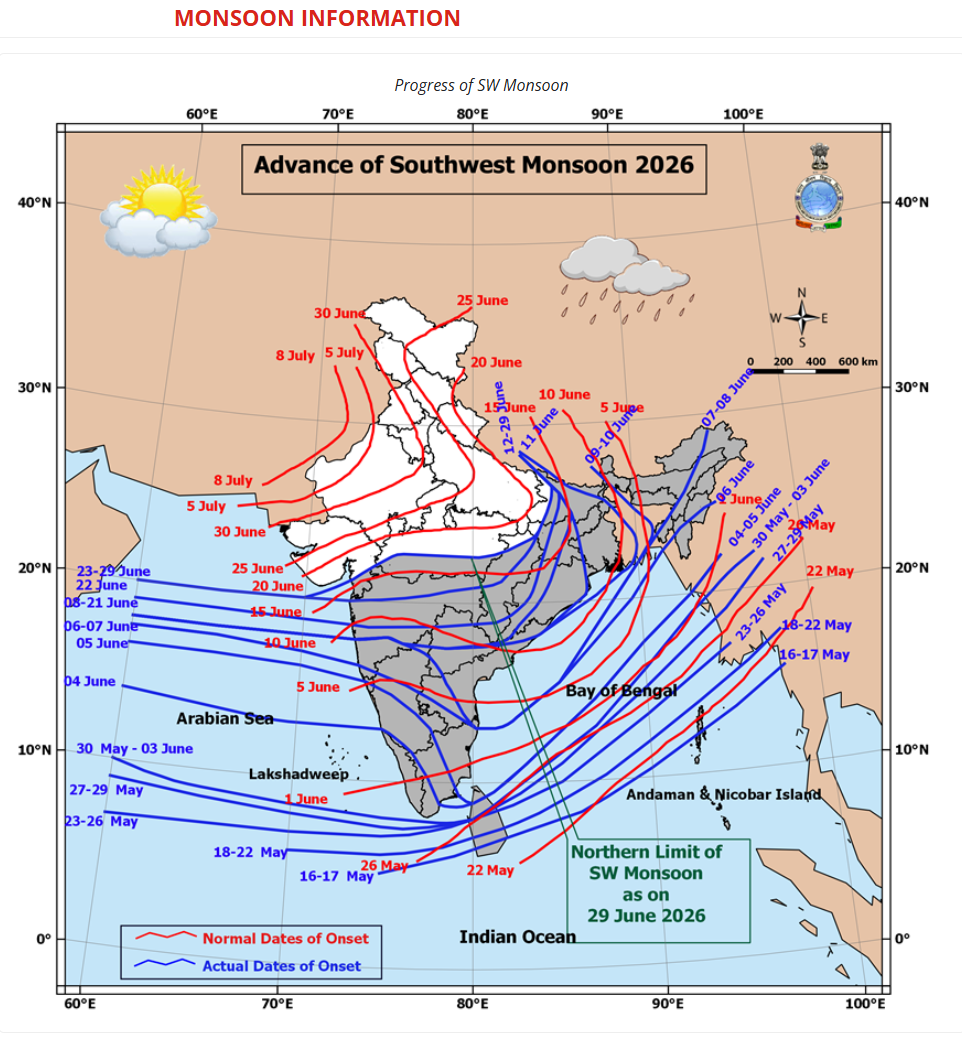
June 2026 Set to Be One of India’s Driest Ever June 2026 is set to become India’s fifth driest June since rainfall records began in 1901, with the country recording only 85.2 mm of rainfall until 28 June, compared to the normal 165.3 mm, a deficit of over 43%. Only 1905, 1926, 2009 and 2014 recorded less than 100 mm of June rainfall. The weak monsoon has been attributed to subdued monsoon winds, an unfavourable Madden-Julian Oscillation (MJO) phase, the absence of pre-monsoon low-pressure systems or cyclones in the north Indian Ocean, and the emerging El Niño, which is expected to have a greater impact in the coming months. The delayed monsoon has postponed its advance over Delhi and much of north India until early July, raising concerns that the seasonal rainfall forecast may need to be revised downward.
Rainfall across India till June 28 has been 43 per cent below normal, the weakest start to the summer monsoon in more than a decade and a half, leaving 76 per cent of the country “deficient” or “large deficient” in rainfall. Forecasters expect July, too, to be drier than usual.
FLOOD 2026
The Nowhere land of Ravi Parineeta Dandekar here describes the precarious situation of around 4000 people from about 8 villages on Right bank of Ravi River in Punjab, close to international border, downstream of Madhopur Barrage. She describes, based on field visit and interviews with people, how they faced the Aug 2025 flood disaster when three gates of overflowing Madhopur barrage got washed away. There is no permanent bridge for these people and people narrate how they pleaded with govt for rescue and relief, which finally arrived only when a soldier appealed to army and NDRF.

Governance, Accountability and the Collapse of Madhopur Barrage Parineeta Dandekar, based on interviews during her field visit in Ravi Basin from Himachal Pradesh to Madhopur barrage in Punjab and downstream, and available official information, analyses the breach of FRL at Ranjit Sagar Dam and subsequent washing away of Madhopur barrage gates and embankments downstream in Aug 2025. It paints a bit frightening situation with no official attempt at investigating the disaster, no attempt to learn lessons or fix accountability. Even as we are close to the next monsoon. Please Read, Share.
Flash Flood Threat Along Siji River The Lower Siang district administration on June 28, 2026, issued an urgent advisory asking residents living along the Siji River to relocate to safer areas after a massive landslide blocked the river at the Siji–Magi stretch, creating a temporary natural dam. The blockage has caused water to accumulate upstream, raising fears that a sudden breach could trigger flash floods downstream.
Officials warned that the Siji River, which flows into Assam as the Gai Nadi, could inundate settlements in both Arunachal Pradesh and Assam if the landslide dam collapses. Residents living along the riverbanks have been advised to move to safer locations, avoid low-lying areas, and remain prepared for immediate evacuation.
The incident took place at a stretch currently being restored by the Siji-Magi Crusher and Contractor Association. The sudden collapse sent massive amounts of soil, rocks, and debris into the river, creating a temporary obstruction. According to eyewitness accounts, a motorcycle and its rider were caught near the landslide area during the incident. However, both managed to escape safely, avoiding a major tragedy.
Floods damage rail bridge in Assam On 28 June 2026, the Northeast Frontier Railway (NFR) suspended train services between Archipathar and Simen Chapari stations in Assam’s Dhemaji district after heavy rainfall of over 110 mm caused severe flooding and riverbank erosion, destabilising a railway bridge over the Simen River. The bridge, built in 1965, partially collapsed when erosion made one of its piers unstable. Train services between Murkongselek and Silapathar were suspended until further notice, with buses arranged for stranded passengers and help desks opened at Dhemaji, Silapathar and Murkongselek stations. No casualties or damage to trains were reported, as rail traffic had already been halted due to flooding. The disruption comes amid widespread floods across Assam, with floodwaters also washing away a 300-metre iron bridge over the Kemi River, cutting off several villages.
Bridge Collapse Severs North Sikkim Road Link Heavy rainfall in North Sikkim has washed away a Bailey Bridge over the Phee Khola stream at Phidang in the Dzongu region, severing the crucial Phidang–Sankalang road link. The bridge collapsed after continuous rain caused a sharp rise in water levels, damaging its foundations and disrupting connectivity to several remote villages in Mangan district. The incident has isolated parts of the Dzongu region and affected the movement of residents and essential supplies. Authorities are assessing the damage and restoration work is expected to begin once weather conditions improve. The collapse highlights the increasing vulnerability of mountain infrastructure in Sikkim to extreme rainfall events and landslides during the monsoon season.
Punjab Floods Added to NCERT Textbook The devastating Punjab floods of 2025 have been included as a case study in the new Class 9 NCERT social science textbook, Understanding Society: India and Beyond – Grade 9 Part 1. The case study aims to help students understand natural disasters, their impacts, and disaster management through real-life examples. The textbook adopts a worksheet-based approach, encouraging students to explore disasters through personal experiences and independent research.
CLOUD BURSTS
Cloudburst Triggers Flash Floods in Leparada, East Siang On 28 June 2026, a cloudburst triggered flash floods in Arunachal Pradesh’s Leparada and East Siang districts following intense rainfall, prompting authorities to issue a red alert and begin evacuation measures. Three families were shifted to safer locations in East Siang, while the situation remained critical in Leparada, where all major rivers and streams were flowing above the danger mark. Continuous rain disrupted power supply, triggered multiple landslides, and severely affected road connectivity, hampering relief efforts. Officials urged residents in vulnerable and low-lying areas to avoid unnecessary travel and follow evacuation advisories, as heavy rainfall was expected to continue.
Cloudburst-Like Event Hits Chamoli A cloudburst-like incident on June 25-26, 2026 night triggered by intense rainfall struck the Narayanbagad area of Chamoli, sending large volumes of water and debris into residential areas and the main market. The Government Model Inter College, nearby buildings, shops, and several parked vehicles were damaged by the debris flow. Heavy rain also brought debris onto the Simli–Gwaldam National Highway, temporarily disrupting traffic until the Border Roads Organisation cleared the route and reopened it. Although no casualties were reported, residents highlighted the area’s vulnerability to recurring such events and demanded compensation, relief measures, and long-term disaster mitigation efforts.
Cloudburst Alert in Bageshwar’s Lahur Valley Following reports of heavy rainfall and a possible cloudburst in the Lahur Valley of Bageshwar district in last week of May, the district administration became alert. While no major loss of life or widespread damage has been officially confirmed, authorities have intensified monitoring and deployed revenue and disaster management teams to assess the situation.
According to preliminary information, a landslide occurred near a cowshed in Surag village, resulting in the disappearance of 11 goats. Tehsildar Nisha Rani stated that investigations are underway and that the full extent of the damage will be known only after a detailed assessment. So far, no other significant damage or casualties have been reported, and officials continue to monitor the area closely.
Heavy Rain Triggers Debris Flow in Tehri Intense rainfall spell on May 15 in the Jaunpur block of Tehri district, triggered a debris flow near Bilondi Bridge on the Thatyur–Bhawan–Nagun road, damaging more than six shops and burying one house. A car and five to six two-wheelers were trapped, while the debris blocked the road and stranded several vehicles on both sides. Although no casualties were reported, local businesses suffered losses, including damage to 215 bags of cement stored in a shop. Authorities deployed excavators to clear the debris and restore traffic, while affected residents and traders demanded compensation for their losses. The report states that a cloudburst near Bilondi Bridge in the Suakholi area of Tehri Garhwal on May 15 triggered a flash flood that damaged some shops. No loss of life was reported.
Cloudburst Triggers Flash Flood at Shakumbhari Devi Shrine A cloudburst in the Shivalik hills late on May 28, 2026 night triggered a sudden flash flood at the Shakumbhari Devi temple complex in Saharanpur, causing extensive damage to vehicles, shops, and infrastructure. The floodwaters rapidly entered the temple area around 10:30 p.m., reaching the steps of the main shrine and inundating nearby markets.
More than a dozen vehicles, including cars, tractors, and trolleys, were swept away or buried under debris. Several shops selling offerings and other goods were damaged or washed away. A 65-year-old woman pilgrim from Haridwar lost her life after being swept away by the flood, and her body was later recovered about one kilometre downstream. The flood also damaged construction equipment and infrastructure associated with an elevated bridge project, with excavators, a crane, generators, and some bridge pillars affected.
SOUTH ASIA
Ganga Treaty Renegotiation A treaty renewal that took the erosion crisis seriously would need, at minimum, three things the current process does not yet provide: a permanent consultation channel that includes affected district administrations in Malda and Murshidabad, not just state capitals; a displacement and land-loss registry maintained separately from the anti-erosion projects already in place, so that the human cost is tracked over time rather than reconstructed years later by researchers; and a binding dispute-resolution mechanism of the kind the Indus treaty has and the Ganga treaty has never had, so that future disagreements do not depend entirely on the state of bilateral relations in a given year.
Over the last fifty years, the river has already shown what an infrastructure decision made without those safeguards looks like on the ground. Whatever New Delhi and Dhaka negotiate before December 2026, the families of Akheriganj and the dozens of villages that have followed it into the river remain the clearest evidence of what gets left behind when diplomacy is not built to see them. (By Utkarsh Mishra)
Ganga Treaty Needs a Healthy River Basin The author Md Sarwar Hossain argues that discussions should go beyond water sharing and focus on protecting the ecological health of the entire Ganga basin. Climate change, shrinking dry-season flows, pollution and rising water demand are placing unprecedented stress on the river, threatening livelihoods, agriculture, fisheries and ecosystems in both countries.
The article highlights that reduced river flows, altered hydrology and upstream diversions are increasing salinity, degrading wetlands, weakening fisheries and reducing the river’s resilience. It warns that the Farakka Barrage has altered sediment transport, increased upstream flood risks, accelerated downstream erosion, disrupted Hilsa migration and threatened species such as the Gangetic dolphin and gharial.
Drawing on recent research, the author proposes adopting a “Safe Operating Space (SOS)” approach for rivers to define ecological limits for sustainable management. The article concludes that renewing the treaty must be accompanied by science-based, basin-wide cooperation that prioritises environmental flows and river health, ensuring the Ganga remains resilient enough to sustain both India and Bangladesh under a changing climate.
Bangladesh approach to Ganga Water Treaty Within the framework of a commercial approach, Bangladesh has almost no chance of succeeding in discussions with India. Instead, the nature-based approach will be more suitable for Bangladesh on this matter. Secondly, Bangladesh must promptly sign and ratify the UN’s 1997 convention on international river usage in the parliament. (Nazrul Islam)
Part 2 Even presenting any demand for the removal of the Farakka Barrage, increasing the share of the Ganges’ dry-season flow, or ensuring ”minimum flow” will be difficult for the Bangladeshi delegation. India’s experienced negotiators will quickly reveal the inconsistency in the positions of Bangladeshi representatives and be able to dismiss these claims. In light of the potential for such unfortunate consequences, we hope that the government will reconsider the Ganges (Padma) Barrage Project. (Nazrul Islam)
SANDRP
Also see: DRP 22 June 2026 & DRP 15 June 2026
Follow us on: www.facebook.com/sandrp.in; https://twitter.com/Indian_Rivers


