Guest Article by: Rahul Yaduka
1. Paradox of Abundance and Insecurity
Kosi Diyara, the land-waterscape trapped within the embankments along the river Kosi in Bihar, harbours various paradoxes. One of them is that it is a water-abundant region facing recurrent floods and yet witnessing persistent livelihood and water insecurity. This water insecurity manifests in different forms in different seasons. For instance, during the flood period from mid-May to mid-October, the Kharif paddy crop is prone to flooding. On the other hand, during the cultivation of the Rabi crop, viz., wheat, between December and April, the lack of irrigation infrastructure and required capital inputs makes irrigation challenging despite the abundance of water.
This article delves into a paradox of sorts, where there is quantitatively abundant water amidst water insecurity of multiple kinds. It argues that in Kosi, water insecurity is not about scarcity per se. Rather, it is produced in a thick context where hydrological volatility, weak infrastructure, spatial fragmentation due to embankments, and adaptive responses intersect. This argument is derived from ethnographic engagement with different kinds of interactions that people have with water.
2. The Floodplain as an Uncertain Hydrological Landscape
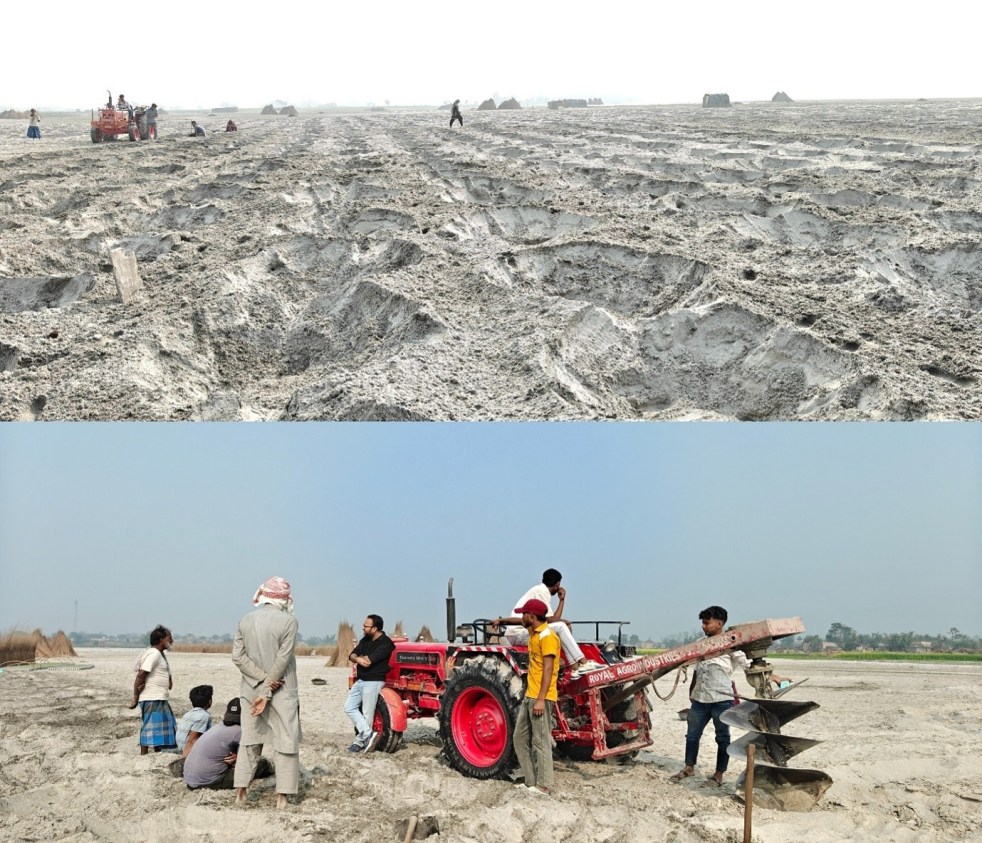
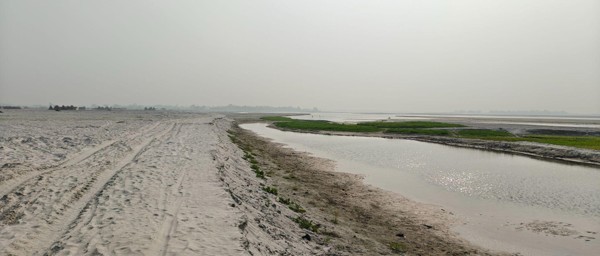
As floodwaters start receding around the end of October, they leave the landscape with an uneven distribution of water and sand, as shown in Picture 1. By December, the landscape shows remnants of floods. The land dries up, the river confines itself to channels in which it will flow until the next floods, and the silt also takes its due place. In other words, it becomes clear where there will be cultivable land, river channels and silt-deposited land. It is in this context of precarity and uncertainty that the community’s ad-hoc response needs to be situated. Depending on what the flood leaves for their land, households in the region decide what to do in the coming months. If the land dries out on time and is not deposited by coarse sand, wheat, mixed with pulses and oilseeds, can be sown in December. If the river submerges the land or if the land is heavily deposited by sand, no agriculture is possible, possibly for many years, and households have the choice either to migrate in search of a livelihood or engage as sharecroppers with those in their village whose land is still cultivable. This indeed is a precarious situation. This story, however, sheds light on an innovative practice where migrant farmers use the region’s hydrological volatility for cultivation by adapting to local realities.
3. Making Productive Use of ‘Wasteland’: Migrant Farmers and Adaptive Water Use
During fieldwork for my doctoral research in the Kosi diyara in 2022 and 2023, I saw and heard of farmers from the distant Baghpat district of Western Uttar Pradesh undertaking painstaking cultivation of watermelons and pumpkins on the burning sand of the Kosi diyara. I later learnt that this practice is also prevalent in other states like Uttar Pradesh and Assam. In Bihar, it is done across the Kosi region and in some parts of eastern districts of Bihar. The common denominator is the silt and sand deposited by the riverine floods. Apart from watermelon and pumpkin, farmers also cultivate muskmelon, bottle gourd, cucumber, etc.
While visiting the same location I went to in September 2025 near Ghuran village in Supaul district on the eastern side of the eastern Kosi embankment, I enquired about these farmers who cultivate watermelons and pumpkins on sand. I was happy to know that some of them were already there with their families. I decided to meet them.
a. Settling down
These farmers come in December to first arrange the land on which they will cultivate. For this, they typically deal with the local Mukhiya [head of local government at the village level] and a few other influential people of the village. The local landowners whose land is under sand generally don’t consider it of any worth anyway. In such a condition, even a meagre amount of INR 2400-3200 per acre for 5 months from December to April is something they are happy to receive.
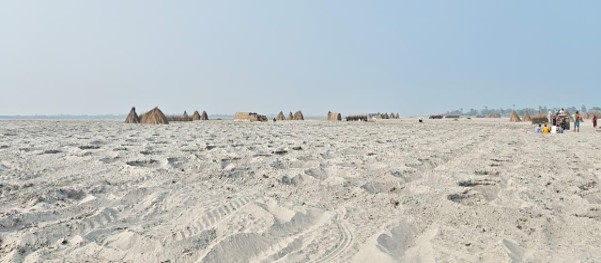
The first thing the farmers do after this is to construct huts amid a vast landscape with sand all around, as shown in Picture 2. These are huts made of locally available material. Having put homes in place, they return to Baghpat to bring their families with them since the whole family is involved in cultivation for the next 4 months. If there are children, they are either left with their grandparents or other close relatives or brought along to Kosi. If the children come along, their education suffers.
b. Preparing the soil and saplings
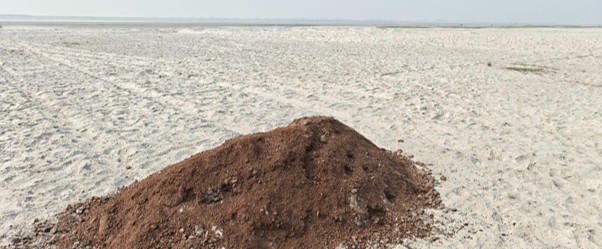
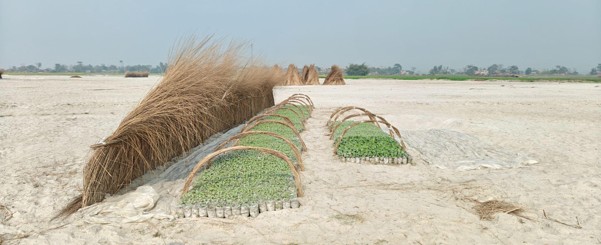
Once the land has been transacted, huts built, and families brought into Koshi Diyara, the farmers purchase organic manure made of locally available hen excreta. They also mix small quantities of DAP [Diammonium Phosphate] with this before using it in the field, as shown in Picture 3. Simultaneously, they start sowing watermelon and pumpkin seeds in small plastic pouches and allow them to develop as saplings. It was interesting to see that they had protected the saplings from harsh winds using a wall made of locally available material called khar, shown in Picture 4.
c. From pouches to the fields
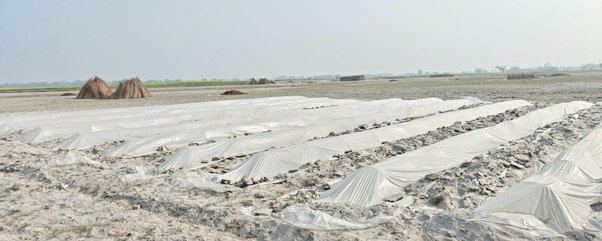
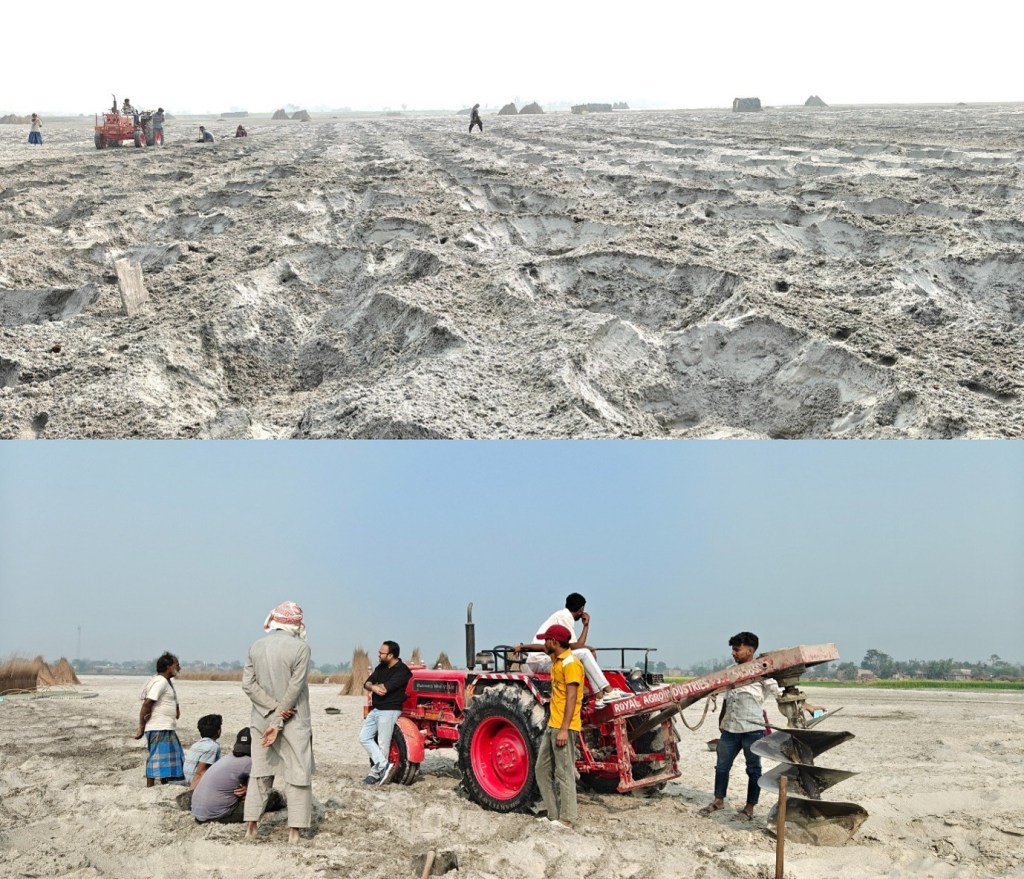
When these saplings grow, they are planted in the trenches, as shown in Picture 5. These trenches were dug manually a few years ago, but nowadays are generally dug using a tool at the rear end of the tractor, as shown in Picture 6. I was told that this was brought from Baghpat on a 22-wheel truck. Alongside, manual labour is used to add manure to the trenches before the saplings are planted. I also observed a few elderly women and men from nearby villages working there as manual labourers. They were paid ₹200–250 per day for work from 9 a.m. to 5 p.m.
d. Irrigation, Harvesting and Marketing
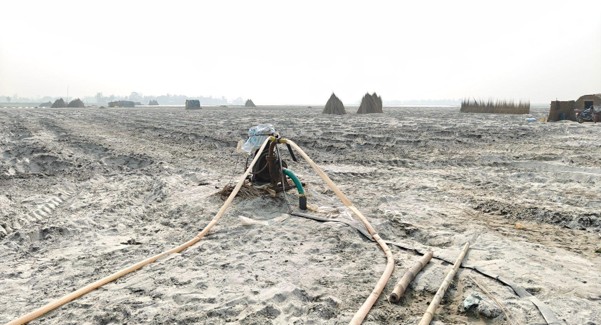
Once the saplings start growing, they are irrigated in a timely manner. The pump sets, shown in Picture 7, are installed on the sandy expanse itself because it is the riverbed where the water table is very easily reachable. The farmers told me that the pipes used in irrigation are also not local but brought from Baghpat itself. This is because the local pipes are rather thick and they get blocked easily, but the thinner pipes are more efficient. By the end of March or the beginning of April, the crop becomes ready for early harvest. Regarding marketing, the farmers said that the produce is not sold much locally because the cost is higher due to better quality. As a result, most of the produce is sent to West Bengal. In a personal conversation, one of the farmers who has been undertaking this practice for over a decade now said that they invest around 6.5-7 lakh rupees on a plot of land of 10 acres, and if conditions are favourable on all fronts, they can earn a profit of around 2-5-3 lakh rupees.
e. Structural challenges in adaptation
I asked both a local elder and a farmer from Baghpat why people from the Kosi region do not adopt this cultivation method themselves. The response was that local people are not willing to learn. One remark made was that people are ready to go to big cities and do menial work, but they are not willing to learn and work here on their own land. However, the farmers from Baghpat also said that they have no problem teaching these techniques; the issue is that local people rarely show interest in learning this technology. Their comment, however, needs to be examined in the local context.
As told by local farmers, the practices adopted by the farmers from Baghpat demand huge capital while purchasing seeds and manure, improving tractors and special pipes, and the procurement of land, etc. The farmers in the Kosi region generally don’t have this kind of surplus generated from agriculture. The cultivation happens broadly in the period between January and April, much of which overlaps with the drying up of sand and strong dry winds. The cultivation is also labour-intensive, with whole migrant families toiling on the hot sand under scorching sun and hot winds. The local farmers repeatedly said that they cannot undertake such strenuous labour. The local cultivation of wheat, paddy, and other crops, they told, doesn’t demand consistent work in the field like that demanded by Baghpat farmers. The state government of Bihar is not reported to have taken any initiative in supporting local farmers to adopt this practice either.
4. Water Security as Adaptation
The discussion above invites us to reconsider how water security is understood and measured. Rather than a single, universal standard, water security means different things depending on who is using water and for what purpose, under what circumstances. While floods devastate settled agriculture by depositing sand and inundating land, migrant farmers read these same conditions as an opportunity, aligning their cultivation with the flood rhythm to cultivate cash crops. The Kosi case reveals that water insecurity is not simply a function of scarcity or abundance, but is deeply entangled with uncertainty and hydrological volatility. The migrant farmers offer a striking counterpoint: their security derives precisely from working with the region’s hydrological logic rather than against it. In the Kosi basin, insecurity persists not despite abundance, but because that abundance arrives in forms that local communities struggle to manage. Yet the water security that migrant farmers achieve is inherently provisional, seasonal, landscape-specific, and contingent on a particular alignment of cultivation strategy and ecological conditions. It is resilience built on adaptation, not on stability.
Rahul Yaduka (ry14@soas.ac.uk) is Postdoctoral Researcher, WATCON Project, SOAS, University of London


