
(Feature Image: Flash flood at Chanju III HEP site in Chamba on July 19. Source: The Modern Himachal)
A flash flood in the Chanju stream on July 19, 2026, caused significant damage to the Chanju-III Hydroelectric Project (HEP) in Ravi basin. The project is being built near Chanju and Dehra villages in Churah subdivision of Chamba district, Himachal Pradesh. As per initial reports, the swollen stream washed away large quantities of construction material and damaged several temporary structures at the project site.
Project authorities informed the revenue department that part of the project site was flooded after continuous rainfall since the morning. The resultant flash flood washed away construction materials and buried additional materials under debris. The reported losses include 12 mm, 16 mm and 32 mm steel reinforcement bars, 10 mm and 20 mm aggregates, stocks of river sand and crusher sand, wire crates used for protection works and other temporary infrastructure. The workers’ tin sheds also developed cracks due to ground subsidence caused by river erosion at the site.
The Patwari (Revenue Officer) of Chanju described the situation as serious in a preliminary report submitted to the Tehsildar, recommending relief measures and further administrative action. District officials said damage assessment was underway and safety monitoring at the project site had been intensified. Fortunately, no casualties were reported.
Landslide in July 2025: The latest flood damage has occurred barely a year after another major disaster at the same project. On the night of July 21-22, 2025, intense rainfall triggered a massive landslide that buried heavy construction machinery at the Chanju-III project site. Falling rocks and debris also damaged the project office and store buildings. The contractor estimated losses of around ₹32 lakh. Although no workers were injured, the incident disrupted construction activities and highlighted the growing landslide vulnerability of the project area.
Flash Flood in Sept. 2025: About six weeks after the July 2025 landslide, the project was again hit by another flood disaster. On the night of Sept. 3 – 4, 2025, a sudden flash flood in the Chanju stream buried heavy machinery and construction equipment deployed in Package-I of the project. Local residents reported that the stream rose rapidly during the night, carrying huge quantities of debris that engulfed machinery stationed near the channel. The construction activities had already been suspended because of continuous rainfall, preventing any loss of life. The incident caused substantial financial losses & further delayed project execution.
Worker Death in Fire in March 2025: Apart from natural disasters, the project has also witnessed serious industrial accidents. On March 14, 2025, a major fire broke out in the residential colony of the under-construction project. One employee lost his life after becoming trapped inside his room as flames engulfed the workers’ accommodation. Despite efforts by fellow workers and local residents, the victim could not be rescued. Fire tenders reached the remote site from Tissa, nearly 40 km away, after the blaze had already spread.
Environmental Violations in March 2025: Local residents alleged that the project developer had felled around a dozen healthy trees while constructing an access road to the dam site. They also accused the company of dumping excavated material directly into a nearby stream, obstructing its natural flow and increasing flood risks during the monsoon. Forest officials reportedly confirmed damage to forest vegetation and forwarded a report to higher authorities. The local administration also acknowledged the matter and assured appropriate action.
Worker Killed in Rockfall in May 2024: On May 3, 2024, a rockfall at the project’s weir site killed one worker and injured two others after boulders suddenly rolled down from the hillside onto workers. Construction work was suspended following the incident. According to reports, the weir site was already known to be vulnerable to rockfalls and landslides, but the contractor allegedly failed to implement adequate safety measures, making the accident avoidable.
This SANDRP report has also documented several other accidents and disaster taking place the project site. Besides, the local people have complained of environmental violations including tree felling and debris dumping into the stream and protested over its impacts. Together, these incidents point to persistent safety, environmental and disaster management concerns related the project.
The Project: Chanju III HEP is being developed by Himachal Pradesh Power Corporation Ltd. (HPPCL). The project proposes diversion of Chanju stream and its feeding tributary Mahed nullah through 30 meter and 15 meter long drop type trench weirs. It involves construction of 5 km long head race tunnel (HRT), 6 adits, 2 feeder tunnels and 1 connecting tunnel apart from 2 desilting tanks, an underground forebay, penstock and a power house.
The Environment Impact Assessment (EIA) report – prepared by WAPCOS in July 2016 – mentions 45 months as construction period. Construction started on March 31, 2019 and is estimated to be completed by July 31, 2027. The foundation stone of the project along with 30 Mw Deothal Chanju HEP was laid by Prime Minister Narendra Modi on Oct. 13, 2022.
The project is estimated to cost ₹418.57 crore and will divert 28.5 hectares of forest land. The per MW installed capacity cost of the project is likely to be much higher than Rs. 8.72 crore that this cost indicates.
Cascade of HEPs: Chanju is perennial stream originating from Kundi Mural Lake. It is a left bank tributary of Baira river which in turn feeds Siul river a key tributary of Ravi river. In upper stretch Chanju river is known as Deothal khad (nullah).
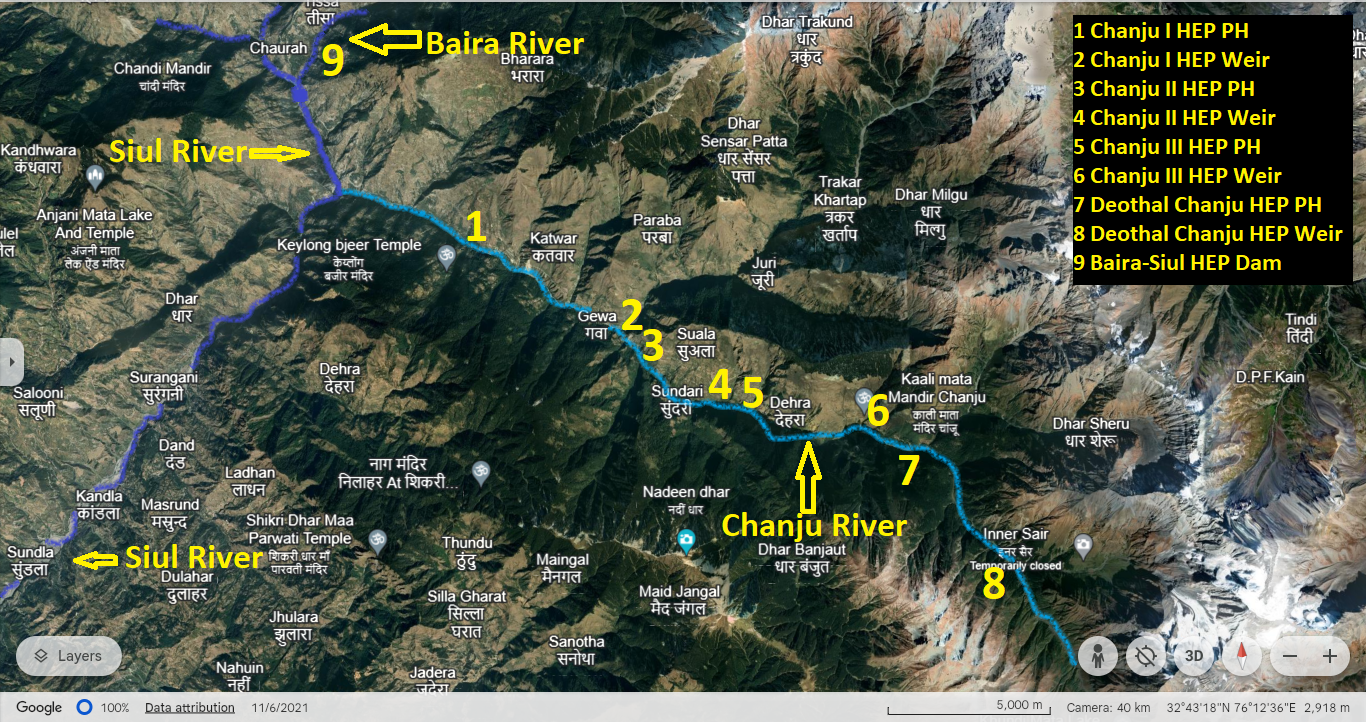
Presently there are 4 HEPs on the Chanju river including 36 Mw Chanju I commissioned in July 2017; 19.8 Mw Chanju II commissioned in 2021, 48 Mw Chanju III HEP under construction and 30 Mw Deothal Chanju (IV) HEP in clearance stage. The cost of Deothal Chanju HEP is ₹273.91 crore and it is proposed to be completed in 45 months.
Summary: Over the past two years, the Chanju III HEP has suffered significant damages from repeated accidents, disasters and environmental violations which clearly suggests that the project site has become highly vulnerable to multiple geological and hydrological hazards. The increasing incidents of disasters and violations have also raised serious questions about HPPCL’s project planning, construction practices, environmental compliance and disaster preparedness. Before proceeding with its construction, the project should undergo a comprehensive review covering geological stability, cumulative disaster risks, environmental compliance and worker safety through an independent expert assessment.
SANDRP


