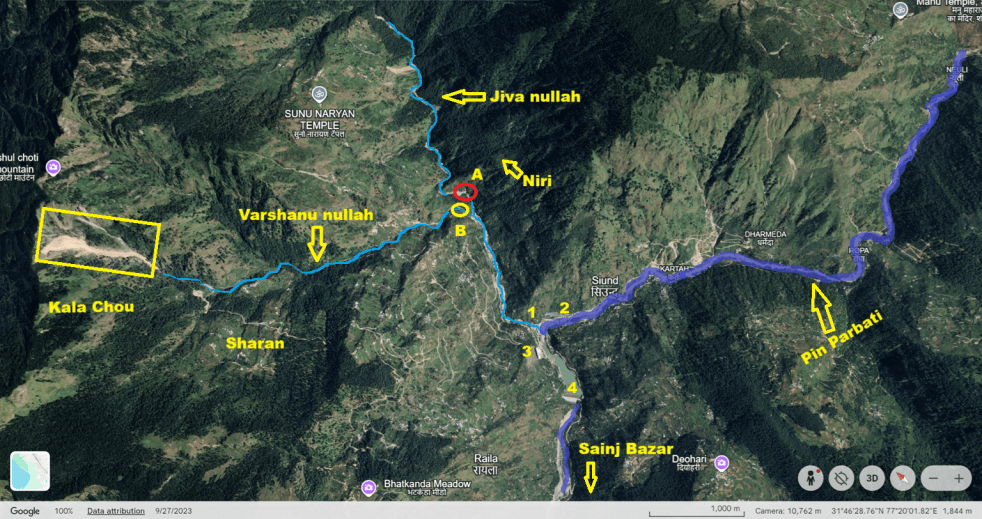
(Feature Image: Google Earth image marks locations mentioned in the report along landslide lakes and nearby hydropower infrastructure in the Sainj Valley. The red circle marks the probable location of the landslide lake on Jiva nullah, while the yellow circle indicates the landslide lake that formed on Varshanu nullah in June 2025. The numbered locations represent: (1) 1 MW Jiva Small HEP, (2) 100 MW Sainj HEP powerhouse, (3) 800 MW Parbati-II HEP powerhouse and (4) the dam of the 520 MW Parbati-III HEP.)
Fresh landslides and the continued expansion of a landslide-dammed lake on Jiva nullah in the Sainj Valley of Kullu district, Himachal Pradesh, have once again raised concerns over a potential downstream flood disaster. Although no official estimate of the lake’s area or stored water volume has been made public, local residents say the impounded water body has expanded steadily over the past three years.
Location: While media reports have generally stated that the landslide-dammed lake is located near Sharan village, Ramesh Dhami, a resident of nearby Raila village, shared that the lake is actually situated just downhill of Niri village (approximately 31°47′56.38″ N, 77°20′08.96″ E).
The site lies about 3 km upstream of the 520 MW Parbati-III HEP dam and about 30 m upstream of the diversion structure of the 1 Mw Jiva Small HEP. Ramesh Dhami shared that the lake was formed in July 2023 and slope failures have regularly been happening there.
Jiva Nallah is a tributary of the Pin Parbati river, which ultimately joins the Beas river. The villages of Sharan and Niri are situated on the opposite hillsides above Jiva nullah, about 3 km apart in aerial distance. Sharan village lies in the catchment of Varshanu nullah, which joins Jiva stream from the west just downstream of Niri village.
According to Ramesh Dhami, the officials of NHPC’s Parbati-III HEP attempted to breach the landslide lake during Jan-Feb 2026. However, they were only able to partially clear the blockage. “Large boulders have formed a narrow passage for water flow in the Jiva stream, while repeated rockfalls and debris continue to fill the gap. As a result, the lake is gradually increasing in size and it appears difficult to remove the blockage using JCB machines,” Dhami said.
Dhami further stated that a separate landslide lake was formed on Varshanu nullah near Huran village on June 25, 2025, after a cloudburst triggered a massive landslide near the uphill Kala Chou area. According to him, the administration later breached the lake without causing any significant damage downstream.
Although, Google Earth Sept. 2025 imagery clearly captures the landslide scar in Varshanu catchment, the lake formed in Jiva stream in 2023 is not visible.
Fresh Landslides: Covering concerns raised by local people, media reports published on July 11, July 21 and July 26, 2026 stated that fresh landslides triggered by monsoon rains have repeatedly deposited large quantities of rocks and debris into Jiva nullah, further restricting the stream’s natural flow and gradually increasing the size of the landslide lake.
Although the channel has not been completely blocked and water continues to seep through one side, the repeated slope failures have increased the volume of water impounded behind the stream blockage.
Villagers cautioned that the ongoing monsoon rainfall, further landslides or a flash flood in the stream could completely block the channel and raise the risk of a sudden breach. They have urged the administration to take timely preventive measures before the situation deteriorates further.
June 2025 Cloudburst: The villagers’ concerns are rooted in the devastating June 25, 2025 cloudburst event in Jiva nullah catchment. The disaster claimed three lives, washed away six houses, and caused property losses worth several crores of rupees. The flash flood also severely impacted downstream public infrastructure and hydropower projects.
Official Response: Though the administration has expressed serious concern over the expanding lake size, so far, no major intervention has been undertaken to safely drain the landslide lake. In response to the potential threat, a 12-member team from the State Disaster Response Force (SDRF) was dispatched to assess the situation.
The SDRF team reached the site on July 24, 2026 and documented its condition through photographs and video recordings, examined the stability of the landslide dam and assessed possible measures to reduce the risk of flooding.
The inspection report has been submitted to the district administration for further action. The administration has also appealed to residents and tourists to avoid visiting riverbanks and nallahs during the monsoon. Meanwhile, local residents have repeatedly urged the administration to take timely preventive measures to avoid further expansion of the lake and minimize the risk of a sudden breach.
Potential Flood Threat: Following the June 25 cloudburst in Jiva nullah, the bed level of the Pin Parbati river rose by up to 10 meters at several locations. The sharp rise in the riverbed level has emerged as a serious threat not only to the downstream hydropower projects but also to Sainj Bazaar.
As per the President ofSainj Valley Development Committee the failure of the landslide dam could trigger a sudden flash flood affecting settlements located along Jiva nallah and the Pin Parbati river.
The committee has identified about a dozen vulnerable villages including Nadahara Vihali, Siund, Soti, Sainj, Bakshahal, Kharatla, Treheda, Talara, Sapangani, Bihali and Larji. The committee fears that a sudden breach could damage roads, bridges and agricultural land in downstream areas.
The risks extend beyond local settlements. The Sainj valley hosts several major hydropower projects whose infrastructure could be affected by a sudden breach of the landslide lake. The event could also fill up the downstream river corridors with debris and sediments. Potentially vulnerable projects include NHPC’s 800 MW Parbati-II HEP, 520 MW Parbati-III HEP, HPPCL’s 100 MW Sainj HEP and the 126 MW Larji HEP.
The June 2025 cloudburst had already demonstrated these risks. Large volumes of debris damaged the Jiva SHEP, blocked the tailrace channel of the Sainj HEP, disrupted generation at Parbati-II project and accelerated sediment deposition in downstream reservoirs.
Notably, the Sainj Valley has also witnessed a devastating flood in July 2023 which caused widespread destruction and triggered serious concerns among local communities over the operation of NHPC’s 520 MW Parbati-III HEP.
Experts have since stressed that unless catchment stabilisation, slope protection, erosion control and regular sediment management are undertaken, such recurring events could increasingly threaten hydropower generation, reservoir storage and downstream infrastructure in the Beas basin.
Summary: The repeated landslides in July 2026 around the artificial lake formed on Jiva nullah near Niri village in Sainj Vally in 2023, have enlarged the impounded water body and renewed fears of downstream flooding. While the administration has intensified monitoring through SDRF inspections, local communities continue to seek proactive interventions before another episode of heavy rainfall triggers a major disaster. The situation also underlines the need for continuous monitoring of landslide-dammed lakes, timely mitigation measures and integrated disaster management in the fragile Himalayan river basins.
SANDRP

 SANDRP