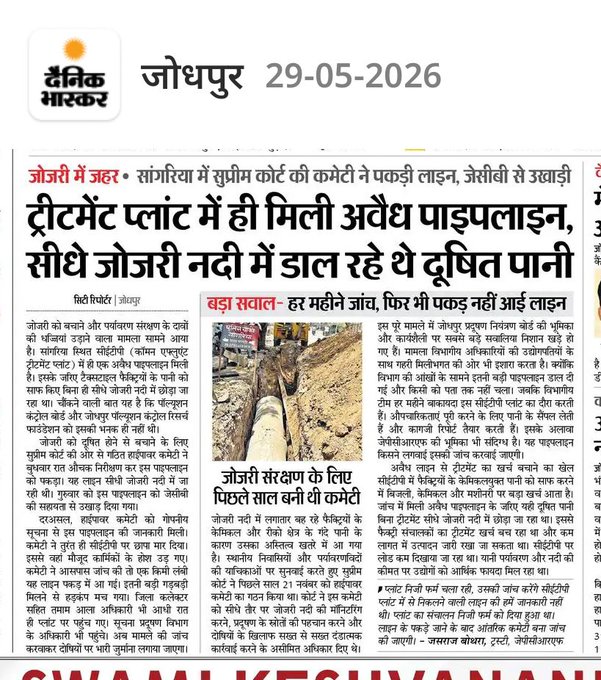
(Feature Image: Dainik Bhaskar 29 May 2026 clip on illegal pipeline from CETP discharging effluents in Jojari river.)
Even for the murky dealings going on in the name of pollution control in India, this must figure most imaginative, filmy stuff. On May 27, a 4 km long secret pipeline was discovered by a Supreme Court appointed committee in Jodhpur district in Rajasthan. The pipeline connected a Central Effluent Treatment Plant and Jojari River. It’s not yet clear for how long this has been going and how many more such imaginative infrastructure exist.
However, what was strange was that on May 28, the very next day, the pipeline was destroyed. Should it not have continued to exist for some more time, possibly in an inoperative mode to understand the modus operandi? Was the pipeline destroyed with permission of the SC appointed committee or SC? While two pollution control board officials have been suspended, what is the value of assurances given by the Rajasthan Additional Advocate General to the court?
This episode also means complete failure of not only the pollution control board, but also failure of all the judicial work that has been going on related to the Jajori-Bandi-Luni River System, including by the NGT, High Court and the Supreme Court. One also hopes that the SC will ensure that accountability be fixed at every level after a proper independent assessment of the whole situation is done.
SC questions 4-km secret pipeline dumping waste into Jojari river The Supreme Court has come down heavily on Rajasthan authorities after a court-appointed committee on May 27 discovered a suspected 4-kilometre-long concealed pipeline allegedly discharging untreated industrial effluents into the Jojari River near Jodhpur. Hearing the matter, a Bench of Justice Vikram Nath and Justice Sandeep Mehta questioned how such a large underground discharge system could exist without the knowledge of industries, CETP operators and regulatory authorities responsible for monitoring pollution in the region.
The Court also sought answers from the Rajasthan Government and the Pollution Control Board, asking what local officials had been doing despite continuous monitoring of the river system. Expressing concern over the state of the Jojari-Bandi-Luni river network, the Bench observed that years of judicial intervention and environmental monitoring appeared to have failed in preventing serious pollution.
Appearing for Rajasthan, Additional Advocate General Shiv Mangal Sharma informed the Court that a special team from Jaipur was immediately sent to Jodhpur, two Pollution Control Board officials were suspended, senior officers were transferred, criminal proceedings were initiated and environmental compensation proceedings were started. He further informed the Court that all 306 textile units connected to the Common Effluent Treatment Plant (CETP) in Jodhpur, along with the CETP itself, had been shut down pending investigation and corrective measures.
Sharma also assured the Bench that an FIR would be registered and a Special Investigation Team (SIT) headed by a senior IPS officer would investigate the entire episode, including the role of industries, CETP management and government officials. He submitted that a CBI probe was not necessary at this stage as the SIT would independently examine the matter.
The Court stressed that accountability must be fixed at every level and that every individual involved in the alleged illegal discharge—from the lowest-ranking official to senior authorities—must be identified and proceeded against.
SC CBI probe into Jojari river pollution The High-Power Committee formed by the Supreme Court to protect the Jojari river had conducted a surprise inspection on May 27 night and detected the illegal pipeline. At the CETP in Sangaria, Jodhpur, untreated wastewater from textile factories was allegedly being discharged directly into the Jojari river through the pipeline. The pipeline was later uprooted using JCB machines on May 28.
The committee had reportedly received confidential information about the illegal line and immediately raided the CETP plant. During inspection, officials traced nearly a kilometre of the pipeline, triggering panic among authorities. The district collector and several senior officials reached the plant late at night, along with pollution control officials. Heavy penalties are likely to be imposed after investigation. The Court Questioned how such a system operated undetected despite regular monitoring.
RSPCB regional officer removed, 2 officials suspended The Rajasthan State Pollution Control Board has placed its Jodhpur regional officer under awaiting posting orders (APO) and suspended two officials after an illegal pipeline discharging untreated industrial waste into the Jojari River was uncovered during a surprise inspection by a Supreme Court-appointed committee. According to an order issued by the Board late May 28 night, Jodhpur Regional Officer Kamini Songara was relieved with immediate effect. Lab in-charge Devendra Singh and Assistant Environmental Engineer Kunal Khatri were suspended in connection with the case.
HYDRO POWER PROJECTS
The Cost of Climate Chaos in the Indian Himalayas In the Assar area of the Chenab Valley, the earth is literally sinking. Entire stretches of land are sliding due to the reservoir-induced erosion caused by the Baglihar dam. The state calls this dam ‘progress’, but the families watching cracks widen in their living rooms and the roofs above their heads are not so sure. The Himalayas are Asia’s water reservoirs, sustaining half a billion people. By treating them as an exotic destination waiting to be exploited for financial and political gains, the Indian state is gambling with the climate security of the entire subcontinent.
Policies are drafted by bureaucrats who have never seen a glacial lake burst, while people who have lived in balance with these peaks for centuries are not counted even as stakeholders or consulted properly in the process of policy development. The region has been reduced to an energy corridor and a pilgrimage circuit, while New Delhi refuses to recognize a living ecosystem that has sustained generations for centuries.
Locals oppose Chenab-Beas Link Proposal Echoing environmental concerns against the proposed Rs 2,356 crore Chenab-Beas tunnel hydro power project, the Save Lahaul Society has demanded that the government reconsider the project in the interest of the local residents and the fragile ecology. “This project could prove disastrous for the entire region, including the entire fragile area of Lahaul and, along the flow of the Beas, Kullu, Mandi, Kangra, and Punjab,” said BS Rana, President of the Save Lahaul Society. Otherwise the residents will be compelled to launch an agitation against the environmentally degrading project, he warned.
“We deeply disagree with this model of indiscriminate development, we cannot permit ourselves to tamper with or act cruelly toward nature and the natural course of creation,” he lamented. He also expressed resentment against such a strategy in developing the border areas, which he added was even more inhumane and inappropriate. Rana said the project will generate 4,000 MW of power and the water of the Chandra River will be diverted into the Beas River. “As we know, the land on both sides of the Pir Panjal is extremely fragile from an environmental perspective and has become highly prone to landslides and soil erosion over the past four years. In such a situation, this project could prove disastrous for the entire region,” said Rana.
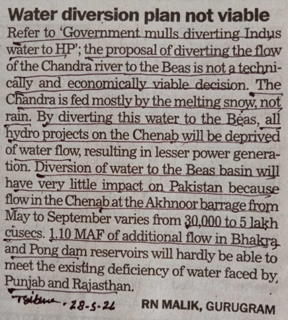
NHPC Notice inviting bids for Chenab Beas Link 3 Through a Tender Notice on May 20, 2026, NHPC Ltd, through its website has invited bids for the works of “Construction of Civil works of Barrage & Stilling basin, River Diversion Arrangements, U/s Plastic cutoff trench, Power Intake Structures, Water Diversion Tunnel, outfall Structure, associated HM works including adit plugs and associated works of Chenab-Beas Link Tunnel Projects (Link-3) at Koksar, Lahaul-Spiti dist of Himachal Pradesh”. The works are to be completed in 49 months and last date for submitting bids is July 24 2026. On May 23, 2026, NHPC brought out a notice cancelling the tender notice.
Uttarakhand No Hydro decision should apply to Arunachal Pradesh All these concerns are looming ominously over Arunachal Pradesh as well and the same principles which the Centre has applied against any new dams in Uttarakhand should be applied to Arunachal Pradesh as well, environmentalist Himanshu Thakkar, of SANDRP said. Pointing out that the dangers stemming from big dams in Arunachal Pradesh could be even worse in view of the massive interventions (far bigger than what had been made in Uttarakhand), Thakkar said that the whole of Northeast falls in the highly seismic Zone V, not to mention its status as a global biodiversity hotspot, and a treasure-trove of ethnic cultures featuring small, close-knit communities.
Dams will impact Arunachal in the same way or even worse than what we have seen in Uttarakhand. Therefore, the Centre needs to apply the same principles it has followed to stall any further dam construction in Uttarakhand. On the contrary, it is in a tearing hurry to push through large projects in Arunachal, which smacks of double standards, he added. Thakkar said that the cavalier attitude of the Centre stood exposed when it introduced some modifications in the Subansiri Lower project only after a prolonged and intense mass protest. In Uttarakhand also, we have had mass protests. The Uttarakhand disaster in 2013 was accelerated by dams. Even the Supreme Court had intervened in 2013 but it took the Centre 13 years to acknowledge the perilous impacts of dams on rivers, livelihoods, environment and biodiversity, and communities, he said.
New Indian Express Edit It (the GOI decision of no more hydro in Upper Ganga basin) is a clear acknowledgement that ecological vulnerability can no longer be a secondary consideration during infrastructure planning in the fragile Himalayan region… The key question is whether such a consideration can become a broader principle for the entire Himalayan region. There is compelling evidence to say it should… Given this, a new national framework must be chalked out with the Uttarakhand affidavit as a starting point.
Fire damages Machhkund HEP in Odisha A fire broke out at the 120 MW Machhkund Hydro Power House at Ankadeli under Lamtaput block of Odisha’s Koraput district on May 23 afternoon. All personnel were safely evacuated, and no casualties were reported, though some workers suffered mild suffocation from smoke. The HEP is located near the iconic Duduma Waterfalls on the Odisha-Andhra Pradesh border.
The blaze originated when a current transformer (CT) connected to a transformer burst outside and adjacent to the powerhouse. Connected cables then caught fire, with flames spreading through the cable gallery into the main powerhouse and damaging electrical and allied equipment. All six units were operational at the time and were shut down.
Under agreements in 1945 (with revisions in 1978 and 2020), power sharing and operation & maintenance costs are divided equally on a 50:50 basis between AP and Odisha. However, management, operation, and administrative control rest with the Andhra Pradesh government and AP Power Generation Corporation (APGENCO). A detailed assessment of the extent of damage will be carried out by APGENCO, following which necessary repair and replacement works will be undertaken. Restoration work and resumption of power generation may take over six months.
Proposed SUMP: Development or gamble with Arunachal’s future While the GoAP presents the project as a symbol of development, energy security, and economic progress, a growing number of residents view it very differently. For many communities living along the Siang River, the project represents not opportunity, but uncertainty, displacement, environmental degradation and the possible destruction of a way of life that has existed for generations. For residents of the Siang region, the river is far more than a source of water. It is deeply connected to their livelihoods, culture, traditions and identity.
Across India and the world, large dam projects have often left behind a complicated legacy of environmental damage, inadequate rehabilitation and communities struggling to rebuild their lives after displacement. Residents of the Siang basin are therefore asking a reasonable question: if such projects have produced mixed outcomes elsewhere, why should they blindly trust promises that everything will be different this time? Yet instead of engaging meaningfully with these concerns, critics argue that the state Govt has increasingly adopted an attitude of dismissiveness. Public consultations have been viewed by many as procedural formalities rather than genuine exercises in democratic participation. Villagers and community organizations repeatedly express fears that their objections are being ignored while decisions are made far away from the communities most directly affected.
Mega projects in Arunachal leading to rising human-elephant conflicts: Study A first ever comprehensive study on Managing Human Elephant Conflicts in Arunachal Pradesh has revealed that the state has registered 1,503 cases of human-elephant conflicts between 2007 and 2024- -91 per cent of which resulted in crop loss and human casualties in 2 per cent incidents. More than 80 per cent of such incidents were reported in the past 10 years, between 2014 and 2024. Such conflicts have also led to the death of 17 elephants in six years (2018-2024), all due to electrocution and at least three human casualties every year.
The disturbance caused by infrastructure projects seems to have led to a 78 per cent rise in distribution pattern of the elephants, from 7,001 sq.kms in 2019 to 12,446 sq kms. in 2024. “The evidence of increasing distributional range of elephants in Arunachal Pradesh could signify changes in the interface between people and elephants. The indirect evidence of elephant presence collected by the forest department indicates that the elephant range in the state extends beyond the protected areas,” said the report prepared by World Wide Fund for Nature-India (WWF-India) and Arunachal Pradesh forest department.
The report was released on May 25. Citing an example of how a hydro power project constructed by the NHPC (National Hydro Power Corporation Limited) on the Subansiri river disturbed an elephant corridor that connected elephant populations of Panir Reserve Forest (Banderdewa Forest Division, Arunachal Pradesh) and Dulung Reserve Forest with Subansiri Reserve Forest (Lakhimpur Forest Division, Assam) across the Subansiri River. “The ancillary development, such as project township and roads, has also changed the land use in the corridor region. In addition, sand mining along the river has further hindered elephant movement through this corridor in recent times.”
The expansion of the National Highway-13 from Nechipu to Hoj, passing through Seppa, Khodaso, and Sagalee in 2023 and two hydro power projects in the Ranga river and Pare river may have disrupted the movement of elephants in the area. “According to local forest officials, a group of 25 to 30 elephants has become isolated in a small patch of forest on the left bank of the Pare river, on the northern side of NH 13. These elephants frequently come into conflict with nearby villages, including Ompuli, Khyunglo, Dapo, and the 47 and 52 km Camps. Furthermore, movement restriction and isolation also have implications for long term viability of the elephant sub- population here,” said the report.
Kalai-II HEP gets Forest Clearance amid Heron concerns The Union Environment Ministry’s Forest Advisory Committee has granted in-principle forest clearance to the 1,200 MW Kalai-II hydroelectric project on the Lohit River in Arunachal Pradesh, despite concerns over its impact on the critically endangered white-bellied heron. The project will require diversion of around 869 hectares of forest land and the felling of over 33,000 trees in Anjaw and Namsai districts.
Environmentalists and researchers have criticised the project proposal for allegedly failing to adequately mention the habitat of the white-bellied heron — one of the world’s rarest birds and a Schedule-I protected species under the Wildlife Protection Act. The Lohit river basin is considered an important habitat for the species, which is highly vulnerable to habitat fragmentation and river flow alteration caused by dams.
The ₹14,000-crore run-of-the-river project, being developed by THDC India Limited, is part of a broader hydropower push in Arunachal Pradesh. Critics warn that repeated clearances for large hydropower projects in ecologically fragile eastern Himalayan river systems could threaten biodiversity and river ecosystems. Compensatory afforestation for this project is proposed across 51 patches of degraded forest land in Madhya Pradesh.
Govt inks pact for developing 1,750 Mw Demwe Lower HEP The Arunachal Pradesh govt on May 27 signed an agreement with Greenko Demwe Power Ltd for developing the 1,750-mw Demwe Lower Hydroelectric Project, a statement said. The Demwe Lower Hydroelectric Project will be developed on the Lohit River near Parshuram Kund and Brahma Kund, it added.
FAC grants in principle approval to Attuni HEP The FAC granted in-principle approval for diversion of 261.53 hectares of unclassed forest land for the 680 Mw Attunli HEP on the Talo (Tangon) river in Dibang Sub-basin of the Brahmaputra river valley. The project involves the felling of 47,243 trees. Compensatory afforestation has been proposed over 523.762 hectares of degraded forest land in West Kameng district.
A sub-committee that visited the site in October 2024 — on directions of the FAC’s May 2024 meeting — recommended approval subject to conditions. These include requirements that quarry sites be treated as mining proposals with approved mining and mine closure plans, that a geological and slope-stability study be conducted by a reputed institution given the steep terrain, and that the wildlife and biodiversity management plan be vetted by the Wildlife Institute of India.
The last condition reflects the project’s location upstream of the Etalin HEP, also in Dibang Valley, and is aimed at ensuring ecological consistency across both projects. The Dibang Valley is a biodiversity hotspot & the FAC had previously declined forest clearance for the Etalin (3,097 mw) plant.
DAMS
Major fire at Medigadda Barrage A major fire broke out at the Medigadda Barrage of the Kaleshwaram Lift Irrigation Project in Jayashankar Bhupalpally district on May 25. According to officials, the fire erupted at the camp office of Larsen & Toubro, the construction company associated with the project. The flames spread rapidly through the camp office, sending thick black smoke into the surrounding area.
Authorities have not yet confirmed the exact cause of the fire or the extent of property damage caused in the incident. Police and project officials have started an investigation to determine how the fire started and assess losses at the camp office.
Govt mulls Rs 2.3K cr project to divert Indus water to HP The Centre has proposed two projects linked to the Chenab river system worth Rs 2,620 crore. These include Rs 2,352-crore Chenab-Beas Link Tunnel in Himachal Pradesh and Rs 268-crore sediment bypass tunnel at Salal Dam in Jammu & Kashmir.
The Chenab-Beas Link Tunnel Project is set to be placed for the Centre’s approval soon. The project involves the construction of an 8.7-km-long tunnel that will divert surplus water from the Chenab basin into the Beas river system in Himachal, thus benefitting Punjab, Haryana, Delhi and Rajasthan. The water from Lahaul’s Chandra river, a tributary of the Chenab, will be channelled towards the Beas basin through hydraulic structures and tunnels, a move expected to help generate an additional 4,000 MW of electricity in Himachal. It includes a proposal to build a 19-metre-high barrage in the Lahaul valley.
Bhakhra Dam tilt triggers emergency IIT study The Bhakra Beas Management Board (BBMB) has commissioned an emergency study after detecting that the main wall of the Bhakra dam on the Sutlej river along the Punjab-Himachal Pradesh border is tilting outward beyond permissible limits. “The permissible deflection of the wall under ideal conditions is 1.03 inches. At present, the dam is experiencing a continuous tilt of 1.77 inches,” BBMB Chair Manoj Tripathi said. “While this is a cause for concern and we want to assess the situation thoroughly, it is a preventative measure to ensure long-term structural integrity.”
The study has been awarded to the Indian Institute of Technology Roorkee for ₹3 cr, with an additional ₹1.3 cr allocated for foreign consultants. The study will be led by ML Sharma, who heads the International Centre of Excellence for Dams (ICED) at IIT-Roorkee. The team is set to start work after signing a memorandum of understanding, which is expected “very soon”.
“We expect interim reports to guide immediate safety measures as the study progresses, with the final comprehensive report and action plan being submitted within six months to one year,” BBMB Secretary BS Sinhmar added. For the past 10 years, the water level at the dam’s reservoir, Gobind Sagar Lake, has failed to recede to its minimum draw-down level of 1,472 ft. This lack of seasonal relief means the dam wall has been under continuous, unyielding hydraulic stress.
Compounding the pressure is massive sedimentation. Commissioned in 1963, the reservoir has lost over 25% of its original capacity to silt. A senior BBMB official revealed that underwater mounds of silt rising up to 1,535 feet have formed inside the reservoir, just 10km from the main dam wall. Manjit Singh Randhawa, founder of the NGO Lok Raj Punjab, warned that the situation demands emergency preparedness. “If there is structural vulnerability and water has to be released under emergency circumstances, it will cause total havoc downstream,” Randhawa said. “We want the BBMB to provide complete clarity and take swift corrective steps.”
BBMB Dilemma about Bhakra Dam: Store the water or release? With the water level in the Bhakra Dam reservoir (at 1580 ft this year compared to 1535 ft last year on the same date) nearly 45 feet higher than last year despite lower inflows, the Bhakra Beas Management Board (BBMB) and Punjab’s water resources department are facing a difficult situation this summer amid fears of a weak monsoon as well as floods similar to those witnessed in 2023 and 2025 that caused extensive damage across the state. However, water levels in Pong and Ranjit Sagar reservoirs are lower than last year.
BBMB chairman added that if the IMD provides a clearer rainfall and weather forecast on May 31, a technical committee meeting (TCM) involving partner states — Punjab, Haryana and Rajasthan — will be convened to decide the future course of action. Punjab is currently drawing nearly 12,000 cusecs of water from the Bhakra reservoir for agricultural purposes and the demand is expected to rise from June 1 with the commencement of paddy transplantation in the state.
Foreign experts inspect Polavaram Dam works Foreign expert Sean Hinchberger continued his 3 day visit to the Polavaram Project for the second consecutive day on May 28 along with officials of the Central and State Water Resources Departments. Following the field inspection, an extensive review meeting was conducted. While Berger inspected Gap-1 and Gap-2 of the diaphragm wall on the first day, the second day’s visit focused on the borrow earth being used in the construction of the Earth-cum-Rock Fill (ECRF) Dam.
Survey begins for Bodhghat dam The Chhattisgarh government has begun a survey for the long-pending Bodhghat dam project in Dantewada district after recent anti-Naxal operations improved state access to the region. The proposed multipurpose project on the Indravati River is expected to generate hydropower and support irrigation, but has revived fears of large-scale displacement among Adivasi communities.
Local residents and activists warned that the project could submerge dozens of villages, forests and agricultural lands in Bastar, threatening livelihoods, cultural identity and traditional forest-based economies. Many villagers said they had not been adequately informed about the survey.
Telangana, Karnataka explore joint barrage project Telangana has proposed a barrage downstream of the Narayanapura dam on the Krishna river as part of a joint plan with Karnataka to address drinking water needs and support existing lift irrigation schemes in both states. The proposal was discussed on May 25 during a meeting between Telangana irrigation minister N Uttam Kumar Reddy and Karnataka minor irrigation minister NS Boseraju, along with Raichur MP G Kumar Naik and Telangana ministers Vakiti Srihari and Jupally Krishna Rao at the secretariat. Minister Uttam Reddy also made a detailed presentation on the project and its potential benefits.
The state govt has identified three possible locations downstream of the Narayanapura spillway – near Shaktinagar bridge, near Ganjapalli village and near Koratakunda village – for the proposed barrage aimed at supplying drinking water to nearby villages and creating storage for use by both states. Officials said Koratakunda emerged as the most suitable site after technical and economic studies, with the proposed structure capable of storing one tmcft of water at a full reservoir level (FRL) of 332 metres. “The FRL of the proposed barrage is fixed such that it does not interfere with the FRL of any existing upstream barrage. The Gurjapur barrage, located approximately 10 to 15 km upstream, has an FRL of 336 metres,” Uttam Reddy explained to Karnataka officials.
Silt, seepage in dams threaten Coimbatore’s water security The report warns that heavy silt accumulation in the Pillur Dam and persistent seepage at the Siruvani Dam are emerging threats to Coimbatore’s drinking water supply system. Experts say siltation is reducing the storage capacity of Pillur, while seepage at Siruvani is leading to significant water loss and could further weaken the reservoir’s efficiency. Together, these problems may affect the reliability of water availability for the city, prompting calls for urgent desilting, repairs, and coordinated action by Tamil Nadu and Kerala authorities to safeguard Coimbatore’s key water sources.
The delay by the Kerala govt in finalising a rectification method for seepage at the Siruvani dam could worsen leakage and threaten Coimbatore’s drinking water supply. As seepage increases, storage efficiency may decline, reducing dependable water availability for the city. At present, nearly 10 million litres per day (MLD) of water is being lost through seepage every day while the drinking water drawal demand from this dam for the district is 101 MLD.
Experts from the Central Water and Power Research Station (CWPRS) were roped in as consultants by the Tamil Nadu Water Supply and Drainage Board (TWAD) and the Coimbatore corporation in 2024. After a couple of site inspections in the same year and a joint inspection held with the interstate officials in September 2024, the corporation paid Rs 17.5 lakh to CWPRS for finalising the technology for the rectification.
Relevant decisions of MoEF’s Forest Advisory Committee meeting held on May 8 2026 – Proposal for diversion of forest land for JSW Energy PSP Two Ltd for non-forestry use of 207.171 ha (originally proposed for 243.74 ha) of forest land for Bhavali Pumped Storage Project (1500 MW) in Thane & Nasik District in Mah: APPROVED
Minutes 2: 1. Diversion of 869.3503 ha. of forest land (Reserved Forest and Others forest land) for THDC’s Kalai Hydro Electric Project Stage- II (1200 MW) on Lohit river in Villages- Chunyu & Mechong, District- Anjaw in Arunachal Pradesh: APPROVED
2. Diversion of 261.53 ha of unclassed forest land for SJVN’s Attunli HEP (680 MW) on Talo (Tangon) river in Anini Forest Division, Dist- Dibang Valley in Arunachal Pradesh: APPROVED
3. Diversion of 160.783 ha. forest land for Shirawta Off Stream Open Loop Pumped Storage Project (1800 MW) at Village Khandashi, Rakaswadi, Thoran, Jambhavali, Tal. Maval, Dist. Pune, Mah Tata Power Company Limited, Pune: APPROVED
4. Diversion of 233 ha. forest land for Saidongar-I Karjat OffStream Open Loop Pumped Storage Project (3000 MW) at Pali, Tal. Kotal Khalati, Saidongar & Dhak Village, Karjat Taluka, Raigad Dist in Mah of Torrent PSP 3 Pvt Ltd- Change in CA land: APPROVED
NDSA National workshop National Dam Safety Authority (NDSA), conducted a one day national workshop titled “Empowering Dam Safety: Interactive Familiarisation with RRSSD & RBSD Digital Platforms of NDSA” on 27 May 2026 at the Central Water Commission in hybrid mode. The workshop brought together senior officials from State Dam Safety Organisations (SDSOs), Dam Safety Units (DSUs), dam owning agencies, Central Water Commission (CWC), National Disaster Management Authority (NDMA), CWPRS NHPC, SJVN, THDC, NEEPCO, UJVNL, BBMB, technical experts from C-DAC and experts associated with dam safety and disaster resilience.

During the program, the Secretary, Ministry of Jal Shakti released the National Register of Specified Dams (NRSD) 2026 and launched the DHARMA (Dam Health and Rehabilitation & Monitoring Application) Mobile Application. The workshop focused on strengthening institutional capacity and operational preparedness in dam safety through hands on training on advanced digital initiatives developed by NDSA, particularly the Rashtriya Bandh Suraksha Darpan (RBSD) and Rapid Risk Screening of Specified Dams (RRSSD) platforms.
RBSD was presented as a national digital dashboard designed to enhance flood risk awareness, support dam break analysis and facilitate informed decision making for dam safety management. Experts from NDSA and C-DAC conducted detailed sessions on the methodology, features and live demonstration of the RBSD portal.
The RRSSD platform was showcased as a standardised rapid risk assessment framework aimed at identifying vulnerability indicators in specified dams, prioritising dams requiring detailed investigations and generating consistent risk profiles using a unified methodology.
URBAN RIVERS
Untreated sewage polluting Chandigarh rivers Officials said several drains carrying untreated or partially treated sewage continue to enter the river, increasing pollution levels and threatening downstream drinking water supplies. The situation has worsened due to rapid urbanisation, poor sewerage infrastructure and gaps in monitoring and enforcement. Environmentalists cautioned that continued contamination could affect aquatic ecosystems, groundwater quality and potable water availability for nearby settlements. They also stressed the urgent need for upgraded sewage treatment facilities, stricter pollution control and restoration of natural river flows.
RIVER CONSERVATION
Man Made reasons for erasure of three Hooghly Islands The engineers who drew up a river-training scheme for the lower Hooghly in 1981 — to keep the approach to Haldia port navigable for large cargo vessels — knew that part of their plan would intensify erosion along the shores of three islands downstream — two of them inhabited. So they included a protective wall for those islands as a component of the scheme. That wall was never built. And 2 (Lohachara -disappeared in 2006- and uninhibited Bedford) of those islands are now gone. A third, Ghoramara — whose population ran into the thousands has lost more than half its land area over the past few decades and continues to erode at up to 36 metres of shoreline a year at its most exposed sections.
These islands became briefly famous as the world’s first inhabited islands claimed by rising seas. Documents obtained from Kolkata Port Trust under the RTI Act, however, tell a more specific story. A port development scheme formulated in 1981 had explicitly named a component: ‘Protection of Bedford and Ghoramara Islands’. In RTI replies, KoPT confirmed it was never built.
The Farakka Barrage, completed upriver in 1975, had reduced freshwater flow into the lower Hooghly, weakening its ability to flush silt seaward. The approach channel to Haldia Dock Complex was silting up. In 1981, the shipping ministry adopted the ‘Comprehensive Scheme for the Improvement of Draught in the Hooghly Estuary’ — a seven-part plan to concentrate the river’s tidal force into the Haldia-facing western channel, scouring it deeper for larger vessels.
The problem was the geography below Haldia. The Hooghly there divides around a large river island called Nayachara, splitting tidal flow between the western Haldia channel and the eastern Rangafalla, which runs past Ghoramara, Bedford and Lohachara. In the early 1990s, Unit I — a 2,800-metre guide wall at Nayachara’s northern tip — was completed. It did what it was designed to do: Redirect tidal energy towards Haldia. After that, what happened downstream was recorded in a peer-reviewed research published in the Journal of the Indian Society of Remote Sensing: As Nayachara grew with accumulated sediment, Ghoramara shrank. That divergence in the satellite record has continued for decades. Unit VII was supposed to stop this, but never got built.
Tuhin Ghosh, director of the School of Oceanographic Studies, Jadavpur University, and lead author of the IPCC Special Report on the Ocean and Cryosphere says: “The greater impact here is from the incomplete intervention, not sea level rise.”
In Oct 1998, an independent mathematical model review commissioned by the port authority from Hamburg University — led by Prof J Sundermann — confirmed the scheme’s technical soundness and issued a precise warning: Implementation could not be delayed beyond 21 months, as the estuary’s rapidly shifting flow conditions would render the underlying models obsolete. The wall for Ghoramara and Bedford was among what remained to be built. The islands paid the price. (Achintyarup Ray)
1947 novel by Tarashankar Bandyopadhyay: A Tale of Hansuli Turn Tarashankar Bandyopadhyay’s 1947 novel Hansuli Banker Upakatha – translated into English by Ben Conisbee Baer as The Tale of Hansuli Turn – captures this world at the moment of its breaking. It is one of the great river novels of modern Bengal, and it asks a question that has become more urgent with every passing decade: what is lost when we sever the ritual from the river?

The tree stood at Hansuli Turn, a sharp bend in the Kopai River, in what is now West Bengal’s Birbhum district. The Kahar community, a marginalised group whose traditional livelihood of palanquin-bearing had collapsed under modernity’s advance, lived at this bend. And every year, before the monsoon, the women of the community would tie an old sari around the roots of the babla tree that held the embankment together. This was not superstition. It was not an empty ritual. It was, in the most precise sense, river management – the kind that understands that an embankment is not merely a pile of earth but a relationship, a covenant between a community and the water that sustains and threatens it.
This was the system the British engineer Sir William Willcocks, in his remarkable 1930 lectures at the University of Calcutta, described as “overflow irrigation” – an indigenous practice that was admirably suited both to agricultural productivity and to malaria control. The colonial administration ignored him. Willcocks’s 1930 lectures were published by the University of Calcutta, later reprinted by BR Publishing Corporation in Delhi in 1984. They were widely accepted among scholars. But they were never allowed to change policy. To accept Willcocks’s argument would have been to admit that the colonial approach to water management in Bengal was not merely imperfect but actively destructive. The knowledge was institutionally buried.
The novel does not resolve this conflict neatly. Bandyopadhyay understood that the old ways could not simply be preserved in amber, that modernity was coming whether the Kahars willed it or not. But he also understood, with a clarity that feels prophetic now, that something irreplaceable was being lost. The embankment that the Kahars maintained as a ritual would be replaced by an embankment that the state built and abandoned. The river they negotiated with would become a river they defended against. Today, the river Bandyopadhyay immortalised is just a trickle. The sari is no longer tied to the babla tree. The covenant is broken, and the land bears the scars.
In the 1950s, after devastating floods, the United Nations dispatched the Krug Mission to East Pakistan. Its recommendation – the “Cordon Approach” of uninterrupted embankments separating floodplains from rivers – was precisely the logic Willcocks had warned against and Bandyopadhyay had mourned. Dutch engineers, coming from a delta that carries 2.7 million tonnes of sediment annually, advised on a delta that carries between 1.5 and 2 billion tonnes. They were solving a problem their rivers did not pose, using methods their landscape could sustain, and imposing them on a delta that works by entirely different rules. From 1961 to 1964, the Coastal Embankment Project constructed approximately 4,800 kilometres of embankments, creating 139 permanent polders. The osthomasi badh – the embankment that breathed – was declared obsolete. Within decades, riverbeds silted up. Land inside polders subsided below river level. Permanent waterlogging began affecting over two million people.
Then, in the 1990s, something remarkable happened in Bangladesh. In the southwest delta, in districts like Satkhira and Khulna, communities facing permanent waterlogging did what their ancestors would have done – though the knowledge had to be painfully reconstructed. They broke open a polder embankment. The state sued them for destroying government property. But the tidal water rushed in, deposited sediment, raised the land, and the waterlogging receded. (Zakir Kibria is a Bangladeshi writer, policy analyst and entrepreneur based in Kathmandu, Nepal.)
RIVERS
Vegetative measures needed to protect Wah Lwu stream Vegetative slope stabilisation is essential to fully mitigate erosion and siltation risks to the Wah Lwu stream, the Meghalaya State Pollution Control Board said in a report dated May 25, 2026. The matter relates to a news item titled Soil dumping: Umiam river cries for help, published on news website shillongtimes.com on May 26, 2024. The report was submitted in compliance with NGT orders dated January 30, 2026 and April 24, 2026.
The Meghalaya State Pollution Control Board conducted an inspection on May 7, 2026 at the site of Oriental Star Luxury Resort, adjacent to the Wah Lwu stream in East Khasi Hills district. During the inspection, the board observed that both retaining walls had been constructed using reinforced concrete and stone masonry, and that the construction methodology appeared adequate for slope stabilisation and erosion control.
Invasive fish transforming the Godavari river ecosystem A recent study titled ‘Exotic fish and aquatic ecosystem disservices in River Godavari’ published in Current Science however reveals that Tilapia, an exotic and highly invasive fish, has rapidly proliferated and outnumbered the native fish found in the river, threatening biodiversity, the survival of other fish species in the river and the livelihoods of several fisherfolk who depend on the river for their fish catch.
The invasive Nile tilapia, introduced in India for aquaculture, is rapidly spreading in the upper stretches of the Godavari River and displacing native fish species. Surveys in 2025 found tilapia making up 20–70% of catches in some areas. Its spread, along with altered river flows, has reduced indigenous fish populations, damaged aquatic vegetation, and affected river ecology.
Fisherfolk are also facing income losses because tilapia sells at much lower prices than native fish. Overfishing and use of small-mesh nets are further harming native fish while helping tilapia survive and multiply. The article calls for urgent community-led management, research, and policy action to control tilapia and protect native biodiversity and livelihoods.
‘Agencies working in silos’: SC forms panel for Yamuna clean up A bench of Justices Manoj Mishra and Manmohan passed the order while hearing civil appeals by Noida and the DJB against environmental compensation imposed by NGT. The committee will include the chief secretaries and heads of pollution control boards of all states through which the Yamuna flows, along with amicus curiae and senior advocate K Parmeshwar. It has been asked to submit its report within eight weeks.
The court said there was no single, comprehensive action plan for the Yamuna’s rejuvenation. “A river is greater than the sum of its parts. Its revival requires a long-term, integrated strategy akin to the Namami Gange Program. The plan must clearly state its objectives, implementation strategy, roles and responsibilities of each agency, budgetary allocations and timelines. Coordination and monitoring must be entrusted to a single authority.”
Accepting a suggestion made by the amicus, the court decided to create the panel under the Union home secretary, with liberty to co-opt experts or other authorities as required. The judges observed that encroachment on the Yamuna riverbed, especially in Delhi’s fragile zone ‘O’, indiscriminate discharge of toxic effluents by illegal industries, untreated sewage from unauthorised colonies, and the mixing of sewage with rainwater drains had pushed the river to the brink.
“Multiple agencies working in silos have left drainage, sewage, stormwater, drinking water and effluent treatment systems either non-functional or operating below capacity,” the court said. “Instead of curbing pollution, they are aggravating it.” It added that “tough decisions” such as removing encroachments, shutting illegal industries and relocating unauthorised colonies were unavoidable, but could succeed only if the Centre, states and Union territories acted together.
The case originated from a 2018 petition by environmentalist Abhisht Kusum Gupta regarding pollution from the Kondli drain flowing into the Yamuna through Noida. Earlier, the National Green Tribunal had imposed interim environmental compensation of ₹100 crore on Noida Authority and ₹50 crore on the Delhi Jal Board for restoration failures. The matter will next be heard on August 8.
Delhi HC warns against new construction on floodplains The Delhi High Court observed that residential colonies in Delhi’s Yamuna floodplain area (Zone ‘O’) are environmentally unsustainable and “completely impermissible.” While noting that 91 unauthorised colonies currently enjoy temporary protection from demolition until December 2026, the court directed authorities to ensure that no fresh construction, repair, or renovation takes place in the ecologically sensitive floodplain zone. The court also expressed concern over continuing illegal construction activities and asked the Centre, DDA, and other agencies to develop a strategy for the future of lakhs of residents living in the area.
NGT issues notice on Illegal construction, pollution in Pahuj river Taking a serious cognisance of alleged encroachment, pollution, and obstruction of natural water channels in Pahuj river running through Madhya Pradesh and Uttar Pradesh, the principal bench of NGT, New Delhi, has issued notices to the concerned authorities seeking their responses in the matter which will be heard on Aug 17. A petition was filed by local residents and environmental activists.
According to the petition, the Pahuja, referred to as ‘Pushpavati’ in ancient texts, is a major tributary of Sindh river and plays a crucial role in maintaining water security, groundwater recharge, and ecological balance in the drought-prone Bundelkhand region. Originating near Sujawani village in Madhya Pradesh’s Shivpuri district, the river flows for nearly 265 kilometres through parts of MP and UP covering a catchment area of around 3,648 sqkm before merging in Sindh near Deori village of Jalaun district.
The petitioner alleged that large-scale concrete construction work is being carried out illegally within the riverbed and floodplain areas near Unao in Datia district of MP. They claimed that such activities are obstructing the river’s natural flow and threatening its ecological system.
Serious allegations were also made regarding encroachments and illegal constructions on natural drains and feeder channels recorded as ‘Nala’ in revenue records in areas including Unao and Bhander in Datia, as well as Lahargird, Nayagaon, Simardha, Pohra, Dhamna, Pandokhar, and Nadigaon villages in Jhansi and Jalaun districts of UP.
Yamuna cruise launch delayed again as river stretch dries up Delhi government’s proposed Yamuna cruise service between Sonia Vihar and Jagatpur has been delayed again due to critically low water levels in the river. Officials said the cruise boat can currently move only a few hundred metres as large parts of the 5-km route have dried up, with water depth in many places falling to just 2-3 feet — far below the required navigable depth of 6-7 feet. The ₹20-crore project, initially planned for launch in February and later postponed to May, is now unlikely to begin even in June. Authorities also expressed concerns over operating the service during monsoon months due to safety risks from rising river levels.
Experts said that the ecotourism, water sports, and cruise plan seems to be poorly thought out. Bhim Singh Rawat, a Yamuna activist and member of the South Asia Network on Dams, Rivers and People (SANDRP), said that the rejuvenation of the river should the first priority and the eco-tourism and water sports should only come later. “The river is struggling to get a basic minimum environmental flow. Barely 350 cusecs of water is being released from the Hathinikund, while the river needs at least 1500 cusecs of water. A similar plan to run taxi in the stretch had failed in the past but no lessons have been learnt.”
Yamuna levels dip sharply near Wazirabad The low water levels have affected raw water availability for Delhi’s treatment plants, disrupting supply in several parts of the city, especially areas at the tail end of the Delhi Jal Board network. Officials linked the crisis to extreme summer heat, rising demand and inadequate upstream flow in the Yamuna.
Bhim Singh Rawat SANDRP, said, “Yamuna has never been a seasonal river but its exploitation has reached such a level that river beds are dry and river is largely running dry…Both Haryana and Delhi have the maximum role to play in restoring the river. Haryana needs to adopt water saving measures, drip irrigation and shift away from water guzzling crops to reduce irrigation water consumption. Delhi needs to focus on revival of other sources, minimise wastage and increase treated waste water use to reduce the direct dependence on river.”
Yamuna shrinks into narrow brown stream in Delhi Experts attribute the river’s condition to extremely low upstream water releases, excessive diversion through canals and barrages, intense summer heat and rising pollution loads. Reduced flow has weakened the river’s ability to dilute sewage and industrial waste, worsening water quality and giving the river its muddy appearance. The report highlights how the Yamuna increasingly behaves like a seasonal drain during peak summer, exposing the long-term impacts of over-extraction, untreated sewage discharge and poor river management in Delhi.
According to an official mandate, Haryana’s Hathnikund Barrage has been releasing just 9.9 cumecs (352 cusecs) into the Yamuna. “However, this is too little and cannot meet the ecological needs of the river. Also, this water can travel barely 10 kilometres downstream in summer through the vast stretches of the floodplains, factoring in percolation and evaporation,” said Bhim Singh Rawat, a Yamuna activist and associate coordinator of SANDRP. A study by the National Institute of Hydrology in 2019 recommended a flow of 23 cumecs in the lean season, he added.
“Natural depressions and pits have formed upstream of bridges, creating a false impression of the water level being satisfactory. Yamuna no longer resembles a river in the summer season as it is deprived of sufficient water level round the year, barring monsoon,” said Rawat, adding that all its basin states have spent crores in cleaning it without any tangible results, but have ignored the issue of ensuring its ecological flow, particularly during the lean season.
CAG flags chronic low water levels at Wazirabad Barrage A Comptroller and Auditor General (CAG) report revealed that Delhi’s Wazirabad barrage recorded water levels below the required mark for 494 days between 2017 and 2022, affecting nearly 27% of the period. The low levels, especially during summer, reduced the functioning capacity of the Wazirabad and Chandrawal water treatment plants, worsening Delhi’s recurring water shortages. The report highlighted the need for coordinated action between the Delhi and Haryana governments to maintain adequate Yamuna flows, while officials also pointed to heavy silt accumulation and delayed desilting projects as factors aggravating the crisis.
Receding Yamuna exposes idols and waste on riverbed As the Yamuna’s water level has receded in Delhi, hundreds of discarded religious idols, posters, flowers and worship materials have surfaced along the riverbanks and dry riverbed areas, especially near Ramghat. The exposed waste has renewed concerns over pollution and the ineffective enforcement of restrictions on idol immersion in the river.
Environmentalists and civic agencies have repeatedly warned that idol immersion and dumping of puja waste is a major contributor to pollution in the river. Bhim Singh Rawat of SANDRP, said this shows that judgments of the NGT are being violated. “This is clearly illegal. NGT has time and again pointed out that idols and worship material cannot be dumped in the river. Artificial ponds and symbolic immersions in them must be carried out. These idols are made of POP (plaster of paris) and toxic chemicals which seep into the river where the water is still relatively clean while harming the biota and river ecology.”
He said this showed that the marshals and personnel of territorial army deployed to prevent this were having little impact. “It seems Delhi’s govt has left the river orphaned with anyone allowed to do anything. The wire mesh on bridges is broken. There are no collection points or regular cleaning drives. Even if activists request people to stop dumping, no one cares to listen. Harming river is no way to worship it,” he added. He said that court orders & the NGT have been ineffective and that an independent body like Yamuna monitoring committee should oversee such drives.
Parched Delhi to push Haryana for water via the Somb route The Capital continued to face a water deficit of around 10% on May 28, with the Wazirabad water treatment plant — which, along with Chandrawal, supplies over 20% of the city’s drinking water — running at half its capacity as the Yamuna river channel remained starved of flow. With negotiations over the Munak canal yielding only a partial recovery, the Delhi Jal Board will send officials to Haryana to seek the release of additional water through the Somb, a smaller tributary of the Yamuna.
Bhim Singh Rawat, SANDRP, cautioned that the Somb route was not without constraints. “Somb used to be a perennial tributary, but it has been badly exploited and turned into a seasonal stream. It will still have evaporation losses as the sandy bed is now parched, and a regular, constant release will be needed for water to reach Wazirabad,” Rawat said. He noted that a sustained large-scale release over 15 days was arranged during Chhath last year and said the current crisis warranted a similar effort.
The strain is showing across the distribution network. A third DJB official said the utility was receiving 4,000-5,000 complaints daily covering sewage, water supply and contamination. “The number of contamination complaints has also gone up over the last week. Low supply pressure and the use of pumps worsen the problem — there is a lack of water in the system while pump pressure pulls water in from leakage points as well,” the official said.
9 Delhi STPs fail pollution norms in April A Delhi Pollution Control Committee (DPCC) report found that 9 of Delhi’s 37 STPs either failed to meet Central Pollution Control Board (CPCB) standards in April or were non-operational. The STPs failed on key parameters such as Biological Oxygen Demand (BOD), Total Suspended Solids (TSS), and faecal coliform levels. The report highlighted that despite improvements on paper, Yamuna’s water quality continued to deteriorate, with experts questioning the effectiveness of sewage treatment and river-cleaning efforts.
How Sewage Reaches the Yamuna While wastewater is supposed to pass through sewers, pumping stations, and STPs, major gaps in infrastructure allow untreated or partially treated waste to flow directly into drains and eventually the river. Unsewered colonies, leaking and damaged sewer lines, overloaded systems, illegal dumping of septic tank waste, and underperforming STPs are identified as key reasons. Experts argue that Delhi generates more sewage than its treatment system can effectively handle, making sewage contamination one of the biggest drivers of the Yamuna’s persistent pollution crisis.
NGT to probe violation claims against Faridabad electroplating units The NGT has formed a committee to investigate alleged violations of environmental norms by 250 electroplating units and the Common Effluent Treatment Plant (CETP) operating in Faridabad’s Sector 58 industrial area. A report is due in eight weeks. Faridabad deputy commissioner will act as the nodal agency for the joint committee. The matter has been listed for further hearing on Aug 24, 2026.
The petitioner, Faridabad resident Narendra Sirohi, alleged that some electroplating units, despite being connected to the CETP, are discharging industrial effluent into open land and natural drains through tankers. Meanwhile, the CETP is allegedly not linked to the Continuous Emission/Effluent Monitoring System (CEMS), which is used for real-time monitoring.
Additionally, mandatory disclosures and performance-related requirements under the Environmental (Protection) Second Amendment Rules, 2024, are not being complied with. Sirohi cited an RTI response dated March 3, 2026, claiming that no adequacy report of the CETP was available with Haryana State Pollution Control Board (HSPCB).
Action against illegal bleach houses in Panipat Following a report by The Tribune, the Panipat district administration ordered a survey of illegal bleach houses accused of discharging untreated wastewater and causing pollution. The HSPCB also sought action against units operating without proper environmental clearances or treatment facilities.
RIVERS BIODIVERSITY
World Otter Day is observed on the last Wednesday of May each year. In 2026, it fell on May 27, marking the 10th annual observance since its launch in 2017. The day highlights the ecological importance of otters as indicators of healthy rivers and wetlands, since they help maintain aquatic ecosystem balance. India is home to three otter species — the smooth-coated otter, Asian small-clawed otter and Eurasian otter — all of which face threats from habitat loss, river pollution, sand mining, wetland degradation and poaching.
Rare rusty-spotted cat found in Chambal Sanctuary Researchers from the Wildlife Institute of India recorded the first confirmed sighting of the rare rusty-spotted cat in the National Chambal Sanctuary, marking its first documented presence in southern Uttar Pradesh. The discovery was based on two roadkill cases found in 2025 near the Chambal-Yamuna ravine landscape. Scientists say the finding is important for conservation planning, while also highlighting growing threats from road traffic and habitat disturbance.
Rare dragonfly rediscovered in Arunachal after 110 years A rare dragonfly species, the Long-tailed Duskhawker (Gynacantha khasiaca), has been rediscovered in Arunachal Pradesh’s Namdapha National Park after more than 110 years. It was last recorded in 1914 and was recently spotted by citizen scientists during a biodiversity survey along the Miao–Vijaynagar area. The finding was later confirmed through scientific documentation.
The species belongs to the Odonata group and is considered ecologically important as dragonflies are indicators of healthy freshwater ecosystems. It has earlier been reported from parts of India as well as Nepal, Myanmar, and Bangladesh. The rediscovery highlights the rich but underexplored biodiversity of the Eastern Himalayas and the importance of continued field surveys and habitat conservation.
Rare Himalayan plant rediscovered in Arunachal after 188 years Scientists have rediscovered Vaccinium piliferum, a rare wild relative of the blueberry, in Arunachal Pradesh’s Vijoynagar region after nearly 188 years. The plant was last recorded in 1836 during colonial botanical surveys and had not been seen since. Only a small population (about 16 plants) was found, making it highly endangered. The species grows in remote Himalayan forests and has features similar to blueberries and cranberries. The discovery highlights the rich but underexplored biodiversity of the Eastern Himalayas and stresses the urgent need for conservation of such fragile species and habitats.
First confirmed sighting of Bent-Toed Gecko recorded in Assam’s Urpad Beel Assam has recorded the first confirmed sighting of the bent-toed gecko (Cyrtodactylus bapme) at Urpad Beel, marking an important addition to the state’s biodiversity records. The species was previously known from nearby regions but had not been officially documented in Assam until now. The discovery highlights the ecological richness of Assam’s wetlands and surrounding habitats, which continue to support rare and lesser-known species. Researchers say such findings underline the importance of continued field surveys and conservation of wetland ecosystems, which are under pressure from human activities.
FISH, FISHERIES, FISHERFOLKS
Mass fish Death in Delhi’s Sanjay Lake in May 2026 due to Mismanagement In fact, the incident has happened despite crores of rupees having already been spent on the restoration work of Sanjay Lake by various agencies under different schemes. Sadly, a detailed break-up of the expenditure is not publicly available. Similarly, there is no official information on the quantity, timing, or species of fish released into the lake.
This mass fish death episode amply demonstrates the level of inefficiency prevailing among the multiple agencies managing the lakes in Delhi. It also exposes the deep institutional failures affecting the water governance system in the national capital. Blaming the heat spell will only act as a cover up, allowing the real culprits go scot-free. The incident indeed warrants a thorough independent probe and strict action against all involved. Is that too much to ask?
Mass fish death in Sanjay Lake Hundreds of dead fish have covered Sanjay Lake, New Delhi’s largest artificial wetland, after a lethal combination of temperatures exceeding 45 degrees and chronic pollution affecting the capital’s rivers. “The main reason appears to be the dumping of untreated wastewater, a situation that worsens during the summer when, due to high temperatures, there is more evaporation and a decrease in the flow of fresh water,” Bhim Singh Rawat, associate coordinator of the SANDRP, explained to EFE.
The ecological disaster was unleashed after the pipe that supplies water to the lake from a wastewater treatment plant broke days ago, draining the lake’s flow to a minimum and drying out the soil. According to Rawat, as the water evaporated due to the extreme heat, oxygen levels plummeted, causing the mass suffocation of wildlife in an ecosystem that experts already considered a ticking time bomb. According to water expert Bhim Singh Rawat, parts of the lake dried up due to leakage in the Delhi Jal Board’s water supply pipeline, which may have caused large-scale fish deaths.
SAND MINING
SC orders crackdown on illegal Chambal sand mining The Supreme Court on May 26 said environmental governance cannot be treated as a reactive exercise that begins only after repeated court interventions or when officials face the threat of personal accountability before constitutional courts. A Bench of Justice Vikram Nath and Justice Sandeep Mehta said the constitutional duties flowing from Articles 21, 48A and 51A(g) require the State and its agencies to actively anticipate environmental harm, prevent ecological damage, and protect fragile ecosystems through effective governance and enforcement.
Using its powers under Article 142 of the Constitution, the Bench directed the three states to immediately strengthen field-level enforcement by filling vacant posts of forest guards and other frontline staff. It also ordered the states to set up and operationalise surveillance infrastructure such as CCTV systems, integrated monitoring mechanisms, control centres and related technology. Court said all major surveillance measures must be implemented on a “war footing” and completed within six months.
The Bench further directed the states to ensure that all FIRs and criminal cases relating to illegal mining and transportation are properly investigated, not only against vehicle drivers but also against owners, financiers, operators, contractors and all others involved in organising, funding or benefiting from the illegal mining operations. It said the investigation should also identify ownership networks and financial beneficiaries linked to such activities.
Court also asked the states to examine the possibility of involving local communities in conservation work, afforestation, eco-tourism, eco-restoration and surveillance support connected with the protection of the sanctuary and nearby ecologically sensitive areas. It said this would help strengthen grassroots-level conservation efforts and encourage public participation in environmental protection.
The Bench considered compliance affidavits filed by the three states and the National Highways Authority of India. While it acknowledged some administrative progress and better coordination compared to earlier hearings, Court expressed dissatisfaction over the absence of concrete measures to stop the use of unregistered and unidentified vehicles in illegal mining and transportation activities. Court noted that the affidavits did not present an effective enforcement framework to deal with these violations.
Referring to the report submitted by the Central Empowered Committee, the Bench noted that despite identification of several vulnerable locations, proper surveillance systems, live monitoring mechanisms, GPS integration measures, inter-state coordination protocols and enforcement infrastructure had still not been effectively put in place. Court said this reflected “administrative apathy and institutional paralysis” in dealing with organised and brazen illegal mining activities in protected forest and wildlife areas, resulting in serious ecological damage and failure of enforcement. The matter has been listed for further hearing on July 22.
‘Can’t plead helplessness’ The Supreme Court’s latest indictment of Rajasthan, Madhya Pradesh and Uttar Pradesh over illegal sand mining in and around the inter-state National Chambal Gharial Sanctuary reflects years of judicial frustration with persistent administrative apathy, leading to an environmental and governance crisis.
The apex court, which took suo motu cognizance of the matter in March, was particularly harsh on Rajasthan in its May 26 order, slamming its “wholly casual, indifferent and indolent” conduct, and rebuking the state administration for demonstrating “persistent inaction” and a “disturbing lack of seriousness”.
SC issues fresh directions The Court warned that if the report was correct, it indicated serious enforcement failures and possible false affidavits by authorities. It directed Rajasthan, Madhya Pradesh and Uttar Pradesh to consider granting prosecution immunity or legal protection to forest guards engaged in anti-mining operations in the Chambal Sanctuary. The Court noted that forest personnel face violent attacks and retaliatory cases while acting against illegal sand miners.
The SC observed that strict enforcement alone may not stop illegal sand mining in the National Chambal Sanctuary and stressed the need to provide alternative livelihoods to local communities dependent on mining activities. The Court suggested involving local people in conservation work, eco-restoration, afforestation, eco-tourism and surveillance activities linked to the sanctuary.
On May 20, 2026, the SC directed the Rajasthan government to expedite recruitment of forest guards while hearing a case related to rampant illegal sand mining in the National Chambal Gharial Sanctuary. The Court expressed concern over the severe shortage of trained forest staff and questioned the state over continued dependence on home guards for forest protection duties.
The Bench of Justices Vikram Nath and Sandeep Mehta observed that strengthening forest staff was essential for monitoring illegal mining, surveillance and protection of wildlife habitats in the tri-state sanctuary spread across Rajasthan, Madhya Pradesh and Uttar Pradesh. The Court also reviewed measures such as installation of CCTV cameras, GPS tracking of vehicles and monitoring of vulnerable mining routes.
The SC observed that action against drivers and labourers alone would not stop illegal sand mining in the National Chambal Sanctuary and stressed the need to target the “kingpins” operating the mining networks. The Court suggested attaching properties acquired through illegal mining as an effective way to reach the main operators behind the trade.
Rajasthan informed the Court that over ₹65 crore had been sanctioned for surveillance systems and that hundreds of FIRs had been registered. However, the Court noted that most arrests involved only drivers and labourers while the real operators remained untouched. The Bench also pressed the state to speed up recruitment of forest guards for better protection of the sanctuary.
Crackdown Needed on Illegal Sand Mining The editorial criticises state governments for weak enforcement and lack of political will, despite repeated court interventions and warnings from the SC and NGT. It highlights how illegal mining networks continue to operate due to poor monitoring and inadequate administrative action. The editorial says legal and regulated sand mining should continue to meet construction needs, but calls for stronger action against illegal operators through stricter policing, GPS tracking, drone surveillance, digital transit passes and tougher enforcement against sand mafias.
Yamuna mining: NGT seeks report from Ghaziabad authorities The NGT has directed the state environment impact assessment authority (SEIAA) and the Ghaziabad district magistrate to examine whether the environmental clearance granted to a company mining sand on the Yamuna riverbed near Loni be cancelled, following repeated allegations of violation of mining norms. A 3-quorum comprising Justice Arun Kumar Tyagi, A. Senthil Vel, and Afroz Ahmad, in an order dated May 18, said the authorities have to take the decision after taking into consideration 23 incidents of illegal mining.
The matter was brought to the NGT by a resident of Pachyara village, Bittu, who alleged the company, New Panther Security Guard Services, was mining sand beyond the area leased to them. “I had filed the complaint in 2023, seeking cancellation of the company’s environmental clearance because of mining violations. Apart from overmining, they have also used mechanised and semi-mechanised machinery in riverbed mining. I had also submitted video and photographic evidence to support,” he said.
NGT directed the authorities to probe into the allegations and take appropriate action after hearing both the applicant and the company. An official from the Ghaziabad administration meanwhile said fines of Rs 50,000 and Rs 5 lakh had been imposed on the violators. While the company appealed against the action in the Supreme Court, it was referred back to the NGT again.
Birbhum’s sand mafia fuels exploitation and river destruction The report investigates how illegal sand mining in West Bengal’s Birbhum district has created a vast extraction economy built on the labour of poor Adivasi families, including women and children. It links the sand trade to violence, political protection, environmental degradation, and social exploitation, while severely damaging the Ajay, Mayurakshi, and other river systems through erosion, channel instability, groundwater decline, and threats to bridges and embankments. The article argues that weak enforcement and entrenched political interests have allowed the illegal mining network to flourish despite growing ecological and human costs.
AP illegal sand mining trail leads ED to Hyderabad, Jaipur, Coimbatore The trail of alleged illegal sand mining in Andhra Pradesh during the YSRCP government in Andhra Pradesh, has led the Enforcement Directorate to conduct searches at eight locations connected to three companies in Hyderabad, Jaipur and Coimbatore on Tuesday, May 26. In a statement to media on Friday, May 29, the ED has stated that it has recovered Rs 1.53 crore in Indian currency, 1,800 USD, several digital devices and incriminating documents, including the details of movable and immovable properties held in the names of the accused and their family members.
The alleged sand mining scam, according to the Enforcement Directorate, was perpetrated collectively by Jaiprakash Power Ventures Ltd (JPVL), Prathima Infrastructure Ltd, and GCKC Projects and Works Pvt Ltd, in mining operations such as illegal mining of sand, provisions of tenders and agreements.
Youth dies after falling into pit at illegal sand mining site A 35-year-old man died after falling into a deep pit allegedly created due to illegal sand excavation at Shekapur (Bai) sand ghat in Hinganghat taluka of Wardha district, triggering anger among local residents against the administration and sand mafia. Locals alleged that thousands of tipper vehicles are transporting sand from Shekapur ghat without paying royalty. They claimed that big roads have been constructed in the riverbed & excavation has created nearly 30 to 40 feet deep pits in the riverbed.
The incident occurred when the deceased, Rahul Anil Kolse (35), a resident of Shekapur, was crossing the riverbed with his nephew. His nephew fell into the water after losing balance. Kolse rushed to save him but fell into a deep pit and drowned, said sources. Locals alleged that the govt spends crores of rupees every year on river conservation campaigns, but illegal sand excavation continues to cause large-scale damage to riverbeds.
Rampant mining puts Aravallis under threat Between 2018 and 2023, over 29,000 cases of illegal mining were reported across Aravalli districts, while demand for minerals used in construction and urban expansion continues to intensify pressure on the landscape. Local communities say mining has damaged grazing lands, reduced livestock-based livelihoods, lowered groundwater levels, increased dust pollution, & contributed to health issues like silicosis.
WETLANDS, LAKES, WATER BODIES
SC to examine ‘Vague’ wetland definition in 2017 rules The Supreme Court on May 26 agreed to examine whether the definition of “wetland” under the Wetlands (Conservation and Management) Rules, 2017 is vague and weakens legal protection for ecologically sensitive water bodies. Petitioners argued that the 2017 Rules diluted the earlier definition by excluding river channels, paddy fields and several human-made water bodies, potentially leaving many wetlands unprotected. The Court limited its notice to the issue of vagueness in the definition and sought responses from the Centre and the National Wetlands Committee by August 10, 2026.
Appearing for the petitioner, Senior Advocate Gopal Sankaranarayanan argued that the 2017 Rules substantially diluted the protection available to wetlands by narrowing the definition, resulting in a large number of ecologically sensitive sites being excluded from regulatory safeguards. “The definition has been diluted under the rules. 44 out of 99 sites go out of protection immediately,” Sankaranarayanan submitted.
He further contended that the impact was much wider, affecting wetlands across the country. “There are more than one lakh wetlands across the country. Every bird sanctuary loses its protection. This could not have been the meaning of this definition,” he argued, adding that the definition conflicted with two earlier Supreme Court judgments that had relied on the broader 2010 definition aligned with international convention standards.
According to the petitioners, the exclusionary portion of Rule 2(g) effectively strips protection from several water bodies by excluding river channels, paddy fields, human-made water bodies or tanks constructed for drinking water purposes, and structures created for aquaculture, salt production, recreation and irrigation. Sankaranarayanan argued that the Court had earlier extended protection to nearly two lakh wetlands that had been identified, but the present rules undermine those safeguards.
Petitioners argued that the 2017 Rules diluted protections available under the earlier 2010 Rules by excluding river channels, paddy fields, drinking water tanks, aquaculture ponds, salt pans and several human-made water bodies from the definition of wetlands. They claimed this exclusion has already pushed 44 out of 99 protected wetland sites out of regulatory safeguards and could affect thousands of wetlands and bird habitats across the country.
The plea further contended that the Rules give excessive discretion to authorities in identifying wetlands and involve a lengthy notification process, resulting in many States failing to officially notify wetlands for protection. The petition seeks to declare Rule 2(g) unconstitutional and violative of Articles 14, 19 and 21 of the Constitution.
Why Kashmir’s lakes are vanishing In this episode of Frontline Conversations, host Gowhar Geelani leads a discussion on the disappearance and shrinking of Kashmir’s lakes and wetlands, following a recent CAG report that revealed more than 500 lakes in Jammu and Kashmir have either vanished or significantly receded. The panel examines the environmental, political, and social dimensions of Kashmir’s ecological crisis—from shrinking water bodies like Dal Lake, Wular Lake, and Anchar Lake to glacier melt, overtourism, sewage dumping, encroachments, biodiversity loss, and failures in environmental governance. Experts further debate the role of media, civil society, policymakers, and younger generations in preserving Kashmir’s wetlands and water bodies before irreversible damage is done.
RAMSAR WETLANDS
Kutch pastoralists protest solar project near Ramsar wetland More than 500 Maldharis and villagers from 16 villages in Gujarat’s Kutch region are protesting against a proposed solar power project by NTPC Renewable Energy Ltd near the Chhari-Dhand wetland in the Banni grasslands. The wetland was recently declared a Ramsar-protected site and is considered ecologically fragile.
Protesters say the project threatens grazing lands, traditional settlements, burial grounds and wetlands that sustain local pastoral livelihoods and biodiversity. The contested land reportedly supports nearly 3,000 cattle and forms a major part of the local milk economy. Conservationists also warn that solar panels and transmission lines could harm migratory birds using the wetland.
Villagers allege that heavy machinery work has already started without proper ecological assessment or community consent. Several villages have filed community forest resource claims under the Forest Rights Act, 2006, over the same grasslands. The protest has sparked a broader debate over balancing India’s renewable energy expansion with protection of ecologically sensitive wetlands and pastoral livelihoods.
Expanding salt pans and algal blooms threaten Sambhar’s flamingos A study using nearly four decades of satellite data (1984–2023) has found that Rajasthan’s Sambhar Salt Lake is facing a serious ecological crisis due to shrinking natural water levels, expanding salt pans, and increasing algal blooms. Researchers found that illegal salt mining, excessive groundwater extraction, and reduced river inflows have made the lake shallower, warmer, and more saline, creating ideal conditions for large algal blooms. In 2022, algal blooms covered up to 43% of the lake’s natural water surface. The study warns that continued expansion of salt pans & habitat degradation could further impact migratory bird populations and calls for stricter regulation of salt extraction, groundwater use & restoration of natural inflows to protect this important wetland.
WATER OPTIONS
“What Modern Planners Missed: Enduring Legacy of Traditional Irrigation” The article by Bharat Dogra highlights how India’s traditional irrigation and water conservation systems evolved over centuries to suit local ecological conditions & ensure water security even in low-rainfall regions. It describes diverse indigenous systems such as Rajasthan’s kundis and kuis, Meghalaya’s bamboo irrigation channels, interconnected tank systems in south India, Maharashtra’s Phad irrigation & Bihar’s pynes, all managed through community participation.
Citing scholars like Nirmal Sengupta and historical observations by British engineer Sir Arthur Cotton, the piece emphasises that traditional irrigation systems reflected deep engineering knowledge, efficient water use and ecological understanding. The author concludes that modern water planning should learn from and revive traditional irrigation wisdom rather than ignoring it, especially in the context of growing water scarcity and climate challenges.
NMCG pushes circular water economy The NMCG is promoting a “circular water economy” model that treats sewage as a resource rather than waste. Under its framework for safe reuse of treated water, wastewater from sewage treatment plants is being supplied for industrial and non-potable uses, including at the Mathura Refinery, Pragati Power Plant in Delhi, and Jojobera Thermal Power Plant in Jharkhand. The initiative aims to reduce freshwater extraction from rivers and groundwater by replacing it with treated wastewater in sectors such as industry, agriculture, construction, and power generation. NMCG says the approach can improve river health, strengthen long-term water security & reduce pressure on already stressed freshwater sources.
GROUNDWATER
Export crops drying out Bundelkhand’s villages The report argues that groundwater depletion in Bundelkhand is being driven not only by drought and climate stress but also by the cultivation of water-intensive crops such as wheat and rice that are linked to national procurement systems and export markets. As groundwater extraction rises faster than recharge, wells and hand pumps are running dry, especially in poorer and marginalized communities. The article highlights how the burden falls disproportionately on Dalit households, many of whom face both water scarcity and social exclusion in accessing water sources. It contends that current water-supply schemes address infrastructure gaps but fail to tackle the deeper issues of groundwater over-extraction, crop policy, and unequal access to water.
NGT plea flags “grave” water crisis across Haryana A petition before the National Green Tribunal highlights a deepening water crisis in Haryana, marked by widespread waterlogging, soil salinity, and severe groundwater depletion. It states that nearly 9.8 lakh acres are affected, with over 60% of groundwater units over-exploited, reflecting decades of poor water management since the Green Revolution. The plea points to a stark imbalance—some regions facing rising water tables and unusable farmland, while others suffer acute water scarcity. It calls for a court-monitored expert committee to prepare a time-bound, data-driven action plan, warning of growing impacts on agriculture, livelihoods, and water security.
URBAN LAKES, WETLANDS
Ukil Bheri encroachments in Kolkata Despite several requests to the Kolkata Municipal Corporation to clear encroachments from Ukil Bheri, a waterbody, no action has been taken, the West Bengal State Wetlands Authority said in a reply affidavit dated May 22, 2026. The matter relates to the alleged illegal filling up of Ukil Bheri, a waterbody in Mouza Nimokpoktan under the Kolkata Municipal Corporation in South 24 Parganas district. The report by the West Bengal State Wetlands Authority stated that a joint committee constituted on the orders of the NGT visited the site on February 17, 2022 and later submitted its final report.
Bengaluru’s vanishing lakes – science & Society must act The article argues that lake conservation cannot be left to scientists or government alone. It requires active public participation, open data, cultural awareness, and decentralized management, because the survival of Bengaluru’s lakes is directly tied to the city’s future water security and livability.
Flamingo surge revives wetland restoration demand A large gathering of flamingos at the NRI Lake wetlands in Navi Mumbai has drawn huge crowds of birdwatchers and revived demands from environmentalists to restore the neighbouring DPS and TS Chanakya wetlands. Conservation groups said increasing visitor pressure on a single habitat highlights the urgent need to revive all three interconnected wetlands for migratory birds and biodiversity conservation.
As the DPS and T S Chanakya wetlands have turned toxic due to stagnant water and blue-green algae accumulation, a portion of NRI Lake has become the main destination for flamingos flying out of the Thane Creek Flamingo Sanctuary during high tide. The sanctuary, a Ramsar site of global importance, hosts migratory flamingos during the winter and summer months before they return to Kutch ahead of the monsoon.
Citizens seek restoration of neglected Wadachiwadi lake Years of unchecked silt accumulation, encroachments, poor maintenance and the absence of a scientific revival plan have reduced the once-thriving historic lake to a barren stretch of cracked earth, residents said.
HYDRAA fences 52.2 acre of Mushkin Cheruvu HYDRAA on May 30, launched a major operation at Mushkin Cheruvu located in Puppalaguda & Narsingi villages of Gandipet mandal in Rangareddy dist, taking up measures to protect the lake’s Full Tank Level (FTL) area & govt land.
NGT hearing on pond rejuvenation in Lucknow The NGT on May 26, 2026 directed the Municipal Corporation, Lucknow, to take over five ponds within the Omaxe City project. The developers were directed to hand over possession of the ponds to the corporation within 10 days and file an action-taken report. The Municipal Corporation, Lucknow, was also directed to take the necessary steps after taking possession of the ponds for their cleaning, rejuvenation and maintenance, in accordance with directions issued by the Supreme Court and the NGT.
The matter concerns alleged encroachment by Omaxe Limited on five waterbodies or ponds while developing a residential township named Omaxe City on land in the villages of Aurangabad Khalsa and Ramaniya Estate, Lucknow. It has been alleged that the ponds were converted into plots, parks and roads. At the hearing on May 26, 2026, the tribunal was informed that the ponds had not yet been handed over to the Municipal Corporation, Lucknow. Counsel for Omaxe Limited and Ramaniya Estate Developers submitted that they were ready to hand over possession of the ponds to the corporation.
Noida Forest Dept to revive 10 ponds The Noida forest dept has sought action to revive 10 ponds across Gautam Budh Nagar to improve groundwater recharge amid rapidly declining water tables caused by urbanisation and concretisation. Officials said restoring traditional ponds can strengthen rainwater harvesting, recharge aquifers and improve local biodiversity. The initiative follows directions under NGT guidelines and will involve desilting, cleaning & structural restoration of selected ponds in villages including Satharpur, Harola, Roza, Salarpur Khadar & Koudli Bangar.
Authorities noted that groundwater levels in the district have fallen sharply in recent years, making pond rejuvenation an important long-term strategy for water security. Officials also stressed the need to protect ponds from encroachment and reconnect them with natural drainage systems to improve recharge capacity.
URBAN WATER
Flood-prone Guwahati increasingly depends on water tankers The report highlights a growing paradox in Guwahati, where many residents facing recurrent flooding are simultaneously struggling to access safe drinking water. Due to inadequate piped water supply, delayed infrastructure projects, falling groundwater levels, and uneven distribution networks, households, hostels, hospitals, and businesses are increasingly relying on private and municipal water tankers. While tankers provide a crucial lifeline, concerns remain over rising costs, water quality, and the city’s long-term dependence on purchased water despite abundant rainfall and proximity to the Brahmaputra. Experts say the situation reflects deeper failures in urban water management and infrastructure planning.
PMC portal to check water tanker malpractices The Pune Municipal Corporation has introduced an OTP-based “Tanker Management Portal” on an experimental basis to curb malpractices in Pune’s water tanker system. The portal tracks tanker movements, records delivery details and requires residential societies to verify water delivery through OTP confirmation, increasing transparency and accountability.
Delhi water crisis Amid a continuing water crisis that has impacted millions and disrupted supply across several parts of the Capital for over a week, CM Rekha Gupta on May 30 chaired a high-level review meeting and directed officials to intensify emergency response measures such as pumping from the dry Yamuna riverbed, ramping up water tanker operations, and diverting additional raw water to sustain treatment plants.
To counter the crisis, DJB has installed emergency pumping arrangements directly in the dry riverbed, which will contribute nearly 40 MGD of additional raw water. Alongside this, around 130 MGD has been diverted from the Carrier Line Canal through the Twin Mains system. Together, these measures have been put in place to sustain production at the Wazirabad and Chandrawal treatment plants, the officials cited above said.
The government also reviewed long-term initiatives, including a feasibility study by IIT-Roorkee on bringing water from Haryana through a dedicated pipeline network to reduce transmission losses and leakages. Officials said work is underway on dredging and de-silting near Wazirabad, construction of new water treatment plants, development of additional borewells in the Yamuna floodplains, and implementation of a phased dual water supply system for non-potable use of treated wastewater.
Delhi facing 90 MGD shortfall Authorities said the situation is unlikely to improve unless more water is released directly into the Yamuna river channel. Govt data showed that while Delhi normally receives around 1,002 MGD, the current supply has fallen to nearly 904–905 MGD. Delhi is facing water shortages as the Yamuna river’s water level has dropped sharply during the ongoing heatwave. This has reduced output at the Wazirabad and Chandrawal water treatment plants, leading to supply cuts of up to 25% in several parts of the city. Water level of the Yamuna dipped to around 668.5 feet on May 28, six feet below the normal level of 674.5 feet, at the Wazirabad barrage, leaving just around 1-1.5 feet of water in the pondage area, from where the water treatment plants at Wazirabad and Chandrawal draw raw water. The water level has clocked a steady decline over the past few days, closing in on the historic low of 667 feet, which was recorded on July 16, 2021, officials familiar with the matter said.
Delhi CM on May 30 said the Haryana government has assured Delhi of a minimum supply of 1,000 cusecs of water through the Munak Canal. Officials informed the meeting that more than 980 DJB tankers are making over 6,000 trips daily to supply water across the city. Small tankers have also been deployed in densely populated areas and narrow lanes. Additional borewells in the Yamuna Khadar area have increased water production capacity by 10.5 MGD per day.
Delhi faces severe water crisis Amid an intense heatwave and falling Yamuna water levels, several parts of Delhi are facing acute water shortages, with residents complaining of inadequate tanker supply, irregular water distribution and unresponsive helplines. Areas across central, western and northern Delhi reported dry taps, low water pressure and long waits for water tankers.
Residents said the Delhi Jal Board’s helplines often remained unreachable or complaints went unresolved, forcing many people to depend on private tankers or queue for hours to collect water. In some low-income settlements, families reported severe disruption to daily life, hygiene and drinking water access.
Contaminated water in Gulmohar Park Residents of South Delhi’s Gulmohar Park have complained of severe contamination in drinking water supply, with foul-smelling, yellow and murky water reportedly causing diarrhoea, infections and hospitalisations among children and senior citizens. More than 80 complaints were filed on the Chief Minister’s grievance portal as many families stopped using Delhi Jal Board (DJB) water and shifted to private tankers.
Untreated sewage discharge in Gurugram housing society Residents of Siddhartha NCR Green society in Gurugram’s Sector 95 have alleged that untreated sewage has been flowing from a non-functional STP into a nearby vacant plot for over two years, creating a large pool of contaminated wastewater and raising serious environmental and public health concerns. Residents claim repeated complaints to the builder and authorities have failed to resolve the issue, with fears of foul odour, mosquito breeding, groundwater contamination, and disease risks. The case has added to broader concerns over sewage management failures in Gurugram, where gaps in sewer infrastructure and malfunctioning STPs continue to contribute to untreated wastewater discharge into drains connected to the Yamuna river system.
INDUSTRIAL WATER
Dalit farmers oppose google data centre in Andhra A Frontline report highlights growing resistance by Dalit farmers in Andhra Pradesh’s Visakhapatnam district against a proposed Google-linked data centre project. Around 200 acres of assigned Dalit farmland near Star Hill in Tarluvada village have been allocated for the project, raising fears of displacement, livelihood loss, groundwater depletion, and environmental damage.
The affected families say the land, allotted to them in the 1970s, transformed their economic condition and dignity after generations of caste discrimination and landlessness. Many allege that proper consent was not obtained and compensation offered is far below market value. Some families have approached the Andhra Pradesh High Court challenging the acquisition process.
The article also raises concerns over the huge water and electricity demands of data centres in an already water-stressed region, while local communities fear they will receive only low-paying jobs in return for losing agricultural land and traditional livelihoods. Farmers say they are being pressured to sell their land to the government for Google’s data center project.
The project has received major state incentives, including subsidised land, discounted water and electricity support worth an estimated $2.3 billion over 20 years. The report highlights fear among local communities about displacement, water scarcity and rising pressure on resources in a city already classified as facing “extremely high” water stress. Farmers losing land for the project said compensation cannot replace long-term livelihoods, while activists criticised the lack of public consultation and environmental scrutiny.
Pharma waste crisis in Himachal Himachal Pradesh’s Baddi pharma hub is facing a serious environmental crisis as untreated drug waste is allegedly dumped into land and rivers, polluting soil and water. This has led to rising health issues, toxic river conditions, livestock deaths, and growing concerns that antibiotics are becoming ineffective. Experts warn that poor waste management and weak enforcement are worsening groundwater contamination and long-term public health risks.
CLIMATE CRISIS
Media ignoring corporate role in Climate Crisis: Report A News Laundry article argues that mainstream media often sidelines the role of large corporations in worsening India’s climate and water crises while focusing mainly on weather events and individual responsibility. The piece says industries linked to mining, fossil fuels, infrastructure expansion and groundwater extraction continue to receive political and media protection despite causing severe ecological damage.
The article highlights how corporate-driven overexploitation of water, land and natural resources is intensifying droughts, water scarcity, pollution and climate vulnerability, particularly affecting poor and marginalised communities. It also criticises media narratives that underreport environmental conflicts and displacement linked to corporate projects. The report calls for greater scrutiny of corporate environmental impacts and stronger public debate on resource justice, climate accountability and sustainable development.
JJM/ RURAL WATER SUPPLY
Torch march in Devprayag over prolonged water crisis Residents of Hinsariyakhal village in Uttarakhand’s Devprayag region held a torch march to protest a severe drinking water shortage that has persisted for months despite rising summer temperatures. Villagers accused the government and water department of ignoring repeated complaints and failing to ensure access to clean drinking water. The protest highlighted the irony of water scarcity in Devprayag, the sacred confluence where the Bhagirathi and Alaknanda rivers form the Ganga. Residents warned that their agitation would intensify if the crisis is not resolved, reflecting growing concerns over water management in the Himalayan state.
GENDER ISSUES
Need to decentralise power in Water Governance In rural India, access to water is not only a necessity for survival but also a deeply political resource. It is unequally distributed across lines of gender, class, caste and religion. Reading (Rege, S. (2006). Writing caste/writing gender: Reading Dalit women’s testimonios. Zubaan) helps us observe the inseparability of caste hierarchy and patriarchal control in the Indian rural context. Their membership in water-user groups or regulatory bodies remains nominal, as mere forms of tokenistic representation. Effective water governance plays a fundamental role in ensuring increased water potential and security. As Cornwall & Gaventa opined back in 2000, the time has come to shift the narrative of women from ‘users and choosers’ to ‘makers and shapers’ of water resources.
In Assam, a company is bringing women farmers to the supply chain In Umpanai, women have always been central to farming. They sow, harvest, carry produce, clear fields and manage domestic work simultaneously. Yet for years, many remained outside the actual business of agriculture — pricing, negotiations and market access were largely controlled elsewhere.
Things started looking up last year after the mountain village was adopted by Guwahati-based import-export company. The company is trying to bring 300 women farmers like Kropi into formal supply chains by connecting remote villages directly to domestic and international markets, reducing dependence on middlemen and introducing women to digital and market systems they were previously excluded from.
AGRICULTURE
Bundelkhand’s Soil Revolution Since 2022, over fifty ancient Chandela-era tanks in the aspirational block of Gaurihar, have seen community-led desiltation. The process has helped move accumulated fertility, the region’s best topsoil for decades, back to the farms that needed it most. For every rupee the project spends on desilting, farmers spend about three rupees of their own money transporting the silt to their fields. The Gaurihar intervention is not just a water conservation story but has been designed with a view to regenerating agriculture naturally. Preliminary results from an ongoing evaluation by DSC Foundation and IRMA reveal that farmers who applied silt were nearly three times more likely to move away from chemical farming than those who did not. The silt, when used on farmers’ fields, helps the shift away from the increasingly elusive fertiliser bag.
Wheat yields on silt-applied, naturally-farmed plots showed an 18% advantage over chemically-managed fields in controlled comparisons — and for Til (sesame), the gap was as wide as 58%. Farmers who have applied silt and moved to natural farming practices report that productivity, after an initial dip of 10-20% in the first year, begins recovering by year two and potentially exceeds the chemical baseline by year three.
Bundelkhand’s soils did not collapse in a season. They will not recover in one either. But standing between the roar of the crushers at Kabrai & the quiet hum of a bio-input drum fermenting under a neem tree in Khadera, you get a sense of what is at stake. One economy is mining the earth’s past. The other is carefully, stubbornly, investing in its future. (Shambu Prasad & Sachin Oza)
MONSOON
IMD forecast predicts below-normal monsoon in 2026 The India Meteorological Department (IMD) has forecast below-normal southwest monsoon rainfall for India during June–September 2026, with seasonal rainfall expected to be around 90% of the Long Period Average (LPA) ±4%. Below-normal rainfall is likely over Central India, South Peninsular India, Northwest India and the Monsoon Core Zone, which includes most rainfed agricultural regions.
The forecast indicates that most parts of the country are likely to receive below-normal rainfall, except some areas of Northwest India, Northeast India, eastern parts of the south peninsula and isolated pockets of East and Central India where normal to above-normal rainfall may occur.
For June 2026 specifically, rainfall across the country is also expected to remain below normal, while above-normal maximum and minimum temperatures are likely over most regions, raising concerns about heat stress and water availability. The IMD said neutral Indian Ocean Dipole (IOD) conditions currently prevail and are expected to continue through the monsoon season. The next forecast update for July rainfall will be issued in the last week of June 2026.
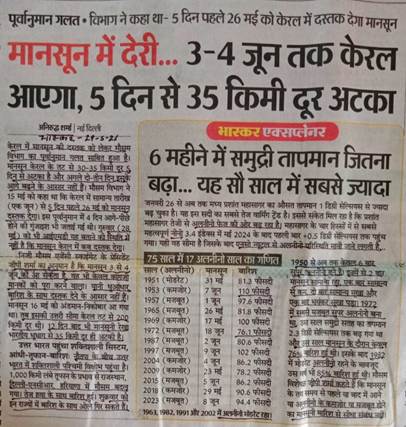
In 1997, one of the strongest El Ninos ever recorded could not break India’s monsoon because the Indian Ocean pushed back. The IOD is flat this year. El Nino is still building. And the September peak is heading straight for India’s standing crops.
Precipitation extremes in 2025 The study analysed 46 major extreme precipitation events worldwide in 2025, including tropical cyclones, monsoon floods and severe storms, many of which broke historical rainfall records. It found that climate change and rising temperatures are intensifying short-duration heavy rainfall and flash floods by increasing atmospheric moisture. The paper identifies Asia, especially South Asia and India, as major hotspots for worsening monsoon extremes, urban flooding and clustered heavy rainfall events, highlighting the urgent need for stronger flood preparedness and climate-resilient infrastructure.
FLOOD
Flash floods wreak havoc in Arunachal’s Upper Subansiri Flash floods triggered by heavy rainfall wreaked havoc in Arunachal Pradesh’s Upper Subansiri district, washing away crucial bridges, damaging houses, and disrupting connectivity in several villages, officials said on May 22. The District Disaster Management Authority (DDMA) has issued an advisory, urging people to refrain from venturing into rivers for fishing and other activities amid forecasts for more rains. Among the bridges washed away were the RCC bridge at Nyo Koro near Ningping village and another connecting Longte village with the Giba headquarters, the officials said. In Ningping village, seven kutcha houses suffered extensive damage due to the flash floods, while agricultural fields, livestock, and other properties were also reportedly destroyed in the deluge, they said.
URBAN FLOODS
Urban flooding in Gujarat linked to disappearing lakes and wetlands The article highlights how rapid urbanisation, encroachments and poor urban planning in Gujarat’s cities are worsening urban flooding by destroying lakes, wetlands and natural drainage systems. It argues that many traditional water bodies that once absorbed rainwater and reduced flooding have either disappeared or become heavily polluted and disconnected from their catchments. In Ahmedabad, official reports show that 37 lakes have vanished due to encroachment and exclusion from development plans, while waterbody areas around major lakes such as Vastrapur, Memnagar, Thaltej and Sola have shrunk sharply.
Guwahati’s flood crisis linked to waste mismanagement The report argues that Guwahati’s recurring urban floods are driven not just by heavy rainfall or inadequate drainage but also by widespread littering and poor waste disposal practices. The article highlights that despite desiltation efforts, indiscriminate dumping of waste by residents and weak enforcement continue to block drainage networks, making flooding a persistent urban problem. It stresses that improving civic behaviour, waste management, and drain maintenance is as important as infrastructure upgrades in tackling the city’s flood crisis.
Delhi’s drainage master plan 1st phase to last 3 years till 2028-29 The ₹57,364-crore master plan was unveiled last year to overhaul the 18,958km of drain network in the city. It aims to address chronic waterlogging by dividing the city into three key basins—Najafgarh, Barapullah, and Trans-Yamuna. “As per our estimates, interventions worth ₹33,500 crore would be required in Najafgarh basin, the largest with 918 sq km catchment area, ₹14,547 crore in Barapullah (376 sq km) and ₹9,317 crore in Trans-Yamuna (197 sq km),” said the senior official quoted above.
LANDSLIDES
NHAI pays ₹1.8 Cr to Shimla orchard owner A Shimla orchard owner, Narinder Singh Rathore, won ₹1.8 crore compensation from the National Highways Authority of India after landslides linked to the Kalka-Shimla highway widening project damaged his apple orchard and hundreds of trees. NHAI had initially termed the incident an “Act of God” caused by heavy rainfall, but later changed its stand following hearings before the National Green Tribunal and a joint damage assessment. The farmer subsequently withdrew the case.
ENERGY OPTIONS
Air pollution reduced India’s solar output by ~10%: Study A study highlighted in The Hindu found that air pollution significantly reduced India’s solar power generation potential in 2023, with aerosols and particulate pollution cutting solar output by nearly one-tenth. The study warns that pollution from coal-fired power plants and other emission sources is undermining the
ENVIRONMENT GOVERNANCE
NGT order on Pipavav Port raises questions on “Green Justice” An article examines criticism surrounding a recent NGT order related to Gujarat’s Pipavav Port expansion project. Environmentalists and legal experts argue that the ruling reflects a weakening of environmental oversight and raises concerns about the future of ecological justice in India.
The article says the NGT allowed the project to proceed despite objections over possible impacts on coastal ecology, mangroves, fishing livelihoods and cumulative environmental damage. Critics contend that the tribunal relied heavily on technical compliance and post-facto assessments rather than precautionary environmental principles.
The piece also highlights broader concerns that environmental clearances increasingly prioritise infrastructure and industrial expansion over ecological protection and community rights. It argues that such decisions undermine public trust in environmental governance and weaken safeguards meant to protect fragile coastal ecosystems and local livelihoods.
Activists oppose EC to Sijimali bauxite mine The National Alliance of People’s Movements (NAPM) has urged the Union Environment Ministry to reject the Expert Appraisal Committee’s recommendation granting environmental clearance to the proposed Sijimali Bauxite Mine in Odisha’s Rayagada and Kalahandi districts. Activists Prafulla Samantara and Narendra Mohanty said mining by Vedanta Limited would threaten the Panichida-Shuagad river system and over 100 perennial streams, including Ranijhola, Jamu and Gurungijhola, causing severe ecological damage and affecting millet cultivation and livelihoods of tribal and Dalit communities.
The activists also alleged that sacred tribal worship sites would be destroyed and accused authorities of forcible land acquisition and fraudulent gram sabhas. They said local protests against the project have faced police repression, with 12 villagers reportedly jailed for participating in the movement. NAPM warned that if the clearance is not revoked and the mining lease not cancelled, the people’s movement against the project would intensify further.
New coal mine cleared in Hasdeo’s conservation zone The Union Environment Ministry’s Forest Advisory Committee has granted in-principle approval for diversion of 1,742.6 hectares of forest land in the ecologically sensitive Hasdeo Arand for the Kente Extension coal block. The project, allotted to Rajasthan Vidyut Utpadan Nigam Limited and operated by Adani Group, will supply coal to thermal power plants in Rajasthan.
The clearance allows phased mining and felling of 4.48 lakh trees in an area classified by the govt as a “high conservation zone.” The forest is considered one of central India’s largest unfragmented forests and is part of an elephant corridor with rich biodiversity.
Environmental groups and tribal communities have strongly opposed the project, warning of ecological destruction, forest fragmentation and threats to indigenous livelihoods. The approval has renewed criticism over continued coal mining expansion in ecologically sensitive areas despite earlier “no-go” recommendations for mining in Hasdeo Arand.
Massive tree felling for Khajuraho–Panna rail project raises concerns The Khajuraho–Panna railway project has already led to the felling of 54,578 trees, with nearly 50,000 more likely to be cut after authorities changed the rail alignment, citing safety concerns with the original route. Environmentalists and local residents have raised concerns over large-scale forest destruction and wildlife impacts, as satellite images show extensive loss of greenery in the area since 2022.
SOUTH ASIA
A dangerous dam‑building race is threatening South Asia’s shared rivers Bangladesh has just approved one of the largest river engineering projects its history: the Padma Barrage, a vast river-control project intended to restore water in the country’s drought-prone southwest. It comes at a dangerous moment for South Asia’s rivers. China is building the world’s largest hydropower dam upstream on the Brahmaputra, India is accelerating its own dam-building program and the treaty governing Ganges water-sharing between India and Bangladesh expires in December 2026. Rather than easing regional water insecurity, the Padma Barrage risks adding to a cycle of unilateral river engineering across the subcontinent. South Asia is entering a regional dam-building race – without the institutions needed to share its rivers.
There is a deeper irony here. Bangladesh is responding to the damage caused by India’s Farakka Barrage with a major barrage of its own. Farakka was built to solve an economic problem upstream, but imposed major environmental costs downstream in Bangladesh. Those economic problems are still unsolved – Kolkata port still suffers from silt and needs constant dredging. Critics fear the Padma Barrage could reproduce the same pattern: large environmental disruption without the promised benefits. In other words, the same engineering approach that damaged Bangladesh may soon be reproduced within that country.
Bangladesh: Proposed Padma Barrage: a sign of failed diplomacy The project is a geopolitical and engineering statement, approved six months before the Ganga Water Sharing Treaty between the two countries expires. The Padma Barrage is the infrastructure response of a neighbour that believes it has waited too long for a durable solution to a slow-moving crisis. If India and Bangladesh can negotiate a credible successor treaty to the 1996 Ganga Water Sharing Treaty, one incorporating real-time monitoring, binding minimum flow guarantees, climate adaptation, and ecological safeguards, the barrage could complement diplomacy.
Before the Farakka Barrage, dry-season flows in the Padma-Ganga system averaged around 70,000 cusecs. After 1975, they frequently fell to between 10,000 cusecs and 20,000 cusecs.
As a result, the Gorai River, once the lifeline of southwest Bangladesh, now runs virtually dry between February and May. Studies have documented the consequences: 79 rivers in Bangladesh dead or dying, groundwater levels in the Barind Tract falling by 10 metres to 15 metres, and rising salinity intrusion in the Sundarbans.
Between 1997 and 2016, Bangladesh received its stipulated treaty share during only 21 of 60 critical dry-season periods. The 1996 treaty, based on hydrological data from 1949 to 1988, failed to account for climate change, growing upstream withdrawals, ecological requirements, or sediment dynamics. It treated the Ganga as a divisible pipeline rather than a living river system.
India’s proposals for a shorter 10- to 15-year renewal period are viewed in Dhaka as a way of keeping Bangladesh in a state of perpetual diplomatic dependence. The approval of barrage is facing criticism in Bangladesh: Bangladesh may unintentionally weaken its negotiating leverage with India. (By Jannatul Naym Pieal)
Nepal’s Hydropower Vision depends on India Nepal aspires to become the “hydropower battery of South Asia,” targeting an installed capacity of 28.5 gigawatts (GW) by 2035, with 13.5 GW planned for domestic use and 15 GW for export to India and Bangladesh. Besides the geo-hydrological obstacles and financial constraints, this vision must navigate a complex co-riparian hydro-political context with India. Nepal depends for its hydropower vision on India as both the primary buyer and the exclusive transit route for hydropower exports to Bangladesh. Nepal’s rivers contribute 46 percent of the Ganga’s annual flows, which shoots up to 72 percent during the lean dry season.
India Alerts Pak about Salal Gate Opening Last week, the District Magistrate of J&K’s Reasi district announced the opening of the spillway gates of 130 m high Salal Dam for flushing of silt ahead of the monsoon. This was shared with the Pak’s Punjab province’s agriculture dept. “The water level in the Chenab may rise by 2-3 mts due to the opening of the spillway gates of the dam by India,” Sialkot’s deputy commissioner said while alerting the disaster management authorities.
In August 2025, India alerted Pakistan about potential flooding in the River Sutlej after it released water from overflowing dams and swollen rivers. The gesture by India allowed Pakistan to evacuate tens of thousands of people, residing in low-lying regions, in time.
Trial by Water: Indus Basin and India-Pakistan Relations In Trial by Water, Uttam Kumar Sinha examines the history and geopolitics of the Indus Basin and the evolution of the Indus Waters Treaty between India and Pakistan. The book explains how the treaty divided the eastern rivers for India and the western rivers for Pakistan, while remaining shaped by political mistrust and regional tensions. The book also discusses how climate change, rising water demand, hydropower projects and security concerns are reshaping the treaty’s relevance, especially after India placed the agreement in abeyance following the 2025 Pahalgam terror attack.
THE REST OF THE WORLD
Why Countries are removing hundreds of dams The report highlights a growing global movement, especially in Europe, to remove old and obsolete dams in order to restore river ecosystems, improve biodiversity, and reconnect natural river flows. A record 603 dams and river barriers were dismantled across 21 European countries in 2025, helping migratory fish such as salmon return to rivers that had been blocked for decades. Experts say dam removal can quickly improve water quality, river health, and climate resilience. However, governments also face challenges in balancing river restoration with hydropower generation and energy security, leading to debates over which dams should be removed and which remain essential.
3-D printed hydro turbine: potential Researchers at Oak Ridge National Laboratory & Wisconsin startup Cadens have developed 3D-printed turbines they say can reduce hydropower costs by up to 40% per KW, with the added ability to retrofit existing dams. Of the roughly 90,000 dams in the U.S., fewer than 3% currently generate electricity. The new manufacturing approach could make small-scale hydropower economically viable at an estimated 50,000 of those sites.
SANDRP
Also see: DRP 25 May 2026 & DRP 18 May 2026
Follow us on: www.facebook.com/sandrp.in; https://twitter.com/Indian_Rivers

 SANDRP