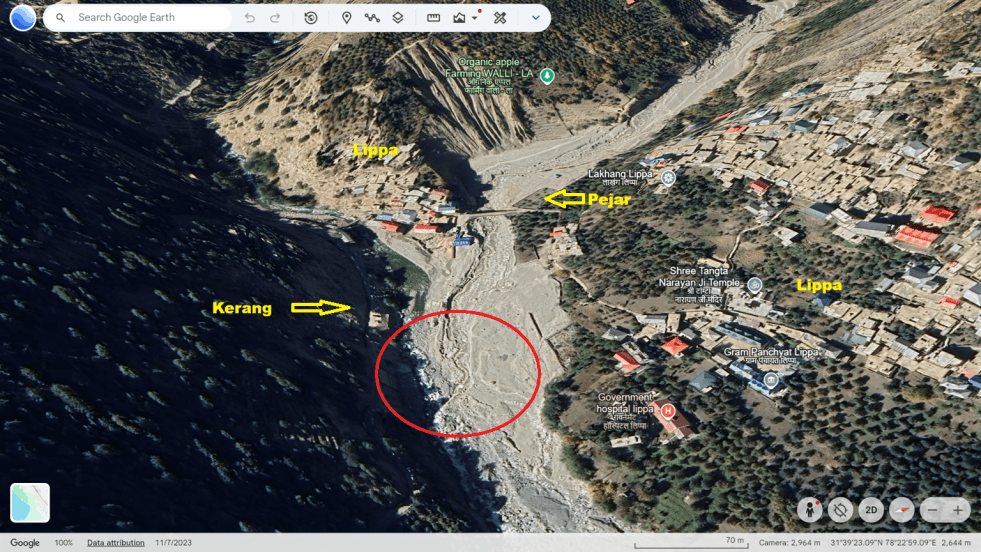
(Feature Image: Google Earth image showing Lippa village, Pejar and Kerang streams and location of artificial lake in red circle.)
A flash flood triggered by heavy rainfall on 9 July 2026 created an artificial lake in Lippa village under Pooh subdivision of Kinnaur district, Himachal Pradesh. The deluge originated in the Pejar (Pager) nallah, which carried huge amount of boulders, debris and slush into the Kerang stream (Teti khad) blocking its natural flow. The obstruction caused water to accumulate rapidly, creating an artificial lake at the confluence of Pejar and Kerang stream.
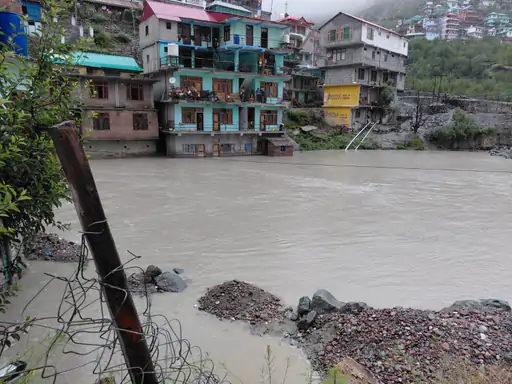
The flood spell and the resultant lake formation severely affected the Lippa residents. The rising water completely submerged the village’s 100-foot-long iron valley bridge. Several houses located along the Kerang stream experienced flooding, with water reaching the lower storeys and threatening their structural stability.
Although road connectivity was restored, the lake remained a major concern for over a week. The villagers also feared that another spell of heavy rainfall could trigger fresh debris flows in the Pejar nallah and enlarge the lake or cause sudden flooding downstream. The recurring disaster also posed a continuing threat to nearby residential buildings and public infrastructure.
Administration Efforts
Following repeated complaints from residents, the district administration deployed earth-moving machinery and partially breached the artificial lake. Officials explained that initial attempts to deploy heavy equipment had failed because the area around the lake had become extremely slushy, preventing machinery from reaching the blockage safely.
Once excavators reached the site, authorities began removing debris to gradually release the impounded water without triggering sudden downstream flooding. Deputy Commissioner Dr. Amit Kumar Sharma confirmed that an artificial lake had formed due to the flash flood and stated that machinery was being used to slowly remove the obstruction.
This July 17 report mentions ongoing administrative efforts to breach the lake and says although the water level had reduced compared to the initial flooding, the lake continued to threaten nearby residential buildings and the bridge. District administration also appealed to residents to remain vigilant in the wake of active monsoon season.
When contacted on July 21, an official of the District Disaster Management Authority (DDMA), Kinnaur, said that reduced rainfall and the partial breaching of the lake had brought the situation under control, but cautioned that another flash flood could aggravate the situation.
HPPCL Kasang HEP Muck Disposal Blamed
Local residents have consistently linked the worsening flood situation to the Integrated Kashang Hydroelectric Project (HEP) being developed by the Himachal Pradesh Power Corp Ltkd (HPPCL). Panchayat representatives and villagers allege that the problem intensified after excavation of the project’s water diversion tunnel began above Lippa.
According to them, the excavated muck was dumped into nearby nullahs without a designated disposal site, raising the streambed and significantly reducing the carrying capacity of the Kerang stream. Panchayat Pradhan UC Negi alleged that although flooding occurred earlier, artificial lake formation became severe only after HEP work altered the drainage channel.
Former Himachal Forest Development Corp Vice-Chairman Surat Negi, after visiting the village, criticised the administration for failing to initiate relief work even a week after the disaster. He also blamed HPPCL for failing to establish a proper muck disposal site during tunnel construction, saying that this negligence contributed significantly to the blockage.
HPPCL Rejects Allegations
HPPCL Managing Director Abid Hussain Sadiq denied that the corporation’s hydropower project was responsible for the formation of the artificial lake, noting that the issue was already before the court. He further stated that the corporation was willing to financially support mitigation measures being prepared by the district administration. According to him, the Deputy Commissioner was preparing a detailed project report (DPR) for long-term flood mitigation and HPPCL would contribute towards its implementation.
High Court Pulls Up Administration
Like last year, the disaster has again attracted judicial scrutiny. The Himachal Pradesh High Court on July 15 took serious note of the administration’s failure to adequately address the hazard. The court directed the Deputy Commissioner, Kinnaur to appear personally before it on July 27 and explain why adequate machinery had not been deployed despite previous judicial orders.
The Court referred to a report submitted by amicus curiae C.D. Negi, which documented that the bridge remained submerged under debris while nearby buildings continued to face serious risk. The Bench observed that although 16 Oct. 2025 directions required additional machinery, only one JCB had reportedly been deployed for around 40 hours, reflecting complete non-compliance with previous court orders.
The Public Works Department (PWD) informed the Court that a private chain-mounted excavator had worked from 7 to 15 Sept. 2025 for approximately 40 hours to remove debris and restore the original flow of the Kerang stream. It further informed the Court that a ₹1.25 crore proposal had been prepared for periodic dredging and lowering the stream bed over a 100-metre stretch, while a larger ₹18.67 crore mitigation project had been prepared for submission to the State Disaster Management Authority (SDMA). The larger project is expected to take approximately 36 months to complete.
Becoming Annual Problem
Residents say the flooding is no longer an isolated event but has become a recurring annual phenomenon. Every monsoon, heavy rainfall transforms the village stream into an artificial lake, inundating the ground floors of houses located along the Kerang stream. Several families reported that floodwater remained inside their homes for over a week during the latest event.
According to villagers, repeated inundation has weakened building foundations. They fear that unless permanent mitigation measures are implemented, continued flooding may eventually render several houses unsafe for habitation.
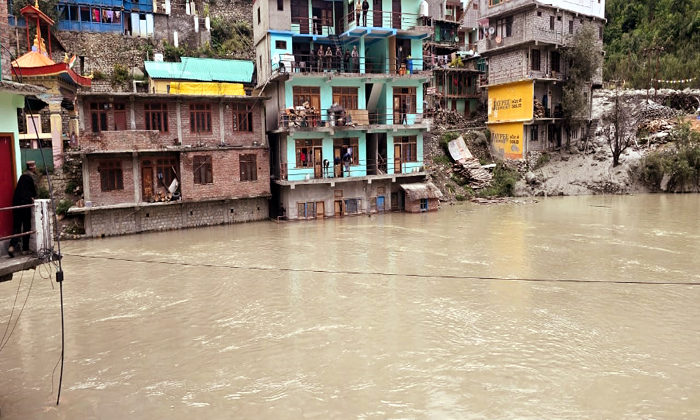
In this detailed report, SANDRP had documented the formation of artificial lake at Lippa following a ‘cloudburst’ induced flash flood incident in Sept. 2025. The report highlighted villagers’ allegations that indiscriminate dumping of muck and debris from the HPPCL’s hydropower project had reduced the Kerang stream’s capacity to flush flood-borne sediment, contributing to the artificial lake’s formation.
The report further covered the villagers’ appeal to the Himachal Pradesh High Court, the Court’s intervention directing authorities to take immediate action, the long-standing opposition to the hydro project and the recurring flash flood risks faced by Lippa residents due to hydropower project and inadequate muck management.
Recurring Disaster & Regulatory Failures
The recurring formation of an artificial lake at Lippa in Sutlej basin highlights the increasingly dangerous interaction between extreme rainfall, the fragile Himalayan landscape and hydropower project. While the immediate trigger has been intense monsoon-induced flash floods, the repeated impoundment of water points to deeper issues of inadequate drainage, poor muck disposal and the cumulative impacts of hydropower development in the basin.
Unless these underlying causes are addressed through comprehensive management, scientific muck disposal, restoration of natural drainage channels and continuous monitoring of vulnerable mountain streams, Lippa is likely to remain exposed to recurring artificial lakes, placing homes, public infrastructure and local livelihoods at risk every monsoon.
The disaster also raises concerns about the role of regulatory and judicial institutions. While the Himachal Pradesh High Court has recently intervened to ensure immediate mitigation measures, its earlier approach was less reassuring.
In January 2019, the Court dismissed the villagers’ challenge to the forest land lease for the Integrated Kashang Hydroelectric Project by questioning the petitioner’s locus standi rather than examining the unresolved forest rights issues. At the same time, the separate petition seeking settlement of community forest rights, despite the NGT’s 2016 directions, has remained pending for years before the same High Court.
Equally contentious was the Expert Appraisal Committee’s (EAC) decision in June 2020 to effectively revive the expired environmental clearance for Kashang HEP Stages II and III by treating all four stages as a single project. This interpretation bypassed the need for a fresh environmental appraisal despite serious concerns over ecological impacts, climate vulnerability and the project’s economic viability, raising broader questions about the effectiveness of environmental governance in the fragile Himalayan region.
SANDRP


