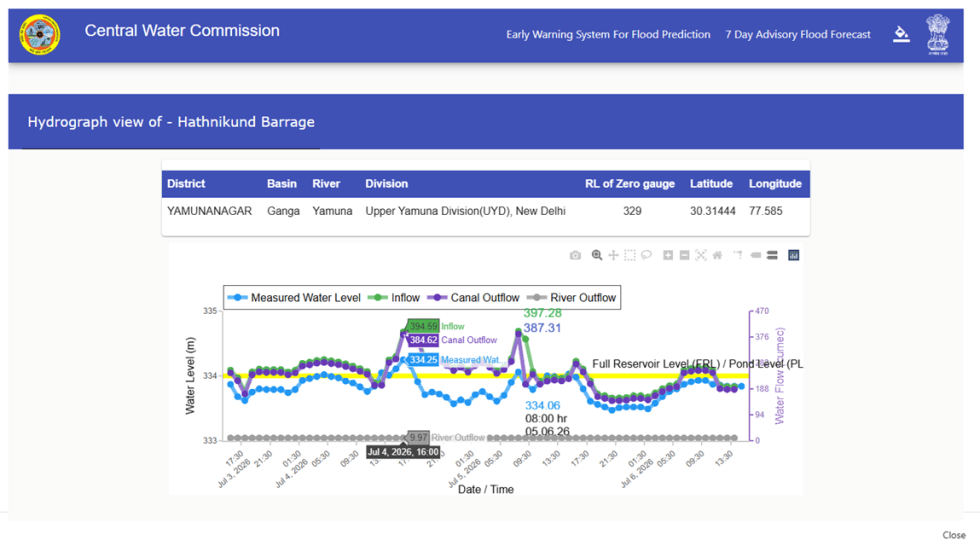
(Feature Image: HKB July 06, 2026 hydrograph showing only 9.97 cusecs flow being released in Yamuna despite substantial rise in inflows. Source: CWC)
It is well known that excessive diversion of Yamuna waters at the Hathnikund Barrage (HKB) in Yamuna Nagar, Haryana over the past two-and-a-half decades has turned the perennial river into a seasonal stream in its upper reaches during the lean season. However, an analysis of the Central Water Commission’s (CWC) hourly discharge figures and hydrographs since July 1, 2026 reveals that the river is now being deprived of its essential flows even during the monsoon.
With the onset of the monsoon, hourly inflows at the HKB increased steadily, recording an average three-to-four-fold rise during the first nine days of July. Despite this substantial increase, the river continued to receive only 352 cusecs, the same totally inadequate release maintained during the lean season, while the additional inflows were diverted into the Western and Eastern Yamuna canals. The river was allowed higher flows for next three days only after the inflows at HKB crossed 40,000 cusecs and has again come down to the 352 cusecs as of July 14, 2026.
The pattern of increasing diversions is also reflected in the changing operational rules at the barrage. Until a few years ago, canal withdrawals during the monsoon were suspended once inflows crossed 60,000 cusecs. This threshold was subsequently raised to 70,000 cusecs and has now been increased to 1 lakh cusecs which is a 66 percent increase over the original limit. As a result, canals continue diverting water until much higher flows are reached, systematically denying the river its natural monsoon discharge even when water is abundantly available.
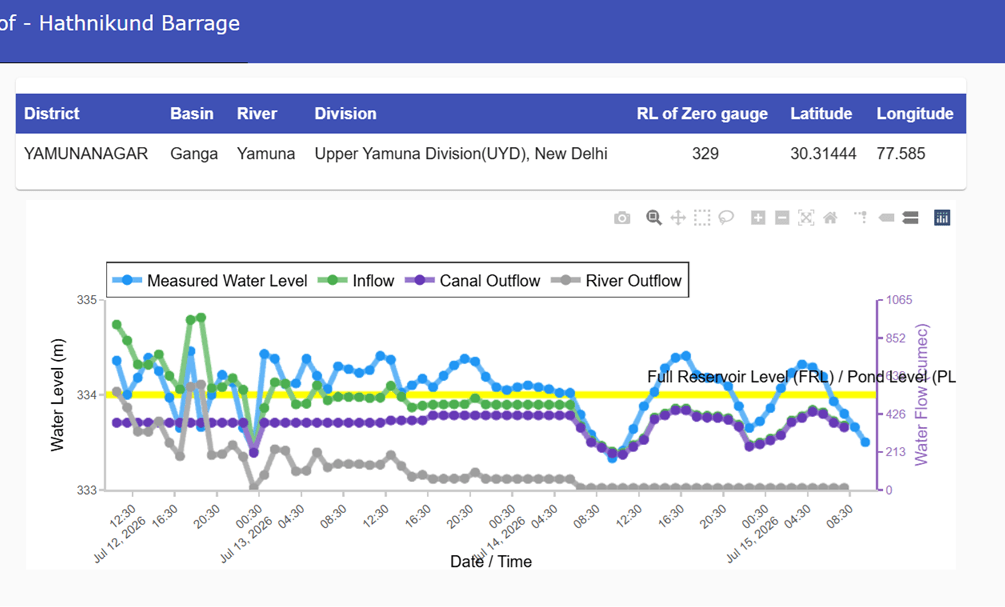
The continued denial of ecological flows during the lean season is equally alarming. More than six years have passed since the National Institute of Hydrology (NIH) recommended a minimum environmental flow of 812 cusecs for the Yamuna. Yet, the Ministry of Jal Shakti has not notified these environmental flow requirements, leaving the recommendation without any legal or operational effect.
Broadly, the policy direction adopted by the Union and basin state governments further contradicts the stated objective of rejuvenating the Yamuna. Despite several high-level meetings involving the governments of Delhi, Haryana and Uttar Pradesh, the emphasis continues to be on construction of upstream dams and increasing water withdrawals rather than restoring river flows. The announcements made in these meetings and the actions taken on the ground remain inconsistent and, in many respects, counterproductive to the goal of river restoration.
The ongoing negotiations to revise the Upper Yamuna River Board (UYRB) agreement also fails to address the fundamental issue of excessive abstraction. None of the basin states has proposed reducing its increasing water demand from the river, nor has the Union Government made any visible effort to steer the negotiations in this direction.
Contrary to this, the Union Government on June 29, 2026 has facilitated an agreement between Haryana and Rajasthan to divert an additional 577 MCM of Yamuna water from the HKB during the monsoon. This decision further undermines the very objective of Yamuna rejuvenation.
It is a known fact that throughout the year, the river is burdened with increasing load of untreated effluents. Thus, allowing the river to receive its natural monsoon flows are indispensable for maintaining its ecological integrity, transporting sediment, flushing pollutants, recharging floodplains and sustaining downstream ecosystems. Equally important is action plan to ensure adequate flows in the river during the lean season.
Until governments take concrete efforts for restoring flows in the river, investments in sewage infrastructure, riverfront development and other engineering interventions are bound to fail to achieve the Yamuna rejuvenation target.
Rajasthan, Haryana sign ₹34,102-cr Yamuna water project Rajasthan and Haryana govts signed a Memorandum of Agreement (MoA) on June 29 to implement the long-pending ₹34,102-crore Yamuna Water Project, operationalising the 1994 Upper Yamuna River Board Agreement after a delay of nearly 32 years. The project will transport Rajasthan’s allocated 577 million cubic metres (MCM) of Yamuna water from the Hathnikund Barrage through a 295.5-km underground pipeline via the Western Yamuna Canal system during the monsoon (July–October). It aims to provide long-term drinking water security to districts of Churu, Sikar and Jhunjhunu in Rajasthan, while also benefiting Bhiwani, Dadri and Hisar in Haryana. The agreement was signed in the presence of Union Home Minister Amit Shah and Union Jal Shakti Minister C.R. Paatil, who described it as a major step towards resolving a decades-old interstate water-sharing issue.
Punjab, Haryana, HP divided over Water Sharing The latest chapter in the dispute has emerged around the proposed Kishau Dam project on the Tons river. Several Punjab-based groups and intellectuals have questioned why the state was not formally involved in discussions regarding the project. They argue that Punjab, being a riparian state to the Yamuna before the division of the erstwhile Punjab, should have been consulted and granted a share in Yamuna waters. The issue has revived Punjab’s long-standing contention that it has been denied its rightful claim over Yamuna waters. While Haryana continues to press for completion of the Sutlej-Yamuna Link (SYL) canal to secure additional water supplies, Punjab maintains that the question of its share in Yamuna waters must first be settled.
The Human Story Behind the Renuka Dam It is the deep-seated fear that brought the Renuka Dam Displaced Struggle Committee to a press conference in Nahan recently. But they were not there to chant slogans against development. Their grievance runs far deeper. As they stood before the microphones, their words cut through the silence—their fight, they insisted, is against the suffocating veil of opacity, the blatant disregard for environmental laws, and the casual dismissal of their basic human rights.
As the press conference drew to a close, the committee issued a resolute warning. They vowed that Renuka will not be allowed to become yet another grim footnote in history- another Bhakra, another Pong – where the displaced are left waiting for a justice that never comes. “If this government continues to trample environmental laws and ignore our rights,” Thakur declared, his voice now firm with defiance, “then this struggle will no longer be just about money. It will transform into a vast, unstoppable movement – a fight to redefine what development truly means. We will settle for nothing less than justice, transparency, and a genuine seat at the table where our future is being decided.”
Fresh proposal to divert Ganga water for Yamuna cleanup The proposal was discussed at a high-level meeting chaired by Union Jal Shakti Minister C.R. Patil with representatives of Delhi, Haryana, Uttar Pradesh and Rajasthan. According to officials, the plan involves releasing additional Ganga water through the Upper Ganga Canal–Yamuna canal network to augment environmental flows in the Yamuna.
However, the proposal is likely to raise questions about: The availability of surplus water in the Ganga basin. Inter-state water-sharing arrangements. Whether augmenting flows alone can clean the river without first stopping sewage and industrial pollution at source. Experts cautioned that merely importing water would not revive the river unless untreated sewage inflows, excessive upstream abstractions and inadequate environmental flows from the Yamuna itself are addressed.
DAMS & HEPs IN YAMUNA BASIN
Agenda of EAC held on June 29-30, 2026 Parbati Complex Major Micro Irrigation Project [CCA of 18,500 Ha] in 1981.998 Ha at Sub-district Huzur, Sehore, Shyampu and Kalapipal District Bhopal, Sehore, Shajapur, Madhya Pradesh – Terms of Reference
INTERLINKING OF YAMUNA RIVERS
Ken-Betwa Linking: Construction continues without valid forest dept clearance An examination of government documents has revealed that several mandatory conditions for forest clearance have not been met. Among these, the most crucial condition, the rehabilitation of affected families, is still incomplete. According to rules, if the necessary conditions are not met, the project needs to obtain forest clearance again. District administration data indicates that the complete rehabilitation of affected families has not yet occurred.
Furthermore, important recommendations from the Central Empowered Committee (CEC) and the National Tiger Conservation Authority (NTCA) have also not been fully complied with. Under these circumstances, questions are being raised about the validity of this project, worth approximately 45,000 crore rupees.
Despite the ban, proposal for a 78 MW power plant According to documents, despite clear conditions, the Ken-Betwa Link Project Authority (KBLPA) is moving forward with a proposal to establish a 78 MW capacity power plant within the Panna Tiger Reserve. According to Himanshu Thakkar (SANDRP), the project’s official map still includes the power plant proposal. In the review meeting on July 19, 2024, the possibility of constructing a power house within the forest was discussed, contrary to the conditions of forest clearance, and it was decided to conduct a separate study for this.
According to Thakkar, the Ken river’s water merges into the Yamuna at Chilla, so a scientific assessment of the river’s natural flow and the minimum water requirement of the downstream area should have been done. He says that such an assessment is not publicly available. According to him, many mandatory conditions for Stage-1 and Stage-2 forest clearance in the project were not fully complied with.
Pyre Protest Resumes As per July 4 report, people affected by the Ken-Betwa Link Project and other irrigation projects in Madhya Pradesh’s Chhatarpur and Panna districts have resumed their ‘Chita Andolan’ (pyre protest) after alleging that the administration failed to honour assurances made when the agitation was suspended in April. Led largely by tribal women, protesters are demanding fair rehabilitation, adequate compensation and relief before displacement. They accused the authorities of demolishing homes during the monsoon, filing false cases, carrying out forced evictions, and creating fear through police action. Activists also alleged that nearly 50,000 people face displacement and warned that the project would destroy millions of trees, harm the Panna Tiger Reserve, and damage the Ken River ecosystem. Protesters vowed to continue the agitation until their demands for justice are met.
KBL could dry up Ken river: Activist Social activist Amit Bhatnagar criticized the KBLP, arguing that it is based on outdated data and threatens the ecological health of the Ken River. He contends that, despite being presented as a river-linking project, it primarily diverts water from the Ken to the Betwa, raising concerns that the Ken could lose much of its flow. Bhatnagar also warned that the project would submerge forests and affect wildlife habitats, including parts of the Panna Tiger Reserve, while displacing local and tribal communities.
YAMUNA WATERWAYS
Govt to launch Yamuna cruise after monsoon Delhi Tourism Minister Kapil Mishra on July 3 announced that an international-standard cruise service on the Yamuna will be launched after the monsoon season as part of the Delhi government’s efforts to promote tourism.
YAMUNA RIVERS
Ujjain to Divert polluted Kanh river through 30-km underground corridor Madhya Pradesh govt is implementing a ₹919.94-cr Kanh Diversion Closed Duct Project to prevent the polluted Kanh River from entering the Shipra River in Ujjain. The 30.15-km-long project, expected to be completed by May 2027, aims to improve water quality in the Shipra ahead of Simhastha 2028.
The project includes a 12-km-long underground D-shaped tunnel built about 100 ft (30 m) below ground and an additional 18.15 km covered canal using the cut-and-cover method. Around 70% of the work has been completed by a team of 80 experts from Hyderabad.
Under the scheme, Kanh River water will be diverted near Jamalpura village before reaching Ujjain & discharged downstream into the Gambhir River, away from the city and Shipra ghats. The construction agency will also operate & maintain the system for 15 years after completion.
Cricket Match on Fly Ash Island Highlights Betwa Pollution Activists organised a symbolic cricket match on a fly ash island that has formed in the Betwa River near Parichha Thermal Power Plant in Jhansi, Uttar Pradesh, to protest the worsening pollution of the river. They alleged that fly ash discharged from the thermal power plant has accumulated in the river, creating artificial islands, degrading water quality, threatening aquatic biodiversity, and affecting farmers and communities dependent on the river. Through the unusual protest, the participants demanded immediate action to stop fly ash dumping, restore the river’s ecological health, and hold the responsible authorities accountable.
Ash Dump Threatens Parichha Dam’s Storage Capacity On 27 June 2026, Bhanu Sahay, president of the Bundelkhand State Formation Front, alleged that continuous fly ash deposition from the Parichha Thermal Power Plant has severely affected the Parichha Dam on the Betwa River, reducing its water storage capacity by nearly half. According to Sahay, the accumulation of ash has altered the river’s morphology, created large ash islands within the reservoir, and diminished the dam’s ability to store water, posing a serious threat to Bundelkhand’s future water security, irrigation and drinking water supply.
He accused the thermal power plant authorities and the Irrigation Department of negligence and administrative inaction despite the worsening situation. Sahay announced that he would approach the NGT seeking accountability, action against those responsible, and restoration of the reservoir’s storage capacity.
Hindon Turns into ‘Dead River’ June 15 report mentions that Harnandi River in Ghaziabad is facing severe pollution due to the discharge of untreated sewage, drain water, and solid waste from the city and 13 surrounding villages. Several stretches of the river have recorded zero dissolved oxygen levels, threatening aquatic life and further degrading water quality. Although authorities proposed measures such as phytoremediation, silt catchers, and filter chambers to restore the river, most projects remain unimplemented.
Toxic Hindon Raises Cancer Fears As per this March 1, 2026 report, the industrial effluents discharged into the Harnandi (Hindon/Krishna) River have severely polluted the river and contaminated groundwater in villages along its banks in Saharanpur. According to the report, groundwater up to a depth of 120 feet has become unsafe for drinking, affecting more than 20 villages. Residents have reported rising cases of cancer, skin diseases, liver ailments, and other serious health problems, with over 350 deaths linked to pollution-related illnesses in recent years. Several villages, including Shabbirpur, Shimlana, Maheshpur, and Haroda, have witnessed a growing number of cancer cases. Despite repeated protests, legislative interventions, and government assurances, effective measures to control industrial pollution and restore the river have remained inadequate.
YAMUNA FLOODPLAIN
Yamuna Bazar demolition leaves families in limbo On 25 June 2026, the Delhi Development Authority (DDA) carried out a demolition drive in Yamuna Bazar after issuing eviction notices to clear settlements on the protected Yamuna floodplain in compliance with NGT directions. The action displaced families who have lived along the river for generations and depend on it for their livelihoods as boat operators, priests, flower sellers and workers conducting religious rites. Residents said they were given little time to vacate and raised concerns over the lack of adequate rehabilitation, with many unwilling to move to temporary shelter homes due to safety and livelihood concerns. The demolition is part of the DDA’s plan to restore the Yamuna floodplain and develop the Yamuna Bazar area as a heritage and public space, but affected families fear the loss of both their homes and their long-standing cultural and economic ties with the river.
Displaced families lose address in SIR season It has been two weeks since the bulldozers left Yamuna Bazaar, but for hundreds of families displaced by the Delhi Development Authority’s demolition drive, the struggle is only beginning. As they grapple with soaring rents and uncertainty over rehabilitation, many say that the absence of a permanent address has complicated the process of filling out their Special Intensive Revision (SIR) forms.
For families of priests who have lived on the Yamuna’s banks for generations, the loss is not just of a home but of a way of life. Even now, many come to the ghats every evening to sit by their ‘Yamuna Mata’, underscoring their emotional bond with the river and its banks. The DDA carried out a demolition drive between Ghat No. 2 and 32 in the Yamuna Bazar area on June 25. The area was home to 80 families, who were asked to move to nearby shelter homes. However, residents said they did not find the shelters safe to stay to live in with their families.
Delhi govt plans two new bridges on Yamuna The Delhi govt on June 19 has approved the first phase of a ₹12,000-crore Elevated Ring Road Corridor, which includes the construction of two new bridges over the Yamuna River to improve east-west connectivity and reduce traffic congestion. The approved phase will extend from Metcalfe House in Civil Lines to the DND Flyway near Ashram, forming part of a planned 55-km elevated ring road.
Illegal Farmhouses in Floodplain Thousands of houses, farmhouses, and unauthorized colonies have reportedly been built along the Yamuna and Hindon rivers, including in 16 villages in Ghaziabad. Surveys have identified extensive illegal construction in several villages of Noida and Greater Noida, with more than 5,000 farmhouses estimated to exist in the Yamuna floodplain. Officials warn that such developments increase flood risks and damage river ecosystems, while residents argue that developers should also be held accountable for selling plots in restricted areas. The court order has renewed pressure on local authorities to take action against these encroachments & prevent further construction in notified floodplains.
Noida Cracks Down on Floodplain Encroachments The Noida Authority has ordered the demolition of illegal farmhouses, permanent houses, resorts, and other structures built in the Yamuna and Harnandi floodplains by June 20, 2026. Authority CEO Krishna Karunesh directed officials to remove all unauthorized constructions and warned of action against officials who fail to comply. The authority stated that the notified floodplain areas prohibit permanent construction, but extensive encroachments have developed over the years. Officials also noted that these illegal settlements increase flood risks and complicate rescue operations during periods of high water, particularly along the Yamuna and Harnandi rivers.
Faridabad Targets Illegal Farmhouses The Faridabad administration is set to demolish nearly 200 illegal farmhouses built on agricultural land along the Yamuna floodplain and in unauthorized colonies across the district. Most of these constructions have been identified in flood-prone areas, where they pose risks to life and property during the monsoon. Villages such as Kidawali, Ismailpur, Sehatpur, Agwanpur, Bhupani, and Lalpur have witnessed extensive illegal plotting and farmhouse development. Authorities have issued notices to developers and plan to carry out phased demolition drives in the Yamuna floodplain and other ecologically sensitive areas.
YAMUNA POLLUTION
Pollution remains high in Yamuna Water quality in the Yamuna showed marginal improvement at some locations in May when compared with April, but the pollution still was alarmingly high across the heavily contaminated stretch flowing through Delhi, according to the latest monitoring report of the Delhi Pollution Control Committee (DPCC). The report is based on water samples collected on May 5. DPCC analyses the samples collected from eight locations of the Yamuna every month.
Bhim Singh Rawat of SANDRP said DPCC’s latest Yamuna water quality report presents a familiar picture of the river’s continuous degradation. “The Yamuna usually gets some relief only during the flood season, when higher flows dilute pollution. This year, however, forecasts of a weak monsoon due to the emerging El Niño conditions may further worsen the river’s water quality,” said Rawat.
He added that successive monthly reports make one fact abundantly clear — without adequate environmental flows, the Yamuna cannot be restored. “While govt continues to focus on river cleaning infrastructure through new projects, budgets and action plans, the most critical requirement of ensuring sufficient environmental flows remains largely ignored. Rather than competing to extract more water from the Yamuna, the central and the basin states, including Delhi, now must priorities restoring environmental flows in the river,” Rawat said.
Experts called for greater efforts to revive the river. Rawat said the river resembles a cesspool of sewage during summer with hardly any fresh water left in it. “Govts are not making any realistic efforts to improve the environmental flow in Yamuna,” he said.
Drain discharge in Yamuna rises 76% more than estimated: DJB The estimate of wastewater flow in the 22 drains that enter Yamuna along the stretch between Wazirabad and Okhla has been revised from 750.4 mgd in May 2025 to 1324.4 mgd in May 2026, Delhi government reports show. Larger drain systems such as Najafgarh, Shahdara, and Barapullah saw the highest jump ranging from two to 4.7 times the previous estimates, forcing city administrators to reassess the baseline for rejuvenation of the river. Government officials say that the revised figures, based on reassessment surveys and volumetric studies carried out last year, indicate a more realistic situation.
The Najafgarh drain, previously estimated to be carrying 452.34 mgd wastewater, has been found to be dumping around 862 mgd into the river, more than the combined effluent treatment capacity (814.226 mgd) of all 37 STPs in the Capital. According to a report submitted by Delhi to the Union government, the estimated flow has increased in at least 11 drains, although five, Najafgarh (862 mgd), Shahdara (160.8mgd), Barapullah (151.61 mgd), Delhi Gate (86.68 mgd), and Sen Nursing Home (26.35 mgd) account for 97.2% of the overall wastewater inflow. HT has seen copy of the reports.
Bhim Singh Rawat, coordinator of the SANDRP, said that the foundation of planning wastewater treatment in Delhi has been flawed. “DJB uses a rule of thumb that 80% of water it supplies returns as grey water. This does not include water residents derive from other sources such as groundwater,” he said. “Secondly, there is an interstate issue with large increase in wastewater volume from Haryana and UP due to expansion of NCR settlements. We need a proper scientific analysis to create a baseline so that treatment facilities can be planned accordingly.”
Rawat said that STPs alone will not be able to tackle the problem and the environmental flow in the river needs to be increased through release of additional water from the Hathnikund barrage. “It has to be treated as an interstate project, with the central government steering it at every step.”
16 more DSTPs in pipeline The Delhi govt plans to award contracts for 16 more decentralised sewage treatment plants (DSTPs) by July. Work for 13 DSTPs was awarded following a tender process in May. With this addition, the total treatment capacity of the DSTPs is expected to reach 170 MGD.
Haryana Plans 19 STPs The govt has planned the construction and upgradation of 19 STPs to curb sewage and industrial pollution. The plan includes 10 STPs with a combined treatment capacity of about 580 MLD and nine CETPs to treat industrial wastewater across multiple districts. Chief Secretary Anurag Rastogi directed officials to expedite the projects, which are estimated to cost around ₹800 crore, alongside measures such as drone mapping of drains, in-situ treatment of polluted drains, and real-time monitoring of water quality.
HSPCB recovers only 12.58% of EC This June 28 report mentions Haryana State Pollution Control Board (HSPCB) has recovered only ₹6.95 crore (12.58%) of the ₹55.28 crore in environmental compensation (EC) imposed on 89 industries, builders, government departments and other establishments in Panipat for violating environmental norms. Major defaulters include National Fertilisers Ltd., Ansal Builders, TDI Infra, Panipat Thermal Power Station (PTPS), and the Public Health Department, with ₹48.31 crore still outstanding. The data, obtained through an RTI by environmentalist Varun Gulati, revealed that 26 establishments have not paid any part of the penalties.
HSPCB cracks down on defaulters Under the new directive, defaulting units will be denied renewal of their Consent to Operate (CTO) and Consent to Establish (CTE) until all outstanding dues are cleared. The decision aims to expedite recovery of pending compensation and strengthen compliance with environmental regulations. Regional offices have been directed to intensify recovery efforts.
The status of the Drain No 6 The HSPCB has recently conducted a study of Drain No. 6, a major water channel flowing from Panipat through Sonepat before entering Delhi and ultimately joining the Yamuna. Drain No. 6 originates near Samalkha in Panipat and enters Sonepat at Bhora Rasulpur.
During the study, a total of 36 discharge points have been identified from where untreated domestic sewage is being discharged into the drain. A total of 11 untreated discharge points in Panipat account for 12.9 MLD of effluents, while 25 such points in Sonepat contribute 29.27 MLD. Besides this, around 90.5 MLD of treated wastewater is discharged into the drain through one STP in Samalkha and 4 CETPs located at Barhi, Rai, Kundli and Murthal.
36 industrial units face action for polluting drain No. 6 Drain No. 6 carries an average flow of 60–70 MLD at the Sonepat border. By the time the drain reaches the Delhi border near Narela-Singhu, the flow rises to about 220 MLD. The situation worsens further when Delhi’s Bakner drain adds another 90 MLD of wastewater.
132 illegal bleaching units sealed in Panipat An RTI reply has revealed that the HSPCB has sealed 132 illegal bleaching units in Panipat over the past decade, but environmental compensation has been imposed on only three units so far. The units were allegedly polluting groundwater, agricultural land and water bodies, including the Yamuna River, by discharging untreated chemical effluents.
The information under RTI, obtained by environmental activist Varun Gulati, showed that proposals to impose compensation on 26 additional units are still pending. The compensation imposed so far includes ₹35.2 lakh on a unit in Karhans village and ₹2.12 lakh and ₹1.75 lakh on two units in Jattal village.
Panipat’s global textile status marred by failing infra Despite being internationally recognized as India’s “handloom city” and a major hub for carpets, textiles and home furnishings exports, Panipat is struggling with crumbling infrastructure. Poor roads, inadequate drainage, traffic congestion and deteriorating civic amenities are affecting both residents and the city’s textile industry.
Noida’s twin rivers too much polluted Despite being flanked by the Yamuna and Hindon rivers, Noida faces growing water scarcity because both rivers are heavily polluted and unsuitable for drinking, irrigation or even sustaining aquatic life. Environmentalists attribute the crisis to untreated sewage and industrial effluents, warning that heavy metal contamination in the Hindon could also degrade groundwater quality. As a result, Noida increasingly depends on Ganga water and groundwater to meet its drinking water needs.
Ghaziabad plans STP at Loni to curb pollution by 2028 The Ghaziabad Jal Nigam, in collaboration with the Centre’s Namami Gange program, has prepared a detailed project report for the project, which has been given a three-year timeline for completion. Officials said the proposed STP will intercept untreated domestic sewage and wastewater generated by industrial units in Indrapuri, Banthala and Lal Bagh before it reaches the Yamuna. At present, much of the wastewater from these industrial clusters is discharged into the Shahdara drain, one of the major drains carrying pollutants into the river. According to officials, the project follows directions issued by Supreme Court, NGT and ministry of home affairs, which have called for stricter measures to curb pollution in the Yamuna.
UPPCB to crack down on illegal polluting units On 20 June 2026, the Uttar Pradesh Pollution Control Board (UPPCB) announced a joint inspection drive to identify and act against illegal industrial units operating in residential areas and polluting the Yamuna and Hindon rivers. Around 3,500 industrial units, mainly in Loni and near Sahibabad, have been identified for inspection in coordination with the electricity department. Officials said units found illegally discharging untreated effluents into drains or rivers, particularly those engaged in dyeing and chemical processing, will have their electricity connections disconnected and be sealed.
Over the past three months, UPPCB has already sealed about 250 illegal units for directly discharging waste into the Shahdara drain, Yamuna and Hindon. An NGT petition on Hindon river pollution has been pending since 2022, while the state has also acknowledged a 285.43 MLD gap between sewage generation and treatment capacity across seven districts.
1,500 factories polluting air, water in Ghaziabad: UPPCB The UPPCB has raised concerns over discharge of untreated or inadequately treated effluents into drains and water bodies. Groundwater contamination in industrial clusters, particularly in areas such as Sahibabad.
YAMUNA RIVERS BIODIVERSITY
Banned Pesticide Linked to Crocodile Deaths in Rajasthan River An investigation by an NGT-appointed joint committee has found traces of the banned organochlorine pesticide Aldrin in the Chandraloi river in Kota district, Rajasthan, linking it to the deaths of mugger crocodiles. The case began in December 2024, when four protected mugger crocodiles were found dead in the river, following an earlier incident in 2022 in which around 50 crocodiles reportedly died due to industrial pollution.
While the Rajasthan Forest Department acknowledged the presence of Aldrin in its response to the NGT, it denied responsibility, arguing that pesticide regulation falls under the agriculture department and pollution control agencies. The report highlights the absence of a clear investigation into the source of the banned pesticide, questions official accountability, and notes that no concrete action plan has been presented for pollution control, regular water quality monitoring or crocodile conservation. The matter is pending before the NGT.
MINING IN YAMUNA RIVERS
NGT Seeks Explanation for Two-Month Delay in Yamuna Illegal Mining Inspection On 7 July 2026, the NGT sought an explanation from a joint supervisory committee over a delay of more than two months in conducting an inspection into allegations of illegal sand mining along the Yamuna River in Shamli district. The tribunal observed that the committee had failed to comply with its earlier directions to inspect the site and submit a report within the stipulated time, raising concerns that the delay could allow continued illegal mining and further environmental degradation. The matter pertains to alleged unauthorised sand extraction from the Yamuna riverbed, which can destabilise river morphology, accelerate bank erosion, damage aquatic habitats and threaten nearby infrastructure. Expressing dissatisfaction over the lack of timely action, the NGT directed the committee to explain the reasons for the delay and proceed with the inspection and submission of its report without further postponement.
Three murders expose the continuing terror of mining mafias In a village near the Delhi–Karnal highway, three friends who had reportedly opposed illegal mining were killed in a brutal manner on the night of June 10. Narendra, Vinod and Aneep of Diqadla village had allegedly incurred the hostility of powerful interests because they were believed to have complained about illegal mining. The brutal killing near Samalkha is a tragic reminder that much more needs to be done to confront the mining mafias & to protect both communities & ecosystems.
According to a study by SANDRP, during the 16-month period from December 2020 to March 2022, incidents related to river sand mining reported in the English-language media resulted in 418 deaths and 438 injuries. These figures include deaths and injuries arising from violence, accidents and conflicts linked to sand mining.
Even these alarming numbers are likely to be only a fraction of the real toll. Deaths and injuries associated with sand and stone mining, many of which go unreported, are almost certainly far higher. In several regions, mining mafias have become extraordinarily powerful. Urgent action is needed not only to curb their environmentally destructive practices but also to end the violence and fear they impose on local communities.
Illegal Sand Miner Threatens Tehsildar in MP On 26 June 2026, a revenue team led by Badarwas Tehsildar Sachin Bhargava was threatened during an operation against illegal soil excavation linked to sand mining near the Sindh River in Sadbud village, Shivpuri district, Madhya Pradesh. The accused, Jaymandal Yadav, allegedly threatened to shoot the tehsildar and called for his son to bring a gun while officials attempted to seize vehicles involved in the illegal activity. During the confrontation, the accused fled with a Hydra excavator and one tractor-trolley, while another tractor loaded with illegally excavated soil was seized. Police registered an FIR against Jaymandal Yadav, Lakhan Yadav and Vikul Yadav on charges including criminal intimidation, threatening government officials and obstructing public servants from performing their duties.
Mining in Ken fuels migration from riverbank village Bharat Dogra highlights how intensive sand mining along the Ken river in Bodepurva village, Banda district, has devastated the livelihoods of the Kevat community, triggering large-scale migration. Villagers allege that excessive sand extraction over the past five years has destroyed fertile floodplain farmland by leaving mining debris across areas once used for vegetable cultivation. As agriculture collapsed, many families were forced to migrate in search of work. The report also raises concerns over broader ecological impacts, including altered river flow, reduced water availability, degradation of aquatic habitats, and increased flood and erosion risks, arguing that the short-term gains from sand mining have come at the expense of sustainable livelihoods and river health.
YAMUNA WETLANDS
NGT Flags Violations at Jhansi’s Historic Laxmi Tal On 3 July 2026, the NGT scheduled the next hearing in the case concerning the deteriorating condition of Laxmi Tal, a historic lake in Jhansi, after a joint committee report found serious environmental violations. The committee reported untreated sewage discharge, large-scale encroachments, indiscriminate dumping of solid waste and construction debris, deterioration of water quality, and inadequate protection of the lake’s catchment area, all of which have significantly degraded the waterbody. The case highlights persistent shortcomings in the conservation and management of one of Bundelkhand’s important historic urban waterbodies.
YAMUNA WATER RESOURCES MANAGEMENT
₹974-Cr Chambal Water Project Delayed The ₹974-cr Chambal Drinking Water Project in Rajasthan’s Bundi dist has been delayed for over four years, with work reportedly stalled due to funding shortages. Despite ₹425 cr already being spent, around 85,000 people in nearly 50 villages continue to depend on water tankers during the summer. The project was originally expected to supply drinking water to about 500 villages by Nov 2024, but the target has been missed. Raising the issue in the Assembly, local MLA Ashok Chandna highlighted the delays, while the state govt has now assured completion by Apr 2027.
Plastic waste chemicals polluting Jaipur water sources A new study from the IIT Roorkee has found that chemicals leaching from plastic waste at the Mathuradaspura dumping yard near Jaipur are contaminating nearby groundwater and surface water sources. The study detected elevated levels of phthalates & bisphenol compounds, chemicals commonly used in plastic products and known to pose risks to human health & ecosystems.
Researchers collected water samples from wells, hand pumps and surface water bodies around the landfill and found evidence of contamination linked to long-term accumulation and degradation of plastic waste. The study warns that continued leaching of these chemicals could affect drinking water quality and increase health risks for communities dependent on local water sources.
Section of Aravali hillock flattened in Mangar A section of an Aravali hillock covering about one acre has been flattened in Mangar, an ecologically sensitive area in Haryana known for the Mangar Bani sacred grove and its rich biodiversity. The incident has raised concerns over possible illegal excavation or land alteration in the protected Aravali landscape. Following complaints and media reports, district authorities have launched an investigation to determine whether environmental and mining regulations were violated and to identify those responsible.
Experts question independence of SC appointed Aravalli panel A group of scientists, environmentalists, policy experts and retired forest officials have written to the Chief Justice of India, raising concerns over the independence and composition of the Supreme Court-appointed committee reviewing the definition and protection of the Aravalli Range. They have urged the court to reconstitute the panel with independent experts from diverse disciplines.
The experts argue that the committee is dominated by serving or retired government officials and institutions linked to the MoEFCC, raising concerns about potential conflicts of interest. They contend that the panel lacks specialists in fields such as hydrology, ecology, wildlife conservation, GIS mapping, public health and traditional livelihoods, which are essential for assessing the Aravallis as an ecological system rather than merely a geological formation. The committee has been asked to submit its report by August 31, 2026.
Fresh survey ordered for Aravalli land amid data mismatch The Supreme Court-appointed Central Empowered Committee (CEC) has ordered a fresh, plot-by-plot survey of protected Aravalli land in Anangpur after major discrepancies were found between official maps and ground verification. The issue relates to enforcement of a Punjab Land Preservation Act, 1900 provision, under which large areas are treated as forest land, making thousands of existing structures potentially illegal. A previous Supreme Court of India order (July 21, 2022) had directed demolition of such structures built without approval.
Groundwater Approval Delays Hit Haryana Industries Over 2,000 groundwater extraction applications are pending in Haryana due to the absence of a chairperson in the Haryana Water Resources Authority (HWRA) for 9 months. This has delayed issuance of mandatory NOCs.
The backlog is disrupting business operations, investments and compliance, while raising concerns over weakening groundwater regulation. Experts warn that delays, combined with limited regulatory coverage and ongoing illegal extraction, could undermine sustainable groundwater management in a state already facing water stress.
Toxic leachate at Bandhwari raise fresh concerns A recent inspection at the Bandhwari landfill on the Gurugram–Faridabad road found several damaged, tilted and incomplete boundary walls, allowing waste and toxic leachate to spill beyond the landfill into the ecologically sensitive Aravalli region. The inspection also found a leachate pond within accumulated waste and nearby trees that had turned brown and lifeless, indicating possible long-term contamination. Environmentalists warned that leachate — the toxic liquid produced when rainwater percolates through decomposing waste — can contaminate soil & groundwater, damage vegetation & ecosystems.
Why Gurugram Floods Every Monsoon The article argues that poor urban planning, not heavy rainfall alone, is the primary reason for Gurugram’s recurring floods. It explains that rapid urbanisation has replaced natural wetlands, ponds and open land with concrete surfaces, drastically reducing the city’s ability to absorb rainwater. Encroachment and blockage of natural drainage channels, inadequate stormwater drainage infrastructure, and unregulated construction in low-lying areas have further aggravated waterlogging.
Gurgaon Commissions ₹105-Cr SWD On 6 July 2026, the Gurugram Metropolitan Development Authority (GMDA) announced the commissioning of the ₹105-crore, 4.3-km Leg-4 stormwater drain, designed to reduce chronic monsoon flooding in Gurugram. Running from Vatika Chowk to Sector 37D parallel to NH-48, the new drain diverts excess rainwater away from the overburdened Badshahpur drain, the city’s main stormwater channel, before rejoining it downstream. The project aims to reduce waterlogging at major flood-prone locations such as Hero Honda Chowk, Rajiv Chowk and stretches of NH-48, where intense rainfall, rapid runoff from the Aravalli foothills, rapid urbanisation, and the limited carrying capacity of existing drainage infrastructure have led to recurring flooding.
Delhi Plans Mandatory Water Meters on All Borewells The Delhi government is drafting a new borewell policy under which all domestic and commercial borewells will be required to install water meters. Users will be charged according to the quantity of groundwater extracted, with the data helping authorities determine future water bills and monitor groundwater use across the city. The policy is also expected to create a mechanism for regularising thousands of unauthorised borewells currently operating in Delhi. Officials said the broader objective is to address water scarcity, falling groundwater levels and weak regulation of private extraction, while linking authorised borewells to rainwater harvesting requirements as part of the city’s groundwater management strategy.
Delhi’s Defence Colony hit by water contamination After Gulmohar Park and Hauz Khas, water contamination has now hit Defence Colony, with residents alleging muddy and foul-smelling water being supplied through the Delhi Jal Board (DJB) network. The worst impacted are blocks C and D, which comprise around 50-60 households, they said. Residents said the issue has been persisting for the past three days, forcing them to purchase water for all their needs. They alleged that complaints to the DJB have so far fallen on deaf ears.
Residents struggle with sewage-contaminated water Investigations by DJB pointed to possible contamination from damaged pipelines, ageing infrastructure, construction activity & leaks in the colony’s 60-yr-old internal water network.
FLOOD IN YAMUNA BASIN
Rain boosts Yamuna levels The water levels in Yamuna stretch in Delhi rose sharply on July 12, increasing by over 2 metres, following heavy rainfall in the hills upstream. This marks the first instance where the river has risen above 204m-mark after a prolonged dry period during summer months, said officials. According to officials, the river rose from 201.87m at 10pm on July 11 to 204.05m at 11am at the Old Railway Bridge — 2.18m in 12 hours.
Rising Yamuna Exposes Weak Flood Protection in Panipat On 13 July 2026, the rising Yamuna River exposed shortcomings in Panipat’s flood preparedness as fresh erosion damaged newly built embankments despite government claims that flood-control measures had been completed before the monsoon. Following heavy rainfall in the Himalayan catchments, the river level rose to around 229.60 metres, close to the warning level, triggering severe bank erosion along several stretches. Although around ₹9 crore had been allocated to strengthen embankments with work scheduled for completion by 30 June, local residents alleged that the Irrigation Department failed to finish the works on time. In response, officials began emergency dumping of stones to reinforce vulnerable riverbanks and prevent further erosion. The incident has raised concerns over the quality and timeliness of pre-monsoon flood protection works along the Yamuna in Haryana.
Rising Yamuna Triggers Bank Erosion in Shamli On 13 July 2026, the rising Yamuna River, following heavy rainfall in the Himalayan catchment and increased releases from the Hathnikund Barrage, triggered bank erosion along the river in Bhadi village of Shamli district. Farmers reported that nearly three feet of fertile agricultural land had already been eroded, while the edge of an existing spur (thokar) collapsed, developed cracks, and several under-construction spurs were submerged, forcing the Drainage Department to suspend ongoing anti-erosion works until water levels recede.
Local farmers alleged that spurs constructed on the Haryana side had diverted the river’s flow towards the Uttar Pradesh bank, accelerating erosion. They also questioned the quality of the protection works and warned that, unless urgent corrective measures are taken, several riverside villages could face severe losses. The report notes that thousands of bighas of farmland in villages including Lakshmipura, Bhadi Mustafabad, Salhapur, Nai Nagla and Manglaura were lost to Yamuna erosion in 2025, with affected farmers still awaiting compensation.
Incomplete Spurs Leave Shamli Vulnerable On 15 July 2026, farmers in Sakauti, Udpur, Nai Nagla and Manglaura villages of Shamli district raised concerns that repair and reconstruction of Yamuna anti-erosion spurs (thokars) damaged during the 2025 floods remain incomplete, leaving the riverbank vulnerable to renewed erosion. Residents said that despite repeated complaints and inspections by the Drainage Department, construction work has not begun, even as the season’s initial rains have already triggered riverbank erosion near Manglaura. Farmers alleged that while anti-erosion works are progressing in other parts of the district, the worst-affected villages have been neglected.
MP Inspects Yamuna Embankments in Baghpat As the Yamuna River continues to rise following increased upstream releases, Baghpat MP Rajkumar Sangwan inspected flood protection works and embankments along the river in Chhaprauli tehsil, Uttar Pradesh. Officials informed him that repair and reinforcement of embankments were underway and that continuous monitoring of the river level was being carried out in view of the rising Yamuna.
UP keeps flood watch teams ready The irrigation department and district administration have set up a flood monitoring cell along Yamuna in Loni and fortified the Alipore embankment. The water discharge at the Okhla barrage is currently recorded at around 10,000 cusecs against a design capacity of 3 lakh cusecs. A flood-like situation typically arises when discharge crosses 1 lakh cusecs. Alipur, Navada, Badarpur, Mirpur Hindu and the Tronica City industrial area in Loni were heavily affected after the embankment had breached in 2023 and 2024. Loni areas vulnerable to flood also include Panchayara, Elaichipur and Lutfullapur villages.
Of the 18km Alipore embankment, which runs along Yamuna, 9.6km falls in Loni while the rest is under Baghpat district. The embankment can withstand water pressure in excess of 2 lakh cusecs. “For the past three years, Loni has been witnessing floods, with the flood of 2023 being the worst because it breached the Alipore embankment, inundating about 142 hectares. The floodwater affected more than six villages, and people had to be evacuated,” said Ramandand Singh, a farmer from Panchayara village.
Mathura: Keshi Ghat Submerged The Yamuna’s water level in Mathura–Vrindavan has risen rapidly following increased releases from the Hathnikund Barrage after heavy rainfall in the upper catchment. Water has reached and submerged the steps of the historic Keshi Ghat in Vrindavan, while low-lying riverside areas have started experiencing inundation. The rising river has heightened concerns among residents living along the floodplain, prompting the district administration to monitor the situation closely and alert people in vulnerable areas.
Hindon Floods Fields On 13 July 2026, the rising Hindon River inundated hundreds of bighas of agricultural land in villages along the river in Meerut district, submerging standing crops and intensifying a fodder shortage for livestock. The flooding, triggered by continuous heavy rainfall in the upper catchment, left sugarcane, fodder and other seasonal crops under water, while farmers found it difficult to access fields located across the river. Farmers warned that if water levels remain high, crop losses and economic hardship would increase, and urged the administration to arrange drainage, conduct damage assessments and provide compensation to affected cultivators.
HFL BREACH
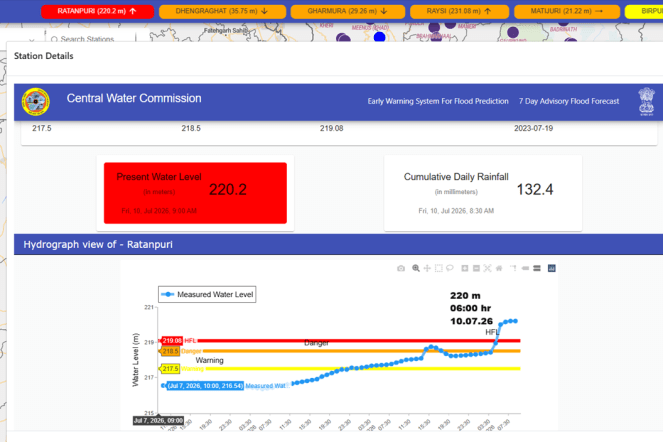
River Kali, a tributary of Hindon in upper Yamuna basin has crossed its old HFL 219.08 m dated 19.07.2023 at 6 am on 10.7.2026, reached 220.2 m at 9 am on 10.7.2026.
RELEVANT REPORTS
Urban Water Meandering in Policy & Governance Vacuum India’s recurring urban water crises demand more than emergency responses—they require integrated policies, accountable governance, and nature-based solutions to build resilient cities for a changing climate. (Himanshu Thakkar)
How is World Restoring its Rivers by Parineeta Dandekar A journey through river restoration projects across the world. Explore real-world examples of floodplain recovery, habitat restoration, daylighting, and urban river revival through site visits and conversations with experts. Understand the stories of successful and not-so-successful restoration.
Urge to set up Statutory River Authority The suggestion in Punjab, of a group of experts to the state government to set up an independent River Authority for the integrated protection, restoration and management of state’s Rivers is most welcome. The proposal seeks to improve governance of the rivers by ensuring ecological flows, regulating riverbed mining, preventing encroachments, restoring floodplains, monitoring and control pollution. The least it can help is trigger a debate around governance of rivers in Punjab and beyond. And possibly some initial steps towards resolving this governance vacuum around rivers.
Can 2027 Nashik Kumbh help improve the state of Godavari River? The question is, who will take the initiative to ensure that Kumbh each time help improve the state of the river? The government, in the state or centre, driven by the vote bank politics, is not likely to take this up, though it is its duty to do that. That is also apparent from its track record. The Judiciary which has taken up some aspects of this issue, thanks to petitions by civil society groups, can also take up, but it does not seem to be the case. Media and civil society groups can raise these issues, but will that achieve the objective? That leaves one agency that seems completely out of picture. The religious groups and institutions that are organizing the Kumbh are possibly the most appropriate ones to take up this cause. Will they?
SANDRP
Also see: Yamuna Manthan June 2026 & May 2026
Follow us on: www.facebook.com/sandrp.in; https://twitter.com/Indian_Rivers


