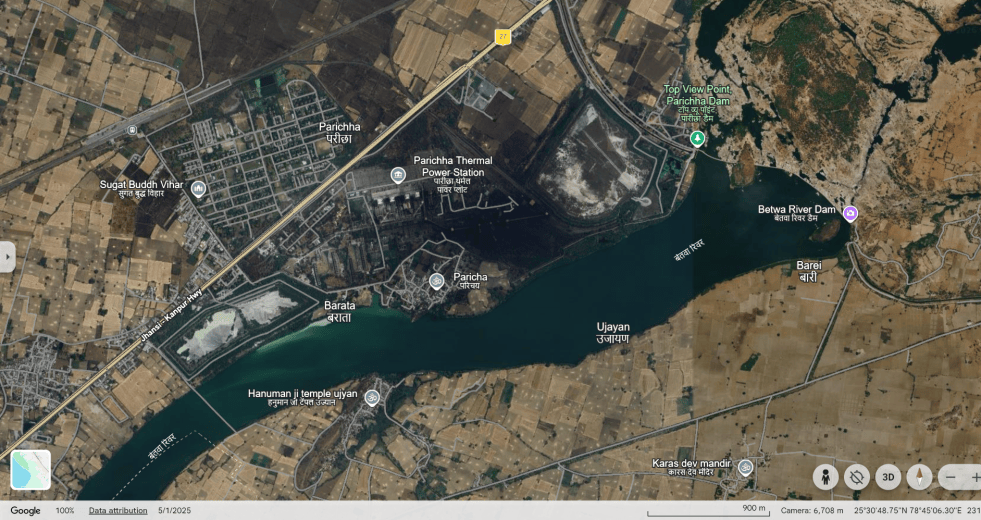
(Feature Image: Google Earth Jan 2025 imagery shows Parichha power plant, fly ash dumps in quite proximity to Betwa river near Parchha dam in Jhansi, UP)
The information in the NGT order and media reports on fly ash pollution from the Parichha Thermal Power Plant in Jhansi has raised serious concerns over the contamination of the Betwa river. The petition has revealed that the continuous discharge of fly ash has led to the formation of large ash islands in the riverbed, obstructing its natural flow. It has further claimed that the toxic heavy metals in the fly ash have been harming aquatic ecosystems in the river. The petition has also raised concerns over air pollution and adverse health impacts on nearby residents.
Significantly, a joint investigation committee constituted by the DM inspected the site on June 17 & 23, 2026 and confirmed the complaints. In fact, several media reports and studies over the past 15 years have highlighted the adverse impacts of Parichha plant fly ash on the Betwa river, groundwater and air quality in nearby villages. They have also mentioned about scores of cattle deaths allegedly linked to contaminated water, damage to crops and health problems among villagers. The continued accumulation and dumping of fly ash have reportedly reduced the water storage capacity of Parichha dam as well.
It is deeply disappointing that the district administration, plant management and environmental protection agencies have allowed the situation to deteriorate over the years. The NGT’s intervention is welcome but it must now ensure a thorough and independent assessment of the impacts on the Betwa river, aquatic life, people’s health, livestock and crops. The Tribunal must fix accountability, ensure adequate compensation for affected communities and take strict action against all responsible agencies. Most importantly, the proceedings must lead to a lasting solution to the fly ash pollution in Betwa river and nearby villages rather than end with another round of notices and assurances.
The Parichha Thermal Power Station is owned and operated by the Uttar Pradesh Rajya Vidyut Utpadan Nigam Limited (UPRVUNL). It is located at Parichha in Jhansi district, Uttar Pradesh, on the bank of the Betwa River. The plant draws water from the river and receives coal by rail from domestic coal mines. The Betwa, also known as Vetravati in Sanskrit, is popularly called the “Ganga of Bundelkhand.” It is a major river of central India and an important right-bank tributary of the Yamuna. The river is about 590 km long. It originates in the Vindhya Range near Jhiri village in Raisen district of Madhya Pradesh and joins the Yamuna near Merapur village in Hamirpur district, Uttar Pradesh.
NGT seeks replies over alleged fly ash dumping in Betwa The petitioners claimed that three large ash deposits, each measuring around 180 feet by 230 feet and rising nearly four feet above the water level, have formed in the river. The NGT principal bench heard Original Application No. 528/2026 filed by environmental activist Narendra Kushwaha on Sept. 10. The application also raised concerns over possible contamination by heavy metals reportedly present in fly ash, including arsenic, lead, cadmium, chromium and mercury.
The NGT order noted that a joint investigation committee constituted by the Jhansi district administration & other authorities had inspected the site on Jun 17 & 23 following complaints. The tribunal observed that the matter involved a substantial issues concerning compliance with environmental norms & issued notices to the respondents. Next hearing on Nov 19.
As per a Sept 2019 report, the Parichha Thermal Power Plant in Jhansi was generating around 14,000 metric tonnes of wet ash daily from six units, while its existing ash ponds were nearing full capacity. The report highlighted serious concerns over ash contamination of the Betwa river, with more than 50 domestic animals reportedly dying in Parichha and Richhaura villages over two years. Villagers also complained of polluted hand-pump water and ash deposits of 20–25 feet along the riverbed, which had made the river shallower and increased the risk of flooding. Ash accumulation had also reportedly reduced the storage capacity of Parichha Dam, raising concerns over future irrigation. To accommodate the growing ash output, the plant planned a new ash pond requiring the acquisition of 572 acres from three adjoining villages. The proposal was rejected by the environment department
As per a May 2019 report, all four ash ponds at the Parichha Thermal Power Plant, each with a reported capacity of 5 million tonnes, had filled up. The plant subsequently promoted the use of fly ash in activities such as mine filling and manufacturing construction materials, resulting in nearly 90% of the ash reportedly being collected for reuse.
This July 2018 report mentioned that despite repeated warnings to the plant authorities, ash discharge reportedly continued. The irrigation department had invited tenders to assess silt accumulation in Parichha Dam and 21 other dams and lakes.
A portion of the fly ash dam at the Parichha Thermal Power Plant collapsed in Feb. 2015, allowing hundreds of tonnes of ash to flow directly into the Betwa River. Plant officials estimated that repairs would take 5-7 days, raising fears of further ash discharge. The incident occurred despite longstanding protests, a case against the plant management, a High Court PIL & 8 notices by the Pollution Control Board warning the plant to take corrective action.
Effect of Fly Ash Disposal on GW Quality near Parichha Plant In Aug. 2015 investigation, the ground water samples were collected from nearby areas of Parichha Thermal Power Plant at six locations during the period of Jan 2014 to May 2014. The samples were analyzed for physico-chemical properties and heavy metal content. The concentration of Turbidity, EC and Alkalinity was exceeding the standard at all locations and shows that the groundwater is not fit for drinking. It was found that concentration of lead was exceeding the limit in groundwater.
This Feb. 2011 report also highlighted how fly ash and coal dust from the Parichha Thermal Power Station have severely affected the health, farmland, air and water quality of Parichha, Richhaura & nearby villages. Despite years of protests, official acknowledgements of pollution & repeated demands for relocation, authorities have failed to provide a lasting solution.
This 2009 study titled Environmental Impact of Fly Ash from Parichha Thermal Power Station underlined the serious environmental and health risks posed by fly ash from the coal-fired power plant in Jhansi, Uttar Pradesh. At the time, the 640 MW plant consumed around 10,000 tonnes of coal daily and generated over 4,000 tonnes of fly ash. The study noted that only one of its two chimneys was equipped with electrostatic precipitators (ESPs), despite their reported 99.7% efficiency. It found that continuous fly ash deposition over nearly two decades was threatening surrounding agricultural land and posed potential long-term risks to human health and animals.
Aging units’ long-term outage and retirement In October 2023, the CEA’s monthly Installed Capacity report stated that Units 1 and 2 had been retired from its records. As of January 2024, the CEA’s list of retired generating units listed the retirement dates of Units 1 and 2 as October 11, 2023. In a letter uploaded to the CEA’s website in early 2024, the CEA secretary confirmed that the retirement proposal for Units 1 and 2 had been granted approval by the UPRVUNL Board of Directors during meetings in both 2019 and 2021, and the Government of Uttar Pradesh had given final approval of the retirement in September 2022.
DAMS, HEPs IN YAMUNA BASIN
Kishau Dam: Can the Dehradun Valley afford the risk? In this article Lokesh Ohri highlights that more than 17 villages face submergence due to Kishau project which threatens communities dependent on agriculture, horticulture, animal husbandry, forests and fisheries. The proposed reservoir could extend around 32 km from Moharad to Tiuni, submerging approximately 2,438 acres of forest land and more than 1.5 million trees.
He questions the project’s outdated planning, reliance on old seismic and displacement data, and the absence of a comprehensive environmental impact assessment. The original dam site was reportedly abandoned following concerns over earthquake risks, while the current site raises further geological and safety questions. Located in a highly seismically vulnerable region covering Zones IV and V, the project could increase risks associated with reservoir-induced seismicity, slope instability, landslides and flash floods. It could also disrupt the Tons River’s sediment flow, aquatic habitats, fish breeding grounds and migratory routes, causing lasting ecological damage.
The author also questions the justification for another mega project when solar and wind energy offer alternatives with potentially lower social and environmental costs. The central argument is that the promised water, irrigation and power benefits cannot justify pushing the Kishau Dam without credible environmental and geological assessments, meaningful consultation with affected communities, and a transparent evaluation of alternatives.
Villagers Protest Kishau Dam, Demand Relocation Hundreds of men and women from villages affected by the proposed Kishau Dam on the Tons River staged a protest at Kwan, demanding protection of their ancestral land, fertile farms, homes and cultural heritage. They urged the government to build the dam at its original Kishau site or shift the proposed location 10–15 km towards Meenas. Villagers said the project would submerge several revenue villages and fertile agricultural land, forcing hundreds of families to lose their livelihoods and migrate. They submitted a memorandum to Cm Pushkar Singh Dhami through the Kalsi SDM.
Villagers alleged that no formal consultation has been held with them despite the project being planned for decades. They fear losing hundreds of hectares of fertile farmland and their livelihoods, and are demanding alternatives to protect their villages, along with a clear rehabilitation and compensation policy framed through consultation with affected residents.
Villagers in Mashwar of Himachal Pradesh’s Shillai subdivision have strongly opposed the proposed Kishau Dam, vowing not to allow construction at the site. They plan to form a Kishau Dam Struggle Committee to organise the protest and have also warned against unauthorised activities, including drone surveys. The villagers are prepared to take legal action to protect their land, forests, water resources, rights and cultural heritage.
INTERLINKING OF YAMUNA RIVERS
Why villagers protesting against Ken Betwa link project Environmentalists have long opposed the project, saying the proposed 2-km-long Daudhan Dam on the Ken River will inundate some 9,000 hectares (22,200 acres) of land, including a significant portion of the Panna Tiger Reserve, one of India’s most successful tiger conservation programmes. The government has said the environmental impact is “unavoidable”, but can be mitigated through tree planting, wildlife conservation and other measures. Some critics even question the scientific basis for the multi-billion-dollar plan. “There is a big question mark over this project’s feasibility because it rests on a hydrological presumption: a surplus in the Ken basin and a deficit in the Betwa basin,” said Himanshu Thakkar, coordinator of the South Asia Network on Dams, Rivers and People (SANDRP). “That presumption has never been conclusively established.”
Divya Ahirwar: The young face of the Ken-Betwa protest The young Dalit councillor from Chhatarpur district of Madhya Pradesh, has drawn the country’s attention to the agitation of Adivasis and farmers against the Ken-Betwa river-linking project in Madhya Pradesh.
HC seeks reply on Environmental Compliance in two weeks Madhya Pradesh High Court granted the Centre and state government two additional weeks to respond to a PIL concerning environmental compliance in the Ken-Betwa Link Project. Petitioner Arihant Tiwari raised concerns about potential impacts on Panna Tiger Reserve, wildlife corridors and the Ken Gharial Sanctuary, citing mandatory environmental safeguards.
The HC on Oct. 09 directed Union govt to produce the Centrally Empowered Committee (CEC) report on alleged irregularities in the Ken-Betwa link project, while hearing a PIL warning of serious social and environmental consequences. The plea sought a scientific study of the possible impact on gharials and aquatic life in Ken Gharial Sanctuary. Questioning a 2017 environmental impact report and alleging factual errors, it sought an independent and scientific assessment. The petitioner also raised serious concerns about the project’s possible regional climate impact from such large-scale tree felling.
YAMUNA RIVERS
Hindon pollution: UP asks NGT for 2 weeks to reply to complaints In an adjournment application dated Oct 31, the state’s standing counsel informed the tribunal that the chief secretary had directed the state to file an updated affidavit in compliance with its August 17 order, but information from the concerned departments and authorities was still awaited. “Some important information is awaited from the concerned departments and authorities,” the application stated, seeking two weeks to file a fresh affidavit. It mentions Nov 2, 2026, as the next date of hearing. The application, however, does not mean the tribunal has granted the adjournment; its acceptance would be subject to the tribunal’s satisfaction.
Separately, UPPCB informed the tribunal that a joint committee of the Central Pollution Control Board (CPCB) and UPPCB inspected 20 STPs across the Hindon basin. Eight were categorised as non-compliant with standards prescribed under the environment ministry’s October 13, 2017 notification.
YAMUNA AS WATERWAYS
Experts say impact of cruise on Yamuna ecology not studied Environmentalists questioned the newly launched Yamuna cruise service on Nov. 10, saying it was introduced without an ecological impact assessment or navigability studies in one of the river’s last remaining relatively clean stretches. Bhim Singh Rawat of SANDRP said the government should have commissioned an ecological impact assessment and a topographical study before allowing motorised cruise operations.
“This clean part of the river sees migratory birds, and efforts should be made to cause minimal disturbance. A similar plan to run a water taxi in this stretch failed in the past, but no lessons have been learnt. They should first assess the depth of the river and the requirements for boat operations, as this might adversely impact aquatic life,” he said.
Rawat said ecological restoration, rather than eco-tourism, should be the government’s priority, particularly along the Sonia Vihar–Jagatpur stretch, which supports aquatic life and attracts migratory birds. He also cautioned that motorised propellers could harm aquatic species, citing similar services in other cities. “Additionally, the river runs dry in May-June, exposing the riverbed. This year, we saw a monsoon deficit, and ecological flow in the river is missing. The river did not cross even the warning level once during the monsoon,” he said.
Navigability concerns are not new. In June 2023, an 11-metre Indian Navy boat, Barasingha, brought to Delhi to assess the river’s navigability, got stranded because of insufficient water depth. It required a minimum depth of two metres, while the riverbed in that stretch had only 0.9 to one metre of water.In 2015, the Inland Waterways Authority of India proposed a 16-km water taxi service between Sonia Vihar and Tronica City. The Delhi government rejected the proposal in 2021, citing severe pollution and inadequate water levels.
Delhi launches Yamuna cruise, 60 take ride About 60 people took a ride as Delhi Nov. 10 launched the ‘Namo Yamuna River Cruise Service’ in Sonia Vihar, marking the beginning of a new recreational tourism initiative along the river. The service will offer visitors a 35-45-minute cruise experience along the Yamuna, with electric boats, a riverfront terminal and family-oriented recreational facilities. The pilot project, developed by Delhi govt in coordination with Inland Waterways Authority of India, covers the 4km Sonia Vihar-Jagatpur stretch. An electric cruise with a capacity of 30 passengers has been introduced, while another vessel of the same capacity is expected to join the service by Feb-March 2027.
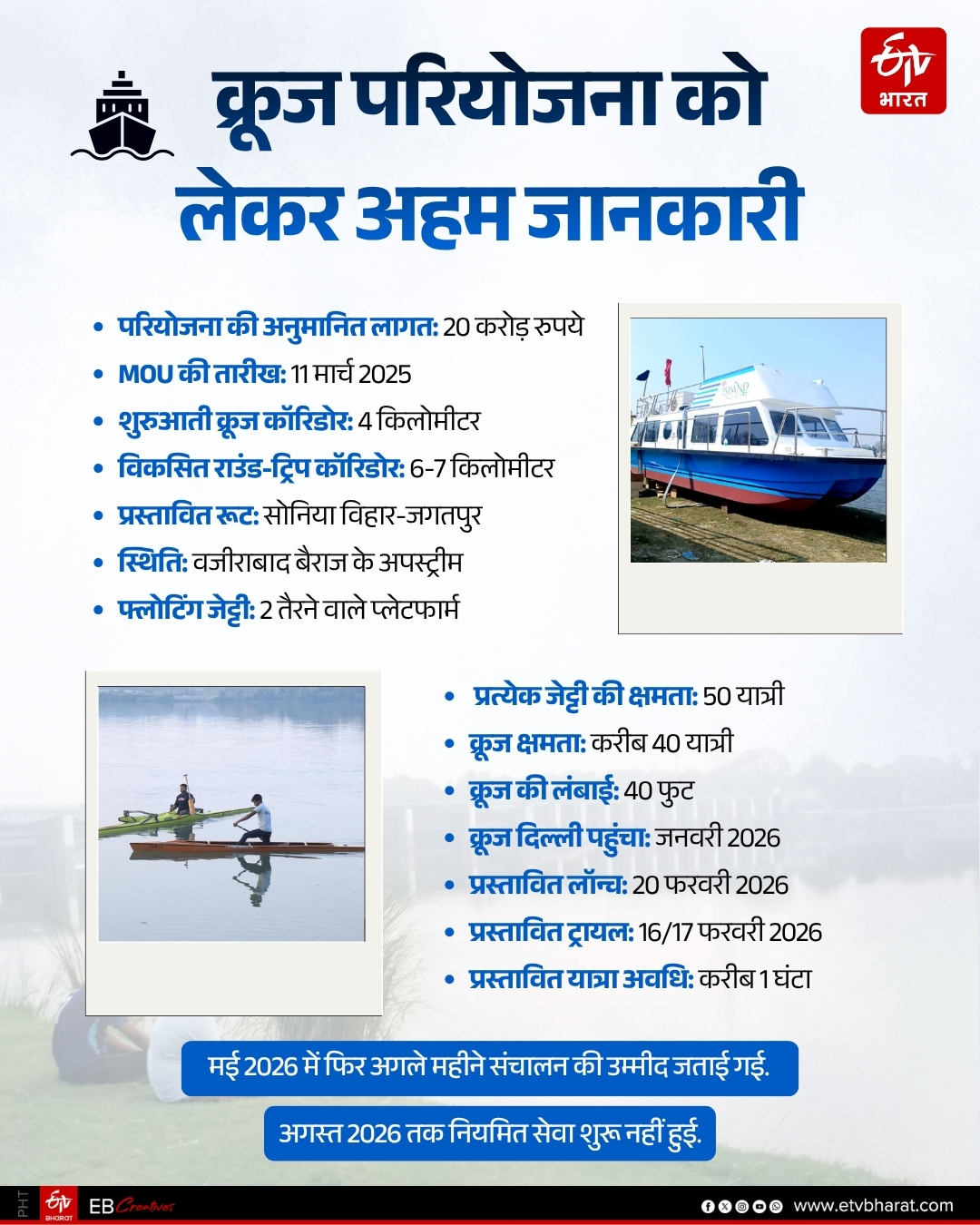
However, environmental concerns have also been raised over the project. Bhim Singh Rawat, associate coordinator, SANDRP, said similar proposals in the past had not materialised because of inadequate water flow in the Yamuna. He cautioned that cruise operations and associated noise could disturb aquatic life and migratory birds, particularly in the stretch upstream of Wazirabad, where human intervention has so far been limited. He said govt should prioritise restoring ecological flow, reducing pollution and protecting the river’s floodplains.
Delhi CM said that, in addition to the new tourist attraction, “equal attention must be paid to keeping the Yamuna clean and protecting its ecology.” However, the project’s viability has been questioned by environmental organizations such as the SANDRP, which insist that restoring the river’s ecosystem should be the priority before any tourism development.
YAMUNA RIVERFRONT
Prioritize Yamuna Rejuvenation, Floodplain Protection rather than pushing Sabarmati type Riverfront Development Project Concerned citizens, experts and river activists have urged the Central and Delhi governments to focus on reviving the Yamuna and protecting its floodplain rather than pursuing the proposed 52-km Sabarmati-style riverfront project. In a letter dated 30 October 2026, they have cautioned that the YRFD project could harm the Yamuna floodplain ecology, reduce river’s flood-carrying capacity and increase flood risks in Delhi. They have also questioned the lack of publicly available project studies and recalled the NGT’s 2015 judgment against a similar proposal. The signatories have called for reducing pollution, ensuring adequate environmental flows, completing scientific floodplain mapping and preventing further encroachment.
Experts object to Sabarmati-style YRFD Eighteen water experts, environmentalists, researchers and civil society representatives have raised concerns over the Delhi government’s proposed Sabarmati-style Yamuna Riverfront Development (YRFD) project, warning that it could threaten the river’s ecological integrity, compromise flood safety and weaken floodplain protection in the city.
In a representation addressed to Union Jal Shakti Minister CR Patil, Union environment minister Bhupender Yadav, Delhi L-G Taranjit Singh Sandhu, CM Rekha Gupta and ministers Pravesh Verma & Manjinder Sirsa, the signatories have urged the government to reconsider the project before committing public funds. The signatories argued that replicating the Ahmedabad riverfront model in Delhi would be scientifically inappropriate, given the fundamental differences between the largely seasonal Sabarmati and the glacier-fed Yamuna river. Flood safety is another concern. They urged the authorities to ensure that no project compromises the integrity of the river, its floodplain and the national capital’s long-term flood security.
Sabarmati-style YRFD ‘could worsen flood risks The 18 signatories have urged the Centre and Delhi govt to reconsider the plan, citing the Yamuna’s different ecological and hydrological characteristics and the potential to aggravate flood risks in the capital. The letter argued that the Sabarmati model cannot be replicated along the Yamuna without accounting for the fundamental differences between the two rivers. The signatories have stated that the Sabarmati is a seasonal river whose urban stretch in Ahmedabad is sustained by regulated water from the Narmada canal system and impounded by the Vasna barrage. In contrast, the Yamuna is a glacier-fed Himalayan river that carries substantial silt and experiences seasonal variations in flow.
They also pointed out that most polluting drains have been diverted away from the Sabarmati riverfront stretch, an arrangement that cannot be replicated on the Yamuna, which flows through several states downstream of Delhi. The signatories warn that further construction on the Yamuna floodplain could compromise the river’s flood-carrying capacity, particularly after the floods of 2023 and 2025. The letter said that accumulated silt, encroachments, and infrastructure such as bridges, roads, and barrages had already reduced the river’s cross-sectional area, making it vulnerable to flooding at lower flows.
Will Yamuna get its Sabarmati makeover? Delhi is planning to develop a Sabarmati riverfront-like project along the Yamuna in two phases, with plans to create large parks, cycle tracks, open spaces and sports facilities along the river. The 52-km stretch of the Yamuna in Delhi will be divided into two phases, with Wazirabad serving as the midpoint.
Delhi water minister Parvesh Verma said the government has initiated the process of signing a memorandum of understanding (MoU) with the Sabarmati Riverfront Development Corporation Limited (SRFDCL), which will provide technical guidance for the project.
“We have initiated the files for signing an MoU with the Sabarmati Riverfront Corporation. They will guide us in overcoming the hurdles encountered during the execution of the Sabarmati project and help us with the no-objection certificates (NOCs) and infrastructure development required for a similar riverfront along the Yamuna. We are moving ahead, and a consultant is being hired to execute the project,” Verma said. The minister said the project would be implemented in two phases. The first phase will cover the stretch from Palla to Wazirabad, while the second will extend from Wazirabad to Kalindi Kunj.
Experts have called for an independent scientific assessment of the Yamuna’s flood-carrying capacity, fearing that sediment accumulation and construction in the floodplain may have reduced the space available for floodwaters. They warn that obstructing the river’s natural spread could raise water levels and increase flood risks in surrounding areas.
Faridabad Metropolitan Development Authority (FMDA) is planning to develop a riverfront along the Yamuna on the lines of Ahmedabad’s Sabarmati Riverfront. The proposed project includes walking paths, cycling tracks, parks, ghats, boating facilities, children’s recreational spaces and green areas. It will be developed in phases, with emphasis on promoting tourism, providing public amenities, increasing green cover and preventing encroachment on the floodplain. Although the proposal has received approval, its estimated cost and budget are yet to be finalised.
A major challenge alongside the riverfront development is preventing industrial pollution from entering the Yamuna. Faridabad has around 30,000 industrial units, reportedly generating over 60 MLD of wastewater. Under the Yamuna Action Plan, three CETPs with a combined capacity of 90 MLD are proposed at Pratapgarh, Mirzapur and Badshahpur, at an estimated cost of ₹400 crore. The first phase involves a 15 MLD CETP at Badshahpur, with plans to treat and reuse industrial wastewater, potentially reducing polluted discharges into the Agra Canal and Yamuna.
YAMUNA FLOODPLAIN
Yamuna flood wall risks deepening floodplain problem The available evidence points to a mismatch between upstream discharge and water levels recorded in Delhi. In Sep 2025, the Yamuna reached nearly 207.5 m at the railway bridge when discharge at Hathnikund Barrage was reported at around 3.2 lakh cusecs. During the July 2023 floods, the river reached a record 208.66 m at a reported discharge of around 3.5 lakh cusecs. The two figures do not establish a complete causal explanation, but they do show why experts are asking whether the river is carrying less water within Delhi than it did previously, or whether other changes are influencing flood levels.
Bhim Singh Rawat, SANDRP, said construction should be reconsidered until ongoing topographic and bathymetric surveys are completed. He also called for an independent investigation into the river’s carrying capacity and the cumulative impact of existing infrastructure. His position identifies two missing pieces in the current debate: updated physical information about the river channel and a system-wide assessment rather than a project-by-project review.
₹99-cr wall along Yamuna stretch The Delhi government on Oct. 23 approved projects worth ₹622 crore to strengthen the Capital’s flood-control and drainage infrastructure, including a ₹99-crore reinforced concrete wall along a vulnerable stretch of the Yamuna and three biomining projects worth ₹260 crore to scientifically process and dispose of silt removed from drains.
The proposed wall, however, has drawn criticism from environmental activists, who warned that it could restrict the river’s natural flow without addressing the underlying causes of rising flood risks. Bhim Singh Rawat, SANDRP, described the wall as a “half-baked measure” that failed to address the underlying causes of rising flood risks. He called for construction to be halted until ongoing topographic and bathymetric surveys of the river are completed.
An analysis of the 2022, 2023 and 2025 floods indicated a significant change in the Yamuna’s flooding pattern, Rawat said. Despite peak flood volumes at Hathnikund Barrage being comparatively lower than during the historic 1978 flood, Delhi experienced unexpectedly high water levels, raising concerns about the river’s reduced capacity to carry floodwater, he said.
Delhi’s Rs 99cr plan to box in Yamuna raises red flags Approved as part of a Rs 622-crore flood-control plan, the 47 km long concrete wall, estimated to cost Rs 99 crore, is likely to run from Magazine Road drain to Old Railway Bridge. The six-to-seven-foot-high structure is intended to protect vulnerable low-lying areas from inundation. But experts argue the project risks treating the symptoms rather than addressing why Yamuna has been reaching high levels even at comparatively lower upstream discharges.
In Sept 2025, the river reached nearly 207.5 metres at Delhi’s railway bridge, while discharge at Hathnikund Barrage was reported at around 3.2 lakh cusecs. During the July 2023 floods, it rose to a record 208.66 m at a reported discharge of around 3.5 lakh cusecs. Experts say these patterns warrant investigation into changes in the river’s carrying capacity, floodplain encroachment, riverbed conditions and the cumulative impact of infrastructure.
Similar concerns have been raised over Delhi’s proposed 22-km Yamuna riverfront project, where experts stress the need to prioritise river restoration and floodplain protection over interventions that could further constrain the river. “Construction of the wall should be reconsidered until the ongoing topographic and bathymetric surveys are completed. The changing relationship between upstream discharge and water levels in Delhi warrants an independent investigation into the river’s carrying capacity and the cumulative impact of existing infrastructure,” said Bhim Singh Rawat, associate coordinator of SANDRP.
YAMUNA POLLUTION
Delhi govt begins Yamuna defoaming work To find a lasting solution to the toxic foam in this stretch – an issue that triggers a political showdown every year before the festival – the Delhi government has commissioned a structural feasibility study of the Okhla barrage by the Irrigation Research Institute (IRI), Roorkee. The government has entrusted the work to Uttar Pradesh’s irrigation and water resources department, providing it ₹91 lakh to examine possible changes to the slope of the barrage’s outfall points to minimise the churning of water, officials said. Separately, ₹68.46 crore has been allocated for a permanent Chhath ghat near Kalindi Kunj, modelled on the Hathi Ghat at ITO.
Bhim Singh Rawat, of the SANDRP, said the Parliamentary Committee on Yamuna flagged the issues of surfactant and slope in 2023, but no work has been done so far. “Treating symptoms during the festive season serves political aims but does not address the root cause. Additionally, a massive amount of chemicals is being sprayed into the river during defoaming drives, which will impact downstream ecology. Changing the barrage slope will not reduce the water’s pollution level; it may just impact the froth’s visibility.”
He added that creating a ghat and filling it with potable water will not help the river in any way. “Last year around Chhath, the river’s flow was increased by diverting water from canals at Hathnikund. It shows that if there is political will, we can increase the environmental flow in Yamuna. We need to focus on increasing e-flow, improving STPs and preventing pollutants and surfactants from entering river streams,” he added.
Froth returns in Yamuna Bhim Singh Rawat, of SANDRP, said that low temperatures and the stabilisation of froth were among the factors behind the intensification of foam formation. However, he said, the phenomenon reflected the extremely poor state of the Yamuna.
The DJB will initiate the spraying of chemical defoaming agents in the coming weeks to control froth formation ahead of the Chhath festival. However, there have been controversies over its use. Rawat said that attempts to spray defoaming agents were merely an effort to treat the symptoms. “The reality is that the river water is extremely polluted and the river is ecologically dead at this point. From the rampant use of surfactants to industrial waste, the problem has only become more aggravated over the last decade,” he added.
DJB plans ₹149 cr sewer line through floodplain The Delhi Jal Board (DJB) plans to lay an 8.34-km sewer rising main through the Yamuna’s ecologically sensitive floodplain to carry sewage from the Ring Road pumping station to the STP. The upcoming 1,800mm-diameter pipeline has received administrative approval of its estimated cost of ₹148.90 crore from the DJB board, according to the project details. The civic utility says the new line will help address recurring sewage overflows caused by three ageing gravity ducts, built in 1938, 1972 and 1992, which have become inadequate and silted up.
DJB has invited bids for laying rising main from Ring Road pumping station to Okhla STP through Yamuna flood plain alignment dated October 26. The project has an estimated value of approximately ₹140.04 crore and a completion period of 1.5 years. “The project is intended to convey sewage directly to the 124-million-gallon-a-day Okhla STP, reducing the load on the existing ducts and minimising overflows and foul conditions in the Sriniwaspuri, Kalkaji, NFC and Captain Gaur Marg areas, particularly during the monsoon,” officials added.
However, the proposed alignment through the Yamuna floodplain raises questions about how the pipeline will be constructed without compromising the floodplain’s ecological functions, including its capacity to accommodate floodwater and support groundwater recharge. Bhim Singh Rawat, of the SANDRP, said that no further construction should be permitted in Yamuna floodplains which have already been encroached to great extent. “What happened to the interceptor sewage project which was supposed to divert all this sewage? Hundreds of crores have gone down the drain. Delhi needs to learn lessons from its failures. We keep targeting floodplains with proje
HM launches Rs 8,941-cr push to stop sewage Launched from the Najafgarh area, the package includes 10 projects worth Rs 2,827.11 crore that were inaugurated and 33 projects worth Rs 6,114.11 crore for which foundation stones were laid. The government aims to complete the works over the next two to two-and-a-half years, after which it expects no untreated wastewater generated in Delhi to flow into the Yamuna through drains.
Among the major projects is a 124 MGD sewage treatment plant at Okhla, costing Rs 1,161 crore. The package also includes the upgradation of 8 existing STPs at a cost of Rs 1,041 crore. Their combined treatment capacity is expected to increase from 78.2 MGD to 140.8 MGD, benefiting around 78.5 lakh people. Another key component is the construction of 29 decentralised STPs and sewage pumping stations in Outer Delhi at a cost of Rs 3,113.67 cr.
JICA projects to boost rejuvenation The combined total cost of the four JICA-assisted facilities is INR 1810 crores approximately. JICA-assisted projects:– Okhla Wastewater Treatment Plant (564 MLD). India’s largest wastewater treatment plant, and the single biggest contributor to cleaner water in the Yamuna. Rithala STP (184 MLD) and Kondli STP (205 MLD). Rehabilitated and upgraded sewage treatment plants in two of Delhi’s major drainage zones, raising the quality of treated effluent reaching the river. Chandrawal Water Treatment Plant (477 MLD).
Of Delhi’s 37 existing sewage treatment plants, 28 have been upgraded over the past one-and-a-half years, he said. However, a gap of 250 MGD remains in sewage treatment capacity, for which new plants are being constructed. “The Yamuna’s water is still not clean today because, out of our 37 existing sewage treatment plants, we have upgraded 28 in the past one-and-a-half years. But there is still a gap of 250 MGD in sewage treatment capacity, for which new plants are being constructed,” Verma said in a statement.
Animal waste, garbage in city’s raw water canal Flagging the presence of domestic garbage and animal waste in the Munak Canal, the Upper Yamuna River Board (UYRB) has directed Delhi govt to restrict access to the system that carries the raw water provided to 60% of the Capital’s residents. A senior govt official on Oct. 20 said that board members inspected the Haiderpur Water Treatment Plant (WTP) and nearby areas, finding the canal’s condition to be highly unhygienic. The water contained large amounts of refuse and a significant quantity of animal dung, said the official, adding that “open defecation is also prevalent along the Bawana belt.”
Last year, a report by the SANDRP flagged several polluting activities taking place along the Munak canal, particularly in the Bawana region. This included open defecation along the canal slopes, industrial waste dumping and burning, the build up of garbage heaps and cattle dung.
Floodplain in Noida bears dangerous levels of nitrate contamination In at least two samples of the underground water tested by Central Ground Water Board in 2025, these levels were almost double the permissible limits. Data released by the Lucknow office of CGWB reveals that nitrate levels have often breached the safe limits in different parts of the district over the years. Responding to an RTI application filed by environmentalist Amit Gupta, the CGWB office has released the report of tests conducted at 13 sites in GB Nagar during 2025, while the study for the current year is in progress.
According to the data released for the years 2019, 2021, 2022, 2023, 2024 and 2025, the tests were conducted at different numbers of sites in the district–the maximum being 13–and only twice–in the years 2023 and 2025–were samples tested from all these sites. At both the sites where the nitrate levels breached safe limits in 2025, even higher concentrations were reported during the 2023 study, and they were found to be 160 in Choroli, Jewar & 72 in Dadri.
12 illegal dyeing units found in Gurugram Twelve illegal dyeing units have been identified in Gurugram, Haryana, and action has been taken against them, according to a report filed by the Haryana State Pollution Control Board (HSPCB) on November 5, 2026. The report stated that the board had initiated action under applicable environmental laws after receiving a complaint from applicant Varun Gulati on April 12, 2026, alleging that polluting dyeing units were operating without authorisation.
Field inspections, surveillance and verification were carried out at the locations identified in the complaint to detect units operating without the required statutory permissions or pollution-control measures. The HSPCB assured the NGT that it would continue monitoring the identified locations and take action against any dyeing unit found operating without the necessary permissions or in violation of environmental norms.
MINING IN YAMUNA RIVERS
SC panel: Phase out ‘unsustainable’ river sand mining in 3 years, desilt dams The SC-appointed Central Empowered Committee (CEC) has said that the country should phase out “unsustainable” sand extraction from rivers within three years, and instead desilt dams to meet the construction sector demand. The recommendation is part of the CEC’s Report No. 36 of 2026, filed before the apex court on Nov 2, in the suo motu case on illegal sand mining in the National Chambal Sanctuary.
“A time-bound roadmap shall be prepared to progressively phase out unsustainable sand extraction from active river channels over the next three years, alongside development of adequate alternative sources, including reservoir sediment, M-sand and recycled C&D waste, while ensuring that legitimate construction requirements are met,” the report states.
The committee also recommended a set of measures on “digital monitoring and traceability of mineral movement”. Key among these will be regulation through secure electronic transit permits, incorporating unique QR/barcodes or RFID-based identification. Additionally, state mining departments shall establish a digital monitoring system on permissions, quantities permitted, actual extraction, transit permits and end-use.
On dams, it recommended that “a time-bound desiltation programme be prepared, with contracts for eligible works awarded within the next three years, followed by a structured 10-year desiltation cycle for reservoirs identified as suitable”. The court had sought the report on October 6 when it widened the Chambal proceedings to cover river sand mining across the country. In earlier hearings, the court had warned that the activity has a “disastrous effect” on river ecosystems and cannot continue unchecked.
A two-judge bench headed by Justice Vikram Nath also appointed advocates Nikhil Goel and Rupali Samuel as amicus to assist the court. The CEC recommended that the Ministry of Jal Shakti lead a comprehensive national framework specifying reservoir-wise sediment availability, recoverable quantities, processing requirements, timelines, financing arrangements and environmental safeguards in consultation with the CWC, National Dam Safety Authority, MoEFCC and State Governments. Sand, a minor mineral, and water are state subjects.
The CEC cited data from the Ministry of Jal Shakti, placed before Parliament in December 2025, that of the 439 reservoirs in the country assessed, gross storage lost to sedimentation averaged 19.24 %. Desilting, the report argues, would serve the “dual purpose of restoring reservoir storage capacity and meeting part of the growing demand for construction materials”. According to the Jal Shakti reply cited by the report, the 2025 national register lists 6,628 specified dams.
The panel recommended that all storage dams over 15 years old that have not been systematically desilted be assessed, and about one-tenth of reservoirs found suitable would be desilted each year. The panel adds that the cycle “should not be construed as a mandate for desiltation of every dam”. However, the CEC acknowledged that it does not know how much usable sand the dams hold since the potential of reservoir sediment as a source of construction sand “has not been adequately assessed at the national level”. It said “the total volume of accumulated sediment cannot be equated with the quantity that is technically recoverable, environmentally permissible or commercially usable”.
On illegal mining, it said: “There is no consolidated, reliable national database that quantifies the volume or value of illegally extracted river sand.” The available material, it said, “does not support a scientifically defensible national estimate of its total volume or value”.
The CEC’s recommendation for a national desilting plan is a deviation from earlier efforts to regulate illegal sand mining by banning it in specified areas. A 2020 CEC report on Rajasthan found that legal sand collection fell from about 57 million tonnes a year to 5 million after the SC restrained mining. It identified that gap as the main driver of illegal mining. The new report stated only that alternatives must be developed “while ensuring that legitimate construction requirements met”. The report also cited the desilting project by Bhakra Beas Management Board, as a model, which plans to excavate deposits up to two metres deep in the Bhakra reservoir.
CEC flags staff, surveillance gaps in Chambal sanctuary Supreme Court-appointed Central Empowered Committee (CEC) has flagged staff shortages, surveillance gaps and weak enforcement in National Chambal Wildlife Sanctuary in its fifth report on illegal sand mining. The report was uploaded on CEC’s website on Nov. 04 and will now be submitted to Supreme Court.
CEC recommended that Uttar Pradesh immediately fill two key vacant posts in its Agra division and strengthen monitoring to curb illegal sand mining. It said the posts of deputy conservator of forests (DCF) and assistant conservator of forests (ACF) in the Agra division of the sanctuary had been vacant for several months. While the divisional forest officer (DFO), Agra, held additional charge of DCF, no officer had been assigned charge of ACF. Officials at the sanctuary were unavailable for a comment on the matter. The committee said the prolonged vacancies could affect the sanctuary’s management and supervision. It recommended that UP fill both posts immediately.
CEC also highlighted gaps in surveillance and enforcement across the sanctuary. The report also raised concerns over enforcement against illegal mining and transportation of sand. The committee called for verification of their operational status and their effectiveness in reducing pressure on riverbed sand resources. CEC also flagged discrepancies in data provided by various departments on illegal extraction and transportation of sand in Ken river catchment. It said the figures supplied by the forest and mining departments did not tally and needed to be reconciled before they could be relied upon.
The committee has sought joint verification of 14 locations in Ken river catchment and all 31 approved sand quarries, including their boundaries, permissions and actual operations. It has asked the states concerned to submit a verification report and reconcile discrepancies in illegal mining cases within six weeks.
CEC said that although the three states had taken several steps, gaps remained in staffing, surveillance, inter-departmental coordination and monitoring. It also sought detailed compliance reports distinguishing between measures proposed, sanctioned, procured, installed and actually operational.
NGT panel flags possible official nexus Raising concerns about possible connivance between local officials and illegal sand mining operators, an NGT-appointed committee has found that a taskforce set up by the Madhya Pradesh government to clamp down on the menace has not been effectively functioning on the ground level.
The committee raised concerns about possible connivance between local officials and illegal mining operators, saying authorities appeared to have acted against smaller sand stockpiles while failing to take similarly effective action against larger ones. In addition, the committee found patches of alleged illegal excavation within a restricted zone near a bridge in Datia district, observed sand-transporting vehicles operating without visible or registered number plates, and reported that no check-posts had been established at the locations it inspected in Bhind and Datia.
Action against illegal sand mining in Yamuna, Ghaziabad Instructions have been issued to all field units under the Police Commissionerate, Ghaziabad, Uttar Pradesh, to maintain zero tolerance towards illegal mining, ensure that no vehicle transports minerals without a valid electronic transit pass and coordinate with Delhi Police along the interstate border. This was stated in a compliance affidavit filed by the Commissioner of Police, Ghaziabad, in response to orders issued by the NGT on August 11 and October 1, 2026.
The report, dated Nov 5, stated that a Joint Task Force for Loni tehsil, covering the sensitive Yamuna riverbed and embankment (pushta), had been reconstituted by the district administration in coordination with the Ghaziabad Police Commissionerate. A coordination meeting of the Joint Inter-State Task Force, comprising senior administrative, police and mining officials from Uttar Pradesh and Delhi, was held under the chairmanship of the Additional District Magistrate, Ghaziabad, on September 8, 2026.
The meeting decided to intensify joint patrolling after the monsoon, recognising that the end of the monsoon mining moratorium on September 30, 2026, could increase the risk of illegal sand extraction. A joint roster-based patrolling schedule was established along the Yamuna border. The report stated that 90 per cent of the demarcation of the interstate boundary between Delhi and Uttar Pradesh had been completed. The SDM, Loni, and the Tehsildar, Karawal Nagar (Delhi), were instructed to resolve discrepancies in land records at Badarpur village.
Himachal: Centre clears scientific river dredging in forest areas The Union Environment Ministry has issued detailed guidelines allowing the removal of silt, debris, stones and boulders accumulated in river channels following natural disasters and extreme weather events, subject to stringent environmental safeguards and monitoring. Issued under the Van (Sanrakshan Evam Samvardhan) Adhiniyam, 1980, the guidelines aim to restore natural river courses and flow, protect forest and riverine ecosystems, stabilise riverbanks and minimise flood risks.
The exemption will apply to forest areas outside protected areas where material has accumulated due to floods, landslides, cloudbursts, earthquakes and other natural disasters. However, it will not cover activities undertaken primarily for commercial extraction of minerals or riverbed material. Under the guidelines, the State Forest Department or an agency under its control will have to prepare a comprehensive dredging plan based on scientific assessment by a reputed national institute. The plan must specify the river stretch, quantity and nature of material to be removed, methodology, machinery, duration, environmental safeguards and arrangements for disposal or utilisation.
States will also be required to establish monitoring mechanisms to verify the quantity of material removed, its transportation and disposal, and utilisation of proceeds. The guidelines make it clear that states collecting royalty from the disposal of dredged material must obtain requisite approvals under the forest conservation law and other applicable legislation. Any dredging beyond the approved period or outside the permitted scope will be treated as commercial mining, inviting possible suspension of operations and legal action.
YAMUNA URBAN WATER
Delhi renovates 1,200 RWH systems The Delhi Jal Board has renovated nearly 1,200 rainwater harvesting systems across the national capital to improve groundwater recharge, officials told news agency Press Trust of India. The water management agency has also decided to maintain the systems and inspect them regularly to ensure they remain functional. The Delhi government is also planning a Rainwater Harvesting Policy 2026 to increase groundwater recharge and control urban flooding.
Of the renovated systems, 500 belong to other departments, including schools run by the Municipal Corporation of Delhi. The DJB offers two incentives to encourage property owners to install such systems. It provides financial assistance of Rs 25,000 for plots measuring between 100 and 500 square metres and up to Rs 50,000 for plots larger than 500 square metres. Property owners can also receive a 10 per cent rebate on their monthly water bills.
Gurugram: MCG to shut 94 tubewells by Jan 2027 The Municipal Corporation of Gurugram (MCG) has prepared a draft groundwater action plan proposing the closure of 94 of its 581 tubewells within 90 days, by January 2027, as the Punjab and Haryana High Court presses for measures to arrest the city’s falling water table. The draft plan was sent by the MCG Commissioner to the CEO of the Gurugram Metropolitan Development Authority (GMDA) on October 6, in compliance with directions in CWP-20032-2008, a petition filed in 2008 over groundwater extraction that has since expanded into a wider case concerning water governance in Gurugram. Gurugram regularly battles severe waterlogging during the monsoon, yet its groundwater levels continue to decline. The city draws more than 100 million litres of groundwater a day, while the water table in Gurugram city and surrounding areas fell by an average of seven centimetres annually between 2023 and 2026.
Gurgaon’s 80% dug wells choked with muck, run dry According to a survey, 257 of 321 wells — 80% — documented across three blocks were inactive. The survey conducted in 2025 over a year found that Pataudi had the highest proportion of inactive wells, with 84 of the 88 documented structures lying unused. In the city, 100 of 136 wells were inactive, while Sohna had 73 inactive wells among 97 documented.
The study has raised questions about whether these neglected structures can be revived to help recharge groundwater. Besides the three blocks, Farrukhnagar has 103 wells, of which 74 are inactive, according to an expert. The survey by GuruJal is part of Wells of Gurgaon: Echoes of water, echoes of time.
Alleged illegal commercial groundwater extraction in Jaipur The NGT directed a three-member joint committee on October 26to investigate allegations of unauthorised commercial groundwater extraction and distribution in Vasundhara Vihar, Sirsi, Jaipur. The complaint alleged that a local water supply operation functioning under the name “Balaji Water Suppliers” was involved in large-scale groundwater extraction and unauthorised commercial distribution.
According to the applicant, those involved had constructed an underground reservoir measuring approximately 25ft by 25ft by 25ft and were extracting thousands of litres of groundwater daily using high-powered industrial pumps connected to a public electricity pole. The applicant alleged that the operation used an unauthorised commercial electricity connection and was depleting the local water table, drying up domestic wells in the neighbourhood and threatening a nearby micro-forest of Melia dubia (Malabar neem).
RELEVANT REPORTS
The State Sees Pipes Rivers Have Other Ideas Parineeta Dandekar of the SANDRP joins us to talk about what makes a river a river, and what happens when we treat it as plumbing. From Himalayan dams and river-linking schemes to the Godavari’s pollution crisis, we explore what our plans for rivers leave out: fish, floodplains, livelihoods, culture, tradition, songs and stories. Through it all runs Parineeta’s infectious passion for rivers, not just as ecosystems to protect, but as living relationships we are in danger of losing.
River interlinking may cause biodiversity may take a new turn India’s river linking proposals seek to address water distribution, agricultural productivity and flood and drought risks. However, the study argues that changes in hydrological connectivity could also affect the movement of invasive species and the survival of native freshwater life. This could negatively affect the health and ecological balance of freshwater ecosystems and threaten livelihoods, the very objectives that the plans aim at achieving. The article argues that river linking must be assessed beyond engineering promises, with greater attention to ecology, river health, livelihoods and long-term consequences. (Shreya Sarkar, Padmini Pani)
Ganges cleanup struggling The reason, reporting suggests, lies not in any single failure but in a combination of patchy enforcement, explosive population growth, sprawling urbanization, a reliance on state governments to turn national ambition into action, and a challenge far larger than policymakers appreciated when the program was launched.
NMCG panel to investigate Budhi Ganga river The NMCG has formed a technical group to investigate the origin, historical course and current flow of Uttar Pradesh’s Budhi Ganga river. The investigation will examine historical maps, satellite images and land records to verify the river’s route, which a petitioner claims stretches approximately 93km. The case, before the NGT since 2023, involves allegations of floodplain encroachment and disputes over the river’s origin and classification. Authorities have also been directed to report on floodplain demarcation, with 1,157 boundary pillars planned along the river.
SANDRP
Also see: Yamuna Manthan Oct. 2026 & Sept. 2026
Follow us on: www.facebook.com/sandrp.in; https://twitter.com/Indian_Rivers


