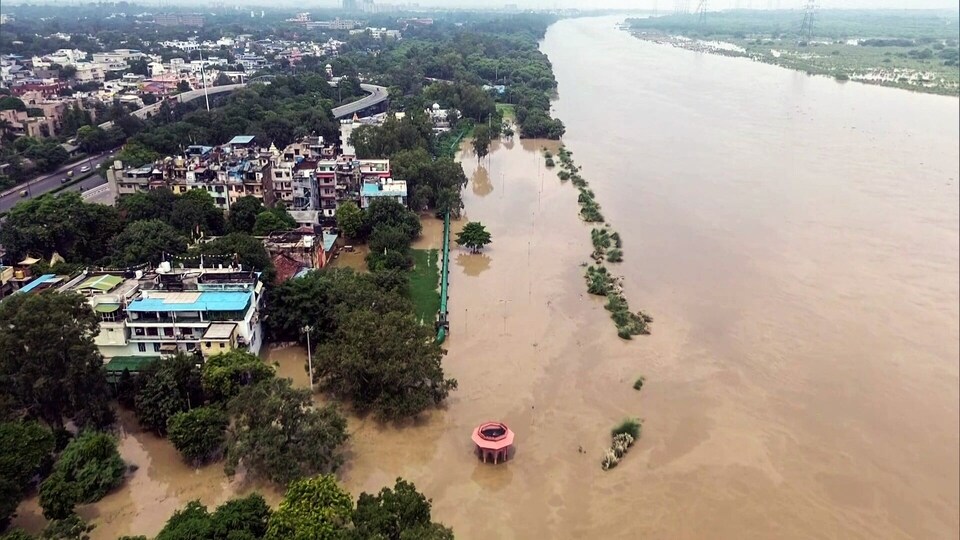
(Feature Image: Vasudev ghat and Tibetan colony submerged under Yamuna flood water in Sept. 2025. Source: HT)
30 Oct. 2026
To:
- Shri C. R. Patil Hon’ble Union Minister of Jal Shakti, minister-jalshakti@gov.in
- Shri Bhupender Yadav, Hon’ble Union Environment Minister, mefcc@gov.in
- Shri Taranjit Singh Sandhu, Hon’ble LG Delhi, lggc.delhi@nic.in; pstolg.delhi@nic.in
- Smt. Rekha Gupta, Hon’ble CM Delhi, cmdelhi@nic.in; secy-cmdelhi@delhi.gov.in
- Shri Pravesh Verma, Hon’ble Water Minister Delhi, parveshsahebsingh@gmail.com
- Shri Manjinder Sirsa, Hon’ble Environment Minister Delhi, minfs-delhi@delhi.gov.in
Subject: Serious Concerns Regarding the Proposed Sabarmati type Yamuna Riverfront Development (YRFD) Project in Delhi
Several media reports over the past week have quoted Shri Pravesh Verma, Hon’ble Water Minister, Government of Delhi, announcing the initiation of an MoU process with the Sabarmati Riverfront Development Corporation Limited (SRFDCL) for a Sabarmati-style riverfront development project along the Yamuna river in Delhi. The proposed project reportedly covers the entire 52-km stretch of river in two phases from Palla to Wazirabad in Phase I and Wazirabad to Kalindi Kunj in Phase II.
Given the ecological importance of the Yamuna floodplain, the river’s flood history and the existing pressures on its flow and carrying capacity, we wish to express our serious concerns and urge the Government to reconsider its priorities before committing public funds to this project. Key concerns:
1. Lack of transparency and public scrutiny: Despite the scale of the proposed 52-km YRFD, no comprehensive project document including pre-feasibility assessment, Detailed Project Report (DPR), Environment Impact Assessment (EIA) are available in the public domain to assess its potential and adverse impacts on the rejuvenation of Yamuna river, protection of its floodplain and potential impacts on Delhi’s flood security. It is not clear on what basis the government has decided to go for Yamuna River Front Development on the lines of Sabarmati River Front Development.
2. Fundamental Difference between Yamuna and Sabarmati: The Sabarmati is currently a seasonal river that originates in the Aravalli range, while the Yamuna is a glacier-fed Himalayan river that becomes an alluvial river as it flows through the Gangetic plain. Therefore, a riverfront model developed for the Sabarmati cannot be applied to the Yamuna without considering their fundamental hydrological, geomorphological and ecological differences.
Moreover, the Sabarmati riverfront in Ahmedabad relies on regulated water supply from the Narmada canal system. These flows are impounded by Vasna barrage turning the river into a linear stagnant water body in its urban stretch. Most polluting drains have also been diverted away from the riverfront stretch, downstream of Vasna barrage. But the Yamuna in Delhi faces a very different situation. The diversion of polluted water downstream of Vasna barrage done in case of Sabarmati River is neither advisable, nor possible as there are other states downstream of Delhi, through which Yamuna flows. Barring the monsoon months, the Yamuna river struggles for adequate flows and suffers from severe pollution load.
3. Risks to Flood Safety and Carrying Capacity: The exceptional floods in Delhi in 2023 and 2025 have raised serious concerns about the Yamuna’s flood-carrying capacity and the cumulative impacts of floodplain encroachment by bridges, roads, barrages and other infrastructure projects. The causes of these unusual flood events have not been adequately investigated and addressed. It is likely that due to accumulation of silt and debris on the Yamuna riverbed, the riverbed level has gone up, the cross section area has decreased and river carrying capacity has significantly reduced, due to which the river is flooding at lower flows as has happened in recent years. The proposed river front development will worsen this situation.
Notably, the floods also inundated large areas of the Delhi Development Authority’s (DDA) biodiversity parks created along the floodplain. Under such scenario, the further development in form of YRFD project on the floodplain without a comprehensive assessment of its cumulative impacts on river’s flood absorption and carrying capacity has potential to aggravate flood risks and damages in future.
4. Dilution of Floodplain Governance: The proposed project must be reviewed in the context of the growing threats and challenges to floodplain management affairs in Delhi. Firstly, despite repeated judicial directions, scientific mapping and demarcation of the Yamuna floodplain has yet to be completed. Secondly, the division of the O-Zone into O-1 and O-2 under the Master Plan of Delhi 2047 also raises concerns about the dilution of existing floodplain safeguards. Meanwhile, the floodplain continues to face piecemeal encroachment through construction debris dumping and other development projects.
5. Violation of NGT’s Judgment: The National Green Tribunal (NGT), in its landmark Mailey Se Nirmal Yamuna judgment of Jan. 13, 2015 has already rejected a similar YRFD proposal by the DDA while upholding concerns about its impact on the river’s flood-carrying capacity and floodplain protection. The Tribunal also emphasized on the implementation of the Expert Committee’s recommendations to protect and restore the Yamuna floodplain.
What is needed: In view of these concerns, we urge all the concerned government to take the following steps rather than proceeding with the proposed riverfront development:
1. Prioritize River Rejuvenation: Take urgent measures to ensure adequate environmental flows in the Yamuna and control, reduce its increasing pollution load. Notify and implement the NIH’s 2019 recommendation to increase lean-season flows from 10 cumecs to 23 cumecs. The priority must be to rejuvenate the river. Sabarmati type riverfront development project will severely undermine the ecological integrity of Yamuna river and its floodplain and has potential to aggravate flood impacts in Delhi.
2. Investigate the Causes of Recent Floods: Complete the ongoing topographic, bathymetric and cross-sectional surveys of the river. Independently assess the flooding of 2023 and 2025 including the cumulative impact of river infrastructures and biodiversity parks on flood absorption and carrying capacity of the river. Make the findings public and implement corrective measures.
3. Protect Floodplain: The immediate priority must be to complete scientific floodplain mapping and demarcation, preserve existing O-Zone safeguards and prevent further encroachment on the Yamuna floodplain.
4. Compliance to NGT directions: Review the various proposed works on Yamuna, including the proposed YRFD project against the directions of NGT’s Jan. 2015 Mailey Se Nirmal Yamuna judgment.
5. Ensure Transparent Decision-Making Process: Disclose the pre-feasibility assessment, DPR, cost estimates and relevant environmental studies and public consultation process for YRFD and all of the proposed projects related to Yamuna. No project should be taken up without fulfilling all applicable legal and basic requirements and enabling meaningful public consultation process.
We wish to underline that replication of a Sabarmati like riverfront development plan cannot resolve the crisis of Yamuna pollution, floodplain mismanagement and flood threats, it will only worsen the situation. The Government first needs a scientifically sound plan to restore the river’s environmental flows, reduce pollution load, protect its floodplain and understand the causes of its changing flood behavior. There is urgent need to create a transparent, accountable governance around functioning of each STP and around each project related to Yamuna.
We urge the concerned Central Government Ministries and Government of Delhi to ensure that no project compromises the integrity of Yamuna river, its floodplain and long term flood security of the national capital. Public resources should be directed towards addressing the causes of the river’s degradation and flood risks, rather than undertaking large-scale riverfront development plan.
Yours Sincerely:
- Shashi Shekhar, Former Secretary, MoWR, RD, GR shekhar.shashi1956@gmail.com
- Dr Ravi Chopra, Scientist rachop@gmail.com
- Soumya Dutta, Climate Scientist, soumyadutta.delhi@gmail.com
- Bhavreen Kandhari, Warrior Moms bhavreenkandhari@gmail.com
- Kavita Upadhyay, Environmental Researcher, kavita.dineshagnee@gmail.com
- Avli Verma, Researcher, Manthan Adhyayan Kendra avliverma219@gmail.com
- Dr. Shiv Singh Rawat, Water Resources Expert, ssrawat110@gmail.com
- Diwan Singh, Convener, Natural Heritage First, diwans2007@gmail.com
- Verhaen Khanna, New Delhi Nature Society, newdelhinaturesociety@gmail.com
- Paras Tyagi, Centre for Youth Culture Law & Environment, reachcycle@gmail.com
- Ashok Upadhya, Friends of Yamuna Foundation, ashokupadhyay4046@gmail.com
- Sharda Bakshi, Yamuna Jiye Abhiyan (YJA), shraddha.bakshi04@icloud.com
- Sudha Mohan, Yamuna Jiye Abhiyan (YJA), sudhababa@gmail.com
- Meera Sanghamitra, meeraengages@gmail.com
- Dr Supriya Mahajan Sardana, sups.kab@gmail.com
- Radhika Gulati, Citizen radhikatulsian@yahoo.com
- Abhishek Singh abhishek.singh676@gmail.com
- Bhim Singh Rawat, SANDRP, bhim.sandrp@gmail.com
Copy To:
- Smt. Archana Varma, Secretary, MoJS, secy-mowr@nic.in
- Shri Narendra Bhooshan, Secretary, MoEF&CC, secy-moef@gov.in
- Shri Rajeev Kumar Mital, Director General, NMCG, dg@nmcg.nic.in
- Shri Ravi Bhusan Kumar, Member Secretary, UYRB, msuyrb-mowr@nic.in
- Shri H. S. Sengar, Chief Engineer, CWC, ceybo-cwc@nic.in
- Shri Prasoon Gargava, Member Secretary, CPCB, mscb.cpcb@nic.in
- Shri N. Saravana Kumar, Vice- Chairman, DDA vcdda@dda.org.in
- Shri Amit Kumar Jain, Secretary, DJB, secy.djb@gmail.com
- Shri Navin K. Choudhary, Add. Chief Secretary, I&FC, secretaryifcdgnctd@gmail.com
- Shri Vijay Kumar Bidhuri, Secretary Environment & Forest, Delhi Senv@nic.in
- Sh. Sandeep Mishra, Member Secretary, DPCC, msdpcc@nic.in
- Prof. A. K. Gosain, Member Yamuna Principal Committee, akgosain@gmail.com
- Prof. C. R. Babu, Member Yamuna Principal Committee, crbabu26@gmail.com
- Public Grievance, NGT, publicgrievance-ngt@gov.in, rg.ngt@nic.in
References:
1. Yamuna set for Sabarmati riverfront-style makeover in Delhi along 52-km stretch
3. Mailey Se Nirmal Yamuna Judgement
4. Sept 2025: Why did Yamuna Repeat July 2023 Like Flood Spell in Delhi?
5. Yamuna Photo Blog Sept 2025: ‘Riverfront’ Projects submerged Again
6. Yamuna Floodplain: Will DDA Review Riverfront Projects or Continue Ad-hoc Experiments?
7. Letter: Encroachment of Yamuna floodplain near Wazirabad Barrage


