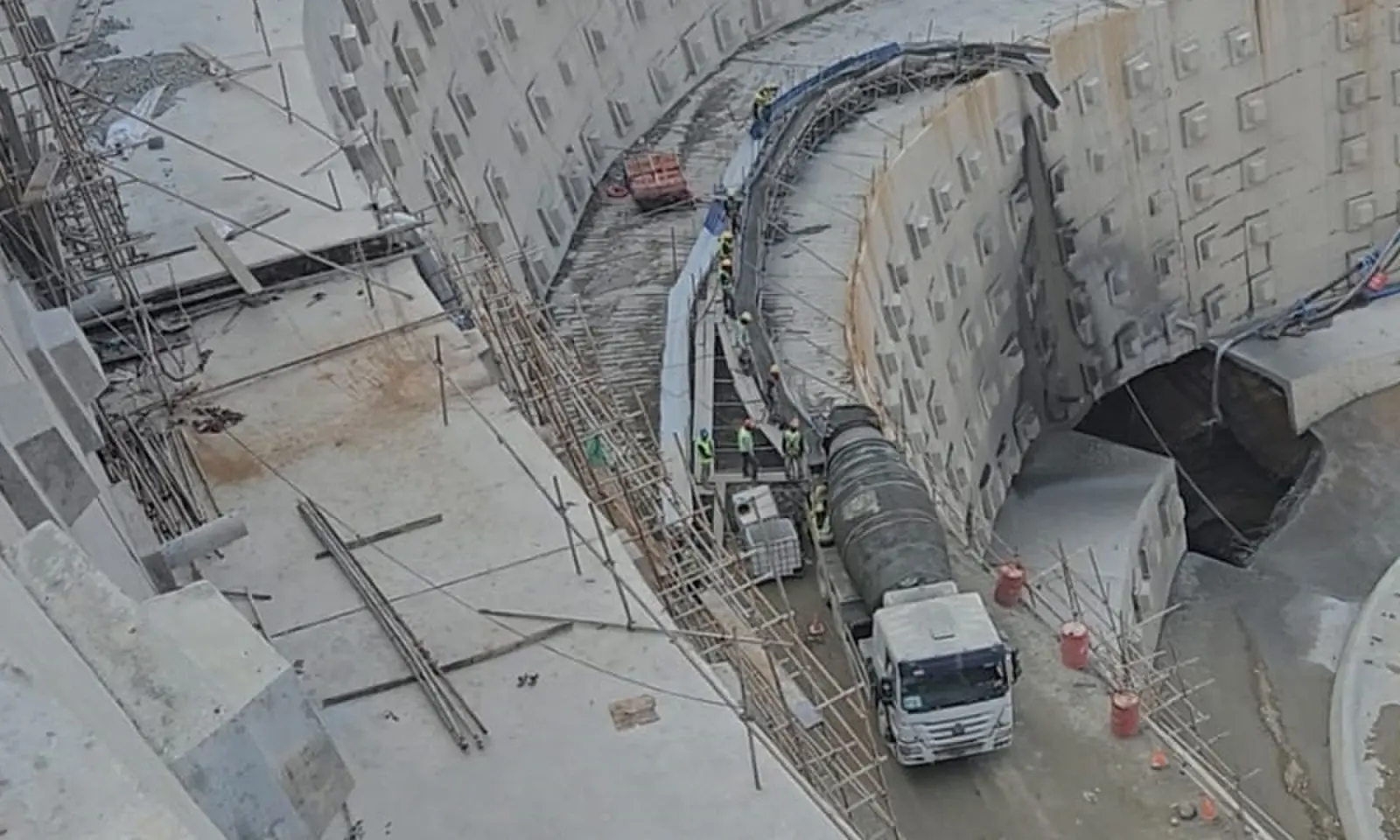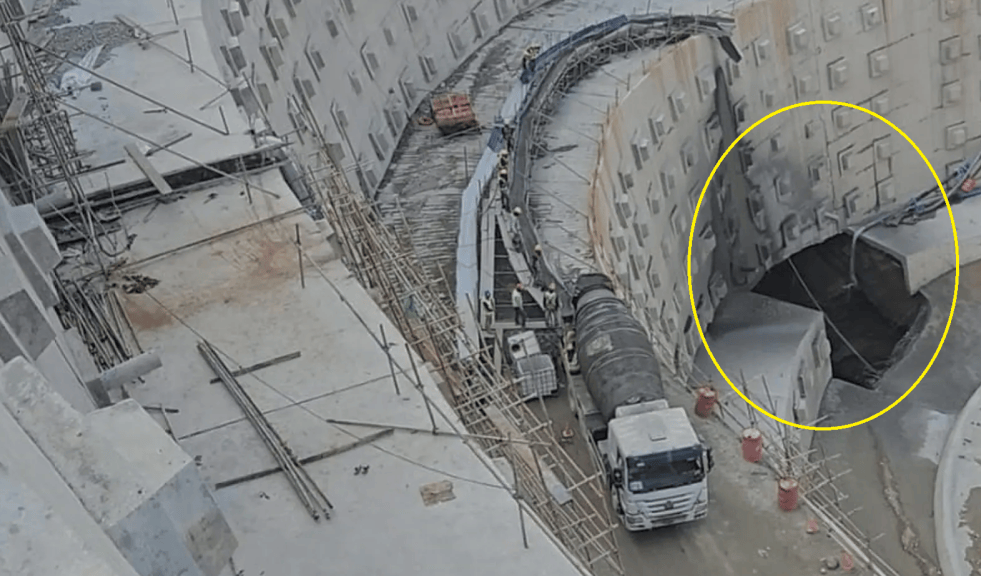
(Feature Image: Cavity formed in Tarbela T 5 Extention project. Source: The Dawn)
After Aug. 2025 coffer dam collapse, a fresh incident at Pakistan’s Tarbela Dam Fifth Extension Hydropower Project (T-5) has disrupted construction work and flooded parts of the project site. The incident occurred on Nov 9, 2026 afternoon during excavation of the second bench of the connecting tunnel at the T-5 project.
According to the Water and Power Development Authority (WAPDA), Pakistan a weak section of rock collapsed during excavation, allowing water from the intake pit to flow into the connecting tunnel and the under-construction powerhouse. However, reports have also described the incident as a breach of the protective embankment. The exact sequence and cause of the incident require confirmation through the official inquiry.
As per WAPDA all workers were evacuated safely and there was no death due to the incident. Some reports have mentioned about rescue of a worker who was swept away in the gushing water from the tunnel. The incident has reportedly led to the suspension of construction work for an indefinite period. The extent of damage to the project equipment and components was under assessment.
Downstream Flood Threat: The incident also prompted precautionary measures concerning water releases from Tarbela Dam into the Indus river. The Indus River System Authority (IRSA) decided to lower the reservoir level from around 1,496 feet to 1,490 feet. As per IRSA around 1,000 cusecs of water had gushed out of the intake pit and was subsequently accommodated in Chashma Barrage.
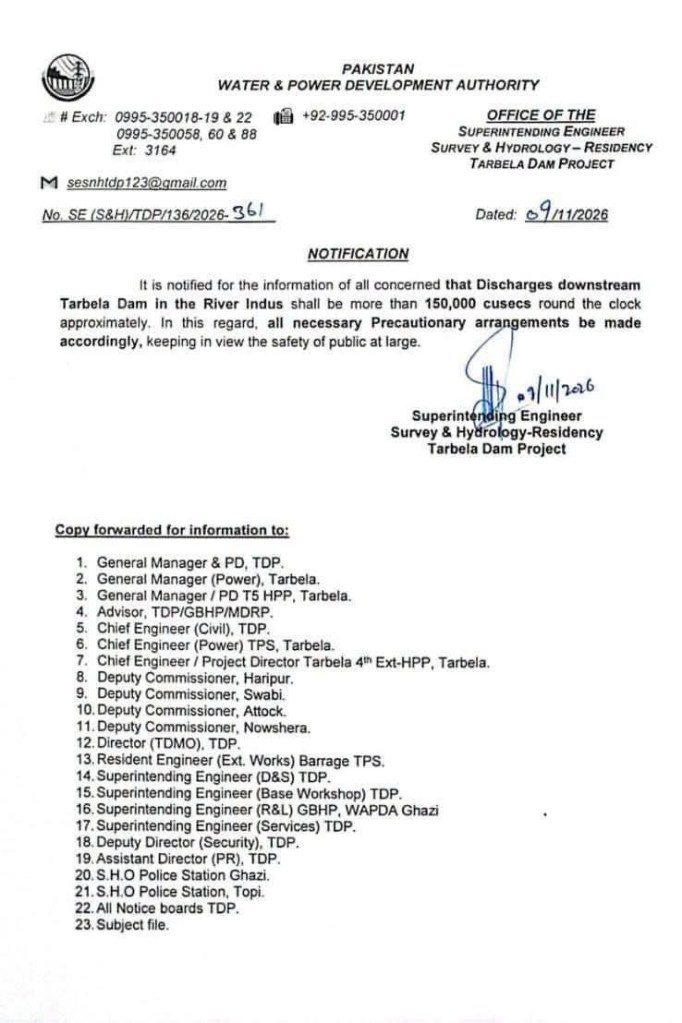
Following this, the WAPDA issued a notification stating that downstream releases were expected to remain above 1,50,000 cusecs and advised the concerned authorities to make necessary safety arrangements. The Khyber Pakhtunkhwa Provincial Disaster Management Authority (PDMA) also issued an alert to the administrations of Haripur, Swabi and Nowshera districts.
Official Response: WAPDA confirmed the incident but rejected reports that the main Tunnel No. 5 had collapsed. It stated that the main tunnel, under-construction powerhouse, tailrace culvert and switchyard had not suffered damage. It also reported that water had been drained from the intake pit and that dewatering of the under-construction powerhouse had begun.
On Nov. 10, WAPDA Chairman visited the site and directed the consultants to prepare a detailed report on the incident. He also ordered a departmental inquiry and asked the project team to implement immediate remedial measures. The chairman directed the consultants, contractor and WAPDA team to prepare short, medium and long-term preventive measures. They were also asked to finalise a contingency plan to minimise delays. The Ministry of Water Resources sought an initial assessment from WAPDA.
Tarbela Extension Project: Tarbela Dam is one of the world’s largest earth-filled dams. It is built on the Indus river in Haripur district, Pakistan. The T-5 project is an extension of the existing dam and will convert the existing T 5, previously used for irrigation releases, into a power tunnel.
The project will use the existing dam infrastructure to generate additional electricity without constructing a new dam. It will add 1,530 MW of generating capacity through three units of 510 MW each. This will increase Tarbela’s installed hydropower capacity from 4,888 MW to 6,418 MW.
The project was originally scheduled for completion in 2026. The first generating unit was, in updated schedule, expected to be commissioned in 2027. However, the Aug. 2025 cofferdam collapse caused major delays and extending completion target to the end of June 2028. The Nov. 2026 incident may cause further delays, although a revised completion schedule has not yet been announced.
Financing: The T-5 project has received substantial international financing. According to this report, the World Bank (WB) provided a loan of US $390 million, while the Asian Infrastructure Investment Bank (AIIB) provided US $300 million. In June 2026, the WB also approved US $300 million in additional financing, reportedly to address cost overruns and support the completion of the project including additional civil works and rehabilitation of the T-5 gates.
Contractors: The major contractors and agencies involved in the project include POWERCHINA (Power Construction Corporation of China Limited), which was awarded a US $354.6 million civil works contract in May 2021, Harbin Electric International Company Limited (HEI) and Harbin Electric Machinery Company Limited (HEC).
The consultancy work is being undertaken by a joint venture involving Pakistan’s MM Pakistan and China’s BIDR. The WAPDA is the implementing authority. The involvement of multiple international contractors, consultants and financing institutions makes accountability for construction quality, project delays and cost escalation particularly important.
Aug. 2025 Cofferdam Collapse: The latest incident is not the first major construction failure at the T-5 project. In Aug. 2025, a cofferdam at the project site collapsed and flooded parts of the construction area. A subsequent official inquiry found that the cofferdam failure was caused by technical shortcomings and contractual violations, not unusual flooding. Inadequate protective layers and filter arrangements also contributed to the collapse. It held the contractor, consultant and WAPDA responsible.
The incident caused significant financial losses and completion delays. As per this report, the project’s original estimated cost of PKR 82.36 billion rose to around PKR 317 billion. The completion deadline also shifted from 2026 to June 2028. The electricity generation over 30 years was estimated as PKR 27–28 per unit. The Planning Commission reportedly warned that this high cost could make the project economically unviable.
Impact & Implications: The Nov. 2026 incident has renewed concerns about geological assessment, construction quality and safety management at the T-5 project site. The exact cause of the incident and extent of damage will be established through a detailed technical investigation. The dewatering, inspection and any necessary repairs could further delay construction and commissioning of the project.
Coming within about 15 months of the Aug. 2025 cofferdam collapse, this second major incident raises serious questions about the adequacy of project design, geological investigations, construction quality, project supervision and risk management. It may also add to the project’s already substantial cost and time overruns.
SANDRP