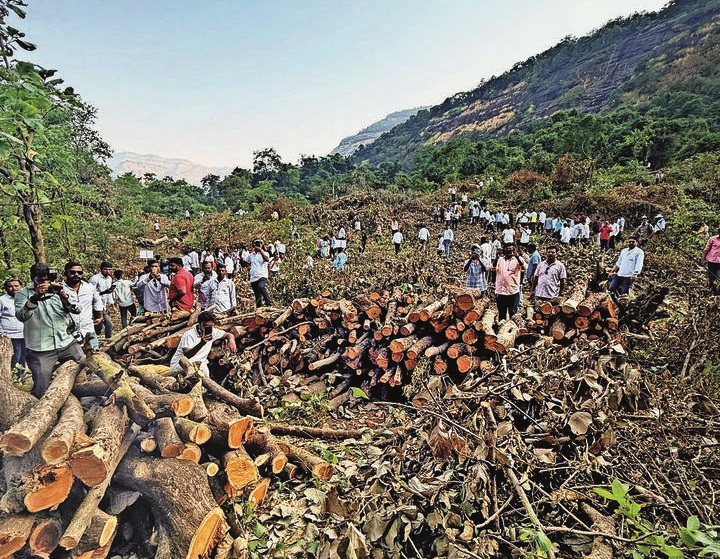
(Feature Image: Felled trees lie piled up at the site of Torrent’s proposed pumped-storage project in Karjat. Source: Mumbai Mirror)
Amid growing opposition to the proposed 3,000 MW Saidongar-I pumped-storage hydropower project in Karjat, Maharashtra, the most important question that needs to be asked is whether we are doing honest assessment of impacts of such projects. It may be remembered that these are not even location specific projects. A pump storage project does not have to come in the middle of western ghats, needing destruction of thousands of trees. Can these be called renewable energy projects or ‘clean’ without adequately assessing their impacts on forests, water sources, wildlife and local communities.
The project requires felling of nearly 32,000 trees in ecologically sensitive Western Ghats. The concern is also about the long term changes to the landscape. It is true that some energy storage is important for supporting renewable energy, however why are we refusing to look at various options and not even doing options assessment?
There is a need to scrutinize how forest clearance, excavation, tunnelling and changes in natural drainage could affect watersheds in mountain areas, particularly in Western Ghat region which is exposed to intense monsoon rainfall and prolonged dry periods. The recurring droughts in Maharashtra, including the one unfolding this year, make it crucial to consider water security together with energy planning. Indeed, the proposed planting of 90,000 trees cannot compensate for the ecological functions of a mature forest system.
Before going ahead, the govt must undertake credible environmental and hydrological assessments and ensure independent scientific scrutiny of the project’s impacts. Being outside a protected-area boundary does not mean that a project has no wider ecological consequences. Can the project be called clean if it damages the forests, watersheds and ecosystems that help communities sustain their livelihoods and cope with climate change?
HYDRO POWER PROJECTS
Hydropower vs Forest: The Cost of 32,000 Trees in Maharashtra’s Sahyadris Dr Pratik Kad a climate scientist examines the proposed felling of nearly 32,000 trees for Torrent Power’s pumped-storage hydropower project in Karjat, Maharashtra. The project, outside Bhimashankar Wildlife Sanctuary, faces opposition over forest loss and ecological risks. The piece explores how energy and water security, environmental assessments, and compensatory afforestation intersect amid Maharashtra’s drought and the Western Ghats’ ecological sensitivity. Will energy and ecosystem needs be balanced, or do clean energy projects risk undermining climate resilience?
India needs renewable energy, but the proposed felling of nearly 32,000 trees for a 3,000 MW pumped-storage hydropower project in Karjat in Maharashtra’s Raigad district raises an important question. Are we adequately accounting for the effects of infrastructure on mountain ecosystems that help us cope with climate change?
I see this controversy as more than a debate over how many trees are being cut down. It is about how changing the land surface can affect the surrounding climate and water cycle. Forests influence how the land absorbs solar energy, exchanges heat and moisture with the atmosphere, and responds to rainfall. Their roots and leaf litter help protect soil, while vegetation affects runoff and the movement of water through the catchment. In mountainous terrain, where steep slopes and complex topography interact with heavy rainfall, these processes are important.
Removing forest cover and disturbing soil can increase erosion and change runoff patterns. Excavation, tunnelling, blasting and changes to natural drainage may add to these pressures, especially during intense monsoon rainfall. The precise effects depend on local geology, soil, vegetation, and the scale of disturbance.
It would be wrong to claim that cutting trees will automatically cause drought or dry up local wells. But that uncertainty makes a proper assessment more important, not less. For the Saidongar area, authorities should make the projects hydrological assessments available and monitor streamflow and erosion where relevant. These observations would help establish whether construction is changing local environmental conditions.
Heavy Rain Does Not Guarantee Water Security: The Western Ghats shape Maharashtra’s rainfall distribution. Moist monsoon winds produce heavy rainfall along the windward slopes, while areas farther inland receive less precipitation because of the rain-shadow effect. Even where rainfall is abundant, water availability varies across seasons and years. Intense rainfall over a short period does not guarantee sufficient water during the dry months. Forests influence this seasonal cycle, but their relationship with groundwater is not straightforward. Vegetation can protect soil, affect infiltration, and influence how water moves through a catchment.
Climate change adds to the challenge. Changes in rainfall intensity and dry spells are affecting both water availability and the risks associated with extreme rainfall. In steep terrain, poorly managed construction can worsen erosion and sediment movement during heavy downpours.
Maharashtra’s Drought: The debate over the Karjat project is taking place as Maharashtra faces a serious drought situation. In September, the state declared 265 talukas drought-affected. By mid-October, reports said the number had increased to 305 talukas, reflecting the scale of the rainfall deficit and agricultural distress across the state. The government also announced relief measures and water-management interventions.
This drought cannot be attributed to forest clearance for a single project. It does, however, underline why water security must be considered alongside energy planning. Rainfall deficits, prolonged dry spells, rising temperatures, land-use changes, and the condition of local watersheds can all influence water availability although their relative contributions vary by region.
In Maharashtra, where farmers are already confronting water stress, infrastructure decisions should be informed by a thorough understanding of how mountain catchments store, move, and release water. The environmental assessment of the Saidongar project should, therefore, examine potential changes to drainage, streamflow and erosion, as well as the implications for local water resources. These questions deserve particular attention in a landscape shaped by intense monsoon rainfall followed by a long dry season.
Energy security and water security cannot be planned in isolation. Maharashtra needs reliable electricity, but it also needs resilient watersheds and landscapes that can help communities cope with increasingly challenging climatic conditions.
The Paradox of Clean Energy: The Maharashtra government and Torrent Power have defended the Karjat project on the grounds of its energy-storage benefits and proposed environmental safeguards. But, being outside a protected-area boundary does not, by itself, settle the question of wider ecological impacts. Those depend on the forests affected, habitat connections, drainage and the project’s construction footprint.
This is where the climate-policy contradiction emerges. Energy storage can help reduce emissions by enabling greater use of renewable electricity. Forests, meanwhile, support biodiversity and can help maintain soil and watershed functions that contribute to climate resilience. Mitigation and adaptation are both necessary. A project that supports the first should not be exempt from scrutiny of its effects on the second.
This does not mean that every project involving forest clearance should be rejected. It means that its benefits must be weighed against its environmental costs, and that less damaging locations or designs should be considered wherever feasible.
Can Planting More Trees Replace a Forest?: Protecting forests and restoring degraded catchments should complement the transition to renewable energy, not be treated as an afterthought. The government has proposed planting 90,000 trees to compensate for the forest clearance. However, an established forest contains mature trees, developed soils, and interconnected habitats that take decades to form. Newly planted trees cannot immediately replace these ecological functions. Meeting a compensatory planting requirement is not the same as preserving a natural forest.
Defending the project, CM Devendra Fadanavis has argued that its long-term clean energy benefits outweigh the environmental damage. However, such assurances raise questions when they are not backed by transparent scientific evidence.
Promises of compensatory planting cannot substitute for a credible assessment of ecological costs, particularly in light of concerns raised over earlier projects, including Tapovan. Public anger is growing when official statements appear to offer reassurance without adequately addressing the scientific questions at stake.
All ministers must make the project’s environmental assessments publicly available. They should explain how the impacts on catchment hydrology, biodiversity, and forest connectivity have been evaluated.
Climate and scientific literacy cannot be optional in decisions of this scale. Regulatory approval is not proof that environmental costs are negligible and political assurances cannot replace independent scientific scrutiny. Responsible leadership means confronting the evidence, acknowledging uncertainty and being accountable for the long-term consequences of decisions made today.
The Western Ghats Need Consistent Protection: The larger issue is whether infrastructure decisions in ecologically important mountain landscapes adequately account for cumulative environmental impacts, rather than assessing each project in isolation. India’s clean energy transition is necessary, but its success should not be measured only by the electricity stored or emissions avoided. It must also be judged by whether development protects the natural systems that help communities adapt to climate change. Clean energy is essential. So is protecting the landscapes that sustain us. Maharashtra must plan for both.
Youths launch ‘jal andolan’ to save Karjat’s trees Ahead of PM Narendra Modi’s likely visit to Karjat on Nov. 03 to lay the foundation stone for a Rs 13,500-crore power project, citizens upped the ante with another protest. A group of youngsters has launched a ‘jal andolan’ in a forest near Saidongar in the Raigad district against the plan to axe over 32,000 trees for the project.
The youths have been partially submersing themselves daily in a waterbody for the past five days and peacefully singing tribal songs seeking the conservation of ‘jal, jungle, jeevan’ (water, forests, biodiversity). A separate ‘Karjat bandh’ on Nov. 02 has been announced. The tree felling plan was halted last week amid massive pushback from citizens and opposition parties.
Local tribals have backed the protest. One of them told reporters that they have been vocal in their objection to the power project from the start as they do not want the centuries-old forest to be damaged, but govt has refused to take no for an answer. A tribal person expressed confidence that in light of the protests, the PM will likely defer his visit.
Environmentalist D Stalin of NGO Vanashakti, who is also supporting the youths, alleged that public hearings for the project were held over 15km from tribal hamlets, making it difficult for many of those affected to register their objection in person. Stalin alleged that documents released by the forest department show that over 48,000 trees will have to make way for the project, but the media has been told only about 32,490 trees.
Villages resisting Karjat PSP The proposed project requires 377 hectares of land, including 233 hectares belonging to the forest department and 144 hectares spread across Dhak, Pali, Potal, Ambot and Bhaliwadi. A total of 32,400 trees are to be felled.
The project, estimated to cost Rs 13,505 crore, is being developed by Gujarat-based Torrent Power. The tree felling has triggered protests by villagers, with political leaders, environmentalists and students visiting the site over the past week. The forest department has temporarily stopped the operation following the protests, but residents say they have not received clarity on whether the halt is official or permanent. More than 1,000 trees have already been cut.
The five villages are located along the ridges of Saidongar Hill, named after a local village deity and part of the Sahyadri range. The hill is around 16 km from Bhimashankar forest, an ecologically sensitive area identified by the Western Ghats Ecology Expert Panel. The forest has patches of dense vegetation and is home to medicinal plants such as gulvel (giloy) and adulsa (Malabar nut). It also provides habitat to wildlife, including the Indian giant squirrel, locally known as the shekru and Maharashtra’s state animal.
For residents, however, the forest is also an important source of income and food. Most families in the five villages belong to the Katkari tribal community. The proposed project is being defended by the state government as a way to meet Maharashtra’s peak electricity demand and reduce dependence on thermal power. CM Devendra Fadnavis has said the project will provide cleaner power during peak demand.
The forest department issued a no-objection certificate for the tree felling on October 14. The permission letter reportedly stated that the operation should be completed by November 3, when PM Narendra Modi is tentatively scheduled to visit Karjat for the project’s bhoomipujan.
For the villagers, the proposed plantation and the government’s argument about cleaner energy have not addressed their immediate concern: the loss of a forest they depend on for their livelihood. With the tree felling temporarily halted, residents say they will continue to visit the site to ensure that the operation does not resume.
Villagers allege inadequate consultation Sambhaji Kumbhar, another resident of the project-affected area, alleged that the company began engaging with villagers last year but did not take the entire community into confidence before advancing the project. “The company came to the village last year. This time, it started laying the groundwork for the project by taking some local influential people into confidence. But all the villagers were not consulted,” Kumbhar alleged. He further claimed that some villagers received Diwali gifts from the company last year, while cash packets were allegedly delivered to the homes of some residents. These allegations could not be independently verified.
Ecological Concerns: The proposed felling of 32,490 trees has emerged as one of the main points of contention. According to reports citing Forest Department documents, permission for the tree felling was granted on October 14. The affected locations include Saidongar and other villages in the Karjat region. The project is expected to require the diversion of around 233 hectares of forest land, in addition to non-forest land. Environmental activists have questioned the potential consequences of the proposed changes to the landscape, including their impact on wildlife, biodiversity, bird nesting sites and natural habitats.
Environmentalists argue that the impact of clearing an established forest cannot be measured solely by counting the trees that would be felled. They say forests support interconnected ecosystems, provide habitats for wildlife, regulate water flows and sustain communities that depend on natural resources. They have also questioned whether planting new trees can adequately compensate for the loss of an established forest ecosystem.
The concerns have added to wider questions about the cumulative environmental impact of multiple pumped-storage projects proposed across Maharashtra. For opponents of the Saidongar-I project, the central issue is whether the long-term benefits of energy storage justify the ecological costs and whether the government has adequately considered alternatives.
Residents of Dhak and Potal villages demanded the government to cancel the pumped-storage hydro power plant project by Torrent Power citing adverse impacts of felling of trees on a large scale on their livelihood and natural resources. Residents, led by Shiv Sena (Uddhav Balasaheb Thackeray) party, protested in front of Karjat Tehsildar office in April 2026 and submitted representations of their opposition to various government departments.
Handle Arunachal Anti Dam Protests with care: Uttam Sinha Disquiet in Arunachal over a hydropower project must be handled with care. Genuine concerns have to be separated from shady outfits. The importance of sensitively handling the ongoing unrest in Arunachal Pradesh against the Menga dam of the 1600 MW Subansiri Upper Hydro Project (SUHP) cannot be over emphasised. The protests have to be taken in all seriousness. India cannot afford to meet its strategic needs with a disillusioned border population. National interest projects must include people’s cooperation. Uttam Sinha is a saner, reasoned voice on these issues in India from the authority side.
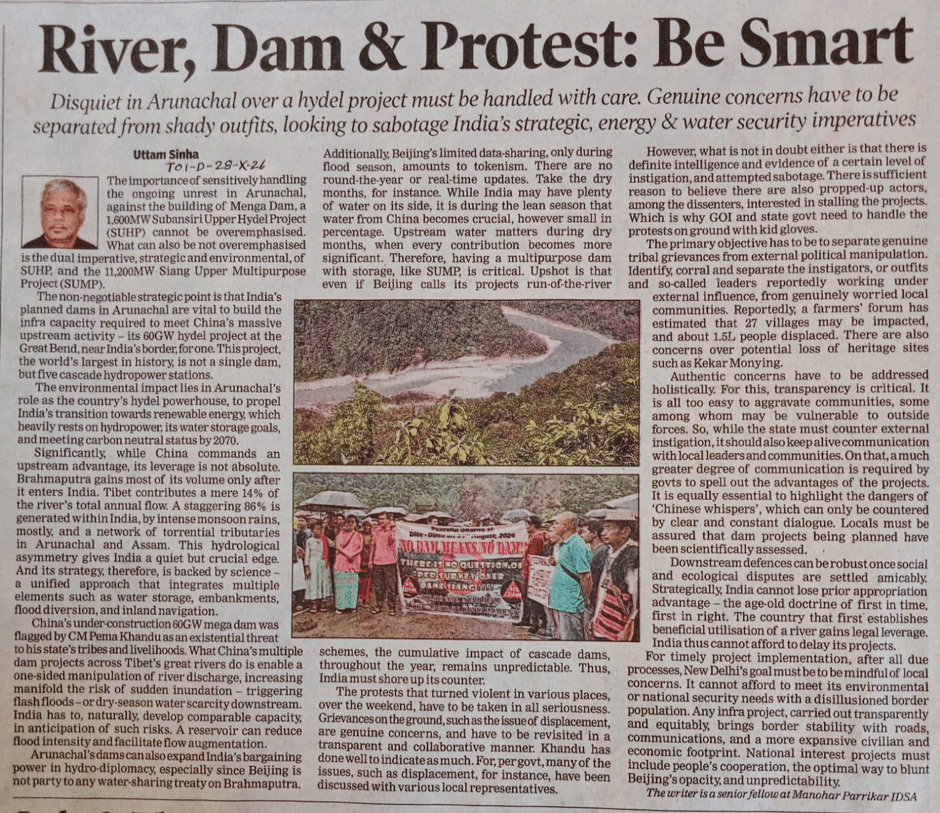
However, the author basically fully supports the projects, without throwing any additional light on the justification of the projects. He claims: “Locals must be assured that dam projects being planned have been scientifically assessed.” But such assurances need to get reflected in some real, credible, scientific studies and information sharing, there is no evidence of that either in the article or beyond it. His claim about prior appropriation right also holds little water in absence of any enforceable international doctrine or institution that can enforce any such right, particularly in view of China’s lack of respect for either. It is not clear what his hint that cascade of five hydropower projects imply five dams is based on.
Siang villagers: We will die rather than give our land “We will not abandon our settlement. We would rather die here than surrender our land. If the Chinese dam is the threat, why should our govt build another mega dam in the Siang belt” John Panyang, a farmer living along Siang river in Geku town said. The main reservoir of the proposed mega dam is reportedly planned near Geku village, about 35 km downstream from district headquarters Yingkiong.
“We do not want compensation in exchange for losing our homeland. Where will we go, and what will we eat?” asked Oken Boli Panggyeng, a homemaker. “No dam survey, no detailed project report. That is our slogan,” she said, adding that villagers were prepared to prioritise the agitation over the upcoming paddy harvest. “Harvesting will begin in the first week of Nov. We may lose our paddy, but we do not want to lose our land. If the protests intensify, we may not go for the harvest at all,” she said.
TOI Edit on Arunachal Hydro: Dams can work only with local support The people in the area are worried, and recent violence in Pasighat (& Upper Subansiri area) shows that the government needs to listen more carefully. India’s security matters, but so do the people who live near the border. They know and care for the land, and their support is important. The government should explain its plans clearly, listen to local people, and study the effects on nature before deciding what to do. The dam may be needed, but it should move ahead only if the plans are safe, fair, and made with local people’s involvement.
AT EDIT No Room for Dissent Labelling protesters, especially those from the Siang belt, as Chinese agents and anti-national without understanding the tribe’s dynamism, is unfortunate. The Adis are patriotic people, and history bears witness to the valiant battles they fought for their land and country against the British regime. Instead of resorting to a confrontational approach, which has evidently been counterproductive so far, the best way forward would be to keep the SUMP on the back burner and start stakeholder consultations in right earnest, involving the younger generation.
To make that happen, confidence-building measures are needed, such as the release of all detainees and the withdrawal of cases. The government should meet with the SIFF, CBOs, and clan-based organisations. It needs to have a dialogue with a wider spectrum of society, not just restrict itself to those it feels are pro-dam. The more the government resorts to oppression, the more disastrous the consequences will be, because you cannot oppress people in their own land. If people say no to dam, the government should listen to them.
SUMP: NHPC appoints PR agency, paying crores NHPC acknowledged that opposition to the project showed no signs of abating despite what they described as “pro-people CSR activities” and the appointment of a public relations agency to build local support. NHPC awarded Mumbai-based Concept Public Relations a one-year, Rs 8.73-crore contract in July 2025, with services beginning the following month. The engagement was subsequently extended by three months, until November 6, 2026, at unchanged rates, taking its value to approximately Rs 10.91 crore.
NHPC identifies “growing negative discourse” around the dam project and acknowledges concerns over submergence, displacement, environmental damage and land loss. Bosiram Siram, president of the Arunachal Pradesh Congress Committee (APCC), said: “Unless the local people, indigenous farmers and villagers are convinced, it is not possible to implement the project because the landowners are reluctant. The government did not consult with the landowners and a large population can be displaced as a result of the project”.
Arunachal women leading protests in Siang Valley Tensions escalated on 23 October, when protesters from Geku and nearby Komkar gathered at Dite-Dime during a 12-hour bandh against the project. At least four women were injured after clashes broke out between police and protesters, when security forces fired tear-gas shells to disperse the crowd, according to media reports. Women were at the forefront of the demonstration, removing their clothes at a police barricade in a dramatic expression of opposition to the project and the security deployment.
The Press Club of India (PCI) on Oct. 30 expressed shock over the Police including the name of senior journalist Tongam Rina in their requests for search warrants in connection with the October 23 violence in Pasighat.
Scores of anti-SUMP citizens in Delhi detained Several citizens, including Katon Moyong, also known as Abor Man, were detained by the Delhi Police on Oct. 31 during a solidarity protest against the proposed SUMP in Arunachal Pradesh, organised by the Youth for Change (YFC) Arunachal and Himkhand at around 3 pm at Arunachal Bhavan in New Delhi. The protest was organised to express solidarity with indigenous communities opposing the proposed project in the Siang region, demanding immediate withdrawal of the SUMP, withdrawal of forces from Arunachal, release of arrested and detained activists, and withdrawal of charges against activists and leaders.
AITF offers peace initiative Taking note of the recent developments concerning the SUMP, the Arunachal Indigenous Tribes Forum (AITF) – a conglomeration of apex federating community-based organisations – has offered a peace initiative to facilitate dialogue among all stakeholders and work towards “restoring trust, peace and normalcy.” In a press release, the AITF stated that it has constituted a seven-member peace committee “to engage with all concerned stakeholders, listen to their grievances and facilitate a constructive and lawful dialogue towards restoring trust, peace and normalcy.”
Former CM Gegong Apang on Nov. 01 served a final ultimatum to the government to permanently stop the PFR survey and cancel the SUMP forever. Apang, a staunch opponent of the proposed dam project, made the demand on behalf of the people of Arunachal Pradesh in general and the people of Upper Siang, Siang, West Siang, East Siang, Lower Siang, Dibang Valley, and Lohit districts and the Adi people in particular. He also demanded a high-level judicial inquiry headed by a retired Supreme Court judge into corruption allegations levelled by anti-dam activist Katon Moyong against the CM and his party’s MLAs and MPs for allowing hydropower projects across the state.
J&K HC strikes down water tax on Hydropower generation In a setback to J&K govt, the high court (HC) of Jammu & Kashmir and Ladakh on Oct 29 2026 struck down the 2010 Water Resources Act, ruling that water usage charges levied on hydropower projects amounted to a tax on electricity generation, a subject beyond the erstwhile state legislature’s powers. A division bench of Justices Sanjay Dhar and Rajnesh Oswal quashed demand notices issued to 13 independent power producers and restrained J&K govt from imposing any tax on electricity generation under the guise of water usage charges or any other levy.
The producers had challenged the law, arguing that charges fixed by Water Resources Regulatory Authority on April 2, 2019, were linked to the height from which water drove turbines rather than the volume consumed, effectively taxing power generation. Govt defended the levy, citing its authority to regulate water storage and use, National Water Policy and the need to conserve J&K’s water resources.
DAMS
Kishau Dam: Can the Dehradun Valley afford the risk? In times when technology has progressed to an extent that alternatives such as solar and wind energy can produce power without permanently changing river ecosystems or displacing large communities, clearing the way for another mega dam raises suspicion, especially since we all know who the contractual beneficiaries of such a project shall be. (Lokesh Ohri)
INTERLINKING OF RIVERS
NHPC wants the Chenab-Beas link project to be completed in 3 years According to this Jagran report, NHPC wants the Rs 2301 Cr Chandra (a tributary of Chenab River in Himachal Pradesh) Beas link project to be completed in 36 months. The prospective contractors wanted the time limited increased to 48 months, but NHPC has declined the request. The dam of the project will be near Koksar in Lahaul Spiti district and power house at Madhi near Manali. In the pre-bid meeting, the national and international contractors said the area is remote, the winter is very cold and the 7.2 m dia Double Shield Hard Rock Boring Machine’s transport, assembly and dis-assembly will take time. NHPC wants the TBM to reach the site next month. The 8.7 km long head race tunnel of the project is the most difficult part. The likely progress for this is 300 m per month, NHPC wants the underground tunnel work to continue in winter.
URBAN RIVERS
HEXAVALENT CHROMIUM PRESENT IN GODAVARI, EXTENT STILL UNKNOWN: Institutional Apathy & Opacity Ahead of Kumbh Mela Water testing from accredited laboratory shows that Hexavalent Chromium, a known category 1 carcinogen is also present in surface water of Nandini tributary flowing into Godavari River. This is in addition to it being present in groundwater in Nasik’s Duttnagar area.
The concerned Maharashtra authorities have still not done assessment of source of contamination, extent of pollution of shallow and deep aquifers, surface waters, soil, crops, air, animals and people. MPCB has claimed to have closed down 17 units, but it has not disclosed what was the basis of this action. All concerned authorities, including MPCB, MIDC, Nasik Municipal Corporation and Nasik administration need to move fast to address these issues urgently and transparently, as this letter to the concerned authorities shows. Plz Share widely.
Nashik Admin refuses extra water release for Kumbh Mela The Nashik district administration has ruled out releasing water from the Gangapur Dam complex for the Dhwajarohan ceremony of the Simhastha Kumbh Mela, scheduled for Oct 31 in Nashik when President Droupadi Murmu is expected to perform the ceremony. District guardian minister Girish Mahajan, who chaired the district-level water reservation committee meeting, said water would be released only for the thermal power station. He clarified that the govt does not permit the release of water for religious purposes.
The committee decided to reserve 6.9 TMC, of water for the Nashik Municipal Corporation (NMC), against its demand of 8 TMC. Mahajan said water rotation from the dams would continue as planned by the committee. “There is one release of water from Gangapur Dam for industrial use — the thermal power plant that requires water. It will be done,” Mahajan said. On water reserved for Simhastha Kumbh Mela, the minister said 635 mcft of water for drinking purposes for Sadhugram has been included in the reservation.
RIVERS
The State Sees Pipes Rivers Have Other Ideas Parineeta Dandekar of the South Asia Network on Dams, Rivers and People (SANDRP) joins us to talk about what makes a river a river, and what happens when we treat it as plumbing. From Himalayan dams and river-linking schemes to the Godavari’s pollution crisis, we explore what our plans for rivers leave out: fish, floodplains, livelihoods, culture, tradition, songs and stories. Through it all runs Parineeta’s infectious passion for rivers, not just as ecosystems to protect, but as living relationships we are in danger of losing.
Doodh Ganga under pressure Climate change is accelerating glacier loss in Kashmir’s Pir Panjal. The resulting water scarcity is adding to mental health burden on women.
‘Damodar, Adi Ganga Among 17 Polluted Rivers’ The Adi Ganga flowing through Kolkata today offers perhaps the starkest snapshot of Bengal’s river crisis. It is among 17 rivers in the state that have critically-polluted stretches, according to the latest Central Pollution Control Board assessment. These rivers are Hooghly, Churni, Damodar, Jalangi, Mathabhanga, Barakar, Dwarakeshwar, Dwarka, Rupnarayan, Teesta, Bidyadhari, Kansi, Silabati, Kalijani, Mayurakshi and Karola. At Jirat Bridge, a West Bengal Pollution Control Board sample collected in Nov last year had found the water blackish and foul-smelling, with biochemical oxygen demand at 18.5 mg/l, dissolved oxygen at just 2 mg/l and faecal coliform at a staggering 84 lakh MPN per 100 ml.
Toxic legacy of chromium in UP Even decades after industrial dumping of chromium was detected and stopped, the toxic element continues to poison water, soil and lives across three Ganga-adjacent districts.
NMCG panel to investigate Budhi Ganga river The NMCG has formed a technical group to investigate the origin, historical course and current flow of Uttar Pradesh’s Budhi Ganga river. The investigation will examine historical maps, satellite images and land records to verify the river’s route, which a petitioner claims stretches approximately 93km. The case, before the NGT since 2023, involves allegations of floodplain encroachment and disputes over the river’s origin and classification. Authorities have also been directed to report on floodplain demarcation, with 1,157 boundary pillars planned along the river.
Prioritize Yamuna Rejuvenation, Floodplain Protection rather than pushing Sabarmati type Riverfront Development Project Concerned citizens, experts and river activists have urged the Central and Delhi governments to focus on reviving the Yamuna and protecting its floodplain rather than pursuing the proposed 52-km Sabarmati-style riverfront project. In a letter dated 30 October 2026, they have cautioned that the YRFD project could harm the Yamuna floodplain ecology, reduce river’s flood-carrying capacity and increase flood risks in Delhi. They have also questioned the lack of publicly available project studies and recalled the NGT’s 2015 judgment against a similar proposal. The signatories have called for reducing pollution, ensuring adequate environmental flows, completing scientific floodplain mapping and preventing further encroachment.
Experts object to Sabarmati-style Yamuna project Eighteen water experts, environmentalists, researchers and civil society representatives have raised concerns over the Delhi government’s proposed Sabarmati-style Yamuna Riverfront Development (YRFD) project, warning that it could threaten the river’s ecological integrity, compromise flood safety and weaken floodplain protection in the city.
In a representation addressed to Union Jal Shakti Minister CR Patil, Union environment minister Bhupender Yadav, Delhi L-G Taranjit Singh Sandhu, CM Rekha Gupta and ministers Pravesh Verma & Manjinder Sirsa, the signatories have urged the government to reconsider the project before committing public funds. The signatories argued that replicating the Ahmedabad riverfront model in Delhi would be scientifically inappropriate, given the fundamental differences between the largely seasonal Sabarmati and the glacier-fed Yamuna river. Flood safety is another concern. They urged the authorities to ensure that no project compromises the integrity of the river, its floodplain and the national capital’s long-term flood security.
Delhi’s Rs 99cr plan to box in Yamuna raises red flags Approved as part of a Rs 622-crore flood-control plan, the 47 km long concrete wall, estimated to cost Rs 99 crore, is likely to run from Magazine Road drain to Old Railway Bridge. The six-to-seven-foot-high structure is intended to protect vulnerable low-lying areas from inundation. But experts argue the project risks treating the symptoms rather than addressing why Yamuna has been reaching high levels even at comparatively lower upstream discharges.
In Sept 2025, the river reached nearly 207.5 metres at Delhi’s railway bridge, while discharge at Hathnikund Barrage was reported at around 3.2 lakh cusecs. During the July 2023 floods, it rose to a record 208.66 m at a reported discharge of around 3.5 lakh cusecs. Experts say these patterns warrant investigation into changes in the river’s carrying capacity, floodplain encroachment, riverbed conditions and the cumulative impact of infrastructure.
Similar concerns have been raised over Delhi’s proposed 22-km Yamuna riverfront project, where experts stress the need to prioritise river restoration and floodplain protection over interventions that could further constrain the river. “Construction of the wall should be reconsidered until the ongoing topographic and bathymetric surveys are completed. The changing relationship between upstream discharge and water levels in Delhi warrants an independent investigation into the river’s carrying capacity and the cumulative impact of existing infrastructure,” said Bhim Singh Rawat, associate coordinator of SANDRP.
Hindon pollution: UP asks NGT for 2 weeks to reply to complaints In an adjournment application dated Oct 31, the state’s standing counsel informed the tribunal that the chief secretary had directed the state to file an updated affidavit in compliance with its August 17 order, but information from the concerned departments and authorities was still awaited. “Some important information is awaited from the concerned departments and authorities,” the application stated, seeking two weeks to file a fresh affidavit. It mentions November 2, 2026, as the next date of hearing. The application, however, does not mean the tribunal has granted the adjournment; its acceptance would be subject to the tribunal’s satisfaction.
Separately, UPPCB informed the tribunal that a joint committee of the Central Pollution Control Board (CPCB) and UPPCB inspected 20 STPs across the Hindon basin. Eight were categorised as non-compliant with standards prescribed under the environment ministry’s October 13, 2017 notification.
SAND MINING
SC warns of CBI probe into Raj river pollution Supreme Court Oct. 26 warned Rajasthan govt that it may order a CBI probe into alleged illegal mining and dubious regularisation of leases along the Jojari-Luni-Bandi river system, questioning the role of state officials in allowing environmental violations to continue. A division bench of Justices Vikram Nath and Sandeep Mehta, while hearing suo motu proceedings concerning pollution in the river system, expressed concern over cases of leases being regularised even after alleged illegal mining was detected. The court cautioned that several officials could face serious consequences if the state failed to take corrective measures.
The SC bench also questioned the state’s claim that cases had been registered against illegal mining operators, asking how river flows could be protected when mining leases were continuously being granted in areas where violations had already been detected. The court asked state govt to submit a concrete financial proposal for establishing common effluent treatment plants equipped with zero-liquid-discharge technology. The state has been asked to place its restoration proposal for the river system on record by the next hearing on Nov 27.
NGT panel flags possible official nexus Raising concerns about possible connivance between local officials and illegal sand mining operators, an NGT-appointed committee has found that a taskforce set up by the Madhya Pradesh government to clamp down on the menace has not been effectively functioning on the ground level.
The committee raised concerns about possible connivance between local officials and illegal mining operators, saying authorities appeared to have acted against smaller sand stockpiles while failing to take similarly effective action against larger ones. In addition, the committee found patches of alleged illegal excavation within a restricted zone near a bridge in Datia district, observed sand-transporting vehicles operating without visible or registered number plates, and reported that no check-posts had been established at the locations it inspected in Bhind and Datia.
WETLANDS, LAKES, WATER BODIES
Manasbal wetland pollution The reports submitted by the Central Pollution Control Board (CPCB) and the Jammu and Kashmir Pollution Control Committee (J&KPCC) on the water quality of Manasbal wetland and sources of pollution do not reflect the actual conditions, according to a response filed by applicant Raja Muzaffar Bhat on October 17, 2026. Both reports, submitted to the NGT, acknowledged that untreated domestic wastewater from households along the wetland’s periphery was being discharged directly into it. They also recorded the dumping of mixed municipal solid waste along its banks, with the CPCB noting that some of the waste was partially submerged.
WATER OPTIONS
Delhi renovates 1,200 RWH systems The Delhi Jal Board has renovated nearly 1,200 rainwater harvesting systems across the national capital to improve groundwater recharge, officials told news agency Press Trust of India. The water management agency has also decided to maintain the systems and inspect them regularly to ensure they remain functional. The Delhi government is also planning a Rainwater Harvesting Policy 2026 to increase groundwater recharge and control urban flooding.
Of the renovated systems, 500 belong to other departments, including schools run by the Municipal Corporation of Delhi. The DJB offers two incentives to encourage property owners to install such systems. It provides financial assistance of Rs 25,000 for plots measuring between 100 and 500 square metres and up to Rs 50,000 for plots larger than 500 square metres. Property owners can also receive a 10 per cent rebate on their monthly water bills.
HMWSSB to supply treated sewage water The HMWSSB will launch its Green Water tanker service on November 1, supplying treated sewage water for construction, industrial and gardening needs. The first phase will have 21 tankers, while around 100 private tankers have registered for the initiative. In the first phase, the HMWSSB has arranged 21 tankers to source treated water from sewage treatment plants (STPs) across the city. The service will later be expanded to all divisions. Each tanker will be painted green, carry prescribed branding and prominently display the warning: ‘STP Treated Water – Not for Drinking.’
Spring Cleansing Collective An entire village joins in the annual festival of Rohanposh to restore and maintain its cluster of natural springs which feed not only their village but dozens of its neighbours in the Qazigund belt of Jammu and Kashmir.
GROUNDWATER
Union Minister launches Groundwater recharge mobile app The Union Minister of Jal Shakti has launched the Punah Bharan Mobile Application to support scientific groundwater recharge planning. The mobile application enables users to identify potential artificial recharge zones within a radial distance of up to 3 km and explore suitable recharge structures based on local conditions.
The web portal provides access to village-level Artificial Recharge Structure (ARS) zonation maps, GIS tools and thematic layers, supporting informed planning for sustainable groundwater management. The platform utilises geospatial datasets, including rainfall, groundwater levels, groundwater yield, slope and drainage, to help identify potential recharge areas and plan appropriate interventions.
URBAN WATER
Madras HC restrains CMDA, GCC from issuing completion certificates in aquifer recharge zones The petitioner had sought the court to issue directions to ensure that the developments (constructions) in aquifer recharge zones at Kottivakkam, Palavakkam, Neelankarai, Okkiam Thuraipakkam, Injambakkam, Karapakkam, Sholinganallur and Uttandi adhered to the Tamil Nadu Combined Development and Building Rules, 2019. He had also prayed for action to remove such constructions that did not follow these rules.
The petitioner alleged that the authorities were not monitoring the constructions made in aquifer recharge zones and rampant violations of the rules were affecting the water bodies as well as ground water table. He alleged that constructions had been made in violation of the rules even after the petition was filed in 2019. The bench ordered the GCC commissioner to appoint a monitoring committee to oversee the process of enumeration of violations and ensure the exercise is completed preferably within six months. The respondents are directed to ensure that all further constructions and building planning permissions are strictly made in accordance with Appendix ‘A’ of the 2019 Rules and other applicable laws.
Alleged illegal commercial groundwater extraction in Jaipur The NGT directed a three-member joint committee on October 26to investigate allegations of unauthorised commercial groundwater extraction and distribution in Vasundhara Vihar, Sirsi, Jaipur. The complaint alleged that a local water supply operation functioning under the name “Balaji Water Suppliers” was involved in large-scale groundwater extraction and unauthorised commercial distribution.
According to the applicant, those involved had constructed an underground reservoir measuring approximately 25ft by 25ft by 25ft and were extracting thousands of litres of groundwater daily using high-powered industrial pumps connected to a public electricity pole. The applicant alleged that the operation used an unauthorised commercial electricity connection and was depleting the local water table, drying up domestic wells in the neighbourhood and threatening a nearby micro-forest of Melia dubia (Malabar neem).
HFL BREACH
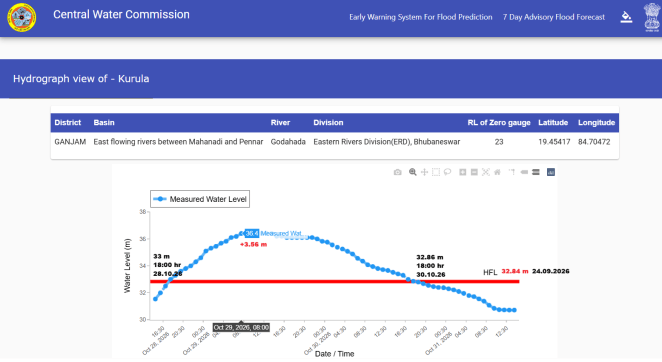
Highest Flood Level Breach in October 2026 The HFLs of both the Sarayan and Shilabati rivers in the Ganga basin is crossed by narrow margins. In contrast, the Mandrathanaya and Godahada rivers in the EFR basin between the Mahanadi & Pennar breached their respective HFLs by more than 3 metres, mainly due to the impact of Cyclone Arnab. Notably, the Godahada River at the Kurula monitoring site had attained a new HFL in Sept. 2026, which is breached again just a month later in Oct. 2026.
ENERGY OPTIONS
100% charge waiver for battery energy storage systems under new TN policy After detailed discussions, the state cabinet approved the Battery Energy Storage System (BESS) Policy 2026 on Oct. 29. The policy targeting 1 MW and above projects aims to speed up the installation of BESS across power generation and transmission networks, improve the utilisation of renewable energy and reduce the wastage of power (curtailment) generated from renewable sources. The policy, accessed by TNIE, covers two categories of battery storage systems – standalone BESS and co-located BESS.
SOUTH ASIA
Oct 2026: Shintaphu Lake GLOF and Artificial Lake in Bhutan This report provides key information about the Bhutan’s Oct 29 2026 GLOF event. It is good to see that Bhutan had kept this GLOF under watch and took prompt advance action to evacuate the people from harm’s way and also alerted downstream India. What is less known is that the GLOF and debris has blocked a stream, creating a large lake behind the dammed debris. This could potentially create a downstream flood event, though it is hoped that the lake level can be lowered without creating a disaster.
Study: China’s Medog Dam to face increased flood risk Chinese researchers have found that the Yarlung Tsangpo River – soon to host the Medog Dam – may face increased run-off and flood risks over this century. Using tree-ring width chronologies in the south-eastern Tibetan Plateau, the team reconstructed the river’s run-off history from 1325 to 2020.
“These results provide a long-term perspective on hydroclimatic variability in the Yarlung Tsangpo River and a scientific basis for assessing future water-resource risks,” the team said in a paper published in the Chinese-language journal China Science Bulletin on Oct 8 2026. The researchers from the Chinese Academy of Sciences and Yunnan University said future run-off should be considered in planning “water resource development and storage infrastructure” and in assessing transboundary water risks in the region.
The run-off that occurred within the period for which there have been instrumental records at the Nuxia station remains within the range of historical natural variability. The team then incorporated climate data to create a model of monthly run-off at the station from 2030 to 2100. Under the middle-of-the-road and high-emissions climate scenarios used by the Intergovernmental Panel on Climate Change, run-off was estimated to increase by about 20 per cent and 29 per cent respectively compared to the reconstructed historical period.
In June, Chinese geologists said they had found that an active fault line directly beneath the planned project could pose a threat to its integrity and urged engineers to implement measures to mitigate the risk of collapses and landslides.
SANDRP
Also see: DRP 26 Oct. 2026 & DRP 19 Oct. 2026
Follow us on: www.facebook.com/sandrp.in; https://twitter.com/Indian_Rivers


