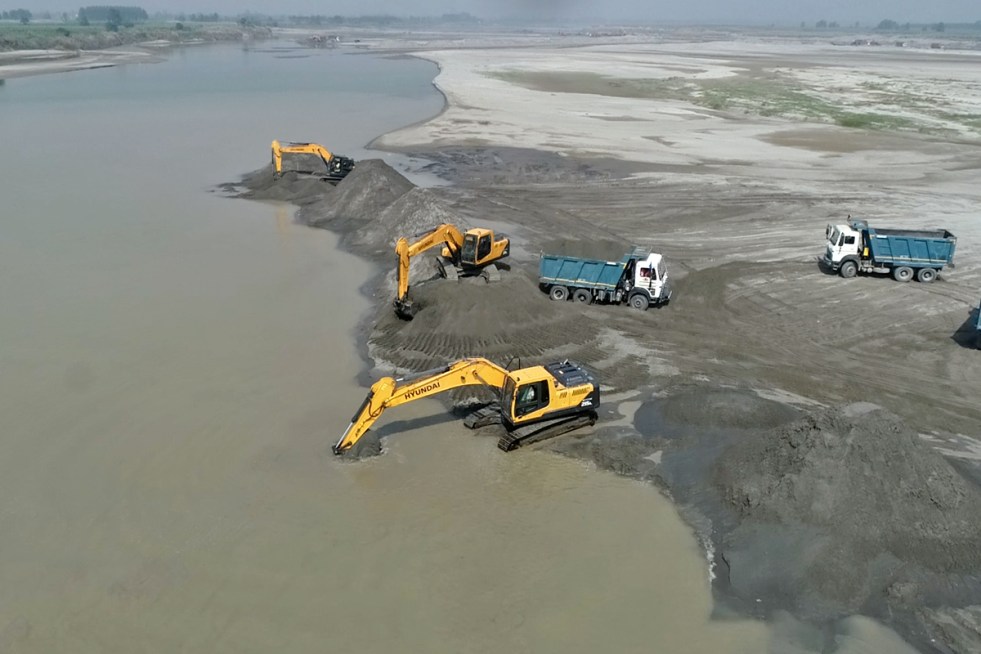
(Feature image:- Rampant sand mining damaging Yamuna’s ecology. Hridesh Joshi/Mongabay India)
In an important welcome development, the Supreme Court-appointed Central Empowered Committee (CEC) has proposed a three-year roadmap to phase out unsustainable river sand mining. It has recommended meeting part of the construction industry’s demand through reservoir desilting, manufactured sand (M-sand) and recycled construction and demolition (C&D) waste. It has also suggested assessing storage reservoirs over 15 years old and desilting those found suitable annually under a 10-year cycle.
While the CEC’s suggestions are welcome, they have not addressed some fundamental concerns about reservoir desilting. First, the CEC itself has admitted that India lacks a national assessment of the quantity of usable sand stored in reservoirs. Secondly, the total volume of accumulated sediment cannot be equated with the quantity that can be safely recovered and commercially used. The proposal has to be part of a larger efforts to curb illegal mining through credible, accountable regulation and bans in specified areas, with involvement of local communities. In fact, a CWC committee in 2022 had already found large-scale desilting of reservoirs as technically and economically unviable and had recommended dredging only at selected river stretches after scientific assessment.
Therefore, the immediate priority should be a scientific assessment of each reservoir’s sediment composition, recoverable quantity, environmental impacts and costs through participatory governance. M-sand, recycled C&D waste and better construction practices can also help reduce demand for river sand. These alternatives need quality standards, incentives and wider adoption. More importantly, the objective should not simply be to shift mining from riverbeds to reservoirs. It should be to stop destructive mining practices and reduce construction demand while protecting rivers and strengthening accountability.
EDIT: Respect the River, It’s not a quarry Rivers should not be treated as quarries. The challenge is to reconcile the demand for building material with the equally compelling need to keep water bodies alive. Unregulated extraction of sand is a serious environmental challenge — it deepens and widens the riverbed, destabilises riverbanks, alters natural water flow, and causes downstream erosion. The Supreme Court has pulled up state governments at least three times since 2023 for their failure to check illegal sand mining. But a nearly 40 per cent gap in sand supplies for India’s burgeoning construction industry has meant that court orders remain largely unimplemented. The CEC, which advises the SC on forest-related matters, has now proposed a different approach. It has recommended a three-year road map to phase out sand extraction from active river channels.
In 2022, a committee headed by former Central Water Commission chairperson B K Mittal had found large-scale desilting technologically and economically unviable. Like the CEC, it recommended dredging only at specific reaches of rivers, when backed by scientific studies.
SC Panel: Phase out unsustainable River Sand Mining in three years, desilt dams The SC-appointed Central Empowered Committee (CEC) has said that the country should phase out “unsustainable” sand extraction from rivers within three years, and instead desilt dams to meet the construction sector demand. The recommendation is part of the CEC’s Report No. 36 of 2026, filed before the apex court on Nov 2 2026, in the suo motu case on illegal sand mining in the National Chambal Sanctuary.
“A time-bound roadmap shall be prepared to progressively phase out unsustainable sand extraction from active river channels over the next three years, alongside development of adequate alternative sources, including reservoir sediment, M-sand and recycled C&D waste, while ensuring that legitimate construction requirements are met,” the report states. The committee also recommended a set of measures on “digital monitoring and traceability of mineral movement”. Key among these will be regulation through secure electronic transit permits, incorporating unique QR/barcodes or RFID-based identification. Additionally, state mining departments shall establish a digital monitoring system on permissions, quantities permitted, actual extraction, transit permits and end-use.
On dams, it recommended that “a time-bound desiltation programme be prepared, with contracts for eligible works awarded within the next three years, followed by a structured 10-year desiltation cycle for reservoirs identified as suitable”. The CEC recommended that the Ministry of Jal Shakti lead a comprehensive national framework specifying reservoir-wise sediment availability, recoverable quantities, processing requirements, timelines, financing arrangements and environmental safeguards in consultation with the CWC, National Dam Safety Authority, MoEFCC and State Governments.
The panel recommended that all storage dams over 15 years old that have not been systematically desilted be assessed, and about one-tenth of reservoirs found suitable would be desilted each year. The recovered sand, the CEC recommended, would be sold through transparent mechanisms. The panel adds that the cycle “should not be construed as a mandate for desiltation of every dam”.
CEC flags staff, surveillance gaps in Chambal sanctuary Supreme Court-appointed Central Empowered Committee (CEC) has flagged staff shortages, surveillance gaps and weak enforcement in National Chambal Wildlife Sanctuary in its fifth report on illegal sand mining. The report was uploaded on CEC’s website on Nov. 04 and will now be submitted to Supreme Court.
CEC recommended that Uttar Pradesh immediately fill two key vacant posts in its Agra division and strengthen monitoring to curb illegal sand mining. It said the posts of deputy conservator of forests (DCF) and assistant conservator of forests (ACF) in the Agra division of the sanctuary had been vacant for several months. While the divisional forest officer (DFO), Agra, held additional charge of DCF, no officer had been assigned charge of ACF. Officials at the sanctuary were unavailable for a comment on the matter. The committee said the prolonged vacancies could affect the sanctuary’s management and supervision. It recommended that UP fill both posts immediately.
CEC also highlighted gaps in surveillance and enforcement across the sanctuary. The report also raised concerns over enforcement against illegal mining and transportation of sand. The committee called for verification of their operational status and their effectiveness in reducing pressure on riverbed sand resources. CEC also flagged discrepancies in data provided by various departments on illegal extraction and transportation of sand in Ken river catchment. It said the figures supplied by the forest and mining departments did not tally and needed to be reconciled before they could be relied upon.
The committee has sought joint verification of 14 locations in Ken river catchment and all 31 approved sand quarries, including their boundaries, permissions and actual operations. It has asked the states concerned to submit a verification report and reconcile discrepancies in illegal mining cases within six weeks.
CEC said that although the three states had taken several steps, gaps remained in staffing, surveillance, inter-departmental coordination and monitoring. It also sought detailed compliance reports distinguishing between measures proposed, sanctioned, procured, installed and actually operational.
NGT panel flags possible official nexus Raising concerns about possible connivance between local officials and illegal sand mining operators, an NGT-appointed committee has found that a taskforce set up by the Madhya Pradesh government to clamp down on the menace has not been effectively functioning on the ground level.
The committee raised concerns about possible connivance between local officials and illegal mining operators, saying authorities appeared to have acted against smaller sand stockpiles while failing to take similarly effective action against larger ones. In addition, the committee found patches of alleged illegal excavation within a restricted zone near a bridge in Datia district, observed sand-transporting vehicles operating without visible or registered number plates, and reported that no check-posts had been established at the locations it inspected in Bhind and Datia.
Action against illegal sand mining in Yamuna, Ghaziabad Instructions have been issued to all field units under the Police Commissionerate, Ghaziabad, Uttar Pradesh, to maintain zero tolerance towards illegal mining, ensure that no vehicle transports minerals without a valid electronic transit pass and coordinate with Delhi Police along the interstate border. This was stated in a compliance affidavit filed by the Commissioner of Police, Ghaziabad, in response to orders issued by the NGT on August 11 and October 1, 2026.
The report, dated Nov 5, stated that a Joint Task Force for Loni tehsil, covering the sensitive Yamuna riverbed and embankment (pushta), had been reconstituted by the district administration in coordination with the Ghaziabad Police Commissionerate. A coordination meeting of the Joint Inter-State Task Force, comprising senior administrative, police and mining officials from Uttar Pradesh and Delhi, was held under the chairmanship of the Additional District Magistrate, Ghaziabad, on September 8, 2026.
The meeting decided to intensify joint patrolling after the monsoon, recognising that the end of the monsoon mining moratorium on September 30, 2026, could increase the risk of illegal sand extraction. A joint roster-based patrolling schedule was established along the Yamuna border. The report stated that 90 per cent of the demarcation of the interstate boundary between Delhi and Uttar Pradesh had been completed. The SDM, Loni, and the Tehsildar, Karawal Nagar (Delhi), were instructed to resolve discrepancies in land records at Badarpur village.
SC orders SIT probe into illegal mining along Jojari-Bandi-Luni tri-river system Supreme Court has ordered a Special Investigation Team (SIT) probe into organised illegal river sand (bajri) mining and pollution along the Jojari-Bandi-Luni river system. It has also restrained Rajasthan govt from granting fresh permissions for setting up industries along or near the river ecosystem until its High Flood Line and buffer zones are scientifically determined.A bench of Justices Vikram Nath and Sandeep Mehta, in an order dated Oct 26, directed the state to constitute an SIT headed by an officer not below the rank of inspector general of police, with the superintendents of police of Jodhpur, Balotra and Pali as its members.
The directions were issued while hearing a suo motu writ petition. “The investigation will identify persons and entities involved in illegal extraction, transportation and sale of bajri, beneficiaries of the operations and possible involvement of public officials,” the court said. The SIT has been asked to submit a status report before the next hearing on Nov 27.
HYDRO POWER PROJECTS
The Riskiest Place to Dam a River: Medog, SUMP and the Untamed Yarlung Tsangpo Gorge In this fascinating blog, Parineeta Dandekar and Chintan Sheth paint a rather frightening picture of the situation at the Yarlung Tsangpo Gorge, the untamed, World’s deepest gorge, that is also world’s largest factory of silt, one of the world’s most seismically active area, an area that has already seen at least five instances of river blocking landslide dams in last 26 years.
Worryingly, just upstream of the Gorge, China is building the world’s highest capacity hydropower project in most non-transparent way, not even informing its neighbors what are the basic parameters of its project. And just downstream from the Gorge India is planning to build its by far the highest capacity hydropower project when the local communities for decades have been opposing any such project.
The report has warned that China’s proposed 60,000 MW Medog hydropower project and India’s proposed 11,000 MW Siang Upper Multipurpose Project (SUMP) are being planned in one of the world’s most geologically unstable and disaster-prone regions, potentially exposing millions of people downstream to serious risks. The report argues that the combination of seismic activity, landslides, glacial lake outburst floods (GLOFs), extreme sediment flows and climate change makes the Yarlung Tsangpo gorge an exceptionally hazardous location for large hydropower infrastructure.
Is SUMP justified or is it costly chest thumping? In this episode, Sonikka Loganathan of The Hindu speaks to Omair Ahmad, former South Asia editor of ‘The Third Pole’, about how much of the project is driven by strategic considerations, the costs to local communities and the environment, and what an effective transboundary water-sharing strategy could look like. Omair says a number of noteworthy things, some key aspects:
– When the governments do not want oversight or accountability, when it does not to get into the logic of something, they speak in terms of national security discourse. It kind of shuts off a lot of debate.
– How is this a national security issue? What can this dam do in terms of providing national security? Very little.
– The security of the lower Siang downwards and in Assam is dependent on the 80% of the water of Brahmaputra that comes from the region, not from China. And their security is in danger due to the destruction of floodplains and water bodies in this region.
– We certainly need to talk to the Chinese about the water from their region flowing to India, about landslides, destruction of fisheries etc happening in Arunachal Pradesh due to the changes in water flows from China. The only way to achieve that is to open up communication with the Chinese. Through multilateral bodies or bilateral framework. To get good data, to get joint monitoring of the river on both sides of the border.
– As far as the 80% if concerned, the building of SUMP will not help. Look what we are doing on Teesta in terms of building cascade of projects and their impact on water flow downstream. During non-monsoon months, we store the water for 20 hrs and release it for 4 hours. This has dried out the riverbeds, and then suddenly there is big flow when electricity is generated. This destroys the ecosystems and livelihood of millions. So you are creating the human security issue in all these basins and then call it national security threat in case of Siang.
– Does it make a lot of sense for China to spend billions and billions of dollars of project and then use it to mildly inconvenience a small, tiny population in Arunachal Pradesh? How does it make sense as a military plan?
– Once the Chinese dam is built, it can theoretically disrupt the water flow to Arunachal Pradesh for some critical times, not stop it for long, nor release it all in one go. If China does not release water, it cannot generate electricity. It does not make sense for China to not generate electricity after building such a costly project.
Petition to halt PFR activities A group of scientists, researchers, conservation practitioners and concerned citizens has expressed solidarity with the people of the Siang valley opposing the proposed SUMP, urging the Arunachal Pradesh and union governments to halt all activities related to the preparation of its pre-feasibility report (PFR). The signatories said the Siang River, its forests and surrounding mountains sustain extraordinary biodiversity, traditional knowledge systems, livelihoods and the cultural identity of the indigenous Adi communities. The statement comes amid protests, arrests and detentions of anti-dam activists, who recently rejected the state government’s call for talks. After walking nearly 400 kms for 12 days, 15 villagers from the Siang belt reached the state capital, carrying a message for the government: listen to the people before deciding the fate of their ancestral lands.
Communities fighting back Estimates suggest that the project could displace between 1.25 lakh and 1.5 lakh indigenous people. Of the 27 villages facing submergence, 20 lie in Upper Siang district and seven in Siang district. Another 56 villages would be affected. Even Yingkiong, the headquarters of Upper Siang district, faces the risk of flooding. Roughly 11 per cent of Arunachal Pradesh’s total population could be displaced. Opposition to the project is not new. The UPA government declared it a national project in 2008, but it has made little headway against sustained resistance from the Adi community, Arunachal Pradesh’s second-largest tribe.
Fin Min Clears Rs 1,400 Cr Grant for Sawalkote HEP The Public Investment Board (PIB) has approved a Rs 1,400-crore grant for infrastructure works at J&K’s 1,800-MW Sawalkote hydropower project, but has referred the proposed Rs 18,730.25-crore loan to the Economic Affairs Department’s budget division for separate consideration, ETV Bharat has learnt. The Finance Ministry body has cleared the funding structure for the National Hydroelectric Power Corporation (NHPC)-developed project, fixing a debt-equity ratio of 75:25, according to official records accessed by ETV Bharat. However, it has not yet recommended the full debt support sought by the Power Ministry.
Protest against Tarali PSP near Tarali Hundreds of farmers, environmentalists and activists from across Maharashtra staged a protest at Tarali PSP near Tarali dam in Patan taluka on Saturday, alleging large-scale destruction of forests. They warned the project could threaten irrigation supplies for thousands of hectares in western Maharashtra. The protest drew farmers from Sangli and neighbouring districts who fear the Rs 5,600-crore project will adversely affect water availability from Tarali dam, a key source feeding the Krishna and Arphal canal systems.
Maruti Chavan, a grape grower from Palus in Sangli district, said farmers dependent on canal water were already facing shortages. Protesters claimed that thousands of hectares under sugar cane, grape cultivation and dairy farming depend on water released from major dams in Satara district, and feared the hydropower project could affect the region’s agricultural economy. The agitators also accused the company of causing ecological damage in the Sahyadri ranges and alleged that the project’s valuation had been shown at only a fraction of its actual cost to reduce environmental compensation liabilities.
Some activists also alleged that govt had agreed to procure power from the project at a higher rate, ultimately burdening consumers with increased electricity bills. Adani Green Energy Limited’s (AGEL) dismissed the allegations, particularly claims that the project cost was deliberately reduced in official submissions. According to company officials, nearly 70% of the work has been completed.
Adani Grp claims 1500 MW Tarali PSP cost is Rs 56.75 Cr, not Rs 5675 Cr ADANI Green Energy Ltd has sought to sharply revise downwards the cost of its 1,500 MW hydropower project in Maharashtra’s Satara district to Rs 56.75 crore from Rs 5,675 crore. This reduction in cost proportionally reduces the money Adani Green Energy has to deposit towards wildlife sanctuary conservation and protection to just Rs 2.27 crore as against Rs 227 crore. The proposal to revise the project cost estimate to Rs 56.75 crore was accepted by the Maharashtra forest department recently, and the company accordingly deposited Rs 56.75 lakh (1% of Rs 56.75 crore) into the bank account of Sahyadri Tiger Reserve, with the balance to be deposited after the National Board for Wildlife (NBWL) clears the project.
Adani Green Energy had made the request for revising the cost to Rs 56.75 crore in a notarised affidavit to the Maharashtra forest department on Sept 8 2026. In the letter of the Union Ministry of Environment, Forest and Climate Change dated Feb 11, 2025, which recommended grant of prior Environment Clearance to the project, the cost is clearly mentioned as Rs 5,675 crore.
Following a complaint by Rohan Bhate, Honorary Wildlife Warden, Satara district, registered on October 30 with the Prime Minister’s grievance redressal portal and to the Chief Minister of Maharashtra through the state government’s Aaple Sarkar grievance redressal portal, alleging “incorrect cost of the project”, the Union Ministry of Environment, Forest (MoEF&CC) has directed the state forest department on November 6 to investigate the matter on priority. The state forest department has also initiated a probe.
MP plans 1920 MW PSP at Gandhi Sagar dam Madhya Pradesh cabinet will meet at Gandhi Sagar dam on Nov 18 as a ‘Destination Cabinet,’ aiming to highlight the Rs 11,500 crore, 1,920 MW Gandhi Sagar Pumped Hydro Storage Project being developed in Mandsaur district. Developed by the Greenko Group, it is the largest standalone PSP under construction in India and will be the country’s biggest of its kind once completed. Two turbines are already ready and the weight commissioning work will be carried out in December, Greenko Group AGM Kamlesh Singh Parihar told TOI.
The project is coming up on about 414 hectares in a village of Khemla block, Rampura tehsil, Neemuch district. It is a closed-loop system with two reservoirs: the existing Gandhi Sagar reservoir, with a capacity of about 270 TMC (thousand million cubic feet) or 7,643.70 MCM as the lower one and a new upper reservoir built by Greenko. Only 2.4 TMC (67.66 MCM) of water will be reused, circulating between the two without being consumed, he said.
DAMS
Will build Mekedatu dam: Karnataka CM D.K. Shivakumar on Nov. 14 asserted that Karnataka will go ahead with the Mekedatu balancing reservoir project, describing it as the State’s right and duty, while assuring that Tamil Nadu would receive its stipulated share of Cauvery water. Responding to opposition to the project from leaders in Tamil Nadu, including State Congress president Manickam Tagore, Mr. Shivakumar said the neighbouring State should send a delegation to Karnataka to understand the project’s benefits rather than oppose it. Karnataka minister Priyank Kharge on Nov. 15 said the law was on the state’s side in the ongoing dispute over the proposed Mekedatu dam project on the Cauvery river. Kharge went on to add that that both Karnataka and Tamil Nadu would have to abide by the Supreme Court’s directions.
Villagers Protest Kishau Dam, Demand Relocation Hundreds of men and women from villages affected by the proposed Kishau Dam on the Tons River staged a protest at Kwan, demanding protection of their ancestral land, fertile farms, homes and cultural heritage. They urged the government to build the dam at its original Kishau site or shift the proposed location 10–15 km towards Meenas. Villagers said the project would submerge several revenue villages and fertile agricultural land, forcing hundreds of families to lose their livelihoods and migrate. They submitted a memorandum to Cm Pushkar Singh Dhami through the Kalsi SDM.
Villagers alleged that no formal consultation has been held with them despite the project being planned for decades. They fear losing hundreds of hectares of fertile farmland and their livelihoods, and are demanding alternatives to protect their villages, along with a clear rehabilitation and compensation policy framed through consultation with affected residents.
Villagers in Mashwar of Himachal Pradesh’s Shillai subdivision have strongly opposed the proposed Kishau Dam, vowing not to allow construction at the site. They plan to form a Kishau Dam Struggle Committee to organise the protest and have also warned against unauthorised activities, including drone surveys. The villagers are prepared to take legal action to protect their land, forests, water resources, rights and cultural heritage.
INTERLINKING OF RIVERS
Why villagers protesting against Ken Betwa link project Environmentalists have long opposed the project, saying the proposed 2-km-long Daudhan Dam on the Ken River will inundate some 9,000 hectares (22,200 acres) of land, including a significant portion of the Panna Tiger Reserve, one of India’s most successful tiger conservation programmes. The government has said the environmental impact is “unavoidable”, but can be mitigated through tree planting, wildlife conservation and other measures. Some critics even question the scientific basis for the multi-billion-dollar plan. “There is a big question mark over this project’s feasibility because it rests on a hydrological presumption: a surplus in the Ken basin and a deficit in the Betwa basin,” said Himanshu Thakkar, coordinator of the SANDRP. “That presumption has never been conclusively established.”
RIVERS
From purifying ourselves to polluting waterbodies: Devotion and denial, faith and failure The images from Har ki Pauri in Haridwar were damning. To clean the Ganga before Diwali, authorities stopped the river’s flow for 18 days. What surfaced was not a sacred river but a landfill: tons of waste, discarded clothes, puja material, plastic, flowers and debris exposed on the riverbed. Equally ironic, some people still took a holy dip in the remaining trickles—and left behind more clothes and puja material. This should not surprise a civilisation that thrives on cultural practices that instigate pollution. The question, then, is not merely why the Ganga is dying. It is why a morally dying civilisation continues to be fuelled by a culture of polluting. (By Mansee Bal Bhargava, Priya Sharma)
Ganga canal clean-Up A stretch of the River Ganga near Haridwar has appeared strikingly clear following a large clean-up drive ahead of the 2027 Ardh Kumbh. Sanitation workers, government departments, civic bodies, local organisations and volunteers reportedly removed nearly 150 metric tonnes of waste from a 10-km stretch. The waste included silt, plastic, discarded clothes and religious offerings. As part of the operation, a canal was reportedly closed for about 20 days, exposing waste accumulated along the riverbed near key ghats, including Har Ki Pauri.
Mahanadi Floods Expose Risks of Fly Ash Dumping Site The Raigarh Environment Department granted Adani Power Limited permission to dump fly ash at Chhota Ghotla village near the Mahanadi. The site, reportedly a former gravel extraction pit, was submerged during the Mahanadi floods. Floodwater entered the dumping yard and carried fly ash into nearby agricultural fields, damaging fertile farmland.
The incident has raised questions about the environmental clearance and safeguards provided at the site. The article points out that CPCB’s March 2019 guidelines discourage fly ash filling in floodplains and ecologically sensitive areas. They also require protective embankments where water bodies are located nearby to prevent ash from entering water and soil. The author questions whether these requirements were followed and whether the site was properly inspected before permission was granted.
Despite visible evidence of flooding and ash spreading into fields, the Raigarh Environment Department has reportedly remained silent. The article questions whether fly ash dumping will be allowed to continue at this flood-affected site and demands accountability from the authorities.
Kanpur’s water fails, from the surface to the borewell In Kanpur, every Ganga sample exceeded the government’s benchmark for biochemical oxygen demand in bathing water, at about 1.5 times the permissible level. The readings were more than twice the stricter benchmark for water used as a drinking source. The samples were collected during the monsoon, when higher flows dilute contaminants five to 20 times, so dry-season concentrations could be several times higher, said Abhijit Mukherjee, a professor at IIT Kharagpur whose laboratory did the testing.
“A river is not a snapshot,” the Centre said on Nov. 13, defending the Clean Ganga program that has come under scrutiny following a media report that found a large stretch of the river severely polluted despite a decade of funding and infrastructure efforts.
DPCC fines STPs and CETPs Rs 50 Cr, but recovery is just Rs 3 lakhs Delhi’s treatment plants, some operated by private organisations and most by Delhi Jal Board (DJB), seem to be getting away lightly as penalties imposed on them remain largely unrecovered. An RTI disclosure has revealed that Delhi Pollution Control Committee (DPCC) imposed nearly Rs 49.7 crore in environmental compensation on sewage treatment plants (STPs) and common effluent treatment plants (CETPs) in the past six years, but managed to recover just Rs 3 lakh. This exposes a troubling disconnect between pollution-control efforts and ground realities, raising questions as to whether the penalties are serving as a deterrent at all.
Parichha Fly Ash Damaging Health of People & Betwa River It is deeply disappointing that the district administration, plant management and environmental protection agencies have allowed the situation to deteriorate over the years. The NGT’s intervention is welcome but it must now ensure a thorough and independent assessment of the impacts on the Betwa river, aquatic life, people’s health, livestock and crops. The Tribunal must fix accountability, ensure adequate compensation for affected communities and take strict action against all responsible agencies. Most importantly, the proceedings must lead to a lasting solution to the fly ash pollution in Betwa river and nearby villages rather than end with another round of notices and assurances.
Delhi plans to expand floodplain embankment road between Wazirabad Road and Sonia Vihar The Delhi government plans to extend the Sonia Vihar embankment road from Wazirabad Road to Zero Pusta in the Yamuna floodplains to improve connectivity in trans-Yamuna areas and provide access to a proposed ferry service complex, even as environmental activists have raised concerns over the ecological impact of further infrastructure development in the already encroached floodplain.
The Irrigation and Flood Control Department has initiated the process of appointing consultants and surveyors to conduct a feasibility study for extending service roads along the embankment and finalising the alignment of an additional road along the existing left flood bund (Sonia Vihar), from Sonia Vihar Pusta to the Water Sports Club, officials said. “The proposed road will connect the Nanaksar Gurudwara located near Wazirabad Road to the complex. Additionally, the existing road leading from Sonia Vihar Pusta Road to the Water Sports Club (jetty) will also be improved,” a senior government official said.
The proposed route lies entirely within the floodplain, an area where construction is generally restricted. Therefore, a feasibility study is planned to assess the impact, including the number of trees that might be affected by the road’s width. The study is essential to identify any existing underground infrastructure—such as water pipelines, power lines, or other utilities—that may lie along the proposed alignment of the road. The stretch also has a pipeline network connecting the Sonia Vihar pumping station to the Sonia Vihar water treatment plant.
As part of the feasibility study for the floodplain area, a topographical survey of the land will be conducted at 20-metre intervals. The study will also include an assessment of existing permanent structures and trees located within the floodplain. A survey using Ground Penetrating Radar (GPR) will be carried out to identify subsurface features. Following this, a Detailed Project Report (DPR) for the road construction will be prepared, the official added. Bhim Singh Rawat, SANDRP, said that no further construction should be permitted in the Yamuna floodplains, which have already been encroached upon to a great extent. “Delhi needs to learn lessons from its failures. We keep targeting floodplains with projects like riverfronts, flood walls and sewer lines, which harm the river ecosystem in the long run,” he added.
As per this April 2025 report the govt had announced the construction of a 5.5- km-long elevated road in the Pushta Sonia Vihar area, aimed at easing traffic congestion and improving connectivity in the trans-Yamuna region. The project, with an estimated cost of ₹500 crore, has received approval from the Chief Minister Rekha Gupta, according to Public Works Department (PWD) Minister Parvesh Verma. ‘The local MLA and Minister Kapil Mishra has been pushing for this project. Due to the presence of many trees in the area, we have decided to construct a flyover instead of a conventional road. After discussions with the chief minister, the project has been approved, and work will commence following deliberations with the Flood Department,’ Verma said.
DJB plans ₹149 cr sewer line through floodplain The Delhi Jal Board (DJB) plans to lay an 8.34-km sewer rising main through the Yamuna’s ecologically sensitive floodplain to carry sewage from the Ring Road pumping station to the STP. The upcoming 1,800mm-diameter pipeline has received administrative approval of its estimated cost of ₹148.90 crore from the DJB board, according to the project details. The civic utility says the new line will help address recurring sewage overflows caused by three ageing gravity ducts, built in 1938, 1972 and 1992, which have become inadequate and silted up.
DJB has invited bids for laying rising main from Ring Road pumping station to Okhla STP through Yamuna flood plain alignment dated October 26. The project has an estimated value of approximately ₹140.04 crore and a completion period of 1.5 years. “The project is intended to convey sewage directly to the 124-million-gallon-a-day Okhla STP, reducing the load on the existing ducts and minimising overflows and foul conditions in the Sriniwaspuri, Kalkaji, NFC and Captain Gaur Marg areas, particularly during the monsoon,” officials added.
However, the proposed alignment through the Yamuna floodplain raises questions about how the pipeline will be constructed without compromising the floodplain’s ecological functions, including its capacity to accommodate floodwater and support groundwater recharge. Bhim Singh Rawat, of the SANDRP, said that no further construction should be permitted in Yamuna floodplains which have already been encroached to great extent. “What happened to the interceptor sewage project which was supposed to divert all this sewage? Hundreds of crores have gone down the drain. Delhi needs to learn lessons from its failures. We keep targeting floodplains with project.
Experts say impact of cruise on Yamuna ecology not studied Environmentalists questioned the newly launched Yamuna cruise service on Nov. 10, saying it was introduced without an ecological impact assessment or navigability studies in one of the river’s last remaining relatively clean stretches. Bhim Singh Rawat of SANDRP said the government should have commissioned an ecological impact assessment and a topographical study before allowing motorised cruise operations.
“This clean part of the river sees migratory birds, and efforts should be made to cause minimal disturbance. A similar plan to run a water taxi in this stretch failed in the past, but no lessons have been learnt. They should first assess the depth of the river and the requirements for boat operations, as this might adversely impact aquatic life,” he said.
Rawat said ecological restoration, rather than eco-tourism, should be the government’s priority, particularly along the Sonia Vihar–Jagatpur stretch, which supports aquatic life and attracts migratory birds. He also cautioned that motorised propellers could harm aquatic species, citing similar services in other cities. “Additionally, the river runs dry in May-June, exposing the riverbed. This year, we saw a monsoon deficit, and ecological flow in the river is missing. The river did not cross even the warning level once during the monsoon,” he said.
Navigability concerns are not new. In June 2023, an 11-metre Indian Navy boat, Barasingha, brought to Delhi to assess the river’s navigability, got stranded because of insufficient water depth. It required a minimum depth of two metres, while the riverbed in that stretch had only 0.9 to one metre of water.In 2015, the Inland Waterways Authority of India proposed a 16-km water taxi service between Sonia Vihar and Tronica City. The Delhi government rejected the proposal in 2021, citing severe pollution and inadequate water levels.
Delhi launches Yamuna cruise, 60 take ride About 60 people took a ride as Delhi Nov. 10 launched the ‘Namo Yamuna River Cruise Service’ in Sonia Vihar, marking the beginning of a new recreational tourism initiative along the river. The service will offer visitors a 35-45-minute cruise experience along the Yamuna, with electric boats, a riverfront terminal and family-oriented recreational facilities. The pilot project, developed by Delhi govt in coordination with Inland Waterways Authority of India, covers the 4km Sonia Vihar-Jagatpur stretch. An electric cruise with a capacity of 30 passengers has been introduced, while another vessel of the same capacity is expected to join the service by Feb-March 2027.
However, environmental concerns have also been raised over the project. Bhim Singh Rawat, associate coordinator, SANDRP, said similar proposals in the past had not materialised because of inadequate water flow in the Yamuna. He cautioned that cruise operations and associated noise could disturb aquatic life and migratory birds, particularly in the stretch upstream of Wazirabad, where human intervention has so far been limited. He said govt should prioritise restoring ecological flow, reducing pollution and protecting the river’s floodplains.
Delhi CM said that, in addition to the new tourist attraction, “equal attention must be paid to keeping the Yamuna clean and protecting its ecology.” However, the project’s viability has been questioned by environmental organizations such as the SANDRP, which insist that restoring the river’s ecosystem should be the priority before any tourism development.
Yamuna Cruise Raises Concerns The article questions the launch of the ₹20-crore Namo Yamuna River Safari between Sonia Vihar and Jagatpur, a 5km stretch upstream of Wazirabad Barrage. The author argues that the government has selected a relatively cleaner section of the Yamuna, while the severely polluted stretches downstream, affected by major drains and industrial waste, remain neglected. The absence of a specific environmental impact study on the Yamuna stretch is a major concern. The author argues that promoting river tourism without addressing sewage pollution, industrial discharges, ecological impacts and seasonal water shortages risks turning the Yamuna into a recreational corridor while leaving its fundamental problems unresolved.
Lakhs spent on removing the foam on Yamuna Froth continued to surface on the Yamuna during Chhath Puja, despite a defoaming drive and thousands of crores spent on the river’s rejuvenation. In November 2025, The Indian Express reported that Earth Warrior, a nonprofit, had written to LG VK Saxena, CM Rekha Gupta and other officials, raising concerns over the prolonged use of defoaming chemicals in the Yamuna. In its letter, the organisation claimed that the spraying had continued for “more than 40 days till date (November 23, 2025)” and had “commenced in the second week of October 2025”, unlike the shorter duration associated with the Chhath Puja period in previous years.
“This is a silicon-based defoamer, and it is not a solution to the problem. It is only a temporary measure. Applying it to the foam makes the foam disappear, but it does not improve the water quality.” He added, “This chemical can accumulate in the river, posing a threat to aquatic life and plants. If fish consume it, their skin could deteriorate. This is one of the problems associated with using defoamers.”
Bhim Singh Rawat, SANDRP, also described defoaming as a temporary intervention. “The defoamer is essentially a temporary intervention. It may disperse the foam on the river’s surface, but it does not address the underlying pollution or improve the water quality of the Yamuna. It makes the foam disappear from public view, but the pollution remains in the river,” he said.
Rawat pointed to how briefly the chemical works after being sprayed. “The chemical has some effect on the frothing immediately after it is applied or sprayed. There may be other, less harmful liquids that could be sprayed on the froth to suppress its quantity and achieve a similar effect. However, the effect is only temporary and lasts as long as the spraying continues. Once they stop spraying, the froth begins to reappear within half an hour to an hour, with small particles or ‘seeds’ of froth floating on the river’s surface.”
He also raised concerns about the chemicals persisting in the river. “There are concerns about the persistence of these chemicals in the river. If they take a long time to biodegrade, they could accumulate in the aquatic environment. We need proper scientific assessment of their impact on aquatic organisms, plants and fish rather than assuming that dispersing the foam is a harmless intervention.”
Focus on Yamuna Rejuvenation, not beautification This article is entirely based on the letter initiated and sent by SANDRP, but the article does not mention SANDRP, which is not a problem.
Faridabad Metropolitan Development Authority (FMDA) is planning to develop a riverfront along the Yamuna on the lines of Ahmedabad’s Sabarmati Riverfront. The proposed project includes walking paths, cycling tracks, parks, ghats, boating facilities, children’s recreational spaces and green areas. It will be developed in phases, with emphasis on promoting tourism, providing public amenities, increasing green cover and preventing encroachment on the floodplain. Although the proposal has received approval, its estimated cost and budget are yet to be finalised.
A major challenge alongside the riverfront development is preventing industrial pollution from entering the Yamuna. Faridabad has around 30,000 industrial units, reportedly generating over 60 MLD of wastewater. Under the Yamuna Action Plan, three CETPs with a combined capacity of 90 MLD are proposed at Pratapgarh, Mirzapur and Badshahpur, at an estimated cost of ₹400 crore. The first phase involves a 15 MLD CETP at Badshahpur, with plans to treat and reuse industrial wastewater, potentially reducing polluted discharges into the Agra Canal and Yamuna.
12 illegal dyeing units found in Gurugram Twelve illegal dyeing units have been identified in Gurugram, Haryana, and action has been taken against them, according to a report filed by the Haryana State Pollution Control Board (HSPCB) on November 5, 2026. The report stated that the board had initiated action under applicable environmental laws after receiving a complaint from applicant Varun Gulati on April 12, 2026, alleging that polluting dyeing units were operating without authorisation.
Field inspections, surveillance and verification were carried out at the locations identified in the complaint to detect units operating without the required statutory permissions or pollution-control measures. The HSPCB assured the NGT that it would continue monitoring the identified locations and take action against any dyeing unit found operating without the necessary permissions or in violation of environmental norms.
Hindon pollution: UP asks NGT for 2 weeks to reply to complaints In an adjournment application dated Oct 31, the state’s standing counsel informed the tribunal that the chief secretary had directed the state to file an updated affidavit in compliance with its August 17 order, but information from the concerned departments and authorities was still awaited. “Some important information is awaited from the concerned departments and authorities,” the application stated, seeking two weeks to file a fresh affidavit. It mentions Nov 2, 2026, as the next date of hearing. The application, however, does not mean the tribunal has granted the adjournment; its acceptance would be subject to the tribunal’s satisfaction.
Separately, UPPCB informed the tribunal that a joint committee of the Central Pollution Control Board (CPCB) and UPPCB inspected 20 STPs across the Hindon basin. Eight were categorised as non-compliant with standards prescribed under the environment ministry’s October 13, 2017 notification.
FISH, FISHERIES, FISHERFOLKS
Mass fish death in Yamuna again A day after hundreds of dead fish were spotted in the Yamuna near Sonia Vihar – the second such incident in less than a month – the Delhi Irrigation and Flood Control department approached the police on Nov. 12 seeking an FIR over social media posts alleging that chemicals were being sprayed into the river ahead of Chhath Puja. The latest fish deaths were reported on Nov. 11, a day after the launch of the Namo Yamuna River Safari, an electric river cruise. On October 14, large numbers of dead fish were spotted along the Burari stretch, with industrial effluents entering through drains 2 and 8 suspected to be have contributed to the deaths.
The latest incident coincided with a deterioration in the quality of raw water drawn from the Yamuna, with ammonia levels rising to around 1.3 mg/l. This had forced the Delhi Jal Board (DJB) to curtail production at its Sonia Vihar Water Treatment Plant for nearly five hours on Nov. 11. Bhim Singh Rawat, SANDRP said back-to-back fish deaths in a relatively cleaner stretch of the Yamuna was alarming. “Laboratory testing is the first essential step towards identifying the cause and deciding remedial action,” he said.
The fish deaths in Oct. were concerning as they occurred soon after monsoon, when the river is expected to have adequate water and cleaner upstream inflows. Fishermen had reported a rising stink from the river before the dead fish were found floating in its main channel. At the time, environmental experts called for an investigation into the possible causes, including industrial pollution, untreated sewage discharges and restricted environmental flows. Bhim Singh Rawat of SANDRP had warned that if pollution was responsible for the death of the fish, the adverse effects could extend to Delhi’s drinking water source.
The latest incident along Sonia Vihar comes amid continuing concerns over the river’s health, with experts calling for scientific investigation rather than assumptions. Following the October incident, environmental group Earth Warrior had similarly sought immediate water testing for dissolved oxygen, biochemical oxygen demand, faecal coliform, heavy metals and toxic substances. Bhim Singh Rawat, SANDRP had also identified industrial pollution as a possible cause. He pointed to untreated waste entering the river through drains in Haryana and restricted water flows needed to sustain the river. Experts told PTI that the exact cause and source of the fish deaths could be established only through an investigation and water-quality tests. This ground report attempts to find reasons behind mass fish death in Yamuna reported on Nov. 11, 2026.
Maharashtra’s floating-solar push leaves fishing communities uncertain In 2018, the Maharashtra State Electricity Distribution Company proposed a 1,000 MW floating-solar project at Ujani, then among the largest proposals of its kind in India. Concerns from fishing communities led the state government to appoint a committee to examine environmental impacts, including effects on aquatic ecosystems, reservoir users and water levels. But the committee’s findings have not been made public, and no project-specific assessment appears to be publicly available showing what a development of this scale could mean for Ujani’s fisheries and ecology.
MSEDCL invited bids later that year, but the project never reached construction. In 2025, after years of little progress, it was revived under a public-private partnership model, with the Water Resources Department taking over and inviting bids for floating solar on up to 15% of the reservoir.
Then, in 2026, the proposal changed scale again. The Maharashtra government signed an investment memorandum with JW Global Group and partners for a 2 GW floating-solar project at Ujani, alongside a battery energy storage system. The broader ₹1.65 lakh crore proposal also includes a hyperscale AI data centre and a green-hydrogen facility.
The MoU, however, is not construction. The April 2026 announcement said required studies would begin after the agreement. Water-use permissions, environmental and ecological assessments, grid connectivity, power-evacuation arrangements and commercial agreements still have to be established. The first phase is expected to cover more than 680 acres around the reservoir.
For fisherfolk, the repeated announcements have produced an odd kind of uncertainty: the project keeps returning, while basic answers about how it will coexist with fishing remain unanswered. The same pattern appears elsewhere in Maharashtra. The state has announced floating-solar projects on reservoirs including Jayakwadi, Tansa and Modak Sagar, Morbe and Erai. Many have struggled to move beyond planning.
GROUNDWATER
Rebalancing India’s Rice economy India has proved its competitiveness in global rice markets and the next challenge is to make that competitiveness sustainable; the country’s rice policy needs a more differentiated production strategy that moves from volume to value: more crop per drop, more income per tonne, and less energy use per unit exported. (A.V. Manjunatha,Vikram Patil)
Groundwater recharge needs local action El Niño and below-normal rainfall heighten pressure on India’s groundwater reserves, underscoring the need to combine scientific recharge planning with efficient irrigation and crop diversification.
Telangana to roll out groundwater action plan Bracing for the looming El Niño threat and the possibility of groundwater stress during the coming months, the Telangana Government is preparing a coordinated State-wide action plan to boost groundwater recharge, regulate extraction and ensure sustainable management of available water resources, said the Minister for Irrigation and Civil Supplies, N Uttam Kumar Reddy on Nov. 13.
Pointing out that more than 94 per cent of water utilisation in Telangana was accounted for by irrigation, while domestic and other uses constituted only about 1.8 per cent, the expert stressed the need to quantify groundwater availability and requirements at the watershed level. The expert recommended mapping water availability against irrigation requirements in every watershed and using the findings to guide farmers on suitable crops. Experts have proposed constituting a task force reporting directly to the State leadership, with weekly, 10-day or fortnightly meetings to monitor the situation and coordinate corrective measures.
Nitrate levels breach at 358 sites across Andhra Pradesh Groundwater quality concerns are mounting across Andhra Pradesh, with the Central Ground Water Board (CGWB) reporting excessive levels of nitrate, uranium and fluoride at hundreds of locations across the state. According to the CGWB’s Annual Ground Water Quality Report 2026 annexures, based on pre-monsoon 2025 sampling, nitrate levels exceeded the permissible drinking-water limit of 45 mg per litre at 358 locations. Prakasam district reported the highest number of nitrate-affected sampling points at 54, followed by Palnadu (38), Annamayya (24), and Sri Sathya Sai and YSR Kadapa districts with 23 each.
Radon levels exceed in 70% of Tehri groundwater samples: NIH study Radon levels in seven of 10 groundwater samples collected from Tehri Garhwal district in Uttarakhand’s Lesser Himalayan region exceeded the US Environmental Protection Agency’s drinking-water benchmark, a study by researchers at National Institute of Hydrology (NIH), Roorkee, has found. The study, published in the Journal of Radioanalytical and Nuclear Chemistry on Nov 6, found radon concentrations ranging from 2.18 to 43.29 becquerels per litre (Bq/L), against the US benchmark of 11.1 Bq/L.
URBAN WATER
E. coli Found in Bhopal Drinking Water Govt laboratory tests confirmed the presence of dangerous E. coli bacteria in drinking water supplied to Vaishali Nagar, Bhopal. The contamination was detected in two tests, with 660 MPN per 100 ml on Oct 28 and 350 MPN on Nov 13, against the permissible level of zero. Nearly 200 families have stopped drinking tap water and are buying bottled water. Residents suspect that sewage is entering drinking water pipelines through leaks, possibly due to overflowing sewage chambers in nearby Vayu Nagar. The affected Kolar water supply network serves around seven lakh people across nine municipal zones through 1.35 lakh connections, supplying 34 MLD of water daily. The findings have raised questions about the Bhopal Municipal Corporation’s water-quality monitoring, particularly after its earlier sampling reportedly showed no contamination. The Corporation has collected fresh samples and assured precautionary measures.
E. coli Contamination in 50 Indore Borewells; NGT Orders Probe The NGT has taken suo motu cognisance after E. coli bacteria were detected in water samples from more than 50 private borewells across Indore. Contamination was reported at government hospitals, private hostels, residential areas and other institutions. The Municipal Corporation declared the affected water unsafe for drinking and sealed some borewells. The NGT has directed the Indore Municipal Corporation, Madhya Pradesh Pollution Control Board and other departments to investigate the contamination, take steps to treat the affected water and submit a report. The case has intensified concerns over drinking-water safety and monitoring following the deaths of 36 people due to contaminated water in Bhagirathpura.
LOCAL WATER SYSTEMS
Forest water bodies are drying up According to the first-ever census of water bodies conducted by the Ministry of Jal Shakti, out of 24.24 lakh water bodies in the country, approximately 3.94 lakh (about 16.2 per cent) have either dried up or become unusable. A large proportion of these consist of natural ponds and tanks located in rural and forest areas. Furthermore, thousands of springs in hilly and forested regions are now on the verge of drying up.
A recent report by the Indian Institute of Technology (IIT) Gandhinagar — based on a study of 10,476 lakes, ponds and natural water bodies across the country — reveals that the surface area of nearly 44.8 per cent of these water bodies has declined significantly. The weak southwest monsoon has reduced the average extent of these water bodies by approximately 5 per cent.
FLOOD 2026
Assam’s Flood Devastation and Climate Crisis Floods are a common feature in Assam during the monsoons, with a large part of the state being floodplains of the Brahmaputra River. As per Rastreeya Barh Ayog, 39.58% of Assam is flood prone (31.05 L ha). This is 9.4% of all flood prone areas in India. This year’s flood is considered as one of the worst, if not the worst in several decades. Experts suggest that increased rainfall intensity due to the climate crisis and deforestation in the upper catchments significantly enhance flood risks for Assam.
ENVIRONMENT GOVERNANCE
NBWL cleared 99K ha wildlife habitat in 12 years India’s apex wildlife body has cleared at least 99,000 hectares of forests and wildlife habitats for mines, industry, dams and highways—an area about a third larger than Singapore—our analysis of its meeting minutes from 2014 to 2026 found. About three-quarters of this land lies inside Protected Areas. These diversions violate wildlife-protection laws and have turned the Standing Committee of the National Board for Wildlife into a rubber stamp, giving legal cover to projects that damage some of India’s last and most critical wildlife habitats. (Prakriti Srivastava And Prerna Singh Bindra)
Written Down or Left Out: Biodiversity Amendment & Northeast’s Oral Knowledge The Biological Diversity (Amendment) Act, 2023 was presented as a modernisation of a two-decade-old law, one that would ease compliance for the traditional-medicine industry and tidy up a cumbersome benefit-sharing regime. Less remarked upon is the line it draws through traditional knowledge itself. The amendment sorts such knowledge into two kinds. One is “codified,” and the law treats it generously. The other is everything else, and the law leaves it in a far weaker place. The Northeast India, one of the world’s richest storehouses of plants and the knowledge of their use, holds that knowledge almost entirely in memory rather than in books, and so sits on the wrong side of that line. (Aaditya Bajpai)
SOUTH ASIA
Nov. 2026: Another Setback for Pakistan’s Tarbela T-5 Project The Nov. 2026 incident has renewed concerns about geological assessment, construction quality and safety management at the T-5 project site. The exact cause of the incident and extent of damage will be established through a detailed technical investigation. The dewatering, inspection and any necessary repairs could further delay construction and commissioning of the project. Coming within about 15 months of the Aug. 2025 cofferdam collapse, this second major incident raises serious questions about the adequacy of project design, geological investigations, construction quality, project supervision and risk management. It may also add to the project’s already substantial cost and time overruns.
India plans to let Ganga treaty expire India may continue supplying Bangladesh the same share of Ganga water after the 1996 pact ends in December, while seeking fresh terms to meet the needs of Kolkata Port, NTPC plant and the Sundarbans. Full revision of the Ganga Water Treaty is not possible in the four weeks left before it expires, says Manjur Ahmed Chowdhury, former Chairman of the National River Conservation Commission of Bangladesh, but ‘having a bad treaty is better than not having any treaty at all’
SANDRP
Also see: DRP 09 Nov 2026 & DRP 02 Nov 2026
Follow us on: www.facebook.com/sandrp.in; https://twitter.com/Indian_Rivers


