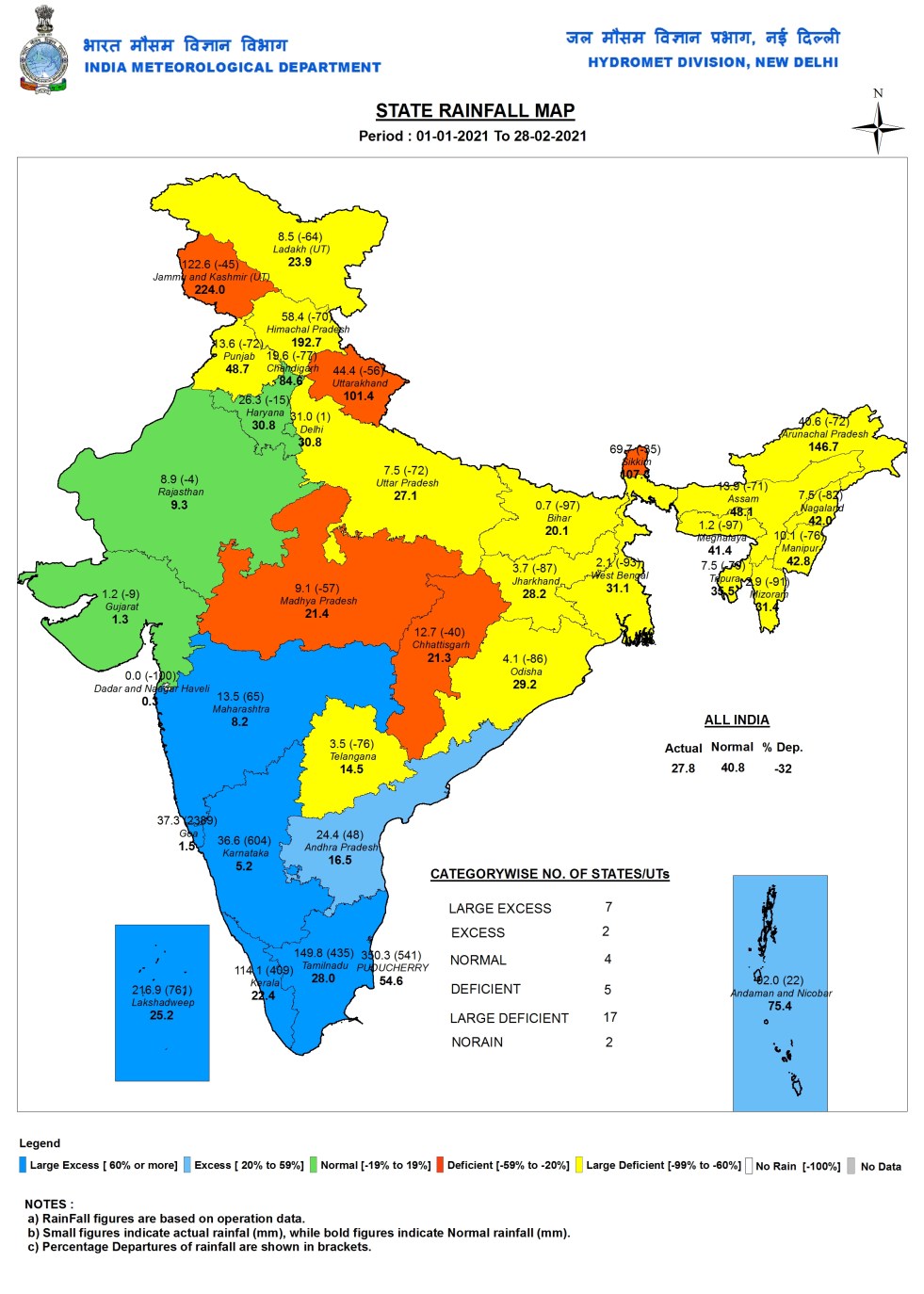
In the just concluded Winter Season (Jan 1 2021 to Feb 28 2021), as per India Meteorological Department (IMD), India received 32% below Normal Rainfall. The Normal rainfall in this two-month season is supposed to be quite low at 40.8 mm, but the actual rainfall was just 27.8 mm, which means rainfall was less than 0.5 mm per day in the season. Out of this the Rainfall in January 2021 was 20.2 mm, 17% above the normal rainfall of 17.3 mm. So in February 2021, the rainfall was 7.6 mm, against the normal rainfall of 23.5 mm, so the February rainfall was 68% below normal!
Continue reading “District wise Winter 2021 Rainfall in India”Tag: Uttarakhand

Force Multipliers in Uttarakhand disaster
Given below if the text of the presentation made by SANDRP coordinator on Day 1 at the FICCI-NIDM (NIDM: National Institute of Disaster Management; FICCI: Federation of Indian Chambers of Commerce and Industry) 3-day training program on Feb 18-20, 2021 on “Resilient Infrastructure in Hilly Areas: Avalanche, GLOF & Debris Flow” in the context of the Chamoli Disaster of Feb 7, 2021.
Continue reading “Force Multipliers in Uttarakhand disaster”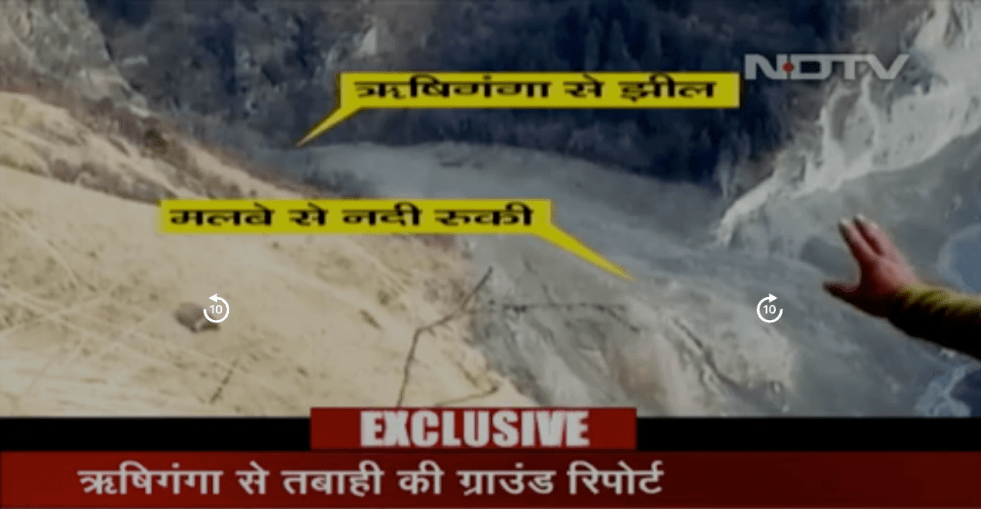
Rishiganga Ground visit report reveals landslide dam & raises questions
The first ground visit report of the Rishiganga catchment in Uttarakhand’s Chamoli district by Dr Naresh Rana, a geologist after the Chamoli Avalanche disaster of Feb 7, 2021 has been shared by NDTV on Feb 11, 2021[i]. Dr Rana visited the catchment of the Rishiganga to understand the ground situation on Feb 10 ,2021 and this is possibly the first such visit since the disaster.
Continue reading “Rishiganga Ground visit report reveals landslide dam & raises questions”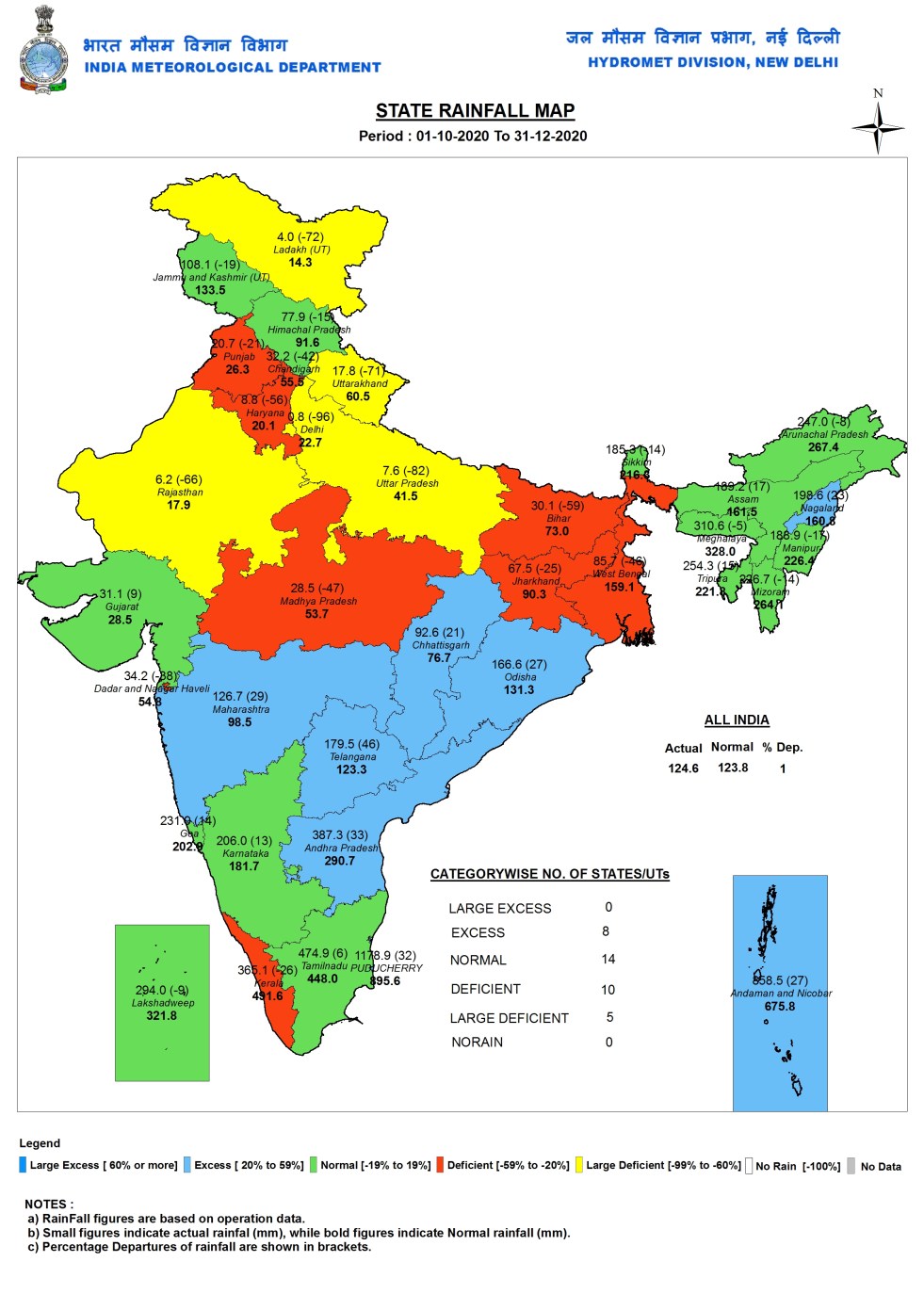
Post Monsoon 2020: State wise Rainfall
According to India Meteorological Department (IMD), during the just concluded Post Monsoon Rainfall for 2020, that included rainfall during Oct-Dec months, India received 124.6 mm rainfall, 0.64% above the normal rainfall of 123.8 mm during the period. As per IMD[i] definition, the rainfall was thus normal.
This three-month period from Oct 1, to Dec 31 includes the North East Monsoon that mainly affects parts of South India including Tamil Nadu, Puducherry, Rayalseema, parts of Karnataka and Kerala. IMD declared on Jan 1, 2021 that the of NE Monsoon ended on Dec 31, 2020 with normal overall rainfall: TN had 6% above normal, Karnatak 13% above normal, Puducherry 32% above normal, Andhra Pradesh 33% above normal. However, Lakshadweep had 9% below normal and Kerala 26% below normal. This monsoon provides 48% of the annual rainfall of TN so it is most imp for that state.
The rainfall revived only towards the end of November, mainly due to two consecutive cyclones — Nivar and Burevi — both of which developed in the Bay of Bengal. While Cyclone Nivar crossed the coast close to Karaikal near Puducherry and brought heavy showers for the east and coastal districts of Tamil Nadu, Cyclone Burevi weakened before it reached land.
Continue reading “Post Monsoon 2020: State wise Rainfall”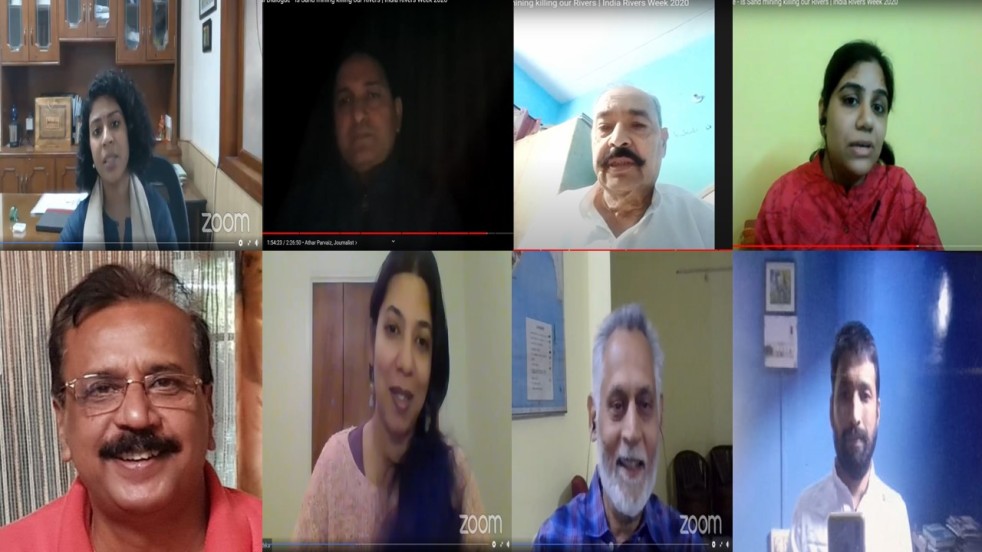
North India Sand Mining Dialogue under IRW 2020: Local communities need to have key role in governance
The Key message that came through from all the panelists and North India Sand mining presentation was that if we are to see any improvement in the murky state of sand mining that is a threat to everyone today, then we urgently need key role for the local communities and civil society in sand mining governance. The second loud & clear message was that the Supreme Order of 2012 on the need for environmental appraisal and clearance of sand mining leases stands violated in letter and spirit by the Union Government. These messages also provide us the way forward.
Continue reading “North India Sand Mining Dialogue under IRW 2020: Local communities need to have key role in governance”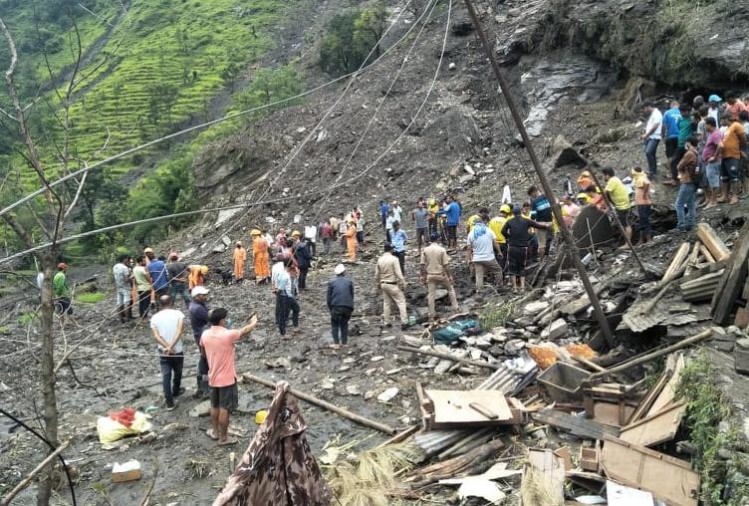
Cloud Bursts in Indian Himalayan Region in Pre-monsoon & Monsoon 2020
The Indian Himalayan region has been facing increased cloud burst incidents for past many years. These events are followed by flash floods, landslides causing widespread damages to human lives and properties. However the forecasting, monitoring and management efforts are lagging far behind. This state wise overview attempts to understand the trend and resultant losses from such incidents during the pre-monsoon (Apr-May) southwest monsoon season (June-Sept) 2020.
SANDRP has been highlighting the issue since 2018. The details of these can be seen by exploring the hyperlink of Uttarakhand in 2018 and 2019, Himachal Pradesh 2019, Jammu and Kashmir and North East 2019.
Continue reading “Cloud Bursts in Indian Himalayan Region in Pre-monsoon & Monsoon 2020”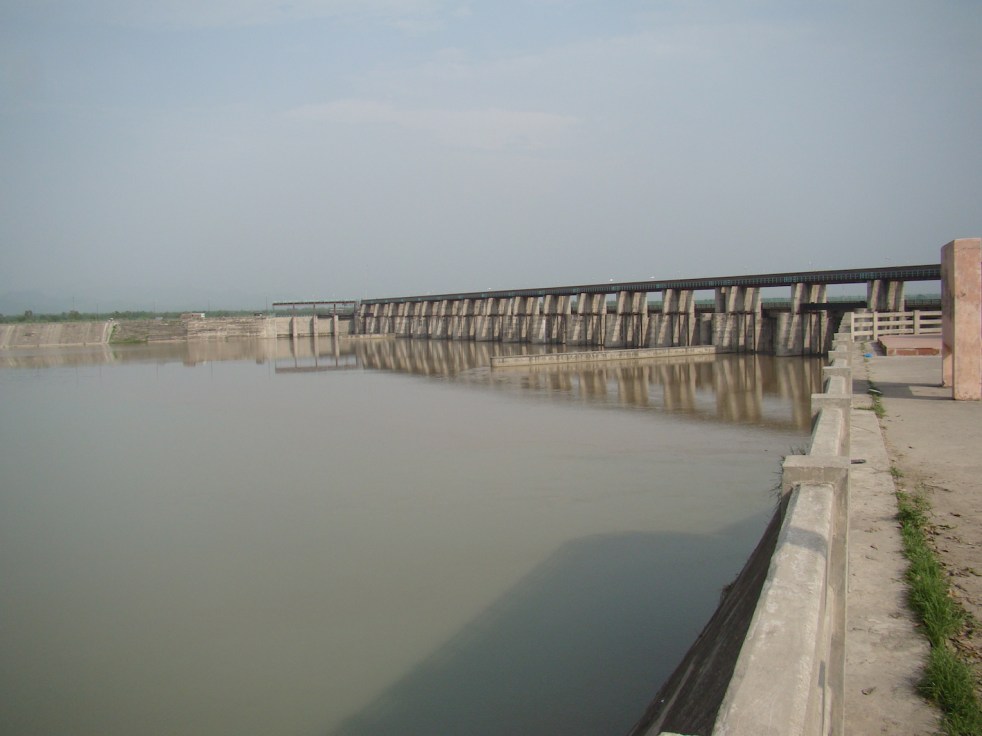
Sau sunar ki aur ek lohar ki – How a single decision sealed Yamuna’s fate
Guest Article by Shri Manoj Misra
Delhiites in early-mid April 2020 were pleasantly surprised to find a much healthy river Yamuna in their city. Social media was full of pictures and videos. Many had resigned not to find a living Yamuna in the city in their lifetime. But the pleasant fact was that the river in the city had indeed as if by magic come alive and presented a picture that was hard to believe. There was a river side which did not stink and looked cleaner than usual.
Continue reading “Sau sunar ki aur ek lohar ki – How a single decision sealed Yamuna’s fate”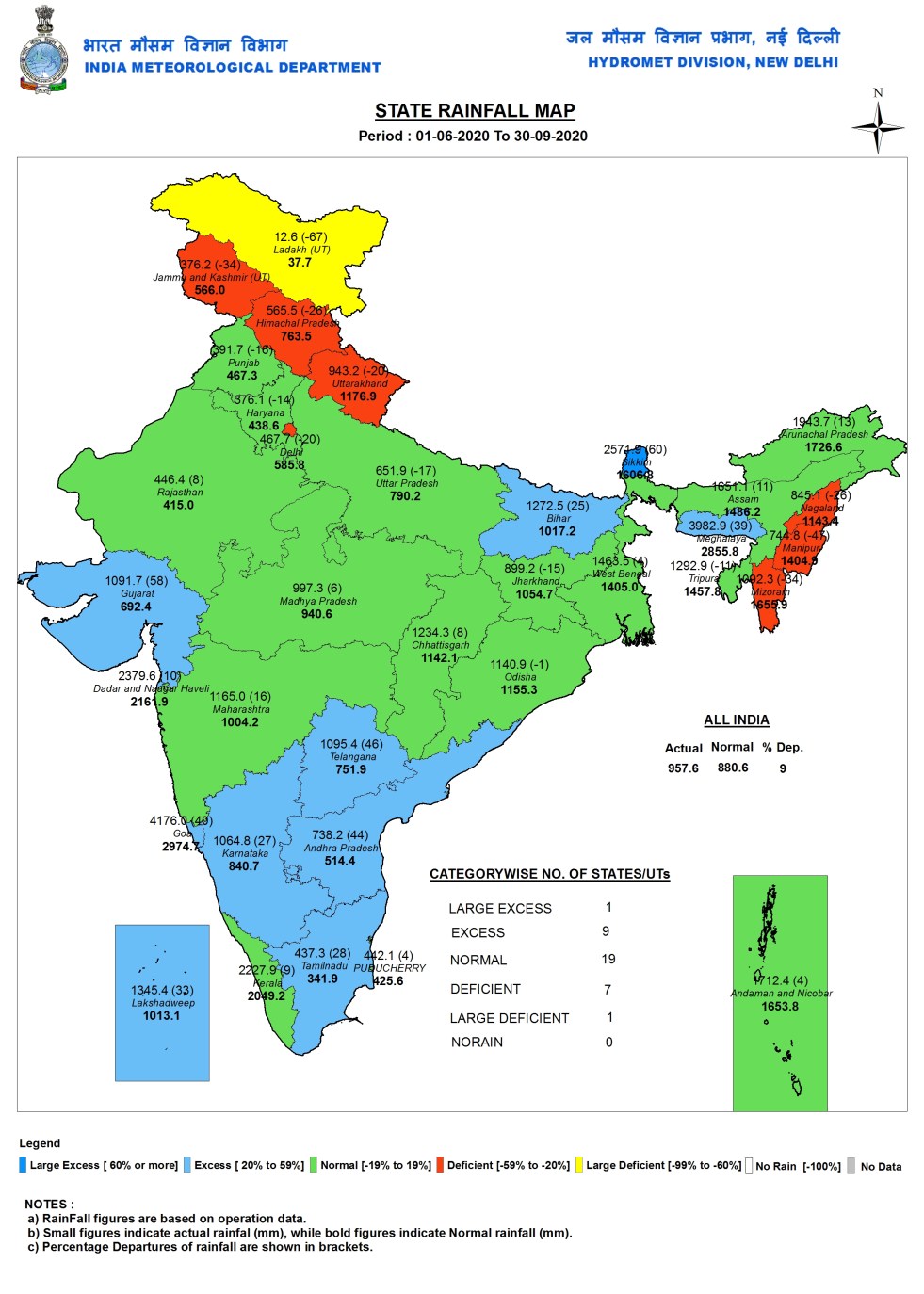
SW Monsoon 2020: District Wise Rainfall
India received 957.6 mm rainfall in Just concluded South West Monsoon 2020, during the scheduled 4 month monsoon from June 1 to Sept 30, 2020. This is 8.74% above normal monsoon rainfall of 880.6 as per India Meteorological Department (IMD). This is considered ABOVE NORMAL rainfall, since rainfall is in the range 4-10% above Normal rainfall. This sounds good at national level, but the situation on ground could be very different, if we see the rainfall across the country.
It is noteworthy as per even IMD, monsoon has not yet withdrawn from most parts of the country. But IMD closes its monsoon rainfall account at 0830 hours on Sept 30, so all rainfall after that hour has to be counted in “Post Monsoon” rainfall book, even though the rainfall is very much part of monsoon as per IMD.
Continue reading “SW Monsoon 2020: District Wise Rainfall”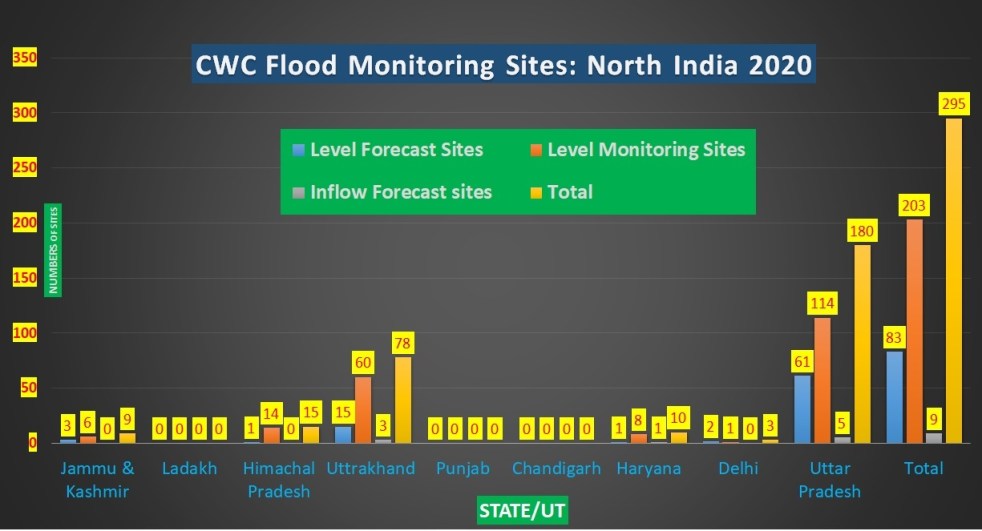
North India; CWC Flood Forecasting Sites 2020; New Website Old Problems
Flood forecasting is an important activity during monsoon, considering the huge and increasing flood prone area, flood frequency, intensity and flood damages. Accurate and timely flood forecasting can hugely help reduce the damages due to floods. Central Water Commission (CWC) is the only agency responsible for flood forecasting in India. To understand the CWC’s flood forecasting better, we have compiled the list of the various flood, inflow forecasting sites and flood monitoring sites in India.
In this compilation, we have given state wise list of CWC’s level forecasting, flood monitoring and inflow forecasting sites in North India, comprising of Union Territories Jammu & Kashmir, Ladakh, Chandigarh, Delhi and states of Himachal Pradesh, Uttarakhand, Punjab, Haryana and Uttar Pradesh. It includes available details like name of river, sub basin, Warning level (WL), Danger Level (DL), High Flood Level (HFL), Full Reservoir Level (FRL), Maximum Water Level (MWL), as applicable. As we see below, there are many gaps in this basic information for the sites that are part of CWC’s list. A similar zonewise overview of CWC’s sites was compiled in 2018 and 2019, which can be seen here: Overview of CWC Flood Forecasting Sites 2018: North India; Overview of CWC Flood Forecasting Sites 2019: North India. We have brought this updated compilation for 2020 as there are large number of changes.
Continue reading “North India; CWC Flood Forecasting Sites 2020; New Website Old Problems”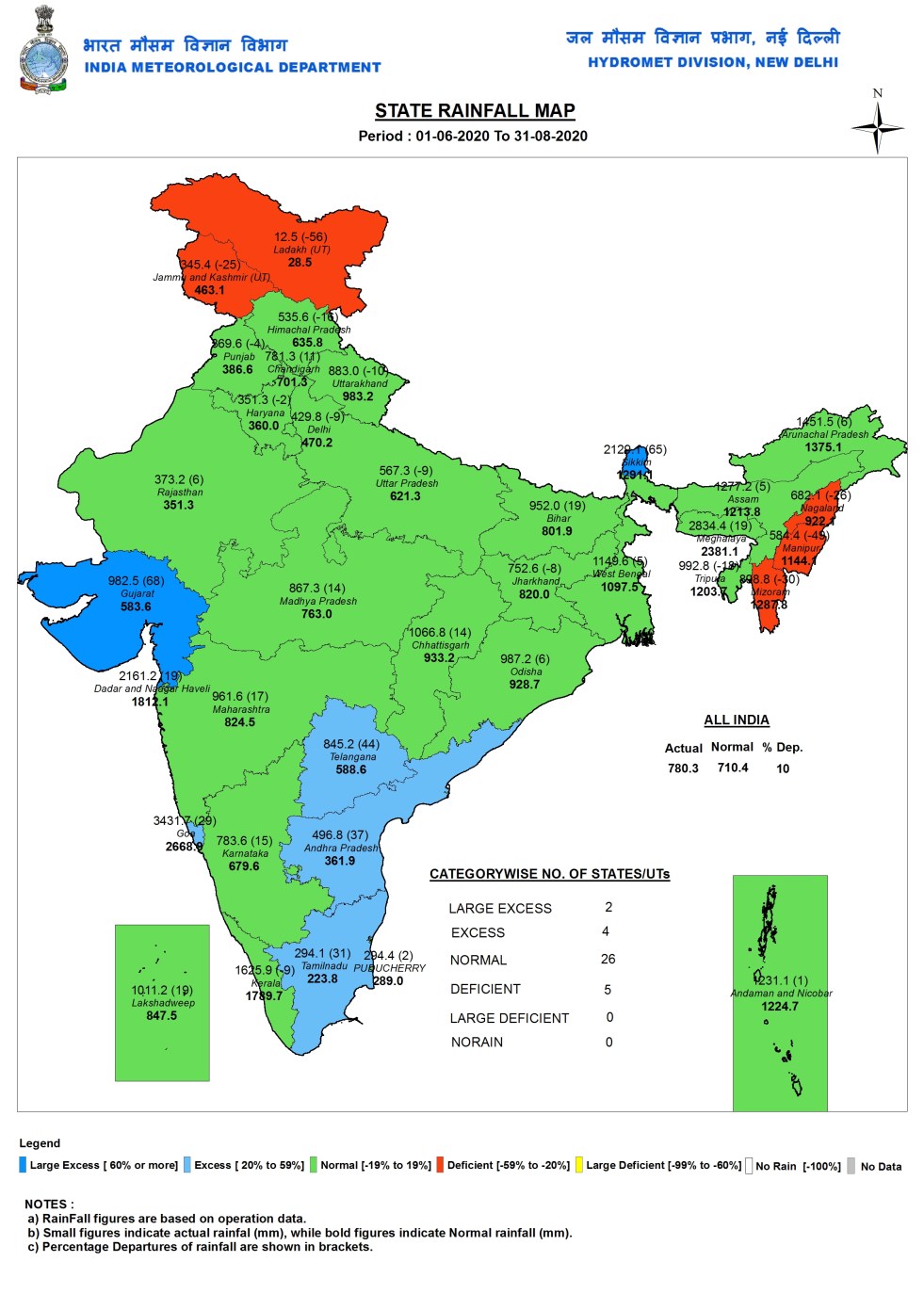
District wise rainfall in June-Aug 2020 in India
In the ongoing South West Monsoon, India received 44 year old high surplus rainfall of 327 mm in just concluded Aug 2020, 26.6% above normal rainfall of 258.2 mm. This helped the total June-Aug 2020 rainfall to achieve 10% surplus, with actual rainfall 780.3 mm, 69.9 mm higher than normal rainfall of 710.4 mm. In June the country received 18% above normal rainfall and in July it received 9.9% below normal rainfall, the rainfall at the end of June was just 1.1 mm above normal. Thus almost the entire surplus rainfall is thanks to the rainfall during Aug 2020. The rainfall distribution has however, been far from normal that these figures suggest, as we can see from the state wise and district wise figures below.
Continue reading “District wise rainfall in June-Aug 2020 in India” SANDRP