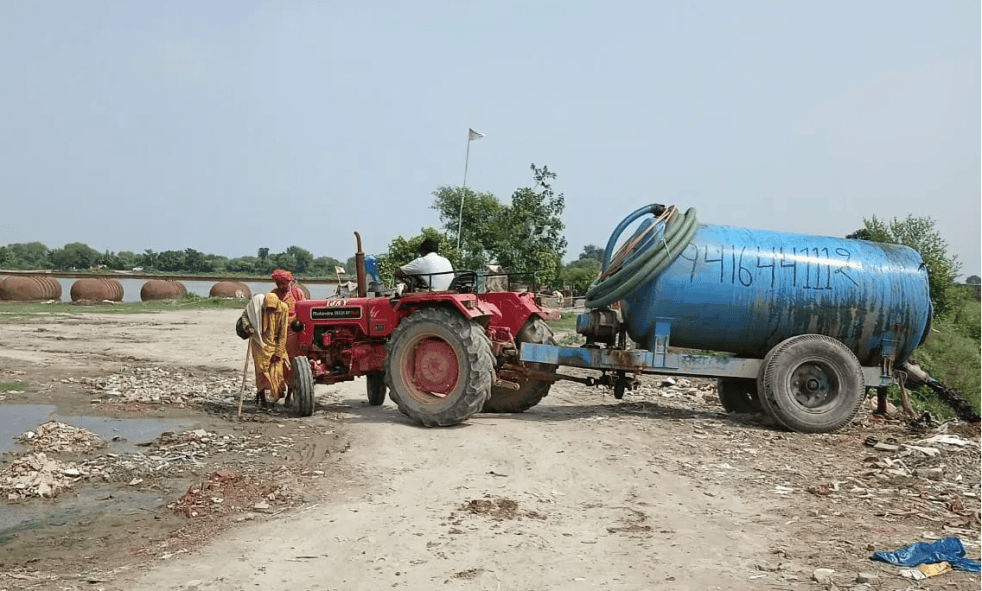
(Feature Image: A tanker discharging untreated sewage in an open area near Yamuna river close to Mokshdham in Vrindavan. Source: Amar Ujala, Sept. 10, 2026)
Multiple reports over the past month again highlight serious failures in water governance in major cities in the Yamuna basin including Delhi, Gurugram, Greater Noida, Noida, Vrindavan and Bhopal. The problems range from poor rainwater harvesting and inadequate sewage networks to ineffective sewage treatment capacity, unregulated groundwater extraction and neglect of water bodies.
In Delhi, agencies have still not fully complied with NGT directions on rainwater harvesting, groundwater recharge and monitoring. At the same time, the High Court is forced to bring different agencies together and set timelines to address sewage, drainage and industrial-area problems.
Meanwhile, the CAG report has found that the Gurugram city is expanding sewage treatment capacity without ensuring the required sewerage network and efficiency of existing STPs. Notably, recurring flooding in Delhi and Gurugram underlines systematic flaws in drainage and urban planning.
The proceedings in NGT cases from Noida and Greater Noida reveal administrative failure to protect groundwater and surface water resources. There are thousands of illegal vehicle-washing units extracting groundwater, while wetlands are being defiled by solid-waste dumping.
The incident of a tanker dumping untreated sewage close to Yamunain Vrindavan raises questions about the objectives of river-cleaning programs. In Bhopal, the NGT continues to deal with pollution and encroachment of the Kerwa, Kaliasot and Bhoj wetlands.
These cases point to a common problem which is the absence of an effective urban water policy and management system in the river cities. In fact, the judiciary is deeply occupied with routine matters of water governance that should have been handled by the responsible agencies. In reality, these problems are a result of absence of policy and fragmented planning.
Therefore, what is required is an integrated urban water policy that treats available water resources and the problems of drainage, sewage and water bodies pollution as part of one system. The policy must guide the cities to protect their natural water bodies, maximise rainwater recharge, optimize treated sewage usage and regulate groundwater extraction.
At the same time, it must ensure complete sewage collection, treatment and prevent untreated effluents from reaching rivers and lakes. Unless river cities adopt such a holistic approach, urban water problems will continue to multiply and the condition of rivers, lakes and groundwater will deteriorate further in Yamuna basin.
DJB given 4 weeks to reply on RWH systems allegations NGT has granted the Delhi Jal Board (DJB) four weeks to file a compliance report following allegations that it failed to adhere to the tribunal’s directions on rainwater harvesting systems (RWHS), groundwater recharge, and quality monitoring in the Capital. The applicant in the case claimed that while NGT had explicitly stated that RWHS should not be installed near storm water drains to prevent groundwater contamination, DJB and other agencies including DDA, NDMC, MCD and NHAI have not complied.
The applicant also pointed to NGT directives mandating the installation of piezometers near RWHS to monitor groundwater levels and water quality, as well as separators to remove pollutants before recharge. “Even after nearly seven years of the order, not a single piezometer has been installed by DJB. Each department installing RWH systems must install piezometers within a 1 square km radius. With Delhi spanning 1,500 sq km, 1,500 piezometers are required, but nothing has been done, particularly by DJB,” the applicant said.
Another concern pertained to the depth of recharge borewells. The applicant alleged that “most” borewells are 100 to 400 feet deeper than the water level, violating the NGT directive that they should be at least five metres above the static water table. It was also alleged that deficient RWHS near storm water drains have not been closed or repaired. The applicant cited an action taken report filed by Delhi Pollution Control Committee in 2025, which showed that show cause notices had been issued to DDA and MCD over RWHS deficiencies.
DJB had sought four weeks to obtain instructions and file a further compliance report, which the NGT granted. The next hearing is scheduled for October 27.
The DJB filed a compliance affidavit on Aug 21, 2025 listing the steps taken to comply with the court order of 2019. The applicant, Mahesh Chandra Saxena submitted a tabular note on Feb 14, 2026 disclosing the status of non-compliance by the authorities especially the DJB.
Delhi HC calls for immediate measures to address pollution In a matter concerning waterlogging, untreated sewage, inadequate drainage infrastructure and pollution of the Yamuna, a Division Bench directed multiple authorities to take coordinated and time-bound measures to address deficiencies in drainage, sewage treatment and the redevelopment of non-conforming industrial areas.
The Court expressed serious concern regarding the condition of the open Abul Fazal Drain, which runs alongside a road used by vehicles and pedestrians without adequate protection. Pursuant to its earlier order dated 28 March 2026, the Court had directed the MCD to construct a separator wall between the drain and the road and to install reflectors and lights to make the drain visible to commuters.
The Uttar Pradesh Irrigation Department informed the Court that sanction had been sought from the NMCG and that the Dept intended to commence the work by 15 Sept 2026. The Court directed the NMCG to consider the application and communicate its decision at the earliest.
Th HC noted that 28 existing STPs, having a combined capacity of 735 MGD, were operational and meeting the NGT-prescribed 10/10 parameters. A further 9 STPs, with a combined capacity of 78.86 MGD, were under upgradation and were presently operating at the 30/50 standard. Their upgradation to the 10/10 standard was expected to be completed between December 2027 and May 2028.
Redevelopment of non-conforming industrial areas The Court considered the redevelopment of 25 non-conforming industrial areas in Delhi. Plans prepared by various agencies had been submitted to DSIIDC, forwarded to the MCD and thereafter sent to the DDA for consideration of necessary relaxations under the Master Plan. The Court noted that the absence of a response from the DDA had resulted in a stalemate.
The Court directed the Additional Commissioner (Planning), DDA, to hold a meeting with all authorities concerned on 31 August 2026 and establish clear timelines for approval of the plans and consideration of necessary relaxations.
The Court directed the DDA, Ministry of Industries, GNCTD, MCD and DSIIDC to consider the relevant documents and demarcate the entire Samaypur Badli area so that a fresh redevelopment plan could be prepared. A meeting was directed to be held on 2 September 2026 at 11.30 a.m., under the Chairmanship of the Secretary, Ministry of Industries, GNCTD. Thereafter, Square Design, the agency concerned with preparation of the plans, was directed to commence preparation of a fresh redevelopment plan within 3 months.
The Court directed the authorities concerned to file updated status reports and comply with the timelines stipulated in the order. Further hearing on 25 September 2026 at 4.00 p.m.
The High Court has on Aug 24 directed the NMCG to review the DJB’s proposal to set up 13 new decentralized STPs to prevent untreated sewage from flowing into the Yamuna.
DJB blames DUSIB for delay in STPs The DJB is taking all necessary and expeditious steps to ensure complete interception, diversion and treatment of sewage from all identified drains, subject to the grant of requisite permissions by the concerned authorities. This was stated in the report filed by the DJB on August 29, 2026 before the NGT. The report stated that DJB had already submitted to the tribunal that out of the 22 drains identified for trapping by DJB, the works for five drains (Pant Nagar / Lajpat Nagar) have been completed. In respect of KD1 (Hill view SPS, Vasant Vihar), the modular decentralised STP (STP) work is in progress and likely to be completed by December 31, 2026.
Why Delhi’s drinking water is stuck in a chemistry loop Every year during peak winter and early summer (October to April, flow in the Yamuna river drops sharply and ammonia concentration increases. These ammonia spikes pose a direct threat to Delhi’s water supply, since the Yamuna is the city’s primary drinking water source. Each year, this indirectly affects 19.5 million people in Delhi, yet the issue goes unresolved.
Ammonia exists in water in two equilibrium forms: ammonia and ammonium ion. It harms the entire ecosystem, from fish and amphibians to land animals and humans. Yet, we have not come up with an affordable and scalable ammonia-removal method. This points to a systemic failure, where every responsible authority acknowledges the crisis without addressing it effectively. (Arunima Singh)
NGT orders DDA & IFC to end Yamuna floodplain deadlock According to the 16 July hearing at NGT, DDA received a map of the Delhi floodplains in March 2026. It was prepared by Geo Spatial Delhi Limited (GSDL) and contained detailed elevation measurements and pointed to the area that is likely to be inundated during floods, with a 1% annual probability. DDA then began working on the physical demarcation of the plains using bollards, or thick metal posts. DDA had then set a deadline of 31 July for the completion of the process.
The Irrigation and Flood Control department, however, sent a revised map of the floodplains to DDA in June. “…The DDA has informed that … out of 277 bollards, 206 bollards were fixed, but because of the receipt of the communication from the Irrigation and Flood Control Department of GNCTD, the DDA has not proceeded,” read the NGT document.
DDA told NGT that they stopped the demarcation work and awaited further instructions on whether they should act on the revised map. DDA is now awaiting communication from the I&FC dept. After ordering the Delhi Environment Secretary to clear the confusion and hold a joint meeting of the two depts within a week, NGT scheduled the next hearing on the case for Sept. 18. It asked for progress reports from both departments a week before the next hearing.
63 MLD sewage bypasses STPs in Gurugram The city was generating 550 MLD of domestic sewage in areas under GMDA. Of this, 90 MLD was being treated and reused by colonisers within their premises, leaving 460 MLD to be treated through govt system. GMDA had an installed capacity of 415 MLD across 12 STPs. Yet the average sewage reaching the plants was only 397 MLD, leaving 63 MLD outside the treatment system.
GMDA told CAG that it had prepared an action plan after a detailed survey of drains involving MCG, HSVP, HSIIDC, PHED & HSPCB. It said measures had been taken to increase treatment capacity to 977 MLD by Dec 2028, enough for projected sewage generation of 800 MLD as well as sewage diverted from drains. The existing gap, however, raises a question over how effectively that additional capacity can be used if sewer connectivity does not go up.
IIT study maps how Gurugram floods Based on a citywide “FloodAstra” simulation of 107.3 mm of rainfall over three hours peaking at 73 mm per hour, the study estimated that 31.48 million cubic metres of water entered Gurugram over six hours: 30.98 million cubic metres from direct rainfall and about 0.50 million cubic metres from upstream inflows. The largest sector-to-sector transfer recorded was 44,237 cubic metres, flowing from Sector 1 into Sector 111. Researchers identified 125 connected drainage areas feeding shared corridors across ward and sector lines, warning that fixing or diverting a drain at one point could shift the flooding burden elsewhere in the network rather than solving the problem.
Jhuggis, temple on waterbody, NGT orders removal, restoration The NGT has ordered removal of encroachments found on a nearly 2.5-acre water body in Fatehpur Jharsa, along with restoration and rejuvenation of the pond. A govt demarcation also found a road and footpath built by Haryana Shehri Vikas Pradhikaran (HSVP) over about 1,077 sq yards of the land. The order was passed on Aug 24 by a bench of Justice Arun Kumar Tyagi and expert member A Senthil Vel, disposing of the original application with directions for removal and restoration.
The water body is recorded as a johad in revenue records, and the 2018-19 Jamabandi cited by MCG confirmed this. HSVP told the tribunal that the land had been acquired through notifications issued in 2003 and 2004 for development of residential and commercial Sector 47, with possession handed to its estate officer in Dec 2005. It said the encroachments had come up after a May 25, 2015 status quo order of Punjab and Haryana high court, passed in a separate case challenging the land’s acquisition and that it would remove them according to law once the status quo lifted.
Metro pillars planned at Basai pond’s edge raise ecological concerns Three piers of Gurgaon metro corridor are planned along the edge of Basai pond, with 20.9 square metres of land required for their construction, according to a response by GMRL to an RTI application. The proposal has raised concerns over safeguards for a waterbody already facing multiple ecological pressures. GMRL said the metro project does not fall under EIA Notification, 2006, and does not require environmental clearance, though an ESIA had been carried out.
Illegal dying units keep returning
Pollution shoots up 9X in Haryana An analysis of data collated by Haryana State Pollution Control Board between Jan 2021 and June 2026 – covering 14 monitoring points in Yamuna Nagar, Karnal, Panipat, Sonipat, Palwal and Faridabad – found several pollution hotspots along the river and its feeder drains. Of 57 samples with BOD readings in 2026, 38 breached the CPCB’s bathing-water limit. Faecal coliform exceeded the desirable level in 35 samples.
NGT seeks fresh report on illegal vehicle washing centres in Noida, G Noida The green body is hearing a matter initiated suo motu based on a newspaper report which claimed that 1,000 illegal vehicle washing centres in Noida and Greater Noida were wasting around 30 crore litres of water every month. In a recent order, a bench of NGT noted that the state’s groundwater department had submitted a report that 193 washing centres had been identified in Gautam Buddha Nagar, of which 55 are in industrial areas and 138 in non-industrial areas. It noted that the report detailed that among the 55 industrial units, only 14 have the requisite permissions, while 12 have applications pending.
23 units, however, were found to be operating without any permission or application, on whom the district groundwater management council had decided to impose a penalty of ₹2 lakh under the UP Groundwater Act, the bench noted. Regarding the 138 units in non-industrial areas, the Tribunal said the Uttar Pradesh Pollution Control Board counsel informed it that the electricity supply to 100 units has already been disconnected. The Tribunal, however, sought a “complete report” in this regard from the UPPCB. It directed the groundwater department and UPPCB “to file their compliance reports within four weeks.” Further hearing on Oct 12.
UPPCB tells Noida to act on ‘waste dumping’ near wetlands In a letter dated August 18 and addressed to the chief executive officer of the Noida authority, the UPPCB’s regional office in Noida asked the authority to direct the concerned officer to take steps to ensure compliance. The direction follows the NGT’s July 24 order, which recorded an applicant’s submission that “the said representations have not been considered till now.”
NGT was told that representations regarding the alleged dumping had been pending without action since 2025. One representation was submitted on July 30, 2025, while another was submitted on July 10, 2026. The August 18 letter is the latest administrative step in the matter. The NGT has listed the matter for October 7.
Tanker dumping sewage in Yamuna in Vrindavan Sewage waste collected near Moksha Dham in Vrindavan was reportedly transported in a tanker and emptied near the Yamuna riverbank instead of being sent for treatment. Local residents and Yamuna devotees objected to the incident. The incident raises questions about the effectiveness of ongoing Yamuna-cleaning and sewage-treatment measures. It is claimed that 28 of 32 drains flowing into the Yamuna have been tapped.
Panel to finalise full tank level of Kerwa, Kaliasot, Bhoj wetlands The NGT central bench directed the constitution of a 7-member committee on Aug 31, 2026, to finalise the full tank level (FTL) of Kerwa, Kaliasot and Bhoj Wetland (Bada Talab and Chota Talab) in Bhopal.
The committee should also ensure geo-tagging, satellite imagery, ground truthing, remote sensing and drone survey application with videography at the places where the FTL water level has exceeded the fixed point of pillars already installed during the summer season. In addition, the court directed the inclusion of 4 environmental specialists to participate in the working of the committee formed. Next hearing on September 15, 2026.
Calculate fine for damage to Lower Lake: NGT The NGT has asked the MP PCB to calculate the amount of penalty to be paid by the BMC (Bhopal Municipal Corp) for damage done to Lower Lake by allowing 8 to 10 MLD untreated sewage to flow into the waters and pollute it. A clear report should be submitted within 30 days. Next hearing on Sept 28.
The NGT further asked BMC To furnish information to the NGT on STPs, water supply, drains discharging untreated water into Lower and Upper Lake and measures taken to prevent it.
NGT questions AMRUT sewage system Raising questions over the effectiveness of the city’s sewage system under AMRUT, the NGT on Aug 17 formed another committee to visit Lower Lake and submit a report on drains allegedly discharging untreated sewage into the lake. The Bhopal-based central bench of the NGT took suo motu cognizance of a media report that said that a total of 28 small and large drains are discharging waste water and polluting the lake. The report added that there is no remaining source of freshwater for the lake and only polluted water now enters the lake. NGT asked the newly formed panel to submit its report on the claims within six weeks. The next date of hearing is Oct 5.
DAMS & HEPs IN YAMUNA BASIN
HP: Safety gaps in 3 dams, 12 are high hazard The findings of the Annual Report on Dam Safety–2025-26 was tabled in the Vidhan Sabha on Sep 3 2026. The report documents annual inspections, safety reviews, evaluations and compliance with statutory requirements. While the majority of the dams were found to be functioning satisfactorily, Giri Jateon barrage and the Malana-I and Malana-II hydel projects were placed in Category-II due to deficiencies requiring sustained monitoring and timely corrective action.
The condition of the Giri Jaton Barrage is particularly concerning in the status report. The inspection found evidence of differential settlement, or uneven subsidence, at the expansion joint of one of the barrage piers. The instrument installed to monitor this settlement is currently not functioning. Erosion was also observed in the downstream protection works. At several locations, concrete blocks and the curtain wall were found displaced or shifted from their original positions. Cracks were also recorded in structural components. The report recommended remedial measures along with close monitoring of these issues. The compliance report regarding the Emergency Warning System is also still pending.
Aug. 31, 2026 EAC meeting agenda Shyampur Barrage Major Micro Irrigation Project, Madhya Pradesh – Terms of Reference
The project site is located on the Parbati river which is directly tributary of the Yamuna and it meets in river Yamuna in District Etawa UP. Parbati river flows for 461 km & in MP then 9 kms. In UP where it joins Yamuna river. The Dam site is located between village Shampur (Dist. Sehore) and Chhapri (Dist. Shajapur) MP. The Preliminary investigation was started in 2018 to construct storage reservoir to irrigate 12000 ha under Sehore tehsil of Sehore District. The Gross & Culturable Command Area is 17140 Ha and 12000 Ha respectively.
INTERLINKING OF YAMUNA RIVERS
The surplus that never was: Ken-Betwa’s costly bet The trouble is that almost no one outside govt has been allowed to check the arithmetic. Himanshu Thakkar of SANDRP, has argued for two decades that the hydrological study underpinning the project is treated as a state secret, justified on the grounds that the Ken eventually feeds the Ganga and crosses an international border. The Central Empowered Committee, appointed by the Supreme Court, reached a similar conclusion in an official report, finding that declaring the Ken surplus before meeting the needs of its own upper catchment, a largely tribal region, was premature.
Ken-Betwa Project Sparks Protests In this documentary, we speak to villagers facing displacement, experts (Himanshu Thakkar, SANDRP) and activists to understand the project, the arguments for and against it, and what is at stake for the people living on the ground.
As Adivasis fight displacement and the destruction of a tiger reserve, questions surround how an Andhra-based company with limited dam-building experience won the Rs 3,389-cr Daudhan Dam contract in India’s Rs 44,605-cr Ken-Betwa project. The Nagarjuna Construction Company donated Rs 60 cr to the BJP through electoral bonds in years when it faced tax raids.
Women-led pond restorations Jal Sahelis reviving local water management are challenging the Ken-Betwa Project’s controversial vision of development & water security in Bundelkhand.
YAMUNA FLOWS
Delhi plans to route Tehri Dam water Delhi govt is working on a plan to increase Yamuna’s environmental flow by 1,300 cusecs by routing water through Tehri Dam reservoir to Hindon river, while separately undertaking measures to reduce major transmission losses in a canal network supplying the capital.
A presentation reviewed by Delhi govt shows plans to also divert 500 cusecs to Yamuna through a proposed 29-km-long pipeline, according to a senior Delhi govt official. The plan is intended to ensure that 1,800 cusecs of water is available at Okhla Barrage.
Delhi Jal Board (DJB) has issued a letter of intent to Water and Power Consultancy Services (WAPCOS) to prepare a DPR, with its completion expected by this Oct 2026. Delhi govt will then submit to ministry of housing and urban affairs. A joint survey by DJB and Uttar Pradesh Jal Nigam was conducted in this regard on June 29, the official added.
The second major intervention focuses on reducing transmission losses in the canal network called Delhi sub-branch system. Currently, 330 cusecs is released for Delhi’s drinking water supply, but the city receives only around 230 cusecs after nearly 30% conveyance losses.
Govt is working with Haryana’s irrigation department on repairs and rehabilitation of the system. Three meetings have been held between DJB and the Haryana department on this, the official said. Delhi has also sought Haryana’s consent for bearing its share of the cost of lining the Delhi sub-branch.
A broader plan includes six projects covering different zones of Delhi, with a cost estimated at Rs 15,000 crore. Funding is proposed through urban challenge fund, Delhi govt/DJB contributions and loans, including financing from HUDCO and NABARD. Govt is also planning to regulate groundwater extraction in the capital and finalise a new policy in this regard.
Govt is also planning to regulate groundwater extraction in the capital and finalise a new policy in this regard. Taken together, these measures seek to increase Yamuna’s lean-season flow while improving the efficiency of the water system supplying Delhi and reducing losses before water reaches the city, the official said.
Under this proposal, as part of reducing water losses in the Munak canal system, pipelines are proposed to be laid from Khubru head of the canal system up to Kakroi head, followed by rehabilitation of the DSB of the Munak system. The pipeline system will be around 25km, with an estimated cost of ₹750 crore, while rehabilitation of 41.6km of the DSB canal will be undertaken. Currently, the DSB canal witnesses more than 30% of water transmission loss.
YAMUNA FLOODPLAIN
यमुना नदी बाढ़ क्षेत्र प्रबंधन इसमें कोई संदेह नहीं है कि दिल्ली में यमुना के बाढ़ क्षेत्र (खादर) में बढ़ते अतिक्रमण ने प्राकृतिक बाढ़ को आपदा में बदलने का खतरा पैदा कर दिया है। खादर क्षेत्र का सीमांगन नहीं होने के कारण ओ-ज़ोन (यमुना खादर) का सही तरह से क्रियान्वयन नहीं हो रहा है। लेकिन वर्तमान बहस समस्या के केवल एक हिस्से तक सीमित है, जबकि इसके मूल कारणों पर पर्याप्त ध्यान नहीं दिया जा रहा। सबसे पहले यह समझना जरूरी है कि यमुना के खादर पर किस प्रकार के अतिक्रमण हुए हैं और इसकी सुरक्षा के लिए कौन-सा कानूनी एवं संस्थागत ढांचा उपलब्ध है।
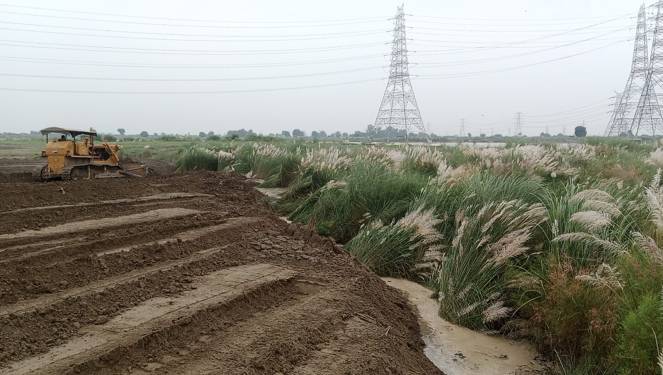
MPD 2047 redraws floodplain even as NGT awaits final demarcation NGT had given DDA time till this July 31 to demarcate the 1-in-100-year flood zone, but the agency on July 15 sought additional time to complete the exercise. Senior officials and experts have questioned the scientific basis of the zonal demarcation and argued that activities should be restricted across the entire floodplain.
“Centre should not approve this proposal as it would legitimise encroachments in one of Delhi’s most ecologically sensitive areas. It would further dilute the already weakened O-Zone provisions and set a dangerous precedent for floodplain governance across the country,” said Bhim Singh Rawat of SANDRP. The researchers estimated that roughly one-third of Delhi’s floodplain has become disconnected over the past century because of embankments and urban development.
SC sets aside NGT order against AoL over floodplain damage The Supreme Court on Aug. 22 set aside a 2017 order of the NGT which had held the Art of Living Foundation responsible for damage to the Yamuna floodplains during its 2016 World Culture Festival. The tribunal allowed the Foundation’s appeal and directed the Delhi Development Authority (DDA) to refund the ₹5 crore environmental compensation deposited by the Foundation.
The Foundation maintained that the site had never been demarcated as a floodplain and that there had been no scientific assessment establishing the extent of environmental damage attributable to the festival. It also questioned the fastening of liability on it when the permissions for the event had been granted by the DDA. The Court today allowed the appeal, set aside the NGT judgment and directed the DDA to return the ₹5 crore deposited by the Foundation as environmental compensation. A detailed judgment is awaited.
Green signal for Akshardham complex expansion The proposal seeks the expansion at Pramukh Swami Maharaj Marg, Akshardham Setu. According to the conditions set by SEIAA, the total built-up area after the expansion cannot exceed 1.02 lakh sqm. The proposal involves demolition of 2,954.2 sqm of the existing Sabha Mandap & fresh construction of up to 24,500 sqm, resulting in a net addition of 21,545.7 sqm over the existing built-up area of 80,907.5 sqm.
Bhim Singh Rawat, SANDRP, however, said, “A key unresolved issue is whether the site falls within the Yamuna floodplain or zone ‘O’, for which SEIAA itself had sought documentary evidence. The site has a high groundwater table of just 4.05m below ground level, while the expansion will add 21,545.7 sqm (5.3 acres) to the existing built-up area.” He added, “Given the poor record of environmental compliance and monitoring, ensuring credible implementation of the clearance conditions is a major concern.” The proposal is also contrary to the broader planning vision of MPD 2047, which envisages a green corridor along the floodplain rather than further concretisation, Rawat pointed out.
Manu Bhatnagar, principal director at Indian National Trust for Art and Cultural Heritage, observed, “If the proposed expansion is coming up within the existing premises… not much can be done. However, if the expansion extends beyond the existing premises, it would constitute a fresh incursion into zone O and should be avoided.”
The recommendation comes with several environmental conditions. Environmental experts have raised concerns over the expansion. Bhim Singh Rawat, SANDRP said the key question is whether the proposed site falls within the Yamuna floodplain or the ‘O’ Zone. He pointed out that the groundwater table in the area is only about 4.05 metres below ground level and that the expansion would add another 21,545.7 sq m of concretised area.
IIT Delhi to conduct study for flood protection wall Irrigation and Flood Control Minister Parvesh Sahib Singh said that Indian Institute of Technology (IIT)-Delhi will be roped in to carry out a study for the construction of a new flood protection wall along a 4-km stretch of the Yamuna. Works on building the flood protection wall along the Yamuna to protect flood-prone areas will be taken up next year after a detailed study. The wall is expected to provide a strong layer of protection to vulnerable localities such as Civil Lines, Kashmere Gate, Yamuna Bazaar and Majnu Ka Tila, areas that have been hit by rising water levels.
Two new bridges planned over Yamuna in Delhi Public Works Department (PWD) Minister Parvesh Sahib Singh on June 18 said the first package of the elevated Ring Road has been approved by the government in a recent meeting. Currently there are around 25 road and rail bridges over the Yamuna connecting the capital to East Delhi and NCR cities like Noida and Ghaziabad.
As per the plan, the Azadpur Flyover-Hanuman Temple ISBT (9.5 km), Chandgi Ram Akhara-Majnu Ka Tilla (2.5 km) and Hanuman Temple ISBT-DND Flyover (11.5 km) corridors will be taken up on priority, the officials said. After completion, the elevated road will join the Azadpur flyover near Mukarba Chowk and the DND road.
Shrinking floodplain According to a recent study by researchers from Delhi University and the Indian Institute of Science Education and Research, compared with 1799, the area of the Yamuna has declined by 89%, while its width has decreased by 68% over the past 200 years. BS Rawat, SANDRP said that the Delhi Development Authority (DDA) has failed to protect Yamuna land. Encroachment along the riverbanks continued to increase because of its negligence. The problem has also been aggravated by the lack of stringent laws to protect the floodplain. There is a need not only for stronger laws, but also for an independent, expert body to oversee the protection of the Yamuna floodplain and related matters.
DPCC finds waste dumping near Yamuna Delhi Pollution Control Committee (DPCC) has found substantial quantities of refuse-derived fuel (RDF), inert material, and construction and demolition (C&D) waste dumped at multiple locations along the boundary wall of NTPC Eco Park, around 2km from the Yamuna, in southeast Delhi’s Badarpur. Officials were informed that the agencies concerned had an agreement with NTPC Ltd for filling low-lying areas within the park with processed inert and C&D waste, but DPCC, while inspecting the site, flagged several deficiencies in the handling and transportation of the waste.
The inspection was conducted on July 14 on the directions of NGT, which took suo motu cognisance of a TOI report, ‘Okhla landfill waste dumped near Yamuna’. In a report dated Sept 2, which has been submitted to NGT, DPCC said the trucks transporting processed inert material and C&D waste from Okhla and Ghazipur landfills were found without green nets or tarpaulin covers, resulting in considerable dispersion of dust. “Such practice is not in conformity with prescribed dust mitigation measures,” it pointed out.
Unabated construction in floodplain Zone-O is not limited to private construction. Construction work is also underway at a Delhi Municipal Corporation primary school in Wazirabad village. This means that even government construction is taking place openly in an area where construction is prohibited.
Sabarmati vision for a rejuvenated Yamuna Delhi must also reconnect with its river. Here again, the Sabarmati provides inspiration, but Delhi cannot simply copy Ahmedabad. The Yamuna is a living floodplain ecosystem, with wetlands, biodiversity and seasonal flows that must be protected. Its riverfront must therefore be nature-led and flood-resilient, not simply a concrete waterfront. Green spaces, walking and cycling corridors, sports facilities and restored ecological areas can bring citizens closer to the river while respecting its natural character. (Parvesh Sahib Singh)
YAMUNA POLLUTION
DJB clears ₹4.5K-cr for rejuvenation project The DJB, as part of its Yamuna rejuvenation program, has approved projects worth nearly ₹4,500 crore, comprising approvals for setting up 15 new decentralised STPs, expanding sewer networks to 3.3 million people, and upgrading STPs, sludge management and in-situ treatment of drains, water minister Parvesh Verma said.
The agency also approved an e-KYC project to trace 3 million illegal water connections, which is causing revenue loss, the minister said. Verma said that all 15 newly awarded DSTPs have been given a 21-month completion timeline.
The government has also decided to introduce performance-based monitoring for STPs, as per which, payments to plant operators will increasingly be linked to the quality of treated water, ensuring continuous compliance with environmental standards and improving operational efficiency, minister Verma said.
DJB to start 18-20 new STPs A key part of the DJB ambitious plan to nearly double the amount of sewage it can treat in a day is to start 18-20 new STPs with a total capacity of treating 460 MGD. In July last year, Union Home Minister Amit Shah directed the Delhi government to nearly double its sewage treatment capacity to 1,500 MGD by 2028.
MPD 2047 seeks 1,000 ha along drains to process silt The Delhi Master Plan 2047 has identified a requirement for around 1,000 hectares of land at different locations along the city’s drains in order to help facilitate the processing of desilted earth. According to the plan document, the Irrigation and Flood Control Department has proposed that the DDA provide land parcels of around one hectare at every 10 km interval along the drains.
HSPCB runs with 41 officials on deputation, 27 posts vacant HSPCB is functioning with 27 sanctioned posts lying vacant and 41 officials on deputation, while seven officers have been assigned additional charge alongside their regular responsibilities. The figures are part of an RTI response issued by HSPCB on Sept 2 and assume significance in light of a NGT direction issued in April 2023 on strengthening pollution control boards.
YAMUNA FISH, FISHERFOLKS
Microplastics found in Yamuna fish A study by researchers associated with the University of Delhi found microplastics in all 220 fish samples collected from different parts of the Yamuna in Delhi and Haryana. The 12 fish species examined contained a total of 1,678 plastic particles, averaging about 7.6 particles per fish. The most serious finding was from Delhi, where fish from Sur Ghat and Sonia Vihar had a higher microplastic burden than those from Yamunanagar and Karnal in Haryana.
MINING IN YAMUNA RIVERS
SC to hear plea on sand mining in Ken with Chambal case The Supreme Court on Aug. 18 has directed the listing of a plea flagging illegal sand mining in Madhya Pradesh’s Ken River, threatening the ecosystem around the Panna Tiger Reserve and Ken Gharial Sanctuary, with suo motu proceedings related to the National Chambal Gharial Sanctuary. Bharat Milan Pandey, a Panna resident, moved the Supreme Court, saying excavators and sand-pulling pumps have been installed for illegal mining brazenly without fear of the law in the Ken River. He pointed out that this was happening even though the government has not issued any contract for sand mining.
Pandey said false cases were registered against him and his family after he dared to complain to the local authorities in Panna and provided them with photographs of the illegal acts. He added that the Madhya Pradesh high court granted him bail. Pandey sought directions similar to the one passed in the Chambal Gharial Sanctuary case. Pandey’s plea said large-scale illegal sand mining is being carried out in the Ken River in Madhya Pradesh’s Panna and Chhatarpur districts. It underlined that the river serves as the lifeline to the flora and fauna of Panna Tiger Reserve and Ken Gharial Sanctuary.
Protect frontline forest staff: SC The Supreme Court directed the States of Madhya Pradesh, Rajasthan, and Uttar Pradesh to immediately issue notifications under Section 218(3) of the Bharatiya Nagarik Suraksha Sanhita, 2023, recognizing that the duties of frontline forest staff safeguarding the National Chambal Gharial Sanctuary are intrinsically connected with maintaining public order. The Court warned that failure on the part of district administrations to enforce its comprehensive enforcement and monitoring directives would invite strict departmental action and legal proceedings for wilful non-compliance.
Guards, check posts to combat illegal mining in NCGS The Madhya Pradesh forest department will deploy more than 100 armed guards, permanent check posts and a surveillance system to protect the Chambal Wildlife Sanctuary from illegal sand mining, officials said on Aug. 12. By September, we will set up 16 permanent check posts, install 35 CCTV cameras, and an Artificial Intelligence (AI) monitoring system at 44 sensitive ghats, where rampant illegal mining has been reported. The decision follows the Supreme Court’s suo motu action against sand mining in the sanctuary,” said Shyam Singh, superintendent of Chambal Wildlife Sanctuary.
NGT rejects incomplete report on illegal bining in Baghpat On July 14, 2026, the Tribunal rejected the report submitted by the Directorate of Geology and Mining and expressed strong dissatisfaction with its contents. The NGT pointed out that the report was neither submitted as an affidavit nor signed by the Director or any competent authority. It also lacked details on compliance with the Tribunal’s earlier directions to stop illegal mining, the action taken so far, and the role and measures undertaken by the Baghpat District Task Force.
During the hearing, the Uttar Pradesh Pollution Control Board (UPPCB) referred to its April 10, 2026 affidavit, stating that an environmental compensation of ₹4,63,563 had been recovered in November 2025 from Smart Mart Stores for violations. The NGT directed that the amount be used for large-scale plantation along the 5-km embankment stretch between Mavikalan and Alipur villages, with UPPCB required to submit a progress report.
The tribunal had completed hearing the arguments and reserved its order on May 8. However, after examining the material on record, the bench considered it necessary to conduct further hearing and to implead additional authorities whose presence was considered necessary for “proper adjudication of the matter”.
Etawah transport officer claims threat to life In Etawah, ARTO Enforcement officer Huma Parveen has reported a threat to her life after seizing an illegal and overloaded truck. She has sought protection from police officials, alleging that some people have been following her and attempting to intimidate her.
ARAVALLIS PROTECTION
SC rejects 6 month extension to Aravalli Report The apex court has rejected a request by the High-Powered Committee examining the definition and protection of the Aravalli Hills for a six-month extension to submit its report, directing the panel to complete its work and file the report by November 30, 2026. The Committee had sought time until February 28, 2027, but the Bench headed by Chief Justice of India Surya Kant declined the request and made it clear that no further extension would be granted. The Court directed the HPC to “work day and night”, if needed, and submit its report by November 30. The case is listed next on December 2. CJI Kant will retire from office on February 9, 2027.
NGT seeks report from Haryana pollution board Environmental compensation amounting to ₹1.78 crore remains to be recovered from 22 stone-crusher units in Mahendragarh, with the NGT directing the HSPCB to submit a fresh status report on the recovery within four weeks.
The tribunal was informed that environmental compensation totalling ₹5.39 crore had been imposed on 88 stone-crusher units for past violations. Of these, 67 units had deposited ₹3.61 crore, while ₹1.78 crore remained pending from 22 units when the HSPCB filed its action-taken report on May 15, 2026. The cases of the defaulting units had been sent to the revenue department for recovery through attachment of properties.
However, the recovery position has changed since the filing of the report. HSPCB counsel Rahul Khurana told the NGT that one more crusher unit had subsequently deposited the compensation and partial recovery had been made from another unit. The bench consequently allowed the pollution control board four weeks to place an updated recovery status on record.
Fight to save Aravallis The need to define the Aravalli range is being questioned by some citizen-led conservation groups. Jyoti Raghavan, from the conservationist group Aravalli Bachao Citizens Movement, notes that the landscape is already widely understood and recognised.
YAMUNA WETLANDS
Construction debris piles up at Basai plant The approval allowing processing of 1,200 tonnes of construction and demolition (C&D) waste per day at the Basai facility expired on Aug. 31, triggering uncertainty over how the city will manage the massive quantities of debris generated every day.
WATER MANAGEMENT IN YAMUNA BASIN
100% tap coverage masked by groundwater concerns in Haryana While all 30.4 lakh rural households in Haryana have functional tap connections, water source quality varies significantly. Testing data from Karnal revealed that canal-fed water recorded safe TDS levels between 142–158 mg/litre, whereas groundwater samples showed 406–427 mg/litre—approaching the Bureau of Indian Standards’ desirable limit of 500 mg/litre.
Central Ground Water Board monitoring highlighted more severe chemical hazards, detecting excess arsenic in 51 habitations and excessive fluoride across 136 locations in Haryana. Prolonged exposure to excess fluoride causes dental and skeletal fluorosis, while chronic arsenic exposure triggers cardiovascular and skin disorders.
Water bills set to rise as Haryana govt introduces 5% annual hike Haryana’s Urban Local Bodies Department is set to revise water tariffs across municipal areas, introducing a 5 per cent annual increase and bringing rates at par with those charged by the Haryana Shehri Vikas Pradhikaran (HSVP). The notification issued on August 18 states that if a water meter remains non-functional for more than two months after notice is served, the connection will be treated as unmetered and billed accordingly.
In addition to consumption-based charges, commercial and institutional consumers will be required to pay a minimum monthly bill of Rs 500 per connection, while industrial consumers will pay at least Rs 1,000 per connection regardless of usage. The notification also states that villages falling within municipal limits will be charged the same water and sewerage rates as urban areas for domestic, commercial and industrial connections. It adds that wastewater charges shall be levied in all areas with a sewerage system.
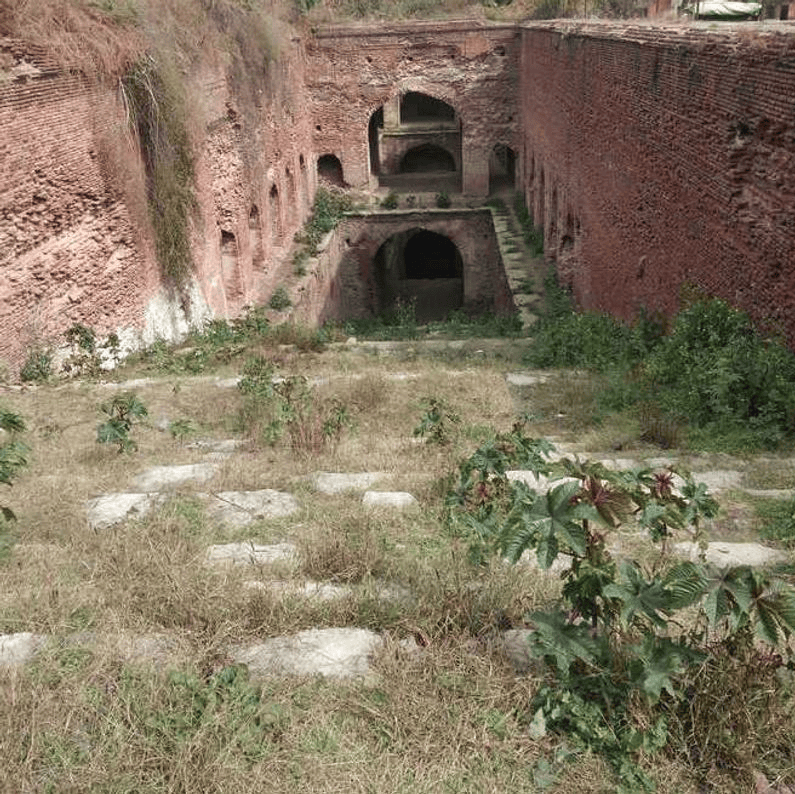
Haryana has declared Luhari Baoli a protected monument Also known as Mughlaai Baoli, the stepwell is located in Luhari village in Jhajjar district. This historical structure is notable for its three-storey design, showcasing architectural elements characteristic of the Tughlaq dynasty. The baoli features six niches on either side, complemented by two stair bays on all levels, facilitating access to the well’s depths. The entrance to the well is adorned with a large pointed arch, emphasising the architectural style of the period. The well is octagonal and has a depth of approximately 40 feet.
MONSOON IN YAMUNA BASIN
Rain deficit in Himachal, Haryana Till the morning of Aug 31, Punjab received 230.5 mm rain against the normal 362.1 mm, Haryana 283.4 mm against 349.9 mm, and Himachal Pradesh 557.1 mm against 613.8 mm, recording deficits of 36%, 19% and 9%, respectively. Up to 19% deficient or excess rainfall is considered normal.
In Aug, Punjab recorded 39% deficient rain, receiving 88.7 mm rain from Aug 1 to the morning of Aug 31 against the normal of 146.2 mm. During this period, Haryana recorded 7% deficient rain as the state received 135.4 mm rain against the normal of 146.1 mm, while Himachal recorded 16% deficient rain as it received 215.6 mm rain against the normal of 256.8 mm.
FLOOD IN YAMUNA BASIN
Yamuna failed to breach warning level The flood level in river in Delhi this year has been the lowest in the past 12 years. This is considered a worrying sign for the health of the river and its wildlife. According to the data, the river reached a maximum level of 204.09 metres at around 6 pm on August 8. This was the lowest maximum water level recorded since 2014.
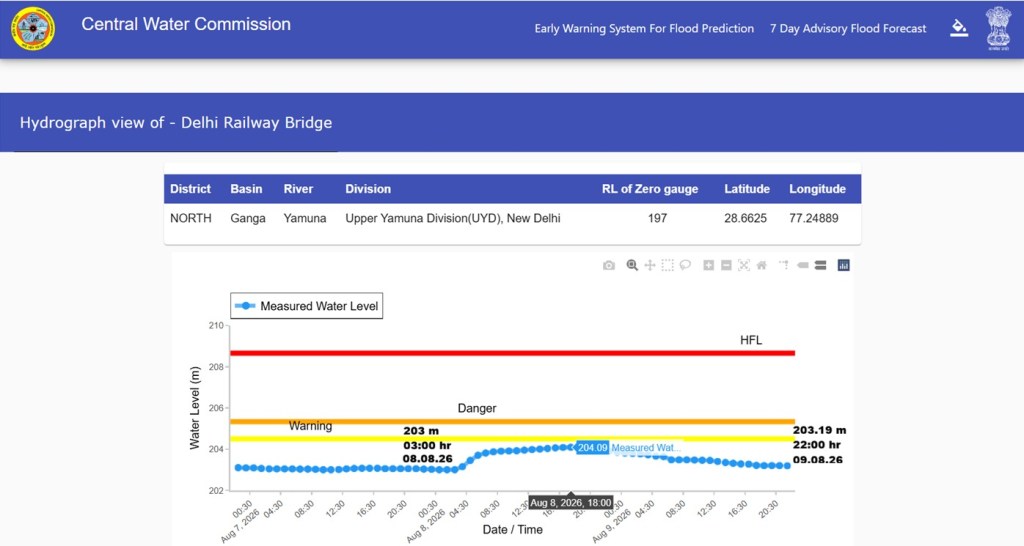
In 2014, the maximum water level recorded in the Yamuna during the monsoon was 204.00 metres. In comparison, the river has witnessed major floods in several recent years. In 2023 and 2025, the Yamuna rose well above the danger level. The river reached a maximum level of 208.66 metres in 2023 and 207.480 metres in 2025.
Bhim Singh Rawat, SANDRP says that this year there has been less rainfall in Himachal Pradesh and Uttarakhand compared to previous years. There is also an assessment that more water may be getting diverted into canals than before, reducing the flow in the main channel of the Yamuna. Environmentalists consider the floods that occur during the monsoon to be the lifeline of the Yamuna. Since the Yamuna has not experienced such a flood this year so far, it is feared that pollution levels in the river may remain higher than usual. The impact could be particularly visible during winter.
Yamuna Fail to hit warning mark The Yamuna was at 204.08 metres on August 8, just below the warning level. Data from previous years showed that the river had failed to reach 204.5 metres only twice in the past decade. The warning level is 204.50 metres and the danger level is 205.33 metres. Bhim Singh Rawat, SANDRP said the river had experienced an unusually dry monsoon so far.
“There is not a single instance when the river has reached 204.5m level. Coupled with erratic rainfall in the upper catchment area, it is also linked to the distribution of water being carried out the Hathnikund barrage with most of the river water being diverted to Eastern and Western Jamuna canals rather than the river stream,” he said.
Rawat said the monsoon was the only period when the river received enough water for pollutants to be flushed downstream. “Depriving river of the monsoonal flow is also bad for its ecology in long run,” he said. Experts said the annual swelling of the Yamuna was important for maintaining its ecological health, supporting aquatic life and recharging underground aquifers beneath the floodplains.
Rise in Yamuna flood levels Varying amounts of water released from the Hathnikund Barrage over the last two days have led to a staggered rise in the level of Yamuna river, with the Central Water Commission’s (CWC) monitoring stations recording different levels of water between the barrage and Delhi. The CWC has forecast a gradual rise in the river water in the Capital over the next two days.
“The water level in Delhi is likely to rise gradually over the next two days as the releases from Hathnikund Barrage have been staggered. The varying releases at different times have resulted in different water levels at monitoring stations between Hathnikund and Delhi.” Bhim Singh Rawat, SANDRP.
Aug-Sep 2026: Mandakini Flood Disaster in Chitrakoot The Mandakini (Paisuni) river has witnessed a major flood event in the pilgrimage town spread across Satna and Chitrakoot districts of Madhya Pradesh and Uttar Pradesh during August 28-30, 2026. The deluge was triggered after prolonged heavy rainfall in the upper hilly catchment of river, which broke records set 23 years ago. The flood spell has killed two people and left one missing in addition to causing widespread damage to public and private properties.
The flood in the Mandakini River on August 29 caused extensive destruction in Chitrakoot. In several areas, water rose to the first floor of houses. Around 100 mud houses collapsed, while approximately 500 homes were partially damaged. The flood affected 14,000 people in 36 villages.
CM direct to remove encroachments Considering the role of natural water flow and the catchment area in causing floods, the Chief Minister directed officials to identify and remove encroachments in the Mandakini River’s catchment area. Officials were also asked to engage with elected representatives and local residents in the process. A separate action plan will also be prepared for the expansion of river ghats.
Decoding why it floods every year in Gurugram To understand why a modern hub succumbs to rainfall every year, MG Devasahayam, former Chief Administrator of the Haryana Urban Development Authority (HUDA), broke down the structural failures rooted in the city’s early planning. He noted that the initial vision for Gurugram in the 1980s violated basic town-planning principles, citing a Tamil proverb that says, “If the first thing is wrong, everything is wrong.”
Devasahayam said urban development must align with the natural terrain and its carrying capacity. He explained that the region was suited only for “low-rise, low-density” development, but was instead built as a “high-rise, high-density” real estate model. He also pointed out the absence of natural drainage, noting that unlike historical cities built along rivers, Gurugram had no natural water sources or adequate drainage network.
Gurgaon’s annual infrastructure betrayal A recent assessment noted that the administration has spent close to Rs 503 crore over the last nine years, up to 2025, on improving the city’s drainage infrastructure. But an hour of heavy rain was enough to bring large parts of the Millennium City to a standstill again. So, it’s no longer just a question of money being spent — it’s a question of whether public spending is addressing the underlying engineering problem, or merely funding another round of emergency pumping, desilting, patching and road repairs.
Gurugram is drowning in its own choices Until its citizens hold themselves accountable—as much as they hold the government to account—the monsoon will keep washing away the illusion of progress by Ritu Rao. Gurugram’s rain problem is really a planning problem. (Shiv Singh Rawat)
RELEVANT REPORTS
NGT issues notice to Centre against amendment on Ganga floodplains The petition, filed by environmentalist Amit Kumar, argues that the change alters the no-construction zone set out in the 2016 order and wrongly pegs the “active floodplain” to a one-in-five-year flood. The order had defined the floodplain largely by a once-in-100-year flood line. Mr. Kumar contended that the amendment runs counter to earlier rulings of the Tribunal and the High Courts, including a 2017 six-member Bench judgment that treated 100 metres from the river’s edge as a no-development zone on the Haridwar-to-Kanpur stretch.
NGT questions basis of flood plain zoning along Ganga During July 20 hearing, the NGT observed that the River Ganga (Rejuvenation, Protection and Management) Authorities Order, 2016, does not define the term “Active Flood Plain” and directed the NMCG to clarify the basis on which it had sought demarcation of flood plains for the 1-in-5-year and 1-in-25-year return periods. The Tribunal further noted that although the NMCG had referred to the Technical Guidelines on Flood Plain Zoning issued by the Central Water Commission in July 2025, the guidelines had not been placed on record. The NMCG was granted four weeks to submit the relevant documents. The case has been listed for further hearing on September 21.
NGT asks NMCG to trace origin of Budhi Ganga river in UP In an order dated August 3, a bench noted that the state’s Irrigation and Water Resources Department had filed a report, saying physical demarcation of the Budhi Ganga floodplain and installation of boundary pillars were being carried out based on a report by the NIH, Roorkee, in accordance with the Ganga Rejuvenation Order, 2016.
“Complete boundary pillar installation across all four reaches (of the river’s floodplain zone) is on track and proposed to be fully concluded by August 30, 2026,” the report said. The tribunal directed the state authorities to file a further progress report at least one week before the next hearing, confirming completion of the floodplain demarcation. Next hearing date Oct 16, 2026.
Gorakhpur CETP delay over govt report: NMCG This was stated in the report NMCG filed before the NGT on August 19, 2026. The matter related to discharge of untreated industrial effluent by GIDA through the Saraya drain into river Ami, a tributary of river Ganga, near village Adilapur, block Piprauli, district Gorakhpur.
5 Ganga states generate 32% more sewage than can be treated: RTI Five states along Ganga – Uttarakhand, Uttar Pradesh, Bihar, Jharkhand and West Bengal – generate a total sewage volume of 11,785.5 MLD, nearly 32% higher than their combined processing capacity of 8,026.7 MLD, according to data provided by CPCB. The information shared in response to an RTI application filed by Noida-based activist Amit Gupta on July 21, showed that UP has the highest sewage generation at 5,500 MLD, followed by West Bengal (4,158 MLD), Bihar (1,100 MLD), Uttarakhand (554.5 MLD) and Jharkhand (473 MLD).
“The 3,758.8-MLD sewage treatment capacity gap raises questions about the adequacy of sewage management and water-quality monitoring of the Ganga,” Gupta said. UP also has the highest number of installed STPs at 158, followed by Uttarakhand (70), West Bengal (59), Jharkhand (37) and Bihar (19). However, the treatment capacity in each state remains lower than its reported sewage generation, indicating a shortfall in the treatment capacity.
Scientist Quits Lucknow Ganga Committee A senior scientist, Prof Venkatesh Dutta, has quit from the District Ganga Committee (DGC), Lucknow, saying he was excluded from crucial decisions related to the protection and rejuvenation of its surroundings and that he could not back “mindless” construction of embankments and highways in eco-sensitive zones. In the letter he said that he had opposed the proposed expansion of a “green corridor project” on the Gomti River’s floodplain, but this proposal was pushed through by the rest of the committee without his knowledge.
SC Bans construction within 100m of Jojari edge The Supreme Court has banned construction within 100 meters of river edges and hazardous industrial activity within 500 meters of flood lines across the Jojari, Bandi, and Luni river basins in Rajasthan. The Court also clarified the authority of the High-Level Ecosystem Oversight Committee, assigned an environmental project to NLU, and scheduled the next hearing for Sept. 22, 2026.
SANDRP
Also see: Yamuna Manthan Aug. 2026 & July 2026
Follow us on: www.facebook.com/sandrp.in; https://twitter.com/Indian_Rivers


