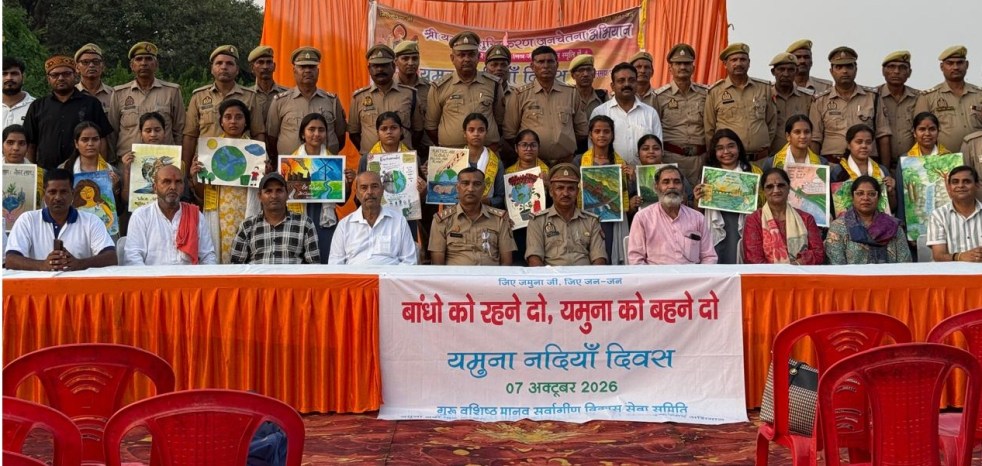
(Feature Image: Marking Yamuna Rivers Day on Oct. 7 to commemorate Yamuna crusader Manoj Misra’s 72nd birth anniversary, members of Nadi Mitra Mandli, school students and Home Guard personnel gather in Agra to discuss the importance of the Yamuna’s tributaries and raise awareness about their disappearance.)
The agreement to build the 236-m high Kishau dam on the Tons river raises serious concerns about the future of the Yamuna. Tons is a larger river system in upper basin and plays a vital role in sustaining Yamuna’s ecosystem. Ironically, the ₹15,000-cr project is being promoted in the name of Yamuna rejuvenation and being justified with baseless ‘rain water flowing in waste’ argument. These unconvincing and contradictory claims clearly underline the basic fallacy in the govt’s dam-building approach.
Interestingly, the govt has acknowledged that the May 1994 Yamuna agreement grossly overlooked the river’s environmental flows. But, the claim that 25% of Kishau dam water will be released into the river, lacks scientific and statutory basis. All these years, the basin states have increased their river-based water demands and are now placing higher stakes. Meanwhile, the Ministry of Jal Shakti has failed to implement its Oct. 2018 environmental-flow notification for the Ganga and its tributaries.
The project also contradicts Union MoJS Minister’s Nov. 2025 statement that new dams are no longer a viable long-term solution to water management. He cited high costs, land acquisition difficulties and shrinking river flows and rightly stressed on water conservation, groundwater recharge and community-led initiatives to manage water demands.
Indeed, the large dams irreversibly damages the very hydrological and ecological functioning of a river. The Kishau dam is planned in a geologically sensitive Himalayan region increasingly exposed to climate change risks. Hence, a thorough exploration of alternatives, a credible impact assessment and the informed consent of affected communities are essential before proceeding with the project.
In fact, the Kishau project is part of a wider pattern of dam-building across the Yamuna basin. The 204 m tall Lakhwar dam is already under construction on Yamuna in upper basin. Then the 104 m high Renuka dam on Giri another tributary of Yaman is in pipeline.
The other major tributaries in lower basin including the Chambal, Betwa, Ken are also under threats from extensive dam development projects. The relentless dam-building spree across the basin is bound to have serious repercussions for the Yamuna’s ecological integrity and undermine efforts to revive or ‘clean’ the river.
If Yamuna rejuvenation is the genuine objective, the focus must shift to demand-side water management issues. Rainwater harvesting, protecting & harnessing local water resources, adequately treating & reusing sewage, adopting water-efficient cropping patterns & improving irrigation efficiency are far more sustainable and viable options. These measures must be given priority over further damming of the Yamuna and its tributaries.
6 states signed Kishau Multipurpose Project agreement Union Home Minister Shri Amit Shah said that first, in August 2018, the dispute over the Lakhwar Multipurpose Project was resolved. In 2019, the dispute over the Renukaji Multipurpose Dam Project in the Upper Yamuna Basin was resolved. In 2021, Madhya Pradesh and Uttar Pradesh reached an agreement on the Ken-Betwa Link Project, benefiting the water-stressed region of Bundelkhand. The revised Parbati-Kalisindh-Chambal River Link project moved forward in 2024. The scheme for transferring water from Hathinikund to the Yamuna through an underground pipeline was approved in February 2024.
Union Home Minister Shri Amit Shah said that with regard to the Kishau Multipurpose Project, an agreement was reached on 12 May 1994 that separate agreements would be entered into for each storage project coming up in the basin. Without that arrangement, this would not have been possible. Subsequently, after the disputes concerning the Lakhwar and Renukaji projects were resolved in 2019, work on Kishau moved forward. Formal agreement on the project was reached on 16 June this year.
Union Home Minister said that when the waters of the Yamuna were allocated, there was a serious lapse on the part of policymakers. The environmental flow of the Yamuna was not calculated at all and all the available water was distributed among the states. No water was left for the river itself. He said that 25 per cent of the water will become available through the Kishau Multipurpose Project Agreement, which will prove extremely beneficial for both Delhi and the Yamuna. It will also contribute to environmental conservation.
The Kishau Dam was one of three storage projects planned in the upper reaches of the Yamuna and its tributaries following a MoU signed on May 12, 1994 by the Yamuna basin regarding the allocation of Yamuna water. The other two projects were Lakhwar and Renukaji, for which the MoUs have already been signed and are under implementation. As per the 1994 MoU, an interim seasonal allocation of the annual utilisable flow of river Yamuna was made among these five states.
Of the total 11.983 billion cubic metres (BCM) of annual utilisable water of the Yamuna, a maximum allocation of 5.730 BCM was made to Haryana, followed by 4.032 BCM to Uttar Pradesh, 1.119 to Rajasthan, 0.724 BCM to Delhi and 0.378 BCM to Himachal Pradesh. When Uttarakhand was created in 2000, the 4.032 BCM share of water of undivided Uttar Pradesh was allocated to UP and Uttarakhand as 3.721 BCM and 0.311 BCM respectively. Earlier this year, a DPR of the Kishau project was circulated among the states concerned but it is yet to be finalised.
Kishau Dam deadlock ends According to the agreed-upon terms, Delhi, Rajasthan and Haryana will bear the estimated cost of ₹2,000-crore on the power component on Himachal’s side, thus ending the deadlock. Himachal Pradesh had secured a right to 378 million cubic metres (MCM) of water in the Yamuna basin,” the official said, pleading anonymity.
Himachal government officials said the agreement would provide substantial long-term financial benefits to the state. “The state will receive around ₹600 crore annually from the power component of the project over the coming years without making any capital investment,” the official said.
The Kishau Dam will be among the tallest dams in India. The 422 MW project, located in Sirmour district, involves construction of a 236-metre-high concrete dam to generate hydropower, create an irrigation potential of 97,000 hectares, and supply 517 MCM of drinking water annually. The project is estimated to cost ₹15,000 crore.
Following consensus among concerned states during a meeting on June 16, the states of Himachal Pradesh, Uttarakhand, Delhi, Uttar Pradesh, Haryana and Rajasthan agreed to sign MoU for the implementation of the project for the rejuvenation of the Yamuna river. After the signing of the MoU, the project will be placed before the Union Cabinet for approval.
The meeting decided that 90% of the cost of the water component of the project will be borne by the Central Govt as Central Assistance, while the remaining 10% financial burden will be shared by the six participating states. The meeting also reached a consensus to allocate Himachal Pradesh’s share of water to Delhi and Rajasthan in return for sharing the cost of Himachal Pradesh’s portion of the power component. This decision will prove to be a significant milestone in the journey towards a cleaner and rejuvenated Yamuna, ensuring an increased flow of clean water in the river.
The Yamuna will receive additional freshwater under the Kishau project, with Delhi and Rajasthan agreeing to fund the project’s power component in return for a share of the water, Union jal shakti minister CR Patil said on Sept. 16. “CMs of Delhi and Rajasthan said that we will make the capital investment for the power project, but we will take the water. So, 75% of the water will come into the Yamuna. 25% will go to Rajasthan,” he said.
The Home Minister expressed confidence that we will be able to achieve the goal of a clean Yamuna by 2029. CM Nayab Singh Saini said Haryana’s share in Yamuna’s water was 48 per cent and so the state will directly benefit from the increased water from the project.
It is worth mentioning the govts of Rajasthan and Haryana on June 29 have signed agreement for construction and implementation of Yamuna Water Project. As per the agreement, approximately 580 MCM of water will be supplied from the Yamuna Canal to Rajasthan through three underground pipelines from July to October. These three pipelines have a diameter of more than 3.6 metres and will provide drinking water to the people of both Rajasthan and Haryana. Disappointingly, the PIB subtitle mentions “The rainwater, which was previously going to waste and not being used by anyone, will now, after this agreement, quench people’s thirst and will be stored in large ponds to help recharge the groundwater level”
Experts raise concerns Himanshu Thakkar, SANDRP said the project is dangerous because the entire Himalayan region falls in an unstable and highly seismic zone. He said the project could increase risks already emerging from climate change. Thakkar also called the government’s claims on Yamuna cleaning and water supply misleading. “The claim that this dam will clean the Yamuna River is misleading. A separate, dedicated program is needed for cleaning and rejuvenating the Yamuna, not simply trying to dilute the pollution by blocking the river’s water,” he said. He argued that the concerned states should focus more on rainwater harvesting to meet their water needs.
Mansi Ashar, a researcher HIMDHARA said a 2014 field study indicated that the impact of the Kishau dam would not be limited to the submergence area. She said the project would affect agriculture, animal husbandry, forests, fisheries and local livelihoods in the Tons River valley. Ginger and tomato cultivation, in particular, would be badly affected, she said.
The document for the 47th meeting of the Expert Appraisal Committee, dated January 2026, states the proposed power generation capacity of the Kishau project as 422MW, with four units of 105.5MW each. It lists the dam height as 232.6m and total submergence area as 2,950 hectares. By contrast, project details available on the Himachal Pradesh Power Corporation Limited website on August 16, 2018, stated the power generation capacity as 660MW, with four units of 165MW each.
The agenda for the 29th EAC meeting on June 15, 2022, also listed Kishau as a 660MW project with an irrigation area of 97,076 hectares. The difference between 660MW and 422MW remains unexplained in the latest document. The total submergence area, however, remains the same at 2,950 hectares in both periods.
Water data also differs across documents. The January 2026 EAC document lists a water benefit of 1,324 million cubic metres from the Kishau reservoir. Of this, Haryana is allocated 633 million cubic metres, Uttar Pradesh 411, Rajasthan 124, Delhi 80, Himachal Pradesh 42 and Uttarakhand 34. By contrast, the central government’s Sept. 15 statement says the project provides for a water storage capacity of 1,562 million cubic metres, irrigation of 97,000 hectares and generation of 1,476 million units of electricity.
Agreement sparks protest Fear of losing their ancestral homes and land brought residents of Kwanu and neighbouring villages in Uttarakhand onto the streets on Sept. 16, a day after the Centre and six Yamuna basin states signed an agreement to move ahead with the long-pending Kishau Multipurpose Project. The Kishau Bandh Sangharsh Samiti staged a protest at Kwanu in the Jaunsar-Bawar region of Uttarakhand in the presence of local MLA Pritam Singh Chauhan. Protesters burned effigies of the Central Government and the state government and raised slogans against the proposed dam.
For families living in the project-affected area, the Kishau project is not simply about a dam or water and power generation. It is about the possibility of being uprooted from land where their families have lived for generations. “Why are people living in the hills being displaced to meet the water and electricity requirements of the plains?” residents asked during the protest, questioning why communities settled in the mountains should have to sacrifice their homes and land for the benefit of areas downstream.
Kishau Bandh Sangharsh Samiti patron Munna Singh Rana, president Surya Pratap Singh and vice-president Narendra Singh Rana said the people of the affected area shared an ancestral and emotional bond with the mountains. The Samiti leaders said compensation could not fully address the loss of ancestral land, homes and the traditional way of life of the affected families. “We may accept death, but we will not leave our soil,” they said, asserting that the affected communities would continue to oppose displacement.
Villagers oppose Dam’s height, location Villagers from Jaunsar-Bawar and Himachal Pradesh unanimously decided at a mahapanchayat in Kwanu that they are not opposed to the Kishau Dam itself, but to its proposed height and location. They demanded that the dam be shifted further towards Meenas from the currently proposed site. They vowed that they would not allow Kwanu to be submerged at any cost. The mahapanchayat witnessed strong protests over the dam’s proposed height and location. Ground Report
DAMS & HEPs IN YAMUNA BASIN
Majhgawan villagers demand compensation & rehabilitation The movement by tribal and other families falling in the submergence area of the Majhgawan Medium Irrigation Project continued for the 21st day on Oct. 02. Families affected by the Majhgawan project say that the biggest question before them is that of the future. The families whose land and homes are falling in the project’s submergence area want to know where they will be settled after displacement and what the complete arrangement for their rehabilitation will be. Protesters say that until every eligible family gets its legal right, the movement will not be ended. Houses in Tapariya, Madaliya and Kunwarpur villages of Ajaygarh were demolished without compensation. Rehabilitation has remained pending for eight years.
Ken-Betwa river-linking project needs rethinking Global river-linking projects have faced serious challenges, including salinity, waterlogging, ecological disruption, pollutant transfer, reduced downstream flows and misjudged water availability. The Ken and Betwa rivers differ in climate, geology, channel form and hydrology, raising questions about how both systems will respond to sustained water transfer. The article argues that river linking must be assessed beyond engineering promises, with greater attention to ecology, river health, livelihoods and long-term consequences. (Shreya Sarkar, Padmini Pani)
Ken Betwa link project’s unaccounted costs Panna’s nesting cliffs, and the vultures that depend on them, sit in the path of India’s first river-linking reservoir. PTR is home to seven of the nine vulture species found in India and remains an important stronghold for these scavenging birds. With 691 vultures, Panna recorded the second-highest vulture population among protected areas in MP in the state’s ‘Population Estimation of Vultures Report 2025’. (By Divya Raje Bhonsale) Environmentalists warn that Daudhan Dam will submerge 9,000 hectares, including parts of Panna Tiger Reserve, while govt says ‘unavoidable’ impact can be mitigated through afforestation and wildlife conservation.
Dodhan dam project oustees protest The agitation by people affected by the Majhgawan dam project in Madhya Pradesh’s Panna district entered its 16th day on Sept. 27, as the protesters staged a ‘satyagraha’ despite rain and waterlogging. Several houses in villages affected by the project have been inundated, with two to three feet of water entering some homes and damaging grain, clothes, and household articles, the protesters claimed.
INTERLINKING OF YAMUNA RIVERS
MP HC asks GoMP response on CEC report The Madhya Pradesh High Court has sought the State’s response on the action taken pursuant to the report submitted by the Supreme Court-appointed Central Empowered Committee (CEC) concerning the Ken-Betwa Link Project. The division bench of Chief Justice Alpesh Y Kogje and Justice Vivek Jain was hearing a PIL raising concerns over the project’s impact on the Panna Tiger Reserve, Ken Gharial Sanctuary and displaced communities. The High Court has now sought the State’s clarification on the status of proceedings before the Supreme Court and the action taken in relation to the CEC report. It also directed the State to respond to the January 21, 2022 communication issued by the Forum for Policy Dialogue on Water Conflicts in India. Next hearing on Oct 13.
Patwari caught taking bribe from tribal The Special Police Establishment (SPE), Lokayukta Sagar has trapped a patwari posted in Panna district for taking bribe of Rs 47,000 on Sept 10 2026. Patwari Santosh Kumar Chikwa demanded Rs 80,000 to prepare the certificate. SP DK Rathore said that the complainant, Ramgopal Adivasi, a resident of village Gahdera, owned a land which got submerged in Dodhan dam being constructed under the Ken-Betwa river link project.
YAMUNA WATER SHARING DISPUTES
Punjab to challenge Kishau dam in SC Punjab’s contention is that the project cannot be finalised on the basis of the existing Yamuna water-sharing arrangement as the state itself was excluded from the 1994 agreement governing allocation of the river’s surface flow. “The 1972 Irrigation Commission Report states that Punjab falls within the Yamuna basin. Since 1992, Punjab has been requesting the Central Government to include it in all discussions on Yamuna water allocation,” said an official in the WRD on condition of anonymity. The state government contends that the May 12, 1994, Yamuna water-sharing MoU, signed between 5 states does not include Punjab.
“In 1954, Punjab was entitled to two-thirds of the Yamuna waters but under the 1994 arrangement, the state was completely ignored. This MoU cannot be treated as an exhaustive or final settlement, particularly as Clause 8 provides for a review after 2025. Therefore, the allocation should now be reviewed and Punjab should get its legitimate share,” said the official.
Punjab’s larger argument is that the Yamuna, like the Ravi and the Beas, was part of the erstwhile Punjab’s river system before the state’s reorganisation in 1966. “If Haryana, despite not being a riparian state of the Ravi and the Beas, can receive their waters as a successor state, Punjab should similarly be considered a successor state for the purpose of the Yamuna waters,” the official said.
The state is expected to rely on the March 12, 1954, agreement between Punjab (before its reorganisation) and Uttar Pradesh, under which Punjab was entitled to a two-thirds of the Yamuna waters. It argued that reorganisation of Punjab could not automatically extinguish that entitlement. Punjab had already lodged a complaint with the Centre under Section 3 of the Inter-State River Water Disputes Act, 1957, on April 25 last year, seeking the constitution of a tribunal to adjudicate its claim to the Yamuna waters. With no action having been taken on the complaint, the state is now considering judicial intervention.
Why is Punjab’s Yamuna claim not one of them? The reason lies in the Punjab Reorganisation Act, which came into force on 1 November 1966 and trifurcated the state. Haryana was carved out, the hill areas went to Himachal Pradesh, and Chandigarh became a Union Territory. Undivided Punjab’s eastern edge ran along the Yamuna, from the Jagadhri tehsil of Ambala district, where Yamunanagar now stands, downstream. All of it went to Haryana.
Parliament took care to parcel out undivided Punjab’s rights in the Bhakra and Beas projects between the successor states, and the Centre’s March 1976 notification gave Haryana 3.5 million acre-feet of Ravi-Beas waters, though reorganised Haryana has never been riparian to either river. Nobody parcelled out undivided Punjab’s Yamuna link. That silence has since been read as extinction.
The settled practice of the Union is that when a state is divided, river assets and the seats that govern them follow both heirs. The only reorganisation read the other way is Punjab’s. If successor states keep their standing in basins they once shared, Punjab belongs on the Upper Yamuna River Board. If present geography alone decides, Haryana has no footing for its existing or future demands on the Ravi-Beas system, including on the western river waters expected to be diverted into it now that the Indus Waters Treaty is held in abeyance. The rule must bind both heirs. (KBS Sidhu)
YAMUNA RIVERS
Kshipra is no longer the river what it used to be A study conducted in September 2026 examined the flow patterns of the Kshipra River. It found that the Kshipra, which was once a perennial river, became an intermittent river around the mid-1990s. This means that its flow is no longer continuous, and several stretches dry up seasonally.
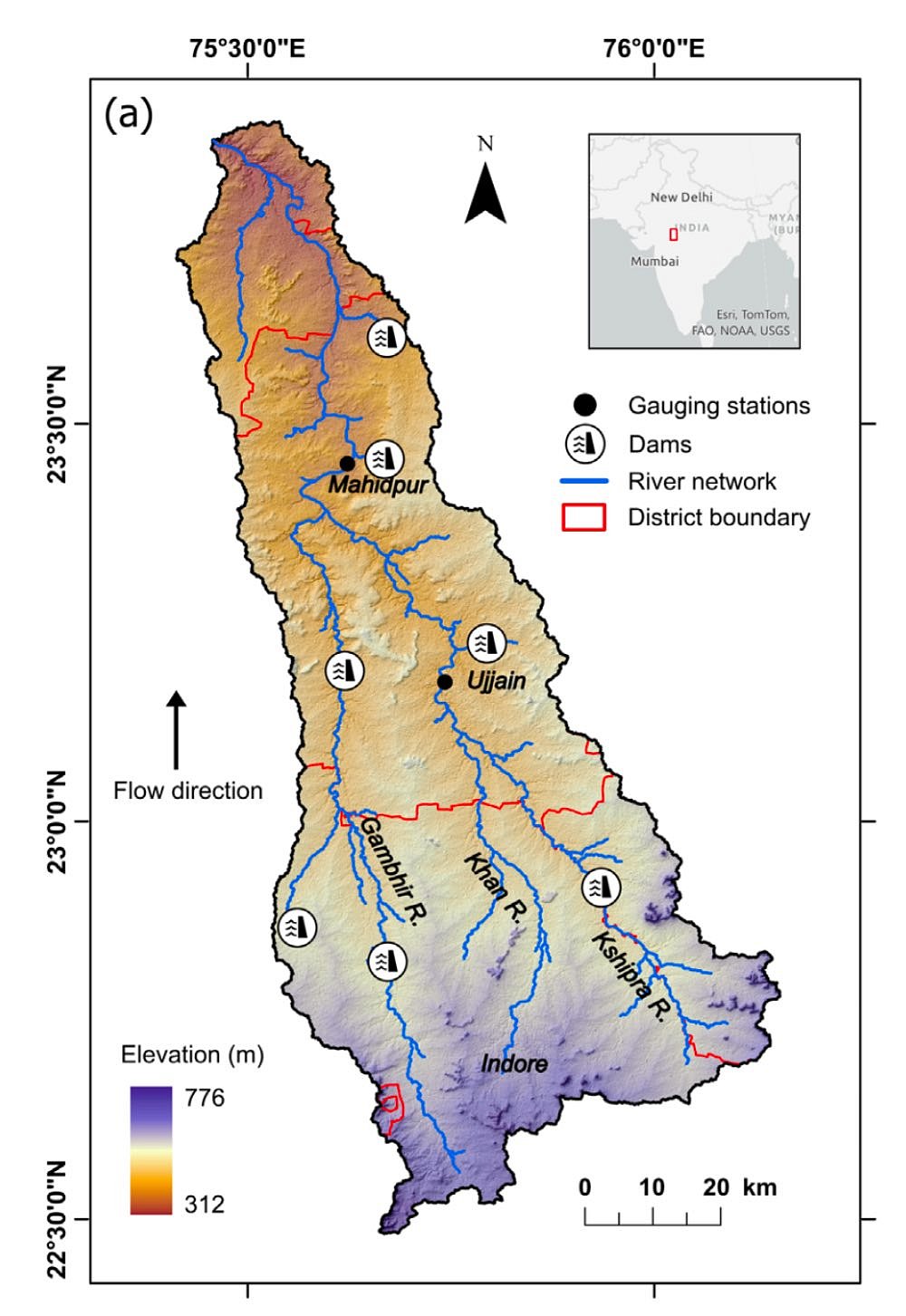
The study finds that the once-perennial Kshipra River in central India has experienced a major decline in hydrological connectivity, with longitudinal connectivity falling from about 95% in the 1960s to nearly half by the early 2000s. Dams, urbanisation, catchment land-use changes, groundwater fluctuations and climate factors have disrupted river flows, floodplain connections and groundwater contributions, leading to increased dryness and loss of riparian vegetation. The study highlights the need to address both human interventions and climate-related changes to restore river connectivity and flows.
Shipra polluted in Ujjain The August report of the MPCB also confirms the poor condition of Shipra’s water. The water at Siddhavat Ghat was found to be ‘NOT SATISFACTORY’ for the second consecutive month. In 2026, a joint committee of the NGT inspected 14 drains in Ujjain. According to religious belief, Siddhavat holds special significance.
According to Pandit Trivedi, Chapter 49 of the Avantika Khanda of the Skanda Purana states that the Shipra originated from Lord Vishnu’s index finger, while the Ganga originated from his feet. As the Shipra flows northwards, it is believed to be ten times more spiritually meritorious than the Ganga for attaining salvation.
YAMUNA FLOWS
Monsoon flush dilutes Yamuna’s pollution load River Yamuna appears to have received some of the monsoon cleansing that was due in early July. In Aug, the river showed a substantial reduction in sewage contamination at some downstream stretches compared to July as well as the same time last year. Despite the improvement, though, organic pollution is still high, and a large stretch of the river is still not fit for bathing.
According to Bhim Singh Rawat of SANDRP, the timing of the sampling matters. He said the floods this season had been erratic and the river had not crossed even the warning level. He also pointed out that the maximum discharge the river received this year from the Hathnikund barrage was 63,109 cusecs on Aug 4, the day before the sampling.
Since 2014, the river had breached warning levels each year, barring 2024, when it was 204.38 m, against the warning level of 204.50 m. This year, the maximum it reached was 204.09 m on Aug 8, which is the lowest since Aug 2004 (203.73 m) and July 2014 (204 m). Rawat also pointed to increased diversion into East and West UP canals at Hathnikund. During the 2023 Delhi floods, the diversion to the canals was stopped once upstream water influx breached 50,000 cusecs and all was released to the main river.
“However, the threshold for when water must be released into the main river was raised from 60,000 cusecs to 70,000 cusecs and subsequently to 1 lakh cusecs from 2024. With flows crossing 60,000 cusecs only once or twice this season, he said, canal operations were not meaningfully curtailed, delaying the additional water that could have provided Yamuna a much-needed monsoon flush,” Rawat said.
YAMUNA FLOODPLAIN
SC flags floodplain definition Supreme Court on Oct. 14 said a Yamuna clean-up plan, drawn up by a high-powered committee headed by the Union home secretary, leaves the definition of its floodplain unsettled and offers no rehabilitation scheme for those living on it. A bench comprising Justices Manoj Mishra and Manmohan raised the concerns during a presentation by the court-appointed committee to draw up a comprehensive action plan for the river.
The judges asked why the definition of active floodplains used in River Ganga (Rejuvenation, Protection and Management) Authorities Order, 2016, was different from Delhi Master Plan 2041 and said such categorisation could open the door to fresh litigation. They also asked why the plan contained no relocation and rehabilitation scheme for unauthorised structures built in critical zones along the river.
SC asks MHA to explain floodplain measures The same SC bench on Sept. 22 noted that a committee had prepared the Yamuna Action Plan following the court’s August 12 order and submitted it for consideration. The court noted that the status report accompanying the plan said there was no proposal to remove or relocate encroachments and unauthorised structures on riverbeds, floodplains or drains in Delhi.
The plan states that 1,799 unauthorised colonies have been identified and an integrated sewerage system is being developed for them. “About 73% of the work has been completed, while the rest is at various stages,” the order stated. The bench, however, sought details on how many of these colonies are located on floodplains to assess whether the action plan would achieve its stated objective. The court also sought an explanation on the classification of floodplains under the Master Plan for Delhi-2047.
The bench also directed a representative of the Ministry of Home Affairs to make a presentation on the Yamuna Action Plan and the steps proposed under it on Oct. 7 at 4pm, the court said. The matter has been listed for further hearing on Nov. 4.
Delhi govt to conduct topographic, underwater terrain surveys The Delhi government will undertake topographic and bathymetric surveys of the entire 48-km Yamuna stretch from Palla at the Delhi-Haryana border to Jaitpur at the Delhi-Uttar Pradesh border to map the riverbed, identify clogged sections and assess changes in the river’s course, senior government officials said.
The surveys will also map embankments, spurs, drains, islands, encroachments and ghats within 100 metres of either bank, with the findings expected to aid flood management as well as planned riverfront development and boat navigation activities, officials said. Besides improving flood management, the government plans to undertake riverfront development projects and boat navigation activities in the river channel, with the survey findings helping in the planning, officials said.
The Irrigation and Flood Control (I&FC) department invited bids on Oct. 1 to undertake two types of surveys. The surveys are likely to cost around ₹80 lakh, and the agency will be given 8 months to complete the exercise. Last year, the Delhi government had stated that it intended to undertake the first dredging of the Yamuna riverbed, for which it would approach the NGT.
The information will help identify areas where the riverbed has changed, where sand deposits have accumulated and where dredging may be required. A Bathymetric survey measures water depth and maps the three-dimensional shape and contours of underwater terrain. It functions as an underwater equivalent to a land topographic survey.
Floodplain is more than an encroachment problem Delhi urgently needs a legally effective system of floodplain protection based on scientific mapping, physical demarcation and an independent floodplain management institution. Zone O must be implemented not merely on paper but on the ground. Until scientific demarcation is completed, effective enforcement of Zone O and the long-term protection of the floodplain will remain impossible. (Bhim Singh Rawat, SANDRP)
YAMUNA RIVERFRONT
CM inaugurates ₹7.52cr bathing ghat in Haripur The bathing ghat, developed by the Mussoorie-Dehradun Development Authority (MDDA), is located on the right bank of the Yamuna. The project includes two reinforced concrete safety walls, each 170 metres long and five metres high, along the river-facing side. Two platforms covering approximately 2,000 square metres have been constructed using reinforced concrete and red sandstone. Steps provide access to the river, while four dedicated aarti sites have been developed for religious ceremonies.
The ghat also features 25 solar lights, 12 benches with shelters, renovated toilets and changing rooms for male and female devotees, and water spouts for drinking water. Approximately 300 metres of stainless-steel railings and chains have been installed along the riverbank to improve safety during bathing and religious events. The CM also unveiled an idol of Maa Yamuna and inaugurated Harighat at Haripur Kalsi, according to a state government release. He also laid the foundation stone for the Maa Yamuna Krishna temple.
YAMUNA POLLUTION
SC panel finds sewage from UP biggest contributor to Yamuna pollution Headed by the Union home secretary, the six-member committee found that an estimated 7,999 MLD of domestic sewage is generated in the Yamuna catchment across five states along its course – Uttarakhand, Himachal Pradesh, Haryana, Delhi and UP. Of this, 6,243.83 MLD is currently treated, leaving a treatment gap of around 22% (1,756 MLD is untreated). Across the Yamuna basin, 520 major drains empty into the river. UP’s treatment gap for sewage is 34% and for wastewater (non-sanitary effluent) is 63%.
Industrial pollution remains concentrated in clusters. Around 6,300 water-polluting industries operate in the catchment. To address the issue, the committee has proposed investments of more than Rs 20,000 crore in sewage treatment infrastructure to reduce pollution loads, improve environmental flow, restore aquatic ecosystems and ultimately rejuvenate the river.
Study flags cancer risk from Yamuna vegetables A new study published in Energy Nexus has raised public health concerns over vegetables cultivated along the Yamuna floodplains in Delhi, flagging high levels of heavy metal contamination and associated cancer risks for consumers. The research, led by Professor Dinabandhu Sahoo of the Department of Botany, examined commonly consumed vegetables grown using untreated Yamuna wastewater.
The study found toxic metals, including nickel, chromium, cadmium and lead, accumulating in vegetables at levels exceeding safety limits prescribed by the FAO. Spinach and onions recorded nickel concentrations up to 97 and 65 times higher than permissible levels, respectively, while chromium levels were 22 times higher in mustard. The researchers called for regular monitoring of soil and crops, stricter pollution control and cultivation of crops that absorb fewer heavy metals.
CPCB finds solid waste, untreated sewage in major Yamuna drains Central Pollution Control Board (CPCB), which assessed the pollution in the Yamuna in Delhi between May 2025 and April 2026, found solid waste at 32 locations, while tapping arrangements in 11 drains were either inadequate or not functioning for several months.
It identified 12 drains as major pollution hotspots. The joint monitoring was initiated under NMCG, in coordination with CPCB, DPCC and DJB. The report identified inadequate tapping arrangements in 11 drains. In 7, the systems were not working. In one drain, the arrangement was not operating and in three, the systems were functional but overflowing. 8 of these drains were on the Sahibi network and 3 in the Shahdara drain network.
The report recommended restoring non-functional tapping systems, ensuring regular cleaning of drains, preventing solid waste dumping and scientifically relocating desilted material from drain banks to dedicated sites. The report said UP and Haryana should carry out a survey for identification of pollution sources of drains in their jurisdiction and implement remedial measures for abatement of pollution of the Yamuna.
Yamuna quality deteriorated in Sept Three of the seven locations showed further deterioration, two locations showed slight improvement, while two more locations showed no change from the August data. The three locations which showed deterioration were Wazirabad, Nizamudin Bridge, and at Asgarpur. Two locations where the level remained the same were ISBT and ITO Bridge. The highest BOD was recorded at ISBT Bridge at 30 mg/l. The highest BOD in August was also recorded at ISBT Bridge, with a level of 28 mg/l.
DJB approves ₹17,969cr sewer overhaul plan Under the 10-year “One Zone, One Operator” model, each operator will be responsible for the repair, maintenance and management of all sewer infrastructure in its zone, including sewer lines, manholes, pumping stations and consumer complaints. The model, senior DJB officials aware of the matter said, is similar to the power distribution system, under which four providers operate in four zones of Delhi.
The board also approved the invitation of tenders for 13 new STPs with a combined capacity of 328 MGD, at an estimated cost of ₹7,373 crore under funding from the NMCG. An Asian Development Bank top-up loan of ₹3,505 crore was also approved for a further 60 MGD sewage treatment plant, transmission upgrades, SCADA systems and distribution improvements. The DJB also approved the Delhi Water & Sewer (Tariff and Metering) Regulations, 2026, replacing the 2012 regulations.
Also, the DJB board also approved a ₹6,044.05-crore project for a comprehensive overhaul of the water supply infrastructure in south Delhi. It will introduce smart meters, bulk flow meters, and chlorine and pressure sensors to enable real-time monitoring, more accurate metering and water auditing.
4 in 10 Delhi households still without sewage connections Data submitted by DJB to the NGT showed that more than 1.65 million – 41.3%– households are not connected to the sewage network. Sewage from the remaining 2.35 million households is currently being carried through the network.
DPCC order ban on idol immersion in Yamuna Delhi Pollution Control Committee (DPCC) has on Sept. 09 issued directions barring idol immersions in the Yamuna and other waterbodies. Violators would have to pay an environmental compensation of Rs 50,000. “No idol immersion shall be allowed in the river Yamuna and other waterbodies, except in designated places identified by local bodies/authorities,” DPCC said. The directive was released keeping in mind the ongoing Ganesh Puja and upcoming Durga Puja.
The DPCC has directed idol makers to use natural clay, biodegradable materials and natural colours. District magistrates have been tasked with enforcing the NMCG directive. DPCC said it will do water-quality assessments before idol immersion, during immersion and after immersion. Delhi lists 81 artificial ponds for Ganesh Visarjan The arrangements follow fresh directions issued by the DPCC on Sept 9, barring idol immersion in the Yamuna and other water bodies except at locations identified by local authorities.
But a rule is only as effective as the alternatives made available to the people expected to follow it. Artificial ponds must be easy to locate, adequate for the size and number of idols, safely managed and supported by clear public communication. Devotees, organisers, idol makers and civic authorities all have a role in making the transition work, particularly when environmental responsibility is being built into longstanding cultural practices.
7 new STPs to check Yamuna pollution in Karnal The Haryana State Pollution Control Board, Karnal Municipal Corporation (KMC), Public Health and Engineering Department (PHED) and other departments are working together to prevent untreated wastewater from entering the river.
Karnal district currently has 14 STPs with a combined capacity of around 130 MLD. A 2-MDL STP is being constructed at Barsat by the PHED, with 70% of the work completed. It is expected to be commissioned by the year-end. A 1.5-MDL STP at Nigdhu has been completed, while work is under way on a 0.8-MDL plant at Karna Canal, formerly known as Mughal Canal, said ADC Rahul Raiya.
The KMC will construct 2 more STPs – a 15-MDL plant adjoining the existing 50-MDL STP in Sector 4 and an 8-MDL plant adjoining the existing 8-MDL STP in Shiv Colony. Tenders for both are under technical evaluation. The PHED will set up 5 mini STPs at Shekhpur Khalsa Malikpur, Halwana, Khora Kheri, Dholakua Bras and Narayana, targeting drains and nullahs flowing towards the Yamuna.
2 HSPCB officers suspended after CM review Two senior pollution control officers in the city were suspended after a citizen complaint over the improper operation of a STP by a builder was reviewed at the highest level. The regional officers for Gurgaon (north), Akansha, and south, Mukul Kumar, were suspended with immediate effect. Separate orders were issued by HSPCB chairperson Shekhar Vidyarthi. The action came after CM himself reviewed complaints filed by residents through various channels on Oct. 02.
UPPCB set to shut 46 illegal jeans factories in Noida & Greater Noida UPPCB headquarters in Lucknow has issued show-cause notices after inspections found that 37 units operating in Noida and nine in Greater Noida were operating without the required clearances and pollution-control measures to prevent contamination of groundwater and land. The notices have been issued under relevant provisions of the Air and Water Pollution Acts for operating highly polluting industrial units in residential areas.
The action-taken report was placed before the tribunal on Sept. 10 during the hearing of a petition filed by environmental activist Varun Gulati, who had named 30 such units as respondents, comprising dyeing and washing units operating illegally in Asgarpur in Sector 128, Garhi Chaukhandi in Sector 68, and Old Haibatpur in Greater Noida. During subsequent inspections, UPPCB’s Noida unit found 13 additional units operating illegally.
YAMUNA FISH, FISHERFOLKS
Mass fish death in Yamuna in Baghpat A mass fish death incident has occurred in Yamuna river in Baghpat on Oct. 13 night, reportedly due to polluted water. Their bodies were found along the riverbanks on Oct. 14 morning. After learning about the incident, hundreds of people from Eidgah Colony and Islamnagar Colony reached the site and collected the dead fish in sacks to take them away. Local residents alleged that fish had died in the past as well because chemically contaminated water was discharged into the Yamuna. They demanded that the drains discharging into the river be closed.
MINING IN YAMUNA RIVERS
Will India’s mining ravaged rivers get justice this time? In a significant development last week, the Supreme Court has expanded its illegal sand mining case from the National Chambal Gharial Sanctuary to rivers across India. For over six months, the apex court has been hearing the matter and issuing directions to state governments of Rajasthan, Madhya Pradesh and Uttar Pradesh. However, the directions issued so far are yet to be fully implemented.
During previous hearing, the SC expanded the matter to include illegal sand mining in Ken river. In latest hearing, the Court has further widened the scope to cover rivers across the country and has directed the Central Empowered Committee (CEC) to submit a report. This is indeed an opportunity to examine illegal riverbed mining problem as a wider governance failure.
The SC has regularly been hearing the matter, made strong remarks and issued strict directions. The main issue now is whether the CEC’s assessment will identify the scale and patterns of illegal mining. Will it bring out the gaps in regulation and enforcement and recommend practical measures to address the root causes? The success of the intervention will depend on whether it brings lasting changes to riverbed mining governance.
SC expands probe into illegal sand mining Noting that the problem requires a pan-India approach, the bench of justices Vikram Nath and Sandeep Mehta on Oct. 06 said, “We direct the CEC to give its report on the issue of river sand mining in the country.” The bench said, “There is a measure of control the states must exercise while enforcing orders on sand mining in rivers. Nature takes care of itself but when you put obstacles, it becomes a problem. Ultimately, rivers will be destroyed, and once destroyed, they cannot be compensated.”
Posting the matter on November 4, the bench told the law officer representing Rajasthan, “We will give you two weeks’ time. You instruct your officials, and if we find the position is the same, we will direct a total ban on sand mining across all rivers in the state.”
The bench was told that one of the pleas, which was listed for hearing along with the suo motu case, has sought directions to the authorities to immediately take steps to completely stop alleged illegal sand mining in the Ken River in Panna district of Madhya Pradesh. The bench also dealt with the issue related to the incident in which a forest ranger was killed last month after being allegedly hit by a dumper while he was trying to stop illegal mining in Rajasthan.
Rajasthan orders weapons, vehicles for forest staff amid attacks Chairing a state-level coordination and monitoring committee meeting convened on the directions of the Supreme Court, Rajasthan chief secretary V Srinivas stressed a zero-tolerance approach towards illegal mining, stronger field patrolling and inspections of vulnerable areas by senior officers.
He also directed departments to coordinate their efforts and submit compliance reports on time. The directions follow multiple attacks linked to alleged illegal mining, prompting renewed concerns over the safety of personnel deployed to prevent unlawful excavation and transportation of sand.
Police constable Surendra Singh was injured after a speeding tractor-trolley allegedly involved in illegal sand mining ran over his leg in Sawai Madhopur’s Chauth Ka Barwara area on October 7. He was referred to Jaipur for treatment, while the elderly woman also sustained injuries. The driver fled the spot.
On the night of Sept. 21, forest ranger Pratap Singh Chundawat, posted in Rajasthan’s Pratapgarh district, was dragged by a dumper when he tried to flag down the vehicle, suspecting illegal mining. Following his death, the Supreme Court on September 23 directed the Rajasthan government to file a report as it examined the continuing menace of illegal sand mining in the Chambal sanctuary.
In another incident on Sept. 26, a forest team was allegedly attacked with stones and gunfire after seizing a tractor-trolley and a compressor machine during action against illegal mining near Kondapura village in Bharatpur district. Earlier, forest personnel were allegedly attacked in Tonk in August, while a forest outpost in the Ranthambore Tiger Reserve was attacked in March, with an arrested person freed and a seized tractor-trolley taken away.
SC seeks response on forest ranger’s death The Supreme Court on Sep 23 took urgent note of the death of a forest ranger in Pratapgarh dist & sought the state govt’s response by Oct 6. A bench of Justice Vikram Nath and Justice Sandeep Mehta listed the matter after senior advocate Nikhil Goel, amicus curiae in the suo motu illegal sand mining case concerning National Chambal Gharial Sanctuary, flagged a news report on the incident. Goel said the report had been shared with Rajasthan’s Additional Advocate General Shiv Mangal Sharma.
Sand extraction from the Chambal has started again in Morena, Madhya Pradesh. Around 20 tractor-trolleys loaded with sand fled at high speed after spotting the police. In Rathore Colony on Tanch Road, a tractor hit a car, sending it into a drain.
According to information, the incident took place at around 5:30 a.m. on Sept. 27. The fleeing tractors also broke a wooden counter and a water pipeline at a house. Two CCTV videos of the incident have emerged. According to local residents, police personnel and police vehicles were also following the tractors.
Guards, check posts to combat illegal mining The Madhya Pradesh forest department will deploy more than 100 armed guards, permanent check posts and a surveillance system to protect the Chambal Wildlife Sanctuary from illegal sand mining, officials said on Aug. 12. By September, we will set up 16 permanent check posts, install 35 CCTV cameras, and an Artificial Intelligence (AI) monitoring system at 44 sensitive ghats, where rampant illegal mining has been reported. The decision follows the Supreme Court’s suo motu action against sand mining in the sanctuary,” said Shyam Singh, superintendent of Chambal Wildlife Sanctuary.
SC to hear plea on sand mining in Ken with Chambal case The Supreme Court on Aug. 18 has directed the listing of a plea flagging illegal sand mining in Madhya Pradesh’s Ken River, threatening the ecosystem around the Panna Tiger Reserve and Ken Gharial Sanctuary, with suo motu proceedings related to the National Chambal Gharial Sanctuary. Bharat Milan Pandey, a Panna resident, moved the Supreme Court, saying excavators and sand-pulling pumps have been installed for illegal mining brazenly without fear of the law in the Ken River. He pointed out that this was happening even though the government has not issued any contract for sand mining.
Pandey said false cases were registered against him and his family after he dared to complain to the local authorities in Panna and provided them with photographs of the illegal acts. He added that the Madhya Pradesh high court granted him bail. Pandey sought directions similar to the one passed in the Chambal Gharial Sanctuary case. Pandey’s plea said large-scale illegal sand mining is being carried out in the Ken River in Madhya Pradesh’s Panna and Chhatarpur districts. It underlined that the river serves as the lifeline to the flora and fauna of Panna Tiger Reserve and Ken Gharial Sanctuary.
NGT to assess illegal mining in Betwa river The NGT central bench Bhopal directed the constitution of a three-member Joint Committee to assess allegations of illegal sand mining activities at the River Betwa located in District Vidisha. The court directed the Committee to visit the site and submit the factual and action taken report within six weeks. The State PCB was appointed as nodal agency for coordination and logistic support. The Tribunal further issued notice to the respondents and directed the applicant to take necessary steps for service to the respondents. The matter was accordingly listed for December 9.
The application claimed that the applicant has been pursuing this matter since August 21, 2024. Per the application, the illegal activities are taking place in Village Jonakhedi, Tehsil Kurwai, District Vidisha. Before the Tribunal, the applicant stated that respondent no. 11, who owns agricultural land in the said village, has been carrying out large-scale illegal sand mining since 2019. The application claimed that respondent no. 11 has no valid environmental clearance, mining lease, approved mining plan, or District Survey Report (DSR).
NGT set aside Shamli DSR In a significant order, the NGT on Oct. 09, directed that the DSRs for Basti and Shamli districts in Uttar Pradesh be set aside. The tribunal noted that, in the case of Basti district, no replenishment study had admittedly been conducted before the DSR was prepared.
In the case of Shamli district, although a replenishment study had been conducted, it was admittedly not placed before the State Level Expert Appraisal Committee (SEAC) and the State Environment Impact Assessment Authority (SEIAA), Uttar Pradesh, when the District Survey Report was approved in a meeting held on August 1, 2024.
The SEIAA, Uttar Pradesh, had “mechanically approved” the DSR of Shamli and Basti without ascertaining whether a replenishment study had been conducted before the reports were prepared, and whether the reports were based on material gathered and recorded in the replenishment study, the NGT order stated.
Since the authorities maintained that a replenishment study had been conducted for Shamli district, the tribunal directed SEAC and SEIAA, Uttar Pradesh, to reappraise the DSR for Shamli in light of the study. While reappraising the Shamli report, SEAC and SEIAA must duly consider the anomalies and objections pointed out by the applicant and recorded in the NGT order, the tribunal said.
NGT directs authorities to act against illegal mining in Banda The tribunal heard the case concerning a mining lease granted to M/s Laxmi Prasad Gupta, Proprietor Umesh Gupta, for extraction of sand/morrum from Gata Nos. 300M and 316M in Bahadurpur Syodha village of Naraini tehsil. The Tribunal concluded that the evidence indicated illegal mining and violations of the Environmental Clearance and applicable environmental laws and regulations. It directed the SEIAA, Uttar Pradesh, and the DM, Banda, to investigate the violations and take appropriate action regarding withdrawal of the Environmental Clearance and cancellation of the mining lease, respectively. The authorities were directed to provide an opportunity of hearing to the applicant and the project proponent in accordance with the principles of natural justice.
The Tribunal also ordered that the project proponent would not be allowed to carry out further mining at the affected site until a decision is taken on withdrawal of the Environmental Clearance and cancellation of the mining lease. The Tribunal further directed the Chief Secretary of the state, Member Secretary of the UPPCB and DM, Banda, to verify the implementation of monitoring mechanisms under the Sustainable Sand Mining Management Guidelines, 2016, and the Enforcement & Monitoring Guidelines for Sand Mining, 2020.
Illegal mining in Banda has been a long-standing issue. In this interview, Mohan Sahu talks about how he says illegal mining operates in the region, and alleges that journalists and activists who speak about the issue face arrests and pressure.
YAMUNA WETLANDS
Keoladeo’s water lifeline is running into trouble Spread across 28.73 square km in Rajasthan’s Bharatpur district, Keoladeo is one of India’s most important habitats for birds. It was declared a Ramsar site and a national park in 1981, and UNESCO declared it a World Heritage Site in 1985. But the wetlands that make the park an important habitat depend heavily on a steady supply of water brought from outside. A large part of the water supplied to Keoladeo comes from the Panchana Dam. Farmers in the surrounding areas also depend on the same water for agriculture, creating a conflict over its use. The park therefore faces a difficult situation: it needs water to sustain its ecosystem, while people living around the same river and dam depend on it for agriculture.
According to Assistant Conservator of Forests Bharatlal Sharma, Keoladeo National Park requires about 550 million cubic feet of water each year. But the park has little natural water of its own. “There are small rivers here and their catchment areas are also small,” said Chetan Kumar BV, Deputy Conservator of Forests at the park. The Chambal supplies about 62 million cubic feet – roughly one-tenth of the park’s annual requirement. “But it isn’t enough,” Sharma said. Most of the park’s water therefore reaches it through the nearby Ajan Dam, which is fed by Panchana.
When Panchana does not supply enough water, the park turns to the Govardhan Drain near the Haryana-Uttar Pradesh border. But this is not considered a suitable alternative: the drain passes through agricultural areas where pesticides are used extensively, and Kumar BV said the water could carry these pollutants into the park. Kumar BV said the capacity of Panchana Dam was tripled in 2003-04, allowing it to hold and regulate much more water. The park has since become more dependent on how water is stored and released from the dam.
Najafgarh wetland drying up Major parts of Najafgarh wetland, spread across Delhi and Haryana, are almost dry. Most of it “could dry up within a month”, potentially affecting the diversity and numbers of birds that depend on it, ecologist and ornithologist TK Roy has warned. Roy’s observations during a field visit to the wetland on Oct 7 come amid concerns over the loss of feeding grounds and habitat just as the winter migration season begins.
The wetland was fully covered with water in Aug following good rainfall. However, large-scale illegal fishing was taking place at the time, disturbing waterbirds and prompting greater flamingos to leave the area. As water levels receded, villagers began cultivating the dried-up portions and large-scale fishing stopped. The receding water, however, has raised concerns about whether the wetland will retain enough suitable habitat to support resident birds and winter migrants in the coming weeks.
NGT asks panel to complete Kerwa dam demarcation in 3 weeks The NGT in its order on Oct. 03 asked the 11-member committee to complete the demarcation work of full tank level (FTL) of Kerwa dam reservoir in three weeks. The tribunal in its August 2026 order on a petition filed by environmental activists Subhash C Pandey and Rashid Noor Khan had ordered a fresh demarcation of Upper Lake, Kaliyasot and Kerwa reservoirs through drone survey and ground truthing, when they attain the FTL, so that the issue is put to rest once for all and encroachments within the buffer zone of Upper Lake and the two dam reservoirs are identified.
The committee, in compliance, carried out the demarcation of Upper Lake and Kaliyasot reservoir but on Sept. 9, the ground truthing of Kerwa dam reservoir was stopped as it had not attained the FTL despite protests by some members including the two petitioners, who were also included in the committee as expert members.
Waterbody encroachment in Agra On March 18, 2026, the NGT directed the district magistrate of Agra to submit a report on the compliance status of the court’s orders regarding a waterbody’s encroachment in the city. The matter will be listed next before the court on July 1, 2026. The applicant sought compliance of the NGT order on Jan. 17, 2025. The counsel for the applicant submitted that no action has been taken to comply with the order.
The tribunal on Jan. 17, 2025, had disposed of the application by directing the district magistrate to take appropriate action and ensure that the pond land is maintained as it is in its size and nature, in accordance with the revenue records. If there is any encroachment, appropriate action must be taken to remove encroachment and restore the pond to its original status. The magistrate should take action within one month and must submit a compliance report to the Registrar General of the NGT. The magistrate has not submitted the compliance report as directed above, the court was informed.
WATER RESOURCES MANAGEMENT IN YAMUNA BASIN
Aquifer recharge project in the Ganges-Yamuna doab A Managed Aquifer Recharge (MAR) project valued at Rs 1.65 crore has been launched in the Ganges-Yamuna Doab region. The three-year scheme aims to direct rainwater into underground aquifers to replenish depleted reserves. The project is funded by NMCG and UP Ground Water Department will implement it. Six pilot sites have been chosen for the initial phase, where recharge structures will be built and monitored to evaluate water absorption and table recovery. Scientists will monitor the six pilot sites to determine which recharge methods work best for different soil and aquifer conditions. Once proven successful, the framework will be expanded to other suitable locations across the Ganges-Yamuna Doab.
Mining in Aravallis causes contaminated reserves With their natural cracks and fissures, the Aravalli hills have the potential to put two million litres of water per hectare into the ground every year, according to experts. This makes the range a critical water recharge zone for several areas in north-west India, where the Aravallis stretch from Delhi to Gujarat.
But decades-long mining of sedimentary rocks, such as limestone and marble, in the range has allegedly resulted in the setting up of numerous stone quarries and stone crushers near or on riverbeds and water bodies. This imperils the water security that the Aravallis once provided.
The SC-appointed panel’s report can change this by establishing ecological boundaries in the range, helping to curb mining operations. To the people impacted by mining activities, however, this looks like a distant dream, as committee members did not even visit some of the worst-affected areas.
When farm ponds fail to hold water A strengthening El Niño has raised concerns over rainfall and agriculture, prompting the government to prioritise farm ponds and other water conservation measures. Bundelkhand’s experience shows farm ponds can support irrigation, but seepage, siltation, poor construction, unsuitable sites and inadequate maintenance limit their effectiveness. Experts recommend scientific site selection, crop-specific pond design, seepage control, regular desiltation, maintenance funding and stronger community involvement to improve outcomes.
YAMUNA URBAN WATER
River Cities Failing to Protect, Sustain Water Resources What is required is an integrated urban water policy that treats available water resources and the problems of drainage, sewage and water bodies pollution as part of one system. The policy must guide the cities to protect their natural water bodies, maximise rainwater recharge, optimize treated sewage usage and regulate groundwater extraction. At the same time, it must ensure complete sewage collection, treatment and prevent untreated effluents from reaching rivers and lakes. Unless river cities adopt such a holistic approach, urban water problems will continue to multiply and the condition of rivers, lakes and groundwater will deteriorate further in Yamuna basin.
HC calls for ‘aggressive measures’ to tackle Gurugram water crisis In an order passed on Sept. 22, a bench comprising Chief Justice Ashwani Kumar Mishra and Justice Rohit Kapoor observed that the city’s proximity to the National Capital has made rapid urbanisation and population influx inevitable, yet basic water resource governance has lagged dangerously behind.
The HC noted that indiscriminate extraction through private borewells over several decades has triggered a steep drop in the GW table across municipal limits. Concurrently, natural catchment systems have collapsed. “Further, the existing natural water bodies have substantially diminished, while the channels that sustained these water bodies remain largely blocked,” the bench said.
It observed that while Gurugram witnesses severe waterlogging every monsoon, the accumulated runoff is not being channelled into replenishing the underground aquifers. The judges raised concerns regarding the inadequate treatment and reuse of wastewater, pointing out that sewage treatment plants are not being operated to their optimum capacity to offset freshwater demand.
HC warns of disaster if groundwater depletion goes unchecked The HC made the observations in its Oct 1 order on a bunch of petitions concerning groundwater-related issues. Citing a Central Ground Water Board affidavit filed with NGT, the court said “the annual extractable ground water resource is twice the available resource. It also recorded admissions from Haryana Water Resources Authority, Panchkula, that water levels in Gurgaon have plunged nearly 40 metres in several areas.
The court directed Gurugram Metropolitan Development Authority (GMDA) chief executive officer P C Meena to convene a high-level meeting on Oct 5 to address the crisis. The court instructed the Central Ground Water Authority to provide exact data on registered and unregistered borewells operating across Gurgaon. It further urged the panel to explore immediately banning groundwater extraction in areas served by GMDA piped water. Meena has been directed to submit an affidavit detailing the outcomes and decisions of the Oct 5 meeting by Oct 8.
Gurugram groundwater extraction hits 213% of limit Gurugram is extracting 43,263 hectare metres of groundwater a year against an extractable limit of 20,333 ha m – 212.77% of the limit. In view of this, environmental activist and lead petitioner Sunil Singh has proposed before the Punjab and Haryana High Court a complete ban on groundwater extraction, a freeze on new construction without an assured surface water supply and judicial oversight for restoring water bodies.
The proposals are part of a case that has been before the HC for nearly two decades. Singh had approached the court in 2008 against alleged rampant and unauthorised tubewell extraction by builders in developing sectors. The case has since involved the wider issue of groundwater depletion and restoration of water bodies in Gurugram.
Water table falls at 6 of 7 urban sites in Gurgaon The findings, submitted by Central Ground Water Authority (CGWA) to Punjab and Haryana High Court, compared pre-monsoon groundwater levels in 2025 and 2026. The declines ranged from 0.08 metres to 2.34 metres. Only one well, at Cell Office, recorded a rise — of 1.34 metres The data also showed how uneven the problem is. In the seven urban sites, groundwater during the two pre-monsoon observations was found between 2.5 metres and 50.3 metres below ground level (mbgl). Four locations had water more than 20 metres below the surface, while Kherki Daula recorded the deepest level at 50.3 metres in 2026.
Gurgaon water demand may rise 52% by 2031 City’s water requirement is likely to rise by around 52% in the next five years, from about 770 MLD now to 1,170 MLD by 2031. The city already faces a gap of around 100 MLD between demand and GMDA’s treatment capacity, according to written submissions by environmental activist Sunil Singh in a groundwater case before the Punjab and Haryana High Court. GMDA’s two water treatment plants have a combined capacity of about 670 MLD, against present potable water demand of around 770 MLD. The remaining roughly 100 MLD is being met through tubewells operated by MCG and private builders, the submissions said.
Indore tragedy was preventable The one-member panel of former MP High Court judge Sushil Kumar Gupta, who submitted his August 18 report to the Indore Bench of the High Court, flags delays of “approximately 859+ days” in inviting important tenders, necessary approvals and completion of work in Bhagirathpura, the hotspot of the tragedy. The probe report has held the then Indore Municipal Corporation (IMC) Additional Commissioner (water supply) Rohit Sisonia and then executive engineer (water supply) Sanjeev Shrivastava “primarily responsible” for several delays.
The judicial inquiry into the Bhagirathpura water contamination tragedy has documented a devastating sequence of administrative and engineering failures behind an outbreak to which it links 22 deaths. Its central finding is unequivocal that the disaster could have been prevented. “The facts brought on record leave no manner of doubt that the incident was preventable,” the commission headed by former judge Sushil Kumar Gupta of MP High Court says, adding that “accountability must necessarily follow”.
The commission has made specific observations about the role of Superintending Engineer Sanjeev Kumar Srivastava. He was posted in the Water Supply Department from 2013 to 2026. According to the commission, during such a long tenure, he should have been aware of the condition of the pipelines, leakages, risks of contamination and the deteriorating network. Despite this, adequate inspection, maintenance and monitoring were not carried out.
DJB begins work on tube wells along Munak canal The Delhi Jal Board (DJB) has begun work on a medium-term project to augment Delhi’s water supply by developing a series of water extraction points along the Munak canal in north Delhi, officials said on Oct. 06. The move comes amid a demand-supply gap of 250 MGD, as per the 2025-26 economic survey, and with three upstream dam projects unlikely to be completed anytime soon. The conveyance system will cost ₹9.3 crore and will be developed over the next five months, a senior government official said. Officials said IIT Roorkee has been hired to assess the water potential.
A second DJB official said the issue has been discussed with the irrigation department of Haryana. DJB currently operates hundreds of tube wells in the Yamuna floodplains for water extraction as sub-surface aquifers get replenished. Haryana’s irrigation department had earlier raised an in-principle objection to additional tube wells being installed along the Yamuna and Munak canal system, arguing that it alters water sharing via the canal.
DJB Jal Manthan charts roadmap for water security Delhi Jal Board’s two-day Jal Manthan 2026 concluded Sept. 16 with experts and officials focusing on improving the city’s water security and accelerating the rejuvenation of the Yamuna. Six key areas were 24×7 quality water supply, circular water economy, future-ready workforce, digital DJB, financial sustainability and Yamuna rejuvenation. The discussions focused on practical and technology-driven solutions for Delhi’s water and wastewater systems. Greater use of treated wastewater for non-potable purposes was another key area. Experts examined reclaimed-water utilisation and recovery of resources from wastewater and sludge.
Polluted water supply in Noida Two weeks ago, Dr Geeta Mishra opened the kitchen tap at her Noida home and was alarmed to find yellowish-black and foul-smelling water, infested with worms. She soon found worms in the bathroom taps and flushes too. The 42-year-old assistant professor had moved to Noida with her husband and 10-year-old son after spending her entire life in Delhi. The family first rented a home in Supertech’s Supernova, in the Nova East and West block, for nearly two years before buying a 3 BHK flat worth a few crores.
With more than 350 families in the project, located in Sector 94 along the Noida-Greater Noida Expressway, facing a worsening water problem, she said she regretted buying the flat she once considered her “dream home”. “When we saw worms coming out of our kitchen tap, it was actually heartbreaking. Then it started coming in our toilet taps and flushes. No matter how many times we clear the washrooms, it doesn’t help,” said Dr Geeta. Residents said they have been forced to buy packaged water for drinking.
MONSOON IN YAMUNA BASIN
Himachal records 41st lowest monsoon rainfall since 1901 The IMD said the southwest monsoon seasonal (June to September) rainfall was normal over the state, with 652.3 mm of actual rainfall against the normal 734.4 mm, reflecting a departure of minus 11 per cent. This year, Himachal Pradesh recorded the 41st lowest monsoon rainfall of 652.3 mm during the monsoon season in the last 125 years. However, the highest rainfall of 1,314.6 mm was recorded in 1922 during the period from 1901 to 2026. The IMD said Himachal Pradesh received normal precipitation, with a departure of minus 17 per cent, recording 212.5 mm of actual rainfall against the normal 256.8 mm rainfall in August.
Deficient rainfall in Haryana & HP During June 01 and Sept. 30, 2026, Haryana recorded 23% deficient rainfall, and Himachal Pradesh recorded 10% deficient rainfall. Up to 19% deficient or excess rainfall is treated as normal. Haryana recorded 333 mm of rainfall against a normal of 430.7 mm. Himachal Pradesh recorded 662.1 mm of rain against a normal of 734.4 mm.
Haryana records 24% rainfall deficit Haryana has recorded 24 per cent less rainfall than normal during the current monsoon season, as per data issued by the IMD on Sept. 17. The cumulative rainfall for the state this monsoon season stands at 313.8 mm against the normal 411.6 mm, reflecting a deficit. In September, the state recorded 34.8 mm of rainfall against the normal of 58.1 mm.
Ambala has recorded a 49 per cent deficit, while the shortfall is 57 per cent in Jind, 48 per cent in Kaithal, 45 per cent in Karnal, 46 per cent in Rohtak and 53 per cent in Sirsa, the data states. Hisar witnessed a deficit of 20 per cent, Jhajjar 16 per cent, Panipat 27 per cent, Sonepat 31 per cent and Yamunanagar 18 per cent. Gurugram has recorded 1 per cent above normal rainfall. It has witnessed 477.6 mm of rainfall against the normal of 473.2 mm.
RELEVANT REPORTS
National Dolphin Day 2026: State of Gangetic Dolphins In last one year, we have found reports of at least ten Gangetic dolphin deaths, including six in Uttar Pradesh, two in West Bengal, and one each in Bihar and Assam. The reported death toll is higher than in the previous two years, indicating continuing concerns over their survival.
Developments over the past year also reveal that the precious mammal’s existence is under increasing threats from the existing and proposed dam projects in the Chambal basin. The issue of ensuring dolphin-friendly operation of the Sharda canal network and taking effective measures to prevent dolphins from becoming stranded in the canals also remains unresolved. At the same time, this mascot of healthy rivers continues to face serious survival challenges from increasing pollution, mechanised riverbed mining, fishing nets and hunting across Uttar Pradesh, Bihar, West Bengal and Assam.
SC gives 8 weeks to clear floodplain encroachments in Patna The bench noted that the court had, on July 21, granted the state six weeks to ensure that every unauthorised structure and encroachment standing on the stretch was cleared. During the Sept 28 hearing, Bihar’s advocate general Satya Darshi Sanjay informed the bench that the court’s orders had only been partially implemented. He cited a recent natural calamity in Nepal that caused the Ganga’s water levels to surge, submerging the specified stretch and temporarily halting demolition and clearance operations.
Govt should consider relocating industrial areas away from rivers: SC The Supreme Court has issued strict directions to the Rajasthan government and concerned authorities in a case concerning pollution and conservation of the Jojari-Bandi-Luni river system. The Court observed that the crisis was not limited to violations by individual industries but also involved inadequate treatment capacity, illegal industrial activities, land-use irregularities and weak monitoring. The next hearing is scheduled for Oct. 26.
“12k river pollution cases pending in NGT” This was stated by Afroz Ahmad, expert member, NGT addressing the gatherings held on July 12 in Sultanpur Lodhi to mark 26th anniversary of the “kar sewa” of the holy Kali Bein. The expert member said that the NGT has directed the authorities in Punjab and several other states to identify river land and remove illegal occupations. “Nearly 12,000 river pollution-related cases are currently pending before the NGT. Strict action is being taken across the country to remove encroachments from river basins and ponds. The judiciary is committed to protecting natural water resources,” he said.
Assess impact of infrastructure on Gomti in Lucknow The city must also assess the cumulative impacts of the Gomti riverfront, the Green Corridor, embankments, roads and surrounding urban expansion. No single project should be examined in isolation from the river system it modifies. The choice before Lucknow is clear: continue spending public money managing the consequences of ecologically unsound development, or restore the natural systems that have regulated water for centuries. (Venkatesh Dutta)
The toxic legacy of chromium in UP Even decades after industrial dumping of chromium was detected and stopped, the toxic element continues to poison water, soil and lives across three Ganga-adjacent districts.
20th meeting of empowered task force on Ganga rejuvenation Reviewing Namami Gange projects as of August 2026, 527 projects have been sanctioned at a cost of ₹43,266 crore, with 368 projects completed. In the sewerage infrastructure sector, 219 projects were sanctioned, establishing 6,603 MLD of treatment capacity and 5,245 km of sewer network. Of these, 147 projects are completed, adding 4,339 MLD sewage treatment capacity and 4,615 km of sewer network.
A key agenda item was the rejuvenation of Gomti Udgam Sthal in Pilibhit, Uttar Pradesh. The Master Plan for the site’s rejuvenation and integrated development was approved in December 2025 by NMCG’s 68th Executive Committee meeting. The DPR for lake restoration and sewage treatment through a 1 MLD Nature-Based Solutions STP has been approved, with administrative approval and expenditure sanction issued on September 17, 2026.
How bugs confirm the health of Uttarakhand’s Rawasan stream A first of its kind study uses stoneflies, caddisflies and mayflies as natural bioindicators to show that Uttarakhand’s Rawasan stream remains clean, resilient and ecologically healthy overall despite minor stress.
747 plant species documented along Ganga: WII study A basin-wide assessment of riparian vegetation along Ganga, from Gangotri in Uttarakhand to Diamond Harbour in West Bengal, has documented 747 plant species, according to a WII study. West Bengal recorded the highest plant diversity, while Uttarakhand had the lowest, according to the findings presented at WII’s 37th Annual Research Seminar in Dehradun.
SANDRP
Also see: Yamuna Manthan Sept. 2026 & Aug. 2026
Follow us on: www.facebook.com/sandrp.in; https://twitter.com/Indian_Rivers


