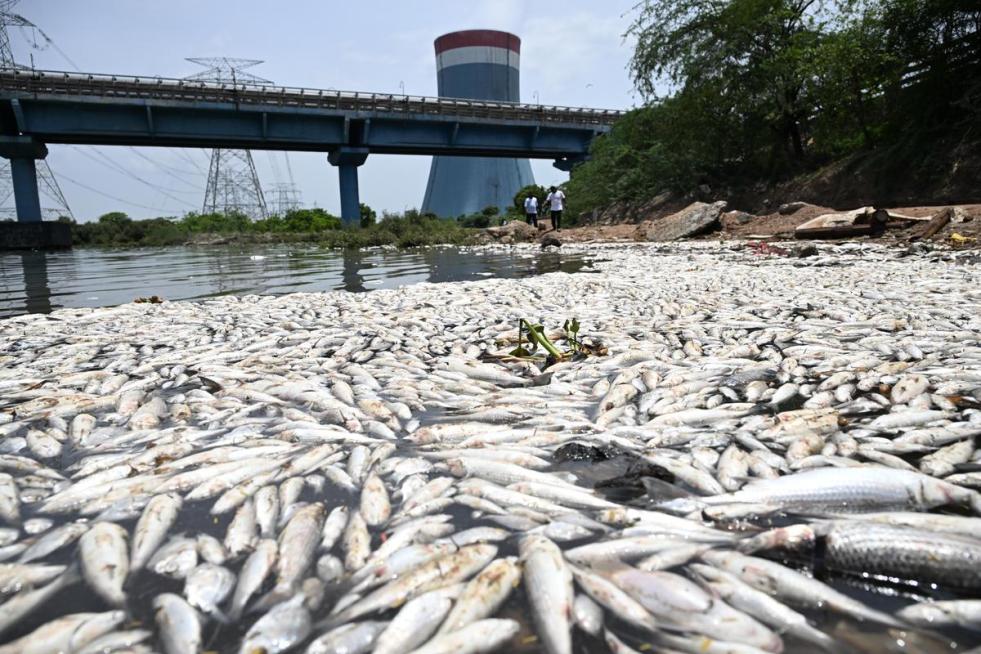
(Feature Image: Mass fish death in Kosasthalaiyar river near the Ennore estuary in Aug. 2026. Source: The Hindu)
Note: This is summary report and the detailed river basin wise compilation of mass fish mortality in Indian rivers between Nov. 2025 to Nov. 2026 can be seen here.
Based on analysis of available media reports, we could document at least 45 incidents of mass fish mortality in Indian rivers during past one year. The incidents were spread across almost all major and smaller river basins and different regions of the country. They affected every part of river systems, including headwaters, tributaries, main river channels, creeks and estuaries. The scale and frequency of these events clearly indicates towards growing threats to freshwater ecosystems and the riverine communities that depend on them.
The basin wise distribution shows that 60% of the incidents have occurred in four river basins. The Ganga basin witnessed the highest number of incidents (9-all in Yamuna basin), followed by the Brahmaputra (7), Krishna (6) & Indus (5). The Godavari basin and the West Flowing Rivers of the Netravati-Gurupura system recorded three incidents each. The Narmada and Mahanadi basins recorded two each. One incident each was reported in the Subarnarekha, Kosasthalaiyar, Cauvery, Ulhas, Sabarmati, Palar, Pennar rivers and Periyar basin.
Within the Ganga basin, the five incidents occurred in the Yamuna itself, while one each was reported in the Sahibi, Gambhiri, Chambal and Betwa rivers highlighting the recurring threat to fish species across the Yamuna and its tributaries. Several other rivers also witnessed repeated incidents during the year. The Indrayani in Pune reported mass fish deaths near Alandi in June, Sept. and Oct. 2026. Similarly, the Phalguni in Mangaluru witnessed at least three incidents in Feb., May and June 2026. These repeated events raise concerns about persistent pollution and the failure to address its underlying sources.
The regional spread shows that North and South India recorded the highest number of incidents, with 12 each. West India followed with 8, Northeast India with 7, Central India with 4 and East India with 3 incidents. Kashmir, Delhi, Maharashtra and Karnataka states witnessed repeated fish mortality events.
The month-wise distribution shows that June recorded the highest number of incidents (9), followed by April and July (7 each), Oct. and Nov. (6 each) and May (3). The month of Feb. March, Aug. and Sept. also recorded two incidents each suggesting that the mass fish mortality was not restricted to a particular season or type of river condition.
Factor wise, the industrial effluents and chemical pollution was suspected as the main reason behind about 20 such incidents. Sewage and domestic wastewater were reported as possible contributing factors in around 10 cases. These causes are just indicators as some incidents involved both industrial and sewage pollution. However, the situation clearly suggests the continuing failure to prevent untreated industrial and municipal waste from entering the affected rivers.
The lack of flows due to inadequate releases from dams, falling water levels and physical obstructions in rivers also appeared to have contributed to fish mortality in some of the cases. The incidents in the Tungabhadra and Cauvery rivers particularly highlighted the ecological consequences of insufficient water availability.
The incidents have occurred in both urban rivers and rural areas. In rural areas, untreated industrial effluents and chemical discharges were among the major suspected causes. In urban stretches, fish deaths were often associated with a combination of industrial pollution, untreated sewage and wastewater. However, the precise causes remain unconfirmed in several cases. Oxygen depletion was also reported as reason in many incidents but it is a result of polluted or stagnant water and not the actual cause behind these incidents.
In several urban and rural locations, mass fish deaths raised concerns about the safety of water used by local communities. In Delhi, the fish mortality incidents in the Yamuna were particularly serious because the river supplies raw water to the city’s treatment plants. In Jamshedpur, the mass fish deaths in the Subarnarekha raised public-health concerns, as the Subarnarekha and Kharkai rivers are described as lifelines for around 15 lakh people. In Mangaluru, following repeated fish deaths in the Phalguni river, residents began getting well water tested.
In Kashmir, fish deaths in the springs caused particular alarm because the springs are the main drinking-water source for nearly all households in many villages. The fish death in Manipur’s Sengmai river also raised similar concerns. These cases show that fish mortality risks can go beyond aquatic ecosystems to water quality and public health. They also expose the vulnerability of riverine communities that depend directly on rivers and local water bodies for their daily needs.
The species found among the dead fish raise further concerns. Tilapia, an invasive fish species in many Indian freshwater systems, was reported among the carcasses in some incidents. Their presence underlines the need for proper species identification and monitoring. It also raises questions about the spread of invasive species and their possible impacts on native freshwater biodiversity.
Public protests and judicial interventions: Several incidents triggered public protests, complaints to pollution control authorities and judicial interventions. These responses reflect growing public frustration over repeated fish deaths and the failure to prevent pollution.
In Ennore Creek, Tamil Nadu, fisherfolk and environmental groups protested after the Aug. 2026 mass fish deaths. They demanded compensation, accountability and implementation of the NGT’s July 2022 order. The state government then announced a four-member expert committee to investigate the incident. However, by Oct. 2026, the fishermen from eight hamlets were still planning to block suspected sewage entry points themselves alleging that authorities had failed to take effective action.
In Jharkhand, the NGT took cognizance of fish deaths and pollution in the Subarnarekha river in May 2026 and directed a three-member joint committee to submit a fact-finding report. In Chhattisgarh, the High Court took suo motu cognizance in May 2026 of severe industrial pollution in the Shivnath and Kharun rivers following reports of mass fish deaths and alleged discharge of untreated industrial effluents. The court also sought explanations from the concerned authorities and directed the preparation of an action plan to address industrial pollution.
In Punjab, farmers and environmentalists raised concerns over toxic pollution and fish deaths in Sutlej near Harike in April 2026. They demanded water-quality testing, an investigation and accountability and also approached the NGT, urging it to take cognizance of the incident. The Phalguni river in Mangaluru has also seen repeated complaints and demands for action. The NGT’s Chennai Bench had earlier taken suo motu cognizance of pollution in the river. However, local groups alleged that only some formal measures had followed and continued to demand a comprehensive inquiry and action against polluting industries.
The situation in the Periyar river, Kerala highlighted the ongoing struggle of affected communities for compensation. Two years after the mass fish kill of May 2024 along the Eloor–Edayar industrial stretch, fisherfolk were still awaiting relief. These cases underline that public protests, committee formation and judicial directions have not always translated into timely investigations, effective action or relief for affected communities. They also show the need for accountability and effective pollution control rather than temporary responses after mass fish deaths.
Persistent gaps in investigation and pollution control: In most incidents, the actual causes of fish mortality remained unidentified or have not been conclusively established. Delays in inspections, water and fish sampling, laboratory testing and public disclosure have weakened efforts to determine the causes and fix responsibility.
The repeated incidents raise serious questions about the effectiveness of existing pollution control measures and the functioning of State Pollution Control Boards and the Central Pollution Control Board (CPCB). Despite regulatory frameworks, monitoring mechanisms and several action plans, untreated industrial and municipal wastewater continues to enter rivers. The recurrence of fish deaths reveals the inadequate enforcement and preventive actions by the concerned agencies.
Unless authorities move beyond post-incident inspections and take sustained action against pollution at its source, these events are likely to recur in bigger number and scale. Under this business as usual scenario, India’s poisoned rivers will continue to become graveyards for precious freshwater biodiversity. Preventing this requires urgent action to protect aquatic life, restore river health and safeguard the communities that depend on these rivers.
SANDRP


