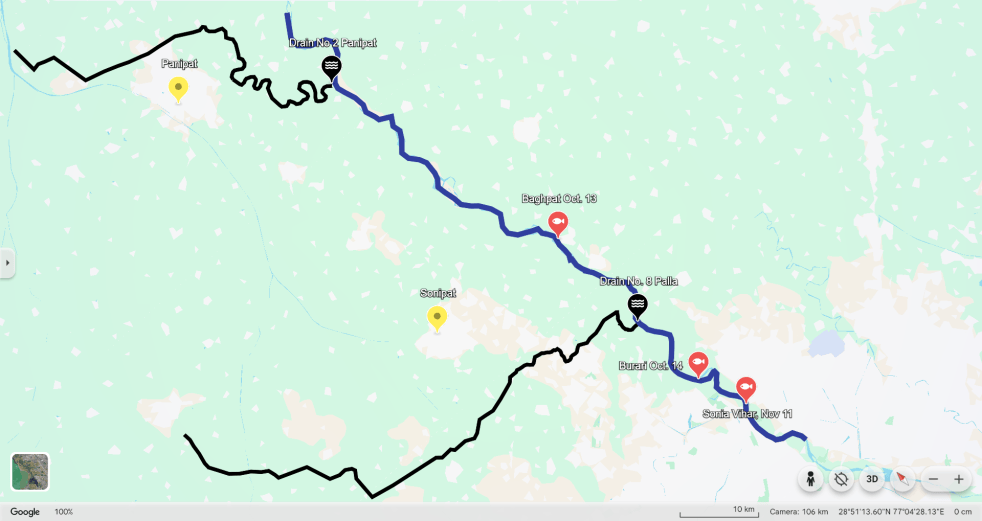
(Feature Image: Google Earth Map showing locations drain number 2 & 8 and mass fish death along Yamuna on Oct. 13 in Baghpat, Oct. 14 in Burari & Nov. 11 in Sonia Vihar, Delhi)
At least three incidents of mass fish mortality in the Yamuna within a month have raised serious concerns about pollution control measures and the failure of government agencies to protect the river’s remaining aquatic life. The incidents were reported in the relatively cleaner stretch of the river upstream of Delhi. Despite the seriousness of these incidents, their causes remain unconfirmed as no conclusive investigation report was done or made public by Nov. 19, 2026.
Oct 14; Mass fish deaths near Burari: The first incident was reported near Badarpur Majra, close to Burari in North Delhi, on Oct 14 evening. The New Delhi Nature Society (NDNS) first flagged the incident on X. It shared about a 1.25 minute long video showing large numbers of dead fish in shallow pools along the riverbank. The fish were reportedly identified as Tilapia, catfish (Mangur) which are invasive species among common carp and several other small fish.
The people recording the video said that the fish were dying because polluted water had entered the river. Photographs taken the following morning with geolocation details also showed scores of dead fish along the riverbank. Local allegations pointed towards the discharge of industrial waste from Haryana. However, no laboratory investigation has established the cause or confirmed the source of pollution.
Quoting the NDNS post to Central Pollution Control Board (CPCB), Delhi Pollution Control Committee (DPCC), the Irrigation and Flood Control (IFC) Department, Delhi; the National Mission for Clean Ganga (NMCG) and other concerned, SANDRP also called for an investigation and preventive action regarding the incident.
SANDRP shared the NDNS post on Oct. 15 and tagged the Central Pollution Control Board (CPCB), Delhi Pollution Control Committee (DPCC), Delhi’s Irrigation and Flood Control (I&FC) Department, the National Mission for Clean Ganga (NMCG) and other concerned agencies requesting for an investigation and preventive action. No response from any so far.
On the same day, Pankaj Kumar of the Earth Warrior group sent a formal complaint to the DPCC Chairman, seeking an urgent investigation and scientific testing of water and fish samples. The letter also copied to Chief Minister Delhi, Lieutenant Governor, Delhi; Water Minister, Delhi; Chief Executive Officer, Delhi Jal Board (DJB), Member Secretary, CPCB also raised concerns about drinking water quality and possible adverse impacts on the health of the citizen. The complaint demanded making the findings public, identification of pollution sources, action against responsible agencies. As per Pankaj Kumar, even after a month, the letter has not received any reply from the concerned departments.
Oct. 14; Mass Fish Death in Baghpat: As per this report, fish in large number were also found dead along one km stretch of Yamuna near Niwada bridge in Baghpat district Uttar Pradesh on Oct. 14 morning. Local people attributed the deaths to chemically contaminated water allegedly discharged into the river through upstream drains the previous night. They also claimed that the river was getting polluted water supply regularly and there have been fish and turtle deaths in the area in past also.
The report also revealed that the Fisheries Department had released 50,000 fish fingerlings into the Yamuna on Oct. 13, just a day before the incident. It is not clear how many of these fingerlings died in the incident. Santosh Verma, Senior Fisheries Inspector (SFI), Baghpat, suspected that industrial wastewater from Haryana could have caused the fish deaths. The department advised people not to consume the dead fish and to bury them safely.
According to Oct. 19 report, the Baghpat District Magistrate (DM) ordered an investigation into the matter directing the Uttar Pradesh Pollution Control Board (UPPCB) officials to inspect industrial units along the Yamuna in Baghpat and Haryana. The investigation was intended to identify pollution sources and establish the actual cause of the fish deaths. The administration also said that action would be taken against industries if violations were found.
Probe Incomplete: To find out the status of the investigation, we contacted Santosh Verma, SFI, Baghpat, on Nov 15. He said that UPPCB officials had collected water samples but had not shared the laboratory report with the Fisheries Department. He also confirmed that fish mortality was a recurring problem in the area.
We also spoke to Rohit Yadav, a Junior Engineer with the UPPCB in Baghpat. He said that the board had collected only water samples two days after the incident. By then, he said, the polluted water had moved downstream. He added that field observations did not reveal any significant change in the colour of the river water. The water samples were sent to the laboratory in Meerut. Although testing had been completed, the final report was awaited.
When asked why fish samples were not collected, Yadav said that the UPPCB was responsible for water testing, while fish testing came under the Fisheries Department. However, the Fisheries Department official could not explain why fish samples were not taken and sent to the ICAR-National Bureau of Fish Genetic Resources (ICAR-NBFGR), Lucknow, for post-mortem.
The UPPCB official also said that no field inspection had yet been conducted to identify the source of pollution or the industries responsible. He acknowledged that fish deaths had been recurring in the region sometimes two or three times a year.
These responses reveal serious gaps in the investigation. Water samples were collected only after the suspected pollution had moved downstream. No fish samples were collected for testing. The final laboratory report was still awaited a month after the incident. There was also no clear account of field inspections to trace the source of pollution.
We also contacted Divyanshu Patel, the Baghpat DM, for an update on the investigation. He had not responded to our phone calls. We have also sought the latest status through email and will update this report if a response is received.
Pollution in Drain No. 2: Notably, this Oct. 14 report highlighted the continued discharge of industrial effluents into the Yamuna through Drain No. 2 in Panipat, despite earlier enforcement measures. The report also quoted local residents alleging that industrial waste was being dumped into the drain through tankers, particularly at night.
Drain No. 2 joins the Yamuna near Khojakipur village in Samalkha. This location is around 40 km upstream of Niwada Bridge in Baghpat. The possibility that pollution from this drain could affect aquatic life in the Yamuna cannot be ruled out. However, there is no official finding or credible evidence linking Drain No. 2 to the Oct. 14 fish deaths in Baghpat.
There is an urgent need to investigate whether new pollution sources in the Samalkha, Ganaur and Murthal areas of Haryana are discharging untreated effluents into the river after Drain 2.
Nov. 11; Mass fish deaths near Sonia Vihar, Delhi: The third incident was reported near Sonia Vihar on Nov. 11. It occurred a day after the launch of the Namo Yamuna River Safari, an electric cruise service between Sonia Vihar and Jagatpur. Several videos circulated on social media showing large numbers of dead fish floating in the river and moving downstream towards Wazirabad Barrage. One video showed a boatman removing dead fish from the river just upstream of the barrage.
The timing of the incident led to allegations that chemicals had been sprayed into the river to improve its appearance before the launch of the river safari. These allegations have not been independently verified.
Ammonia Spike: The fish deaths coincided with an ammonia level of around 1.3 mg/l in the raw water drawn from the river on the morning of Nov. 11. According to a DJB official, the elevated ammonia level affected water production at the Sonia Vihar Water Treatment Plant (WTP) for nearly five hours. Operations were restored after the situation improved.
The plant primarily receives water from the Ganga. This supply on that day was disrupted due to the annual maintenance and closure of the Upper Ganga Canal. As a result, the plant had to rely more on the Yamuna as an alternative source. DJB’s treatment plants are designed to treat raw water with ammonia levels of up to 1 mg/l.
However, some experts questioned whether the rise in ammonia alone could explain the scale of fish mortality. They called for water-quality testing of relevant parameters and examination of fish samples to establish the cause.
Scientific Investigation Missing: Rather than focusing on a scientific investigation into the fish deaths, the incident soon became part of a political dispute. Delhi Water Minister Pravesh Verma alleged that some people had deliberately dumped dead fish into the river. On Nov 12, the IFC Dept filed a complaint with the police, seeking action against unidentified persons for spreading misinformation and attempting to tarnish govt image ahead of Chhath Puja.
Two days later, Wazirabad Police registered FIR under Sections 353(2), 352 and 240 of the Bharatiya Nyaya Sanhita (BNS). The police also arrested Surender Singh Azad, who had initially posted some of the videos showing dead fish. He was subsequently released on bail.
The FIR primarily concerned allegations of misinformation about chemical spraying in the Yamuna and the dumping of dead fish. It does not establish the cause of the fish deaths or provide any scientific findings about the river’s water quality.
The complaint filed by the I&FC Department records the DJB’s categorical denial that it had sprayed chemicals into the Yamuna upstream. It also mentioned that opening of Wazirabad Barrage gates is part of routine water-level and inflow management and it should not be treated as evidence of chemical contamination or proof that dead fish were being carried downstream. The IF&C department also stated that further investigation was in progress to establish the facts.
Fish Deaths in Jhangola & Palla: There are ground video reports suggesting that the fish deaths were not limited to Sonia Vihar but also happened in Jhangola and Palla areas which are located about 15 and 20 km upstream Sonia Vihar. The fishermen interviewed in Jhangola area claimed that they had seen large numbers of dead fish floating downstream on the evening of Nov. 10. They alleged that polluted water had entered the Yamuna through Drain No. 8. They also raised concerns about the impact of reoccurring pollution and fish deaths on their livelihoods, river ecosystem and on people dependent on the Yamuna for drinking water.
Similarly, residents near the confluence of Drain No. 8 and the Yamuna near Palla, the river’s entry point into Delhi, complained that the drain had been carrying heavily polluted water from industrial areas of Sonipat for many years. They also claimed to have seen dead fish near the confluence. These accounts point to possible pollution sources that require investigation. However, they do not officially establish that Drain No. 8 caused the Nov. 11 fish deaths.
Gaps in Pollution Monitoring & Control: The three incidents have exposed major gaps in the response of pollution control and other government agencies. The allegations, complaints and the FIR so far have not answered the central questions which is whether the incidents happened due to industrial pollution through Drain No. 2 & 8, untreated effluents, rise in ammonia levels, chemical use or there are other factors. This could have been established through a proper scientific investigation which all the concerned bodies especially the DPCC, UPPCB, HSPCB and CPCB have conveniently ignored.
A DPCC official, speaking on condition of anonymity, told us that the committee had not taken cognisance of either incident and had not collected water samples for laboratory testing. This raises questions about the DPCC’s response to the two incidents in Delhi. It is also unclear which government agency in Delhi is responsible for collecting dead fish and arranging post-mortem examinations to establish the cause of mortality. There is no publicly available information confirming whether fish samples were collected and tested after either incident.
The DJB has also not shared an official report establishing whether the ammonia episode was linked to the fish deaths. Similarly, the I&FC Department has not made public any scientific investigation into the deaths or identified the source of pollution. The cause of the Baghpat fish deaths also remains unknown apparently due to negligence on behalf of UPPCB and Fisheries Department.
Despite high-level meetings and the constitution of an inter-state committee under the Union Home Secretary to coordinate Yamuna pollution control, reports continue to indicate that Drain No. 2 & 8 in Haryana carry industrial effluents into the river. This raises serious questions about the effectiveness of the HSPCB in preventing and controlling industrial pollution. It also highlights persistent gaps in monitoring, enforcement and accountability despite repeated government interventions.
In addition to these state level agencies, the CPCB and NMCG which have important role in monitoring and coordinating Yamuna pollution control efforts. Both have largely remained inactive on these mass fish death incidents. Their response to these recurring incidents and the steps taken to coordinate with state agencies need to be made public.
Unanswered Questions: The three incidents have raised several important questions that require urgent answers including what are the actual reasons behind the mass fish deaths, the number and species affected? Why water and fish samples were not collected immediately and which agency was responsible for the lapses? Is upstream pollution common link for mass fish kill in Baghpat and Burari on Oct. 14? Has Nov. 11 incident affected Delhi stretch of Yamuna lying between Palla to Wazirabad?
Why industrial effluents continue to reach the river through Drain No. 2 & 8 and have new unauthorised pollution discharge points emerged between these drains? What is the truth behind chemical spray and dumping of dead fish allegations? What has been the impact of the incidents on the river’s water quality, aquatic life & fishermen livelihoods? What concrete steps have been taken by all the concerned agencies to prevent further fish deaths in the river?
Past Incidents: Notably, the Yamuna has also witnessed similar mass fish deaths in Delhi in in 2024 and 2025. In July 2024, large numbers of dead fish found dead along the river in Burari area. In its subsequent submission to the National Green Tribunal (NGT), the DPCC attributed the incident to polluted water entering the river through Haryana’s Drain No. 8.
In May 2025, another mass fish mortality incident was reported in the Burari stretch of the river. The local people again blamed untreated industrial effluents in Drain No. 8. They alleged that such incidents recur whenever polluted is discharged in the drain from Sonipat areas.
Hearing the matter in Sept, 2025, the NGT reprimanded the Delhi and Haryana governments and concerned agencies for shifting responsibility. The tribunal directed the CPCB to convene a joint meeting, fix accountability and prepare a preventive action plan. It also criticised the NMCG for seeking to place responsibility solely on the River Rejuvenation Committee. In Baghpat too similar mass fish death incidents were reported in June 2025 and May 2022.
Will this become a recurring feature of the Yamuna? Fish populations and diversity are important indicators of a river’s health. The recurring mass fish deaths in Yamuna are a clear warning of a deteriorating river ecosystem. Failure to investigate such incidents promptly puts aquatic life and fisheries at risk. It also raises serious questions about the functioning of government agencies and the effectiveness of pollution control measures in Haryana, Uttar Pradesh and Delhi. Will the concerned agencies take concrete action to prevent further fish deaths, or will they continue to let such incidents become a recurring feature of the Yamuna?
SANDRP


