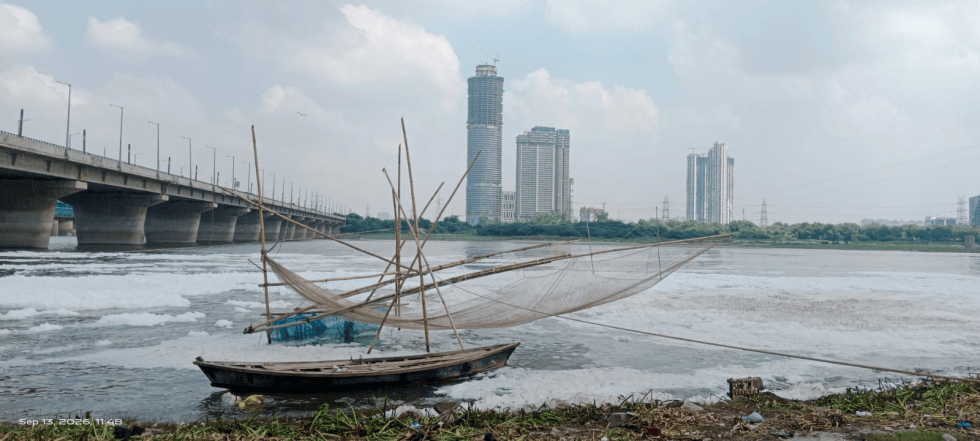
(Feature image: Yamuna fishers net tied to a boat downstream Okhala barrage in Sept. 2026. Bhim Singh Rawat/ SANDRP)
On the occasion of the 29th World Fisheries Day, small-scale inland fisheries deserve attention. The recently published book Small-scale Inland Fisheries in India highlights the sector’s contribution to livelihoods, poverty alleviation and nutritional security. The small-scale fishers are often among the worst & silently affected by the growing adverse impacts of development projects on rivers. They also bear economic and livelihood costs of declining fish catches that result from development projects. However, they have little influence over decisions on river management and fisheries governance. No development Project has ever counted them among affected, or have even attempted compensation, leave aside rehabilitation for them.
India’s freshwater fish conservation requires healthy rivers, effective pollution control, protected fish habitats and recognition of riverine communities. Therefore, the marginal small-scale inland fishers must be kept in the center of fisheries policy. Their welfare and participation are essential for sustainable inland fisheries and healthy rivers.
The recently launched India’s National Plan of Action (NPOA) for small-scale inland fisheries offers an important opportunity. The proposed plan must recognize riverine fishers’ rights and ensure their meaningful participation in decision-making. Their traditional knowledge and close engagement with rivers can also help track changes in fish populations and identify sources of pollution. With adequate institutional support, they can become key partners in protecting river ecosystems and sustaining inland fisheries.
FISH, FISHERIES, FISHERFOLKS
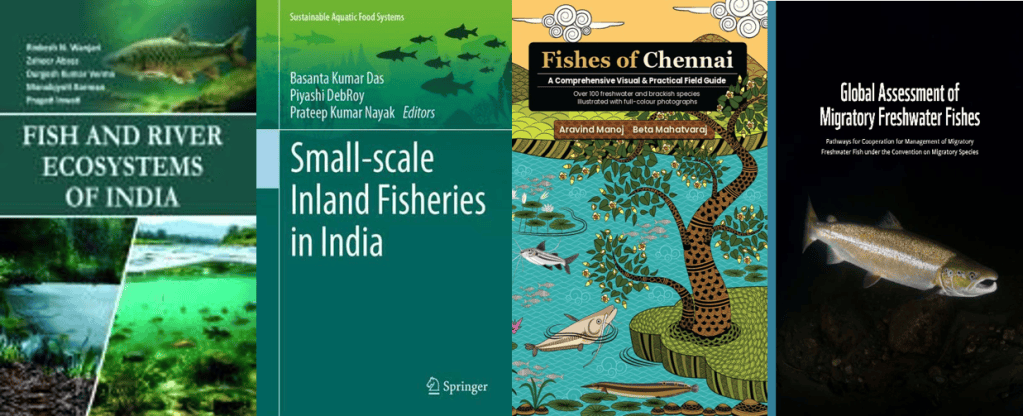
Book Small scale Inland fishers in India -This book offers an overview of the small-scale inland fisheries sector in India, a crucial yet often overlooked component of the nation’s livelihood and poverty alleviation efforts. By examining the management systems across the social-ecological realms, it highlights the urgent need to integrate small-scale inland fisheries into global and national policies. Key topics include nutritional security, governance, gender, climate change and policy frameworks, supported by relevant case studies.
National action plan for inland small-scale fisheries Dr Abhilaksh Likhi, Secretary, Department of Fisheries, Government of India formally launched India’s development phase of the National Plan of Action (NPOA) for small-scale inland fisheries. The plan is being developed under the framework of the UN Food and Agriculture Organization’s (FAO). The initiative is being led by the Union Department of Fisheries in collaboration with the Bay of Bengal Programme Inter-Governmental Organisation (BOBP-IGO). Addressing the gathering, Dr Abhilaksh Likhi called for a mission-mode outreach programme to take India’s proposed national action plan for sustainable inland small-scale fisheries to fishing communities across the country. “The document must translate into practical improvements in livelihoods rather than remain confined to government offices”, he said, adding that the proposed plan must prioritise sustainability amid climate crisis, and strengthen value chains to improve fishers’ income.
Dr Likhi further said: “India has set a target of 30 million tonnes in fish production over the next five years, while seafood exports are expected to rise to Rs 1.25 lakh crore”. Highlighting the sector’s current status, he said India had achieved an annual fish production of 19.7 million tonnes, with inland fisheries contributing approximately three-fourths of this output, while seafood exports had crossed Rs 70,000 crore. However, Fisheries Secretary stressed that production and export growth must go hand in hand with securing the livelihoods of small-scale fishers.On sustainability, Dr Likhi flagged climate change and deteriorating water quality as major concerns for inland fisheries, pointing to challenges such as declining oxygen levels in water bodies. He said the plan must incorporate measures to build climate resilience, drawing on the experience of fishing communities who directly confront these challenges.
FISH AND RIVER ECOSYSTEMS OF INDIA Bridging science and practice, the volume maps India’s major river basins and their fish diversity, highlights Ramsar sites and biodiversity hotspots, and interprets how these designations contribute to global conservation outcomes. It demystifies legislation and policy frameworks—from protected-area instruments to environmental flow standards—translating compliance requirements into field actions. Community knowledge is woven throughout, showing how indigenous practices, seasonal calendars, and customary norms can strengthen co-management and restoration outcomes. The book closes with future directions that integrate robust science, policy reform, finance, and community stewardship, supported by case studies of river-habitat restoration and species-recovery successes.
WFD 2026: Discovery of New Freshwater Fish Species in India The findings show that the Northeast region accounts for a large share of these discoveries, followed by the Western Ghats. Two remarkable discoveries are subterranean fish species found in groundwater in Bihar and Assam, while new catfish species have been described from rivers and streams in Odisha and Manipur. Other important findings include new or previously unrecognized fish species from Maharashtra’s Krishna basin, Karnataka’s Cauvery basin and Kerala’s Periyar river system. Most importantly, these discoveries reveal the still-undocumented diversity of fish in Indian rivers and freshwater ecosystems. They also highlight the threats these species and their habitats face from pollution, dams, habitat destruction, river modification, invasive species and groundwater over-extraction, underlining the urgent need for better research and conservation.
WFD 2026: Important Report, Studies & Books on Freshwater Fish in India A common finding across many of these publications is the growing pressure on riverine fish and fisheries due to altered river flows, habitat fragmentation, climate change, pollution, invasive species & unsustainable fishing. On positive side, research in the Cauvery basin has developed indicators to assess river health by examining fish diversity, vegetation and land-use patterns. While, a book Small-scale Inland Fisheries in India has highlighted the contribution of inland fisheries to livelihoods, poverty alleviation and nutritional security, another book Fish and River Ecosystems of India has documented fish diversity across major river basins, biodiversity hotspots and Ramsar sites.
2026: Over 40 Mass fish deaths across Indian rivers- An Overview Based on analysis of available media reports, we could document at least 45 incidents of mass fish mortality in Indian rivers during past one year. The incidents were spread across almost all major and smaller river basins and different regions of the country. They affected every part of river systems, including headwaters, tributaries, main river channels, creeks and estuaries. The scale and frequency of these events clearly indicates towards growing threats to freshwater ecosystems and the riverine communities that depend on them.
The repeated incidents raise serious questions about the effectiveness of existing pollution control measures and the functioning of State Pollution Control Boards and the Central Pollution Control Board (CPCB). Despite regulatory frameworks, monitoring mechanisms and several action plans, untreated industrial and municipal wastewater continues to enter rivers. The recurrence of fish deaths reveals the inadequate enforcement and preventive actions by the concerned agencies.
Who is responsible for 3 mass fish deaths in Yamuna in 1 month? The recurring mass fish deaths in Yamuna are a clear warning of a deteriorating river ecosystem. Failure to investigate such incidents promptly puts aquatic life and fisheries at risk. It also raises serious questions about the functioning of government agencies and the effectiveness of pollution control measures in Haryana, Uttar Pradesh and Delhi. Will the concerned agencies take concrete action to prevent further fish deaths, or will they continue to let such incidents become a recurring feature of the Yamuna?
SANDRP’s report highlights major gaps in pollution monitoring and control. A DPCC official, speaking anonymously, said the committee had not taken cognisance of either Delhi incident and had not collected water samples. It is unclear which agency is responsible for collecting dead fish and conducting post-mortem examinations. The CPCB and the National Mission for Clean Ganga have remained largely inactive. Despite high-level meetings and an inter-state committee under the Union Home Secretary, industrial effluents continue to reach the river through Drain No. 2 and Drain No. 8 in Haryana.
Two new loaches of the genus Mesonoemacheilus from the Western Ghats Abstract: –Two new species of the ‘Mesonoemacheilus guentheri’ group are described from the Western Ghats Hotspot, based on morphological and multi-locus molecular data (mitochondrial cytochrome oxidase subunit 1, cytochrome b and nuclear Recombination-Activating Gene 1 sequences). Mesonoemacheilus mannanorum, new species, from a headwater stream of the Periyar River, is distinguished by a unique colour pattern of three series of whitish blotches on a brown background, and 8–9 branched pectoral-fin rays. Mesonoemacheilus sabariensis, new species, from a headwater stream of the Pamba River, is distinguished by a unique colour pattern comprising midlateral series of regularly or irregularly set and shaped whitish blotches with a wide brown margin, and pointed, elongated nasal flap-bars. Mesonoemacheilus now comprises 11 species, all of which are endemic to the rivers draining the Western Ghats Biodiversity Hotspot.
KUFOS researchers discover two fish species in Western Ghats The study noted that the two new species have a highly restricted distribution, being confined to small headwater tributaries of the Periyar and Pampa rivers. The habitats where the two species occur are also threatened by several alien fishes, increasing their potential extinction risk. Given the small distribution and ongoing threats, Mesonoemacheilus mannanorum and Mesonoemacheilus sabariensis could qualify for the endangered category on the IUCN Red List, the study noted.
HYDRO POWER PROJECTS
Siang Dam or Disaster? Is China preparing a Water Bomb for India? Why Modiji took a U-turn on Siang? Himanshu Thakkar is a prominent environmental activist, water resources expert, and the coordinator of the South Asia Network on Dams, Rivers and People (SANDRP). For over three decades, he has been a leading voice in debates around large dams, river conservation, environmental accountability and sustainable water management in India. Today, we speak with him about the proposed Siang mega dam, its environmental implications and a fundamental question: Does India really need more mega dams?
Arunachal CM said that the proposed SUMP would have a storage capacity of around 9.2 billion cubic metres (BCM), compared with the reported 5.2 BCM capacity of the Chinese project. (Where is the 5.2 BCM figure from?)
Excellent report on downstream impacts of the 405 MW Ranganadi HEP This report provides excellent details about how the downstream affected villages are suffering the adverse impacts of the 405 MW Ranganadi HEP in Arunachal Pradesh, commissioned in 2000. The impacts includes drying up of rivers, sudden floods, lack of electricity, decrease in groundwater levels, destruction of orange and other crops, destruction of fisheries, among others. Titled “Beyond Displacement: The Untold Story of Panyor Hydropower Project”, the 15 minute video report is by Bengia Ajum.
Arunachal Times video report on 600 MW Kameng HEP downstream impacts The NEEPCO’s 600 mw run-of-the-river Kameng hydroelectric project in Bichom river has reduced the once mighty river to a stream. Fishes have disappeared, and the villagers downstream are facing acute water shortage, leading to dwindling of horticulture and agriculture activities. In monsoon, sudden release of water from the dam creates erosion and disaster in downstream area. The KaHEP Downstream People’s Affected Forum (KDPAF) has sought intervention by the government and the NEEPCO. It has asked that the flow of the river be maintained, and that the affected villagers be compensated. – Video courtesy: KDPAF.
Kalai-II dam project’s flawed clearances expose risks of fast-tracking SUMP Although framed as a run-of-the-river project, Kalai-II relies on daily pondage behind a 198-metre-high dam to meet peak power demand — creating erratic, unnatural water surges during lean winter months that disrupt aquatic habitats, river transport, and floodplain farming. Simultaneously, trapping Himalayan silt behind the dam wall releases sediment-starved water downstream, accelerating riverbank erosion in upper Assam while depriving agricultural floodplains of natural soil replenishment. Coupled with the severe seismic hazards of Zone V and the growing threat of glacial lake outburst floods (GLOFs), the project introduces significant downstream hydrological risks across the Brahmaputra basin.
Kalai-II illustrates how official appraisal processes can advance towards forest and financial approvals even when baseline ecological assessments miss critical Schedule I species and rely on ecologically mismatched off-site mitigation. State leaders have repeatedly assured residents in the Siang valley that the PFR is merely a preliminary study and that no final decision has been made. For indigenous communities protesting the SUMP, Kalai-II demonstrates that once initial surveys and clearances are permitted, institutional momentum tends to push projects toward a foregone conclusion by sidelining genuine community consent, treating glaring EIA gaps as post-approval formalities, and trading away irreplaceable Himalayan river ecosystems for distant or inadequate mitigation measures.
Harnessing energy from Arunachal’s rivers cannot come at the cost of sidelining the critically endangered white-bellied heron, bypassing local consent, or treating distant afforestation in central India as an equivalent trade for a living Himalayan ecosystem. Whether along the Lohit or the Siang, state and central authorities must enforce rigorous scientific accountability, respect genuine local consent, and protect the rivers, forests, and indigenous communities of Arunachal before irreversible damage is done. (Badak Yomgam)
Karjat tree felling raises questions about the cost of green energy With Maharashtra fast-tracking pumped storage projects, the loss of thousands of trees in the Sahyadris puts the focus on villagers, wildlife and whether compensatory afforestation works.
DAM SAFETY
CWPRS-Pune to hold National Conference on Dam Safety, Rivers Central Water & Power Research Station, Pune, will host a two-day national conference on Integrated River, Reservoir and Dam Systems (IRRDS–2026) on November 19 and 20. The conference will focus on the theme “Connecting Rivers, Reservoirs and Dams for a Resilient Water Future”. The two-day conference will cover six thematic areas: integrated river basin and reservoir systems; climate resilience and extreme events; dam health, safety and resilient infrastructure; integrated reservoir sediment management; advanced survey and digital technologies; and hydraulic structures and spillways.
DAMS
Uttam Sinha: Has Farakka outlived its economic life and functional utility? Growing disquiet in Bihar over Farakka’s consequences demands fresh examination. Equally important is whether the barrage has delivered the navigational and economic benefits originally envisaged for the Calcutta port. However sensitive the question, it is worth asking whether Farakka has outlived its economic life and functional utility.
The immediate priority must be to prevent December 12 from becoming a cliff edge. India and Bangladesh should consider an interim arrangement that preserves existing operational practices without prejudicing either side’s position on a future treaty. …transparency cannot be a one-sided obligation. India should share timely, reliable upstream-flow data, while Bangladesh should provide corresponding downstream information on the Padma and related hydrological conditions.
The successor arrangement must also address climate resilience. Joint flood forecasting, early-warning systems, drought planning and procedures for extreme events are essential. The rational course is to preserve negotiated sharing while building a framework for shared water security.
Telangana seeks CG nod for Sammakkasagar Barrage The project is intended to use Godavari waters for drinking and irrigation water supplies in parts of Telangana. Telangana has sought CG nod after revising the project design to reduce the extent of submergence in the neighbouring state. The project was initially proposed at Kantalapalli, where an estimated 11,408 acres of land in Chhattisgarh was likely to be submerged. The original proposal was also expected to affect 17 Adivasi villages and security infrastructure in the region.
To address these concerns and minimise submergence, the proposed barrage was shifted from Kantalapalli to Tupakulagudem in Mulugu district of Telangana. According to a study conducted by the Indian Institute of Technology (IIT) Kharagpur, approximately 33 acres of land in Chhattisgarh would be submerged when the barrage operates at its Full Reservoir Level (FRL). Even under extreme flood conditions, the affected area would not exceed 100 acres, the study found. The project has a storage capacity of 6.94 thousand million cubic feet (TMC) of water at its FRL of 83 metres.
Telangana to KRMB: AP’s 90 TMC Palnadu diversion plan illegal Alleging that the project was being taken up illegally, Telangana irrigation officials have lodged a complaint with the Krishna River Management Board (KRMB), seeking an immediate halt to Andhra Pradesh’s construction of the Palnadu Drinking Water Supply Scheme. The AP government is executing the Rs 1,200-crore project to draw 1.865 tmcft of water from the Nagarjunasagar Project (NSP) backwaters, from below the 510-ft dead storage level. The scheme is intended to supply drinking water to 363 villages in 11 mandals in the Palnadu region, covering a population of about 10 lakh.
Taken up last year, the project has reportedly seen about 20% of its construction work completed, according to Telangana officials. They argued that Andhra Pradesh cannot draw water from rivers without the consent of the river management boards and should submit the project details to both the KRMB and Telangana.
URBAN RIVERS
Rs. 500 cr Mula-Mutha pollution abatement project In a report filed before NGT on Oct. 29, PMRDA stated that the project includes river rejuvenation, interception and diversion of open drains and nallahs, construction of decentralised and centralised STPs, laying of interceptor trunk mains and in-situ ecological restoration across the 107-km river network within its jurisdiction. The total estimated cost of the project is approximately Rs 500 crore.
The authority plans to construct STPs, pumping stations and interceptor sewer pipelines across 107 km of river stretches. The project is expected to be completed by August 2030. A joint committee report dated July 9, 2026, found that water samples collected upstream of the Pimple Nilakh crematorium showed high levels of organic pollution and severe depletion of dissolved oxygen due to the discharge of untreated domestic sewage. The report linked these conditions to fish deaths in Sept. 2024.
Alteration of natural waterway in Talegaon Dabhade A construction company has allegedly altered a natural waterway passing through Talegaon Dabhade village in Maval taluka of Pune district, Maharashtra, which eventually flows into the Indrayani river. The alterations have caused irreversible ecological damage and created a potential flooding risk, applicant Krishna Kumar Shyamlal Kapoor alleged in a submission filed before the NGT on Oct. 26. Earlier, on Oct. 9, the NGT had directed the applicant to submit geotagged photographs, along with a drainage or nallah map of the site and revenue records establishing the existence of the waterway.
RIVERS
Ecological costs of Unchecked Development in Chenab Valley The A recent report by the SANDRP, Infrastructure Projects in Chenab Basin and Climate Change: Need to Exercise Caution (27 April 2025), brings these concerns into focus.
Drawing on field visits from the river’s origin to Akhnoor in October and November 2024, community interactions, scientific studies and government records, it examines how conditions in the basin are changing and what that means for expanding infrastructure. Its findings deserve close attention from policymakers, hydropower authorities, environmental regulators and civil society across Jammu and Kashmir. (By Sadaket Ali Malik)
Inside Sonbhadra–Singrauli Sonbhadra-Singrauli, on the Uttar Pradesh-Madhya Pradesh border, is one of India’s largest coal mining and thermal power regions. Its mines and power plants supply electricity to homes and industries across the country. While the coal here lights up millions of homes across India, the people living on top of it say they are paying with their health.
Residents describe a side of that story that rarely reaches the national debate, from its polluted air to its contaminated water and degraded soil. Dust and emissions from mining and power plants hang over the region, and the improper disposal of fly ash has raised serious concerns about its rivers, reservoirs and groundwater. Scientific studies have documented fluoride, arsenic, mercury and lead in the region, and fluorosis has been reported in several areas. Locals say livestock have died after drinking water contaminated with fly ash, and that farming and livelihoods are suffering. With few healthcare facilities nearby, many villagers have to travel far for treatment.
Tracing the impacts of changing waters in Tripura’s gas-producing hills Across Tripura’s forested hills, gas drilling is altering water systems in ways that remain largely undocumented, leaving Indigenous communities to navigate polluted rivers, shrinking resources, and limited institutional accountability.
Court’s message a river cannot be revived in Silos The In a significant ruling, the Supreme Court has sought to address the institutional and administrative failures impeding the Yamuna’s rejuvenation. It has held all states and Union Territories (UTs) in the Yamuna basin accountable for the river’s health. The Court’s insistence on viewing the Yamuna as a single ecological system should end the fragmented approach that has plagued India’s river restoration projects. The SC has called for greater coordination among the states and UTs that share the river and made the administration of each answerable for the decline in the Yamuna’s water quality within its jurisdiction. The Central Pollution Control Board has been tasked with devising a liability framework under which polluters and negligent officials can be penalised. These measures could bring transparency to river governance.
The SC has rightly questioned the reliance on sewage treatment plants (STPs) as the principal instrument for checking river pollution. The problem is not merely the inadequate treatment capacity of these plants but also their poor utilisation and management. Delhi’s 37 STPs consistently fail to meet prescribed discharge standards. Treated wastewater often flows into drains carrying untreated sewage. The priority must shift from adding treatment capacity to making existing plants work efficiently, reusing treated water, and bringing unsewered areas into an effective water cleansing and waste-disposal system.
The Court’s latest directive, too, has emphasised that ecological restoration cannot proceed without rehabilitation schemes. Its larger message — river restoration cannot be separated from the quality of urban governance — should not be lost on the states that share the Yamuna basin.
Delhi govt’s ‘clean Yamuna’ A cruise, a dip and a camera crew. But has the Yamuna actually become cleaner? Delhi government wants you to believe it has. Its own pollution reports tell a different story.
SAND MINING
WATER OPTIONS
Andhra: MGNREGA works improve water availability, vegetation Beyond wages and employment, MGNREGA may be reshaping landscapes. New research explores how water conservation assets are influencing hydrology and greenery in Prakasam district, Andhra Pradesh.
URBAN LAKES, WETLANDS
Greens move NGT to save DPS lake Seeking to expedite the implementation of the Maharashtra State Board for Wildlife’s long-pending resolution to accord Conservation Reserve status to the 12-hectare DPS Flamingo Lake, the NatConnect Foundation has moved the NGT, seeking legal protection for the wetland. A comprehensive proposal for the Conservation Reserve, submitted by the PCCF (Wildlife) on October 28, 2025, is awaiting approval from CM Devendra Fadnavis, Kumar told the NGT, citing information received under the RTI Act. The Revenue and Forest Department’s reply stated that no Government Resolution, notification or order had been issued to give effect to the State Wildlife Board’s decision. Kumar, director of NatConnect Foundation, said in his plea that the prolonged delay had contributed to the neglect of the lake, which he alleged had turned toxic. The plea comes amid concerns over the approaching winter migration of flamingos. With sparse rainfall in their breeding grounds in Kutch, the birds are expected to move in search of suitable feeding habitats, potentially reaching Navi Mumbai’s wetlands earlier than in previous seasons.
NGT Seeks Explanation Over ₹13.09 Cr Study The NGT, in the matter of the flamingoes death case has directed the Salim Ali Centre for Ornithology and Natural History (SACON) to appear as a respondent in the case in order to understand so as to understand its proposed three-year study and the costing of approximately ₹13.09 crore on the impact of streetlights on flamingo habitats near DPS Lake wetland.
The tribunal in its orders noted that the tribunal had directed the City and Industrial Development Corporation (CIDCO) in April 2026 to commission a study through SACON to assess the impact of streetlights on the flamingos’ habitat. According to an affidavit filed by CIDCO, SACON initially proposed conducting the study over five years at an estimated cost of ₹23.32 crore. Following CIDCO’s request to reduce the duration and expenditure, SACON revised its proposal to three years at approximately ₹13.09 crore.
The corporation sought two weeks’ additional time to obtain comparative proposals from other agencies. Taking note of the substantial difference in the proposed timelines and costs, the tribunal directed its registry to implead SACON as respondent and issue notice, returnable within four weeks. It also permitted CIDCO to approach other agencies during this period. The matter has been posted for further consideration on Nov. 27. In June 2024, the NGT had taken cognizance of April 2024 flamingo death near DPS lake.
Damdama Lake lost 95% of its mapped area in 3 decades The Aravali reservoir in south Gurgaon, a popular weekend destination for Delhiites for decades, has been shrinking steadily and might well have entered its final years. The lake, as it flows today, has lost 95% of its mapped area since 1993, shrinking to 7.9 acres from 153.6 acres 32 years ago. For perspective, that’s a size reduction from 118 football fields to barely six. The shrinkage is a result of both groundwater depletion and destruction of natural rainwater channels.
Wrapping around the Sohna Aravalis like an amoeba, the lake is a rain-fed reservoir. Maps show the lake’s current catchment is spread across 24.5 sqkm and the lake itself has splintered, having five ‘sub-basins’ now instead of one composite lake. The lake’s shrinking was mapped by GuruJal, a water conservation initiative working on pond rejuvenation, eco-restoration and water stewardship.
A 2025 assessment underlined major changes in the natural drainage network around the lake. The study mapped 22 depressions in the landscape, where rainwater gets collected instead of flowing into the lake. These depressions have been caused by construction and mining activity, with land around the Sohna Aravalis constantly under real estate pressure. GuruJal suggested redesigning the landscape for the lake’s restoration, besides deepening its basin. The catchment that feeds it also needs protection.
Still, Damdama Lake holds promise, much like the bond of four friends that endured distance and silence before finding its way back. Standing once more beneath the tree by the lake shore, the four friends sensed that the lake, like their friendship, could be renewed with care and attention. What had receded could return; what had lapsed could be rekindled—through patience, commitment, and shared responsibility. The lake is not a passive witness to lives as they unfold, but a living presence, awaiting restoration through human understanding and engagement. This understanding is echoed in Amitav Ghosh’s latest book Ghost-Eye, where the world of human existence coexists with parallel realms in which mountains, rivers, lakes, and forests are alive and capable of purposeful interaction with people. Damdama Lake belongs to such a realm, communicating with humankind through subtle signs and silent urgings. It calls upon the people of the National Capital Region to remember the joy it once offered and to recognise their responsibility to care for it, just as one nurtures friendships shaped by shared moments and lasting bonds. (Ritu Rao)
INDUSTRIAL WATER SUPPLY
Thirsty data centres, dry state: Maharashtra plans a separate water company Amid concerns over the growing water requirements of data centres and industries, Mah CM on Nov 20 2026 directed the Maharashtra Industrial Development Corporation (MIDC) to prepare a proposal for setting up a wholly owned subsidiary to manage water supply to industrial units and data centres. The proposed company will source and distribute treated wastewater from municipal sewage treatment plants, along with water from conventional sources. The government also plans to bring the operation and maintenance of existing treatment plants and industrial water supply under an integrated system.
The Industries Department has also constituted a 17-member committee, headed by former Atomic Energy Commission chairman Anil Kakodkar, to examine the environmental and infrastructure impact of data centres. The panel, which includes government officials, industry representatives and technical experts, was set up after concerns were raised in the Maharashtra Legislative Council over electricity consumption, water use, land requirements, heat and noise. It has been given three months to submit its report.
For the Pune Metropolitan Region, CM directed officials to prepare a preliminary project report for linking the Savitri river basin in central Konkan with the Kukadi, Bhima, Indrayani, Mula-Mutha and Nira basins.
DROUGHT 2026
Maharashtra adds six talukas to drought-hit list Maharashtra has added six more talukas to its drought-hit list, taking the total number of drought-affected talukas in the state to 310, state Revenue Minister Chandrashekhar Bawankule announced. The newly included talukas are Vikramgad, Wada, Dindori, Chiplun, Hatkanangale and Gadhinglaj, which will now receive drought-related relief measures.
In another significant decision, the government has sanctioned Rs 488 crore to complete pending rural drinking water supply schemes. Of this amount, Rs 400 crore will be used for schemes that have completed 75 per cent of their work, while Rs 88 crore will support projects with only 5-20 per cent of work remaining.
MONSOON 2026
IMD study tracks shifting climate zones An analysis of 70 years of meteorological data by the India Meteorological Department reveals shifting climate zones across the country, with implications for agriculture, water resources and rural livelihoods.
CLOUD BURSTS
When the sky falls in Gurez Valley In Kashmir’s remote Gurez Valley, a sudden flash flood swept through a village preparing for a wedding, exposing the vulnerability of mountain communities to extreme weather.
SOUTH ASIA
Nepal: Why Pancheshwar project is unlikely to progress during PM Balen’s India visit The Pancheshwar Multipurpose Project is unlikely to make any significant progress during Prime Minister Balendra Shah’s upcoming visit to India in Nov 2026. The disagreements over the assessment of project benefits, investment sharing and downstream benefits have prevented technical teams and experts from finalising the common Detailed Project Report (DPR) for the project.
“Officials from both Nepal and India have completed the work that needs to be done at the administrative level. If the project is genuinely to move forward, there must be an agreement at the political level,” a senior government source said. “Once there is political agreement, the DPR can be finalised immediately.” Although Nepal is expected to push for an agreement during Shah’s visit, India has reportedly conveyed that it can move towards a formal agreement only after broader political consensus is reached within Nepal.
“There is a deep political divide in Nepal over this project. India’s position is that the government should first secure a minimum level of consensus among all political parties before reaching an agreement,” the source said.
Rare earth demand killing Southeast Asia’s longest river Two mutated fish, pulled recently from the Mekong River in Myanmar, have become the latest grim symbol of a river in crisis. Swollen lumps along their backs and raw patches on their heads have raised alarms about toxic contamination from rare earth mining upstream. The acid and chemical runoffs from these mines do not stay put; they travel downstream, poisoning the water that millions depend on. This is not a new problem—it has been festering for decades. (Hans Harelimana Hirwa, Mansee Bal Bhargava)
SANDRP
Also see: DRP 16 Nov 2026 & DRP 09 Nov 2026
Follow us on: www.facebook.com/sandrp.in; https://twitter.com/Indian_Rivers


