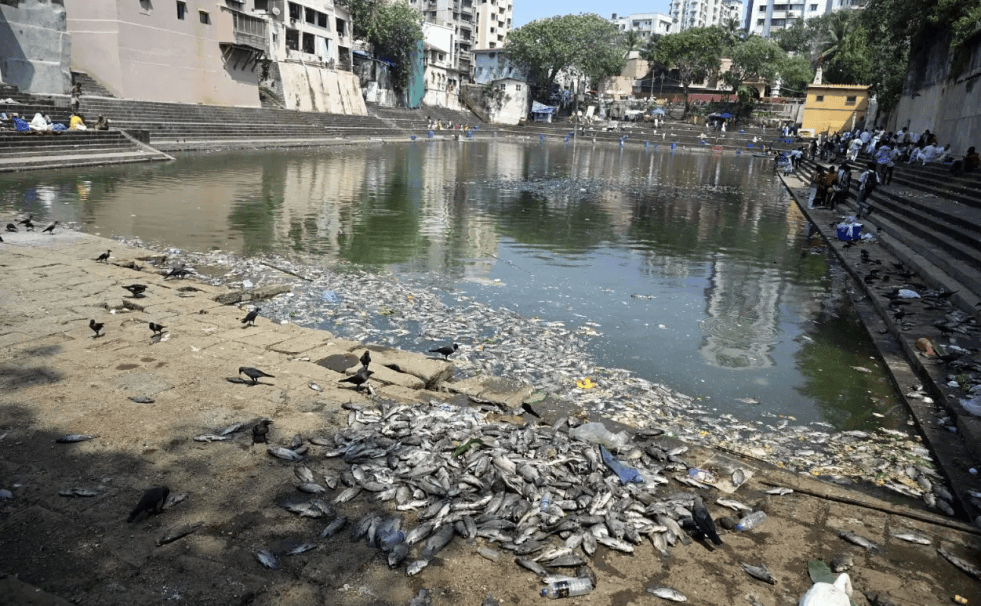
(Feature Image: Mass fish death in historice Banganga Tank in Walkeshwar area of south Mumbai in Oct. 2026. Credit: Ashish Raje/The Hindu)
This is the summary report of mass fish death incidents in urban waterbodies across India from Jan. 2026 to 28 Nov. 2026. The file containing the details of zone wise and city wise incident can be seen here.
Based on available media reports, we could document at least 41 incidents of mass fish deaths in urban lakes, ponds and tanks across India in 2026. The incidents occurred in major metropolitan cities such as Bengaluru, Mumbai, Delhi, Pune, Hyderabad and Guwahati, as well as smaller towns and urban centres.
South India recorded the highest number of 16 incidents. Bengaluru alone accounted for six, while others were reported from Chennai, Salem and Coimbatore in Tamil Nadu and Hyderabad, Tellapur, Warangal and Boduppal in Telangana. West India followed with 12 incidents in cities including Vadodara, Ahmedabad, Panaji, Mumbai, Pune, Ajmer and Jodhpur. North India recorded five incidents, including one each in Srinagar, Chandigarh, Delhi, Gurugram and Kanpur cities.
The affected waterbodies vary widely in size, shape and utility. They include historic lakes such as Ana Sagar in Ajmer and Banganga Tank in Mumbai; major urban lakes such as Pashan in Pune, Sursagar in Vadodara and Durgam Cheruvu in Hyderabad and smaller ponds and local waterbodies in residential areas. The fish deaths at Sukhna Lake in Chandigarh and Deepor Beel in Guwahati have raised serious questions over management of Ramsar sites.
Month wise, June recorded the highest (7) number of incidents, followed by April (6), July (5), and Aug. & Oct. (4 each). 3 incidents each were reported in Jan., May, Sept. and Nov. months. Several cases occurred during summer and the early monsoon period, when falling water levels, high temperatures, reduced dissolved oxygen and the pollutant accumulation make aquatic life in waterbodies vulnerable.
Reasons for Mass Fish Deaths(MFD): Untreated sewage, industrial effluents and chemical contamination has been suspected as the main causes in many cases. Water extraction, declining water levels, poor maintenance and religious offerings were also identified as contributing factors in some incidents. The exact reasons remained unknown in most cases.
A common concern is the expansion of settlements and real-estate development around urban waterbodies without adequate sewage networks, functional STPs and maintenance of stormwater drainage. In several locations, drains continue to carry sewage and wastewater into lakes even as public money is spent on beautification, recreation and tourism projects. This raises questions about the priorities of urban lake restoration programs.
Like previous years, the Bengaluru city has remained a major hotspot. The Harohalli Lake Sunkalpalya Lake, Doddagubbi, Jakkur and Mullur lakes have reported MFD during this year also. The incidents signify persistent entry of sewage and polluted runoff in urban lakes.
Pashan lake MFD in Pune has raised questions about sewage management & coordination among civic agencies. Mumbai’s Banganga Tank faces recurring fish deaths linked to offerings during Pitru Paksha rituals. The administration has failed to take effective preventive steps.
Misplaced Priorities: The Sanjay Lake MFD in Delhi is also an example of lake mismanagement. Fish deaths occurred despite substantial public expenditure on restoration by different agencies. Similarly, Sursagar Lake in Vadodara and Vastral Lake in Ahmedabad demonstrate how expensive beautification and maintenance arrangements can fail to protect aquatic life when facilities such as aeration systems are non-functional or poorly maintained.
The fish deaths in Rankala lake in Kolhapur and Kakkalur lake in Tiruvallur are examples where tourism or beautification plans have got priority while the lake faces serious pollution and maintenance problems.
Impact on Fisheries: The economic losses were particularly serious for people dependent on urban lakes for fishing. At Doddagubbi in Bengaluru, a fishermen’s cooperative reportedly suffered losses of around ₹20 lakh. At Chinna Waddepally Lake in Warangal, nearly 200 fishing-dependent families were affected, with losses estimated at ₹30 lakh. At Raa Cheruvu in Telangana, more than 10 tonnes of fish reportedly died, severely affecting local fishers. Similar losses were reported from waterbodies in Maharashtra, Tamil Nadu and Rajasthan.
Public Health Concerns: The fish deaths at Ambal Nagar tank in Tamil Nadu raised concerns because the waterbody reportedly supports the needs of nearly 18 villages. Incidents at Thangal Lake near Chennai and Chelikunta Lake near Hyderabad also triggered concerns about groundwater quality and public health. In wetlands such as Deepor Beel and Dal Lake, the impacts extended to birds and other aquatic organisms, affecting the wider ecosystem.
Official Inaction: The response of authorities after fish deaths was often inadequate. In several cases, water and fish samples were not collected promptly. Even where investigations identified possible causes, they have not led to sustained corrective measures. The lack of regular monitoring and public disclosure makes it difficult to establish accountability and prevent repeated MFD incidents.
Impact of Judicial Intervention? The judiciary have also intervened in at least two MFD incidents. In Goa, the Bombay High Court took suo motu cognisance of fish deaths at Mala Lake. The NGT has also sought responses from authorities over fish mortality in Jodikere Lake in Athani town of Belagavi. Further, the Pashan Lake incident has raised concerns about regulatory compliance of court orders. Though, the legal interventions brought official attention to the incidents, however, the same has not translated into achieving effective implementation of corrective measures and lasting improvements.
Summary: The 41 reported mas fish death incidents in 2026 reveal the gap between urban lake restoration claims and conditions on the ground. From Bengaluru and Mumbai to Delhi, Pune, Hyderabad and smaller towns, fish deaths have repeatedly been associated with sewage inflows, industrial pollution, falling water levels and poor maintenance. The incidents clearly underline that the beautification and recreational infrastructure cannot replace pollution control and ecological management of urban waterbodies.
Every incident should activate prompt collection and testing of water and fish samples, public disclosure of findings, identification of pollution sources and time-bound corrective action. Urban lakes must be managed as living ecosystems and public assets, with meaningful participation from local communities and fisherfolk. Without corrective actions and accountability of responsible agencies, mass fish deaths will continue to affect the aquatic life and people dependent on the urban waterbodies in India.
SANDRP


