STATEMENT AND MEMORANDUM
FOR IMMEDIATE RELEASE
To:
- Chief Minister of Maharashtra cm@maharashtra.gov.in
- Chief Secretary of Maharashtra cs@maharashtra.gov.in
- Secretary of the Environment and Climate Change Department for the Government of Maharashtra psec.env@maharashtra.gov.in
- Principal Secretary, Public Health Department for the Government of Maharashtra psec.pubhealth@maharashtra.gov.in
- Member Secretary of the Central Pollution Control Board (CPCB) mscb.cpcb@nic.in
- Member Secretary of the Maharashtra Pollution Control Board (MPCB) ms@mpcb.gov.in
- Chief Executive Officer (CEO) of the Maharashtra Industrial Development Corporation (MIDC) ceo@midcindia.org
- Municipal Commissioner, Nashik Municipal Corporation (NMC) commissioner@nmc.gov.in commissionernmc@gmail.com
- District Collector, Nashik collectorofficenashik@gmail.com
SUBJECT: INSTITUTIONAL OPACITY AHEAD OF KUMBH MELA ON HEXAVALENT CHROMIUM POLLUTION IN NASHIK
Four weeks have elapsed since the Maharashtra Pollution Control Board (MPCB) and the Nashik Municipal Corporation (NMC) were formally notified of acute industrial chemical contamination in the groundwater of Ambad (Dattanagar / Maruti Sankul).
Certified testing confirmed the presence of Hexavalent Chromium [Cr(VI)], a Group 1 human carcinogen, at an alarming 50.3 mg/L, surpassing the Bureau of Indian Standards Chromium limit by over 1,000 times. Hexavalent Chromium is not supposed to be present at all in the water sources. MPCB’s own records establish that they have known of chromium in groundwater at least since 2011. Yet over the last 15 years, there has been no targeted effort to contain or remedy it.
Continued reliance on this contaminated groundwater for daily washing and domestic needs has inflicted deep, corrosive chemical ulcers, lymph node inflammation, and trauma on local residents, including young children. It is not known how long or how many people have been exposed to this hazard in different ways.
It needs to be noted that this got exposed not due to the efforts of the concerned authorities, but by the activists working in public interest.
It is again citizen’s testing that has exposed that:
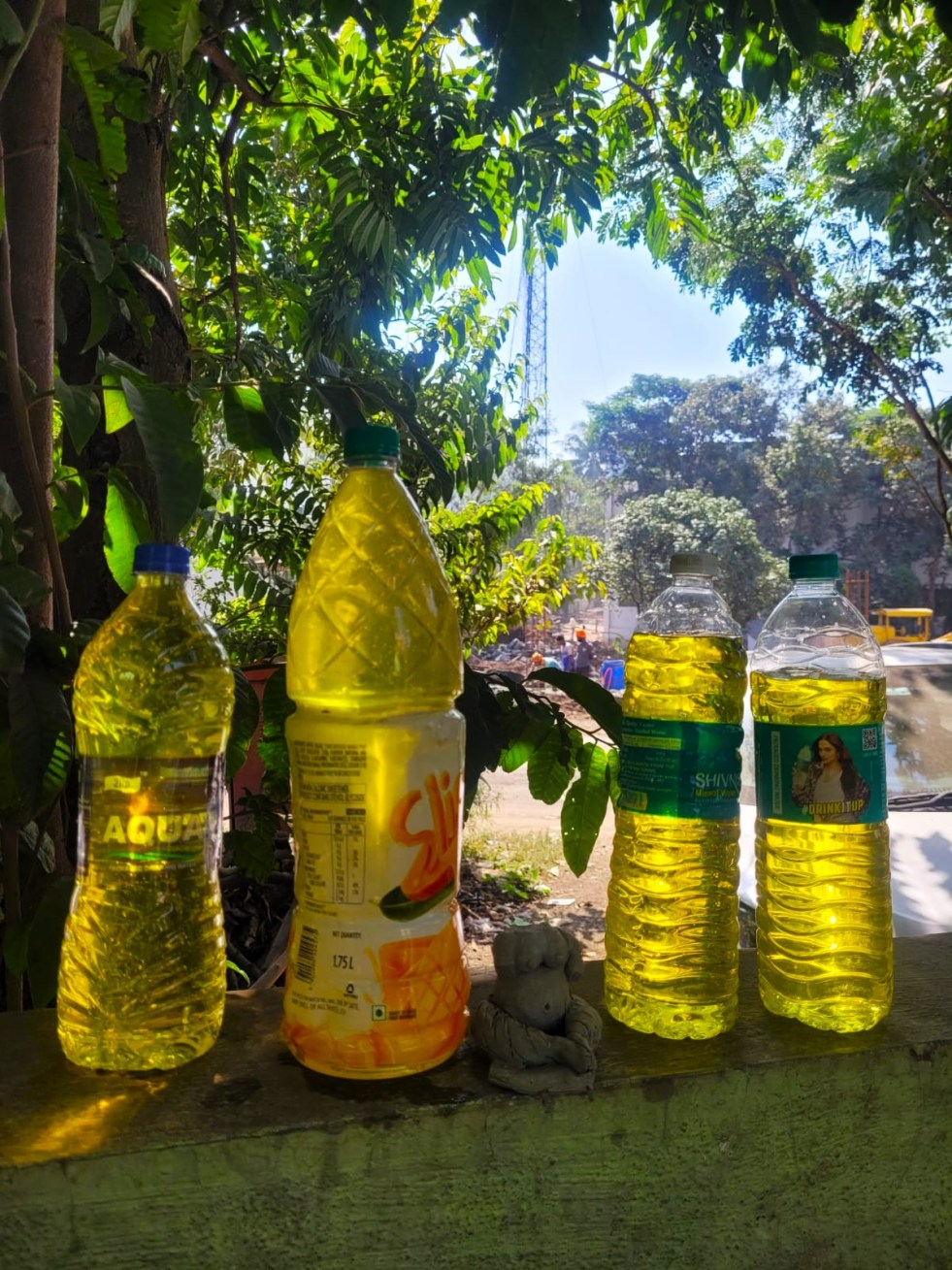
Hexavalent Chromium is not limited to borewells, but has been found beyond permissible limits both in the nallah joining Nandini River and at the confluence of Nandini-Godavari River.
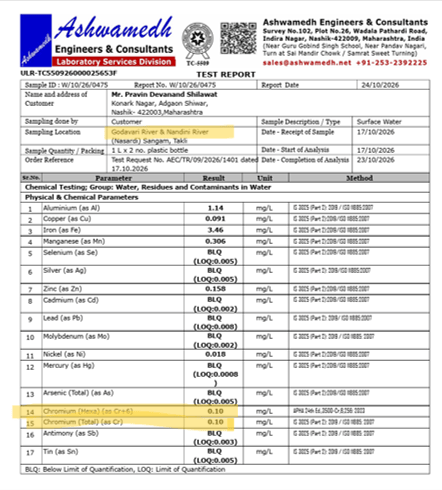
Presence of Hexavalent Chromium in flowing water bodies, after days of closing some industries underlines the seriousness and extent of toxic pollution.
This makes it clear that the urgent first step is to ascertain and communicate the extent of toxic pollution affecting various water sources, air, soil, crops, animals and humans. Proper remedial measures can start only AFTER such an assessment has been done in a credible way.
With the lives of so many people already affected and the sacred Dhvajarohan of the Simhastha Kumbh Mela scheduled for October 31, 2026,
- Opacity regarding the extent of toxic Hexavalent Chromium pollution is unacceptable.
- Withholding critical environmental and clinical public health data violates citizens’ fundamental right to clean water, health, and information.
DEMANDS FOR IMMEDIATE ACTION
We hold the MPCB, NMC, and the District Administration accountable and demand immediate public action and disclosure of the following:
1. Share the extent of Hexavalent Chromium pollution:
Do a credible, scientific assessment and Publish immediately an hydrogeological assessment detailing the full spatial extent, depth, radius, and migration trajectory of the Hexavalent Chromium plume across the Ambad and Satpur industrial corridors, including its impact on Nandini and Godavari rivers, shallow and deep aquifers, soil, air, crops, animals and people.
2. Immediate Public Release of All Government Lab Reports:
Make public every laboratory analysis report for water, effluent, and soil samples collected by government agencies from borewells, dug wells, natural nallahs, the Nandini River, and the Godavari River since June 2026. Display the report prominently on websites of MPCB, NMC, Official Nashik Kumbh Mela and GSDA.
Stop the practice of collecting samples without communicating results to the affected community. Disclose full testing results for:
- Sediments: Deep-bed sediment testing in the natural nallahs, Nandini River and Godavari river.
- Soil & Agriculture: Standing crops, agricultural plots, and produce irrigated with local groundwater.
- Food Chain: Milk and biological samples from dairy cattle reared within the affected perimeter.
3. Mandatory Certified Systemic Health Screenings:
The District Health Department and NMC must conduct comprehensive biological screening, like Whole Blood Chromium and Urine Chromium for all residents showing dermal ulcerations or systemic illness, moving beyond superficial dermatological ointments. All aggregate findings must be made public while safeguarding patient confidentiality.
4. Full Disclosure on Industrial Sources and Enforcement Findings:
Disclose the complete investigation findings regarding the source of this contamination. The administrative closure of some units cannot serve as a substitute for transparency. Disclose:
- How many total industrial units in the Ambad and Satpur clusters were inspected?
- What specific effluent treatment and disposal mechanisms were discovered?
- What exact pathway carried industrial waste into the aquifer (e.g., illegal reverse-boring, unlined holding ponds, or unmonitored storm-water discharges)?
- Provide a list of units closed down so far. Please confirm if these units are closed down or have they only been given notice to close down? What punitive measures are being taken against all such responsible units?
5. Release MPCB’s Historical and Routine Monitoring Data for Red-Category Units:
Publish MPCB’s inspection logs, consent to operate records, and environmental audit histories for all Red-Category electroplating, metal-finishing, and pickling units operating in the industrial areas in Nasik, both legally operating and illegally operating.
Share how frequently the recently closed units were audited over the past 5 years and what actions were taken against polluters.
6. Weekly Public Status Briefings:
In the face of Kumbh Mela and looking at the acute toxicity of Hexavalent Chromium, District Administration, MPCB, and NMC must issue weekly, transparent public bulletins updating the community on industrial audit findings, water quality results, remediation timelines, and health surveillance measures. These should be displayed prominently on their websites.
The health of thousands of local residents and the safety of millions of incoming pilgrims cannot be subordinated to bureaucratic delay.
We expect proactive public disclosure and transparent, enforceable action on the ground.
PDF of the Press Release in English and Marathi can be found here
Issued by:
Rajesh Pandit, Petitioner OA No. 189 of 2026 (WZ), Local Coordinator and Environmental Activist (+91 73041 20077)
Roshan Kedar, Petitioner OA No. 189 of 2026 (WZ), Local Coordinator and Environmental Activist (+91 77098 45504)
Pravin Shilavat, Petitioner OA No. 189 of 2026 (WZ), Local Coordinator and Environmental Activist (+91 85303 43993)
Dattu Dhage, Petitioner OA No. 189 of 2026 (WZ), Local Coordinator and Environmental Activist (+91 98232 20199)
Parineeta Dandekar, South Asia Network on Dams, Rivers and People (SANDRP)
Copy to:
- Regional Officer, MPCB, Nashik – ronashik@mpcb.gov.in
- Regional Officer, MIDC, Nashik – nashik@midcindia.org
- The Civil Surgeon / District Health Officer, District Health Department, Nashik cs_nashik@rediffmail.com
- The Director, Groundwater Surveys and Development Agency (GSDA), Maharashtra dir.gsda@maharashtra.gov.in | dydirhp.gsda@maharashtra.gov.in
- The Nodal Officer / Apex Committee, Simhastha Kumbh Mela Administration, Nashik kumbhmela.2027@mah.gov.in
References:
1. Original Application No. 189 of 2026 (WZ) with I.A. No. 424 of 2026 (WZ) before the Hon’ble National Green Tribunal (WZ)
2. Public Interest Litigation No. PIL/176/2012 and Contempt Petition No. CP/253/2025 before the Hon’ble Bombay High Court
3. Formal Complaint by Roshan Kedar regarding toxic groundwater discharge into Nandini River, dated 29 September 2026
4. Joint Representation to the Chief Minister, Guardian Minister, High Court Committee, and District Collector (File No. DCNSK-29017/33/2024), dated 05 October 2026
5. Statutory Request for Action Taken Report (ATR) and Laboratory Analysis Reports dated 14 October 2026, and Urgent Reminder dated 24 October 2026


