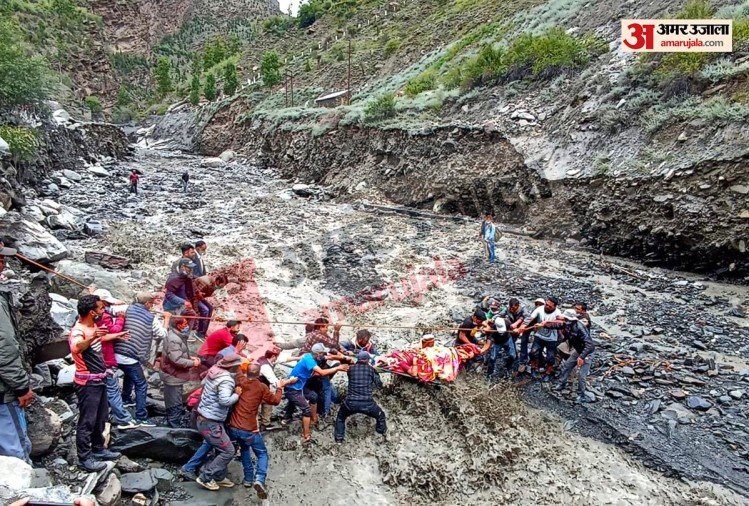
(Feature image:- Local people trying to crossing the overflowing Jahlma drain with a rope to take an injured person to the hospital. Source: Amar Ujala, July 30, 2021.)
The Himalayan states have been facing reoccurring cloud burst disasters for the past several years. The state of Uttarakhand witnessed 50 such events, 24 pre monsoon[i] and 26 during south west monsoon[ii] season of 2021. This account highlights the situation of the emerging climatic threat in Himachal Pradesh in pre monsoon and monsoon months in 2021.
Here it may be noted that during SW Monsoon months of June to Sept 2021, Himachal Pradesh had 10% below normal rainfall, with 8 of the twelve districts of the state experiencing below normal rainfall. Lahaul and Spiti had the highest deficit at -65%. Among the four districts that had above normal rains, Kullu had the highest surplus at +40%. Even during the pre-monsoon months (March to May 2021), HP had 10% below normal rains.
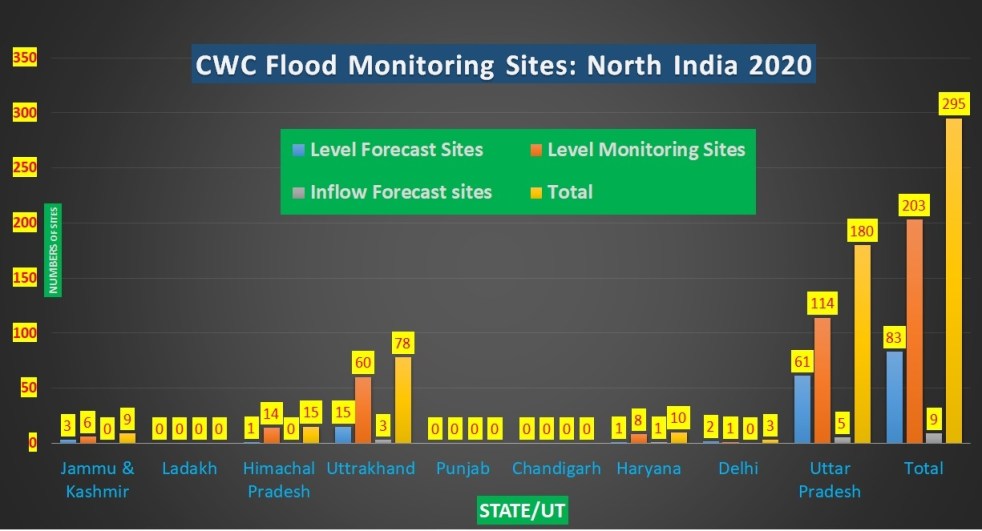
Flood forecasting is an important activity during monsoon, considering the huge and increasing flood prone area, flood frequency, intensity and flood damages. Accurate and timely flood forecasting can hugely help reduce the damages due to floods. Central Water Commission (CWC) is the only agency responsible for flood forecasting in India. To understand the CWC’s flood forecasting better, we have compiled the list of the various flood, inflow forecasting sites and flood monitoring sites in India.
In this compilation, we have given state wise list of CWC’s level forecasting, flood monitoring and inflow forecasting sites in North India, comprising of Union Territories Jammu & Kashmir, Ladakh, Chandigarh, Delhi and states of Himachal Pradesh, Uttarakhand, Punjab, Haryana and Uttar Pradesh. It includes available details like name of river, sub basin, Warning level (WL), Danger Level (DL), High Flood Level (HFL), Full Reservoir Level (FRL), Maximum Water Level (MWL), as applicable. As we see below, there are many gaps in this basic information for the sites that are part of CWC’s list. A similar zonewise overview of CWC’s sites was compiled in 2018 and 2019, which can be seen here: Overview of CWC Flood Forecasting Sites 2018: North India; Overview of CWC Flood Forecasting Sites 2019: North India. We have brought this updated compilation for 2020 as there are large number of changes.
While Indian Parliament has not met since March 2020, Civil Society Groups came together and held a Janta (people’s) Parliament from Aug 16 to 21 Aug 2020, where citizens from across the country from all walks of life enthusiastically participated. On Aug 18 there was a three hour session on Environment issues (such a session is a rarity in Indian Parliament), as part of which, there was a presentation on Water related issues where SANDRP coordinator was invited to speak. Two water related resolutions were passed among others, by the Janta Parliament, one on Flood Management and another on Urban Water Management. See below for details.
This last week, one Contempt of Court case was deservedly in news, when on the eve of India’s 74th Independence day, the apex Court found public spirited Prashant Bhushan guilty of contempt of Court. Prashant Bhushan’s commitment for the cause of the people and responsible governance of various institutions is beyond question. He is known for being critical of the government and judiciary’s track record and is supported in this by most independent minded persons.
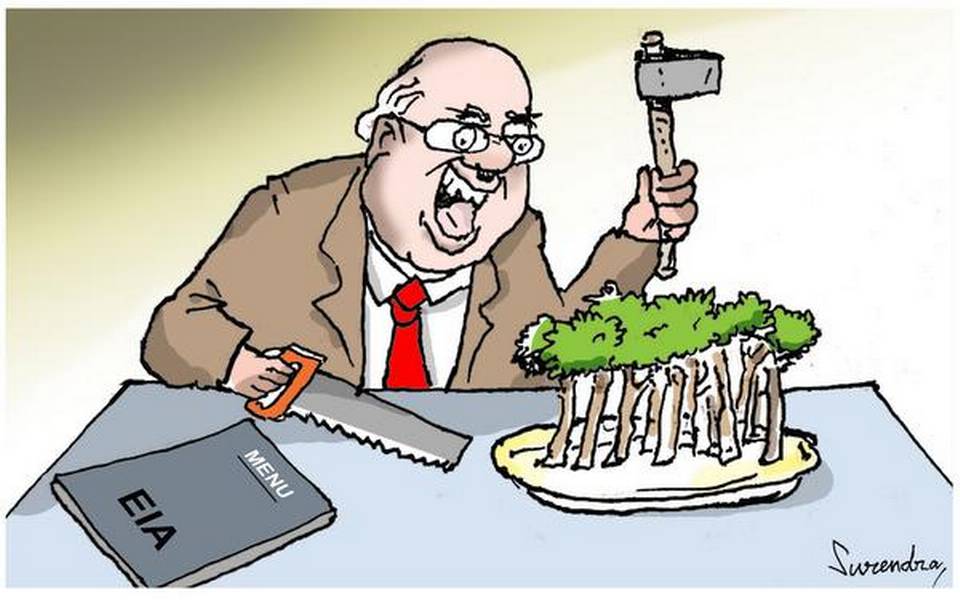
However, there was another contempt case this last week, related to environmental issues, that was not so much in the news. On June 30, 2020, Delhi High Court bench of Chief Justice D N Patel and Justice Prateek Jalan in response to petition by environmentalist Vikrant Tongad had directed, among other things, that Union Ministry of Environment and Forests (MoEF) should translate the Draft EIA (Environment Impact Assessment) Notification of 2020 into all the official languages of India and disseminate widely in ten days. (https://www.thehindu.com/news/cities/Delhi/delhi-hc-extends-public-response-deadline-to-draft-eia-2020/article31951610.ece)
Union Water Resources Minister Shri Gajendra Singh Shekhawat has recently said that the snow this year on Himalayan peaks is the highest in 50 years, and reservoirs like Bhakra, Pong, Ranjit Sagar, Ramganga, Tehri, etc will receive very high water inflow from snowmelt during summer and SW Monsoon.[i] This is in fact the third warning this year on this issue. Earlier on Feb 27, 2020 and then again on May 4, 2020, the Bhakra Beas Management Board (BBMB) provided the same warning to its partner states. However, neither the Union Minister & BBMB, nor the partner states seem ready or doing anything to prepare for the unprecedented situation that the dams and rivers may bring in ongoing summer and coming SW monsoon.
In fact the situation is similar to the one that happened twice at Bhakra-Pong-Ranjit Sagar Dams last year[ii]. Even then not only there were massive floods, but the water flowed away to Pakistan, totally against the declared pronouncements and policy of Indian Government leaders including the Prime Minister. Continue reading “Are we ready to use more water from snow melt in Indus basin this year?”→
Within a week of 21-day long lockdown in India that started at midnight on March 24, 2020, several reports in print, electronic and social media have been doing rounds showing remarkable improvements in water quality in many rivers in the country. Most of these are on the basis of naked eye observations in the form of pictures and videos by people.
Some of the reports quote pollution control boards’ officials and experts with some analytical data. People generally believe that the shutting down of industrial units has led to reduction in discharge of industrial effluents in the rivers, breathing fresh life in pollution laden streams. It’s right that there is halt in industrial belts and there is less industrial pollution reaching the rivers. However there are other factors contributing to the change in the scenario.
India’s environmental Legal system is in deep trouble. Ritwick Dutta shows this through two brilliant articles, but this is also apparent from the failure of pollution control mechanism and people, rivers and environment continues to suffer as is apparent from the poisonous Hindon river basin water that people of over a hundred villages are forced to drink while the cases have been going on in National Green Tribunal. The Yettinahole verdict of the Supreme Court now and NGT earlier seem to have completely ignored all the illegalities and falsehoods involved in the case. The verdict thus also ignored the severe vulnerabilities of the Western Ghats that is getting worse with such mindless developmental interventions. And the government seems happy to destroy the independence status of the NGT through problematic appointments, as Ritwick Dutta shows through another article. What is the hope when the judiciary itself is blind to such glaring disasters?
It’s pretty unusual situation in Bhakra, Pong and Ranjit Sagar dams this summer. These reservoirs on Sutlej, Beas and Ravi rivers respectively, allocated to India under Indo-Pak Indus Waters Treaty, are releasing so much water this summer that a significant part of it is flowing into Pakistan, much against the proclamations of the Government. Continue reading “BBMB & Punjab ill prepared to use water flows to Bhakra dams in 2019 summer”→
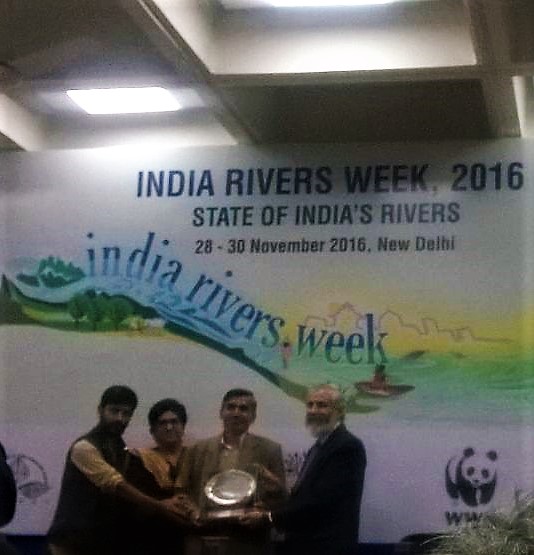
When I talk with Manshi, a friend and co-traveler from Himdhara Collective about Bhagirathh Prayas Samman that the collective received during the India Rivers Week 2016, she is modest, even slightly hesitant. She simply says, “We love the mountains, we want to protect them and help mountain communities fight the unequal battle against unplanned hydropower. That is one motivation of our work. But the other is recognition of the fact that we are privileged… privileged to be able to speak English, to work on a computer, to understand the bureaucratic procedures that alienate a tribal or forest dweller from her land. That understanding also drives us.”
Citation of Bhagirath Prayas Samman given to Himdhara Collective states: “Himdhara’s strength is its engagement with communities, movements and organisations. It has created an effective discourse around issues of resource distribution and their ownership and the resultant impacts on ecological spaces of mountain communities, especially vulnerable groups like indigenous people, dalits and women. It is an honor to recognize and celebrate Himdhara Environment Research and Action Collective’s extraordinary Bhagirath efforts in maintaining the integrity of rivers in Himachal Pradesh.”
In their own words, “Himdhara is an autnomous and informal non registered environment research and action collective, extending solidarity and support, in research and action, to people and organisations asserting their rights over their natural resources and agitating against corporatisation of these resources for destructive development in the state.”
Face of Hydropower in Kinnaur Photo: Himdhara
A collective of young, passionate and questioning minds, Himdhara has been working with communities in far flung areas of Himachal Pradesh include Lahaul and Spiti and Kinnaur in their fight against the onslaught of ill-planned and bumper to bumper hydropower projects in Himachal, amongst other issues.Continue reading “Bhagirath Prayas Samman: Himdhara Collective: Relentless Questioning and Doing”→