Gujarat · Madhya Pradesh · Narmada

Gujarat has so much Narmada water this year: Why not share with drought hit & thirsty?

It’s a strange situation in Gujarat. While everyone is talking about unprecedented drought and the drought hit are suffering due to lack of water for irrigation and even water supply, the Sardar Sarovar Dam today (April 16) is at 119.14 m, and has 1095 Million Cubic Meters (MCM) in Live storage, in addition to about 3700 MCM of water in what is called dead storage. The Dam has received much more water this year compared to last year. SSP Water level on April 16, 2019 is up from 115.55 m, the lowest level it reached this water year[i] on March 3, 2019, since 2018 monsoon.

In fact, it was astonishing to find that the water level at SSP kept rising from March 3 (115.55 m) to April 8, 2019 (119.37 m), it has only marginally dropped since then. This was happening bang in the middle of summer! Continue reading “Gujarat has so much Narmada water this year: Why not share with drought hit & thirsty?” →

DRP News Bulletin

DRP: 15 Apr 2019: Bundelkhand villages demand ponds, not Ken Betwa Link

A pond dug a few years ago in Jignanda village of Hamirpur district still holds plenty of water despite scanty rainfall (Photo by Soumya Sarkar)

In a remarkable campaign during the ongoing general elections, Bundelkhand villages have demanded PONDs for Votes. This is exactly what is required for Bundelkhand, and not the destructive, costly and contractor driven Ken Betwa link that BJP has been trying to push here. Congratulations to the Bundelkhand people and People’s Science Institute that has led this campaign.

Continue reading “DRP: 15 Apr 2019: Bundelkhand villages demand ponds, not Ken Betwa Link” →
DRP News Bulletin

DRP: 1 Apr 2019: Dead Sabarmati shows failure; Ganga going the same way?

As joint monitoring report by Paryavaran Surakhsha Samiti (PSS) and Gujarat Pollution Control Board (GPCB) shows, Sabarmati is severely polluted river, downstream of Ahmedabad and is practically a dead river. Upstream of Ahmedabad, the once perennial river has no water of its own and is stealing the Narmada water meant for drought prone areas.

This incidentally is supposed to be model river rejuvenation as told to SANDRP coordinator on a television channel by no less than Executive Director (Technical) of National Mission on Clean Ganga. In fact posters during the 2014 Parliamentary elections in Varanasi, where Mr Modi fought from, said exactly that. So is the National Ganga river going down that path? Narmada itself is in same situation downstream of the dam in Gujarat as another report here shows. Gujarat model has many examples to show, it seems. 

Continue reading “DRP: 1 Apr 2019: Dead Sabarmati shows failure; Ganga going the same way?” →
DRP News Bulletin

DRP: 18 March 2019: Citizens Act on Worsening Water Pollution

It’s not secret that water pollution is getting worse in India, including pollution of groundwater sources, thought we still donot know the full extent of the pollution of that source. But there is so little citizen action on such an important issue that affects so many so severely on daily basis. So it’s great to see four separate instances of such action this week, one each from Maharashtra, Gujarat, Karnataka and Kerala. In absence of any seriousness shown by governments at centre and states and any effective success from judicial intervention, this is welcome news. One only hopes this is no flash in the pan and rather beginning of citizens’ action to agitate against such rampant water pollution that goes on in India. 

Continue reading “DRP: 18 March 2019: Citizens Act on Worsening Water Pollution” →
DRP News Bulletin

DRP: 11 March 2019: New Subsidies won’t Help Unviable Big Hydro;  Timing Shows Big Dams Pushed for Political Economy

The big hydro push that the Union cabinet passed on the eve of the National elections announcement surely won’t help the destructive and unviable big hydro projects. Big Hydro is already highly subsidised, with no credible assessment of its massive social and environmental impacts. These costs are borne by local people and not by the project developers. The cost of destruction of rivers and fisheries are not even assessed. The increased disaster impact potential due to the project is again not even assessed.

On top of it, the hydro projects are known to increase the flood disaster risks as seen in Kerala in Aug 2018 among so many other instances. So there no case for big hydro projects getting more subsidies. If at all there is case of reducing subsidies. But even these unjustified additional subsidies are NOT going to help push the big hydro, even private sector has realised that big hydro is unviable. Govt should not continue to push big hydro with public money, we hope the people will realise the foolishness and reject them. In changing climate, putting more money on big hydro is certainly not unadvisable. The timing of the move though only strengthens the argument that big dams are essentially pushed for political economy reasons rather than their merit.

According to a report, 2018 saw massive 16% drop in tourist visits to Himachal Pradesh compared to previous year, largely due to water crisis and increasing incidents of landslides, both factors due to environmental degradation, in which hydropower madness has played big role. It is worth to mention, that the Chief Minister of Arunachal Pradesh was first person to welcome Central government decision of incentivizing the hydro projects.  

Continue reading “DRP: 11 March 2019: New Subsidies won’t Help Unviable Big Hydro;  Timing Shows Big Dams Pushed for Political Economy” →
Sand Mining

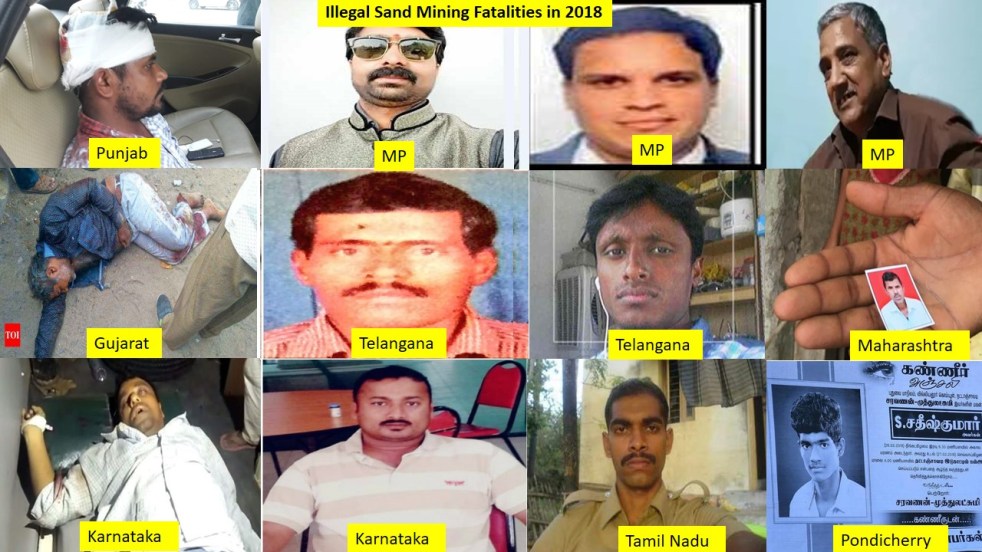
Illegal Sand Mining Violence 2018: at least 28 People died across India

Across the country, many government officials were killed while taking action against illegal sand extraction in 2018. So were the lethal attacks on reporters and citizens for exposing illegalities and objecting to illegal mining activities. Many innocent people lost lives in accidents related to illegal sand mining related incidents which could have been avoided. This compilation of sand mining related incidents also highlights how illegal sand mining was damaging the infrastructure providing essential services.

NORTH INDIA

Uttrakhand A 115 years old British era bridge on Tons river in Birpur, Dehradun collapsed on Dec. 28 reportedly due to overloaded sand trucks. Two people were killed[1] in the accident. The single lane bridge was damaged during 2013 floods and opened for public after repair. 

Continue reading “Illegal Sand Mining Violence 2018: at least 28 People died across India” →

DRP News Bulletin

DRP: 18 Feb 2019: Salutes to the Mithi River Clean up Effort

As this report narrates, a great volunteer effort is underway in Mumbai to clean up Mithi river. What they have achieved is just about 350 m of clean river, after labouring over weekends for several months. But this is such a daunting task to even venture to start. They have not only started, but made visible progress. Let us hope it will achieve all its objectives.

Continue reading “DRP: 18 Feb 2019: Salutes to the Mithi River Clean up Effort” →
DRP News Bulletin

DRP: 11 Feb 2019: Questions over legitimacy of Dam Bachao Abhiyaan

The Dam Bachao Abhiyaan has been coming up in various forms. They blame the upstream water use in the catchment for dams not filling up. The catchment area could be using the water through groundwater (e.g. Hussain Sagar in Hyderabad), Johads (e.g. Sahibi catchment in Alwar), Tanks (e.g. Cauvery catchment in Karnataka), or check dams (e.g. Gandhisagar catchment in Madhya Pradesh, Bisalpur and Ramgarh catchment in Rajasthan), the latest episode reflected in the news below.

One key question that is never answered is, does the construction of dam extinguish all the rights of the catchment area to harvest and use any water for even basic needs and livelihoods? Does the very existence of the dam make all such water use in the catchment illegitimate? What about the right to water and livelihood of the catchment area? Should dam filling be so sacrosanct as to not allow any legitimate water use in the catchment? Hope the court and the government resolves these issues. Hope there is debate on this to decide in which circumstances there will be legitimacy to such Dam Bachao Abhiyaan.

Continue reading “DRP: 11 Feb 2019: Questions over legitimacy of Dam Bachao Abhiyaan” →
Sand Mining

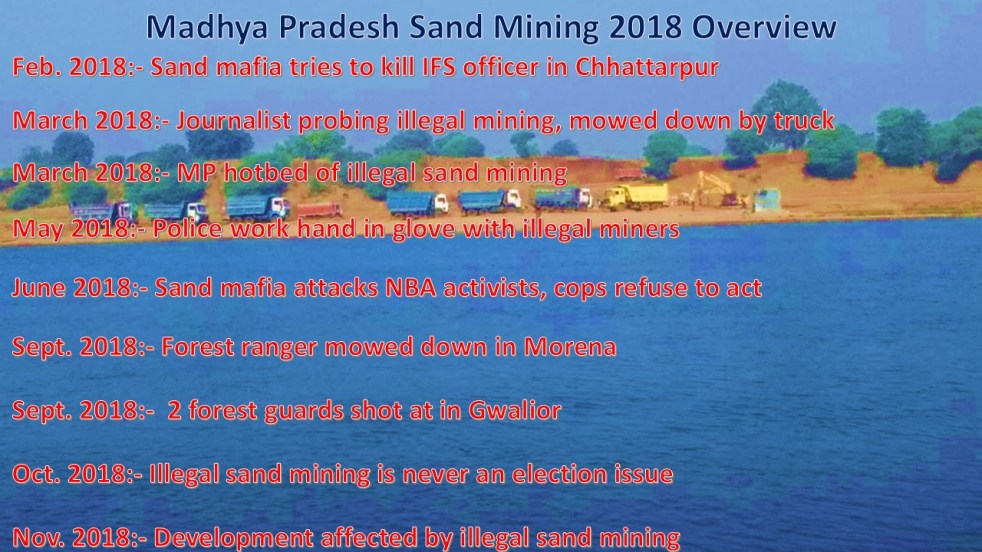
Madhya Pradesh Sand Mining 2018: Unprecedented Violence by Sand Mafia

Madhya Pradesh is one of the worse affected states as far as illegal sand mining is concerned. Over the years unsustainable sand mining has caused great damage to Narmada and its tributaries. The Ken, Betwa, Sindh, Chambal and Son rivers which join Yamuna and Ganga rivers has also been facing severe threats from ongoing illegal sand extraction.

Even in 2018, there was no significant improvement in this regard. There were attacks on govt officials and media persons for exposing illegal sand mining. The state govt failed to stop the illegal sand extraction. 

Continue reading “Madhya Pradesh Sand Mining 2018: Unprecedented Violence by Sand Mafia” →

DRP News Bulletin

DRP: 4 Feb 2019: Bangladesh stops playing blindman’s buff over protection of Rivers. Will India learn? 

In a historic judgement, the High Court (HC) of Bangladesh has said that river encroachers cannot run in any elections or get bank loans. The HC also ordered the government to make a list of every grabber in the country and publish the list in the media to expose them to the public. The grabbers include powerful individuals, businesses and, ironically, government offices. The Gazipur City Corporation is among the grabbers, a judicial inquiry has found.

After the verdict, the government now will have to amend the National River Protection Commission (NRPC) Act 2013 with provisions for punishment and fine for river grabbing. The current NRPC Act does not have provisions for punishment. The government must report to the court in six months on its action in this regard. The HC also declared the NRPC as the legal guardian of all rivers and act like their “parents”.

The landmark verdict comes when river grabbing by influential groups seems unstoppable. Often, grabbers return to steal river land soon after being evicted. The HC delivered the judgment in response to a petition by Human Rights and Peace for Bangladesh. The writ petition was filed on Nov. 7, 2016.

Continue reading “DRP: 4 Feb 2019: Bangladesh stops playing blindman’s buff over protection of Rivers. Will India learn? “ →