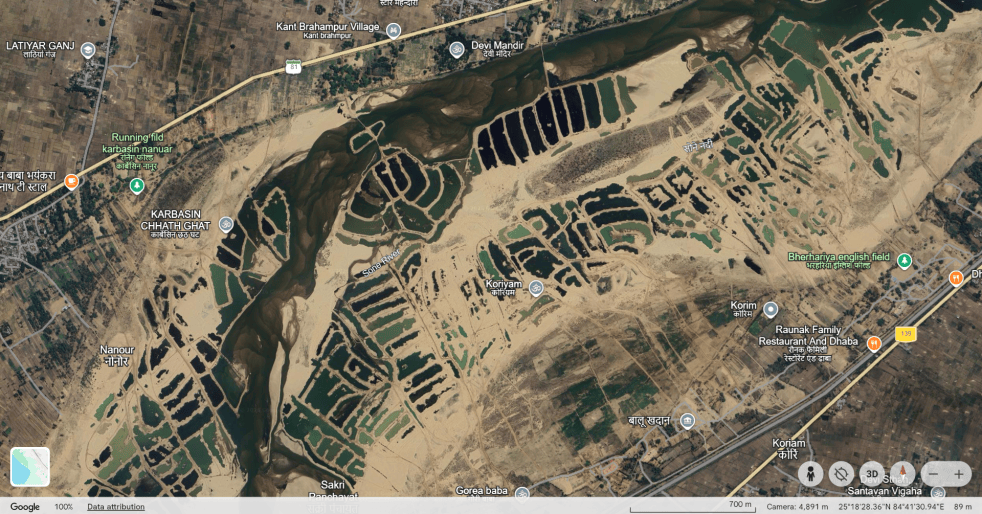
(Feature Image: Google Earth May 2025 imagery showing Sone riverbed ravaged by excessive mechanized sand mining activities near Paliganj in Bihar)
In a significant development last week, the Supreme Court has expanded its illegal sand mining case from the National Chambal Gharial Sanctuary to rivers across India. For over six months, the apex court has been hearing the matter and issuing directions to state governments of Rajasthan, Madhya Pradesh and Uttar Pradesh. However, the directions issued so far are yet to be fully implemented.
During previous hearing, the SC expanded the matter to include illegal sand mining in Ken river. In latest hearing, the Court has further widened the scope to cover rivers across the country and has directed the Central Empowered Committee (CEC) to submit a report. This is indeed an opportunity to examine illegal riverbed mining problem as a wider governance failure.
The SC has regularly been hearing the matter, making strong remarks and issuing strict directions. The main issue now is whether the CEC’s assessment will identify the scale and patterns of illegal mining. Will it bring out the gaps in regulation and enforcement and recommend practical measures to address the root causes? The success of the intervention will depend on whether it brings lasting changes to riverbed mining governance.
‘Rivers once destroyed cannot be compensated’: SC expands probe into illegal sand mining The Supreme Court on Oct. 06 observed that rivers once destroyed cannot be compensated, directing the Central Empowered Committee (CEC) to submit a report on illegal river sand mining across the country. The direction expanded the scope of the apex court’s probe into the matter. The CEC is the expert body assisting the court on environmental issues.
Dealing with the issue in a suo motu proceeding initiated over news reports of rampant illegal sand mining in the Chambal river inside the National Gharial Sanctuary, the court said that the matter assumes significance as, despite several orders passed on the river Chambal, illegal mining continues unabated.
The Supreme Court also pulled up the states of Rajasthan and Madhya Pradesh for their failure to identify the organised gangs responsible for such large-scale extraction. It also took up another petition that alleged rampant illegal sand mining in the Ken River and sought a response from Madhya Pradesh on how huge excavators and sand-pulling pumps have been installed in the river at a time when there is no government contract for sand mining.
Noting that the problem requires a pan-India approach, the bench of justices Vikram Nath and Sandeep Mehta said, “We direct the CEC to give its report on the issue of river sand mining in the country.” The bench said, “There is a measure of control the states must exercise while enforcing orders on sand mining in rivers. Nature takes care of itself but when you put obstacles, it becomes a problem. Ultimately, rivers will be destroyed, and once destroyed, they cannot be compensated.”
The court was assisted in the suo motu proceedings by senior advocate Nikhil Goel and advocate Rupali Fransesca Samuel as amicus curiae, who submitted a note detailing compliance of orders passed with regard to the Chambal sanctuary in May and July this year. Going through the note, the bench said, “The court told Rajasthan that despite past orders to go after the kingpins of the illegal sand-mining mafia operating their nefarious trade across states, not a single such gang has been identified. Even the seized vehicles have been released on payment of a fine.
The court told the state, “We want to inform you that a blanket ban on sand mining will be imposed in Rajasthan. We will not allow the rivers of the state to be destroyed in this manner.”
Goel informed the court that last month, a forest ranger, Pratap Singh Chundawat, was crushed to death by a dumper carrying illegally mined sand while he was on duty. “We will not tolerate such a lacklustre response by the states. There has to be proactive action on your part. Our orders were very clear. Yet, we are told by the amicus that they have hardly been respected or followed,” the bench said.
Posting the matter on November 4, the bench told the law officer representing Rajasthan, “We will give you two weeks’ time. You instruct your officials, and if we find the position is the same, we will direct a total ban on sand mining across all rivers in the state.”
SC Seeks Report on Illegal Sand Mining from River Beds The top court was hearing a suo motu case titled ‘In Re: Illegal sand mining in the National Chambal Sanctuary and threat to endangered aquatic wildlife’. The bench was told that one of the pleas, which was listed for hearing along with the suo motu case, has sought directions to the authorities to immediately take steps to completely stop alleged illegal sand mining in the Ken River in Panna district of Madhya Pradesh.
Senior advocate Nikhil Goel, who is assisting the top court as an amicus curiae in the suo motu case, said the bench may consider expanding the scope of the matter to include the aspect of illegal sand mining from river beds. “We need a specific report from the CEC on sand mining from river beds,” the bench said.
The bench also dealt with the issue related to the incident in which a forest ranger was killed last month after being allegedly hit by a dumper while he was trying to stop illegal mining in Rajasthan.
Rajasthan orders weapons, vehicles for forest staff amid attacks Chairing a state-level coordination and monitoring committee meeting convened on the directions of the Supreme Court, Rajasthan chief secretary V Srinivas stressed a zero-tolerance approach towards illegal mining, stronger field patrolling and inspections of vulnerable areas by senior officers. He also directed departments to coordinate their efforts and submit compliance reports on time. The directions follow multiple attacks linked to alleged illegal mining, prompting renewed concerns over the safety of personnel deployed to prevent unlawful excavation and transportation of sand.
Police constable Surendra Singh was injured after a speeding tractor-trolley allegedly involved in illegal sand mining ran over his leg in Sawai Madhopur’s Chauth Ka Barwara area on October 7. He was referred to Jaipur for treatment, while the elderly woman also sustained injuries. The driver fled the spot. On the night of Sept. 21, forest ranger Pratap Singh Chundawat, posted in Rajasthan’s Pratapgarh district, was dragged by a dumper when he tried to flag down the vehicle, suspecting illegal mining. Following his death, the Supreme Court on September 23 directed the Rajasthan government to file a report as it examined the continuing menace of illegal sand mining in the Chambal sanctuary.
In another incident on Sept. 26, a forest team was allegedly attacked with stones and gunfire after seizing a tractor-trolley and a compressor machine during action against illegal mining near Kondapura village in Bharatpur district. Earlier, forest personnel were allegedly attacked in Tonk in August, while a forest outpost in the Ranthambore Tiger Reserve was attacked in March, with an arrested person freed and a seized tractor-trolley taken away.
NGT directs authorities to act against illegal mining in Banda The tribunal heard the case concerning a mining lease granted to M/s Laxmi Prasad Gupta, Proprietor Umesh Gupta, for extraction of sand/morrum from Gata Nos. 300M and 316M in Bahadurpur Syodha village of Naraini tehsil. The Tribunal concluded that the evidence indicated illegal mining and violations of the Environmental Clearance and applicable environmental laws and regulations. It directed the SEIAA, Uttar Pradesh, and the DM, Banda, to investigate the violations and take appropriate action regarding withdrawal of the Environmental Clearance and cancellation of the mining lease, respectively. The authorities were directed to provide an opportunity of hearing to the applicant and the project proponent in accordance with the principles of natural justice.
The Tribunal also ordered that the project proponent would not be allowed to carry out further mining at the affected site until a decision is taken on withdrawal of the Environmental Clearance and cancellation of the mining lease. The Tribunal further directed the Chief Secretary of the state, Member Secretary of the UPPCB and DM, Banda, to verify the implementation of monitoring mechanisms under the Sustainable Sand Mining Management Guidelines, 2016, and the Enforcement & Monitoring Guidelines for Sand Mining, 2020.
HYDRO POWER PROJECTS
SIFFYW Declares Total boycott of SUMP talks In a Public Notice and Resolution issued on Oct. 9, the SIFFYW said the decision is an “absolute and final directive” against the government’s alleged high-handedness concerning SUMP. The notice alleged that innocent villagers and frontline activists are being arbitrarily arrested and jailed even as community members remain at home, and demanded an immediate end to suppression of indigenous voices.
Seeking the release of the four people from Geku in Upper Siang who were picked up recently for their opposition to the PFR exercises linked with the SUMP, villagers of Geku have decided to meet in Yingkiong, the district headquarters, for a democratic movement. Meanwhile, fearing violence, the DA has imposed restrictions for a month under Section 163 of the Bharatiya Nagarik Suraksha Sanhita, 2023, banning the assembly of more than five people, carrying of weapons, and rallies and marches near the DC and the SP office compounds, the police station, the DC bungalow, SP bungalow, and the residence of MLA Alo Libang.
Sixty-five-year-old Yalek Tair struggles to breathe and suffers from continuous coughing after a severe assault while in police custody left her with two fractured ribs on the right side of her chest and injured her lungs. She is one of many members of the indigenous Adi community who have been protesting against the state government’s plan to build the mega SUMP for years and have suffered police brutality.
Former CM Gegong Apang on Oct. 11 reiterated his demand for scrapping the SUMP and accused CM of preparing a plan to expel the Adis from their ancestral homeland and make them refugees. In a press statement, Apang said the chief minister has taken an anti-Adi stance and decided to destroy the ancestral homeland of the Adis along the Siang River.
While the project is seen as a response to China’s dam activities upstream and a key infrastructure to secure India’s energy and water needs, it remains to be seen how the government will strike a balance between national interest and the legitimate concerns of the affected people over loss of livelihood, submergence and displacement amid the ongoing protests.
Tripura’s damaged 15 MW Dumbur HEP to be revived spending Rs 100 Cr Restoration work on Tripura’s 15 MW Dumbur hydroelectric power project in Gomati district, shut down since extensive damages in 2024 floods, is scheduled to begin in December 2026 at an estimated cost of Rs 100 crore, Power Minister Ratan Lal Nath said. It is hoped that the project will generate 10-11 MW once it is revived.
Tripura’s lone HEP to be revived in Dec. at Rs 100 cr The 2.5-MW Gumti hydroelectric project has remained shut since devastating floods in 2024 caused extensive damage to the facility. The state government has now decided to revive the project following a series of technical studies to assess the feasibility of its restoration. The government has earmarked an estimated Rs 100 crore for the restoration work, which is expected to begin in December. The proposed generation capacity of 10-11 MW, however, is significantly higher than the plant’s original installed capacity of 2.5 MW. The Gumti HEP was established at Tirthamuk 56 years ago by harnessing the Raima and Sarma hill streams. The planned restoration is expected to bring the long-shuttered facility back into operation while renewing attention on dam safety and the management of water infrastructure in Tripura.
DAMS
Kaleshwaram barrages repair to cost Rs 2100 Cr The repairs to the Medigadda, Annaram and Sundilla barrages are expected to cost nearly ₹2,100 crore , with the bulk of the expenditure (Rs 1800 Cr) going towards construction of new diaphragm walls at the three barrages. The govt is also considering setting up a special corporation or dedicated agency to fund and execute the works. The work is expected to start in Mid Nov 2026 with target to complete by June 2027. At Medigadda, the stilling basin is proposed to be extended up to 60 metres, while at Annaram and Sundilla it may be extended by 45-50 metres.
CS asks officials to expedite construction of Isarda dam Chief secretary V Srinivas Oct. 08 directed officials to expedite construction of Isarda Dam, a key component of the ambitious Ramjal Setu Link Project, as well as drinking water distribution works linked to the project. During his visit to Tonk, Srinivas reviewed the progress of the dam and directed officials to maintain the pace of construction and speed up land acquisition for the project.
INTERLINKING OF RIVERS
Ken Betwa Project’s Unaccounted Costs Panna’s nesting cliffs, and the vultures that depend on them, sit in the path of India’s first river-linking reservoir. PTR is home to seven of the nine vulture species found in India and remains an important stronghold for these scavenging birds. With 691 vultures, Panna recorded the second-highest vulture population among protected areas in MP in the state’s ‘Population Estimation of Vultures Report 2025’. (By Divya Raje Bhonsale) Environmentalists warn that Daudhan Dam will submerge 9,000 hectares, including parts of Panna Tiger Reserve, while govt says ‘unavoidable’ impact can be mitigated through afforestation and wildlife conservation.
MP HC asks GoMP response on CEC report The Madhya Pradesh High Court has sought the State’s response on the action taken pursuant to the report submitted by the Supreme Court-appointed Central Empowered Committee (CEC) concerning the Ken-Betwa Link Project. The division bench of Chief Justice Alpesh Y Kogje and Justice Vivek Jain was hearing a PIL raising concerns over the project’s impact on the Panna Tiger Reserve, Ken Gharial Sanctuary and displaced communities. The High Court has now sought the State’s clarification on the status of proceedings before the Supreme Court and the action taken in relation to the CEC report. It also directed the State to respond to the January 21, 2022 communication issued by the Forum for Policy Dialogue on Water Conflicts in India. Next hearing on Oct 13.
URBAN RIVERS
TOXIC EMERGENCY IN NASHIK AHEAD OF KUMBH MELA: GROUNDWATER TESTS 1,000 TIMES OVER SAFE CHROMIUM LIMITS Testing of groundwater in Ambad, Nashik, shows the level of known carcinogen, Hexavalent Chromium, over 1000 times the safe limit. Large number of people who are forced to consume this water in absence of adequate alternative water supply are already suffering skin and other health problems. This was revealed after Parineeta Dandekar of SANDRP visited the site, met people, collected sample, got it tested at accredited laboratory. The Chromium contaminated water is also entering Godavari River, on banks of the river Kumbh Mela will be organised soon. This is potential risk for the pilgrims too. Urgent steps are expected from the authorities as suggested in the PR.
The contaminated water has caused skin and other health-related issues among residents and is also entering the Godavari river through local drains, SANDRP said. Residents have reportedly been forced to depend on contaminated groundwater because of the low and erratic supply of water from the Nashik Municipal Corporation, added SANDRP.
₹1,200 cr Vishwamitri revival project enters 2 phase To provide permanent relief from recurring flood situations in Vadodara, the administration and Irrigation Department are implementing long-term planning under the Vishwamitri Revival Project. The project includes river deepening and widening, riverfront development, protective gabion walls, and water-flow regulation, which are expected to transform the river in the coming years. For now, the administration is focusing on pre-monsoon work, while residents hope the project will once again become a blessing for the city through the Vishwamitri river.
Two years ago, citizens suffered massive losses in crores due to the devastating flood in the Vishwamitri River in Vadodara. Considering the seriousness of this terrible situation, the state government had taken an important decision to deepen and widen the river to increase its water carrying capacity. A special ‘Navlavala Committee’ was formed to carry out this work systematically.
The Navlavala Committee has recommended gabion wall structures at 12 locations and protection walls under bridges. Municipal Commissioner Arun Mahesh Babu said work worth around ₹60-65 crore was completed last year and further work will be taken up this year as approvals are received from the government. He said the river restoration is a 20-year project, and along with construction work, steps will also be taken to regulate the river’s water flow.
Riverfront development is planned for an approximate 8.4 km stretch. A DPR will be prepared for this, and then its planning will be done. According to the Municipal Commissioner, the riverfront will be divided into different sections, with facilities such as a Senior Citizen Park, Children’s Park, Walking Area, and Cycle Track being developed. All these plans are long-term and can be completed in the next 10 years.
The Municipal Commissioner said deepening work at Ajwa and Pratapura lakes will also continue this year. As part of the long-term plan, the Irrigation Department is preparing to build check dams and a diversion canal upstream. Permission has been sought from the state government for 14 km of canal diversion work, which will begin after approvals are granted, along with the check dam project.
Chennai: Riverfront plan may have to wait The govt has announced global tenders to prepare detailed feasibility and project reports for restoring the two rivers, with a vision of boating, walkways, recreational spaces and clean riverbanks modelled partly on Seoul’s Cheonggyecheon and Singapore’s Kallang river. But the condition of Chennai’s Cooum and Adyar rivers and coast may be pointing to a city which is still struggling with the basics. The entire coastal stretch from Adyar bar mouth to Nochikuppam is carpeted with water hyacinth mixed with plastics, liquor bottles and other urban waste. Porur lake, an important drinking water source for the city, is currently covered extensively by water hyacinth, with machinery deployed to remove the growth.
Government data reported this month showed nearly 7.5 crore litres of sewage and sullage flowing daily through 65 open drains in 18 urban local bodies around Chennai, with substantial quantities ultimately reaching waterbodies and the Cooum and Adyar systems. The river plan is the latest in the series of long history of restoration announcements, including an earlier ₹1,500-crore Adyar proposal with a 70-km sewerage pipeline and 14 sewage plants of 110 MLD combined capacity.
RIVERS
New Satellite Data Shows Just How Flawed Most River Models Can Be A new study, led by Colin Gleason, a hydrologist in the Riccio College of Engineering at the University of Massachusetts Amherst, uses data from the NASA-launched Surface Water and Ocean Topography (SWOT) satellite to determine where state-of-the-art, machine learning computer model river estimates are accurate and where they are not. “In this study, we learned where the models are right and where the models are wrong”, he says.
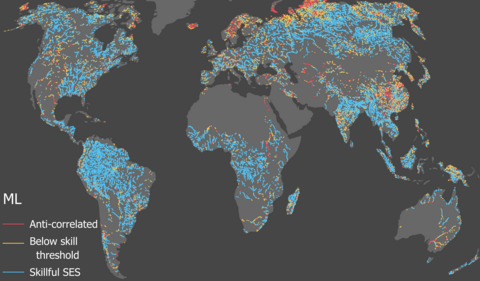
By comparison, models are good at estimating “normal” rivers—not glacially fed, single thread, no estuaries and no dams. “It turns out it’s only 11% of the rivers on Earth that fit that definition of ‘regular,’ so it also kind of challenges our understanding of what a river is,” Gleason said. “A weird river is the norm. A damned river is the norm. A multichannel, complicated planform river is the norm, not the exception.”
Gleason also highlighted that models struggle in arid areas like Australia, Central Asia, the southwestern U.S. and Mexico. This is likely because these locations rely on groundwater, which affects the rivers, but in non-obvious ways and with a delayed response to pumping. The Arctic is also poorly modeled, largely because the datasets to build machine learning models are lacking.
Govt should consider relocating industrial areas away from rivers: SC The Supreme Court has issued strict directions to the Rajasthan government and concerned authorities in a case concerning pollution and conservation of the Jojari-Bandi-Luni river system. The Court observed that the crisis was not limited to violations by individual industries but also involved inadequate treatment capacity, illegal industrial activities, land-use irregularities and weak monitoring. It directed a comprehensive assessment of the feasibility of relocating polluting industrial areas near the rivers, considering ecological sensitivity, carrying capacity, treatment facilities, the possibility of ZLD and the long-term interests of affected communities. The government was also asked to investigate illegal industrial units operating on residential and agricultural land.
The Court ordered the immediate sealing, interception or removal of identified illegal discharge points, bypasses, manholes, chambers, pipelines and drains for which removal permission has already been granted. Officials must physically verify the action taken and submit reports to the committee every 15 days. It also directed the state to establish permanent, district-level mechanisms to prevent industrial pollution and asked the Rajasthan State Pollution Control Board to assess and recover environmental compensation from the responsible industries and persons for the entire period of violations.
The state government must prepare a comprehensive solution plan with clear timelines, responsible departments and measurable targets, taking the committee’s observations into account. The Court also ordered immediate action against illegal gravel and sand mining affecting riverbeds, banks and natural water flow. Complete details of mining areas, leases, permitted quantities, mining depths, replenishment and restoration obligations must be submitted to the committee by Oct. 15. The next hearing is scheduled for Oct. 26.
12k river pollution cases pending before NGT: Expert member To mark the 26th anniversary of the “kar sewa” (voluntary community cleaning) of the holy Kali Bein, a special environmental conference was held in Sultanpur Lodhi on July 12. Addressing the gathering, Afroz Ahmad, expert member, NGT, said every section of society, particularly religious leaders, must come forward to free the country’s rivers from pollution and illegal encroachments.
He said the NGT has directed the authorities in Punjab and several other states to identify river land and remove illegal occupations. “Nearly 12,000 river pollution-related cases are currently pending before the NGT. Strict action is being taken across the country to remove encroachments from river basins and ponds. The judiciary is committed to protecting natural water resources,” he said.
Sikkim SPCB bans dumping of untreated waste into water bodies The Sikkim State Pollution Control Board (SPCB) on October 7 prohibited the discharge or dumping of untreated waste into water bodies across the state, following a recent order of the Sikkim High Court. The notice follows the September 29, 2026 order of the Sikkim High Court, which banned the discharge of untreated waste into water bodies. The SPCB said untreated or inadequately treated sewage, effluents, solid waste, construction debris and other polluting substances must not be discharged directly or indirectly into jhoras, rivers, streams, drains, springs or other water sources.
All concerned have been directed to make proper arrangements for the collection, treatment, disposal and management of waste in accordance with environmental laws and directions issued by competent authorities. The directive comes amid growing concerns over waste management and pollution of Sikkim’s rivers, streams and other natural water sources.
Bicholim locals seek CCTV cameras to curb river pollution Bicholim locals have urged govt to install CCTV cameras along the Bicholim river and nearby walking track to identify and catch people dumping garbage into the river at night.
The toxic legacy of chromium in UP Even decades after industrial dumping of chromium was detected and stopped, the toxic element continues to poison water, soil and lives across three Ganga-adjacent districts.
20th meeting of empowered task force on Ganga rejuvenation Reviewing Namami Gange projects as of August 2026, 527 projects have been sanctioned at a cost of ₹43,266 crore, with 368 projects completed. In the sewerage infrastructure sector, 219 projects were sanctioned, establishing 6,603 MLD of treatment capacity and 5,245 km of sewer network. Of these, 147 projects are completed, adding 4,339 MLD sewage treatment capacity and 4,615 km of sewer network.
A key agenda item was the rejuvenation of Gomti Udgam Sthal in Pilibhit, Uttar Pradesh. The Master Plan for the site’s rejuvenation and integrated development was approved in December 2025 by NMCG’s 68th Executive Committee meeting. The DPR for lake restoration and sewage treatment through a 1 MLD Nature-Based Solutions STP has been approved, with administrative approval and expenditure sanction issued on September 17, 2026. DPRs concerning turtle habitat and Panchvatika restoration are under consideration in the 74th Executive Committee, and infrastructure development DPRs remain under examination. The Minister urged prompt implementation of approved interventions, timely bidding, and constitution of the State-level Steering Committee.
Yamuna quality deteriorated in Sept Three of the seven locations showed further deterioration, two locations showed slight improvement, while two more locations showed no change from the August data. The three locations which showed deterioration were Wazirabad, Nizamudin Bridge, and at Asgarpur. Two locations where the level remained the same were ISBT and ITO Bridge. The highest BOD was recorded at ISBT Bridge at 30 mg/l. The highest BOD in August was also recorded at ISBT Bridge, with a level of 28 mg/l.
FISH, FISHERIES, FISHERFOLKS
National Dolphin Day 2026: State of Gangetic Dolphins In last one year, we have found reports of at least ten Gangetic dolphin deaths, including six in Uttar Pradesh, two in West Bengal, and one each in Bihar and Assam. The reported death toll is higher than in the previous two years, indicating continuing concerns over their survival. Developments over the past year also reveal that the precious mammal’s existence is under increasing threats from the existing and proposed dam projects in the Chambal basin.
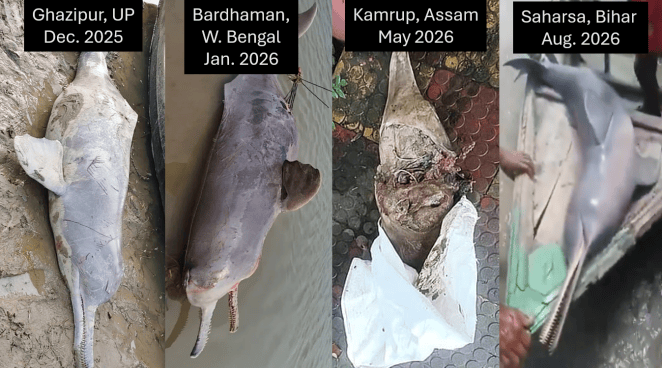
The issue of ensuring dolphin-friendly operation of the Sharda canal network and taking effective measures to prevent dolphins from becoming stranded in the canals also remains unresolved. At the same time, this mascot of healthy rivers continues to face serious survival challenges from increasing pollution, mechanised riverbed mining, fishing nets and hunting across Uttar Pradesh, Bihar, West Bengal and Assam.
FAITH AND ECOLOGY
DNA study finds 7 different groups of freshwater garfish DNA analysis of freshwater garfish from Maharashtra’s Ujani reservoir has identified seven distinct groups among fish currently classified as the same species, suggesting that their diversity may be greater than previously recognised. Researchers compared garfish collected from Ujani reservoir between 2018 and 2021 with samples from across India and other countries.
Freshwater garfish are found across India and several other parts of South and Southeast Asia, and are also traded in regional fisheries. However, researchers said genetic studies of the fish have been limited and carried out only in certain locations. For Maharashtra’s freshwater ecosystems, including the Bhima basin and Ujani reservoir, the study highlights that the visible variety of fish may not tell the whole story. Fish that appear to belong to one species could include several genetically different groups, making accurate identification important for future biodiversity research and conservation.
Mumbai’s Kalu river throws up hundreds of dead fish The sun rose on the Kalu as it did every other day. But on Oct. 05, along with it rose fish – hundreds, stippling the waters in grisly pointillism. Avinash Harad, an environmental activist who had led a group of six researchers on a biodiversity survey to a site on the river – the ferry crossing at Atali and Nandkar, villages on either side of the Kalu – said hundreds of fish had floated to the surface, dead or dying.
“The fish died because of untreated effluents from upstream dyeing units in Ulhasnagar that flowed into the Kalu at high tide,” Harad said. He said the sluice gates of the KT Dam in Titwala are opened during the rains, bringing a surge of water during high tide that conveys factory discharge downstream. “The fish – mostly catfish and tilapia – died along at least 1 km of the Kalu, just before it meets the Ulhas river.”
Tribune Edit: Faith must co-exist with ecological care THOUSANDS of fish dying in Mumbai’s historic Banganga Tank after Pitru Paksha rituals is not an isolated environmental mishap. It is a recurring crisis that exposes the failure to anticipate and manage the ecological impact of religious gatherings. Reports indicate that similar fish deaths have occurred repeatedly in recent years, with organic material from ritual offerings contributing to deterioration in water quality and depletion of dissolved oxygen. The tragedy is that the problem is predictable. The dates of Pitru Paksha are known, the crowds are expected and the nature of the offerings is familiar. Yet preventive action remains inadequate. There is also huge responsibility on region, religious bodies to ensure that faith should not be a reason for ecological damage and destruction.
SAND MINING
4-member team to probe illegal sand mining in Garhwa Garhwa district administration has formed a four-member probe team headed by Banshidhar Nagar SDM Prabhakar Mirdha to investigate complaints of illegal sand mining and storage at various sand ghats in Dhurki block, Garhwa DC Pashupati Nath Mishra said. The team has been directed to submit a detailed report within a week on the alleged activities. Complaints suggest illegal sand mining is taking place frequently at several ghats of Kanhar river, particularly Kadwa, Rampa ghat, Ambakhoriya, Balchaura, Libra ghat, Machpani ghat and ghats near Sukhaldari waterfall. It is alleged that loaders and JCB machines are being used during night hours for mining.
There are also allegations that sand is being illegally stored on forest land, with the involvement of some local officials and forest department personnel. The activity is reportedly affecting wildlife habitats, increasing concerns among villagers over their safety and the protection of crops as animals lose their natural habitat. “The motive of the district administration is to stop illegal sand mining and its storage and saving the govt revenue, protection of environment and wildlife and protection of common people,” Mishra said.
NGT fines Odisha CS, 7 officials Rs 2L The east zone Bench ordered each of the eight respondents – the chief secretary, principal secretary of water resources department, deputy director of mines (Talcher circle), regional transport officer (Angul), tehsildars of Talcher and Parajang, superintendent of police (Angul) and inspector-in-charge of Talcher police station – to pay Rs 25,000 each for causing delay in the proceedings.
The case relates to allegations of mining beyond the permitted lease area and excess extraction at Nizgarhzami Sand Quarry, locally known as Gopinathpur sand quarry, in Brahmani river under Talcher tehsil. “The non-appearance of counsels on behalf of the eight respondents today has the effect of causing unnecessary adjournment and delaying appropriate resolution of the environmental issues involved in the case,” the bench said in its Sept 28 order, a web copy of which was uploaded on Oct. 06. The tribunal held that such “deliberate non-appearance” needed to be remedied by imposing exemplary costs.
The officials were given one more opportunity to file their responses within a month and asked to deposit the costs with the tribunal’s registrar in Kolkata within the same period. The Angul collector was not fined as the tehsildar concerned appeared on his behalf through videoconferencing. The matter will come up for further hearing on Dec 4.
HC refuses protection to contractor from DVAC action Madras high court on Oct. 07 refused to restrain the DVAC from taking any coercive action against a Class-I contractor of state water resources department, who challenged a 2024 communication sent by the ED to the Tamil Nadu DGP in connection with its probe into alleged ₹4,000 crore illegal sand mining. The first bench of Chief Justice Sushrut Arvind Dharmadhikari and Justice G Arul Murugan ordered notices and asked the DVAC to respond to the plea in two weeks.
The petitioner, A Rajkumar, working partner of R S Constructions, a Class-I contractor of the Tamil Nadu Water Resources Department approached the court against a DVAC inquiry based on a 2024 communication issued by the ED in connection with an illegal sand mining investigation.
DVAC books ex-DMK minister Velu, son for illegal sand mining The DVAC has booked former DMK minister E V Velu, his son E V Kumaran, several govt officials and contractors for illegally excavating sand and other material from a lake in Tiruvannamalai, causing an estimated loss of ₹8.2 crore to the exchequer. An FIR was registered following a complaint by anti-corruption NGO Arappor Iyakkam. Describing the matter as a “prima facie case of criminal conspiracy, including criminal misconduct by public servants”, the DVAC registered cases under multiple sections of the Prevention of Corruption Act, 1988.
According to the FIR registered by the Tiruvannamalai detachment of DVAC, a factual verification was conducted based on the complaint, which alleged that Velu abused his official position to facilitate the illegal excavation and removal of lake-bed material from Malappambadi Lake. The complaint alleged that around 12 acres of the lake were excavated to depths of 10 to 23 feet between Nov and Dec 2025. The FIR said 45.72 lakh cubic feet of sand was removed from Malappambadi Lake and transported to level a 124-acre property belonging to Kumaran for the DMK’s northern regional conference held in Dec 2025.
AP HC asks govt to frame guidelines to curb illegal mining High Court on Oct. 01 directed the principal secretaries of mining, revenue, home, environment and forests departments to jointly study illegal mining and sand excavation across the state and frame guidelines to curb such activities. High Court said the guidelines should provide for fixing responsibility on officials when they fail to prevent illegal mining and asked officials of the departments concerned to coordinate and file a comprehensive affidavit instead of submitting separate responses.
A bench headed by Chief Justice Lisa Gill and comprising Justice Challa Gunaranjan found fault with departments shifting responsibility to one another and observed that lack of coordination was allowing illegal mining to continue. Observing that merely seizing vehicles and registering cases against drivers was not enough, High Court asked whether authorities had identified those behind the excavation.
Illegal mining unearthed at Kot Sidhu village A joint team of the mining department and police conducted a late-night raid at an illegal sand mining site in Kot Sidhu village in Lopoke tehsil on Oct. 05. The operation was carried out under the directions of the director, mines and geology department. During the raid, the team found unauthorised excavation of sand actively taking place at the site. However, the machinery operators managed to flee before they could be apprehended. Vishavpal Goyal, the XEN of the mining department, said that officials identified three JCB machines during the raid. Two of the machines had chassis numbers, while one JCB lacked a chassis number. In addition, seven tipper trucks were identified at the site.
GROUNDWATER
NGT permits Raipur stadium to host cricket with GW conditions The NGT has authorised the Shaheed Veer Narayan Singh International Stadium in Raipur to host three international women’s cricket matches scheduled for October 16, 18 and 20, subject to environmental safeguards concerning groundwater use. A bench modified a prior order that had prohibited sports activities at the stadium. The permission was granted on the condition that the stadium deposit Rs 20 lakh with the Chhattisgarh Environment Conservation Board (CECB). The case is scheduled for further hearing on Dec. 9, 2026.
URBAN LAKES, WETLANDS
Kochi’s urban footprint expands as coastal wetlands shrink As per a new study the urbanisation has surged in the Kochi Corporation area over the last 20 years. Between 2004 and 2024, built-up area here rose 48% from 42.86 sqkm to 63.26 sqkm, increasing risks of urban heat, waterlogging and pollution for humans and other living organisms. The study examined land use and land cover changes along the coastal alluvial soil stretch (marine-origin soil found along coastal plains), covering 461 sqkm in Ernakulam and 1,222 sqkm in Alappuzha. It projects 100% growth in built-up area here in three decades, by 2054.
DROUGHT 2026
10% water cut in Maharashtra from Oct 16 In view of the widespread drought and the El Nino factor likely to stretch into next year, water resources department has directed rural and urban local bodies including municipal corporations to impose a 10% cut on water consumption by October 16. The supply should be increased depending on water supply till August 31, 2027, it said.
In a govt resolution issued on Oct. 05, it also directed that 10% of the fresh water bodies of each major reservoir should be kept aside as an emergency reserve. Industries have been asked to develop facilities to reuse or recycle 30% of their total water consumption. Treated waste-water should be used for public gardens, orchards, allotments and other green areas. Also, for construction, industrial processes, washing, green areas, gardens and other non-potable uses, the GR says.
Dharashiv goes 80 days without rain The Dharashiv district in Marathwada region did not receive rain for 80 days, which can cause crop loss in the range of 80 to 85 per cent, according to a government report. Dharashiv, earlier Osmanabad, received 310.7 mm of rainfall against the average expected rainfall of 603.1 mm, which is just 51.51 per cent. The deficit in the district has reached 49.49 per cent, and the number of days when it didn’t rain in most parts of the district has reached 80 till Sep 12, it said. The average groundwater level in the district has dropped by 7.02 metres as compared to the average of the past five years, the report said.
All the 11 talukas of Solapur region are facing drought-like conditions: North Solapur, South Solapur, Barshi, Akkalkot, Pandharpur, Mangalwedha, Sangola, Mohol, Madha, Karmala and Malshiras. Among them Akkalkot, with 19th-century saint Swami Samarth (believed to be an incarnation of Lord Dattatreya), is facing compounding problems. Akkalkot is a drought-prone rain shadow area – and the El Niño induced drought has impacted it, say local residents.
El Niño causing droughts & floods El Niño, the warm phase of a natural fluctuation in the Earth’s climate system, can reshape weather thousands of miles away, bringing drought to some regions while increasing the risk of heavy rain and flooding in others. To understand why, you need to follow what happens to the Pacific’s warm water – and the air above it. Meanwhile, climate change is raising the baseline risk. Higher temperatures accelerate the loss of moisture from soil and vegetation, potentially intensifying drought when rainfall falls short. For governments, that means preparing for extremes in both directions – from failing rains, water shortages and crop losses to intense rainfall, flooding and landslides. The challenge is to turn forecasts into decisions before harvests fail, reservoirs run low or floods force families from their homes.
MONSOON 2026
High Rainfall days in India’s districts in July 2026 An analysis of the daily district wise rainfall data from India Meteorological Department (IMD) for July 2026 shows that there were 844 (718 in July 2025, 914 in July 2024, 855 in July 2023, 809 in July 2022 and 717 in July 2021) instances when district rainfall of a day was above 50 mm.
URBAN FLOODS
Failure lies in flood planning, not in the river Whenever urban flooding occurs in Lucknow, the same explanations are repeated: excessive rainfall, climate change, overflowing drains and the Gomti River’s inability to accommodate excess water. These factors do matter, but they do not explain the entire crisis. The more troubling question is: what have we done to the river, its floodplains and the city’s natural drainage system?
A river and its floodplain are not vacant spaces that can be used for every development project. They are an essential hydrological system. Floodwater needs space, and nature provides that space through floodplains, wetlands and interconnected drainage networks. When these essential spaces are encroached upon or fragmented, the risk of flooding increases and its consequences become more severe. We cannot destroy a city’s natural flood-management system and then blame the rainfall. (Venkatesh Dutta). He stresses to understand the link between the Gomti River, urbanisation and the current flood situation in Lucknow.
Has Urbanisation left Gomti with too little room to breathe? The Gomti rose in Lucknow days after the heaviest rain had passed because runoff from its upper catchment took roughly eight to 10 days to travel downstream. Yet the inundation of low-lying neighbourhoods such as Faizullahganj, Ghaila and Daud Nagar has also put the spotlight on a longer-term transformation of the river’s landscape – the steady urbanisation of areas that once functioned as the Gomti’s floodplain. (Parishmita Saikia)
Gomti floods riverfront Despite a halt in local rainfall, a massive influx of water from upstream catchment areas pushed the Gomti river nearly eight feet above its normal level on on Oct. 03, submerging the iconic Gomti Riverfront and forcing authorities to open all 10 barrage gates. The expanding river has swallowed large, low-lying sections of the riverfront, prompting officials to close the area to the public indefinitely. With the river level high, the irrigation department opened all 10 gates of the Gomti barrage to facilitate the movement of water downstream.
The impact of the rising river was clearly visible at the Gomti Riverfront, where water had spread over large sections of the normally accessible area. With the river expanding beyond its usual channel, several low-lying portions of the riverfront have been submerged.
SOUTH ASIA
BHUTAN Adani Power, Druk ink pact to set up 770 MW HEP The project marks the second major hydropower collaboration between the two partners, following the 570 MW Wangchhu Hydroelectric Project agreement signed in September 2025. It is also part of the broader 5,000 MW hydropower development MoU signed between the Adani Group and DGPC in May 2025.
India, Bhutan explore Brahmaputra Union Minister for Ports, Shipping and Waterways Sarbananda Sonowal recently held a bilateral meeting with Bhutan’s Infrastructure and Transport Minister Lyonpo Chandra Bahadur Gurung, during which he highlighted India’s National Waterway-2 (Brahmaputra river) and the Jogighopa terminal in Assam as key components of this emerging trade corridor. The two sides also discussed ways to strengthen connectivity between Bhutan and India’s national waterways and improve cargo movement through the Northeast.
Sonowal highlighted the strategic importance of NW-2 and the Jogighopa inland waterway terminal as potential gateways for Bhutanese trade with global markets. The ministers also discussed the potential of Manas and Sankosh rivers and their possible connectivity with national waterways, as better integration of these river systems with existing inland water transport infrastructure could open new possibilities for movement of cargo between Bhutan and the Indian riverine network, particularly through Assam.
Nepal Flash Flood Sweeps Away Around 35 Houses Around 35 houses and several bridges were swept away in Nepal’s Gorkha district after a sudden flash flood, suspected to have been triggered by a landslide in the Chekampar area, sent the Budhi Gandaki river overflowing on Sunday, October 11. No casualties have been reported so far, according to the National Disaster Risk Reduction and Management Authority (NDRRMA).
This is the third massive disaster in Nepal within a short interval. On August 26, the Gyirong-Rasuwa disaster, a massive glacier collapse, led to 1,454 confirmed deaths, while more than 5,200 people remained missing. Following that, severe monsoon downpours between September 24 and 27 triggered a second wave of landslides that killed 21 people and rendered 143 people homeless.
Ganga Water Treaty discussions held under JRC framework: MEA Responding to a question, during the weekly media briefing on Bangladesh Water Resources Minister Shahid Uddin Chowdhury Annee’s remarks that an agreement would be signed before the expiry date, MEA spokesperson Randhir Jaiswal on Oct. 09 said, ‘All discussions regarding river-related matters and water-related matters happen within the ambit of the Joint Rivers Commission.’ The remarks come a day after Annee said Bangladesh wanted a new Ganges water-sharing treaty or a revision of the existing agreement before its expiry on December 12, 2026, with an explicit guarantee of the country’s share of the river’s water. The meeting marked the resumption of the Joint Working Group on Trade after a gap of around three years.
SANDRP
Also see: DRP 05 Oct. 2026 & DRP 28 Sept. 2026
Follow us on: www.facebook.com/sandrp.in; https://twitter.com/Indian_Rivers


