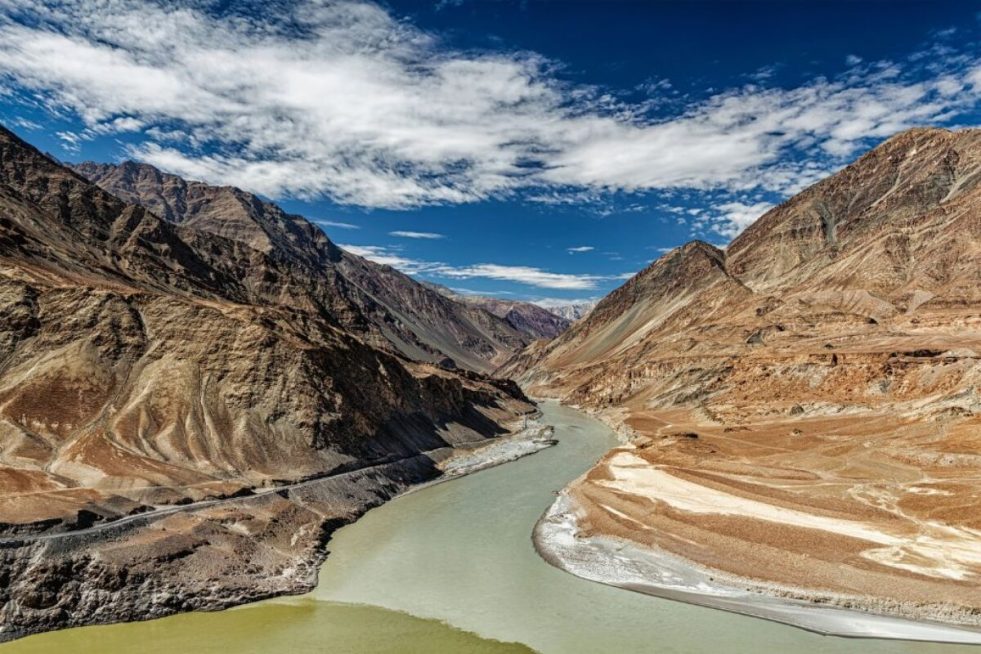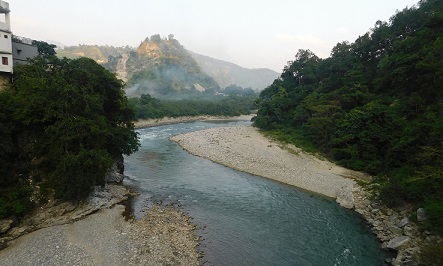
Rivers and lakes of the Indus basin have been at the crossroads of civilizations, trade routes, and ecosystems for centuries. They are surrounded by stories and songs from many religions, languages and tribes. One such river is Beas, celebrated as Vipash[1] or the ‘breaker of chains’ in the Rigveda, circa 1500 BC. Beas originates at 4361 meters near Rohtang Pass[2] and flows through the Himalayan state of Himachal Pradesh before meeting River Sutlej in the plains of Punjab, literally “the land of five rivers’. Beas flows for about 470 kms to water some of the most fertile valleys in the world.
Continue reading “Rewalsar Lake: Where Faiths, Ecosystems and Communities Meet”Tag: Indus
2024: Dams, Mining, Construction Damaging Gangetic Dolphin Habitats
(Feature Image: Dolphin corpse found along Ganga in Sahibganj, Jharkhand in Feb. 2024. Image source: ETV Bharat)
Despite declaring Gangetic Dolphin a National Aquatic Animal in May 2010, launching of Project Dolphin in August 2020 and recognizing October 05 as National Dolphin Day since 2022, the key species indicating river health continues to face unnatural deaths and threats from various developmental activities. This overview highlights the incidents of suspicious death of precious mammal and looming threats on its habitat along with some noteworthy steps being taken by conservationists and governments to protect the endangered species.
Continue reading “2024: Dams, Mining, Construction Damaging Gangetic Dolphin Habitats”SW Monsoon 2024: Rivers Crossing Highest Flood Levels
During southwest monsoon season 2024, SANDRP has tracked at least 64 flood forecast and flood monitoring sites where the respective rivers have crossed the highest flood levels (HFL). Here we present detailed analysis of these sites along with some key observations and other relevant information. SANDRP’s previous reports on the subject can be seen here: HFL breach incidents in 2018, 2019, 2020, May-Sept 2021, Oct.-Nov 2021, May-June 2022, July-October 2022, June-October 2023.
Continue reading “SW Monsoon 2024: Rivers Crossing Highest Flood Levels”DRP 150424: Supreme Court’s order on right to be free from climate change impact is welcome, BUT…
(Feature Image: Polluted Hindon river flowing through Ghaziabad in March 2024. Bhim Singh Rawat/SANDRP)
On March 21, 2024, a case related to the Grean Indian Bustard, a critically endangered bird – numbering less than 150 individuals – has led the Supreme Court of India to expand citizens’ constitutional right to life and equality to include the right to be free from the adverse impact of climate change. The PIL filed by M.K. Ranjitsinh asked to protect the GIB from extinction. In 2021, in this PIL, the Supreme Court had passed directions restricting and regulating power lines and renewable energy projects in an area of 99,000 sq km in Rajasthan and Gujarat.
The Supreme Court’s latest order modified directions passed in the earlier judgment. Chief Justice D.Y. Chandrachud – writing for the 3-judge bench including Justices J.B. Pardiwala and Manoj Mishra – has expanded the contours of environmental jurisprudence: from the oft-repeated polluter pay principle–precautionary principle–public trust doctrine to the larger arena of climate justice, environmental inequity and gender justice. However, in the process, the protection the SC gave through earlier order has been withdrawn.
Continue reading “DRP 150424: Supreme Court’s order on right to be free from climate change impact is welcome, BUT…”DRP 301023: Top scientist Rajeev Raghavan emphasizes need to conserve River Fish
(Feature Image:- Fish catch from a Ramganga stream in Pauri in June 2022. Bhim Singh Rawat/SANDRP)
It is rather rare when we hear the sane voice of a scientist like Rajeev Raghavan neglect of riverine fish conservation in India, from government, research bodies to down to grassroots level. Rajeev Raghavan, incidentally is among the 2% top scientists of the world by the Stanford University, USA. The over emphasis on fish in food, on marine fish, on exotic fish that has such a huge adverse impact on our biodiversity and lack of effort towards conservation of riverine fish are some of the key issues Raghavan emphasizes in this interview. He says most of the fish in the IUCN red list are riverine fish and yet there is so little understanding or effort to conserve such fish or their habitat.
If we see the discussions in the minutes of the meetings of the MoEF’s Expert Appraisal Committee on River Valley Projects in spite of there being permanent presence of a representative of Central Inland Fisheries Research Institute, we see non-existence of any concerns about the impact of the project in riverine fisheries or those who are dependent on them for livelihoods. In fact, we see the shocking spectacle of CIFRI scientists working as consultants to the hydropower companies, working to justify such projects on the highly biodiverse rivers including those of North East India.
Continue reading “DRP 301023: Top scientist Rajeev Raghavan emphasizes need to conserve River Fish”WMO Global Water Report asks for better & shared water data; reduced terrestrial water storage in North India
On Nov 29, 2022, the World Meteorological Organization (WMO) has published its first State of Global Water Resources report to assess the effects of climate, environmental and societal change on the Earth’s water resources. The aim of this annual report is to support monitoring and management of global freshwater resources in an era of growing demand and limited supplies. For report and other related materials, see: https://public.wmo.int/en/our-mandate/water/state-of-global-water-resources
Continue reading “WMO Global Water Report asks for better & shared water data; reduced terrestrial water storage in North India”June-Aug 2021: District wise rainfall in India’s SW Monsoon
In the just concluded month of August 2021, the rainfall in India was a massive 24.13% below normal. Actual rainfall was 195.9 mm, compared to normal rainfall of 258.2 mm, as per figures from India Meteorological Department (IMD). Contrast this with the rainfall in August last year, at 327 mm, was 26.6% above normal, ,and 44 year high. Even in July 2021, the rainfall was much higher at 266.1 mm, 6.73% below normal. In June 2021, the rainfall was 182.9 mm (10.96% above normal), not much below the August 2021 rainfall, when August is supposed to have much higher rainfall than June.
Continue reading “June-Aug 2021: District wise rainfall in India’s SW Monsoon”About landslide lake in Uttarakhand & GLOF in Ladakh
After August 14, 2021 landslide dam[i] on Chenab river in Himachal Pradesh, there have been two more such incidents in north west Himalayan region of Uttarakhand and Ladakh.
Continue reading “About landslide lake in Uttarakhand & GLOF in Ladakh”IMD continues callous reporting of River Wise Rainfall in Monsoon 2020
This rarely gets reported in media, but IMD (India Meteorological Department) also provides river basin wise rainfall figures. Here is an overview of the river basin wise rainfall during SW Monsoon 2020 (June-Sept 2020, though the monsoon withdrew much later), like the way we have been doing for the last three years[i]. Our earlier monsoon 2020 articles provided district wise figures for rainfall in June 2020[ii], June-July 2020[iii], June-Aug 2020[iv] and June Sept 2020[v].
Continue reading “IMD continues callous reporting of River Wise Rainfall in Monsoon 2020”DRP: 11 May 2020: Jindal accepts Etalin HEP is unviable!
This must be the defining (and predictable, this was the lead story in our DRP NB of April 27, 2020, see: https://sandrp.in/2020/04/27/drp-nb-27-april-2020-for-whom-is-this-unviable-etalin-project-being-pushed/) moment in the campaign to save the Dibang Valley now from the proposed 3097 MW Etalin Hydropower Project. The CEO of Jindal Power Ltd has said in so many words that project is NOT an attractive investment, they will struggle to find buyers for the costly power and only support from government can help make the project viable. The CEO seemed to suggest that they would be happy to sell the project to NHPC or form a joint venture with NHPC to get the govt funding for the project. Again completely on predictable line. The question then is why should government spend previous public money on such an unviable project?
So the question remains the same, the one we asked on April 27, 2020: For whom is this unviable Etalin Project being pushed?
Continue reading “DRP: 11 May 2020: Jindal accepts Etalin HEP is unviable!”