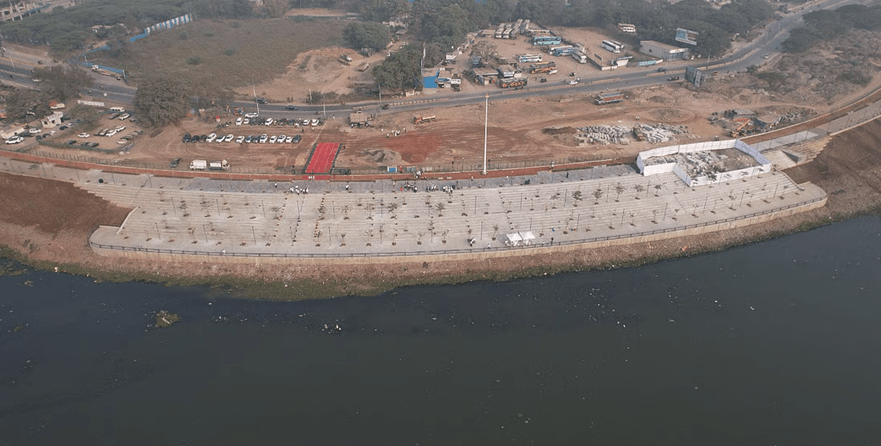
(Feature Image: Pune RFD work along Mula Mutha river. Credit: Free Press Journal)
The Maharashtra government order for a probe into the violations of the Environmental Clearance of the controversial Pune River Front Development (RFD) project is noteworthy for a number of aspects. Most importantly, it signifies a significant gain for the critiques of the project, since the probe has been ordered following a letter by environmentalist Sarang Yadwadkar, who has been relentlessly fighting against the project.
The probe order is also noteworthy as it totally ignores the conflict-of-interest issue. It has asked Pune Municipal Corporation, State Water Resources Department and Maharashtra State Pollution Control Board to conduct the probe and submit a report. The trouble is all these three organisations have been somehow or other involved at various stages of the Pune RFD project and the project has been going on for years under their watchful eyes. These organisations, being part of the state government, will find it difficult to go against the state government. It is good that the order asks these agencies to involve petitioner Sarang Yadwadkar, but the probe should have been done by a group of independent people who have no conflict of interest rather than persons from these three organisations.
The probe is also noteworthy as the complaint was basically about RFD project narrowing the river cross section and thus reducing flood carrying capacity, something that the Maharashtra WRD had expressly prohibited in its clearance letter. This looks such a straight forward issue, but one can trust the government organisations to add a thousand shades of grey here, going by the past situations and track record. One hopes the people of Pune will not allow this to happen.
One only hopes that there is vibrant citizen involvement in RFD projects elsewhere (e.g. Hyderabad) that helps the cause of rivers and where Sabarmati RFD of Ahmedabad is not accepted as a model.
Maharashtra orders probe into violations in Pune RFD The Maharashtra environment department has ordered an inquiry into alleged environmental clearance (EC) violations regarding the PMC’s riverfront development (RFD) project. On April 13, the department directed the commissioner of Pune Municipal Corporation, the chief engineer of the water resources department, and the regional officer of the Maharashtra State Pollution Control Board (MPCB) to conduct site visits and submit a detailed report.
The investigation follows a complaint dated March 6, 2026 filed by environmentalist Sarang Yadwadkar, who alleged that the project has breached several conditions of the environmental clearance granted on Nov 12, 2024. A primary condition of the project’s clearance was strict adherence to a May 3, 2018, water resources department circular. This circular explicitly states that “under no circumstances” should the river’s cross-section or carrying capacity be changed. “The project narrows the riverbed and reduces its width, which is a direct violation of the EC conditions,” Yadwadkar said. He further claimed that project consultants utilised lower flood-level figures than those scientifically recorded by the Maharashtra Engineering Research Institute (MERI). Yadwadkar has now written to the three persons asking for immediate meeting.
The complaint argues that the project’s design significantly reduces the river’s cross-section across its entire 44-km length, drastically compromising its ability to handle floodwaters. “While actual potential flood levels are significantly higher, the project is narrowing the river in defiance of environmental clearances,” he added. The state’s order specifies that the complainant must be included in the upcoming site visits and all relevant consultative meetings. In response to the directives, Ganesh Sonune of the PMC’s environment department stated, “The civic administration will follow the directives of the environment department. The site visit will be carried out soon.”
Citizens group study shows 1,700 ‘transplanted’ trees missing A group of four citizens studying the urban ecology of Pune alerted the municipal commissioner that over 1,000 of 1,713 trees to be transplanted for the Riverfront Development (RFD) project have “gone missing”. The group alleged that there were newly planted trees of the same species at the sites where transplanted trees were to be placed.
Rethinking Pune’s RFD Criticism of the currently implemented section of the contested River Front Development project in Pune highlights ecological damage, shrinking river space, and biodiversity loss. Shailaja Deshpande, Founder and Director Jeevitnadi, reflects and explains how citizen action and institutional cooperation are opening pathways for ecological restoration and long-term sustainability.
HYDRO POWER PROJECTS
Farmers halt work at Luhri HEP Construction at the 210-MW Luhri Hydroelectric Project in Nirath along the Sutlej River was brought to a standstill on April 24 after hundreds of project-affected farmers staged a protest, escalating a simmering dispute over compensation, rehabilitation and environmental damage. Protesters alleged that repeated assurances given by the company and authorities have not translated into action. They claimed that continuous blasting for tunnelling and construction has led to structural damage in nearby villages, with visible cracks appearing in houses and agricultural land. Farmers also cited declining crop yields, attributing losses to dust and pollution from ongoing works. A key grievance remains compensation. Affected families alleged that despite land acquisition, they have not received promised lump-sum payments or employment benefits.
Compensation for people washed away by hydro project after ten months Nearly 10 months after eight workers were washed away in a flash flood in the Manuni rivulet near Dharamshala in Kangra district on June 25, 2025 at a hydropower project, the power company has finally deposited a compensation of Rs 1.22 crore for the lost lives. This will now be distributed among the families of the victims. India Priyadarshini Hydro Power Private Limited has transferred the money to the office of the Employees’ Compensation Commissioner, following orders issued by the court of Senior Civil Judge Hakikat Dhanda.
The court directions came after the hydropower company failed to deposit the compensation amount as required under Section 8(1) of the Workmen’s Compensation Rules, 1923. “Most companies in the hydropower sector do not comply with labour laws and operate without providing adequate safety measures for their workforce,” Ravinder Ravi, Gen Secretary of the Trade Union Coordination Centre added. India Priyadarshini Hydro Power Private Limited is developing a 4.8 MW small hydro project in two phases on the Manuni rivulet near Khaniara, Dharamshala. The work on the project started in 2019.
Himachal Pradesh’s hydropower projects are turning the rivers into a political weapon The mountain river is not a political weapon by nature. It becomes one when governance treats water as revenue to be extracted and rivers as infrastructure to be rerouted. The communities of Kinnaur, Kullu, Mandi, and Chamba do not oppose energy. They oppose the transfer of ecological risk downward — onto their fields, their springs, and their children’s futures — while the financial returns flow elsewhere. Until that asymmetry changes, the hydropower boom will keep building power for the plains on a foundation of dispossession in the hills. (By Ankit Mishra)
Parbati III HEP’s decades old leakage issue resolved? According to this report, the decade long leakage issue in 7 km long head race tunnel of NHPC’s 520 MW Parbati III HEP on Sainj River (Beas tributary) has been resolved.
Kishtwar: Protected Forest Corridor Damaged for Sterlite Power Project A private contractor willfully damaged a protected forest corridor in Kishtwar district without govt clearances to pave the way for a road to ferry construction material for a Rs 384 crore-power transmission line.
The transmission line connects 1000 MW Pakal Dul, 624 MW Kiru power project and 540 MW Kwar power project with a sub-station in Trigam area of Kishtwar for onward supply to the grids in parts of north India. The work on the project started last year on May 27 last year after approval from the Union power ministry and Western Air Command of the Indian Air Force.
A source in the forest department said: “It has been seen that the officials involved in preparing the detailed project reports for power transmission lines only factor in the tract of land for acquisition which falls under the corridor of transmission towers without assessing the feasibility of how the construction material is going to reach the sites”.
Admitting the damage done to the forest, divisional forest officer (Kishtwar) Mahesh Thakur told The Wire that an ‘IR case’ has been registered and a departmental inquiry has been initiated. He however didn’t provide details of the case and the losses caused by the landscaping activities along the one-km unpaved road to the forest.
Balanced, humane approach needed in Kalai-II hydropower project The affected indigenous communities are being asked to part with their ancestral lands, homes, and agricultural fields – resources that are not merely economic assets but the very foundation of their identity and survival. For the Mishmi people, the river, forests, mountains, and streams are sacred and deeply embedded in their cultural, spiritual, and social life. Their traditional practices and livelihoods have evolved in harmony with nature over generations.
It is particularly concerning that fair compensation is reportedly being denied on the grounds that these lands fall under ‘reserved forest’. Notably, a significant portion of the left bank of the Lohit river falls within the Kamlang reserved forest. This classification has further complicated the issue of land ownership and compensation, leading to growing dissatisfaction among the people of Anjaw, particularly the left bank landowners who feel excluded from just rehabilitation measures. (Tititso Lap)
Experts meet to plan conservation of critically endangered White-Bellied Heron The white-bellied heron, scientifically known as Ardea insignis, is found in India, China, Myanmar, and Bhutan. In India, it is found only in Arunachal Pradesh, specifically in Namdapha Tiger Reserve, Kamlang Tiger Reserve, and parts of Anjaw district. Bhutan has the highest population, with around 28 individuals, while India, with an estimated 6-9 individuals, has the second-highest population. The critically endangered bird inhabits undisturbed river systems in the Eastern Himalayas, favouring stretches with sandbanks and gravel beds. Its survival depends on the protection of riparian forests and riverine habitats.
PSP development too slow? This article, interestingly, argues that PSP development in India is too slow!
DAMS
NGRI hands over report on Srisailam Left Bank Canal Tunnel disaster The NGRI has submitted a detailed survey report on the sub-surface conditions of the ongoing Srisailam Left Bank Canal (SLBC) tunnel disaster to Irrigation Minister N Uttam Kumar Reddy. The report highlights stress zones, seepage patterns, and factors behind the February 2025 roof collapse. They explained factors behind the February 22, 2025 roof collapse.
Ken Betwa Project a legal Hot potato? The Ken-Betwa Link project that has become a legal hot potato. Across India, conflicts over land, minerals and ecological preservation are intensifying. Nowhere is this more evident than in the growing unrest surrounding the Ken-Betwa Link Project, where tribal communities have mobilised against what they perceive as a nexus between extractive industries and state power. Protests have drawn attention to the displacement of indigenous populations, the destruction of forest ecosystems and the erosion of traditional livelihoods.
Could this (Meghalaya High Court) template be applied to the Ken-Betwa region and similar areas facing mining pressures? There is no legal impediment to such an application. Activists, affected communities and public interest litigants can invoke the reasoning adopted by the Meghalaya High Court to argue for similar relief. They can point to the Court’s recognition of environmental harm as irreparable, its insistence on strict compliance with licensing regimes, and its emphasis on accountability across multiple agencies.
For the Ken-Betwa region and other conflict zones, this is a crucial insight. The struggle is not only against individual instances of illegality, but against a model of development that prioritises extraction over ecological balance and community rights. Judicial precedents that emphasise environmental protection, regulatory compliance and accountability can strengthen these struggles by providing them with legal legitimacy. (By Sujit Bhar)
Ken Betwa Project: The irreversible course of damage The The Ken–Betwa river-linking project is being pushed through with no apparent concern for the environment or the people it will displace. On 16 April, a joint team of the Chhatarpur district administration reached the protest site to hold talks with the villagers who agreed to defer the protests until a new compensation package was announced.
Amit Bhatnagar, who is leading them under the banner of the Jai Kisan Sangathan, maintains that “sarkari assurances carry little weight with the villagers. Sixty thousand families, in one of the poorest regions in the country, are being affected by this river-linking project.” his could undo years of conservation efforts. Wildlife scientist Dr Raghu Chindawat has been living in Panna from 1995. He points out, “With 70 per cent of the tiger reserve habitat submerged, it will mean the end of the Panna Tiger Reserve and also of the 55-plus tigers and other animals living in it. Using the core area of a tiger reserve park for such a large-scale infrastructure project is unprecedented. If we go ahead, it will be a complete mockery of our institutions and our laws, our Forest Conservation Act, our Wildlife Biodiversity Act.”
Eminent conservationist M.K. Ranjitsinh, who has been involved in shaping wildlife conservation policies for the last five decades, opposed this project tooth-and-nail. He resigned from the Madhya Pradesh Wildlife Board in 2015, saying, “You can have either the interlinking project or the Panna Tiger Reserve. You cannot have both… and the most unfortunate aspect is most of these development projects do not even deliver [what they promise].”
Telangana HC stays action against KCR+3 on Kaleshwaram Project The Telangana high court on April 22 directed the state government not to take any coercive action against Bharat Rashtra Samithi (BRS) president K Chandrasekhar Rao & 3 others on the basis of findings of the PC Ghose Commission, which probed the alleged irregularities in the execution of Kaleshwaram irrigation project. A division bench of the high court comprising chief justice Aparesh Kumar Singh and justice GM Mohiuddin, which reserved its judgement on April 8 and delivered it on Apr 22.
The high court bench said the constitution of the Commission was neither arbitrary, illegal nor ultra vires of the Constitution. “But the findings rendered by the Commission are prejudicial to the conduct and reputation of the petitioners and have been rendered in violation of principles of natural justice and the statutory safeguard provided under section 8B of the Commissions of Inquiry Act, 1952. So, they shall be inoperative and no action can be taken on the basis there,” the court said. The bench found fault with the state government for placing the commission’s findings in the public domain through the media before legislative scrutiny in the assembly.
KCR’s lawyer, Senior Advocate Gandra Mohan Rao clarified that the court has barred reliance on the commission’s findings for initiating any probe, including by central agencies such as the Central Bureau of Investigation.
Gujarat to construct barrage over Sabarmati River Gujarat government is to construct Ged Barrage on Sabarmati river in Sabarkantha district. Dilip Buildcon Ltd has been awarded Rs 268 Cr contract for construction of the barrage, allied works to be completed in 24 months and its maintenance for ten years.
Agenda of MoEF’s Expert Appraisal Committee meeting for River Valley Projects to be held on April 29-30 2026 1. Jethala Balancing Reservoir Lift Irrigation Project (CCA of 29000 Ha) in 1242.13Ha at Sub dist Narsinghgarh, Berasia, Huzur and Shyampur, Dist Sehore and Bhopal, Madhya Pradesh – Terms of Reference
2. Bodwad Parisar Sinchan Yojana (CCA of 53,025 Ha) in 1315.13Ha at Sub Dist Jamner, Motala, Muktainagar (Edlabad), Malkapur and Bodvad, Dist Jalgaon and Buldana, Maharashtra by Tapi Irrigation Development Corp, Jalgaon – Terms of Reference
3. Amba Open Loop Pumped Storage Project (1500 MW) in 272.21 Ha at Sub Dist Mawal and Sudhagad, Dist Pune and Raigad, Maharashtra by M/s NTPC Limited – Terms of Reference
4. Greenko BR-01 Closed Loop Pumped Storage Project in 310.88 Ha at Sub Dist Gobindpur, Akbarpur and Rajauli, Dist Nawada, Bihar by Greenko Br01 Irep Pvt Ltd – Terms of Reference
5. Aruna Open Loop Pumped Storage Project (1500 MW) in area of 334.45 Ha located Sub District Bavda and Vaibhavvadi, District Kolhapur and Sindhudurg, Maharashtra by M/s THDC India Limited – Terms of Reference
6. Barnar Reservoir Project (CCA of 22,226 Ha) in 1052.43 Ha at Sub-dist Sono, Khaira, and Gidhaur etc., Dist Jamui, Bihar – Terms of Reference
7. Niare Hydro Electric Project (909 MW) in 175.05 Ha at village Bodok, Gelomo Camp (Golomoring), Ging, and Kinekio etc., Sub-dist Limeking Circle, District Upper Subansiri, Arunachal Pradesh by Andra Power Pvt Ltd – Terms of Reference
DAM FLOODS
April 2026: HTPS Fly-ash Dam Burst in Korba, Chhattisgarh A JCB operator was killed after a breach in fly ash dam (Rakhad dam) near Jhabu and Nawagaon villages under Katghora tehsil of Korba district in Chhattisgarh on April 19, 2026. The fly ash dam belongs to Hasdeo Thermal Power Station (HTPS), Korba West. The power station is owned and operated by Chhattisgarh State Power Generation Company Limited (CSPGCL). The incident occurred around 12 noon when the JCB operator, identified as 21-year-old Huleshwar Kashyap, along with five other workers, was carrying out earth-filling work on the outer side of about 70-foot-high fly ash dam as part of its maintenance. Suddenly, there was a rise in pressure on one portion of dam embankment and the upper part of it broke away with a loud sound.
Kerala floods 2018: New audio clip reignite debate on man-made Kerala floods Congress leader and Muvattupuzha UDF candidate Mathew Kuzhalnadan has reignited the allegations by sharing an audio clip allegedly featuring Minister K. Krishnankutty. In the clip, Krishnankutty is purportedly heard saying that Mathew T. Thomas—his party colleague and then water resources minister—played a role in delaying the opening of the Thottappally spillway, which is crucial for flood control in Kerala. The recording claims that the delay was intended to prevent downstream sand deposits from being washed away, thereby benefiting a private contractor. It further alleges that Mathew T. Thomas made crores from the deal. The LDF state government defence leaves uncertain areas, which require an inquiry to establish the truth. This was also true about the report submitted by the Kerala High Court senior advocate Jacob P. Alex as amicus curiae, to the high court. The report recommended an inquiry by Supreme Court Judge, but that was never done.
The LDF government’s defence back then was equally questionable. In his report, Adv. Alex noted that, alongside extremely heavy rainfall, the impact of the floods appeared to have been aggravated by various factors, including man-made ones. “None of the 79 dams in Kerala were operated or used for the purpose of flood control/moderation; no effective flood control zone was maintained; reservoir storage remained high even in the first week of August; there was sudden release of water from all dams; reservoir storage capacity had reduced due to siltation; there was no integrated operation of dams based on scientifically identified rule curves; and there was an absence of proper flood warning systems,” the report noted. Kerala govt used the report of the Central Water Commission and a study by K P Sudheer of IIT Madras, critique about both, the SANDRP have written in the past.
Former Janata Dal (S) leader R.S. Prabhat, who was alongside Kuzhalnadan when the audio was released, alleged on April 8 that K.P. Sudheer, who led the IIT Madras study, was subsequently appointed as the executive vice president of the Kerala State Council for Science, Technology, and Environment (KSCSTE) and as ex officio principal secretary to the government of Kerala. This politicisation of the appointments to the scientific position also needs to be inquired into.
INTERSTATE WATER DISPUTES
Kabani runs dry in Wayanad villages as water diverted to Bengaluru A severe summer water crisis has gripped parts of Wayanad as stretches of the Kabani River have run dry, leaving thousands of households in Pulppalli and Mullankolly panchayats struggling for drinking water even as its waters flow downstream towards Bengaluru. Residents said the river, which had adequate flow until last week, abruptly exposed its rocky bed, triggering concern. Mullankolly panchayat vice president Shinu Kachirayil said people realised that water levels had dropped sharply only when the riverbed became visible, attributing it to diversion towards the Beechanahalli dam in Karnataka.
Being a dry zone during summer, more than 70 per cent of households in Pulppalli and Mullankolly panchayats depend on the drinking water distribution system to meet their needs. To tide over the crisis that occurred in the two panchayats in April 2024, water from the Karapuzha dam was channelled into the Kabani through a network of canals and interconnected rivers. A temporary check dam was also built to prevent water from flowing down to Beechanahalli.
URBAN RIVERS
Disclose Musi project reports before talks: Activists Musi Jan Andolan (MJA), a people’s platform focused on the Musi River and its riparian communities, has submitted a representation to the Telangana government’s Cabinet Sub-Committee, seeking disclosure of all project-related documents before consultations on the Musi Riverfront Development project. The submission, addressed to deputy chief minister Mallu Bhatti Vikramarka and ministers D Sridhar Babu and Ponnam Prabhakar, called for a comprehensive re-evaluation of the project from a river-basin perspective.
Musi rejuvenation plan targets sewage interception Funding is expected under the National River Conservation Plan. However, execution may be challenging as the river corridor is occupied by pipelines, power lines, dhobi ghats and informal dumping points, which will need to be relocated or integrated.
RIVERS
The river as goddess, the river as victim When a government uses the rhetoric of devotion, when NGOs reframe the idea of “spiritual purity,” and when civil society is asked to believe that offering milk is more sacred than treating sewage, we are protecting a myth, not the river. (Akanksha)
Karnataka’s temple tourism turns river into sewer Sewage from commercial activities related to religious tourism in Kollur has emerged as a threat to the Mookambika Wildlife Sanctuary in Udupi district, with the depleted Souparnika river carrying sewage and sludge to the core area in summer. The Forest Department recognised the sewage from the temple town of Kollur as a “small but not an insignificant problem” back in 2005 while preparing the management plan, when Kollur still resembled a village. Today, post tourism boom, mushrooming homestays, hotels and the allied service industry has pushed the river, the lifeline of the wildlife habitat, to the edge.
Myntdu siltation sparks fresh water crisis in Jowai For the third consecutive year, administrative apathy and unchecked road construction have turned Jowai’s primary lifeline, the Myntdu River, into a drain of silt. The recurring pollution has left thousands of households facing a critical water shortage despite standing NGT orders to protect the river.
April 17 rainfall triggered a massive flow of loose soil, sand, and construction debris from the ongoing Jowai bypass road project directly into the river. The resulting sludge has clogged the Public Health Engineering (Electrical) intake point at the Mupiah reservoir, the primary source of potable water for Jowai town.
Ganga pollution and sewerage gaps in UP Information submitted in an affidavit dated April 9, 2026 by the state of Uttar Pradesh, in compliance with a NGT order dated November 27, 2025.
In Meerut, delineation of the Ganga floodplain based on a 1:25 flood frequency ratio has been completed. The Central Water Commission is currently determining the floodplain based on a 1:100 flood frequency ratio. Review by the Survey of India is also under way to map the floodplain of the Hindon river.
The report also stated that floodplain zoning has been completed for 10 rivers, including the Ganga, Yamuna, Ramganga, Suwav, Budhiganga, Solani, Mandakini, Ken, Betwa and Khokhri. Work is in progress for 28 rivers, including the Kali (east), Varuna, Hindon, Gomti, Ghaghra, Rapti, Sai, Tedhi, Pahunj, Gangan and Assi, while work for 15 additional rivers has been initiated.
The tribunal directed the state to disclose budgets prepared by each District Ganga Committee since the relevant notification, including allocations, purpose and utilisation. It also directed the submission of details of nodal officers appointed for each Gram Sabha, municipality, planning committee and local authority, along with actions taken to prevent pollution of the Ganga and its tributaries.
Waste dumped on Torsa river banks Dark grey smoke curls above the Torsa riverbank in Jaigaon, a crowded border town of West Bengal, India, separating India and Bhutan. Plastic waste, medical refuse, construction debris and household waste lie scattered across the river bed and cows and dogs forage through the garbage.
DDA to start work on cycling track along floodplains in Delhi The first phase of construction of a 52-95-kilometre cycling corridor along the Yamuna floodplains is set to begin in the next few weeks, after the NGT’s principal committee gave its final approval for the project, officials of the Delhi Development Authority (DDA) said on April 22. The proposal had been under consideration for several months and underwent minor alignment changes before receiving clearance from the NGT’s principal committee. Officials said these changes were made to address environmental concerns and ensure compliance with regulatory norms governing floodplain development.
‘Yamuna cruise service set to begin in May’ The cruise service on the Yamuna is set to start next month, Union Minister for Ports, Shipping, and Waterways Sarbananda Sonowal said on April 24 at the Idea Exchange program of The Indian Express. The cruise will operate upstream on the river between Wazirabad and Sonia Vihar. Last November, Delhi Water Minister Parvesh Sahib Singh had reviewed the project with Sonowal and then LG V K Saxena.
Rejuvenation of Yamuna among non-negotiable priorites: LG Delhi Lt. Governor Taranjit Singh Sandhu on April 08 said that the entire Yamuna floodplain in Delhi will be rejuvenated by the DDA on the lines of Vasudev Ghat, Asita Biodiversity Park and Baansera Park. “These restored ghats, which are bringing the people of Delhi closer to the river and fostering a sense of ownership and belonging towards the Yamuna, can serve as models to be replicated at other locations,” he said.
91 STPs operational in Haryana: CM Nayab Singh Saini on Apr 24 said that the govt’s target is to ensure that not a single drop of untreated water flows into the Yamuna river by the end of 2027. In an official statement, Saini said that at present, 91 STPs with a total capacity of 1,543 MLD are operational in the Yamuna catchment area to treat water flowing into the river. Out of these, 41 STPs with a capacity of 593 MLD have been established in the last five years. Additionally, 11 new STPs are under construction.
The CM further directed that CETPs should be installed on all 11 major drains leading to the Yamuna so that every drop of industrial waste water is treated before entering the river. Saini said that 8 new CETPs with a capacity of 147.5 MLD will be set up in the Yamuna catchment area. According to the statement, officials of the HSPCB also informed that 211 MLD of untreated water flows into Haryana from Delhi through certain drains, which is then treated by Haryana and sent back to Delhi. Saini said that a meeting will be held with the Delhi CM to resolve this issue and ensure that only treated water is discharged into the Yamuna from Delhi.
FISH, FISHERIES, FISHERFOLKS
Dead fish on Yamuna raises effluent concern again Thousands of dead fish have been floating along the Najafgarh drain, Delhi’s most-polluted stormwater drain that empties into the Yamuna, near southwest Delhi’s Rawta village over at least the past five days, with villagers alleging the water colour—usually, a dark shade of grey—has been darker and murkier. The incident has been logged near the Dhansa regulator, locals said. The issue is also not limited to the Najafgarh drain. In May 2025 and prior to that, in July 2024, hundreds of dead fish were recorded along the Yamuna banks near Burari in north Delhi.
Experts, while attributing the deaths to a sharp dip in dissolved oxygen, said the reason for the dip needs to be assessed. Bhim Singh Rawat, a Yamuna activist and of the SANDRP, said that the river in this portion is receiving untreated effluents from Haryana, and the rise in temperature, coupled with industrial effluents, may have led to mass fish mortality. “Such events are usually seen in summer as the flow of water in rivers and drains usually goes down and the concentration of effluents increases, depriving organisms of dissolved oxygen. Most fish cannot survive abrupt dips in dissolved oxygen,” he said.
Bhim Singh Rawat, SANDRP said the incident has been observed near Rawta village, on the Delhi-Haryana border. “This mass fish mortality can be attributed to excessive inflow of untreated residential effluents as well industrial wastes,” Rawat said, adding that all this, paired with an increase in temperature might have caused a drop in the DO level, leading to fish deaths.
Untreated sewage caused fish deaths near Mangaluru The mass deaths of fish reported near Raikatte Bridge in Mangaluru was likely caused by untreated sewage inflow, water stagnation, and depletion of dissolved oxygen levels, according to the inspection by the Regional Office, Karnataka State Pollution Control Board (KSPCB). The Regional Officer of KSPCB, Mangaluru, said that officials had received complaints on February 9 regarding death of fish and blackening of the storm water drain near Raikatte Bridge, which joins the backwaters of the Gurupura river.
Mumbai fishers raise alarm over plight of 45,000+ mangroves Mangroves implicated in a road project face removal or transplantation, raising ecological damage fears and threatening fishers’ way of life.
SAND MINING
NBWL rejects 19 mining proposals in wildlife sanctuaries The proposals, which required approval from Standing Committee of National Board for Wildlife (SC-NBWL), pertained to mining in areas classified as default ESZs – zones where such activities are prohibited. In the absence of formally notified ESZs, a 10-km buffer around protected areas is treated as the default ESZ, where development activities remain regulated.
According to the minutes of the meeting, the panel flagged the state govt’s failure to submit key assessments, including studies on the vulnerability of river stretches to natural hazards, and the impact of mining on ecological stability. The committee also cited the non-finalisation of ESZs for both Rajaji Tiger Reserve and Benog Wildlife Sanctuary as a reason for rejecting the proposals.
The decision comes against the backdrop of a Supreme Court directive issued in November 2025, mandating that ESZs around tiger reserves — including buffer and fringe areas — be notified within a year. “After detailed deliberation, SC-NBWL did not recommend the mining proposals falling in the default ESZ of the Rajaji Tiger Reserve and Benog Wildlife Sanctuary. The state government was further directed to comply with the court’s directions and issue the draft ESZ notification,” the minutes stated.
Mining, road construction across Dhasan, Ken rivers The central bench of NGT directed a two-member joint committee April 21, 2026 to look into the allegations of a mineral-based company engaged in illegal in-stream mining and temporary access road construction across Dhasan and Ken rivers. It was alleged that the company was been building the roads to transport sand minerals, thereby obstructing the natural flow and aggravating environmental harm. The committee was directed to visit the site and submit the factual and action taken report within six weeks.
Bankura’s Sand-Mining Devours Land, Lives and Law Rampant sand mining in Bankura’s rivers, especially the Damodar and Darakeswar, is devastating ecosystems, farmland and livelihoods. Villagers allege a powerful syndicate backed by leaders from both BJP and TMC, alongside complicit officials, enables widespread illegal extraction. Labourers face exploitation, earning meagre wages under coercion.
Vigilance charge-sheet names CPM leaders in ₹8.33cr scam The Vigilance and Anti-Corruption Bureau (VACB) charge-sheet in the Malappattam illegal sand mining case lays bare a tightly run operation in a panchayat where the CPM held near-total political and administrative control. Between 2007 and 2012, when the CPM-led LDF controlled all 13 wards, several of them unopposed, parallel sand mining committees were allegedly set up to siphon off ₹8.33 crore. Of this, only ₹2.07 crore was remitted to the panchayat, resulting in a loss of ₹6.26 crore to the public exchequer, according to the charge-sheet filed before a special court in Thalassery.
WETLANDS, LAKES, WATER BODIES
Haryana govt shifts wetland authority to wildlife department The move follows a March 11 notification reconstituting the Wetland Authority and a subsequent March 24 departmental communication directing the Directorate of Environment & Climate Change to transfer all records, files and budgetary provisions to the PCCF (wildlife), effectively shifting control from the environment directorate to the wildlife wing. For years, the state has struggled with incomplete wetland identification, hampering efforts at conservation of wildlife around the water bodies.
Earlier, wetland-related functions were handled through the directorate of environment and climate change. With this shift, wetlands are now administratively and financially aligned with the department that already manages forests and wildlife habitats. With the PCCF (wildlife) designated as member secretary, the forest department will anchor implementation, monitoring and enforcement of wetland conservation across the state.
Despite the shift, the Wetland Authority continues to be chaired by the chief minister (or minister-in-charge), with the environment minister as senior vice-chairman and the chief secretary as vice-chairman. It includes administrative secretaries from key departments and technical members from pollution control, the biodiversity board and remote sensing agencies. Environmentalists have hailed the move but say the real change will be reflected in execution.
Why J&K wetlands are at a tipping point Wetlands, often dismissed as wastelands, are in fact essential life-support systems. Their degradation is a direct threat to human well-being. The report calls for urgent and coordinated action. Establishing a fully functional Wetlands Authority, enforcing regulations and adopting integrated management approaches are critical first steps. Equally important is the need to regulate tourism, protect rangelands and support indigenous communities, whose knowledge and practices have long sustained these ecosystems.
Improved waste management, pollution control and community-led conservation efforts could help reverse some of the damage. However, time is crucial. Delayed action risks pushing these ecosystems beyond recovery. The wetlands of Jammu and Kashmir stand at a tipping point. Their decline reflects a broader crisis where environmental stewardship has struggled to keep pace with development and climate change. What is at stake is not only the health of ecosystems but also the future of communities that depend on them. The message is clear and urgent. Conservation can no longer be treated as secondary to growth. (By Shaikh Ghulam Rasool)
RAMSAR WETLANDS
Shekha Jheel Bird Sanctuary of Aligarh gets Ramsar tag Shekha Jheel Bird Sanctuary of Aligarh, Uttar Pradesh has got an international tag of Ramsar site, taking India’s total of such protected wetlands to 99 and the state’s tally to 12. “This partially human-made wetland complex, comprising Shekha Jheel Lake and surrounding deciduous forest, was formed following the construction in the 1850s of the Upper Ganges Canal, which flows adjacent to the site,” said the Convention secretariat on its website. The number of Indian wetland sites in the global list of Ramsar Convention has increased from 26 to 99 in the past 11 years, of which 57 have been added in the last four years.
Ramsar wetland tag needs to be followed up with sustained management The 40 Ha Shekha Jheel Bird Sanctuary in Upper Ganga plains in Uttar Pradesh, has been designated a Ramsar site. The wetland is an important bird habitat and lies on the Central Asian Flyway supporting migratory and resident birds. Eutrophication, sewage inflow, invasive water hyacinth, disturbance and encroachment are key pressures facing the wetland currently.
WATER OPTIONS
Mounting evidence that decentralised water restoration delivers greater climate resilience at lower social costs From Rajasthan’s revived Sherni river to the shrinking Yamuna, evidence is mounting that decentralised water restoration may, in some cases, deliver greater climate resilience, groundwater recharge and livelihood gains at lower social costs than conventional big dam-hydropower-led river development. (By Kalyan Chatterjjee)
From Water Scarcity to Women led governance in Dewas The Dewas (Madhya Pradesh) experience demonstrates that sustainable development outcomes are strongest when ecological restoration, gender equity and democratic participation advance together. The transformation from acute water scarcity to women-led local governance in Madhya Pradesh’s Dewas illustrates how community-driven water management can reshape gender roles, livelihoods and political participation at the grassroots. (By Amrendra Kishore)
300-year-old stepwell on Osmania University campus The three-year restoration was undertaken by the Society for the Advancement of Human Endeavour in collaboration with the government, with financial support from Dodla Dairy. The effort was spearheaded by architect Kalpana Ramesh, founder of The Rainwater Project, and gallerist Annapurna Madipadig. The revived stepwell is now functional, with 20,000 to 35,000 litres of water drawn from it daily for plantation activities on the campus. A filtration system has also been installed at the site. Ramesh said the resource could potentially be extended to serve the university’s hostels, which house around 5,000 students.
Decentralised water conservation structures are critical for India A critical paradox defines India’s irrigation landscape: while public investment remains concentrated in large projects, actual irrigation use is largely sustained by decentralised systems. These include not only wells and tube wells, but also local water infrastructure such as check dams, water harvesting tanks, recharge pits, and field bunding structures. By slowing surface runoff and enhancing soil moisture, these interventions play a crucial role in sustaining agriculture, particularly in water-stressed regions.
India’s irrigation challenge is no longer about expanding access alone; it is about managing water more intelligently and equitably across scales. As pressures on water resources intensify, the focus must shift from simply creating infrastructure to improving how water is stored, distributed, and used. Large dams and canal systems will continue to play a critical role in supporting agriculture and regional water security. At the same time, thousands of small, decentralised structures—such as check dams, tanks, and recharge systems—quietly sustain groundwater levels, buffer climate variability, and underpin rural livelihoods.
GROUNDWATER
Review of Documentary: “When water kills: The arsenic crisis in Eastern Uttar Pradesh” Through testimonies and scientific insight, the 2023 film shows how invisible arsenic poisoning is devastating communities in Ballia, turning drinking water into a long-term health crisis shaped by policy gaps and neglect. The film also reflects on gaps between policy intent and everyday realities. It points to findings where arsenic levels in some schools in Ballia have reached 550 micrograms per litre, which is 55 times higher than the World Health Organisation guideline. While programs such as the Jal Jeevan Mission have seen large financial allocations, the documentary presents scenes of dry taps and filtration units that are not always functional.
NGT warns 6 cricket stadiums of shutdown over missing water source details The NGT has issued notices to six cricket stadiums across the country, including Arun Jaitley Stadium in Delhi, asking them to explain why their activities should not be stopped for failing to disclose the source of water used to maintain the pitch and grounds. A bench comprising NGT Chairperson Justice Prakash Shrivastava and expert members A Senthil Vel and Afroz Ahmad observed in an April 16 order that seven stadiums initially failed to submit their replies despite repeated directions.
It stated that during the proceedings, counsel for the stadium in Hyderabad sought three weeks to comply, while the remaining six failed to appear or file any response. The tribunal has directed the CGWA to convey the order to these stadiums. The matter has been posted for further proceedings on July 2.
URBAN LAKES, WETLANDS
Some of Bangalore’s lakes thriving due to community efforts Lake rejuvenation efforts began in 2008, led by the Bangalore Development Authority (BDA) which began the task of cleaning, desilting, de-weeding, development of wetlands, installation of Sewage Treatment Plants (STPs), fencing and so on.
PNLIT (Puttenahalli Neighbourhood Lake Improvement Trust) signed a Memorandum of Understanding (MoU) with BBMP for the maintenance of the Puttenahalli lake in May 2011 and since then the lake has been flourishing. Jalaposhan, another citizen group, signed an MoU for maintaining the Jakkur lake in 2015. The fishing community is also an active stakeholder in this endeavour. Rachenahalli, Sampigehalli were also similarly rejuvenated.
The restoration of the famous Lalbagh lake in South Bengaluru is another example of a scientific, nature-friendly approach which includes biological and mechanical treatments. Lake rejuvenation here was headed by Gurunandan Rao, founder and president of HandsOnFoundation.
However, on March 4, 2020, the Karnataka High Court passed an interim order in response to a Public Interest Litigation (PIL) filed by the Citizens Action Group. The court ruled that the BBMP and the state government should not enter into or renew MoUs with private corporate entities for lake maintenance. Chief Justice Abhay S. Oka observed that, with maintenance MoUs, “the state is virtually parting with the lakes to private corporate entities”. The government since then stopped renewing MOUs with even community groups. After the order, many lake groups did argue that they were not corporate entities and should be allowed to continue. The Karnataka Tank Conservation & Development Authority Act, 2014, permits community involvement in conservation.
Bengaluru: Chandapura Lake remained polluted for most of 2025 The water quality of Chandapura Lake remained at ‘Class E’ — the lowest category — for most of last year, prompting the KSPCB to recommend issuing a notice to the Town Municipal Council (TMC) for violations. Water quality data showed that between December 2024 and November 2025, the lake’s water remained in the ‘Class E’ category for 10 months, indicating it was unfit even for propagation of wildlife and fish and suitable only for industrial cooling and irrigation. For the remaining two months, the quality marginally improved to ‘Class D’.
Yele Mallappa Lake turns into hyacinth carpet Yele Mallappa Shetty Lake, a minor irrigation tank spread across 500 acres along NH-75 beyond KR Pura, is fully covered with hyacinth, indicating massive sewage inflow. According to sources, some residents from Sai Garden, Abhivrudhi Layout, have allowed sewage connections directly into the lake. Besides, the 15MLD capacity STP is said to be insufficient, and over 30MLD of water being released into the lake.
The NGT had already called for rejuvenation and protection of the water body. Based on the direction, the Minor Irrigation department has taken up fencing up to 9.3km, but at crucial points, the fencing is incomplete. A department official stated that only a few metres of fencing from NH-75 towards Kolar is pending, and the department will complete it soon.
Parched Bengaluru lakes leave fauna high and dry A harsh cloudless summer is taking its toll of the city’s water bodies, which give life to urban flora and fauna. Ullal Lake in Kengeri, spread across 29 acres, has an island which is a habitat for peafowl and mongoose. The lake has gone completely dry, except for a few patches where sewage from a diversion line has leaked. Similarly, Uttarahalli Lake has also gone dry due to summer. In West Bengaluru, the iconic man-made Sankey Tank is also drying up. Similarly, the 37-acre Sankey Tank is almost dry, and this has caused concern among regular walkers and residents in the surrounding area.
Water hyacinth clogs Okkiyam Maduvu Residents of Kannagi Nagar are raising a stink about rising mosquito menace that is beginning to bite, thanks to nearby Okkiyam Maduvu which is choked with water hyacinth, turning the waterway into a mosquito-breeding ground. They alleged that neither Public Works Department (PWD) officials have taken any steps to remove the invasive plants nor the Greater Chennai Corporation (GCC) has resumed mosquito-repellent spraying using drones, which was stopped nearly a year ago. Though the civic body has been carrying out mosquito fogging using hand-held machines, locals TNIE spoke to say the spraying is mostly limited to residential streets.
MCD launches new bid to revive Naini lake In a fresh attempt to revive Naini Lake in Model Town, the Municipal Corporation of Delhi (MCD) is set to invite new tender applications at an estimated cost of nearly Rs 10 crore. According to the tender document, the project is to be completed within 12 months and includes civil, electrical, horticulture, as well as operation and maintenance work.
URBAN SEWAGE TREATMENT
Gujarat Scientists claim new method to treat sewage Scientists at the CSIR-Central Salt & Marine Chemicals Research Institute (CSMCRI) in Bhavnagar have claimed to have developed an innovative nature-based sewage treatment system that works much like a natural wetland. The system uses plants, microbes and specially designed beds to clean wastewater.
Plants such as Juncus rigidus (sea rush) and Canna indica (Indian shot) play a role in absorbing pollutants while naturally occurring microbes break down contaminants. Senior scientist Sanak Ray said, “Wastewater passes through multiple stages including filtration, electroactive wetlands and constructed wetlands before reaching a final polishing stage.” The system does not use electricity.
The project was funded by the Biotechnology Industry Research Assistance Council (BIRAC), and the technology has already been transferred to a private company for commercial deployment so it can be adopted by municipalities, real estate developers and environmental start-ups across the country. The system can be scaled to treat anything from a few thousand litres to several million litres of wastewater per day.
Govt looks to earn ₹120cr from Bengaluru’s sludge The state cabinet has approved a proposal to sell 200 tonnes of sludge generated by Bengaluru for the production of biogas every day. The move had been initially announced in the budget document of 2025-26. The project is expected to be taken up on a pilot basis with sludge from five waste treatment plants under the Bengaluru Water Supply and Sewerage Board (BWSSB) to be considered in the first phase. There are 34 wastewater treatment plants in the city, which treat 1,348.5 MLD every day and generate 200 tonnes of sludge.
The govt has approved the plan to sell the sludge to private entities, considering the “high organic matter content” which is conducive for bio-gas production through anaerobic digestion. This will be taken up under a public-private partnership (PPP) model that is expected to generate Rs 85 crore a year. The five waste water treatment plants considered for the first phase are two units in the KC Valley, and one each at Bellandur Amanikere, Vishveshhwara Valley and Hebbal valley. Overall, the five treatment plants generate 550 MLD of water and generate substantial sludge every day.
URBAN WATER
Bengaluru gets Cauvery water, ₹230 cr spent on Thippagondanahalli to go waste The state government’s investment of Rs 230 crore to revive the Thippagondanahalli (TG Halli) reservoir in west of Bengaluru is soon likely to go waste. This is because supply of 20MLD from the reservoir has now been completely stopped, and the government is focusing on utilising water from the river Cauvery to the optimum.
In 2023, water supply had resumed and 30 MLD water was being drawn from TG Halli to supply water to most parts of west and south Bengaluru. This reduced to 20 MLD in 2024 and 2025 and has now stopped. “No water is being supplied from TG Halli reservoir since 2025. After nearly all areas of Bengaluru were covered under Cauvery 5th Stage project, supply from TG Halli was stopped,” a senior BWSSB official said. At present, BWSSB supplies 1,850 MLD water to Bengaluru under Cauvery 5th Stage.
A detailed project report to supply water under Cauvery 6th Stage is being prepared to supply an additional 500 MLD by 2028. The cabinet also approved the project in February, which will cost Rs 6,939crore. “Three years ago, Rs 230 crore was spent on installing new machinery and repairing existing ones. A new ozonization plant was also installed to ensure quality water supply. When supply from TG Halli was started, it was decided to supply in a ratio of 1:10 (1MLD of TG Halli water with 10MLD of Cauvery water). The plan was also to revive the Arkavathi river to ensure continuous supply of water. But we don’t have the exact ground flow map of the river to revive it,” the official admitted. “We don’t know what will happen with TG Halli after some time.
Experts say there is no need to draw water from Mekedatu or Yettinahole if TG Halli is revived and utilised to the fullest. Minor Irrigation department officials said survey and ground investigation is being done in Cauvery Wildlife Sanctuary for constructing a balancing reservoir at a cost of Rs 9,000crore to hold 67.16tmcft water, of which 4.75tmcft will be supplied to Bengaluru. Prof TV Ramachandra, from the Centre for Ecological Sciences, IISc, has opposed the Mekedatu and Yettinahole projects. He said there is no need to bring water from so far to Bengaluru, which receives good rainfall. If rainwater harvesting is efficient and existing infrastructure is utilised, there is no need for anything else, he added.
Well water contamination triggers jaundice outbreak in Kothamangalam A jaundice outbreak has been reported in Ernakulam, allegedly linked to contaminated drinking water. This raises serious concerns about safety and quality of local water supply as temperature soars in the district. In the latest incident, outbreak has been reported from Mulavoor Kavala, a locality situated in ward 25 of Kothamangalam municipality.
Twenty-nine jaundice cases were reported from the area since March 29. Health officials said no one reported a serious health condition following the infection and only one patient needed hospital admission. Health officials said no new case, however, has been reported since the last case on April 17. According to health officials, source of infection is well water as four samples collected from the area showed presence of the pathogen hepatitis A virus.
Stop untreated wastewater inflow into Laharpur dam: NGT The NGT April 21, 2026 directed the Bhopal Municipal Corporation to identify the drains discharging untreated water or sewage water into Laharpur dam and to prevent direct inflow of untreated waste water. The corporation was also asked to take necessary steps for treatment facilities by constructing the STP or decentralising the treatment system near the location. It must also ensure that there shall not be any discharge of untreated water or sewage water into the dam.
Inaugurated in 1979 and completed in 1994 at a cost of Rs 278 crore, the dam’s water has now become black, toxic and unfit for any use, according to the application. Currently, untreated sewage from four major drains and dozens of smaller city sewers discharges directly into the dam. As a result, the contaminated water is being used to irrigate approximately 2,500 acres of agricultural land across 10 to 12 villages, the applicant highlighted. With a depth of about 20 meters and spread over a radius of nearly one kilometer this reservoir now emits foul odor extending up to 600 meters, making life miserable for the surrounding population, the application stated.
The tribunal directed the constitution of a committee to visit the site and submit its report. The Joint committee conducted a site visit of Laharpur dam situated in village Bagmugaliya, tehsil Kolar, district Bhopal and surrounding areas on April 13, 2026.
Delhi makes RWH mandatory The Delhi govt has made rainwater harvesting (RWH) mandatory across the city, with water minister Parvesh Verma chairing a high-level meeting at the Delhi Secretariat on April 20 to outline enforcement measures, timelines and financial incentives.
Under an existing financial assistance scheme, consumers with plots of 100 square metres and above are eligible for subsidies for installing rooftop RWH systems. For plots between 100 and 499.99 sqm, assistance is capped at 50% of the cost or ₹25,000, whichever is lower, while for plots of 500 sqm and above, the cap increases to ₹50,000.
To further incentivise adoption, the Delhi Jal Board (DJB) is offering a 10% rebate on water bills for functional systems, which increases to 15% if both rainwater harvesting and wastewater recycling systems are installed. Non-compliance may attract penalties, including a 1.5-times increase in water bills and disconnection of supply in persistent cases.
Data shared by DJB show that ₹204.46 crore in rebates was disbursed between 2017 and 2024. Officials said RWH systems have been installed in 4,343 out of 4,861 schools and colleges, with a deadline of June 30, 2026, for the remaining institutions. In other government departments, 2,564 installations have been completed out of 3,598 identified sites.
Delhi GW higher recharge than use in 2025 Delhi recharged more water than it extracted from the ground in 2025, showing a significant improvement in groundwater extraction with an extraction rate of 92.1%, according to the latest annual Central Groundwater Board (CGWB) report. The report, dated November 2025 but uploaded recently, shows Delhi extracted 0.32 billion cubic metres (bcm) of groundwater in 2024-25 but was able to recharge 0.38 bcm back.
WATER POLLUTION
Madras HC cautions against water pollution in Tamil Nadu village Pointing out that polluting drinking water is considered a ‘great sin’, Justices G R Swaminathan and B Pugalendhi observed in the April 16 order that if we do not practice sustainable development, the coming generations will be deprived of what we are presently enjoying.
Justices G R Swaminathan and B Pugalendhi madras high court Justices G R Swaminathan and B Pugalendhi pointed out that the vedas warn us not to pollute water. “Polluting water is also treated as a punishable crime. The punishment given by Lord Krishna to the venomous serpent Kaliya is worth mentioning in this context.
4 Punjab districts left without clean water Murky, dark green-coloured water has been flowing through canals and minors for the past week across Ferozepur, Faridkot, Muktsar and Fazilka districts, posing a potential health risk to residents and farmers who use it for drinking and irrigation. The situation has arisen following the closure of the Rajasthan Feeder canal for relining work in Faridkot district till May 3, which may be extended further.
Officials in the Water Resources Department said that water available at Harike barrage, at the confluence of the Sutlej and Beas, was being supplied downstream. Some officials said the water quality might have been affected by stagnant water, industrial effluent and sewage discharge from the Buddha Nullah in Ludhiana.
Taking suo motu cognisance of report titled, the Punjab State & Chandigarh (UT) Human Rights Commission has sought a report from the Chief Engineer, Canals, Water Resources Department, Punjab, a week before the next date of hearing on May 29.
MONSOON 2026
Record April rains in Guwahati According to official data, the Lokpriya Gopinath Bordoloi International Airport weather station recorded 117.4 mm of rainfall between 8:30 am on April 18 and 8:30 am on April 19, surpassing the previous April record of 116.5 mm set in 2004.
ENVIRONMENT GOVERNANCE
‘Scientific temper a must to protect environment’ -Justice Abhay S. Oka has recently said that there is an urgent need to develop scientific temper to protect the environment. Speaking at a lecture in Chennai, he drew attention to practices that harm the environment in the name of tradition. He observed that acts such as pouring milk into rivers, carried out as religious offerings, could be avoided if people approached such practices with rational and scientific thinking.
CLIMATE CRISIS
GLOF early warning system to be set up by NDMA A delegation led by the National Disaster Management Authority has reviewed a glacial lake outburst flood (GLOF) early warning system in Himachal Pradesh, signalling plans to scale up monitoring. The system — developed by the Centre for Development of Advanced Computing — was demonstrated at Sissu on April 15. It integrates sensors to track weather, visibility and lake water levels, transmitting real-time data via satellite. Officials from multiple agencies, including the Central Water Commission and the Wadia Institute of Himalayan Geology, were part of the visit. A similar system will next be installed at Gepang Gath Lake in the Lahaul and Spiti region of Himachal Pradesh after validation.
Himalayan snow cover down 27.8%, lowest in 2 decades: Report Seasonal snow persistence — the duration for which snow remains on the ground without immediately melting — across the Hindu Kush Himalaya (HKH) has fallen to 27.8% below normal in 2026, the lowest in over two decades, raising concerns about water security for nearly two billion people, according to the latest annual snow update by the International Centre for Integrated Mountain Development (ICIMOD).This is the fourth consecutive year of below-normal snow levels, indicating a sustained decline in snow reserves across the region.
NGT takes cognizance of risks from hanging glaciers The Principal Bench of the NGT has taken suo motu cognizance of a news report highlighting the environmental risks posed by unstable hanging glaciers in the Central Himalaya. The Bench comprising Mr. Justice Prakash Shrivastava (Chairperson) and Dr. Afroz Ahmad (Expert Member) registered Original Application No. 258/2026 based on a news item titled “Study Flags Overlooked Danger Posed By Hanging Glaciers On Mountain Slopes in Central Himalaya” published in The Hindu on April 20, 2026. The matter has been listed for further hearing on August 6, 2026, along with a connected case.
Extreme Heath and Agriculture In India, rice farming is not highly mechanized and employs millions of agricultural workers. Based on an ensemble of high-resolution climate change simulations, Im et al. (2017) have shown that extremes of wet bulb temperature in South Asia are likely to approach and, in some locations, exceed critical thresholds for worker safety by the late twenty-first century under high-emission scenarios. The most intense risk from future heat waves is concentrated around densely populated agricultural regions of the Ganges and Indus River basins. Without further mitigation, heatwaves will become a major threat to Indian agricultural workers and rice production.
SANDRP
Also see: DRP 20 April 2026 & DRP 13 April 2026
Follow us on: www.facebook.com/sandrp.in; https://twitter.com/Indian_Rivers


