
It is good to see this week that the National Green Tribunal (NGT) has acknowledged the non-existent or vacuous groundwater governance in India at both central and state levels. It was long overdue. It took the judiciary almost three decades to realise this, since the Supreme Court order in late 1990s for setting up Central Ground Water Authority (CGWA) under the 1986 Environment Protection Act.
The CGWA thus set up was of course bound to spectacularly fail as it indeed did. Ground Water is essentially a decentralised resource occurring at local level. Since most users are also at decentralised level, the regulation can also succeed if it is primarily and in the first place happening at decentralised, resource level. More worryingly, CGWA had to in any case create a façade of regulating groundwater, but it ended up becoming a licensing authority for all kinds sustainable and mostly unsustainable users.
Now that the NGT has acknowledged this reality, it has set up a high-powered expert committee to submit a report in three months to achieve governance to sustain this water lifeline of India. Firstly, the committee has no independent members who have track record of applying their minds independent of the government thinking. More troublesome is the fact that most of the members of the expert committee are members of the institutes that are part of the problem. Will they be able to arrive at any real solutions to this crisis? One is reminded of what Einstein said in this regard: “We can’t solve our problems with the same thinking we used when we created them.”
India’s GW enforcement crisis: NGT Notice to 17 states, 2 UTs, forms panel Pointing out a “serious lapse” by states and Union territories in enforcing groundwater regulations, the National Green Tribunal (NGT) has stepped in to constitute a high-powered expert committee to tackle unchecked extraction and falling water tables. A bench of Chairperson Justice Prakash Shrivastava, along with expert members Dr A Senthil VelandDr Afroz Ahmad, was hearing a suo motu case registered based on a 2023 news report which warned that parts of the Indo-Gangetic basin had already crossed groundwater depletion tipping points, with projections indicating critically low availability in north-west India by 2025.
The NGT directed the formation of a multi-disciplinary panel comprising representatives of the Ministry of Environment, Forest and Climate Change, an expert from IIT Roorkee, GSI, NGRI and the Central Ground Water Authority (as nodal agency), which will examine regulatory lapses, recommend measures in three months to curb over-extraction in critically affected regions, and suggest strategies for groundwater recharge and sustainable management. Next hearing on Aug 25, 2026. The committee is noteworthy for not having any independent expert.
NGT notice to Delhi and 5 other cricket grounds to stop all activities for not submitting demanded information on groundwater use The National Green Tribunal (NGT) has issued notices to six cricket stadiums, including Arun Jaitley Stadium in Delhi, asking them why all their activities should not be stopped, for non-compliance on groundwater use directions by the tribunal. “The submission of Counsel for the Applicant is that all the activities in these six stadiums should be completely stopped and they should not be allowed to carry out any sports activity therein. Hence, a notice is issued to the following six stadiums to explain as to why all their activities should not be stopped on the ground of non-compliance of the Tribunal’s order and not submitting the requisite information,” an order of the NGT dated April 16 said.
The NGT gave the order based on a report by the CGWA (Central Ground Water Authority) that replies from the stadiums show that these stadiums have not complied with orders of the tribunal. The case is ongoing since 2021.
HYDROPOWER PROJECTS
Are Small Hydro Projects Environment Friendly? Himanshu Thakkar from SANDRP argues that the government’s claims are misleading, given current policies do not require environmental, social or disaster impact assessments for such projects. He says there is no credible public consultation process in place, meaning local communities will bear all adverse effects from projects imposed on them without their consent. Thakkar wonders how SHPs will benefit local populations since profits will go to private companies while electricity will be supplied to the grid.
SANDRP has documented instances where several SHP projects in the Western Ghats exploited regulatory loopholes to bypass essential environmental assessments. Such actions not only undermine legal protections for the environment but also raise serious concerns about the long-term implications of these projects on the delicate ecosystems of the Western Ghats. Additionally, details regarding submergence and rehabilitation of affected areas are often not disclosed until the last minute, leaving communities in precarious situations.
In the absence of public hearings, communities remain unaware of potential risks and become vulnerable to floods, droughts, submergence, loss of endemic and endangered species, increasing human-animal conflicts and isolation. In 2011, the Karnataka High Court issued a stay on the construction of mini-hydel projects (MHPs) in the forest areas of the Western Ghats. This decision followed public interest litigations filed by conservationists, including the Western Ghats Environment Forum.
Conservationists raised concerns that the 25 MW limit for mini-hydel projects was being misused through ‘debundling’, which involves splitting larger projects into smaller ones to circumvent EIA. This practice was primarily observed in the Kageneri and Kanchankumari reserve forests, where exploitation of subsidies and preferential tariffs was reported. Additionally, carbon credits under the United Nations Framework Convention on Climate Change (UNFCCC) were also being sought, they claimed. By early 2013, the state government informed the high court that it had cancelled 10 controversial mini-hydel projects in the Western Ghats and decided not to permit any new plants. Elsewhere, the Himachal Pradesh High Court took suo motu cognizance of alleged environmental violations and construction irregularities associated with the 20 MW Rora Khadd Hydroelectric Project located in Yula village of Kinnaur district.
Uttarakhand HC: State govt lacks authority to collect tax on Hydropower generation The dispute originated from the 2012 Act, when the state government imposed a water tax ranging from 2 to 10 paise per unit based on project capacity. Uttarakhand high court on April 27 struck down the Uttarakhand Water Tax on Electricity Generation Act, 2012, ruling that the state legislature lacks the authority to levy tax on electricity generation through hydropower projects. Justice Alok Kumar Verma held that this falls outside the state government’s legislative competence, saying such powers vest solely with the Centre. In October 2023, the high court bench of the then Chief Justice Vipin Sanghi and Justice Ravindra Maithani delivered a split verdict. While Justice Sanghi upheld the validity of the Act, Justice Maithani struck it down.
DAMS
MP High Court Flags Slow Rehab of Narmada Oustees, Seeks Action The Indore bench of Madhya Pradesh High Court expressed concern over slow rehabilitation of Narmada dam oustees and gaps in plot registrations. Hearing Medha Patkar’s petition, the court directed the state government to urgently address complaints of pending allotments, fraud and poor living conditions. Top officials were asked to act and file a fresh report by June 29.
Rajasthan to take Repair, upgrade of Chambal Dams The Rajasthan government has initiated Rs 225 Cr upgrades at dams on the Chambal River, under the Dam Rehabilitation and Improvement Project Phase II, focusing on Rana Pratap Sagar, Jawahar Sagar and Kota Barrage. At Kota barrage, the condition of its 19 radial gates and two sluice gates has deteriorated, with the sluice gates remaining non-functional for years. Under the plan, all 19 radial gates, two sluice gates, stop log gates, a gantry crane, and electrical systems will be replaced.
At Rana Pratap Sagar, the works include replacement of 17 vertical crest gates, sluice gates, stop log gates, and gantry cranes, along with repairs to the ski-jump bucket.
Telangana plans Tumidihatti Barrage: To negotiate with Mah The Telangana govt will initiate a dialogue with the Maharashtra govt for the construction of a 150 m high barrage at Tummidihatti as part of the Pranahita-Chevella project. At 150 m height, Telangana will be able to utiluse 100 TMC water. Chief minister A Revanth Reddy instructed the irrigation officials to start preparations to hold talks with Maharashtra. Mah had earlier agreed to 148 m height. The govt has already spent approximately 11,000 crore on the Pranahita-Chevella project. 71.5 km of canal work has already been executed.
The CM emphasised that the barrage should facilitate water flows to Sripada Yellampalli Reservoir via gravity flow at a minimal cost. Iinister Uttam said four alternative alignment proposals for linking Tummidihatti with Yellampalli are under examination by the state govt. RV Associates and IIT Hyderabad, commissioned to study the options, have submitted their joint recommendations, which are now being scrutinised for feasibility, cost and efficiency.
Release of Bhakra water in Punjab in May could create water scarcity in Kharif in El Nino year This announcement by the Punjab govt for release of Bhakra water in May 2026 for direct sowing of paddy could be problematic in view of the strong El Nino and forecast of deficit monsoon.
Bhakra Pong Desilting Plan sunk The Bhakra Beas Management Board (BBMB) plans to clear accumulated silt from the reservoirs of Bhakra Dam and Pong Dam have hit a roadblock, with high costs, poor response to tenders and absence of a clear policy stalling the progress. Initial tenders for dry desilting, which involves removing silt from exposed reservoir areas during low water levels, failed to attract bidders. A fresh tender process is now underway. The bigger challenge lies in deep-water desilting, where silt deposits cannot be accessed without advanced dredging. Officials said consultations with an Australian agency revealed the exercise would require massive investment, with each dredger costing nearly ₹30 crore and multiple machines needed.
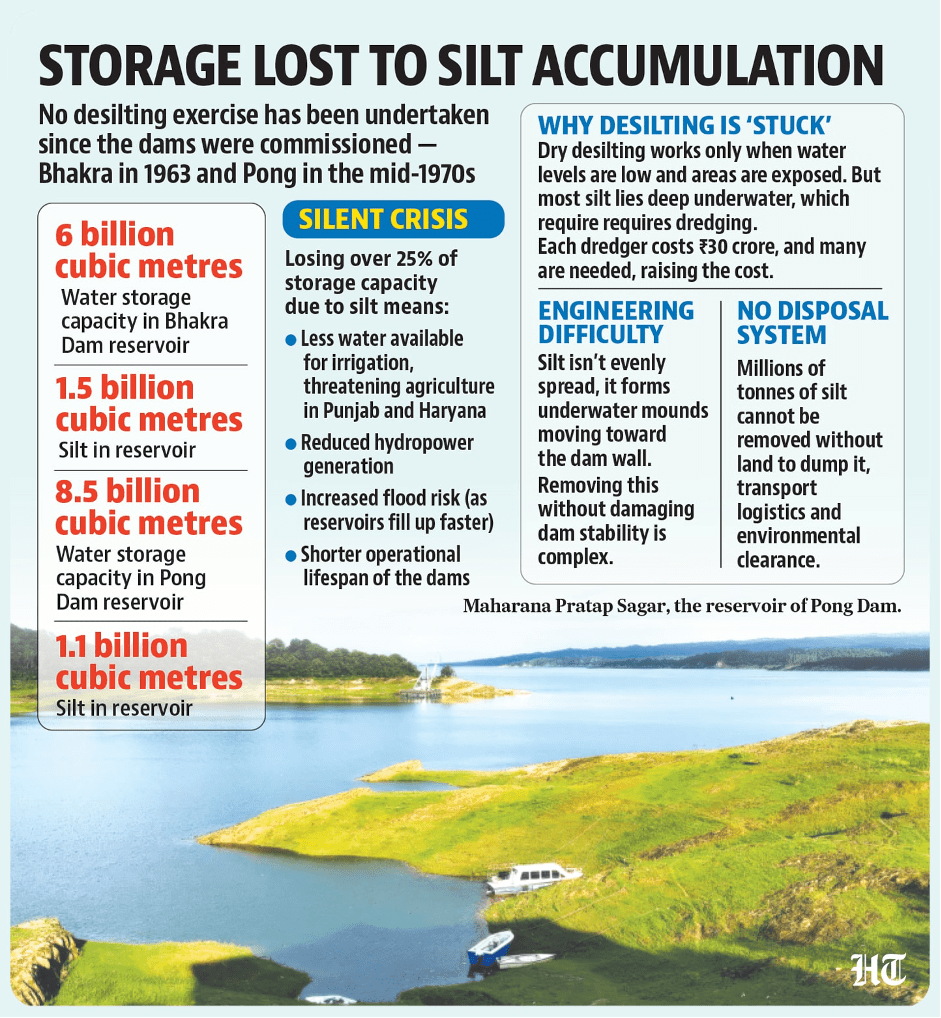
Officials admit that a major bottleneck is the absence of a national policy on reservoir desilting. Another critical issue is disposal of excavated silt, which requires vast tracts of land and a viable system for transport and reuse.
Decisions of MoEF’s Expert Appraisal Committee meeting on River Valley Projects held on Apr 13 2026
1. Ghatghar Open Loop Pumped Storage Project Stage II (125 MW) in 329.846 (320.066 Ha exisiting and 9.78 Ha additional) at Chondhe Bk., and Ghatghar, Sub-District Shahapur & Akola, Dist Thane & Ahmadnagar, Mah by Mah State Power Generation Company Ltd – Terms of Reference: Deferred: the project is located within the Kalsubai Harishchandragad Wildlife Sanctuary, an ecologically sensitive and legally protected area in Western Ghats. PP asked to get necessary permission.
2. Humbarli Birmani Open Loop Pumped Storage Project (6x250MW) in 334.82 ha at Biramani, and Hatlot, Sub-Dist Khed & Mahabaleshwar, Dist Ratnagiri & Satara, Mah by THDC India Limited – Terms of Reference: Deferred: the project boundary is located at a distance of about 8.82 km from the core zone of Koyna Wildlife Sanctuary within the Sahyadri Tiger Reserve, while the buffer zone lies approximately 3.30 km from the lower reservoir. It was further observed that the upper dam/reservoir and intake components fall within the Mahabaleshwar Panchgani Eco Sensitive Zone. Asked to get necessary permissons.
3. Chentikheda Major Irrigation Project (15,300 ha CCA) in 1369.35 ha at Aroda, Pachnia, and Garhi etc., Sub-Dist Vijaypur & Sabalgarh, Dist Sheopur & Morena, Madhya Pradesh – Environmental Clearance: APPROVED
Relevant Agenda of MoEF’s Forest Advisory Committee meeting to be held on May 8 2026
1. Diversion of 869.35 ha forest land for Kalai II HEP in Arunachal Pradesh.
2. Diversion of 261.53 ha forest land for Attulni HEP in Arunachal Pradesh.
3. Diversion of 160.78 ha forest land for Shirawta Off Stream Open Loop Pumped Storage Project (1800 MW)
4. Diversion of 233 ha. forest land (197.0272 Ha Reserved Forest, 26.066 Ha Private Forest and 9.9068 Ha Protected Forest) for Saidongar-I Karjat Off-Stream Open Loop Pumped Storage Project (3000 MW) at Pali, Tal. Kotal Khalati, Saidongar & Dhak Village, Karjat Taluka, Raigad District in Mah in favour of M/s Torrent PSP 3 Pvt Ltd
LOCAL WATER OPTIONS
Farmers petition Guj HC for protecting pond in Botad District A Public Interest Litigation (PIL) has been filed by 41 Gujarat farmers to save a decades-old village pond they claim is essential for their survival. The PIL heard by the division bench challenges a recent government decision to dismantle an earthen bund that sustains a water body in Nagalpar village. The farmers allege that the removal of this bund will effectively dry up the pond, which has served as a critical irrigation resource since 1970. The pond has also been integrated into the Saurashtra Narmada Avataran Irrigation (SAUNI) Yojana.
The high court directed the Nagalpar Gram Panchayat to be officially impleaded in the case. Furthermore, the court has ordered the state government to provide a written explanation by May 6, 2026, justifying the removal of the bund of the pond.
AGRICULTURE
Fossil Delusion and Just Transition Opportunity The farmer pays at both ends – first for expensive inputs, then through income that does not keep pace. Redirecting fertiliser subsidies toward natural farming, on‑farm composting and decentralised renewable energy for irrigation can reduce fossil input dependence significantly while improving soil health and farmer incomes. (Dr Vishvaja Sambath)
URBAN WATER OPTIONS
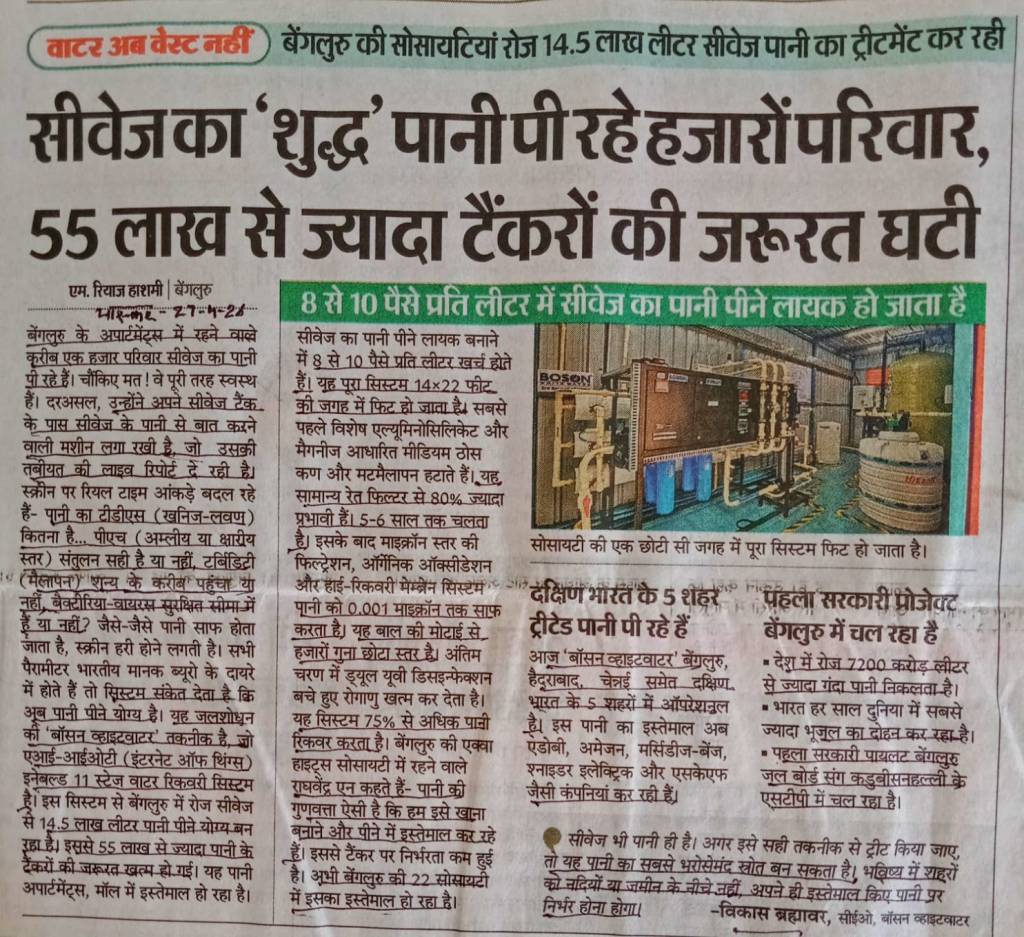
Treated Sewage used for drinking water in 5 South cities including Bangalore According to this report, thousands of families in Bangalore are drinking treated sewage water, not a sign of water problem, but a hope that treated sewage can be of quality that can be used for all purposes. Such communities exist in Chennai and Hyderabad too, besides in two more cities.
RWH helps apartment in Hyderabad While Hyderabad bakes under a brutal water crisis, MNK Vittal Central Court Apartment in Bhoiguda, Secunderabad, remains an oasis. With 27 rainwater harvesting pits and two injection borewells, its 350‑plus residents keep groundwater steady at 250 feet.
INDUSTRIAL WATER SUPPLY
The Resource Arithmetic of Data Centre in India India’s data centre capacity reached 1.5 gigawatts by the end of 2025. Deloitte projects 8 to 10 gigawatts by 2030, a six-fold expansion in four years. The Union Budget 2026 extended a tax holiday until 2047 for foreign companies building data centres in India. At the February 2026 AI Impact Summit, Prime Minister Modi stated that India would invite the world’s data to reside here. Nearly 75 per cent of India’s data centres are already located in water-stressed regions.
Karnataka’s IT Minister Priyank Kharge told the state assembly in March 2026 that each megawatt of data centre capacity requires 25 million litres of water per year. Applied to India’s current 1.5 gigawatt operational capacity that implies 37.5 billion litres annually from data centres alone, before the planned six-fold expansion. A September 2025 Morgan Stanley report projects global AI data centre water consumption reaching 1,068 billion litres annually by 2028, an eleven-fold increase from 2024 levels, with the range running from 637 billion to 1,485 billion litres depending on cooling technology and regional energy mix.
Karnataka’s Data Centre Policy 2022 commits the government to facilitating uninterrupted water supply to data centre entities across the state without specifying what happens when that commitment competes with residential water security during a drought year. No state data centre policy among the 15 currently in force contains mandatory water stress mapping as an environmental clearance condition. The Union Ministry of Environment, Forests and Climate Change does not require thermal impact assessment for data centre approvals. Because data centres are classified as IT or ITeS entities rather than large infrastructure projects, they do not go through the standard environmental impact assessment process.
RAINFALL
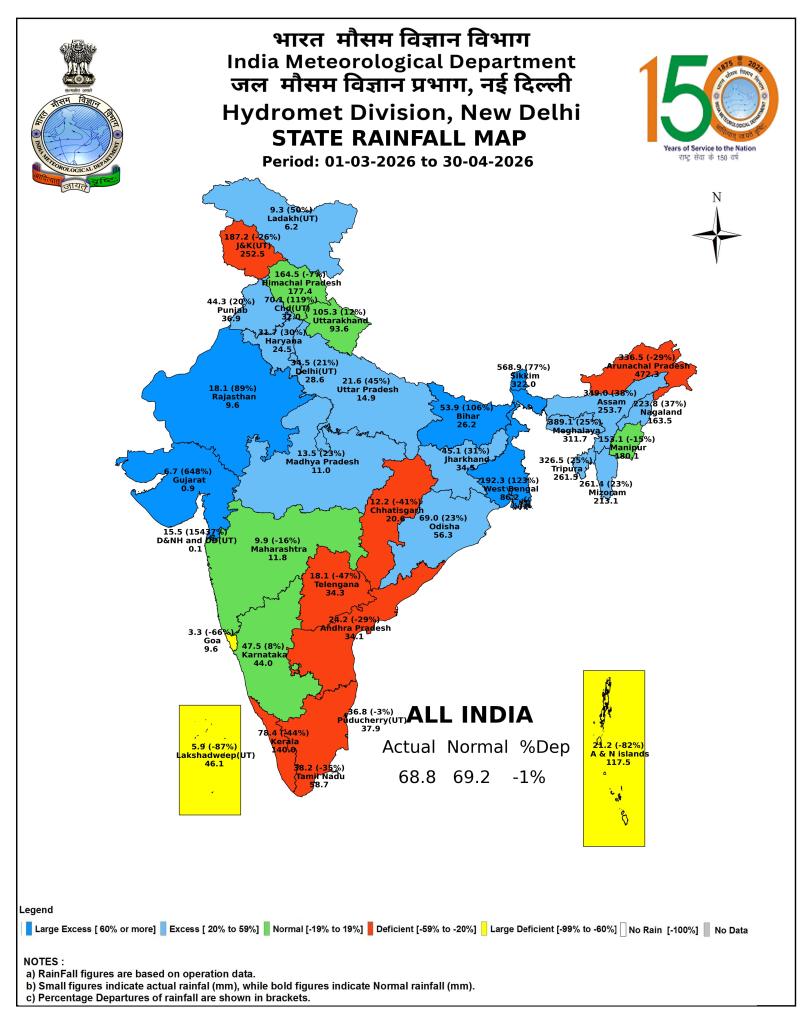
As can be seen from the IMD map below for the state wise rainfall for the two month pre-monsoon period from March 1 to April 30 2026, India received 68.8 mm rainfall, 0.58 % below normal rainfall of 69.2 mm.
INTER LINKING OF RIVERS
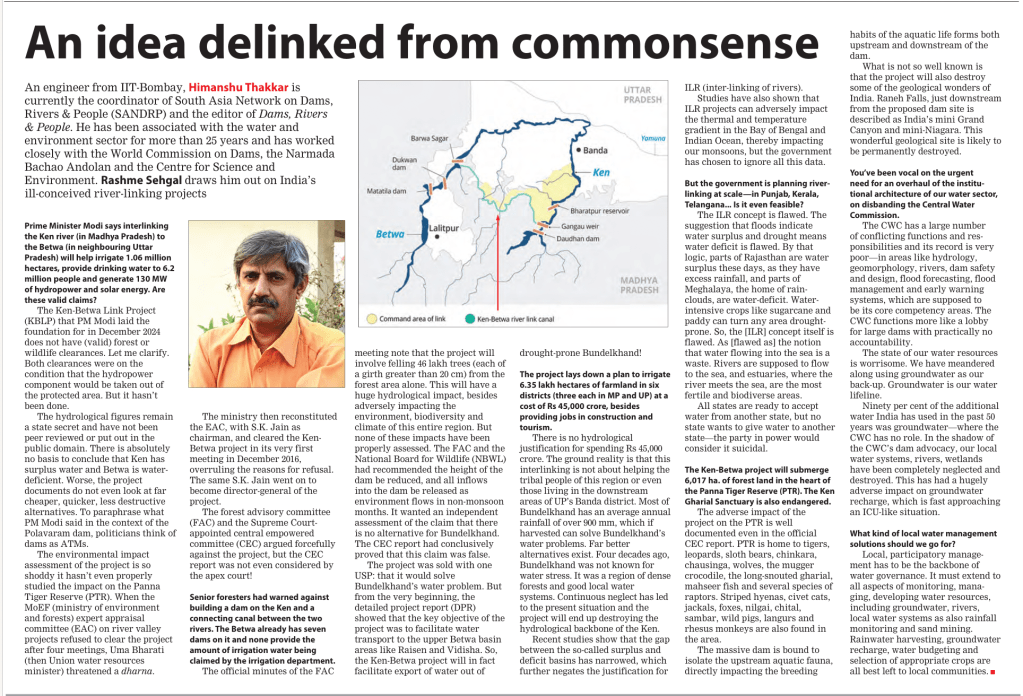
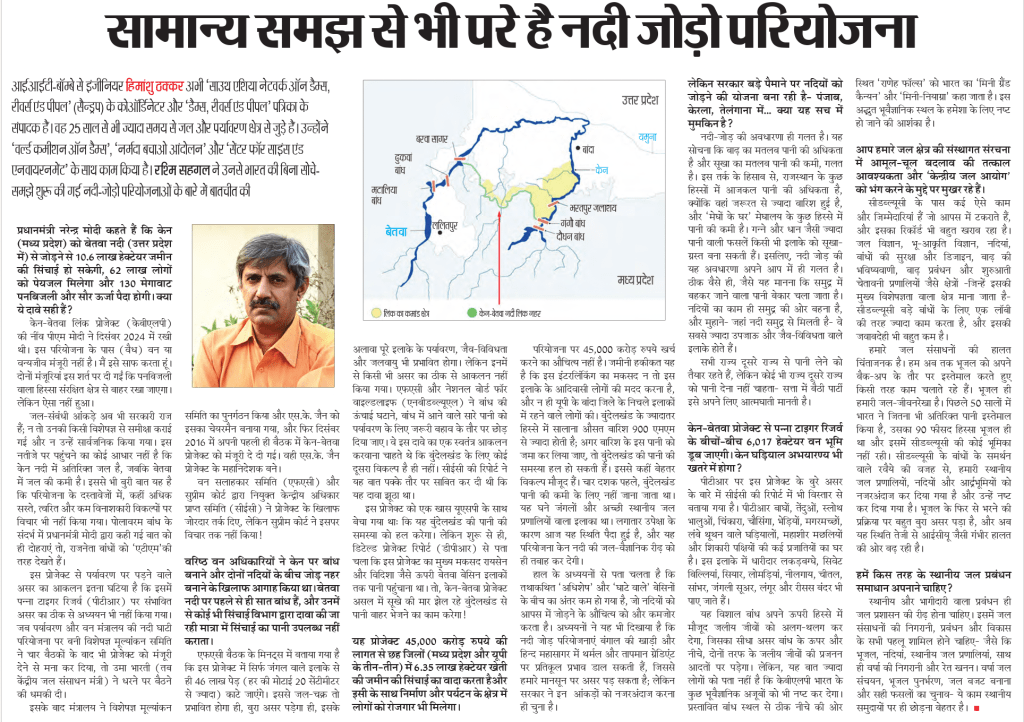
Interview of SANDRP Coordinator published in National Herald and Sunday Navjivan (Hindi). In editing some mistakes have crept in. For example, it says Mr S K Jain went on to become Director General (DG) of Ken Betwa Project, which is not correct, he went on to become DG of National Water Development Agency, the developer of Ken Betwa Project.
REST OF ASIA
Cambodia: How China’s upstream dams are flooding & destroying downstream forests A large flooded forest, which covers much of the Stung Treng Ramsar Site (STRS, Covering 14,600-ha along a 37-km stretch of the Mekong, STRS was designated as a Ramsar Site in 1999.), is a unique riparian ecosystem in north-eastern Cambodia. Since 2008, upstream hydropower development in China and Laos has substantially reshaped the dry‑season hydrology, raising minimum river levels by more than one meter during much of the dry season, and essentially erasing a period of low‑flow that the forest requires to survive. This report shows: (1) dry‑season discharge at Pakse (the nearest Mekong mainstream gauge upstream of STRS) now remains above the pre‑2008 mean throughout January-May (core months of the dry season), with a series of weeks exceeding 150% of the historical mean and other weeks exceeding 200%; (2) cumulative dry‑season releases from major dams in China and Laos are the cause of high levels during the dry season; and (3) remote sensing analysis shows an 18% (500 hectare) decline in the flooded forest extent across whole of STRS between 2018 and 2026, with some hotspots experiencing 35-59% loss. Critically, no routine operational data are publicly available for the largest and most hydrologically influential dams in China.
To address data gaps, this study calls on the Mekong Dam Monitor data archive, which is derived from remote sensing techniques that estimate reservoir operations at large dams. Using Sentinel‑1 radar imagery, which allows surface water detection regardless of cloud cover, reservoir surface area and storage changes can be estimated with a high degree of precision. These estimates are used to construct reservoir operating curves that approximate how dams store water during the wet season and release it during the dry season. These methods build on published peer-reviewed approaches. Baseline comparisons rely on mean discharge data from 1923-2007, representing the pre‑dam period prior to the filling of Xiaowan dam in 2008 — the year during which large upstream dams began exerting a discernible influence on seasonal flow patterns. (This report is generously supported by the BRIDGE (Building River Dialogue and Governance) Project)
THE WORLD
Global hydropower generation 4,437TWh in 2025; share in electricity falls Hydropower output reached record 4,437 terawatt-hours (TWh) in 2025, whilst its share of global electricity generation fell to 14%, the lowest level on record. China recorded the largest increase in hydropower generation in 2025, adding 45 TWh, supported by above-average rainfall from 2024 into 2025. It also remained the world’s largest hydropower generator in 2025 at 1,399 TWh, with hydropower accounting for 13% of its electricity generation.
Despite hydropower capacity growing by 43% since 2010 and generation rising by 29%, capacity factors declined in major markets, including China, where they fell to 34% in 2023 before reaching 36% in 2025.
SANDRP


