Guest Article by Nirmala Gowda
Under the National Water Mission, the Government of Karnataka conducted a consultation workshop on 24 March 2026 on “Climate Change Adaptation and Mitigation Strategies for the Water Sector in Karnataka.” Mapping Malnad attended the session and subsequently, along with SAPACC (South Asian People’s Action on Climate Crisis), submitted written comments on the presentation. This is a summary of our submission.
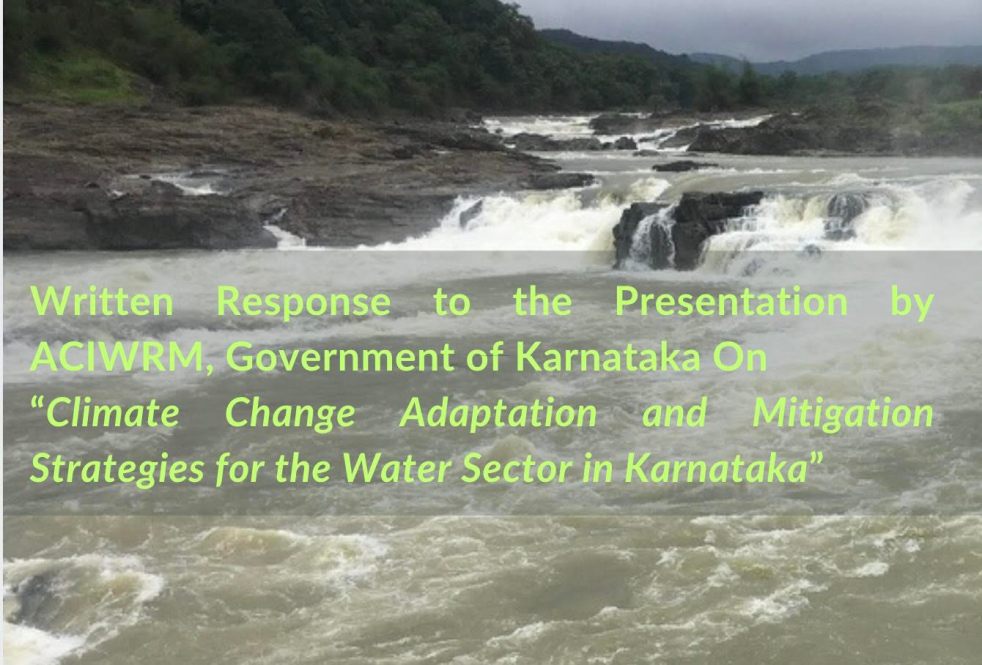
(The background image in the feature photo above is Pandri river, tributary of Kali river, Upstream of Supa Dam in Uttara Kannada District. Photo taken by the author.)
Our response raises concerns regarding both the consultation process and the substantive direction of the draft climate strategy. Climate adaptation planning in the water sector must be participatory and decentralised, following the example of Porto Alegre’s globally recognised participatory budgeting model. At a minimum, consultations should be conducted district-wise and taluk-wise under Deputy Commissioners, involving citizens, communities, farmers, industries, gram panchayats, urban local bodies, district health officials, pollution control authorities, water resource officials, researchers, environmental groups, industries and elected representatives including MLAs and MPs.
We find that the presentation is dressing up conventional, ecologically destructive, supply-side water projects—such as the Yettinahole Project, the Mekedatu Dam-Power Project, and hundreds of unscientific tank-filling schemes—as “climate adaptation.” This runs contrary to the direction recommended by key water policy documents in Karnataka and India, including the Karnataka Jnana Aayoga Task Force’s Karnataka State Water Policy (2019) and the Draft National Water Policy (2020) prepared by the Mihir Shah Committee. Both call for moving away from endless supply-side expansion towards demand management.
The proposed 67.16 TMC Mekedatu Dam-Power project, along with its 400 MW powerhouse infrastructure, would submerge approximately 12,056 acres of the Cauvery Wildlife Sanctuary. This sanctuary supports extraordinary biodiversity, making it one of southern India’s most ecologically significant forest-riverine eco-systems. There is little doubt that the Mekedatu project will push numerous species toward extinction.
Climate change adaptation and mitigation frameworks widely acknowledge the ongoing sixth mass extinction and explicitly call for biodiversity conservation. Consequently, climate strategies within the water sector cannot be pursued in direct conflict with the biodiversity sector. To present the large-scale ecological destruction of the Mekedatu Dam-Power project as climate adaptation is not only illogical but demands far greater scrutiny than it has received.
We urge the government to reduce Bengaluru’s non-revenue water, improve urban water-use efficiency, consider groundwater replenishment models adopted by California’s Orange County, and desilt existing reservoirs. These measures may offer far more immediate and cost-effective adaptation benefits than constructing new dams in wildlife sanctuaries in violation of Section 29 of the Wild Life Protection Act.
Climate-friendly, people-friendly, and wildlife-friendly alternatives exist for augmenting Bengaluru’s water supply. Similarly, peaceful approaches exist for managing water-sharing issues with Tamil Nadu—approaches where large dams and power projects do not take centre stage.
In terms of groundwater crisis, the government needs to address and contain the expansion of the Ethanol Blending Programme (EBP)-induced sugarcane and paddy expansion, which is rapidly escalating water stress in already stressed regions such as the Malaprabha and Cauvery basins. Sugarcane cultivation in Mandya district—which lies entirely within the Cauvery basin—has more than doubled between 2017 and 2023, further depleting the mighty Cauvery, which today is no longer a perennial river.
In Belagavi district, EBP-induced sugarcane expansion has more than doubled between 2017 and 2023 like Mandya, depleting the Malaprabha basin and making sugarcane farmers thirsty and even more aggressive for Mahadayi water via the Kalasa and Bandura project. In line with UNFCCC climate adaptation principles, the transition towards drought-resilient agriculture—as mentioned in the presentation—must therefore be undertaken urgently. The groundwater crisis, which is now permanent, cannot be addressed by V-wires recharge technology unless structural policy drivers like the EBP are contained.
We further highlight that the government’s Cauvery streamflow projections run contrary to the latest science. While government projections show an increase in streamflow of the Cauvery, the peer-reviewed IIT Gandhinagar study—which uses the CMIP6 climate models that underpin the IPCC AR6—indicates a near-term decline of approximately 3.5% in mean annual flows (2026–2050). Planning must consider the best available science.
We also highlight the omission of the massive water pollution crisis, which reduces the very freshwater base that adaptation strategies depend upon. Additionally, we raise the issue of the privatisation of public water sources—to companies such as soft drink companies, bottled water companies, and others. These water resources are constitutionally expected to be held in the public trust, and their commercialisation under conditions of climate stress must be explicitly considered.
Climate resilience, to start with, requires an honest accounting of hydrological realities at the basin scale. The current draft falls short on that. We therefore urge the Government of Karnataka to undertake an institutionalised participatory consultation process befitting a democracy, on the basis of which Karnataka’s climate adaptation and mitigation plan can be built.
You can find our full submission here.
Nirmala Gowda (Mappingmalnad@gmail.com)
Note: Such planning under the National Water Mission is happening across different states. Please write to us with your experiences at: Mappingmalnad@gmail.com and on the blog site in comment mode.
About the author: Nirmala Gowda is an activist-researcher working on water, river, and pollution issues for over a decade. She is the founder and editor of Mapping Malnad and previously co-founded & curated Paani.Earth. Her work spans legal advocacy, grassroots collaborations, and independent research on rivers, forests, and mountains of the Western Ghats in Karnataka.


