Dams · Floods

Overview of CWC’s Flood Forecasting Sites 2018: North East India

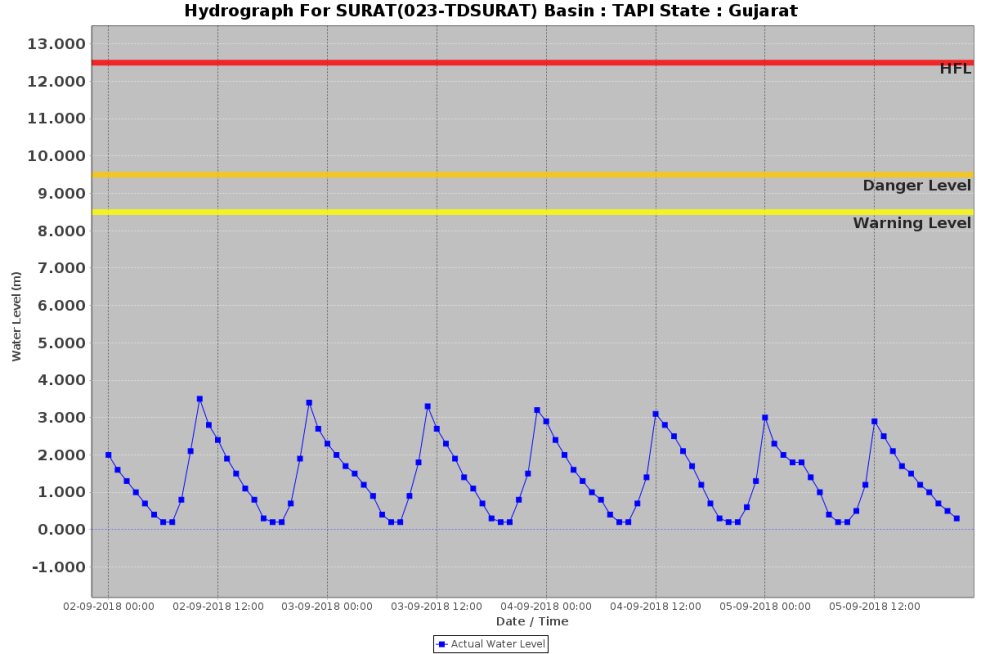
Central Water Commission (CWC) measures and monitors water level at 700 hundred Flood Forecasting site in the country. It publishes this information on its Flood Forecast website[I]. The website has three ways to get this information: Data Flow Map, List Based Exploration, and Hydrograph view. The Hydrograph view provides information for past 72 hours, supposed to be updated every hour. This is in addition to the list of current forecasts.

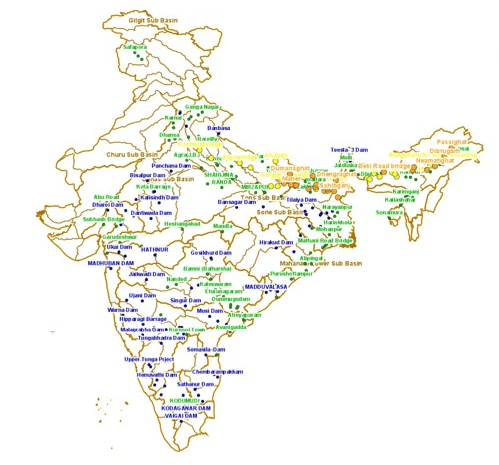
As per the website the Data Flow Map has information about 226 Flood Forecast Sites in the country comprising of 166 Level Forecast Sites and 60 Inflow Forecast Sites. It also monitors 700 Flood sites, information made available through List Based Exploration and Hydrograph View.

In order to better understanding the CWC’s flood monitoring and forecasting work, in this article we have given state wise list of CWC’s Level Forecast, Inflow Forecast and level monitoring sites in North East India. For better understanding, we have also included part of West Bengal that is in Brahmaputra basin here, in addition to the 8 North Eastern states. Similar report has been published for North India[II] and we hope to publish reports covering other regions of India too.

Continue reading “Overview of CWC’s Flood Forecasting Sites 2018: North East India”

Dams · Yamuna River

Floods & Flood Monitoring in Yamuna: July 2018

The release of around 1.31 lakh cusecs of water in Yamuna from Hathnikund barrage at 09:00 hours on July 26, 2018, was certainly first surge of flood this monsoon in the river. But no one expected, most are still in the dark that the release would multiply by over five times in just two days! It is almost a month after the Southwest monsoon arrived. By this time the river usually floods couples of times.

Looking at the lack of significant rainfall in the catchment area over past weeks, the flood is unexpected and has taken many by surprise. The Irrigation and Flood Control Department, Delhi Government has issued warning for flood plain farmers and human settlements close to river banks, but the warning does not seem to commensurate with the flood peak that is likely to hit the capital in next day or two.

23 Yamuna Flood Chart 1963-2016
Bar chart by Irrigation & Flood Control Dept, Delhi showing history of floods in Yamuna river since 1963.

Yamuna has already crossed warning (204 m) and danger level (204.83) at Old Delhi Railway Bridge (ORB), Delhi. The High Flood Level is 207.49 meters, reached on Sept 6,1978 after around 7 lakh cusecs (cubic feet per second) water was released in Yamuna on 3rd Sept 1978 at 04:00 hrs from Tajewala barrage, that was decommissioned and replaced by Hathnikund barrage in early 1990s. The flood monitoring of River Yamuna began in 1963.

Since then, the river has seen high floods in 1988, 1995, 2010 and 2013. The 2010 and 2013 floods also crossed 207 metres mark but fell short of 1978 level.

Continue reading “Floods & Flood Monitoring in Yamuna: July 2018”

Dams · Dams, Rivers & People

How India Measures Water Storages

Govt and media typically report the status of water storage in India using the CWC’s Weekly Reservoir Storage Bulletin, which contain information about just 91 reservoirs in India. In this article we show that the state websites provide information about huge 3863 reservoirs, which even if not sufficient, is a huge improvement over just 91 reservoirs that CWC bulletin includes. We hope all concerned will try to improve the reservoir storage reporting.

It should be added here that this measures only surface water stored in some of the large reservoirs of India. This excludes large number of big reservoirs, lakhs of smaller reservoirs, groundwater aquifers and soil moisture storage. In spite of these limitations, this provides more accurate picture than just the 91 reservoirs of CWC that everyone in India, including media, govt monitoring and policy makers look at.

Continue reading “How India Measures Water Storages”

Dams · DRP News Bulletin

DRP: 11 June 2018 (Groundwater Pollution: The Hidden Killer Menace Lurking All Over)

Aquifers in 16 States in the country are contaminated by uranium, whose presence in drinking water has been linked to chronic kidney disease by several studies, a recent study has shown. More importantly, uranium doesn’t figure on the list of contaminants monitored under the Bureau of Indian Standards’ drinking water specifications. The main source of this contamination is natural, but groundwater depletion by extensive withdrawal of water for irrigation and nitrite pollution due to the excessive use of nitrogenous fertilisers may be exacerbating the problem, said the study.

– The study was carried out by a team of researchers led by Avner Vengosh, professor of geochemistry and water quality at the Nicholas School of the Environment at Duke University in the US. The team, which also included experts from the Central Ground Water Board, the Rajasthan government’s Ground Water Department and Gujarat Water Resources Development Corporation, analysed groundwater samples from 226 locations in Rajasthan and 98 in Gujarat.

Continue reading “DRP: 11 June 2018 (Groundwater Pollution: The Hidden Killer Menace Lurking All Over)”
Dams

India Rivers Studies 2017: Rivers Succumbing To Dams, Pollution & Climate Change

After reviewing status of India rivers, SANDRP presents an account of research, studies and important reports on erratic monsoon, climate change, floods which all are severely affecting the rivers, their aquatic life and livelihood of dependent communities.

Rivers and Monsoon

Number of rainy days falling across river basins in India The study has found that number of rainy days is falling across river basins in India and rainfall intensities are seen to be increasing. The analysis determined changes in heavy precipitation and peak flood for seven river basins in India—Krishna, Godavari, Mahanadi, Narmada, Cauvery, Sabarmati and Brahamani and Baitarani. For the study, data pertaining to daily flows for about 30 odd years and precipitation for 61 years (from 1951 to 2012) were analysed.

The analysis also said the rivers which flow from west to east direction (in India) have more rainy days compared to those which flow towards the west. The study also held that anthropogenic activities (construction of storage reservoirs, diversions, urbanization, land-use change, and soil and water conservation measures, among others) have probably affected the generation of peak floods in the rivers of India. http://www.livemint.com/Politics/c7v8oXmsMDHIldjDv9k6lK/Number-of-rainy-days-falling-across-river-basins-in-India-s.html (Live Mint, 27 April 2017)

Continue reading “India Rivers Studies 2017: Rivers Succumbing To Dams, Pollution & Climate Change”

Dams

North East India Rivers Review 2017: Agenda behind Brahmaputra & Barak Fesitvals won’t Help the Rivers

This eighth Rivers Review 2017 report presents account of key rivers related developments in North Eastern states comprising Assam, Arunachal Pradesh, Manipur and Meghalaya. 

Rivers As National Waterways Rivers of North-East to be tamed for transportation Pursuing its agenda of inland waterway transportation, the Inland Waterways Authority has reportedly organized a road show and a seminar in Guwahati to resolve major issues linked with developing the rivers as viable and sustainable means for cargo and passenger transportation.

Continue reading “North East India Rivers Review 2017: Agenda behind Brahmaputra & Barak Fesitvals won’t Help the Rivers”

Dams · DRP News Bulletin

DRP: 5 Mar 2018 (Will India Face An Unprecedented Water Crisis This Summer?)

Residents of Muruga Tholuvu Harijan Colony in Chennimalai Union have urged the district administration to take steps to provide them water on a regular basis. In a petition, they said that villagers have to go in search of water from other areas and transport it in bicycles regularly. They said that most of the people were labourers and their livelihood is lost when they go in search for water. They said that the situation is worse during summer season, as water is not available at nearby areas and they are unable to purchase water from the market too. http://www.thehindu.com/news/states/provide-drinking-water-villagers/article22935093.ece (The Hindu, 5 March 2018)

With the beginning of summer season, there are several news reports describing the growing water crisis in different parts of country. Here are details of various Indian states suffering from  water scarcity for industrial, irrigational and even for drinking purposes which given the due summer months could develop into grim scenario. These stories also show how the mismanagement of dam storages, exploitation of ground water resources and pollution of rivers have significant role in aggravating the situation.

Gujarat The state is staring at a water crisis this summer, with low water levels in the Narmada dam and almost all other major dams. On March 3, the CM Vijay Rupani has held a meeting with senior minister and bureaucrats to take stock of the water situation in the state and discussed ways to ensure drinking water availability. The government also has decided to allocate Rs 200 crore in special grants for augmentation of local water sources and instructed all collectors to form district committees, have weekly review meetings and start supply of water by tankers wherever required.

Continue reading “DRP: 5 Mar 2018 (Will India Face An Unprecedented Water Crisis This Summer?)”
Dams · DRP News Bulletin

DRP: 4 Dec 2017 (Protests Against Pancheshwar Dam in Champawat, Pithoragarh, Almora, Delhi)

Protests and controversies around Pancheshwar Multipurpose Project (PMP) are only growing louder and wider. While Expert Appraisal Committee (EAC) Rivers Valley Project in unnecessary hurry considering the project tomorrow (05 Dec. 2017)  http://environmentclearance.nic.in/writereaddata/Form-1A/Agenda/2811201745T4GD5I10thAgendaEACHydro05122017.pdf

Villagers and local groups people also continue raising their concerns and objections against 5040 Mw dam project. Today, scores of villagers, environmental groups including regional political party have protested at Jhulaghat in Champawat, Pithoragarh, Almora and in Delhi demanding EAC to listen to the voices of local people and groups.

Continue reading “DRP: 4 Dec 2017 (Protests Against Pancheshwar Dam in Champawat, Pithoragarh, Almora, Delhi)”
Dams

DAM BUILDING MUST BE HALTED FOR A SAFE AND SECURE WORLD

Guest Blog by Manoj Misra

Rivers in different parts of the world have been dammed to fulfill human needs like water for irrigation, industries and domestic supplies. Then there are dams that have been raised to control floods or to produce electricity.

These have often been celebrated as human victory over nature, glorified as engineering marvel and claimed variously as highest, longest etc as a matter of national pride.

But rarely has there been a holistic assessment or appreciation of what a dam does to the natural entity called river and its adverse impacts on all the associated life forms, including humans.

Continue reading “DAM BUILDING MUST BE HALTED FOR A SAFE AND SECURE WORLD”

Dams · DRP News Bulletin

DRP: 2 October 2017 (New Rules Disastrous For India’s Wetlands)

The wetlands are the hotspots of biodiversity, act as carbon sinks, act as buffers against floods and are essential for groundwater recharge. With groundwater reservoirs in the country heavily exploited, this last function has assumed greater importance. http://www.hindustantimes.com/environment/centre-notifies-wetland-rules-environmentalists-unhappy/story-3MoGp9D8eSzHI90zfOXWSO.html

Wetlands can be defined as lands transitional between terrestrial and aquatic eco-systems where the water table is usually at or near the surface or the land is covered by shallow water.

But they are threatened by reclamation and degradation due to activities like drainage and landfill, pollution, hydrological alteration (water withdrawal and changes in inflow and outflow), over-exploitation resulting in loss of biodiversity and disruption in ecosystem services provided by them.

DRP 12

There are at least 115 wetlands that are officially identified by the central government and of those 26 are identified as wetlands of international importance under Ramsar Convention which is an international intergovernmental treaty for conservation of wetlands. India is a party to the treaty. http://www.livemint.com/Politics/y6Tr3tkrr3q28AmGKaBFII/Environment-ministry-notifies-new-wetland-rules.html

The Centre on September 26 notified a new set of rules under the head Wetlands (Conservation and Management) Rules, 2017 replacing the Wetlands (Conservation and Management) Rules, 2010. http://www.thehindu.com/news/national/kerala/new-wetland-conservation-rules-notified/article19779100.ece

It is worth to mention that under the 2010 rules, not a single water body was notified as a wetland over and above the ones already recognised as such by the Centre and the Ramsar Convention, defeating its purpose in a way. http://www.zeebiz.com/agencies/centre-notifies-new-rules-for-preservation-of-wetlands-26312

Similarly, despite country’s space agency ISRO had in 2011 mapped over two lakhs of wetlands across the country, the centre has, so far, notified only 115 wetlands and 63 lakes in 24 states and 2 UTs for conservation and management.

Continue reading “DRP: 2 October 2017 (New Rules Disastrous For India’s Wetlands)”