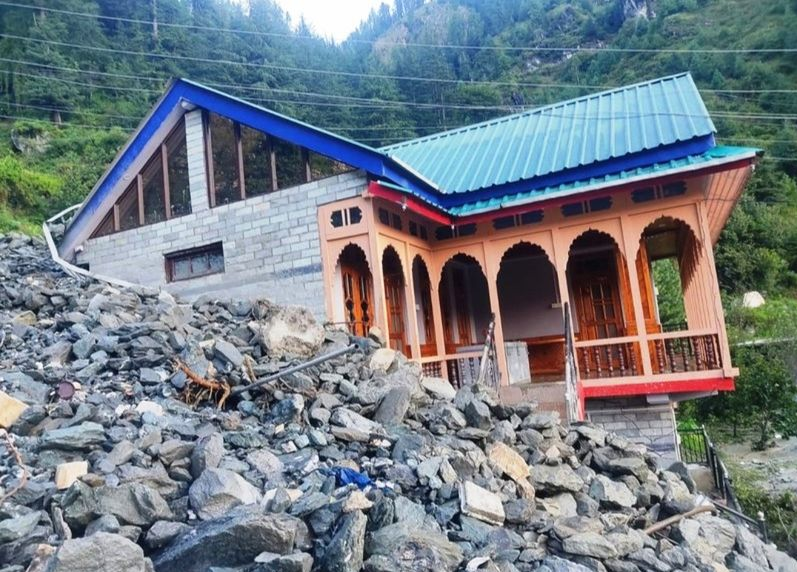
(Feature Image: A damaged house in Palchara village by debris flood after a leak in the Parbati II HEP tunnel on Sept. 19, 2026 in Sainj Valley. Source: The Tribune)
The Sept. 2026 tunnel leakage at NHPC’s Parbati-II HEP in Kullu’s Sainj Valley triggered a sudden flow of water, muck and debris towards Palchara village. Although there was no loss of life, the incident has damaged houses, agricultural land and local infrastructure. It occurred amid a series of leakage and seepage incidents reported in and around the project in recent years, raising renewed concerns over tunnel safety, muck dumping and slope stability in the project area.
Incident: The Parbati II Hydroelectric Project (HEP) in Kullu district, Himachal Pradesh has suffered another tunnel leakage incident on Sept. 19, 2026. The leakage reportedly began from ADIT-V of the project tunnel at around 7:00 pm and gradually turned into a flash flood affecting downstream village by around 9:45 pm.
Impact: The deluge passed through a project dumping site carrying a large amount of muck & debris towards Palchara village under Raila Panchayat before entering a nearby rivulet. Fortunately, villagers sensed the danger in time and moved to safer locations, preventing loss of life.
However, three houses were reportedly buried under the debris while two other houses, two shops and a homestay in Palchara were significantly damaged. Around 15 families have reportedly suffered losses. The flood also affected agricultural land, standing crops and local infrastructure. The debris blocked a road in Raila Panchayat, leaving apple consignments worth around ₹8 crore stranded.
Villagers were shocked by the sudden flood without any rainfall in the area. The affected residents have demanded early assessment of losses and adequate compensation. They have also sought safe locations for families whose houses have been damaged or are under risk.
Response: The officials from local administration and NHPC visited the site during the night hours of Sept. 19 and Sept. 20 to assess the situation. The administration said that the leakage had been stopped and machinery was deployed to remove the accumulated debris. SDM Banjar instructed the officials to monitor the affected area and address residents’ concerns on priority. The administration has begun assessing the damage and asked NHPC to compensate local residents for verified damage.
As per initial assessment, the sudden flood has damaged one house, three sheds and two temporary cafes in the Raila panchayat resulting in estimated financial losses of ₹1 cr to ₹ 1.5 cr, excluding agricultural and horticultural losses. The final damage assessment report is yet to be prepared and released. Pankaj Sharma, SDM Banjar stated that the extent of the damage and the causes of the incident were being investigated.
Reasons? So far, there is no official explanation on the exact cause behind the incident. The NHPC has also not issued a public statement regarding this incident. Media reports have cited different reasons ranging from failure of a pressure wall to a technical snag in in ADIT-5, an access tunnel to the project HRT.
Referring to SDM’s comments, this report stated that the incident occurred near ADIT- 5, a horizontal access tunnel, at RD 14,000 after a technical malfunction in an air-pressure valve connected to the HRT allowed water to escape.
As per this report, two turbines of the project had reportedly been out of operation and were repaired on Sept. 19. It mentioned that the wall of the valve house at ADIT-5 developed a leak after it could not withstand the pressure of water inside the tunnel. This report has linked the incident to a burst in the valve house wall following a massive influx of water into the tunnel. However, the administration has not established this as the definitive cause. As per the administration, the exact cause and sequence of events will become clear only after the investigation.
However, this report has given a different account about the incident. As per the report, the NHPC administration was carrying out a technical investigation into leakages from the hill behind the power house of the project following complaints by the villagers.
During the inspection, the main source of leak was identified and for further investigation, the water supply from the pressure shaft 2 was stopped to empty the affected area. During this period, power generation from turbines 3 and 4 was also temporarily suspended. The technical investigation found that welding had opened at some locations in the lower part of the powerhouse and water was leaking through grouting holes.
There are approximately 600 grouting holes in the lower part of the powerhouse. Leakage from several locations reportedly increased internal pressure causing water to emerge through the weep holes about 25 metres above the bottom.
This is the only report where Ranjeet Singh, GM of the project has shared some details about the incident. He attributed it to the simultaneous failure of multiple components while the generating units were operating at full load. He stated that the vacuum-breaking valve of the ADIT malfunctioned leading to water ingress. The water then changed its course and began flowing through the middle of the dumping site, taking much debris along with it.
He also stated that necessary precautions were taken during the project’s design and construction but certain issues become apparent only after a project becomes fully operational. Responding to questions about the recurrence of leakages, he said vulnerable components are strengthened during annual maintenance and other problems are addressed as they arise. He maintained that there was no threat to villages located close to the HRT. However, given repeated leakage incidents, concerns among residents about the safety of the project and nearby settlements have increased.
Action & Inquiry: According to the Banjar SDM, a 12-member inquiry committee has been formed on Sept. 21 to ascertain the cause of the incident, assess the damage in the affected area and recommend preventive measures. The committee is headed by the Tehsildar of Sainj. The administration has directed it to submit its report in 5 days.
The committee includes GMs of NHPC Parbati I &II HEPs, GM of HPPC, officials from the Jal Shakti and PWD, agriculture experts, the BDO Bhuntar and officials from the Forest and Mining Departments. The committee will examine the technical and administrative aspects. After strong objections from villagers, three new members including village heads of Raila 1, Raila 2 and Panchayati Raj were added into the committee.
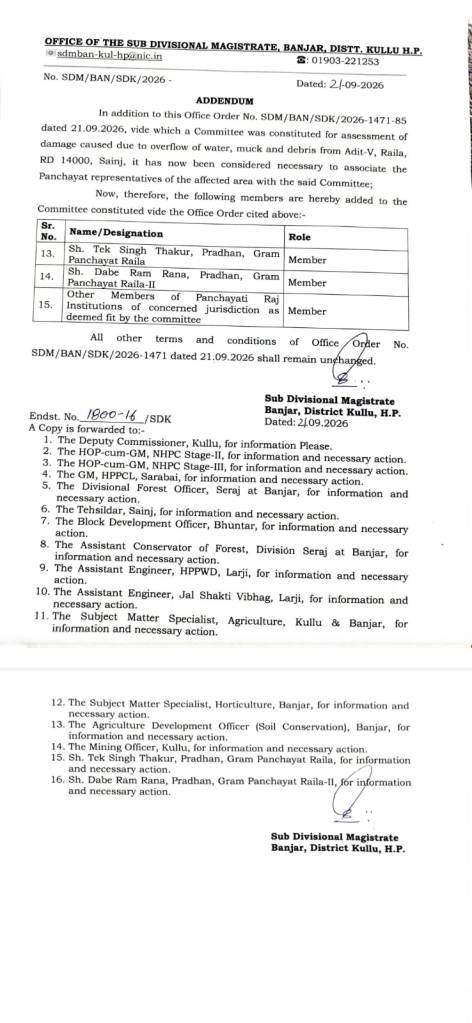
The administration has asked NHPC to submit a report on the reasons for the incident and whether prescribed SOPs were followed. The Banjar SDM will submit a detailed report to the Deputy Commissioner after the site inspection. Further action will be based on the findings.
The Directorate of Energy (DoE) has also sought a report from the project management and sent a departmental team to inspect the site. As per Shubh Karan Singh, Director, DoE, the department would recommend appropriate action to the government based on the NHPC report and its own inspection. Meanwhile, the police have registered an FIR against project management following a complaint by Parag Thakur, the Deputy Pradhan of Raila Panchayat.
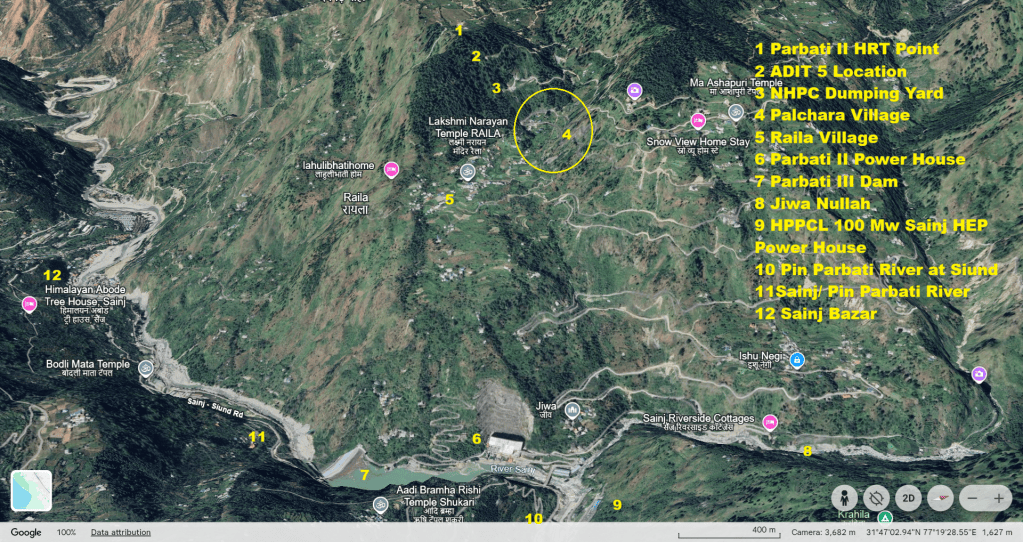
Concerns: The incident has raised concerns among residents of nearby villages. They fear another sudden leakage in the project tunnel could trigger a similar debris flood in the area. Raila panchayat president Tek Singh Thakur has alleged that NHPC’s negligence has created a persistent threat to the area. He said that the panchayat had previously submitted a Gram Sabha proposal seeking removal of the dangerous dumping site but the project management did not act on the proposal. Another local resident said the consequences could have been much more serious if the flood had taken a different route.
The incident has also brought the safety of the NHPC muck dumping site into focus. The leakages picked up debris stored at the project dumping site and transported it downhill. Thus, the movement of the debris increased the impact of the flood.
Villagers have demanded permanent protective measures to prevent debris from reaching residential areas. They have suggested a retaining wall or suitable concrete structure around the vulnerable part of the dumping site.
Threats: Himalaya Niti Abhiyan (HNA) a civil society group in Himachal Pradesh, has raised broader concerns about the geological and slope stability of the area. HNA coordinator Guman Singh said that the HRT emerges at Bhat Kandha village while the ADIT-5 and Palchara village are situated below it on sloping terrain with loose and fragile soil.
HNA has also alleged that the project has increased the vulnerability of Raila panchayat and adjoining settlements to landslides and ground instability. As per HNA, debris accumulated at the dumping site triggered a landslide that damaged two houses in the area during last year’s monsoon. It further claimed that cracks have appeared in several houses in villages under Raila panchayat including Shulga, Dahra, Rumbra, Khadoha, Bagidhar and Rakh Sukhal, since NHPC introduced water into the project tunnel last year.
HNA has further raised concerns about seepage from the mountain slope behind the project powerhouse at Siund. It said the slope had been strengthened with cement but several points had developed water seepage after water from the Parbati river began flowing through the tunnel system. HNA has demanded a technical and geological assessment of the tunnel, dumping site and vulnerable slopes along with measures to protect affected settlements.
Expressing similar concerns, Ramesh Dhami a local reporter has blamed NHPC for underplaying villagers’ concerns. He claims several house under Raila panchayat have developed cracks due to project tunnel work. “There is serious risk of a Joshimath like land subsidence and Nepal like cascading disaster as the hill slope behind the powerhouse has suffered several landslips. However, neither the NHPC management nor the administration has addressed the repeated complaints by the residents,” says Dhami. As per him, the tunnel leakage happened without any rainfall otherwise the incident would have be labelled as natural disaster.
Previous Incidents: The 800 MW project, operated by NHPC, has an 83.7 m high concrete gravity dam at Pulga. The dam diverts water from the Parbati river through a 32 km long HRT to an underground powerhouse at Siund along Sainj river in Beas basin. The project has a long history of tunnel leakage incidents and has suffered significantly due to flash flood and other disasters since the beginning.
August 2026: The continuous water leakage from hills behind the powerhouse on Aug. 12, raised safety concerns among the residents of Raila-2 village. On Aug. 17, the villagers submitted a memorandum to the DC, requesting a high-level technical and geological survey of the affected area. They said that the situation was serious and could endanger the lives of project workers and local people of Shulgae, Rumarae, Khadoa and Jiwa villages. The panchayat has also asked the district administration to prepare a concrete disaster management and safety plan for the area.
New leakage points were discovered there in the following days. While the management initially described the seepage as normal weep holes, concerned villagers demanded an independent investigation. Under mounting pressure, NHPC management on Aug. 23 decided to shut down pressure shaft-2 and stop production from turbines 3 and 4 for repairs. However, the leakage persisted. The situation worsened when pressure shaft-1 was also shut down resulting in a complete halt in power generation from the project.
Just a week before the tunnel leakage incident, the NHPC management said repair work behind the powerhouse had been completed and power generation would resume in a couple of days. The Sept. 11 report, Ranjeet Singh, GM, Parbati II HEP is quoted stating that the pressure shaft-1 was being checked as a precautionary measure and the management would repair if any other leakage points were detected.
June 2025: A flash flood in Sainj Valley inundated the powerhouse of the project with muck and debris, disabling power generation from all four units for at least three weeks.
Nov. 2023: A massive water leakage incident occurred in the drainage gallery of the project power house causing panic among project staff and local people. About two dozen workers reportedly fled the area to save their lives.
April 2022: The project tunnel work was stopped after a sudden ingress of slush and water at Shilagarh. Several workers were working in the tunnel when it was suddenly flooded. This was the second leakage incident in the tunnel within a week. Before this, water leakage was reported in the tunnel at Bhaiwal village around 200 m from the powerhouse causing damage to several houses. The ingress of a huge amount of slush into the tunnel had also damaged the tunnel boring machine in Nov. 2006.
May 2021: At least four workers had died following collapse of a diversion tunnel of the project. July 2020: A fire incident in the project power house had caused significant financial losses to NHPC. 2019: There were leakages from the project tunnel along with landslide incident causing threats to the Jiva villagers. April 2017: The project HRT suffered leakages for about a week which in turn resulted in soil erosion, crop damages and landslide threats to nearby villages.
Replying to a related question in Rajya Sabha, the Ministry of Jal Shakti on Feb. 05, 2024 had confirmed two water leakage incidents in project tunnel in April 2017 caused by cracks in pressure-shaft and in Nov. 2023 during operation of a machine in the left horizontal pressure shaft.
Conclusion: The Sept. 19 tunnel leakage disaster in Parbati II HEP raises wider questions about tunnel safety, muck dumping, slope stability and the vulnerability of settlements below Parbati II HEP infrastructure.
The available information raises serious concerns about possible negligence by NHPC management. It is also concerning that the administration has constituted an inquiry committee that includes NHPC officials. This raises questions about the committee’s credibility to determine the exact cause of the incident, examine NHPC’s role and responsibilities and establish the contribution of the project muck dumping site in increasing the damage.
Given the repeated tunnel leakage and seepage incidents over the years, the project indeed requires an independent technical and geological investigation by experts who are not associated with NHPC or the project. The investigation should examine the cumulative safety record of the project, the causes and consequences of earlier incidents, the adequacy of repairs and maintenance and the safety of downstream settlements.
This is particularly important in view of concerns raised over NHPC’s record of accountability and transparency in responding to project-related incidents and public concerns. The findings should be made public along with clear recommendations and a time-bound action plan to prevent recurrence in future.
As the Sainj Valley is increasingly turning into a disaster zone, the NHPC management and the state government can no longer afford to turn a blind eye to these growing risks.
SANDRP


