
A new UN report released on January 21, 2021 UN has warned the major big dam owning counties about the aging population of fast silting up dams in changing climate and urgent need to start working on decommissioning of uneconomical large dams. Among the few countries that UN has warned includes India with its third largest number of big dams. The added problem in India is the ill maintained and ill operated large dams that UN report did not look into. Indian dams are sanctioned based on highly under estimated siltation rates, there is practically no transparency and accountability in operation of Indian dams and dam almost every year get away with creating avoidable flood disasters. This latest problem is not just related to old dams, but even the newest celebrated ones like the Sardar Sarovar Dam as happened in Gujarat in late August-early Sept 2020. No legal regime exists in India for dam safety, either structural safety or operational safety. And in changing climate, with increasing frequency of higher intensity rainfall events, such risks are already increasing multi-fold.
Continue reading “DRP 250121: UN warns about aging Dams & Floods in changing climate”Tag: CWC
Why are we still building Large Dams?
Analysis of official information shows that Big dams are not longer necessary or viable or optimal in India. Most (over 95% of India’s 5701 large dams (5264 completed and 437 under construction as per CWC’s National Register of Large Dams[i]) are built for irrigation, but most of our irrigation now comes from groundwater. In fact, about 90% of additional irrigation in last four decades has come from groundwater.
Continue reading “Why are we still building Large Dams?”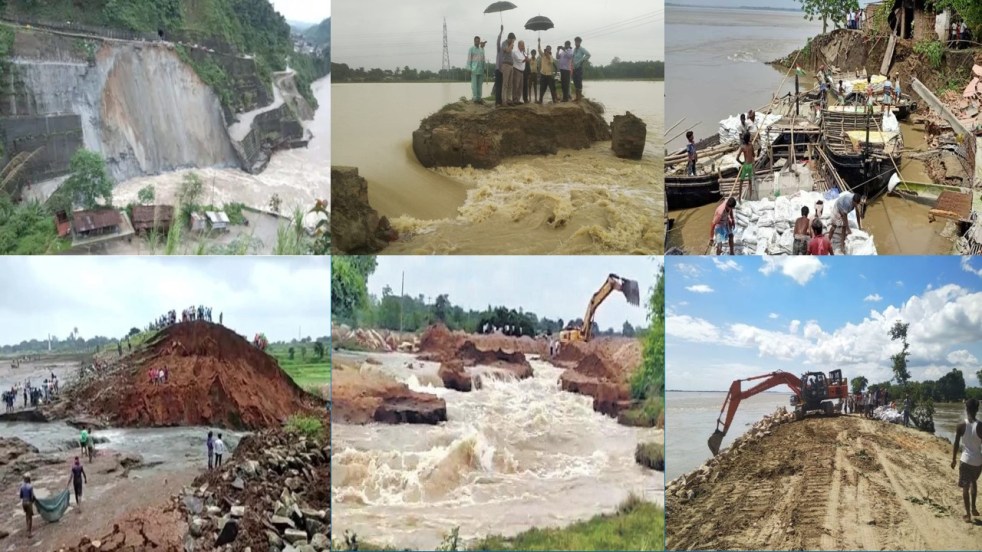
Dam Floods & Embankment Breaches in South West Monsoon 2020
Improper operations of dams, disasters related to dams and hydro projects and breaching of embankments have been aggravating flood disasters during every monsoon. There have been several such incidents during South West Monsoon 2020, taking heavy toll on people and property which could have been avoided or impacts reduced in many cases with proper dam operations and proper maintenance of the embankments. This compilation attempts to put together all such instances when avoidable flood disasters were created by improper operation of dams and breaching of embankments in the south west monsoon 2020.
Continue reading “Dam Floods & Embankment Breaches in South West Monsoon 2020”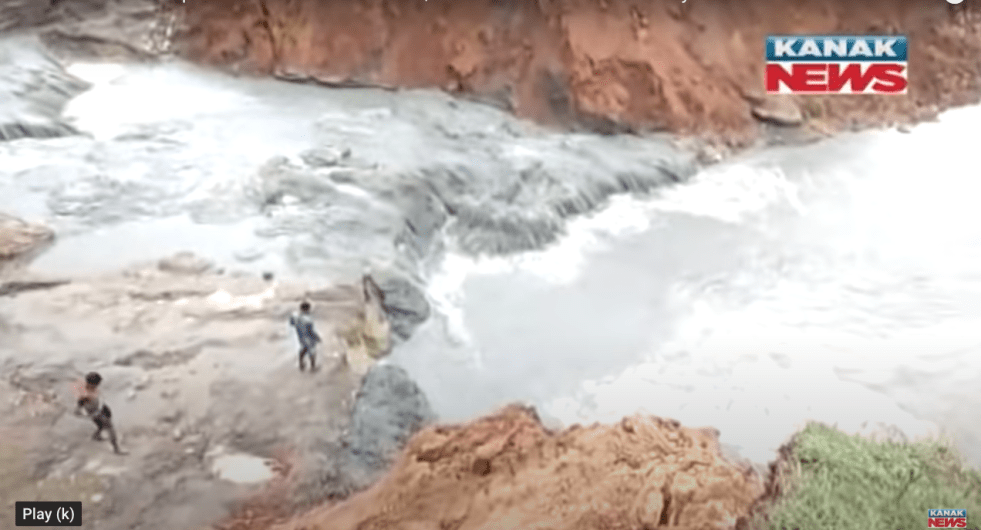
Khanda Dam Breach in Chhattisgarh in Sept 2020
The earthen Khanda dam in Korea district[i] in Chhattisgarh’s Mahanadi basin breached around 6.30 hrs on Wednesday, Sept 23, 2020. Local farmers alleged negligence by the Water Resources Department officials, who were informed about the dilapidated condition of the dam. The engineers even came and inspected, they said, and went away. They alleged that if they had reduced water storage and in stead opened the two canal gates, this situation may not have come.
Continue reading “Khanda Dam Breach in Chhattisgarh in Sept 2020”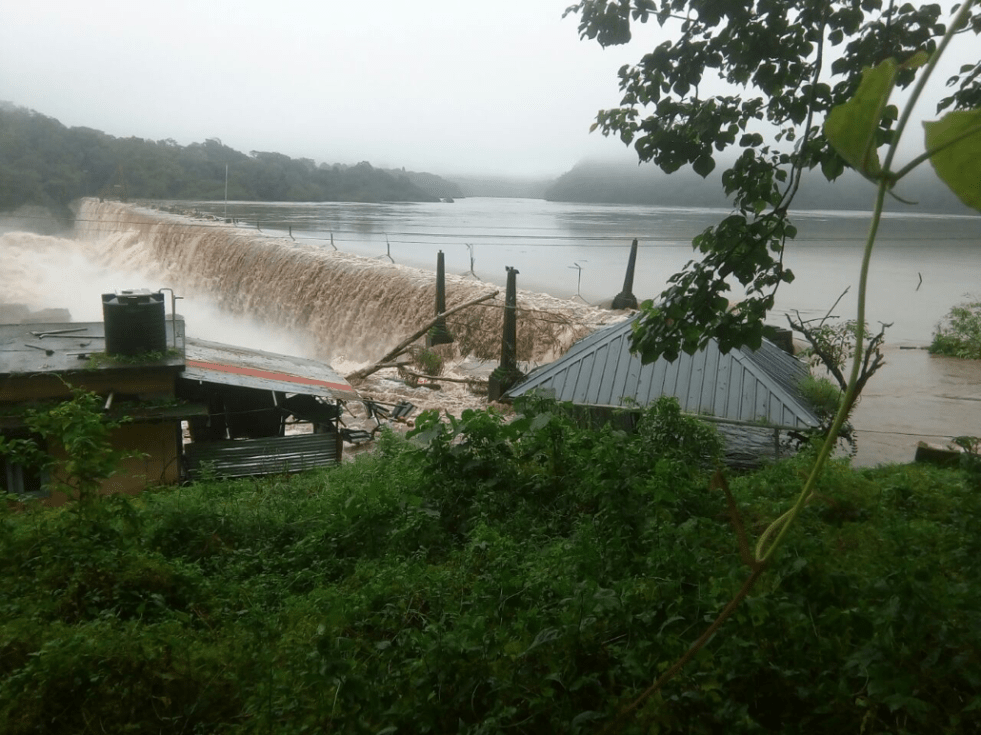
Role of dams in Kerala Floods 2018: The Debate
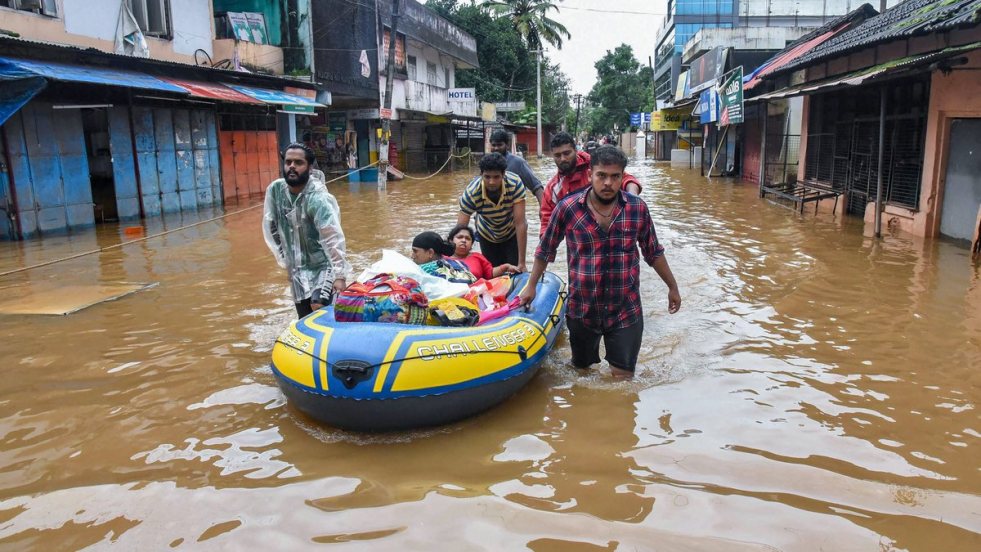
ROLE OF DAMS IN 2018 KERALA FLOODS: Rejoinder of J Harsha to the response by Sudheer et al
Rejoinder Article by: J.Harsha
An article titled “Role of dams on the floods of August 2018 in Periyar River Basin” was published by Sudheer et al. (2019) in Current Science. A rebuttal was prepared and thanks to South Asia Network of Dams, Rivers and People (SANDRP), the same was published by SANDRP on 25th August 2020 (https://sandrp.in/2020/08/25/role-of-dams-in-kerala-floods-distortion-of-science/) for which Sudheer et al. (2019) has now furnished a response (https://sandrp.in/2020/09/19/response-of-sudheer-et-al-to-the-comments-by-mr-j-harsha-on-the-article-role-of-dams-on-the-floods-of-aug-2018-in-periyar-river-basin-kerala/).
In the rebuttal published by SANDRP, I had questioned the very basis of fitting HEC-HMS model for Periyar River Basin (PRB) by Sudheer et al. (2019), and also challenged the assumptions made by them, the methodology followed and the consequent voluminous inferences such as catchment response at Neeleshwaram (L2), virgin simulations, bank full discharges and particularly inferences that indicted nature for the flood calamity but exonerating the role of dams for the floods of Kerala in 2018.
Continue reading “ROLE OF DAMS IN 2018 KERALA FLOODS: Rejoinder of J Harsha to the response by Sudheer et al”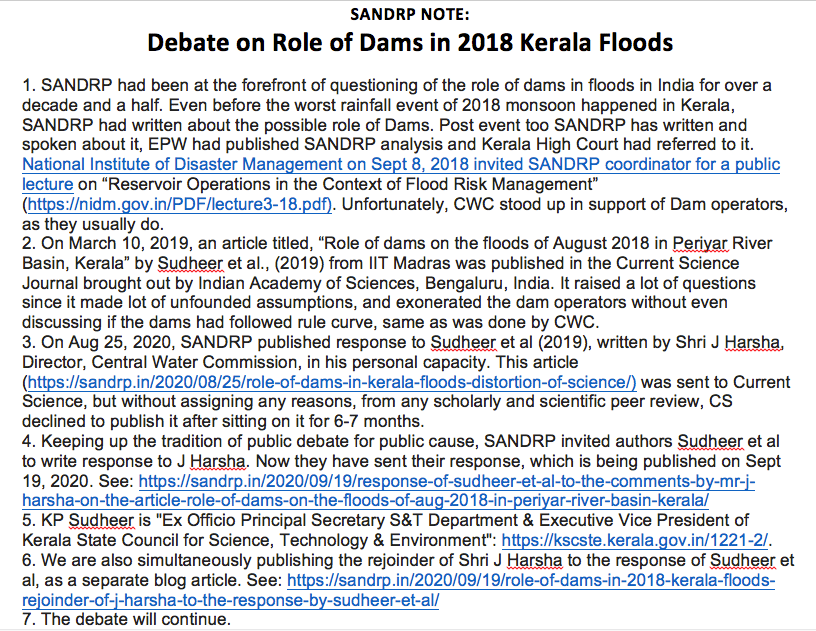
Response of Sudheer et al to the Comments by Mr. J. Harsha on the article, “Role of dams in the floods of Aug 2018 in Periyar River Basin, Kerala”
Sudheer, K P1,2,*, S. Murty Bhallamudi1,3, Balaji Narasimhan1,3, Jobin Thomas1, Bindhu, V M1, Vamsikrishna Vema1,4, Cicily Kurian1,
1Department of civil Engineering, Indian Institute of Technology Madras, Chennai – 600036,
2Department of Agricultural and Biological Engineering, Purdue University, West Lafayette, IN, USA.
3Indo German Centre for Sustainability, Indian Institute of Technology Madras, Chennai – 600036
*Corresponding Author: sudheer@iitm.ac.in
The authors of Sudheer et al. (2019) – hereinafter referred to as ‘authors’ – appreciate Mr. J. Harsha (hereinafter referred to as ‘commenter’) for his judgmental assessment (in his blog appeared on SANDRP website- “https://sandrp.in” on August 25, 2020, see: https://sandrp.in/2020/08/25/role-of-dams-in-kerala-floods-distortion-of-science/) of the authors’ work “Role of dams on the floods of August 2018 in Periyar River Basin, Kerala” (published in the Current Science in 2019: [DOI: 10.18520/cs/v116/i5/780-794]). As mentioned in Sudheer et al. (2019), the primary objective of the article was to examine whether the early release of the water stored in the reservoirs would have attenuated the flood peaks, and if so, what would have been the extent of the attenuation, in the context of debates and discussions in the social, political, as well as scientific domains based on non-sequitur speculations. Accordingly, the authors designed a scientific exercise using a widely used hydrological model (HEC-HMS) to understand the role of the dams in the Periyar River Basin (PRB) in the 2018 flooding situation.
Continue reading “Response of Sudheer et al to the Comments by Mr. J. Harsha on the article, “Role of dams in the floods of Aug 2018 in Periyar River Basin, Kerala””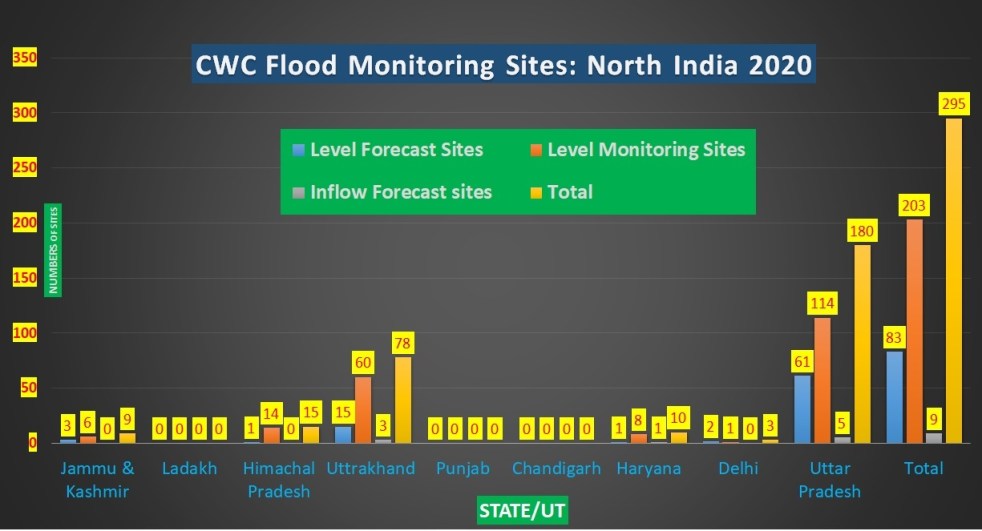
North India; CWC Flood Forecasting Sites 2020; New Website Old Problems
Flood forecasting is an important activity during monsoon, considering the huge and increasing flood prone area, flood frequency, intensity and flood damages. Accurate and timely flood forecasting can hugely help reduce the damages due to floods. Central Water Commission (CWC) is the only agency responsible for flood forecasting in India. To understand the CWC’s flood forecasting better, we have compiled the list of the various flood, inflow forecasting sites and flood monitoring sites in India.
In this compilation, we have given state wise list of CWC’s level forecasting, flood monitoring and inflow forecasting sites in North India, comprising of Union Territories Jammu & Kashmir, Ladakh, Chandigarh, Delhi and states of Himachal Pradesh, Uttarakhand, Punjab, Haryana and Uttar Pradesh. It includes available details like name of river, sub basin, Warning level (WL), Danger Level (DL), High Flood Level (HFL), Full Reservoir Level (FRL), Maximum Water Level (MWL), as applicable. As we see below, there are many gaps in this basic information for the sites that are part of CWC’s list. A similar zonewise overview of CWC’s sites was compiled in 2018 and 2019, which can be seen here: Overview of CWC Flood Forecasting Sites 2018: North India; Overview of CWC Flood Forecasting Sites 2019: North India. We have brought this updated compilation for 2020 as there are large number of changes.
Continue reading “North India; CWC Flood Forecasting Sites 2020; New Website Old Problems”
How SSNNL violated its own Flood Memorandum 2020 during recent SSD induced floods
During the recent Sardar Sarovar Dam (SSD) induced flood disaster in areas downstream of the dam in Gujarat, the dam operator, SSNNL (Sardar Sarovar Narmada Nigam Limited) violated its own Flood Memorandum (FM) 2020[i] in multiple ways.
The FM-2020 titled “Disaster Management Plan – 2020” provides detailed information about how the dam operation is to be done during South West Monsoon 2020, that is from June 1, 2020 to Oct 15, 2020, or whenever the monsoon has withdrawn. It is published by SSNNL’s Flood Control Cell and carries the names of six highest functionaries of SSNNL on second page: Chairman, Managing Director, Jt MD, Director (CAD), Director (Canal) and Director (Civil). It says Officer in charge of Flood Control Cell of SSNNL is Executive Engineer (Narmada Project Main Canal Division-2) and the FM-2020 is compiled by Superintending Engineer, Narmada Project Design Circle.
An earlier version of the Flood Memorandum for 2018[ii] is also available, which is useful as it has some additional information.
Continue reading “How SSNNL violated its own Flood Memorandum 2020 during recent SSD induced floods”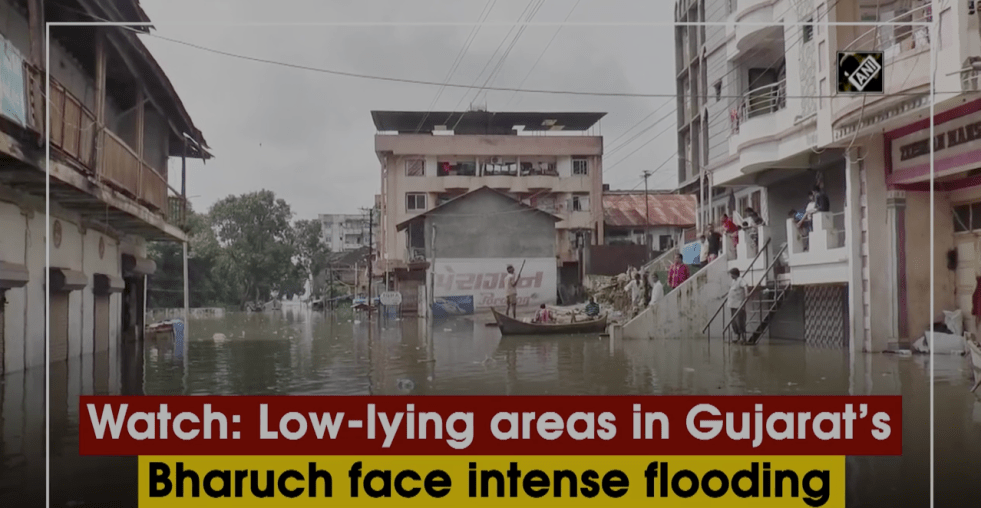
Sardar Sarovar Creates avoidable flood disaster in Bharuch
Sardar Sarovar Dam (SSD) operators are operating the dam callously, almost cruelly, without consideration of the impact of the operation in the downstream area. Till Saturday-Aug 29, 2020 early hours, they were not releasing any water from the spillway gates of the dam, in spite of sufficient actionably information at least since Aug 26 that rainfall is hugely increasing in upstream Narmada basin. They were not even operating powerhouses even though the dam was close to 70% full. Suddenly, by Aug 29 night they started releasing upto ten lakh cusecs – Cubic Feet Per Second (28320 cumecs or Cubic Meters per second) of water[i]. Three days later, in the evening of Tuesday, Sept 1, they closed most of the spillway gates, thus reducing releases from spillway to less than a tenth of the earlier figure. During these 3-4 days (Aug 29-Sept 1), massive quantities were released, upto 30 000 cumecs through spillways, and almost nothing before or after! It created massive flood disaster all along the downstream from Gaudeshwar to Chandod to Bharuch, but the Sardar Sarovar Project (SSP) authorities or the Gujarat government seem least bothered. It is high time people of Gujarat wake up and hold the SSP operators accountable for this man made disaster.
Continue reading “Sardar Sarovar Creates avoidable flood disaster in Bharuch”
