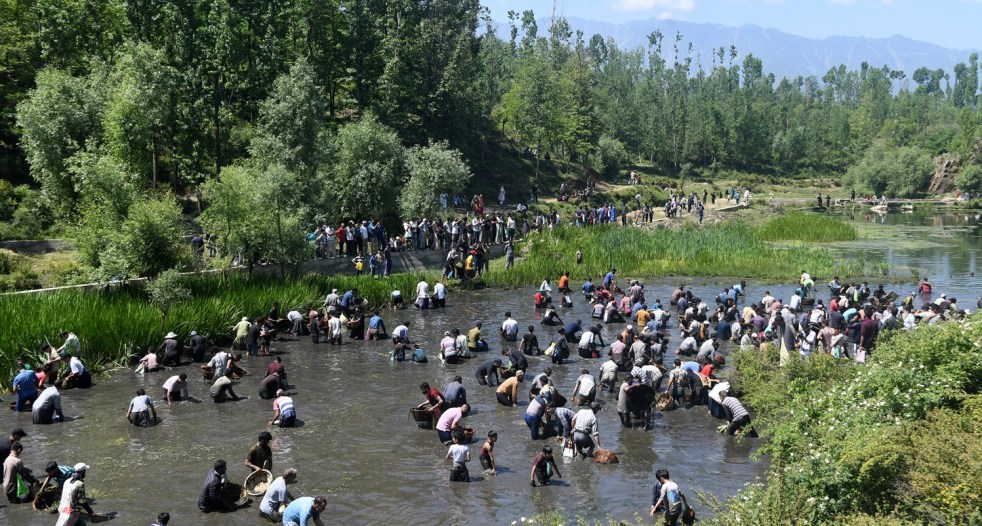
(Feature Image: An aerial view of the cleaning and fishing festival. Image Source: Awaz The Voice.)
Over time, the Panzath fishing festival has emerged as a remarkable community-led initiative aiming to protect and celebrate the sacred Panzath Naag (springs) in Anantnag district of Jammu & Kashmir. The historical springs have immense cultural value and serve as a potable and irrigation water lifeline for over three dozen villages.
The event is organized by local people every year in the third or fourth week of May in Panzath village. The village is located about 2 km away from Qazigund tehsil, which is also known as the gateway town to Kashmir Valley situated on the Jammu-Srinagar National Highway (NH) 44. This year, the ancient cultural activity was organized on May 17, 2026. Locally, the festival is also known as ‘Gaade Maare’, which in Kashmiri means “catch the fish.”
About the Panzath Springs
The Panzath Naag is a network of natural springs located in the upper catchment of the Jhelum River at the foothills of the Pir Panjal mountain range. The Jhelum flows about a km east of Panzath village, while snow-capped peaks surround the area from the north, west, and south.
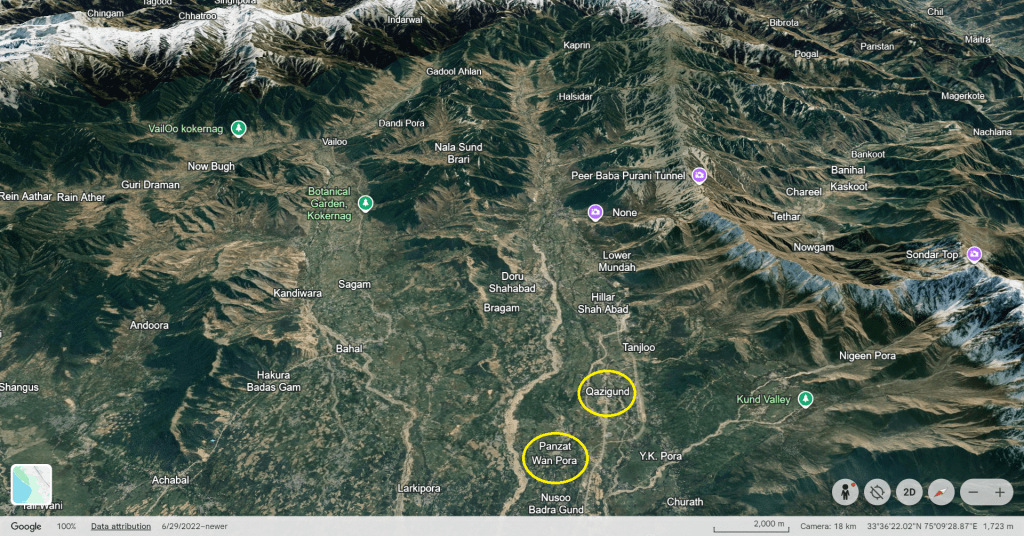
As per locals, Panzath is a Persian word meaning Panj (five) and Hath (hundreds). They believe that once there were five hundred springs emerging in an area of about 1.5 sq km, forming and feeding the small Panzath stream. The Panzath village itself owes its name to these freshwater springs. However, there is no authentic count of the exact number of springs joining the Panzath stream.
Panzath Springs: Historical, Cultural Connections
Though there is no official document in public domain, the Panzath fishing festival is believed to be a centuries-old community tradition. Scholars argue that the practice is documented in ancient texts like Rajatarangini (River of Kings), written by Kalhana in the 12th century, and in the 6th-8th century text Nilamata Purana on the history, geography and culture of Kashmir by sage Vrihadasva.
In Nov 2021 Mongabay report, freelance journalist Waseem Dhar has mentioned Kalhana referring to Panzath springs as Naga of Pancahasta, a pure spot where the river Vitasta (Jhelum) was brought to light a second time by sage Kashyapa’s prayer after it had disappeared from fear of defilement by the touch of sinful men. There are other scholars who link the cultural practice to Mughal era.
In this Aug 2025 informative piece Dr. Masrat Ahmad Mir, lecturer at PG Department History, Govt Degree College, Bemina, Srinagar has beautifully narrated the rich historical, spiritual and cultural significance of Panzath springs. The summary of the article reveals that Panzath festival is rooted around ‘Naag Mouj’ (Mother of the Springs) reflecting Kashmir’s ancient Naag worship traditions that revered serpent-like water deities associated with springs, lakes & rivers.
He mentioned that during the medieval period, the revered Sufi saint Sheikh Aftab (RA) is believed to have lived near the Panzath springs which added spiritual significance to the place. A shrine near the springs still reflects his legacy of peace and devotion. Over centuries, Panzath Nag has remained not just a water source but also a sacred space deeply connected with spirituality, nature and local cultural traditions.
Presently, the event also coincides with ‘Rohan Posh’ (flowering the souls), a traditional springtime social gathering occasion when locals visit graveyards of their relatives to offer prayers and flowers to remember the departed souls.
Panzath Springs: A Reliable Source of Drinking, Irrigation Water & Fisheries
The Panzath springs are a vital source of drinking and irrigation water for nearly 45 villages in the Qazigund belt. A population of about 50,000 from nearby villages relies on the spring network for potable water, while it also supplies irrigation water to thousands of kanals of paddy fields and orchards in the area.
As per a Jal Shakti Department official as quoted in this Jan. 2024 report, the department runs nine drinking water schemes from Panzath springs supplying around 6.72 million litres water daily to 12 villages. He further stated that even during the recent dry spell, when many other water sources saw reduced flow, Panzath springs continued to provide sufficient water.
About four decades back the Department of Fisheries had set up a rainbow trout hatchery based on Panzath springs which has now become the largest seed production unit in the region. In March 2025 report a Fisheries Department Official is quoted stating that the hatchery produces around six lakh rainbow trout seeds and 4–5 tonnes of fish annually earning nearly Rs 42 lakh in revenue. The fish is sold at a sale centre in nearby Wanpora village.
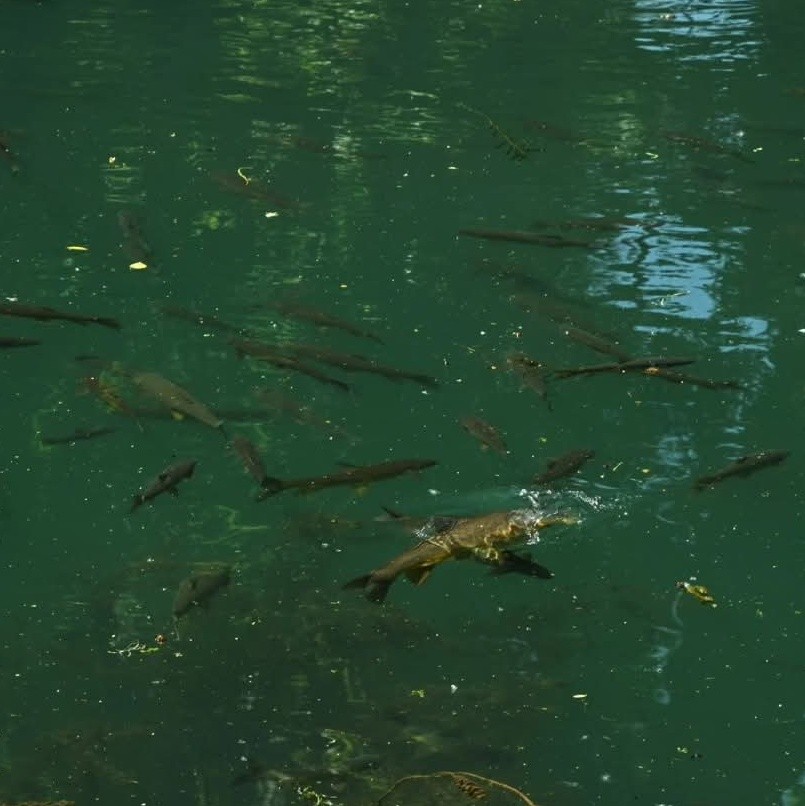
The department has recently built five fish ponds over the Panzath springs to support trout farming and plans to develop more such ponds in future. The Department permits fishing at designated sites in the springs only during the annual festival and prohibits it during the rest of the year.
About Panzath Springs Fishing and Cleaning Festival
In the absence of recorded documents, there is no fixed date for the festival. Native people largely depend on oral traditions passed down through generations to determine the timing of the event. This usually falls during the third or fourth week of May. This is also the period when apple, almond and walnut orchards are in full bloom and before the summer paddy sowing season, when demand for spring-based irrigation rises.
The main objective of the festival is to ensure that the natural springs remain clean and free-flowing throughout the year. There are elderly people who remember taking part in the festival since their childhood.
For past many years, the festival is being organized on Sunday. The announcement for the event is made through local mosques few days in advance to encourage participation.
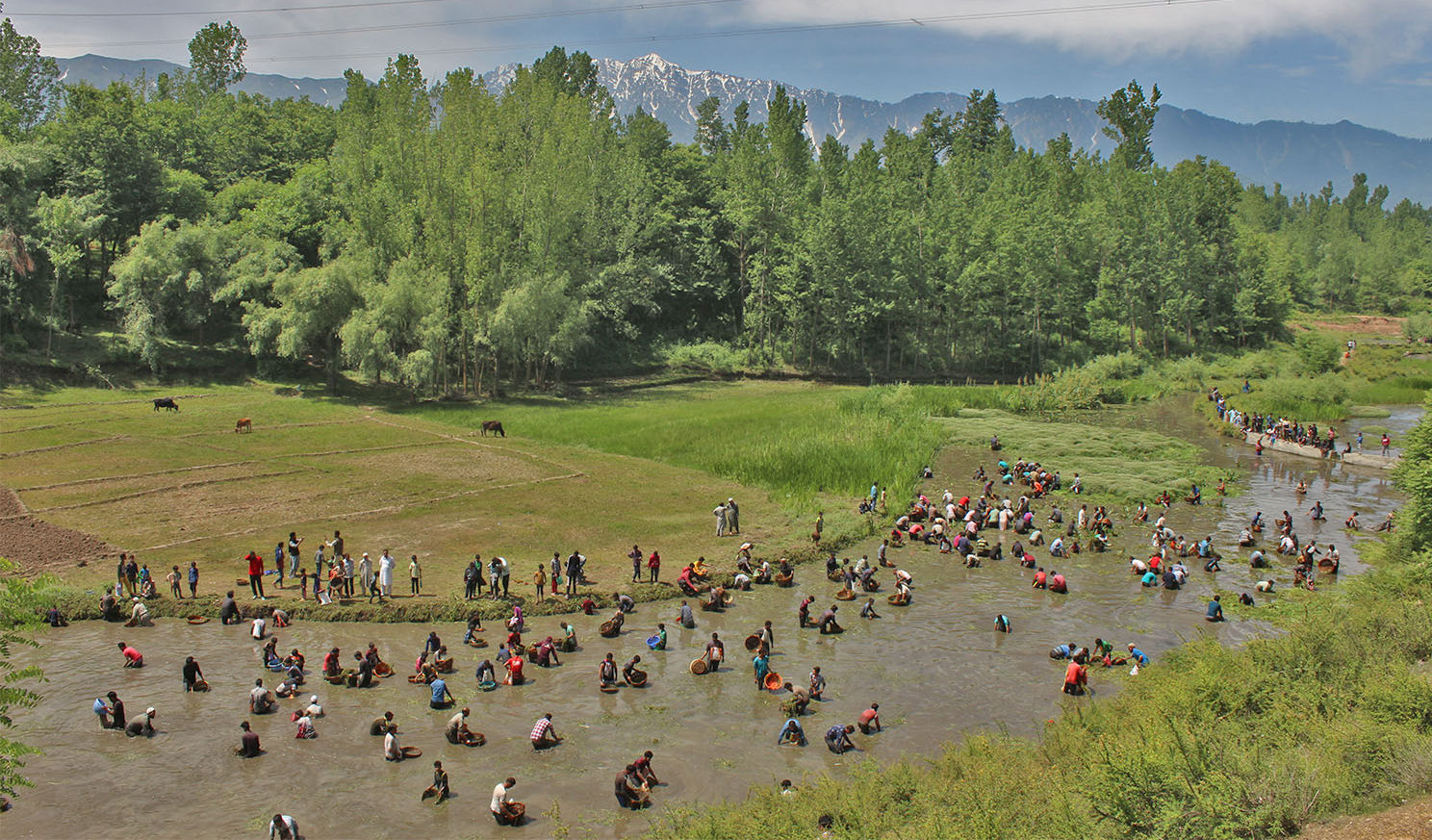
On the day of the festival, hundreds of villagers of all age group including young kids, adults and old people gather along the Panzath springs area. The women join the celebration by singing traditional songs, cheering up the participants and serving meals to their family members. Many families treat the occasion like a community picnic. Visitors and tourists in large number reach the Panzath springs to witness the unique custom.
The festival is divided into two parts. The first round belongs to cleaning the springs. Here, the villagers in large number enter the knee-deep water extracting unwanted aquatic weeds, cleaning the algae bloom from surface, collecting solid waste and removing mud from the springs bed in massive amount. Villagers believe that this hours long labour-intensive exercise clears the weeds and waste chocking of the springs area and the desilting improves the water level and flows in the spring.
In the next round, the villagers carrying traditional baskets and small mosquito nets scan the Panzath springs to catch the fish. The entire task of cleaning and fishing is done using traditional methods. Use of machines, modern fishing gears and large nets is restricted to avoid ecological damage to the Panzath springs. Elderly villagers emphasise that the primary objective of the festival is to clean and restore the Panzath springs in its original shape. Fishing is done to incentivise the youth participants.
Panzath Springs: Threats, Demands and Govt Actions
Multiple reports highlight several concerns surrounding the Panzath springs over the years. Growing encroachment has posed serious threat to the springs. Sewage pollution and solid waste dumping have also degraded water quality. Furthermore, there has been a considerable decline in spring water levels, particularly during summer months, largely due to erratic rainfall patterns linked to climate change.
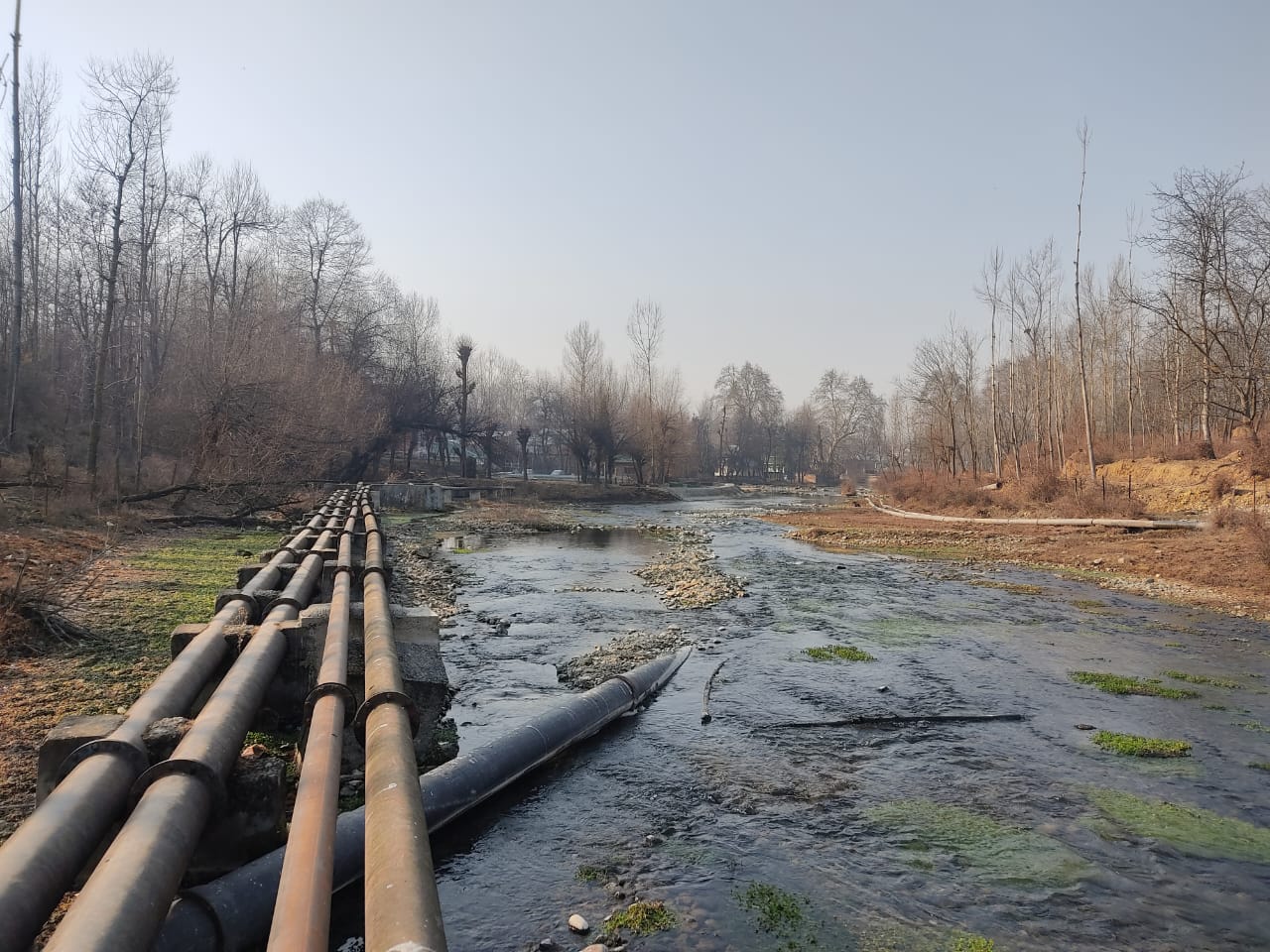
This has led to massive growth of aquatic weeds and algae. Locals allege that water supply pipelines laid across and along the stream obstruct water flow and worsen algal blooms. The gradual degradation of the springs has also taken a toll on aquatic life including fish population.
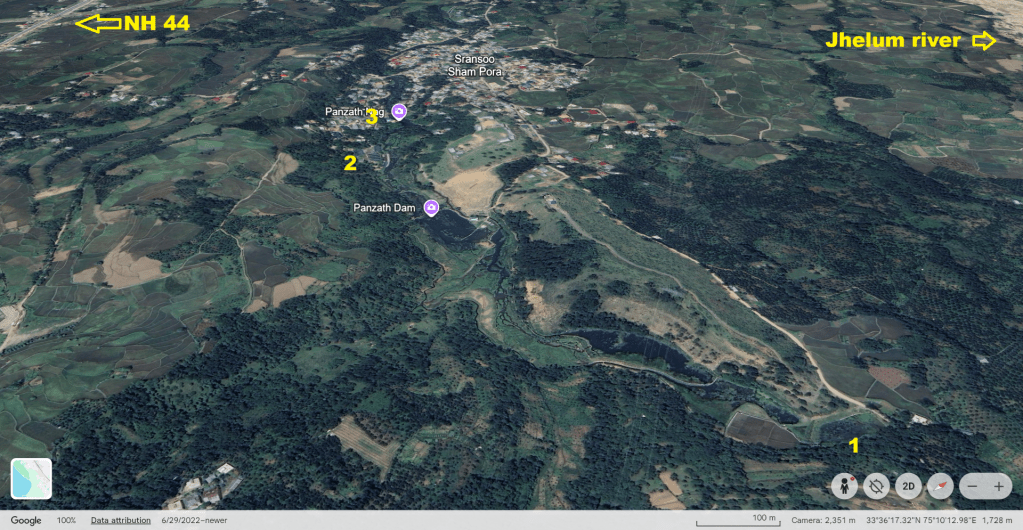
Apart from these problems, locals have for long been demanding to develop the Panzath area as tourist destination and permit private trout farming units in Panzath springs to boost local economy and provide alternative livelihoods to fishing community. They also demand upgradation of Panzath springs-based irrigation channels to reduce seepage losses and construction of retaining walls along the Panzath stream to check soil erosion.
In 2023, when Prime Minister Narendra Modi mentioned the Panzath festival in his Mann Ki Baat program praising the collective effort and getting Panzath Springs national attention. Around same time, Panzath village was brought under the Verinag Development Authority (VDA). Despite this, locals complain of slow progress in tourist infrastructure in the area and claim only a park has been established along the springs so far.
Given the significance of the Panzath springs and their gradual deterioration, experts advocate organizing community-led spring-cleaning activities at least twice a year. However, the Fisheries Department appears to favour mechanised dredging and remains reluctant to allow wider community participation in fisheries activities in the springs.
Summary
While the community-led initiatives under the Panzath Springs Festival are widely appreciated and offer an inspiring model for springs conservation in India, there is still a serious lack of systematic official efforts to scientifically study, document and protect the hydrological, ecological and cultural significance of the Panzath spring system. Despite growing recognition, concerns related to pollution, encroachment, declining water discharge, algal growth and ecological degradation continue to persist.
The Panzath springs represent not only a vital freshwater source for thousands of people but also an important part of Kashmir’s cultural and environmental heritage. Protecting this unique spring ecosystem therefore requires long-term conservation planning, scientific monitoring, restoration measures and meaningful involvement of local communities whose traditions have helped preserve these waters for generations.
SANDRP


