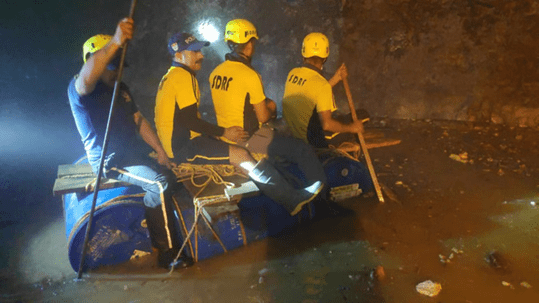
(Feature Image: Rescuers using make shift raft made of plastic drums to search for the missing workers inside flooded Vishnugad-Pipalkoti HEP. Source: Amar Ujala/Aug. 14, 2026)
At least eight workers have been killed in a major disaster inside the tunnel of under-construction Vishnugad Pipalkoti Hydroelectric Project (HEP) on Aug. 13, 2026 in Uttarakhand. The incident occurring between 6:30 and 7:00 pm inside the project’s Tail Race Tunnel (TRT) near Mayapur area in Chamoli district, has also left 12 workers injured and two still missing. The rescued workers have sustained fractures and other trauma injuries and are currently under treatment. The disaster happened about 1.5 km inside the 3 km long TRT, being constructed between Durgapur to Siyasain area in Pipalkoti.
According to State Emergency Operation Centre (SEOC), a total 22 workers from the afternoon shift were inside the tunnel when the disaster happened. Preliminary reports indicate that a landslide above the tunnel alignment created a cavity, allowing a large volume of water, mud and debris to suddenly rush into the tunnel. Workers reportedly heard a loud sound moments before the deluge entered with great force.
Rescued workers described the incident as sudden and devastating. They said water and strong winds entered like a storm, throwing workers off their feet and sweeping several towards the tunnel exit. One worker recalled they could only begin moving out after the water flow reduced. NDRF officials also reported that when rescue teams entered the tunnel, water in large volumes was still flowing inside while seepage from tunnel walls continued to hamper rescue operations.
As per this report, around 16–17 workers along with an electricity operator and a plumber, were working together at one location inside the tunnel. One injured worker said they were trapped up to half their bodies in sludge and managed to escape with great difficulty. During treatment, Sunil Diwan, an injured worker from Chhattisgarh said that they were constructing reinforcement shuttering inside the tunnel when the accident occurred.
The affected workers are engaged by Hindustan Construction Company (HCC) and belong to Chhattisgarh, Jharkhand, Bihar, West Bengal, Uttar Pradesh, Punjab, Himachal Pradesh and Uttarakhand. Of the eight deceased, two workers are from Uttarakhand, three from Uttar Pradesh and three from Chhattisgarh. The two missing workers are from Chhattisgarh and Jharkhand.
Inquiry: On Aug. 14, the Chief Minister Pushkar Singh Dhami has ordered a magisterial inquiry into the disaster. The probe will examine the cause of the accident, possible safety lapses, negligence and accountability. It is also expected to review the tunnel’s ventilation, water drainage, emergency arrangements, identification of vulnerable zones, monitoring of water ingress and whether work should have continued during rainfall. No information is available on the panel members or the deadline for completing the inquiry.
Visiting the tunnel site on Aug. 15, 2026, State Disaster Management Minister Madan Kaushik said the water inside the tunnel was slowing the search and teams had reached only 200-400 metres from the incident site. He also assured protesting workers that the disaster would be investigated through a magisterial inquiry and a separate technical inquiry by the Centre including issues related to safety standards and compensation.
THDCIL Statement: The official release by the project developer erstwhile Tehri Hydro Development Corporation India Limited (now THDC India Ltd) in evening hours of Aug. 14, 2026 stated that “an unfortunate incident occurred in the TRT of the Vishnugad-Pipalkoti HEP on Aug. 13, 2026, at approximately 6:20 PM. A large volume of water and debris suddenly entered the tunnel at Chainage 1440 meters (Face-II), accompanied by a loud noise. At the time of the incident, concrete lining work was underway at Chainage 1230 meters, where 22 workers engaged by the principal executing agency, HCC, were working.”
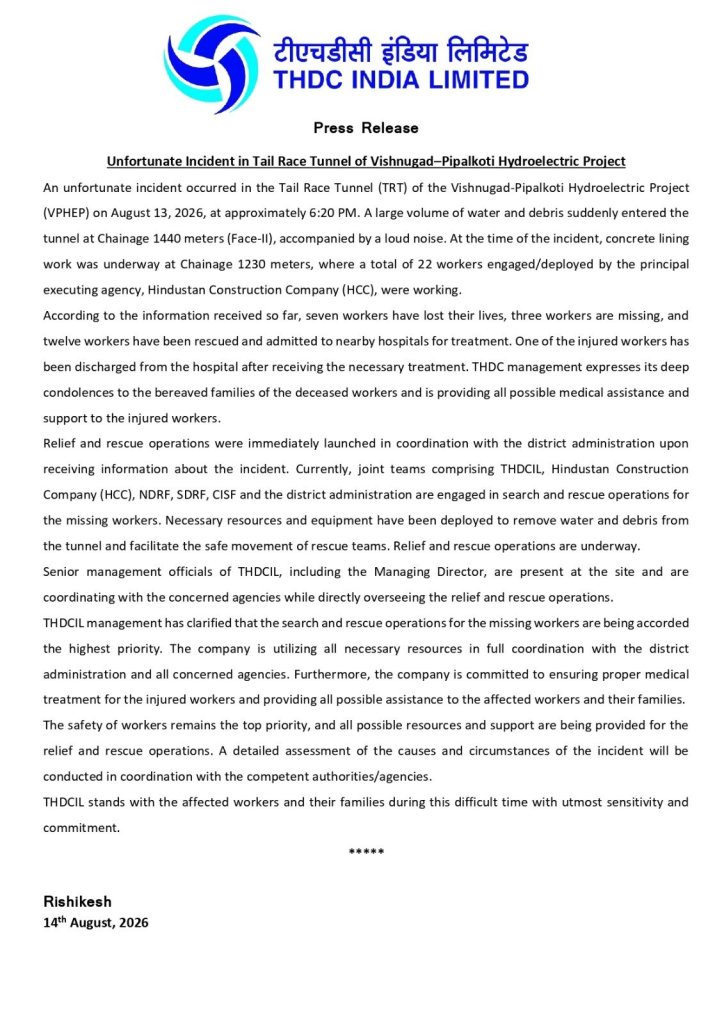
However, the company did not provide information on the cause of the disaster, stating that “a detailed assessment of the causes and circumstances of the incident” will be conducted in coordination with the competent authorities.
Ironically, the disaster has happened just five days after the THDCIL organized a series of environmental awareness activities on Aug., 2026, aimed at promoting environmental consciousness and collective action for the conservation and protection of a clean and healthy environment.
Negligence & Unanswered Questions: Meanwhile, the available information raises several serious questions about the disaster assessment, mitigation, preparedness and workers safety be it actual number of trapped workers, anticipation of tunnel flooding scenario and effective equipment required to enter flooded tunnel to assist timely rescue work, prompt action on water seepages complaints, adequate geological safety assessment to identify and monitor possible vulnerable zones above the tunnel area.
Number of affected workers? There was confusion during the crucial initial hours over actual number of workers trapped inside the flooded tunnel. While, the SEOC has maintained 22 workers were inside of which 8 have died so far, there are reports claiming 28 workers as affected and death toll as nine.
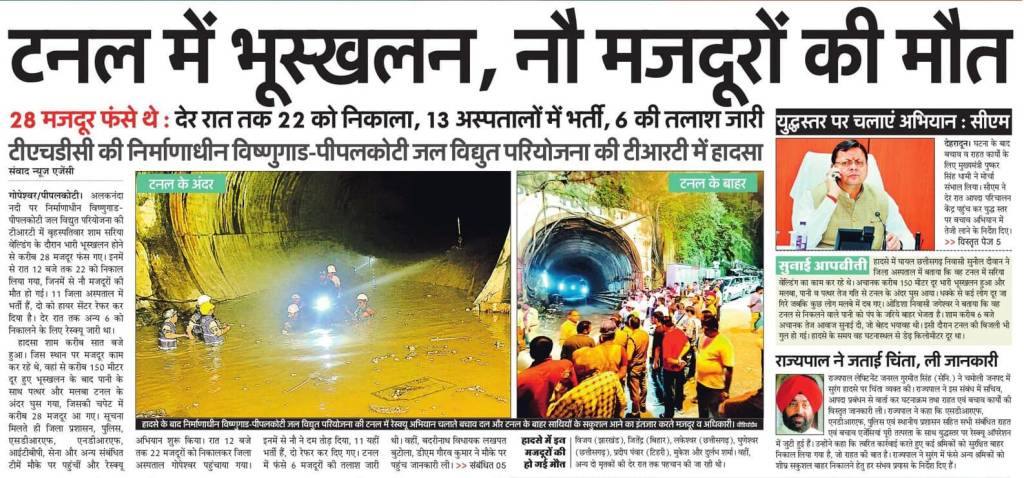
The discrepancy is also reflected in official communications. In a video posted around 11 pm on Aug. 13, 2026, by the Uttarakhand Department of Information and Public Relations (UKDIPR), NDRF Assistant Commandant Alok Jayara said that, according to information initially provided to the NDRF, 28 workers were affected, six of whom had already been rescued by the company. He further said that NDRF teams had rescued 18 of the remaining 22 trapped workers.
Similarly, a post by Prasar Bharati’s news wire PB SHABD around 11:00 am on Aug. 14, 2026 stated that 25 out of 28 affected workers had been evacuated. Further, a tabular sheet image dated Aug. 13, 2026 reportedly by HCC listing 28 workers along with their designation and rescue status has also surfaced in social media.
The conflicting figures raise serious questions about the tunnel-entry registers, worker tracking and emergency accountability protocols at the project site. The basic information should have been immediately available during such a major tunnel emergency situation.
Notably, similar confusion over number of trapped workers was reported during the Feb. 2021 Tapovan disaster, raising concerns on whether lessons are learnt to improve tunnel disaster responses.
Negligence: Workers appear to have received no adequate warning before the sudden flooding. In fact, the workers and villagers have questioned the safety preparedness and alleged negligence by the company at the Vishnugad-Pipalkoti HEP site.
Bharat Bhushan, a 28-year-old electrician who helped in the rescue operation, said workers had repeatedly reported small quantities of loose debris falling from the tunnel roof and walls. They had asked the company to carry out repairs but no adequate safety measures were taken. He also said his ITI friend and senior, 31-year-old Pradeep Panwar, was among those killed.
Another worker Ankush Negi from Gauchar, Chamoli has alleged that water seepage inside the tunnel had increased significantly about three days before the accident. Workers reportedly noticed dirty water seeping through the tunnel and a support rib sinking on Aug. 12, 2026. They informed the officials but, no inspection was done to fix it. Debris reportedly began falling on the afternoon of Aug. 13, before the fatal collapse of tunnel roof followed by a massive water influx.
Citing some of the survived workers, this report claims that three landslides occurred during the incident with the second landslide causing the most damage. Workers at another section of the tunnel reportedly felt three powerful blasts of air followed by a sudden rush of heavy debris before they could understand what was happening.
Supporting the allegations, Lakshmi Devi, village head Haat, said that the mishap was avoidable if workers concerns had been taken seriously. Former village head Rajendra Hatval said similar debris collapses had occurred earlier and alleged that the project had never undergone the safety audit demanded by the villagers. He also pointed to the area’s vulnerability to land subsidence.
Disaster Preparedness: The incident clearly shows the complete failure of THDCIL and HCC in anticipating a tunnel flooding scenario and effective equipment required to assist prompt rescue operations despite the project’s known geological vulnerabilities.
The scale of flooding also appears to have caught the rescue system unprepared as the NDRF officials indicated that boats might be required for the operation. In a late-evening update on Aug.13, Ajay Verma, THDCIL’s project in-charge also said that a loader sent into the tunnel became stuck and was damaged in the floodwater, forcing the company to send another machine.
Then there are visuals showing rescuers using a makeshift raft made from plastic drums in flooded tunnel to search for the missing workers underlining absence of required equipment to deal with the emergency tunnel flooding situation.
The search operation, launched on the evening of Aug. 13, 2026 continued into Aug. 16, 2026 and is severely hampered by low visibility, accumulated sludge and uncertainty about conditions beneath the water. Thus, restricting the movement of rescue teams.
According to NDRF Assistant Commandant Alok Jayara, nearly 900 metres of the tunnel remained flooded with water and sludge, making rescue operations extremely difficult. As per him about 80 rescuers are at work in rotation wading through the chest-deep water and relying largely on manual searches.
Narrating the incident, Shikhar, a welder reportedly engaged by the HCC and among the first responders, has raised serious questions over the company’s disaster preparedness and mitigation arrangements. He also said that the flood was so severe that it inundated machinery and equipment at the spot leading to maximum casualties.
According to him, the spot had remained vulnerable for a long time and the company was aware of the risks. Yet adequate mitigation measures were not put in place. He also alleged that there was no immediate water-diversion facility, which could have helped control the rising water level and supported rescue efforts during the critical hours. As per him, the company lacked suitable equipment to enter the flooded tunnel, making rescue work difficult even for the NDRF in the initial hours.
Source of Water: One of the most important questions is the source of the huge volume of water that flooded the tunnel. It remains unclear whether the water came from rainfall seepage, a water filled cavity or aquifer or an underground water stream above the affected portion of the tunnel.
According to Chamoli Disaster Management Officer Nand Kishore Joshi, the main challenge was the heavy inflow of water mixed with debris. The debris blocked all escape routes, making it difficult for workers to evacuate safely. The administration has deployed at least 10 water-pumping machines from both ends to lower the flood level inside the tunnel.
Project in charge Ajay Verma is quoted in this Aug. 15 report stating that the massive inflow likely came from a pre-existing natural cavity that was filled during the monsoon and found a weak point where excavation was underway. He described the flooding of about 1.2-km of the tunnel as unprecedented and highly unusual.
As per him, the water level had been reduced by about 1.5 metres with additional pumps being deployed and that less than a metre of water remained at that stage. Authorities aim to drain the tunnel completely and conclude the rescue operation soon.
Expressing similar views, Surjeet Singh Pawar, SP Chamoli stated that the district had experienced heavy rainfall in the days before the incident. According to him, the rainwater had accumulated in cavities within the surrounding rocks and pressure was built up after two days of sunlight causing sudden and forceful breach in a weak section of tunnel roof.
Geological Assessment: The EIA report had already identified the project area as geologically challenging. Large sections of the tunnel pass through weak slate and dolomitic limestone with several zones prone to fissures, rock slippage and groundwater seepage. Rock collapses and water seepage had also occurred during construction.
Geologist Naveen Juyal noted that the 2009 EIA had warned of weak rocks, fault lines, waterfalls and other vulnerable zones along the tunnel alignment. He questioned whether adequate safety measures and precautions were actually followed during excavation.
The incident therefore raises serious concerns over geological risk assessment, tunnel safety and disaster preparedness, particularly in a state that has repeatedly experienced catastrophic hydropower and tunnel disasters.
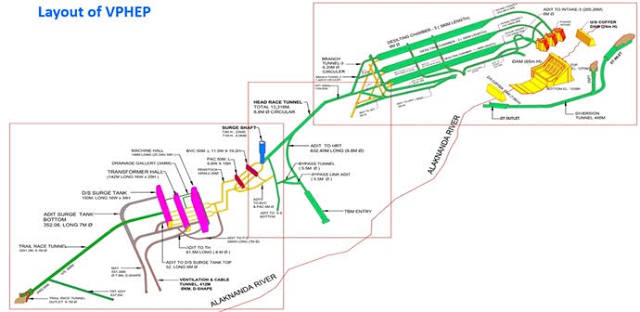
Repeated Delays, Cost Escalation: The 444 MW HEP, being developed on the Alaknanda river, involves construction of a 65-metre-high concrete diversion dam, a 13.4-km HRT and a 3.04-km Tail Race Tunnel (TRT). The salient feature of the project can be seen here.
The project has faced prolonged delays and major cost escalation since the beginning. As per THDCIL’s 6-monthly progress report for the period of Oct 2024 – March 2025, the project was first approved by the CCEA on Aug. 21. 2008 at an estimated cost of ₹2,491.58 crore at March 2008 price level.
Its original completion target was Dec. 2022. However, the actual construction work began only on Jan. 17, 2014 and was scheduled for completion by July 16, 2018 based on a 54-month construction period.
The project revised cost was assessed at ₹3,860.35 crore at Feb. 2019 price levels and vetted by the CEA in March 2020. The completion target was subsequently extended to March 2027. However, THDCIL’s latest schedule now targets commissioning of the first unit by Dec. 2027 and the fourth and final unit by June 2028, indicating further delays.
By March 2025, actual expenditure on the project had reached ₹4,609.64 crore about ₹749 crore above the revised estimates. The Environmental Management Plan (EMP) has an allocation of ₹109.53 crore, based on the EMP dated July 2021. The cited progress report does not provide a reason for the prolonged delay.
Recurring Disasters, Violations: Notably, the project has faced repeated accidents and environmental violations raising questions over its geological assessment and disaster preparedness. SANDRP has documented at least four such incidents in recent years underlining recurring concerns over project’s geological instability, excessive blasting, muck dumping, flash-flood risks and worker safety. The Aug. 2026 tunnel disaster therefore cannot be viewed in isolation.
Tunnel locomotive collision: Only seven months back, two locomotives collided inside the project tunnel on the night of Dec. 30, 2025, during a shift change. More than 60 workers were injured. The accident occurred inside the long tunnel while workers were being transported and reports indicated a possible problem with the braking system of one locomotive. The incident exposed serious questions over worker transportation and tunnel safety management.
Rockslide at dam site: Just last year, a major rockslide occurred at the project dam site at Helang around 11 am on Aug. 2025. Falling rocks and debris injured at least 12 workers. Eight workers with minor injuries were discharged after treatment, while four required further medical care, including two seriously injured workers. The District Magistrate directed the company to resume work only after ensuring worker safety. The local residents had long raised concerns over excessive blasting, hill instability, cracks in houses and muck disposal into the Alaknanda by the project developers.
Flash flood at HCC batching plant: A flash flood in July, 2024 severely damaged the HCC batching plant near Gulabkoti. Project machinery and other assets were also damaged by the deluge while more than 20 workers reportedly had to flee to their safety. The incident highlighted the project’s vulnerability to flash floods and concerns over the blocking and alteration of natural drainage channels by project-related construction activities and muck dumping. It also found serious gaps in disaster monitoring as state and district disaster-management authorities reportedly had little information about the incident.
Violation in muck dumping & excessive blasting: In Sept. 2023, residents reported that muck excavated from the project tunnel work was being dumped directly into the Alaknanda river. There are reports mentioning about cracks in houses in Durgapur, where residents linked repeated tunnel blasting to ground vibrations and risk of structural damage. These concerns highlighted problems related to construction practices, muck management, excessive blasting in project work and its impact on local communities.
Clearly what is required is an independent assessment involving people with independent track record, to fix accountability learn lessons and try to avoid more disasters.
SANDRP
Postscript (updated with information available up to Aug. 26, 2026):
Death Toll Reaches 11: With the recovery of the bodies of two missing workers on Aug. 18, and another worker succumbing to his injuries at AIIMS Rishikesh on Aug. 19, the death toll in the disaster reached eleven. The 117-hour search operation ended on Aug. 18. The last two missing workers were Lukas Topno of Jharkhand and Chetan Poyam of Chhattisgarh while Rohit Pandey (20) from Bihar, later succumbed to his injuries during treatment.
The bodies of the two missing workers were found near a large drilling machine that had become jammed inside the tunnel. According to Karan Singh, an inspector with the State Disaster Response Force (SDRF), the bodies were recovered shortly after the heavy machinery was removed on the morning of August 18. The machine had been blocking access to the section where the workers were trapped.
The rescue operation was severely hampered by continuous water inflow from an internal cavity, heavy slush and compacting mud. A rescue team member said the muck was hardening with each passing day, making the search increasingly difficult. High-capacity pumps were used continuously to drain the tunnel, while rescuers often had to move through more than two feet of dense slush and water, even as adverse weather affected operations outside.
Compensation Package Finalized: THDCIL initially decided on Aug. 14, to pay ₹5 lakh to the family of each deceased worker and ₹1 lakh to each injured worker. Activists criticised the amount as inadequate given the scale of the project and the risks involved. Following workers’ protest, a final relief package was agreed on Aug. 21 at a meeting chaired by Rajkumar Pandey, SDM Chamoli. Representatives of THDCIL, HCC and the Hindustan Federation Union participated.
Under the settlement, the family of each deceased worker will receive around ₹45 lakh in total assistance. This includes ₹11.50 lakh each from THDCIL and HCC, along with additional assistance and ex-gratia payments from other sources. EPF claims will be settled separately. Each injured worker will receive ₹3.50 lakh as ex-gratia compensation, pooled from multiple sources. After verification and completion of documentation, the compensation will be transferred directly to the beneficiaries’ bank accounts within one week.
Separately, on Aug. 22, the PMO announced ₹2 lakh for each deceased worker’s family and ₹50,000 for seriously injured workers. The state govt has also announced ₹4 lakh for each bereaved family and ₹1 lakh for each injured worker.
Magisterial Inquiry: On Aug. 19, Chamoli District Magistrate Gaurav Kumar formally ordered a magisterial inquiry into the disaster. The Pargana Magistrate-cum-Sub-Divisional Magistrate (SDM), Jyotirmath, has been appointed as the Inquiry Officer. The inquiry will examine the causes of the accident, the circumstances leading to the incident, any possible negligence, and the safety measures adopted during tunnel construction.
The Inquiry Officer has been directed to submit a detailed report within 15 days, along with specific recommendations for strengthening safety arrangements and preventing the recurrence of similar incidents at tunnel construction sites. The district administration has instructed all concerned officials and departments to extend full cooperation to the Inquiry Officer and provide all relevant records, documents and other information required for the investigation.
However, there is no update on separate technical inquiry by the Centre as promised by State Disaster Management Minister Madan Kaushik on Aug. 15 during his visit to the tunnel site.
Questions & Concerns: As per Ajay Verma Project In-charge statement on Aug. 15, preliminary assessment indicated that a rain-saturated aquifer had ruptured through the roof of the 3-km tunnel, about 1.44 km from the entrance. Verma described it as a sudden release of water, similar to a cloudburst. He said rainwater from the surrounding slopes had percolated into a water-bearing layer above the tunnel and escaped under pressure through a weak section of rock.
The force of the water was strong enough to push a column of air towards the tunnel mouth. Some workers were thrown towards the entrance, while others were trapped deeper inside by debris. Verma said tunnel excavation had already been completed and lining work was underway when the incident occurred. He also said that loose material reported by workers in the preceding days was associated with ongoing lining work and was much smaller in scale than the material released during the incident.
However, Hemant Dhyani of Ganga Ahvahan has raised serious concerns about construction-stage safety. a member of the Supreme Court-appointed expert body after the 2013 Kedarnath disaster and the 2019 High-Powered Committee on the Char Dham project, pointed out that the tunnel had already been excavated when the incident occurred, raising questions about the adequacy of safety measures.
He noted that the Kedarnath expert body had specifically recommended studies on the impacts of tunnelling, blasting, deforestation and reservoirs on Himalayan hydrogeology. These recommendations, he said, were not adequately acted upon. He warned that similar risks could also affect railway tunnels, where the consequences could be even more serious.
The incident also raises a broader question: have lessons from earlier Himalayan tunnel disasters really been learned? As Jay Singh Rawat has pointed out, Himalayan tunnels are not being excavated through stable and inert rock. They pass through fractured, water-bearing and seismically active mountain systems. Treating them as conventional engineering projects, without giving equal importance to hydrogeological conditions, can expose workers, local communities and fragile ecosystems to serious risks. Similar concerns apply to existing and proposed hydropower, road and railway tunnels across Uttarakhand.
Repeated Disasters across Himalayas: As SANDRP documentation shows, this is the ninth accident or weather-related disaster involving a hydropower or dam project in the Himalayan region since June 24. The incidents have occurred across the Teesta, Brahmaputra, Chenab, Ravi, Beas, Sutlej and Yamuna basins. Seven of the nine affected projects are under construction, including Teesta Stage-VI HEP, Lakhwar Dam on the Yamuna and Kwar and Ratle HEPs on the Chenab.
At least 41 people have been killed in just three of these disasters in addition to significant damages to the project infrastructure and equipment. The toll includes death of 25 workers in the methane explosion in under-construction 500 MW Teesta Stage-VI project in Sikkim on July 20, death of 11 workers in the Vishnugad-Pipalkoti tunnel disaster in Uttarakhand on Aug. 13 and death of at least five people in the flash flood at NEEPCO’s 405 MW Panyor Lower HEP in Arunachal Pradesh on June 24, 2026.
Indeed, the repeated disasters point to the fragility of the Himalayan region and serious gaps in project appraisal, monitoring, safety and regulatory compliance. Yet accountability remains weak. There are rarely clear consequences for agencies or individuals responsible for lapses. Most importantly, there is no credible system of independent post-disaster assessment to establish accountability, identify failures and ensure that lessons are incorporated into future projects. This needs to change. Every major disaster should result in an independent investigation, public disclosure of findings and time-bound action on its recommendations.


