Arunachal Pradesh

EIA-EMP of Kalai II Hydropower Project Doesn’t Comply with its Terms of Reference

Kalai II HEP – Status of compliance with TOR in EIA and EMP:

Serious non compliance of EIA-EMP: EIA-EMP must go back to consultants WAPCOS

Public hearing based on such EIA-EMP will not be legally valid

The EIA EMP reports of the proposed 1200 MW Kalai II HEP in Lohit basin in Anjaw district in Arunachal Pradesh has been put up on the Arunachal Pradesh Pollution Control Board in advance of the public hearing slated for January 18, 2014. The EIA-EMP report is supposed to comply with the Terms of Reference (TOR) for the EIA-EMP given by the EAC and MoEF, this is statutory requirement as per the EIA notification of Sept 2006. We have just checked this compliance and find that the EIA and EMP reports have not fulfilled a very large number of the TOR (Terms of Reference) that the project was to cover in EIA-EMP as per the TOR clearance given for the project on 9.12.2009. Such EIA-EMP will clearly not be acceptable even from statutory and legal point of view and cannot be basis for a public hearing. Hence Arunachal Pradesh State Pollution Control Board (APSPCB) and MoEF should immediately cancel the public hearing and ask the EIA-EMP consultants to comply first with the TOR.

A letter has been sent to APSPCB pointing out the violation of norms in organizing the public hearing and asking them to cancel the public hearing. This letter is available at “Letter to APSPCB – Public Hearing for Kalai-II HEP to be held Violating the Norms”. A detailed critique of the EIA-EMP report of Kalai II project is also available at “Critique of Kalai II HEP’s Environment Impact Assessment (EIA) Study and Environment Management Plan

Invalid extension since EIA-EMP does not comply with the TOR Here it may be added that as per minutes of 70th EAC meeting dated Dec 10-11, 2013, “In the mean while, MOEF issued an Office Memorandum dated 22-Mar-10 which stipulates that the proposals which were granted TORs prior to the issue of this OM, the EIA / EMP reports should be submitted after public consultation no later than four years from the date of the grant of the TORs with primary data not older than three years. Thus the TOR issued to the project on 9th December 2009 is valid up to 8th December 2013”. By this norm, the Kalai II TOR clearance should have lapsed on Dec 8, 2013. However, EAC decided to give an extension to TOR for this project, since the project developer claimed, as noted in EAC minutes, “With the completion of all the studies, the draft EIA/EMP report for 1200MW Kalai-II HEP was prepared and submitted by the developer to Arunachal Pradesh State Pollution Control Board (APSPCB) vide letter dated 31st July 2013…”. However, this assumes that the EIA-EMP submitted complies with the TOR given by MoEF. But this analysis shows that there is serious non compliance of the EIA-EMP with the TOR and hence submission of such fundamentally inadequate EIA-EMP cannot be a valid reason for providing TOR extension beyong legally stipulated period.

Location of Kalai II HEP. Source: EIA report

A list of TOR noncompliancein the EIA-EMP is given below.

Noncompliance in EIA Report:

Geological and Geophysical Aspects

  1. Regional Geology and structure of the catchment – some details only about has been mentioned in the EIA, the latter is not available
  2. Seismicity , tectonics and history of past earthquakes in the area – the EIA only mentioned about seismicity, the latter two has been completely ignored
  3. Critical review of the geological features around the project area – not available
  4. Impact of project on geological environment – not available
  5. Justification for location & execution of the project in relation to structural components (Dam height) – not available

Hydrology

  1. Graph of 10 – daily discharge before and after the project at the dam site immediately below the dam should be provided i n the EIA study – Not available
  2. The TOR mentioned “An elementary stream gauging station should be established at a suitable location downstream to the Dam site of the project” and “Installation of two Rainfall Gauge Stations at upstream of dam site” but none of these has been complied with.

Surprisingly the EIA also mentioned “No gauge and discharge (G&D) data is available at the Kalai-II project site or in the neighborhood.”

Biological resources

1)   “Cropping and horticulture pattern and practices in the study area” – no mention of this in the EIA

2)   Regarding identification of rare and endangered flora and fauna the EIA report mentioned only one “During the study in various seasons in Kalai-II HE project area, following IUCN Red List of threatened plant, Lagerstroemia minuticarpa falls under endangered category. Rest of the species are common in Arunachal Pradesh. However, this species though observed in the study area but not found in the land to be acquired for the project.” (section 8.7 page 8 -22) This is a strange claim that the species is observed in the study area but not found in the land for the project.

3) Fish and Fisheries

a)   The 5 location of study of Fish migrations & Breeding grounds was not done

b)   Impact of Barrage building on fish migration and habitat degradation was not studied

c)   Overall ecological impact upto 10 Km d/ s from the confluence of the TRT with the river or reach of the river in India have not been not studied. The impact of untreated and waste water into the river was not studied and no alternatives explored.

4)                  In the part of impact prediction, impacts on flora and fauna due to changed water quality has not been assessed

Socio Economic aspects In terms of Socio-economic aspects the following should have been included in the EIA report.

· Land details*

· Demographic profile

· Ethnographic Profile

· Economic structure

· Development profile

· Agricultural practices

· Cultural and aesthetics sites

· Infrastructure facilities: education, health and hygiene, communication network, etc.

· Impact on socio- cultural and ethnographic aspects due to Construction of Barrage

But the EIA does not do several of these profiles and limits itself to – Demographic profile, Educational levels, Occupational Profile, Land holding pattern, Assets owned and Livestock and other socio-economic parameters etc.

In page 11- 8 EIA report says “Impacts on cultural, archeological and religious properties Monuments of cultural/ religious/ historical/ archaeological importance are not reported in the project area. Thus, no impacts on such structures is envisaged.” However, the EIA should have looked into the impact of project on places of cultural, religious importance for the  local communities.

Impacts related to Land The EIA ignores what has been suggested in terms of impact prediction for land. The EIA completely ignores –

a) Changes in land use and drainage pattern

b) Changes in land quality including effects of waste disposal

c) River bank and their stability

d) Impact due to submergence

However, in page no 10-23 in the section “Impact of Impoundment on Landuse” the EIA mentions: “The construction of the dam would form the reservoir which will submerge about 640 ha of area in upstream. The area witnessed jhum/shift cultivation practiced by local inhabitants. Submergence of the area would not impact much on the prevailing land use pattern.” This is a false and misleading statement since in the hilly areas of Arunachal Pradesh, shifting cultivation is the main process of cultivation and submergence of such a large area is sure to have impacts on land environment.

TOR Noncompliance in Environment Management Plan:

Under Catchment Area Treatment Plan, the TOR letter had asked the project proponent to prepare 5 thematic maps v i z . Slope map, Drainage map, soil map, Land use/ Land cover Map, Aspect map. Basing on these maps an Erosion Intensity map should have been prepared. But the EMP only has two maps Slope map and Land use Map. No Erosion Intensity map was prepared.

Under Compensatory Afforestation Plan it was mentioned that “The choice of species for Afforestation should be suggested and the proper sites for the same should be demarcated on the maps.” There is no map in the EMP report’s chapter on Compensatory Afforestation Plan.

Under Greenbelt Plan the scoping clearance asked for “….suitable plant species should be recommended with physical and financial details. A layout map showing the proposed sites for developing the green belt should be prepared.” But the EMP report chapter on greenbelt does not at all comply with it. It makes no mention of any species and no map had been prepared.

The TOR clearance letter under “Reservoir Rim Treatment Plan” asked for “Layout map showing the landslide/ landslip zones should be prepared.” But the maps provided in chapter 17 of the EMP report are not at all clear and the when zoomed in they get blurred. So the sites, even if they exist in the maps cannot at all the located.

The TOR clearance letter under “Muck Disposal Plan” had asked for “The quantity of muck to be generated and the quantity of muck proposed to be utilized should be calculated.” This was not complied with and EMP report in chapter 6 mentioned only about the muck generated from excavation. Under the same, the scoping clearance also asked for “Layout map showing the dumping sites viz – viz other project components should be prepared.” There is no layout map showing the dumping sites.

The TOR clearance letter under “Restoration Plan For Stone Quarries” asked for “Layout map showing quarry sites vis-à-vis other project components should be prepared.” There is no map prepared for complying with this condition.

For “Landscaping and Restoration Plan” TOR letter asked for proper map showing landscaping and restoration site but this was not complied with in the EIA report.

The TOR letter asked the consultant to include a “Certificate” in EIA/EMP report regarding portion of EIA/EMP prepared by them and data provided by other organization (s)/Laboratories including status of approval of such laboratories. The consultant WAPCOS did not comply with this.

Conclusion These are crucial issues which were specifically mentioned in the TOR letter and EIA-EMP not complying with such crucial issues is unacceptable. The public hearing of the project is schedule to be held on 18.01.2014 but going for public hearing without complying with the condition mentioned in the TOR clearance is against the due process of law. The public hearing of Kalai II project should not be held and the EIA should be sent back to the projects developer. Moreover, as pointed out at the outset, the TOR extension given to the project beyond the stipulated period was based on false claim of submission of EIA-EMP that adheres to the TOR. Thus the extension given is invalid and the project must be asked to apply for TOR clearance afresh as per the MoEF norms. The public hearing if conducted on January 18, 2014 in spite of this, will not stand legal scrutiny.

Parag Jyoti Saikia  (meandering1800@gmail.com)

South Asia Network on Dams, Rivers and People (SANDRP)


Arunachal Pradesh

Critique of Kalai II HEP’s Environment Impact Assessment (EIA) Study and Environment Management Plan

The 1200 MW Kalai II HEP located on LohitRiver in Anjaw district of Arunachal Pradesh is being developed by Kalai Power Private Limited (KPPL), which is the Special Purpose Vehicle of Reliance Power Limited. The company had signed the Memorandum of Agreement (MOA) with Govt. of Arunachal Pradesh on 2-Mar-09. The EIA consultant for the project is WAPCOS. The project was recommended for scoping clearance in 31st Meeting of Expert Appraisal Committee (EAC) held on 21-22 October 2009. The project was considered in the 70th EAC meeting on 10-11 Dec 2013 for extension of TOR validity. The advertisement published in Arunachal Times suggests the date as 18th January 2014.

The EIA study cannot clearly state whether Kalai II is a storage project or a run of the river project. The EIA study is also not clear about the height of the dam. Detail analysis of the EIA study reveals that the study is incomplete, inadequate and shoddy. The study cannot qualify to be called an EIA study.

It is also important to note that EIA and EMP reports prepared by WAPCOS have not fulfilled a very large number of the TOR (Terms of Reference) that the project was to cover in EIA-EMP as per the TOR clearance given for the project on 9.12.2009. Such EIA-EMP will clearly not be acceptable even from statutory and legal point of view and cannot be basis for a public hearing. A report on the status of compliance with TOR in EIA and EMP is available here – https://sandrp.wordpress.com/2014/01/15/eia-emp-of-kalai-ii-hydropower-project-doesnt-comply-with-its-terms-of-reference/. Arunachal Pradesh State Pollution Control Board (APSPCB) and MoEF should immediately cancel the public hearing and ask the EIA-EMP consultants to comply with the TOR first. A letter sent to APSPCB in this regard can be found here – https://sandrp.wordpress.com/2014/01/15/letter-to-apspcb-public-hearing-for-kalai-ii-hep-to-be-held-violating-the-norms/.

Issues Related with EIA consultant WAPCOS

Cumulative Impacts Assessment Study of Lohit Basin Prepared by WAPCOS is Farce The local people from Lohit basin have categorically stated that the cumulative impact assessment study done for the Lohit basin by WAPCOS is farce. In a news published in Arunachal Times (available in Annexure I) people have stated “Water and Power Consultancy Services (WAPCOS) had earlier conducted a cumulative impact assessment of various hydropower projects in the entire Lohit river basin, as per the directives of MoEF. WAPCOS made a farce report, completing within 2-3 weeks. The study is very poor and shoddy…..” Now for the Kalai II project the same organization is preparing the EIA report. From the track record of WAPCOS and from the experiences of the people in the Lohit basin, it is clear that an EIA prepared by WAPCOS cannot at be accepted as a complete, unbiased study.

People of Lohit Basin will not Accept Studies done by WAPCOS It is important to note that people of Lohit basin have already expressed their anger and disbelief on studies done by WAPCOS. In a letter written to the Union Minister on Environment and Forests on 15 march 2012 the, Peoples Forum For Project Affected Family (PFPAF) had clearly stated the following “….no study of WAPCOS would be acceptable to the people of the Lohit Valley and other social and environment conscious people for two main reasons. Firstly, WAPCOS is an organisation under the Union Water Resources Ministry, and Union Water Resources Ministry is basically a pro dam lobby. WAPCOS also does other pro dam studies like the feasibility reports and Detailed Project Reports for Big dams, such studies are done in favour of Big dams and an organisation that is doing such business cannot be entrusted to do an environment or cumulative impact assessment study. Secondly, WAPCOS also has had very poor track record and has done very poor quality EIA and CIA reports. Hence, in future, we will not accept any reports done by such organisations.”

It is important to note that when the people of the whole Lohit basin had raised objections against WAPCOS, the government and companies should not have hired WAPCOS the project consultant. This indicates a hidden strategy on the part of the project authorities to employ only pro-dam EIA consultants to get favourable outcomes. 

Location of Kalai II HEP. Source: EIA report

Critique of the Kalai II EIA study

Biased EIA An EIA report should be an unbiased assessment of impacts of the project. The EIA report of Kalai II HEP is a biased towards hydropower, as can be seen from what has been written in section 1.3, page 1-3: “In Arunachal Pradesh so far a capacity of 423.5 MW has been developed which is just 0.84 % of the total potential. Hydro projects of about 2600 MW are being constructed which is about 5.17 % of the total potential. It is evident from the above that the capacity developed and under development will be achieved for 3023.5 MW in very near future, still leaving behind a potential of about 47304.5 MW (93.99%).” This shows clear towards hydropower project and this EIA report of Kalai II HEP prepared by WAPCOS cannot be considered a neutral assessment of impacts of the project.

EIA does not mention Maximum Water Level of the reservoir The EIA study does not mention the Maximum Water Level of the reservoir when the dam passes peak flood. It only mentions the FRL as 904.80 m.

Large Submergence Area The area which Kalai II project will submerge is very large considering that it is RoR project. The EIA document in Section 6.4 mentioned “The construction of a 198 m high concrete gravity dam shall create a reservoir of area approx. 640 Ha at FRL of El.904.8m. The reservoir will extend up to 15 km along the river Lohit. The reservoir width shall range from about 600 m to 1000 m over most of its length.” But news report published Arunachal Times states that submergence route extends upto 23 km upstream. The report also stated that the project will submerge the entire Hawai circle and all the major villages directly affecting 1500 people.

It is important to note here is that size of the total area required, the number of affected villages and population mentioned in this EIA is much higher than the numbers mentioned for the project when it was considered for TOR clearance in EAC on 21.10.2009. The minutes of that EAC for Kalai II stated that Total land requirement is 830 ha, which has now grown by 32.5% to 1100 ha (Section 2.2 of EIA), No of affected villages has grown from four villages to 25 (525% increase), No of PAFs has grown from 22 to 595 (2605% increase) and no of affected people has grown from 122 to 2279 (1768% increase). This means that the impacts were grossly understated at scoping stage. Is such gross and deliberate understatement acceptable?

Huge land requirement not justified The project claims to require 1100 ha of land, 370 ha more than the land requirement of 830 ha stated at the time of scoping. This land demand seems unjustified and inflated and cannot be accepted at face value. The EIA does not even attempt to look into this issue.

EIA under estimates the number of affected population Even though the EIA has stated 595 as PAFs it still seems a hugely under stated number of affected families. The report claims that their survey team contacted a total of 595 PAFs where the total population of the project affected area is stated as 2279. But the detailed news report of Arunachal Times says that the project will submerge the entire Hawai circle and all the major villages. If this is true then the project will affect much larger no of people.

It is also relevant to note that even as the Kalai II project will affect 595 families (according to the EIA) in order to generate electricity, 565 families or 91.6% project affected families already have electricity supply. (EIA report page 9-13)

Submergence of the existing national highway: Impacts of alternative road not assessed The reservoir of Kalai II HEP will submerge 16 km of existing national highway. The border roads organization will construct two lane road at a higher elevation in place of this. The construction of this alternative road will imply land use, more social impacts, more blasting and other construction related activities, but these impacts have not been included in the EIA.

The alternative highway is planned to be constructed at elevation 910 m. However, since MWL is not given and also backwater effect, which will be higher than MWL at times of peak flood, it is not clear if the alternative elevation would be affected by back water effect.

Many Maps are not readable The project layout map at Figure-2.1 is not legible. The map is very small and except title none of the other details or legends are legible. The EIA must provide a detailed layout map for the Kalai II HEP. The same is case with Geological Plan of Reservoir Area map (Fig 6.1 and 6.2) which are two very important maps but they are not at all legible.

In most places the project consultant have used unclear maps. e.g. ‘Fig 7.7 – Water Sampling location map’ or ‘Fig 8.1 Terrestrial Ecological sampling location map’. An EIA with such illegible maps cannot be acceptable.

Impacts on Migratory Fish Construction of Kalai HEP II will have devastating impacts on fish in the river. The path of the migratory fish will be blocked and this has been accepted by the EIA as well – “The dam construction activities will also create a problem for migratory fish species (Tor tor and Tor putitora).” (Page 8-38). The two species of Mahseer, Tor tor and Tor putitora, locally known as Ngorika and Ngauch respectively and have been listed as ‘endangered’ in IUCN list. But it is surprising to see that EIA opining that “These migratory fish species may move into the small tributaries of LohitRiver.” It is no clear what is the basis of this statement by WAPCOS, it does not seem to show sufficient ecological literacy. The EIA prepared by WAPCOS also seem to ignore that several dams have been proposed in the tributaries as well. The EIA also does not say how well the area has been studied and what kind of biodiversity we may be losing.

Wrong claims about reservoir water quality The EIA says about reservoir water quality, “The proposed project is envisaged as a runoff the river scheme, with significant diurnal variations in reservoir water level. In such a scenario, significant re-aeration from natural atmosphere takes place, which maintains Dissolved Oxygen in the water body. Thus, in the proposed project, no significant reduction in D.O. level in reservoir water is anticipated.” This conclusion is clearly wrong. The EIA says about the reservoir: “The Gross and diurnal Storage of the Kalai-II reservoir are 318.8 M cum and 29.76 M cum with FRL at El 904.80 m and MDDL at El 900.00 m respectively”. This means that 93.35% of the reservoir is dead storage and only 6.65% of the reservoir capacity acts as live storage. Such a large quantity of dead storage will have huge impact on the water quality and the claim to the otherwise by the EIA is clearly wrong and misleading. Similarly the EIA claim of no Eutrophication risk due to “significant diurnal variations in reservoir water level” is clearly wrong.

No Options Assessment The EIA of Kalai II HEP does not do any options assessment. The EIA religiously focuses on the construction of 1200 MW project without mentioning the fact that successful sub-megawatt capacity hydropower projects (Less than 1 MW) are operational in Anjaw district (see Annexure II).

Conversion of community land into forest land can have negative impacts on the communities The EIA on page 10-25 states, “The total land requirement for the project, is 1100 ha. The entire land is considered as forest land. A part of the community land also includes forest land as well. For EMP purposes, the entire quantity of land has been considered as the forest land.” This can lead to severe impacts on the communities.

Here it is important note the implications of actions of similar nature on the Meyor community in the Kithibo area of Anjaw district, in the upstream of Kalai II HEP. A news published by Asian Human Rights Commission (see Annexure III) reports, “The Asian Human Rights Commission (AHRC) has received information from civil society groups regarding death threats, arbitrary detention and harassment of members of the Meyor community, a group of indigenous people in Arunachal Pradesh. They are being targeted for their activities on conservation of community land and natural resources.” The leaders of the community reported to have “protested the conversion of the community forest land of Walong and Kibitho area into reserved forest land because it was carried out without the free, prior and informed consent of the Meyor community.” It is important to note that this report also mentioned about impact of dams and other development activities on tribal ethnic communities. However, the EIA is silent on these aspects.

Cumulative impact migrant population in Lohit valley can be catastrophic The Kalai II project EIA states that the maximum number of people coming from outside the region for construction will be 3000 and the impacts are predicted to be only in the construction phase. Here it is important note that the number of outside workers provided by EIAs have proved to be gross under-estimates. But the EIA here does not mention anything about the cumulative impacts of migrant population for other projects along with Kalai II. In fact in a letter written to the Minister of Environment and Forests by the PFPAF, it was mentioned that the whole area of Lohit valley is inhabited by tribal population. The total tribal population as according to 2011 census is 16500. The cumulative number of migrant workers will clearly surpass this population figure, leading to severe impacts on the people of the area.

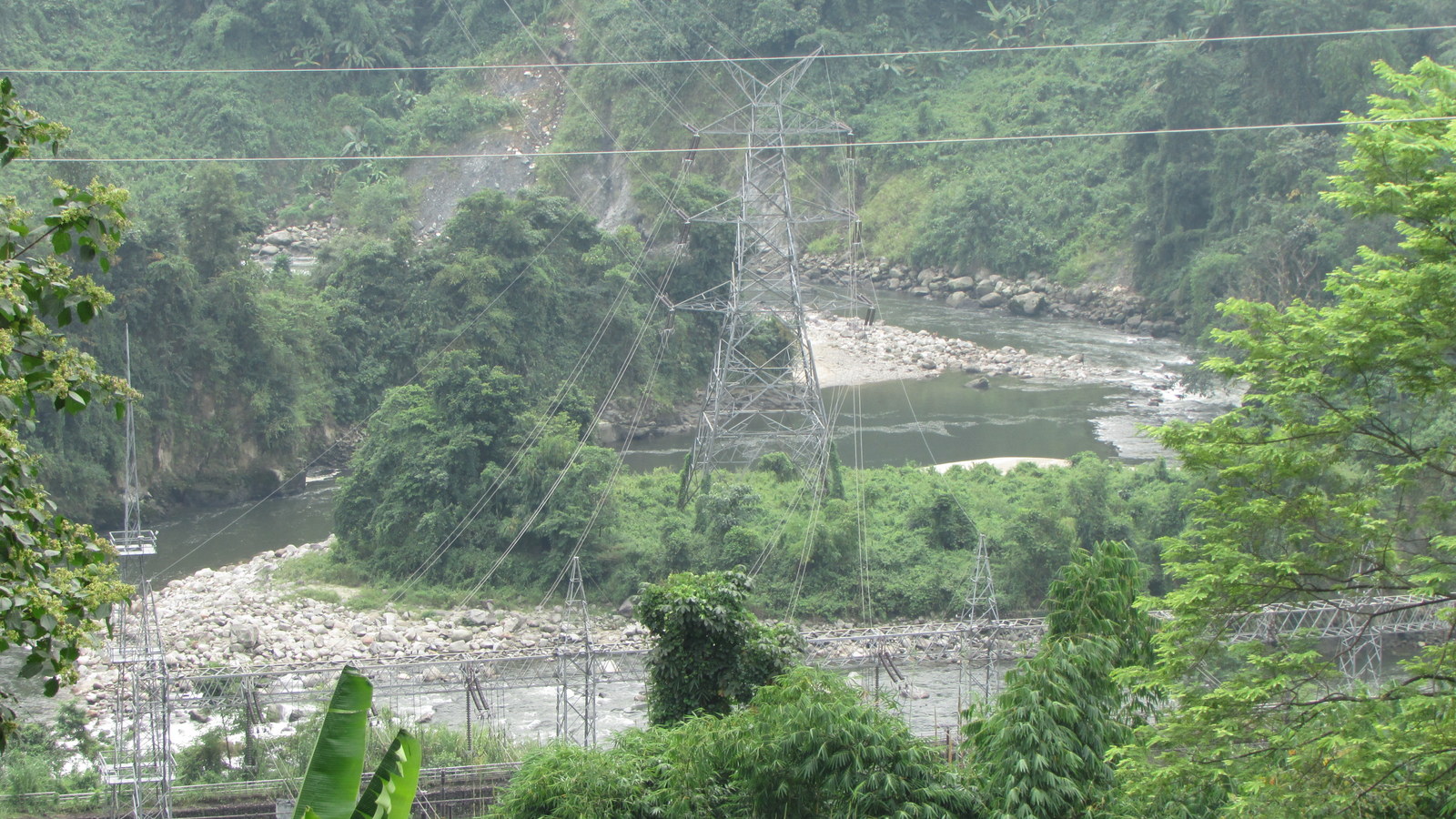
Lohit river in Anjaw district.  Source: EIA report
Lohit river in Anjaw district.
Source: EIA report

Disaster Management Plans do not mention about seismic risks Discussing the disaster management plan for the dam, the EIA study mentions only few issues and ignores the issue of earthquakes: “However, in the eventuality of dam failures in rare conditions, catastrophic condition of flooding may occur in the downstream area resulting in huge loss to human life and property. Floods resulting from the failure of constructed dams have also produced some of the most devastating disasters of the last two centuries. Major causes of failures identified by Costa are overtopping due to inadequate spillway capacity (34 percent), foundation defects (30 percent), and piping and seepage (28 percent).”

The EIA does not include the following important assessments:

a. Assessment of impacts of quarrying on the river bed and river banks The Kalai II project will require 72.6 lac cumec boulders for construction of the project and all of these will be extracted from the river bed and river banks.

Even though the EIA itself mentions how the removing of boulders and gravel from the river bed will affect spawning areas of fishes (page 10-29), but does not suggest for any detail impacts assessment. It limits itself by stating about adequate precautions during dredging period. But it is highly doubtful that any of those precautions will be followed when actual dredging will be done to extract lakh cumecs of construction material when there are no specific steps or mechanisms suggested. Without full assessment and management plan, the EIA cannot be considered adequate.  

b. Assessment of impacts of blasting for tunneling and other works in the pristine and fragile hill range – Blasting in the fragile hill ranges of Arunachal can have severe impacts, especially in increasing the probability of landslides. In Such circumstances, the EIA stating that no major impacts of blasting are envisaged at the ground level is wrong and puts a big question mark on the EIA.

c. Impact of the project on disaster potential of the area has not been assessed.

d. Impacts of peaking power operation on hydrological regime, biodiversity, and life & livelihoods of people

e. Impact of flushing out of silt from the reservoir

f. Impacts of climate change on the project and project’s impacts on local climate

g. There is no assessment of the value of the river that will be destroyed by submergence in the upstream and drying up and changed hydrology in the downstream.

h. The EIA has not properly assessed the downstream impacts of the project. It may be recalled that the ongoing massive agitation in Assam against such impacts of the under construction 2000 MW Lower Subansiri HEP, that has led to stoppage of work there since Dec 2011 is focused on downstream impacts and this project will face the same fate if this is not attended to.

i. No public consultations in Assam Linked to the above issue is the need for public consultations in downstream Assam about this and all other Lohit basin projects, without which there will be no question of public acceptability of the project and the project may face the same fate as that of Lower Subansiri HEP.

Doubtful, contradictory and sweeping statements in EIA The EIA at several places have stated made such statements:

Page 10 -23, para 4: “The construction of the dam would form the reservoir which will submerge about 640 ha of area in upstream. The area witnessed jhum/shift cultivation practiced by local inhabitants. Submergence of the area would not impact much on the prevailing land use pattern.”

This is clearly wrong, since jhum cultivation is one of the key livelihood supporting activity in these areas and if such land is submerged, it will have major impacts on the land use pattern.

Page 10 – 30, para 3: “As a result, barring for monsoon season, (May to September), the river Lohit will have dry periods for few hours for generation of peaking power.”
The idea of ‘few hours’ a complete misnomer and misleading, it will happen daily for 15-20 hours. In the analysis of Lohit basin study SANDRP had found that for Kalai II, “In lean season river water will be stored for a period of 15-20 hours. As a result, downstream stretch of river from the dam site will remain dry for that period. This will be followed by a continuous flow of 1112.27 cumecs (rated discharge) for a period of 4 to 9 hours.” (Lohit Basin Study by WAPCOS: A mockery of e-flows and cumulative impacts – https://sandrp.in/rivers/Lohit_Basin_Study_by_WAPCOS_A_mockery_of_e-flows_and_cumulative_impacts.pdf)

Parag Jyoti Saikia (meandering1800@gmail.com)

with inputs from Himanshu Thakkar  

——————————————————————————-

Annexure I

Villagers block road demanding scrapping of Kalai II dam

Link : http://www.arunachaltimes.in/wordpress/2012/06/06/villagers-block-road-demanding-scrapping-of-kalai-ii-dam/

Raju Mimi

HAWAI, Jun 05: About 500 villagers of Hawai circle on Monday staged a dawn-to-dusk road blockade at Walong-Hawai road demanding scrapping of the 1200 MW Kalai II dam proposed on LohitRiver.

The villagers protested under the banner of Peoples Forum for Project Affected Families (PFPAF). Road communication at Hawai was totally disrupted for the whole day affecting even the movement of military vehicles.

Talking over telephone from Hawai, PFPAF Chairperson Behenso Pul said: We had earlier submitted memorandum demanding scrapping of Kalai II dam to Union Ministry of Forest and Environment, chief minister, local representatives putting our grievances. But no one is listening to us. So we decided to launch our democratic movement.

The villagers staging protest demanded for permanent halt of property survey, and other survey and investigation being carried out for the hydro electric project. A memorandum was submitted to deputy commissioner, Hawai placing all grievances and the demands.

We are highly encouraged by the massive participation of villagers in such short notice. It is a great moral boost for people working against dam, said Pul. But there was no participation from panchayat leaders, students union and other civil society organization.

The Kalai II Hydro Electric Project is to be developed by one of the major Reliance Power subsidiary, Kalai Power Private Limited (KPPL). It was incorporated on September 26, 2007. The project site is in LohitRiver in Kumblung and the submergence route extends upto 23 km upstream.

The project involves construction of 161 meter high concrete dam. An underground power house will be constructed to house 8 units of 150 MW turbines. The total project cost is estimated at Rs. 69,551 million and is likely to be completed in 7 years time.

The Kalai II project will lead to submergence of entire Hawai circle and all the major villages. Around 1500 people are being directly affected by the dam, said Pul. Since last week, we carried out grassroots campaign on dams. We haven’t met one single person who is in favour of dam. Everyone one is scared and against it. In Anjaw district alone, at least 6 large dams are proposed within 150 km of river route out of 13 projects in the entire Lohit basin. Water and Power Consultancy Services (WAPCOS) had earlier conducted a cumulative impact assessment of various hydropower projects in the entire Lohit river basin, as per the directives of MoEF.

WAPCOS made a farce report, completing within 2-3 weeks. The study is very poor and shoddy, said Pul.

According to PFPAF, they are, however, not opposed to all dams in Anjaw district. They view that projects along the tributaries of Lohit river can be harnessed, instead of building large dams along the main river alone. Citing a report in a national news magazine, Pul said the tributaries of Lohit alone had capacity to produce 8000 MW.

Out of the 7 circles in Anjaw district, 5 are situated along the main Lohit river. Even Hawai headquarter is in the bank of Lohit river. So, if dams are built along the main river, majority of the 18000 Mishmi population will be affected, said Pul.

In April 13 meeting with Chief Minister Nabam Tuki at Tezu, the PFPAF had suggested the government to consider harnessing power in the tributaries of Lohit river, not in the main river, where majority of population live. It is learnt that chief minster had made assurance of stopping all dams wherever not required.

If small dams are built in the tributaries, which are in the interior places, people there can benefit in the form of roads and other developments,Pul said.

———————————————————

Annexure II

Anjaw shines in hydro power sector

Link : http://articles.timesofindia.indiatimes.com/2012-01-02/guwahati/30580969_1_hydropower-projects-hydel-project-power-supply

TNN Jan 2, 2012, 05.50AM IST

ITANAGAR: The remote Anjaw district of Arunachal Pradesh is marching ahead to notch a record in the hydropower sector and is being hailed as the future powerhouse of the country with a 58,000 MW hydropower potential.

Kaho, a village in the district located near Kibithoo along the tri-junction of the China-Myanmar-India border, had created a record in 2007 by becoming the first village in the state to have round-the-clock power supply besides supplying power to the Army personnel guarding the frontier.

This feat was achieved thanks to the determination of the lone elected representative of the district, Kalikho Pul, and the equally committed deputy commissioner, Prashant S Lokhande. The two officials were instrumental in commissioning a micro hydel project in the last border village, a 24-hour trek away from last pitch road, for which all the machines and material had to be transported manually.

The duo’s efforts in turning the odds to their advantage made Anjaw the first of the 17 districts in the state to commission many of the ongoing projects.

Pul, who toured the district and inspected all the project sites recently, said the 2X100 KW Yapak, 2X50 KW Khrowtipani, 2X250 KW Matinala and 2X250 KW Teepani projects were commissioned recently and made the border district self-sufficient in power.

At the moment, Hawai, Hayuliang, Goiliang, Manchal, Walong, Kibithoo and Metengliang administrative centres and adjoining villages are getting 24-hour uninterrupted power supply, Pul said, adding that various development activities would begin now with availability of power, thereby boosting the local economy as well.

Located along the Sino-India border, the district is spread across an area of 9,936 sq km and crisscrossed by numerous perennial rivers, including Lohit, Dav, Dalai, Lati, Kulong, Syang, Helei, Yapak and Kathang, has total hydropower potential of above 7,000 MW.

The projects – 2X50 KW Hatipani at Goiliang, 2X30 KW Ashapani, 2X100 KW Kachopani, 2X30 KW Maipani and 2X200 MW Langpani at Gamliang – are likely to be commissioned within a month or two, Pul informed.

He added despite the locational and other disadvantages, the projects could register speedy growth because of proper utilization of funds and strict monitoring.

The hydropower projects were taken up with the vision to benefit the locals as well as the state in general, he said, adding the 16 MW Haleipani project, which is at an advanced stage, is likely to be commissioned within 2012. “It will cater to the needs of Lohit, Dibang and Changlang districts besides meeting the requirements of Anjaw,” he added.

However, according to official sources, no steps have been initiated so far for erecting transmission lines for evacuation of excess power to be generated by the Haleipan project. Once the transmission lines are commissioned the state would be almost self-sufficient and would not need to purchase power at high prices from outside.

Pul added as the Haleipani project is on the verge of completion, the state government, particularly the hydropower department, should take up the transmission line project proposed in Anjaw. The project is pending with the department for the last many years. Without the transmission lines, any quantity of power generated would be futile as it cannot be utilized for any purpose, he said.

Kaho, a village in the district located near Kibithoo along the tri-junction of the China-Myanmar-India border, had created a record in 2007 by becoming the first village in the state to have round-the-clock power supply

——————————————————————–

Annexure III

INDIA: Violent Attack, Arbitrary Detention, Death Threats to activists of Meyor Community, Arunachal Pradesh

Link: http://www.humanrights.asia/news/urgent-appeals/AHRC-UAC-152-2013

ASIAN HUMAN RIGHTS COMMISSION – URGENT APPEALS PROGRAMME: Urgent Appeal Case: AHRC-UAC-152-2013

9 December 2013

—————————————————————————————

INDIA: Violent Attack, Arbitrary Detention, Death Threats to activists of Meyor Community, Arunachal Pradesh

ISSUES: Arbitrary detention, freedom of speech and expression, indigenous people’s rights, protection of environment, land rights, human rights defenders

—————————————————————————————

Dear friends,

The Asian Human Rights Commission (AHRC) has received information from civil society groups regarding death threats, arbitrary detention and harassment of members of the Meyor community, a group of indigenous people in Arunachal Pradesh. They are being targeted for their activities on conservation of community land and natural resources. The Meyor community with about 450 members is classified as one of the Scheduled Tribes under the Indian Constitution and is mostly confined to the Anjaw district of the state. They have been criticized for opposing government activities that includes conversion of community land to reserved forest land and corruption in the Public Distribution System (PDS).

CASE NARRATIVE Several representatives of the community assumed a leadership role. They are, namely:

Mr. Chung Meyor, 33, Dhanbari village

Mr.Chaping Meyor, 55, Gaon Bura (village chief), Khroati village

Mr. Unchen Meyor, 45, Barakhundun village

Mr. Chethel Meyor, 25, Dhanbari village

Mr. Tharpa Meyor, 26, Musai village

Mr. Tenzing Dorjee Meyor, 30, Sotakhundun village

Mr. Fendey Meyor, 30, Musai village of Arunachal Pradesh

These men protested the conversion of the community forest land of Walong and Kibitho area into reserved forest land because it was carried out without the free, prior and informed consent of the Meyor community.

The conversion of community land into forest land was initiated, allegedly, by Mr. Kalikho Pul, a member of the Arunachal Pradesh Legislative Assembly. He allegedly collected signatures from the Meyor community under the pretext of development works in the area. Conversion of this forest area was completed in 1995-1996 with a proposal of afforestation. Through an application, under the Right to Information Act, 2005 filed by Mr Dimso Manyu of the Meyor community, the people came to know of this development only on 14 March 2012.

The villages of the Meyor community are within a 36 square kilometer perimeter and their livelihood is dependent on natural resources. Over a period of time they faced limited access to the land resources due to the conversion of community land into ‘forest land’. Once they came to know of the conversion, the community vehemently opposed it. Due to their opposition, it is alleged that the police and unknown trouble-makers carried out frequent detentions, arrests, tortures and intimidations of community leaders and representatives of the Meyor tribe.

On 26 April 2013, armed reprobates arrived in a white Scorpio Jeep, threatened and attempted to torture Mr. Chung Meyor near Naraliang village on Tezu-Hayuliang Road. On the same day, Mr. Chung lodged a complaint about the incident at the Khupa police station. Police have not taken any action so far.

On 1 June 2013, Mr. Unchen Meyor filed a complaint at the Khupa Police Station. He cited mismanagement, corruption and illegal activities committed at a Fair Price Shop set up under the government’s Public Distribution System. Incidentally, on 12 November 2013 some local youths discovered that Mr. Agam Rai was selling PDS items illegally to people who were not subscribed under the PDS system. In connection to this discovery, a counter- police complaint was lodged by Mr.Kayawlum Tawsik, Chairperson, Zilla Parishad (local government), Anjaw Disttrict, against Mr. Unchen Meyor, Mr. Chethel Meyor and Mr. Tharpa Meyor.

On the night of 13 November 2013, Mr. Unchen and his family were brutally assaulted by a group of criminals at his residence in Barakhundun village. Mr. Unchen is still in critical condition due to injuries to his head, nose and chest. His daughter made a complaint about the attack on 15 November to the Khupa police station. However, till now, the police have not taken any action.

A second time, on 28 November 2013, Mr. Fendey Meyor, member of Gram Panchayat (local government) was arrested by the police from his village, Musai. They demanded the immediate surrender of Mr. Unchen, Mr. Chethen, Mr.Tenjing at the Khupa police. Mr. Fendey was released on 3 December on bail, with fabricated charges of vandalising still pending. Mr. Unchen is in hospital (at Aditya Diagnostic, Diburgar) struggling for his life. Mr. Chethen and Mr. Tenjing are in hiding, fearing for their lives and personal security. Similarly other community activists like Mr. Chung Meyor, Mr. Chaping Meyor and Mr. Tharpa Meyor are equally exposed to threats to their lives.

ADDITIONAL INFORMATION Arunachal Pradesh, bordering on China, is one of the most thinly populated states in India. It has 101 recognized indigenous tribal groups and about 50 languages. There are several rivers with the potential for generating hydro-electric power. The government has planned to construct some 168 mega-dams in the state, a move opposed by the indigenous people living there. There is a heavily militarized presence due to the international border. Draconian measures under the Armed Forces Special Powers Act, 1958 (AFSPA) is applicable in two districts of Arunachal Pradesh, namely Tirap and Changlang, and a 20 kilometer area bordering Assam.

SUGGESTED ACTION:

1.            Urge the Government Authorities of India and the State Government of Arunachal Pradesh to guarantee the physical and psychological security of the members of the Meyor Community and its leaders.

2.            Urge the authorities to protect the indigenous people’s right to land and resources.

3.            Urge the authorities to protect the environment and not to grant deforestation rights.

The AHRC is writing a separate letter to the UN Special Rapporteur on the Rights of Indigenous People and the UN Special Rapporteur on Protection of Human Rights Defenders for immediate intervention in this matter.

——-ooo——-

Arunachal Pradesh

Letter to APSPCB – Public Hearing for Kalai-II HEP to be held Violating the Norms

15 January, 2014

To:

Member Secretary,

ArunachalPradeshState Pollution Control Board,

Itanagar.

Sub: Violations in public hearing to be held on Jan 18, 2014 for 1200 MW Kalai – II HEP

Respected Sir,

The Arunachal Pradesh State Pollution Control Board (APSPCB) has proposed to conduct a public hearing for the 1200 MW Kalai – II project at Hawai on 18–01–2014. Through this communication we urge you to cancel the public hearing which is illegal for the following reasons.

We would also like to point out that EIA and EMP reports prepared by WAPCOS have not fulfilled a very large number of the TOR (Terms of Reference) that the project was to cover in EIA-EMP as per the TOR clearance given for the project on 9.12.2009. Such EIA-EMP will clearly not be acceptable even from statutory and legal point of view and cannot be basis for a public hearing.  A report on the status of compliance with TOR in EIA and EMP is attached along with a detailed critique of the EIA-EMP report. APSPCB and MoEF should immediately cancel the public hearing and ask the EIA-EMP consultants to comply with the TOR first.

1) Project currently has no valid Scoping (ToR) clearance The 1200 MW Kalai II project was granted Scoping (ToR) clearance on 9-12-2009 by the Ministry of Environment & Forests (MoEF). As per MoEF Office Memorandum (OM) dated 22-3-2010 the validity of Scoping (ToR) clearances granted for carrying out pre-construction activities is four years and therefore the clearance for Kalai II has expired on 8- 12-2013.

Hence the public notice dated 13-12-2013 issued by the APSPCB in the Arunachal Times dated 14 – 12 – 2013 for conduct of public hearing (a pre-construction activity) is illegal as the project did not  have valid Scoping / ToR clearance on those dates. Such a notice can only be issued if there is a valid Scoping clearance for carrying out pre-construction activities which is also placed in the public domain, which is not the case till date.

We have noticed that the Expert Appraisal Committee (EAC) on River Valley & Hydroelectric projects discussed the issue of extension of Scoping clearance for the 1200 MW Kalai II project and recommended extension in its December 10-11 2013 meeting. However, an order granting fresh Scoping clearance for an additional year has not been issued by the MoEF, which is the concerned regulatory authority. A perusal of the MoEF website till today (11-01-2014) shows that the Scoping clearance order available for the 1200 MW Kalai II project is only the original one dated 9-12- 2009 (which has expired on 8–12–2013) and no additional/fresh Scoping clearance is available.

In such a scenario, both the announcement and conduct of the public hearing on January 18th, 2014 is illegal, as no clearance existed on the date of public notice. It is only after the MoEF issues a fresh Scoping clearance for pre-construction activities to the 1200 MW Kalai II project (which is also placed in the public domain) can the APSPCB announce and conduct a public hearing (with no less than 30 days notice).

Hence we urge you to immediately cancel the public hearing announced for the 1200 MW Kalai II project proposed for 18-1-2014. Please note that issue of fresh Scoping clearance for preconstruction activities by MoEF between now and 18-1-2014 will still render the conduct of public hearing on 18–1-2014 illegal. Fresh notice will require to be issued after MoEF issues a fresh Scoping clearance with at least 30 days notice.

2. Law does not provide powers to MoEF to provide back dated extensions There is no provision in the EIA notification of Sept 2006 that could empower MoEF to provide back dated ToR clearances. Hence since MoEF has not issued any extension of the ToR to the Kalai II HEP before 8-12-2013 when the earlier ToR clearance expired, no extension of the ToR clearance can now be issued by MoEF and the project proponent will need to apply afresh for stage I or ToR clearance for the project. This will also be in fitness of things considering that WAPCOS is the consultant for the EIA for Kalai II HEP and we had written to the Chief Minister of Arunachal Pradesh (twice) and to the Union Minister of Environment and Forests that an EIA done by the WAPCOS will not be acceptable. We reiterate that stand and suggest that the fresh EIA should be awarded to a credible independent agency and any study by WAPCOS will not be acceptable, both due to its poor track record and also due to the conflict of interest involved in the governance (WAPCOS is an agency under Union Ministry of Water Resources which is largely functioning as a lobby for large river valley projects) and functioning of WAPCOS (as business model of WAPCOS also involves doing pre-feasibility, feasibility and Detailed Project Reports.

3. Non availability of Cumulative Impact Study Non availability of cumulative impact study of all the hydropower projects (including Kalai II) in the Lohit River Basin in the designated places 30 days before pubic hearing is another reason for the lack of legal backing for the public hearing. As per section 9.4 of form I of the EIA notification, it is necessary for the project proponents to provide information about cumulative impacts of the project along with other projects in the river basin. In the case of Kalai II, it would be cumulative impacts for all the hydropower projects in the LohitRiver Basin. However, a cumulative impact study of Lohit basin is available. Hence the public hearing proposed on Jan 18, 2014 is illegal. 

Breathtaking floodplains of the Lohit River, an important tributary of the Brahmaputra, threatened by the 1750 MW Lower Demwe Dam.  Photo: Neeraj Vagholikar
Breathtaking floodplains of the Lohit River, an important tributary of the Brahmaputra, threatened by the 1750 MW Lower Demwe Dam.
Photo: Neeraj Vagholikar

4. ToR of Kalai II not fulfilled As per the scoping Terms of Reference clearance issued to the 1200 MW Kalai II project on Dec 9, 2009, one of the objectives is to “perform a rigorous assessment of the significance of the bio-physical, socio-cultural and cumulative effects of the project.” However, the EIA of the project now available does not fulfill this (and a number of other TORs) and hence public hearing cannot be held without fulfilling the TORs.

5. MoEF OM stands violated Further, the MoEF vide Office Memorandum dated May 28, 2013 has stated that it will assess projects based on cumulative impact assessment studies. A LohitRiver Basin study has been commissioned by EAC/ MoEF to study the cumulative impacts of all the projects in the LohitRiver Basin (including Kalai II HEP). Although the draft report of this study is supposed to have been completed, it has not been approved by the Expert Appraisal Committee and thus and approved study is not available and such an approved study has also not been placed with the individual impact assessment study of the 1200 MW Kalai II project at all the designated places (DC office, etc) 30 days prior to public hearing. Thus public hearing for the project will also be in violation of the MoEF OM of May 28, 2013. This is one more strong ground for rendering the current announcement of the public hearing on 18-1-2014 as illegal.

6. Lessons from Uttarakhand Disaster for June 2013 The Uttarakhand flood disaster of June 2013 and the Supreme Court order of Aug 13, 2013 underscore the need for learning lessons from the disaster and also doing advance and credible cumulative impact assessment of the projects and also assessment of disaster potential and how the large number of projects impact the disaster potential of the area. However, this has not been done as part of the EIA for the project or otherwise and hence conducting a public hearing without such a study will not be prudent or proper.

7. Options Assessment not done Experience has shown that Anjaw district has huge potential of sub MW capacity micro hydro projects and these are sufficient for taking care of the power needs of the district, state and region. However, taking up the public hearing without doing such assessment will be clearly violation of EIA notification as such exercise is necessary part of EIA and this has not been done for Kalai II HEP.

8. Downstream Impacts not assessed, downstream consultations not done Downstream impacts of hydropower projects have proved to be huge and this is a very important and sensitive issue as is evident from the situation with respect of Lower Subansiri HEP in Assam where the project has been stopped for over two years now. In case of Kalai II HEP, comprehensive assessment of downstream impact assessment has not been done, nor has there been public consultations organized in downstream areas, nor has there been any public consultations for the Basin study in Anjaw or downstream areas. Without all these, the project public consultation will neither be useful nor legally valid.

9. Full EIA-EMP not available in local languages The full EIA-EMP or even proper executive summary of the EIA-EMP or the basin study is not available in local languages and also to all the gram sabhas in the affected region a month in advance of the public hearing. Holding public hearing in absence of these will clearly not be valid or proper.

Hoping for the prompt action in this respect from APSPCB to cancel the illegal public hearing for the 1200 MW Kalai II HEP. A failure to take action in this respect will lead to protests and legal action at the appropriate stage.

Yours sincerely,

Himanshu Thakkar and Parag Jyoti Saikia

South Asia Network on Dams, Rivers and People (SANDRP), Delhi

Copy to:

1. Deputy Commissioner, Anjaw district, Arunachal Pradesh

2. Shri Alok Perti, Chairman, Shri B B Barman, Member Secretary, and all the members of the Expert Appraisal Committee on River Valley Projects, MoEF

Arunachal Pradesh · Assam · brahmaputra · Sikkim

Review of Water Sector in Northeast India in 2013: Increasing threats to Rivers, People and Environment

The year 2013 was an important for the water sector of northeastern states of India with several significant events. In this article I have tried to summarize some of the important events, issues and concerns of the water sector in northeast.  

Massive hydropower projects considered and cleared for northeast An analysis done by SANDRP for the year 2013 has showed that massive hydropower capacity in northeast India has been considered and cleared by Expert Appraisal Committee (EAC) on River valley and Hydroelectric projects. The total installed capacity of considered by EAC for the year 2013 is 29458 MW and out of which 21805 MW (over 74% of 29458 MW) projects are in the northeast India. On the other hand out of the total capacity considered for northeast, 20180 MW (over 92.5% of 21805 MW) projects are in Arunachal Pradesh. The total number of projects considered from northeast for 2013 was 37, all (including the Dibang multipurpose project, which is basically a hydro project) are hydropower projects. Out of these 37 projects, 10 projects of 4917 MW installed capacity has been given TOR (Terms of Reference) clearance or the Stage 1 clearance. 4 projects with 953 MW installed capacity has been given final environment clearances. 13 projects with 9078 MW capacity had been given extension of their TOR validity which implies that in next 2-3 years all these projects would also come up for final environmental clearance.

Pare hydro-power project on Pare/Dikrong river in Arunachal Pradesh is currently under -construction.  Photo – Parag Jyoti Saikia
Pare hydro-power project on Pare/Dikrong river in Arunachal Pradesh is currently under -construction.
Photo – Parag Jyoti Saikia

India-China Water Information Sharing MoU of October 2013 One of the most important developments of the year 2013 was the signing of this Memorandum of Understanding through which it was agreed that the current hydrological data (Water Level, Discharge and Rainfall) in respect of three stations, namely, Nugesha, Yangcun and Nuxia located on river Yaluzangbu/Brahmaputra from 1st June to 15th  October every year will now be extended to May 15th to Oct 15th with effect from 2014. Another important news through this agreement is that the Government of India recognizes the value of river since the agreement writes “rivers and related natural resources and the environment are assets of immense value to the socio-economic development.” But this agreement has been misread and misreported by a large section of the media. SANDRP wrote a detailed blog “Media Hype Vs Reality: India-China Water Information Sharing MoU of Oct 2013” which clears the fog around this agreement.   The blog also lists formation and decisions of the meetings of the Expert Level Mechanisms (ELM) on Trans-border rivers and MoUs on Hydrological Data Sharing on River Brahmaputra / Yaluzangbu and Satluj / Langquin Zangbu.   

Forest Clearance Rejected for Tipaimukh and Dibang Hydropower Projects In the year 2013 the rejection of forest clearance to 1500 MW Tipaimukh hydropower project and 3000 MW Dibang multipurpose project by the Forest Advisory Committee (FAC) of MoEF is noteworthy. Here it should be noted that the Prime Minister of India laid foundation stone for the Dibang Project in Jan 2008 when the project did not have any of the statutory clearances! However, NHPC has already started lobbying the Prime Minister headed Cabinet Committee on Investments to intervene for the forest clearance for Dibang Project and a note has already been moved for this. We hope these FAC decisions are not reversed as it happened in case of Kalu dam in Maharashtra, where the FAC decision was reversed following a letter from the Chief Minister. The stay over the construction work of Maphithel dam in Manipur by the National Green Tribunal could have been regarded as a positive sign but recent reports suggests that Union Ministry for Tribal Affairs (MOTA) had done a U-turn by going “back on its views to say that the Forest Rights Act should not apply to the acquisition of land from the Tanghkul and Kuki tribal people as a ‘rare and unique’ exception.”[1]

Two years of Anti-dam protests in Assam and Tripartite Talks The protest against large hydropower dams in Arunachal Pradesh had reached a new milestone as the stoppage of construction work of Lower Suabansiri hydropower project completed two year on 16th December 2013. This stoppage of the construction work of the Lower Subansiri project has brought the issue of downstream impacts of large dams to the forefront and also showed how a mass movement can question a top-down development project. These protests were led by Krishak Mukti Sangram Samiti (KMSS), All Assam Student Union (AASU), Asom Jatiyatabadi Yuba-Chatra Parishad(AJYCP) along with several other organizations.

KMSS president Akhil Gogoi with other members take out a procession in Guwahati on 16th December, 2013.  Picture by UB Photos
KMSS president Akhil Gogoi with other members take out a procession in Guwahati on 16th December, 2013. Picture by UB Photos

On Dec 6, 2013, a tripartite discussion was held involving the central government, Government of Assam and experts protesting organizations. Though this meeting failed to come to a common resolution, it led to the expert to expert meeting on the Lower Subansiri dam issues on 22nd December 2013.

These discussions not only help in building public opinion about the issue but also provide platform to discuss the larger issues related with 168 hydropower dam proposed for Arunachal Pradesh and its cumulative impacts in the larger Brahmaputra basin.

Foreign Funding of Hydropower projects in Northeast In the year 2013 Asian Development Bank has agreed to give loan of $ 200 million to construct the Lower Kopili Hydropower project in Karbi Anglong and Dima Hasao districts Assam. This project is being constructed by Assam Power Generation Corporation Limited (APGCL) and it is 8 km downstream of Kopili hydropower project, first dam on Kopili river. It is important to note that acidic contamination of water due to unabated mining in the upstream Meghalaya is a poses a major threat for the viability of the dam and this was disclosed in a study initiated by the project proponent. This project was given TOR clearance in the 69th meeting of EAC.

Proposed Site for Lower Kopili HEP in Assam Photo - Parag Jyoti Saikia
Proposed Site for Lower Kopili HEP in Assam.
Photo – Parag Jyoti Saikia

Foreign funding of hydropower project comes with the risk of huge cost overruns. This was evident in the case of Pare HEP on Pare/Dikrong river which NEEPCO constructing taking a loan of 80 million euros from KfW, a German Bank. Incidentally, this project was schedule to be completed in September 2013 but Central Electricity Authority status report on projects under execution now states the completion time as 2015. The cost of this project has already increased by 205% from its initial estimates. The loan amount along with the interest rest is also increasing year by year and NEEPCO’s 36th Annual Report of 2011-12 states that the loan taken from KfW is “repayable in 30 equal half yearly installments w.e.f. 30.12.2013.” This implies that even before the completion of the project the company has to start paying back the loan.

SANDRP had written a detail blog titled “Lower Kopili HEP: Oustanding issues that must be resolved before EAC can consider the project” which discussed the issues related with the proposed dam including the increase in intensity of floods in downstream Nagaon.  

Assam’s Flood Devastation For Assam, the central state of northeast India, flood is an annual event. In the year 2013 Assam witnessed three waves of flood. The table below provides a glimpse of the extent of the flood disaster Assam faced in 2013. The data is sourced from National Disaster Management Institute under the Ministry of Home Affairs of Government of India. 

Data from NDMI, Government of India

Months No of affected People No. of affected districts No of affected Villages
30th June

14649

4

70

31st July

7971

4

55

31st Aug

6123

3

73

16th Sept

6123

3

73

But it was surprising to find that the numbers of affected people and villages provided by a central government organization is much less than the number provided by the disaster management department of the state government. The State Disaster Management Authority of Assam (SDMAA) provides much larger number of affected people. During the monsoon months of 2013, SDMAA published daily flood report on its website. After following the flood reports of four months, the following table with some key dates has been prepared to give an idea of the discrepancy between state government and central government data.

Data from SDMAA, Government of Assam

Months No of People affected No. of districts affected No of Villages affected
30th June

22,696

7

125

16th July

31,174

4

107

31st July

7716

4

45

10th August

53,714

4

164

15th August

33,563

5

102

24th August

6123

3

73

31st August

10,851

4

70

2nd September

2714

3

55

6th September

1,45,054

8

411

7th September

3,24,531

14

572

10th September

3,54,731

13

534

16th September

2510

2

16

This discrepancy points towards the lack of the coordination between the state and the central government departments which is clearly not good sign. Floods need serious attention and such misreporting can lead to confusions which will ultimately have bearing on the people of Assam. It is important to mention that many in Assam believe that the problem of flood in Assam has not been dealt adequately by the central government. The discrepancy detailed above reinforces that belief.

False claim about climate induced displacement in Northeast India by a global agency In connection with the flood issue, the year 2013 will also be marked by the publication of the report named “Global Estimates 2012 – People Displaced by Disasters” by Internal Displacement Monitoring Centre (IDMC) based in Geneva, Switzerland. This report had stated that the largest climate induced displacement in the world for the year 2012 happened in two states of Northeast India, Assam and Arunachal Pradesh in June 2012 due to the monsoon floods which displaced 6.9 million people, constituting about 21.2% of the population of the two states. But a detailed analysis of this report by SANDPR revealed that the though these figure are highly exaggerated. This analysis is available at “2012 Floods Displaced 6.9 Million in Northeast-IDMC: Staggering but Highly Exaggerated”.

Havoc of Erosion In Assam, along with annual floods, river bank erosion by Brahmaputra and its tributaries is a major cause of concern. The year 2013 is also no exception and severe erosion was reported in several parts of the state. A report Study of Brahmaputra River Erosion and Its Control done by IIT Roorkee, published in 2012 measured the loss of land due to erosion of Brahmaputra for nearly two decades in twelve reaches of the river. The total loss of land on both sides of the river Brahmaputra is mentioned below.

North Bank

South Bank

Total Erosion Length (km) 1990 to 2007 – 08 (in sq. km) 1997 to 2007-08 (in sq. km) Total Erosion Length (in km) 1990 to 2007 – 08 (in sq. km) 1997 to 2007-08 (in sq. km)
353.85 538.805 327.726 389.13 914.62 730.8

This report, sponsored by National Disaster Management Authority (NDMA), was a very descriptive report from the point of information and data about the river Brahmaputra and its tributaries. But an analysis of the report done by SANDRP, found that this report was biased towards structural interventions and hydropower projects and oversimplifies the problem of erosion by identifying ‘sediment overloading’ as the main reason for erosion. This analysis can be found at NDMA Commissioned IIT Roorkee Study on Brahmaputra River Erosion: A Biased and Structural Solution Oriented Report?”. 

protest against the state governments inactiveness to prevent erosion  Photo: Asomiya Pratidin
protest against the state governments inactiveness to prevent erosion
Photo: Asomiya Pratidin

The year 2013 also witnessed people in river-rine areas of Assam demanding relief from erosion. On May 21st 2013, the people of Bahgara Dhunaguri village panchayat in the Lakhimpur district of Assam floated the effigy of State Water Resources Minister Rajib Lochan Pegu in a traditional raft in the Subansiri River in Dhunaguri Baduli Para area. The TMPK units of Dikrong Awanori and East Dikrong joined in this protest. According to the beliefs of Mishing society when someone dies due to unnatural causes, his/her body is floated in a traditional raft in flowing river. People accused that Mr. Pegu had completely failed to perform his duty as a water resource minister and he had not been able to give any relief to the people by preventing flood and erosion. Failing to perform his duty has been regarded as the ‘unnatural death’ of the minister & that was why people floated the effigy of the minster.[2]
With respect to construction and repair of embankments, some serious issues were brought to light in the year 2013. In May 2013, All Assam Water Resources Contractors’ Association revealed that out of the total embankment length of 4473.82 km in Assam, the government had repaired only 1327 km embankment, leaving 3673 km long embankment completely vulnerable to floods.

Parag Jyoti Saikia (meandering1800@gmail.com)

with inputs from Himanshu Thakkar

——————

In the year 2013, SANDRP has written 13 blogs on issues related to North East India. A list of those blogs is given below. SANDRP has also made continuous submissions on dams and basin studies from Northeast to EAC and those submissions are available in our website https://sandrp.in/.

  1. NDMA Commissioned IIT Roorkee Study on Brahmaputra River Erosion: A Biased and Structural Solution Oriented Report?      
  2. 2012 Floods Displaced 6.9 Million in Northeast-IDMC: Staggering but Highly Exaggerated       
  3. Review of “Water Conflicts in Northeast India – A Compendium of Case Studies”: A Welcome Initiative
  4. CWC Flood Forecast for Assam: Issues Started Arriving before Floods   
  5. Brahmaputra – The Beautiful River or The Battleground?
  6. IWMI report on Glaciers and Snow cover in Himalayas in Changing Climate: Significant Impact on Seasonal flow of the Rivers in India   
  7. Lower Kopili HEP: Oustanding issues that must be resolved before EAC can consider the project 
  8. Subansiri Basin Study – Another Chapter of Environment Subversion in Northeast
  9. Climate Change, Migration and Conflicts in Assam-Bangladesh: Why we need better reports than this 
  10. Hydro Power Projects Violating SC order in the Greenest State of India 
  11. When EIAs Don’t Know River Lengths! Review of EIA/EMP of Simang I & II HEP on Simang River in Arunachal Pradesh        
  12. Media Hype Vs Reality: India-China Water Information Sharing MoU of Oct 2013
  13. Comments on Scoping Clearance Application of Panyor HEP on Ranganadi River in Arunachal Pradesh   


[2] Dainik Janambhumi, Guwahti, “Brahmaputra, Subanshirir Khohoniya Tras” 22nd May, 2013

Delhi

AAP Government in Delhi: Agenda on Water

Dear Arvind and everyone else at AAP,

It is indeed a historic day in Indian politics and governance as AAP government led by Arvind Kejriwal took oath at Ramlila Ground today(December 28, 2013). It gives and amazing, thrilling feeling and has filled us with joy and hope. It is indeed likely to change the politics of India in fundamental ways. Salutes to all those who made this possible.

As well wishers we are unable to avoid the temptation of writing to AAP about some of the things they can be done in whatever little time that they may be allowed to govern in Delhi.

1. Democratise governance of DJB Delhi Jal Board (DJB) is one of the most non-transparent, non participatory, unaccountable bodies. Longer term agenda would need to institutionalize bottom up democracy in its functioning from mohalla sabha level to the top. In the mean time, you can tame some immediate steps to ensure that there is immediate independent oversight and participation of the Board. The steps suggested in AAP manifesto like putting daily readings of bulk water meters at each step are certainly welcome, but more steps are required in this line regarding the governance of the Board.

2. Stop Supply side projects Delhi as a city is privileged place. As even planning commission has noted, Delhi gets more per capita water than Amsterdam, Paris, Bonn or most other European cities. The amount of water that Delhi gets is sufficient to provide for necessary needs of today and even for all future times. Delhi should not be asking for any more water from new dam projects like the Renuka, Lakhwar and other dams. To move in that direction, DJB can be asked to prepare a plan for next 20 years (as a first step) assuming Delhi wont get any more water than it currently gets. As you are well aware, there will be several components of this plan including: A. Rainwater harvesting B. Plugging leaks C. Instituting Water Audits D. Putting in place functioning water meters at each junction E. Adequate treatment of wastewater F. Reuse and recycle of waste water G. avoiding unnecessary water intensive activities H. Protecting local water bodies I. Ensuring sustainability of flood plains, Ridge and other such ecological spaces J. Ensuring protection of catchments. 

Delhi's Water Sources
Map of Delhi’s Water Sources

Some of these are elaborated below and all of them can be effectively achieved only with democratic water governance.

DJB should also be asked to get out of the commitment for resources for Renuka and other upstream projects and also need for such projects.

3. Rainwater harvesting Ask DJB to prepare time bound plan to ensure that there are functioning rainwater harvesting and use/ recharge systems in place at: All government buildings, all colleges, all schools, all institutions, all metros, all railway stations, all flyovers, all (over-ground) metro lines, all parks, all malls, all multiplexes, all commercial buildings. Many of the storm water drains can also be used for recharging groundwater where appropriate. This should be time bound and consequences to follow after a reasonable time limit say one year. There should be some credible way of ensuring that these function.

4. Sewage Treatment PlantsDelhi has India’s largest installed capacity of STPs, but none are functioning as per the design in terms of quantity or quality of outputs. Put in place credible governance for these to ensure that they function and make specific officers responsible for these and mechanisms to ensure they face consequences when these STPs do not function. Each plant can immediately have a monitoring committee including AAP or local MLA, media persons, civil society persons and RWA persons. 

There are 18 STPs in Delhi, even though this map shows the location of only 17 STPs
There are 18 STPs in Delhi, even though this map shows the location of only 17

5. Decentralisedsewage capacities Where necessary and possible, put in place decentralized STPs using less resources and more environment friendly methods in a time bound manner. All large establishments in any case should have their own STPs and water recycle plans. Additional STP capacity should preferably be decentralized one. DJB should be asked to prepare norms and plans for these.

6. Sewage reuse plans DJB should be asked to prepare a credible sewage reuse and recycle plans so that there is less pressure on fresh water supply and more recycled sewage is used to meet non potable use in the city. 

In addition to the DJB the three wings of the MCD must also in tune with the DMC Act 1957 be re-vested with roles and responsibilities for an efficient sewerage system and management in the city.  

7. Drainage system A functioning drainage system and their maintenance is key part of urban water system and it is good that AAP manifesto has included this. DJB should be ask to put their plan on this in public domain along with the maintenance system and those responsible for it. Connect this too to Mohalla Sabha.

8. Groundwater governance It is well known that Delhi is over using groundwater, 2004 estimates show that this was 70% above the recharge then. The governance of groundwater use is under DJB and this needs to be democratized and only at RWA, mohalla or ward level can there be proper governance, which needs to be put in place urgently, along with more recharge systems. Ask DJB to prepare a ground water map of Delhi along with aquifer map (over longer term) and use it to integrate rainwater harvesting, local water sources and Delhi water supply.

9. 700 lphd free water Equity in water distribution remains a serious issue in the city. On the AAP promise to provide free water to those that are going to use less than 700 litres water per household (or less than 140 lpcd), while intentions of helping ensure those who are using minimum water is good, there are a large number of question marks. We sincerely hope this does not translate into clamour for more water for Delhi from outside sources. Secondly, we hope this does not lead to wastage of water, which would actually mean less water available for those who do not have. This also hinges on functioning household level water meters. Moreover, 140 lpcd may be the norm, at least 50 lpcd would be guaranteed with credible enforcement mechanism. Even this 50 lpcd can be provided at minimum token price of Rs 1 per KL. Those who use higher quantity should be asked to pay for the full water use with some subsidy and those who use more than 140 lpcd should be asked to pay higher than cost price so that there is some revenue generation for cross subsidization for the poor. Water price should include the full sewage treatment cost. Incentivising local treatment and reuse is an excellent idea in AAP manifesto. 

The Cost of Delhi's Water: Protest against Construction of Renuka Dam in Himachal Pradesh
The Cost of Delhi’s Water: Protest against Construction of Renuka Dam in Himachal Pradesh

10. Investigate Munak stalemate We have noticed that AAP manifesto talks about ensuring that Delhi gets is water share from Munak based on the money spent. However, one of the reasons Delhi is not getting that water is that Delhi did not enter into an agreement with Haryana before agreeing to provide money for the Munak project. It needs to be investigated why did Delhi agree to spend money on Munak before entering into such legal agreement. AAP govt may consider instituting such an investigation.

11. Yamuna river There is a lot that is required to be done for the Yamuna river, some of which has been highlighted in the AAP manifesto as well.  Some of the steps listed above could help the cause of the river. Some of the addition steps should include: a) Demarcate Yamuna flood plain to ensure there is no more encroachment of the same; b) some of the current encroachments can be asked to vacate the flood plain in time bound manner; c) ensure there is some releases of water from Hathnikund and Wazirabad barrages immediately, ask for a long term plan for the river assuming there will be no more dams in the upstream.

12. Transparency about and reversal of agreements with Degremont, Veolia and other private companies The agreement that DJB has entered into with various private companies on Sonia Vihar, Rithala and other projects and the three water supply zones should be put in public domain and ways found to reverse them where possible.

We know Mr Kejriwal and lot of others at AAP would be familiar with a lot of this since Mr Kejriwal led the successful campaign against water privatisation in Delhi in 2005, and we hope credible steps would be taken up in these directions as soon as possible.

Thanking you,

Yours sincerely,

Himanshu Thakkar

(ht.sandrp@gmail.com)

South Asia Network on Dams, Rivers & People (https://sandrp.wordpress.com/, http://sandrp.in)

Manoj Misra

(yamunajiye@gmail.com)

Yamuna Jiye Abhiyaan (http://www.peaceinst.org/)

Dams · Maharashtra

Multiple Dams for Mumbai Region have Severe Impacts and are Unjustifiable

Press Release                                                                                                                                                  18.12.13                           

Multiple Dams for Mumbai Region have severe impacts and are unjustifiable

More than 50 people including tribal groups, social activists, water experts, ecologists and wildlife experts, academics came together for a brainstorming workshop about Dams coming up for Mumbai Region. The meeting was organized by South Asia Network on Dams, Rivers and People, Shramik Mukti Sangathana, Jalbiradari and Keystone Foundation.

About 12 dams are planned or are under construction to satisfy the increasing thirst of the Mumbai Metropolitan Region (MMR). All of these dams fall in eco-sensitive region of the Western Ghats. They will together submerge more than 22,000 hectares of land, including nearly 7000 hectares of forests, lakhs of trees and more than 750 hectares of Tansa Sanctuary. They will affect a minimum of 100,000 tribals who depend on the forests and their ancestral lands for livelihoods. These dams include Kalu, Shai, Balganga, Susari, Khargihill, Bhugad, Pinjal, Gargai, Middle Vaitarna, Barvi and Poshir, among others. These are in addition to the dams already constructed for MMR water supply.

Tribals and other affected groups of Thane and Raigad region have been strongly opposing these projects. Most people in Mumbai seems unaware of their struggles or impacts of these projects.

Most of these dams are escaping the social and environmental impact assessments and management plans, environment clearance requirements, environmental monitoring or public consultations due  to blunders in environmental impact assessment notification of Sept 2006, which excludes domestic and industrial water supply projects from environmental clearance process.

MMR has not done any sort of options assessment before pushing these projects and cursory review show that many options exist. At the city or Region level, there is no shortfall in water supply currently and the existing problems are due to inequitable, non-transparent, non-participatory and wasteful water governance in MMR. Municipal corporations under the MMR which are pushing new dams do not treat even 15% of their sewage. Bhiwandi Nizampur & Vasai Virar Corp do not treat ANY of their sewage. The Mumbai Region has no estimate of its rainwater harvesting potential, and there is little effective action in this direction despite high rainfall. Water supply and distribution losses are over 30%. Local water sources like rivers, lakes and wells are being destroyed by pollution and encroachments. There is no interest in democratizing governance of MMR water sector.

We urge the MMR region to address these issues first, which would lead to sustainable water supply to the city and suburbs. Konkan Irrigation Department which is constructing most of these projects has violated several laws related to tribal and forest rights, environment, forests and resettlement and has been mostly favoring a single contractor, illegally.

We strongly urge the MMRDA, MCGM, Municipal Corporations of MMR, Maharashtra government, Union Ministry of environment and forests, Maharashtra Forest Department, National Board of Wildlife and all others concerned to ensure that following steps are taken up urgently and in a credible way:

  1. Undertake thorough options assessment for Mumbai’s (and also same for other cities of MMR) water needs which includes groundwater use, local water sources, rainwater harvesting, sewage treatment and reuse, water supply efficiency, etc.,
  2. Undertake Environmental and Social impact assessments for all the dams coming up for Mumbai Region
  3. Take immediate action against KIDC for violating multiple laws while bulldozing ahead with projects and MMRDA for funding projects in the absence of clearances
  4. Respect peoples protests and Gram Sabha resolutions against displacement, deforestation and their refusal to give permission for these projects
  5. Take strong penal action against the officers and the contractors who have displaced Adivasis illegally
  6. Not to resume any work or planning for any project before the above is done, stop work on projects in the meantime.
  7. Change the EIA notification to ensure that all large dams are included for environment clearance, public hearings and EIA requirements.
  8. Immediately institute a credible Cumulative Impact Assessment of the projects already constructed and advanced in implementation.
  9. Institutionalize decentralized, democratic governance of water sector in MMR from bottom to top.


Forests in the Western Ghats are Mumbai’s and MMR’s lungs. They are the watersheds of rivers and water sources like Tansa and Bhatsa and naturally purify Mumbai’s & MMR’s drinking water.

Rich tribal culture of Thane and Raigad is a shared heritage of Mumbai and we have no right to displace the tribals or destroy their livelihoods.

Stop this destruction in Mumbai’s backyard.

Indavi Tulpule (indavi62@gmail.com), Shramik Mukti Sangathana, Thane;

Surekha Dalvi, (surekhadalavi@yahoo.com) Shramik Kranti Sangathana: Raigad;

Brian Lobo, (brianlobo6@gmail.com) Shramik Kashtakari Sanagthana: Dahanu;

Prashant Sarkhot, (loksangramsamiti@gmail.com)Shai Dharan Viroddhi Samiti,

Sitaram Shelar (sitaram.shelar@yuvaindia.org) YUVA, Mumbai;

Janak Daftari (daffy@jalsangrah.org), Jal Biradari, Mumbai

Shripad Dharmadhikary (manthan.shripad@gmail.com), Manthan Adhyayan Kendra, Pune

Parineeta Dandekar (parineeta.dandekar@gmail.com, 09860030472), SANDRP, Pune


Bihar · Embankments

Flood activist Shashi Shekhar on indefinite fast in Sitamarhi (Bihar) Against Unwanted & unjustified embankment and for a River

Today (on Dec 17, 2013) is the 8th day of indefinite fast by flood activist Shashi Shekhar in Sitamarhi (Bihar) with a demand to stop work on the unwanted and unjustified embankment along the Jheem river (part of Adhwara group of rivers in North Bihar) and for bringing Lakhandehi river back to its path where it was flowing less than a decade back. Several others have joined the fast since it started on Dec 10, 2013.

Activist Shashi Shekhar Speaking at a workshop in Patna

The demand is to prevent the shifting of river Lakshmana Ganga (Lakhandehi) toward east and to divert the river towards the west, so that the 147 km stretch of the original course resumes to get the river water, thereby helping hundreds and thousands of farmers, who are presently facing water scarcity. This can be done by desilting of the Lakhandehi river. The demand is also to stop work on the embankment along the Jheem River.

We are copying below the statement below compiled by Megh Pyne Abhiyaan, Bihar, from the statements and reports provided by Mr Shashi Shekhar. It explains the background of the situation.

Bihar government that has taken the decision of building the embankment without any consultation with the local people and even without any impact assessment and seems to be driven by contractor interests and have not yet bothered to respond. The state water resources ministry says that only the Chief Minister Nitish Kumar can take a decision on this and we see not effort from that quarter. With every passing day the health of Mr. Shekhar is deteriorating and the state government will be held responsible for any eventuality in this regard.

All this also highlights a serious anomaly in the Government of India’s EIA notification of Sept 2006 that excludes embankments and other such flood related structures from the need for environment clearances, environment impact assessments and also any public consultation process. This is clearly wrong since embankments have huge social and environmental impacts. This needs to urgently change, but the MoEF has not done that in spite of numerous letters to the ministry since 2006.

Local media is reporting on this on daily basis; the national media is yet to carry this except an isolated report or two[1]. We hope national media carries this important news.

SANDRP

PS: On Dec 19, 2013, Eklavya Prasad conveyed: Flood-activist Shashi Shekhar’s indefinite fast (against the construction of embankments along Adhwara Samuh and demanding de-silting of River Lakshmana Ganga (also known as Lakhandehi) was called off last evening. The negotiations between the district administration/state and Shashiji went off well and ALL his demands were have been accepted. According to Shashiji his indefinite fast has helped to take issues to a logical conclusion!

2. No action was taken following the assurances, so the fast was to resume in January 2014 as per this report: http://www.indiawaterportal.org/articles/indefinite-fast-continues.

3. Chicu from IWP wrote this piece in March 2014, which says the demand of bringing the Lakhandei river back to its course is not feasible and due to the priorities of the state government, the construction of embankments is likely to continue.

4. July 28, 2014: A petition by Shashi Shekhar against “the present project for raising the embankment along river Jhim and Jamura (Adhwara Group) from Sonbarsa Bazar to Sonbarsa Village” was rejected by Patna High Court, see full order: https://indiankanoon.org/doc/154770140/. It said in the end: “Counsel for the petitioners then submitted that in the name of the project the executants of the project are coming to the raiyati land in the adjoining area and are forcibly cutting the soil from the raiyati land. If that is so, the raiyat concerned, from whose land soil is forcibly taken out by the executants of the project, is at liberty to lodge First Information Report against such illegal soil cutting from the raiyati land.”

5. March 28, 2017: A petition by Brahmaputra Infrastructures, one of the contractor for the project, in Patna High Court. The order is available here: https://indiankanoon.org/doc/50437728/.

Statement


Sangharsh Yatra – A incessant protest for service, development and justice

Highlight On December 10, Shashi Shekhar, a well-known flood activist from Sitamarhi district of north Bihar started an indefinite fast on the banks of River Lakshmana Ganga (also known as Lakhandehi), as part of Sangharsh Yatra, protesting against the construction of embankments along Adhwara Samuh rivers.

Background River Lakshmana Ganga (Lakhandehi) previously flowed into India near pillar number 32 at Dularpur village in the Sonbarsa block of Sitamarhi district after crossing Simraha in Nepal. The distance between these two villages across the border is approximately 1.5 kilometers (km). However, presently the river has shifted almost 1-1.5 km east from its original location (i.e pillar number 32). The reason for this shift is being attributed to the siltation that has occurred, 8 km north of the Indo-Nepal border around Laxmipur village, which is located in Nepal. Because of this shift, the river on the Indian side has now started flowing near pillar number 35 at Choti-Bharsar village.

The shift in the river’s course towards east has resulted in its draining into river Jamuda, which is a part of the Adhwara-Samuh. Additional water of river Lakshmana Ganga (Lakhandehi) in river Jamuda has started causing floods thereby affecting Sitamarhi, Darbhanga, and a small part of Madhubani districts. People fear that the consistent shifting and flooding of Lakhandehi towards the east will lead to the flooding of the river Jheem, which is also a part of the Adhwara-samuh. They believe that flooding of Jheem will create havoc in the region as Sonbarsa block will get inundated. The shifting of the Lakshmana Ganga (Lakhandehi) from the west to east has dried up the original 147 km stretch of the river (in India), causing problems for the local farmers. Sustenance of productive agriculture along the old course of Lakshmana Ganga (Lakhandehi) is posing as a huge challenge.

The protest According to Shekhar, since 2002 he has been fighting against the mindless construction of embankments by writing letters to various government authorities and holding discussions with the concerned officials. However, there has been no positive response from the Bihar government, forcing him to take the extreme step of indefinite fast to protect the rivers from further destruction.

According to Shekhar this indefinite fast is to attract state government’s attention to prevent the shifting of river Lakshmana Ganga (Lakhandehi) toward east and to divert the river towards the west, so that the 147 km stretch of the original course resumes to get the river water, thereby helping hundreds and thousands of farmers, who are presently facing the wrath of river water scarcity. On the other hand, Shekhar is also trying to address the problems of farmers around and along the river Jamuda of excessive floods, being caused by the the draining of the river Lakshmana Ganga’s (Lakhandehi) water into river Jamuda. The other reason for Shekhar to resort to an indefinite fast is to highlight the skewed flood management strategy adopted by the state government. According to him, the shifting of Lakhandehi is causing excessive floods in Adhwara-Samuh. However, the state instead of constructing ‘thokars’ (boulder structures) to divert Lakhandehi from east to west, is investing in construction of embankments along the rivers of Adhwara Samuh.

The sheer diversion of the river Lakhandehi will substantially reduce the incidences of floods in Adhwara Samuh. This simple logic/solution is being ignored by the state government under the pretext of Lakhnadehi being a trans-boundary river, as if no structural intervention has ever taken place in any trans-boundary rivers in north Bihar.  According to him the state government is using the scenario to basically push for the mindless construction of embankments along the Adhwara Samuh rivers. The embankments that are being constructed are approximately 20-25 feet tall and the distance between two embankments is 80-500 feet. Shekhar is unable to fathom the technical reasons for the constructions of these embankments along the rivers that stay dry for almost four months a year and are only 20-40 feet wide.

Shekhar is raising strong objections to the manner in which embankments are being constructed and repaired on Adhwara Samuh rivers by contractors – M/S Brahamputra Construction and M/S Avantika Dhara Reddy and Brothers. With support of police officials and some bureaucrats, these contractors have forcibly taken lands from the farmers by threatening them to sign on false papers. Shekhar claims that no compensation has been given by the government for the land that is inside and outside (immediate vicinity) of the embankment. The land acquired for the construction of the embankment is what has been compensated, though farmers have been offered a pittance as compensation against their land.

According to Shekhar, all statutory compliances have been flouted. BIS states that excavation of earth should take place at the distance of 80 feet from the embankment. He mentions that the BIS also states that apart from leaving a distance of 80 feet the excavation should happen parallel to the embankment in small stretches of 20 feet length and 1-3 feet depth. The reason for the excavation to happen in small stretches is to prevent formation of drainage along the embankment. In reality, the excavation is taking place haphazardly. The contractors/petty contractors are extracting earth within 2-5 feet from both sides of the embankment; with an approximate depth of 10 feet and in the process the standing crops have been destroyed for which no compensation has been given to farmers. Shekhar states that the present practice is turning out to be a big scam which he calls as ‘Mitti Ghotatla’ – Soil/Clay scam. Felling of trees along Lakhandehi, Adhwara Samuh and Bhagmati rivers have been carried out for construction purposes. All this is having an adverse environmental/ecological impact on the rivers and human population. Shekhar is unable to fathom why the state government is not keen on diverting river Lakshmana Ganga’s (Lakhandehi) water which will cost far less than constructing embankment on Adhwara Samuh.

Through his indefinite fast, Shekhar is demanding rightful compensation for the affected farmers; a high level enquiry into the illegal manner in which embankments have been constructed along Adhwara Samuh rivers by deceiving local villagers; withdrawal of false police case against satyagrahis fighting to protect the river; an investigation of links between both the contractors — M/S Brahamputra Construction and M/S Avantika Dhara Reddy and Brothers — and Naxalite groups; and an enquiry into the soil/clay scam worth Rs 200 crore in Bagmati and Adhwara Samuh rivers.

Shashi Shekharji has been able to generate support from opposition leaders within the state, farmers and spiritual people from the region but is looking forward to additional support from all quarters to create pressure on the state government to explore alternatives….

(Compiled by – Nidhi Jamwal, Bhavya Durgesh Nandini and Eklavya Prasad)

Statement in Hindi

Statement in Hindi 

Sources

Þ     Personal communication Shashi Shekhar, Dec 2013;

Þ     Brief – Sangharsh Yatra, Dec 2013


Assam · Dam Induced Flood Disaster · Dams

Comments on Scoping Clearance Application of Panyor HEP on Ranganadi River in Arunachal Pradesh

The Arunachal Pradesh government has signed a MoU with Panyor Hydro Power Private Limited, a company based in Hyderabad to construct the Panyor hydro electric project. This will be the second hydroelectric project coming up on the Panyor River which is also known as Ranganadi in the downstream. This project with 80 (2x40MW) MW installed capacity is to be considered for ToR clearance in the 69th meeting of EAC to be held on 11-12 November, 2013.

Salient Features Panyor Hydropower project will be located a Lemma, a village five km upstream of the Yazali town in Lower Subansiri district. The proposed project is 12 km upstream of the Ranganadi dam Stage II with a surface power house on the left bank of the river and a 108 m high concrete gravity dam. This reservoir will cover 7.5 km of the river length. The catchment area of this dam is 1315.50 sq km. The tail race channel will be 300 m long. Total area required for the project is 390 ha. Out of this 42 ha is river area, 25 ha is reserve forest and 323 ha is private land. The total estimated cost of this project is Rs 820 crores which imply that per megawatt cost is Rs 10.25 crores.

First Wave of Flash Flood on June 14, 2008 near N Lakhimpur town, due to excess water released from Ranganadi HEP without prior warning

Critical Issues It was surprising to see that even though the project has been on EAC agenda for ToR clearance MoEF website does not have the complete documents for this project. The PFR document of the project was not opening up in the website. Going through the Form I of the project we found several issues which need to be highlighted.

Downstream impacts In regard of the project on the Panyor river it is very important to remember that the catastrophic downstream impacts of hydropower dams in Arunachal, which has been a subject of much debate in Assam, with specific issues raised against the existing 405 MW HEP on Ranganadi. The release of water from the Ranganadi dam on June 14, 2008 had led to flash floods in a vast area and catastrophic devastation in the downstream. The Ranganadi dam is having severe downstream impacts not only in the Ranganadi valley, but also in the Dikrong valley since water from this dam is released in Dikrong or Pare River through an 8.5 km long diversion tunnel. Now construction of another dam on the same river which needs serious analysis since the Form I (p 45) states “Downstream impact on water, land, human environment due to drying up of the river at least 10 km downstream of the dam.”

The drying of the river for at least 10 km downstream of the proposed dam also need to seriously examined keeping in mind the reservoir spread of the Ranganadi stage I project.

Not a single village affected and no rehabilitation? Form I (p 33) states that not a single village would be affected and no rehabilitation needs to be done, which seems doubtful. The document at the beginning states that the project is located near Lemma village. It also suggests for socio-economic impacts where it mentioned about project affected families. These are serious contradictory issues within the same report and the developer should be asked to resolve this.

Environment Flow contradictory The Form I provides contradictory information regarding environment flow. On the last page, the document states “A scientific study shall be done to assess the downstream requirement of water to decide minimum assured release of water (Environmental Flows) for maintaining the aquatic ecology and water quality of river.” But on page 33 in the section 2.7 the document states that environment flow will be 3 cumecs.

Important aspects left out from scoping of EIA study In the scoping for EIA/EMP study there are several important aspect which the Form I has made no mention at all. These include:

1. Impacts of excavation and mining

2. Impact of the project on landslide and other disaster potential of the area and region.

3. Disaster management plan considering the previous flash flood event in June 2008.

4. Impacts of climate change and impacts of the project on local climate

5. Options assessment including potential of micro hydro (below 1 MW capacity)  projects. The project will submerge a huge 312 ha of land. The PP (Project Proponent) should look into the options for run of river project rather than a dam with such huge submergence.

Wrong answers given in Form 1 In case of some of the information given in the Form 1, it seems wrong and the PP should be asked to correct it. For example (this is not exhaustive list):

1. In case of point 1.26 (p 11), in response to question “Long-term dismantling or decommissioning or restoration works?”, the Form says “No”. This is clearly wrong. After the useful life of the dam, it will need to be decommissioned and this has to be part of the EIA and TOR.

2. Similarly answer to question 1.27 (“Ongoing activity during decommissioning which could have an impact on the environment?”) is wrongly given as No.

3. In para 1.2 (p 6) there is no mention of land requirement for mining material for the project like sand, gravel, boulders, etc.

4. Para 2.2 (p 12) how much water will be used (KLD) or source is not given.

5. Para 2.3, in answer to minerals No is given, where as the project will require sand, clay, gravel, boulders, etc.

6. In response to Para 2.7, the impact of project on aquatic biodiversity, including fisheries should have been mentioned.

7. In response to Para 3.1 use of explosives is admitted. However, it should be told to PP to minimize the use of explosives considering the impact of them on increased landslides and other disasters.

8. In response to Para 3.3 the PP should have mentioned the impact of project on the people who also use the forests, rivers, get affected by other aspects including destruction of biodiversity including fisheries upstream and downstream.

9. In para 4.2 (p 16) and elsewhere, estimate of 1000 populations for “400 technical and labour staff” is clearly wrong. Also estimate of 200 labour vs 150 technical staff also do not seem correct.

10. Para 4.3 should also include the remains of explosives among hazardous waste.

11. Para 5.8 (p 19) answer (Q: Emissions from any other sources) No is clearly wrong, the reservoir covering 312 ha will certainly emit methane needs to be assessed.

12. In para 8.3 (p 22) and point 12 under environmental sensitivity (p 25-6) the vulnerability due to floods and landslides such others also need to be mentioned and response to them included.

13. The whole document keeps mentioning 25 ha forest land without inclusion of the community managed forest land in Arunachal Pradesh. This is clearly wrong information.

14. Under point 3 in on Environmental sensitivity (p 24) in response to “Areas used by protected, important or sensitive species of flora or fauna for breeding, nesting, foraging, resting, over wintering, migration”, it is not sufficient to investigate with forest dept, as the response says, since there are several aspects here (e.g. aquatic biodiversity) that are beyond the domain of forest department.

Cumulative Impact Assessment The information given in para 9.4 (p 24) is clearly wrong. There are at least eleven hydropower projects at various stages in the combined Ranganadi-Dikrong basin, including one operating, one under construction, three TOR approvals given and five additional MoA signed (in addition to the proposed project), see details below:

1. 405 MW Ranganadi HEP (Existing, transferring water from Ranganadi to Dikrong)

2. 110 MW Pare HEP (under construction)

3. 60 MW Par HEP on Dikrong (TOR approved by EAC on 8/9/2012)

4. 60 MW Dardu HEP on Dikrong (TOR approved by EAC on 8/9/2012)

5. 66 MW Turu HEP on Dikrong (TOR approved by EAC on 8/9/2012)

6. 25 MW Adum (Upper) Panyor HEP: Upfront premium and application fee of Rs 11.05 lakhs received by Arunachal Pradesh government from BSS Arunachal Energy Development Pvt. Ltd. (on 10/03/2010)[1]

7. 21 MW Panyor Lepa Middle HEP: Upfront premium nad processing fee of Rs 9.4 lakhs received by Arunachal Pradesh Government from JMD Power Solutions Pvt, New Delhi (on 27/08/2010)

8. 25 MW Papumpam HEP: allotted to: Meena Entrade and Engineering Pvt. Ltd. Naharlagun, AP. on 19/08/2008[2]

9.  15 MW Papum HEP: allotted to Patel Tours and Travels (Mumbai) on Dec 12, 2008

10. 12 MW Poma HEP: allotted to Patel Tours and Travels (Mumbai) on Dec 12, 2008

Hence a credible basin study is required BEFORE any more (including Panyor) projects are considered in Ranganadi-Dikrong basin.

Costly Project Per MW cost of this project will be Rs 10.25 crores according to current estimates. This will be costly affair considering that per MW cost of solar PV project would be lower than this.

Until the above issues are resolved, the project should not be considered for Scoping clearance.


Himanshu Thakkar (ht.sandrp@gmail.com) & Parag Jyoti Saikia (meandering1800@gmail.com)

——————————————————

Annexure: Panchayati Raj Institutions question the project

http://www.arunachaltimes.in/archives/ju09l%2012.html

July 12, 2009

PRIs question Govt on power project

ITANAGAR, July 11: Panchayat leaders of Pistana and Yachuli circles of Lower Subansiri district have voiced their protest against coming up of Panyor Hydro Electric Project, which they claimed was ‘kept secret’ from the public.

In a representation to the Chief Secretary yesterday, the PR leaders led by Zilla Parishad Chairperson Likha Tongum said that  Panyor Hydro Electric Project came to light when M/S Raajratna Energy Holdings Private Ltd of Shimla, started surveying and investigation works in the area. They urged the Chief Secretary to cancel the MoA signed with the private company immediately in the interest of local sentiments.

To the surprise of the people of the area, MoA to this regard was already signed between the govt and the company on February 25 last for implementation of the 80 MW project on BOOT basis for which an amount of Rs 80 lakhs (at Rs 1 lakh per MW) as processing fees was already paid in the name of the Secretary Power, Govt of AP. The grass-root leaders alleged that the whole process was carried out secretly and kept under wraps.

They leaders further came down heavily on the agency for “totally undermining the project affected panchayats”.  

If any agency wants to tap the natural resources available, they have to take the confidence of at least the local panchayat leaders, which is a normal procedure in a democratic setup, the leaders said.

“The local panchayats are the sole custodian and owner of natural resources in the region since time immemorial,” the leaders said and have decided to protest against the execution of the project.

Arunachal Pradesh · Dams · Environment Impact Assessment

When EIAs Don’t Know River Lengths! Review of EIA/EMP of Simang I & II HEP on Simang River in Arunachal Pradesh

for the box 1The Simang River is a tributary of the Siang River which originates at an elevation of 2950 m. The river is 44 km long (as mentioned in the EIA/EMP reports done by consultant R S Environ Link). Total catchment area of Simang River is 554 sq km. There are two projects proposed on the Simang River.  The first one is Simang I with an installed capacity of 67 MW (3 x 22.33 MW) and catchment area of 494 sq km. The second one is the upstream project Simang II with an installed capacity of 66 MW (3 x 22 MW) and catchment area of 422 sq km. These two projects were jointly discussed in the 19th meeting of EAC in October 2008 for the first time. Then these projects were subsequently discussed in the 21st, 36th, 66th and 67th meeting of EAC. A diagram of the two projects on the Simang River is given below.

Diagram of Simang I & II projects on Simang River

Troubled Figures of EIA/EMP

In order to prepare the above diagram EIA/EMP reports of both Simang I and Simang II has been consulted. A detailed analysis of the numbers and figures mentioned in the EIA/EMPs for the river shows serious inadequacies in both the EIAs and raises questions on the authenticity of the EIA studies being done on the river.

1. EIA Wrong about Length of Simang River: It is surprising to find that the EIA studies for the two projects cannot give the correct the length of Simang River and contradicts each other (e.g. paragrapgh 4 page 1.14 of EIA of Simang I). Even though the total length of the river has been mentioned as 44 km in EIA studies of both the projects, lengths of the river over different parts do not add upto that.

The EIA report of Simang I in map of ‘Figure 1.3: Project in Simang Basin’ of page 1.16 shows that the distance between the origin of the river and reservoir of Simang II HEP is 22.27 km. The EIA report of Simang II states that the distance between barrage axis of Simang II and Simang-Siang confluence is 19.66 km (paragraph 1 page 5.2). The stretch of the Simang River used by Simang II barrage is 1.05km (from page 4.6 paragraph 1 & 2 of Simang II EIA report). If we take the total of these three parts of the Simang River, the total length of the river will be 42.98km and not 44 km.

On the other hand if we take some other figures given for different parts of the river, then we get another length for the Simang River. The Simang I EIA shows that the distance between the barrage axis of Simang II and TWL of Simang I is 15.75 km (Figure 1.3). The distance between the TWL of Simang I and it’s confluence with Siang river is given as 3.29 km. From this the total length of the river comes out as 41.31 km excluding the Simang II reservoir area. The stretch of the Simang River used by Simang II reservoir is 1.05 km. So including this total length of the Simang River is 42.36 km, not 44 km.

This is a serious inadequacy on the part of the EIA studies since the studies are not clear even about the river length across different parts of the projects. Either the EIA consultants do not know the rivers or they are fudging figures. In either case, these EIA reports should not be accepted.

2. Incorrect Assessment of River Use for the Projects The EIA reports of both Simang I and II projects gives incorrect figures for stretch of river used for the projects. The stretch of the Simang River submerged by Simang II barrage is 1.05 km (from page 4.6 paragraph 1 & 2 of Simang II EIA report), stretch of river bypassed between Simang II barrage and TWL is 7.75 km. The EIA report of Simang I states that the stretch of river submerged by Simang I barrage is 1.48 km and stretch of river bypassed between Simang I barrage and TWL is 7 km. This concludes that the total length of the river used by the two projects is 17.28 km and not 15.75 km as claimed in the EIA reports. Not giving the correct information about the stretch of the river used for projects is a major lacunae on the part of the EIAs and hence these EIA should be rejected.

3. Incorrect Assessment Distance between Simang-Siang Confluence and Power House of Simang I: It seems the EIA/EMP consultant has no knowledge of the area since the distance stated between the Simang-Siang confluence and Power House also seems to be incorrect. The Simang I EIA in states that distance between barrage axis of dam and Simang-Siang confluence is 9.34 km. It also stated that the distance between barrage axis and power house is 7 km. This leaves the distance between the Simang-Siang confluence and Simang I power house as 2.34 and not 3.29 as shown in Figure 1.3 in page 1.16 of the EIA. This again proves that the EIA report prepared by the consultant is inadequate and it should not be accepted.

4. Assessment of river length for diversion is doubtful The diverted river length for Simang II HEP given as 7.75 km in the EIA seems to be doubtful. But tunnel lengths mentioned in the same document for Simang II are as follows:

Tunnel

Length (km)

HRT

7.4

Surge Shaft

0.017

Pressure Shaft

0.225

Penstock

0.056

TRC

0.202

Total

7.9

In fact the bypassed length of the river is likely to be longer than this length of the various tunnel components since rivers do not flow in straight lines, unlike the tunnels.

Critical Issues Not Addressed by EIA/EMP The projects on the Simang River were first considered for TOR in 2008 in the 19th EAC meeting. The proposal that time was to construct three hydro electric projects (HEPs) on the river. In reply to this the EAC had asked, “Secretary  (Power)  and  Secretary  (Environment)  of  Government  of Arunachal Pradesh  should  attend  the  next meeting to clarify the reason for allotting a series of hydroelectric projects on a river which subsequently flows only through tunnels and damage the aquatic ecology.” The Power secretary and Environment secretary attended the 21st meeting of EAC. Going through the minutes of that meeting, it becomes very obvious that Arunachal with its aim to generate more revenue was ready to dam every river or stream in the state. This strengthens the impression that the Simang I or Simang II HEPs are not going to be much beneficial for the local people, environment or the state.

After going through the EIA/EMP of both the projects we have found that there are several critical issues with these studies. There are several issues which are common in both the studies and several others which are particular to each project. Reading these documents thoroughly gives a feeling that the documents don’t have much of a difference from each other and lot of ‘copy-pasting’ has been done. Some of them are also mere replications (e.g. section 4.2 page 4.7 of Simang I EIA and section 4.1.8 in page 4.6 Simang II EIA). There are also many instances where names and words have been confused, e.g. in page 1.15 of Simang II EIA, in the title of the Table 1.1 “Simang I” has been mentioned instead of “Simang II’. This kind of issues raises question on the validity and authenticity of the EIA/EMP studies done. Some of the critical issues are listed below as an example, this is not exhaustive list.

1. EAC Recommendations not Followed: The EIA/EMP studies of these projects have not followed several of the EAC recommendations. EAC in its meetings had recommended the project proponent to address several important concerns but those were no followed.

“To maintain the aquatic life, a study to be conducted by National Institute of Hydrology, Roorkee. Methodology followed for measurement of water flow to be given.” (19th EAC Meeting)  – There is no mention of any study done on environment flows. The EIA/EMP report of both the projects does not give any details of how the environment flow was measured except mentioning what will be the environmental flow.

Between dam and power house how many streams/ tributaries join and what is their contribution in turn of water in the lean season and monsoon? (19th EAC meeting) – The EIA/EMP of none of the two projects responded to this. There are no accurate details about number the flow contribution of different streams or river joining Simang.

Seismic Studies, Slope Stabilization measures, Reservoir Rim Treatment should be included in the EIA/EMP studies.  (36th EAC meeting) – The EIA/EMP studies of the two projects do not have any details of seismic studies done in the project area.

Disaster Management Plan should be included in the EIA/EMP studies. (36th EAC meeting) – This is very surprising because none of the two projects in Simang River has any disaster management plan in their respective EIA/EMP documents.

Pareng Village located in the upstream of Simang I barrage Siteand near the power house of power house site Simang II HEP. Source: EIA/EMP report of Simang I & II

2. Impact of Migration of Outside Workers on Local Communities not Assessed The EIA/EMP reports estimates that there will be migration of nearly 1000 persons for each project during the peak construction period to this very sparsely populated area. People who live in this area belong to several ethnic tribal groups with unique social, economic, political and cultural values. The EIA/EMP reports do not discuss what will be the impact of such migration on the social, political, economic and cultural lives of the people. Influx of such migration will also have impacts on their human rights as well on women. The EIA/EMPs make no mention of these impacts of migration and that is why the EIA/EMP report is incomplete. Besides, even though the projects had been considered together by EAC, no cumulative impact assessment of migration was done.

3. Shoddy Socio-economic Impact Study: The property surveys which the consultant claim to have done for both these projects are inadequate and shoddy socio-economic impact assessment studies. For Simang I a property survey of project affected families in 5 villages was done but it was found incomplete since it does not take into account two of the project affected villages. On page 6A-10 of the EIA report, these 5 villages are stated as Dosing, Lileng, Pareng, Rengo and Boleng.  But out of these villages, there are only three villages mentioned in the property survey – Pareng, Rengo and Boleng. The two villages Dosing and Lileng were not found in the list and instead there were two different villages mentioned in the list – Yingku and Sine.

But after reading through the EIA study of Simang II, it becomes clear that project consultant had done only one survey for both the projects. The two villages Yingku and Sine are also found in the property survey list for Simang II EIA with the same number of affected families (page 6A-16).

It is also surprising to see how the opinions can be exactly similar for both the projects when the affected families are different for each project (See page 16A-15 of Simang I HEP EIA and page 16A-17 of Simang II HEP EIA). Besides, in the list mentioned in page 6A-17 of Simang II EIA, village named Yingku is mentioned twice but there is no justification provided for that.

This brings to light how recklessly these EIAs had been prepared. In fact, the whole concept of property survey is questionable. It takes into account very limited concerns related with the projects ignoring many serious issues. One important aspect of what is the value of the river and other common property resources for the people of the area finds no mention in the property survey. Such property survey cannot be taken as a full proof socio-economic impact assessment and hence EIA/EMP is incomplete and cannot be accepted.

4. Options Assessment not Done The EIA/EMPs of the proposed projects have not done any options assessment study. For example, the option of sub megawatt micro hydro project for a sparsely populated and pristine area like this has not been assessed. For ethnic tribal communities with small population micro hydro project is a better option. The option of solar power generation has also not been assessed by the EIA/EMPs of the projects.  Options assessment is an important part of the EIA/EMP document and since this is not done the EIA/EMP reports are incomplete and cannot be accepted.

Intermediate zone near Sine Village between barrage and power house of Simang II  Source: EIA report Simang II
Intermediate zone near Sine Village between barrage and power house of Simang II
Source: EIA report Simang II

5. Environmental Flows Assessment not Done: The EIA/EMP reports of the two projects do not give any detail of how environment flow was calculated and how environment flow will be released. We have already mentioned that in the 19th EAC meeting, EAC had suggested that in order to  maintain  the  aquatic  life,  a  study  should be conducted  by  National  Institute  of Hydrology, Roorkee and the methodology followed for measurement of water flow should be made available in the EIA. But there is no mention about any such study in any of the documents.

EIA reports of both projects mentioned about the environment flow release exercise but that should have been done already and should have been a part of the EIA. Since the EIA reports do not mention about any study done on environment flow as asked by the EAC this EIAs cannot be taken as a complete impact assessment.

6. Socio-Economic Impacts of Reduced Flow Ignored:  None of EIA/EMP reports mention about the socio economic impacts of reduced flow in the intermediate stretch between the barrage axis and power house. Besides, in questionnaire of the primary survey/property survey which the EIA consultants claim to have done, there is no question on impacts of the reduce flow of water in the river. Besides, the EIA/EMP studies do not discuss the importance of the river for the local people. This proves that EIA report is inadequate and cannot be accepted.

Power house site of Simang II HEP  Source: EIA report of Simang II
Power house site of Simang II HEP
Source: EIA report of Simang II

7. Impacts of Non-monsoon Peaking Power Generation not Assessed:  EIA/EMP reports of the two projects do not assess how peaking power generation during non-monsoon period will impact the flow in the river downstream from power house. Peaking power generation will have significant impact in the downstream since there will be sudden flow of water in the river for a short period of the day and rest of times it will remain almost dry. This sudden release of water holds threat for the people living downstream as well as their livestock. There are many instances where large number of people and livestock dying due to sudden release of water from upstream dam. Most recently, on Oct 7, 2013, one person was washed away in Arunachal Pradesh due to sudden release of water from the Ranganadi HEP.[1] Besides, this fluctuation in river water on everyday basis will have severe impacts on aquatic bio diversity of the river and use of the river by the people. EIA study ignores all these issues and that is why this study cannot be accepted as a complete study.

8. Impact Assessment of changing sediment releases not Done The EIA/EMP reports do not talk about how sedimentation will impact the reservoir. The EIAs should have included detail analysis of two main impacts – 1.Impact of changing silt flows downstream from desilting chamber and 2. Impacts of silt flushing in monsoon season on the downstream areas. The EIA/EMP report should also do a cumulative study of reservoir sedimentation because the sediment released from the upstream reservoir will affect the reservoir downstream.

9. Socio-economic Impact Assessment of Quarrying not Done:  EIA/EMP of any of the two projects on Simang does not talk about the socio economic impact of quarrying on the local people and environment. EIA/EMP reports also have not assessed how the quarrying in a fragile hill range like Eastern Himalayas will increase the risk of landslide and disaster. Ignoring the disaster risk of quarrying in the hills can have disastrous impacts and the recent Uttarakhand disaster is a proof of that. Since EIA/EMP studies ignore all these issues, they cannot be accepted as complete and that is why EIA/EMPs of Simang I and II should be rejected.

10. False Claim about Height of the Dam: The claim made by the EIA/EMP of both the projects that 18 m high dam reservoir is “very low height” is misleading and false. In the 2nd paragraph of page 10.2, the EMP report of Simang I states “Because it is a run of the river hydro project with a small barrage with very low height (18 m), the inundation will be minimized during reservoir filling.” The same claim has been made in the same page of Simang II EMP. This claim is baseless because according to international standards any dam with a wall height of 15 m or above is a big dam.

11. Climate Change Assessment Not Done EIA/EMP studies of both the projects have not done any climate change impact assessment for the proposed projects. Today when climate change impact risks are increasing day by day, it is very essential for studies like these to do an assessment of possible climate change impacts on the project as well as impacts of the projects on local climate. In fact the word “climate change” is nowhere to be found in the EIA or EMP of the two projects. Without climate change risk assessment, an environment impact assessment cannot complete and that is why this report is unacceptable.

The EIA/EMP studies should also have done an assessment of methane release from the reservoir of the project. Since these important issues are not addressed by the impact assessment study, it cannot be accepted as a complete study.

12. False Claims about Flora and Fauna The EIA/EMP of the two projects makes a completely baseless claim that “There will be no negative impact on flora of region during the operation phase.” This cannot be accepted as truth since during the construction phase of Simang I and II, the forest area diverted will be 29.86 ha and 22.02 ha respectively. After such a diversion forest,   the impact on flora and fauna is inevitable because the area is covered by dense forest. The EIA report of Simang I states that forests constitute the predominant land use in the 10 km area which was studied for this project and 67.66% of this area is covered by dense forests. Besides, none of the two EIA studies provide any data on how many trees will be cut down for the project. These are serious lacunas on the part of EIA/EMP of these two projects and that is why this report cannot be accepted as a comprehensive study.

14. Barrage Location not Clearly Stated for Simang I The EIA report of Simang I is not clear about where the barrage of proposed Simang I HEP will be located. In page 1.5 the EIA report states “The reservoir created by the barrage located near Boleng town will operate between FRL 339 m and MDDL 334 m.” But the same report in page 5.2 says “The proposed Barrage axis is situated about 9.34 Km upstream of confluence of Simang river with Siang river. The river Simang joins the SiangRiver near Boleng township.” Besides, the maps show that Boleng area is located near the confluence of two rivers not near the barrage site. This is a significant error of the EIA study and hence this study is inadequate and cannot be accepted.

Barrage site Simang I HEP Source: EIA report of the Project
Barrage site Simang I HEP
Source: EIA report of the Project

15. Simang II does not assess the project impact on Protected Area EIA states that the distance between Mouling National Park and the reservoir tail at Subbung Nala and Simang River are 5.6 and 5.7 km respectively (page 1.2, paragraph 2). Being in so close proximity of a protected area there should have been impact assessment of the project on the protected area but the EIA/EMP does not mention any such assessment.

16. Threat to Nearly Threatened Mammals The Simang II HEP is a threat to some of the endangered mammal species listed in IUCN Red List. Common leopard (Panthera pardus) and Assamese macaque (Macaca assamensis) which falls in the “Near Threatened” and Gaur (Bos frontalis) falling in “Vulnerable” category of IUCN Red List are found in the project area of Simang II. There are 13 more species of mammals falling under the “Least concern” category of IUCN which are also found in the area. This has been stated in the EIA study of Simang II.

On the other hand, the EIA study of Simang I ignores some the species falling under IUCN Red List. Rhesus macaque, Indian Porcupine and Asiatic Brush Tailed Porcupine which are found in the area fall under the “Least concern” category of IUCN Red List but the EIA report completely ignores this.

The EIA/EMP reports of the two proposed HEP projects on Simang River have significant lacunas and those cannot be ignored. The EIA consultant also had not consulted the local people in preparing the EIA report. This is another significant lacuna on the part of the EIA because it is the local people who are more aware of the local environment and river as they have lived in that place for generations.  It is shameful that on the basis of such studies and reports, public hearing for the two HEPs was held without even announcing the Public hearing dates on the AP Pollution Control Board website. If these dams are constructed on the basis of such shoddy reports and flawed public hearings then it will invite an uncertain future for the people of the area and people have to live at the risk of disaster. The EAC should consider these issues seriously and must not accept these reports. The EAC should also consider recommending the black list of the consultants for the serious lacunae in the reports.

Parag Jyoti Saikia 

(with inputs from Himanshu Thakkar)

email: meandering1800@gmail.com


[1] Man drowns in Ranganadi, body recovered – http://www.arunachaltimes.in/oct13%2007.html