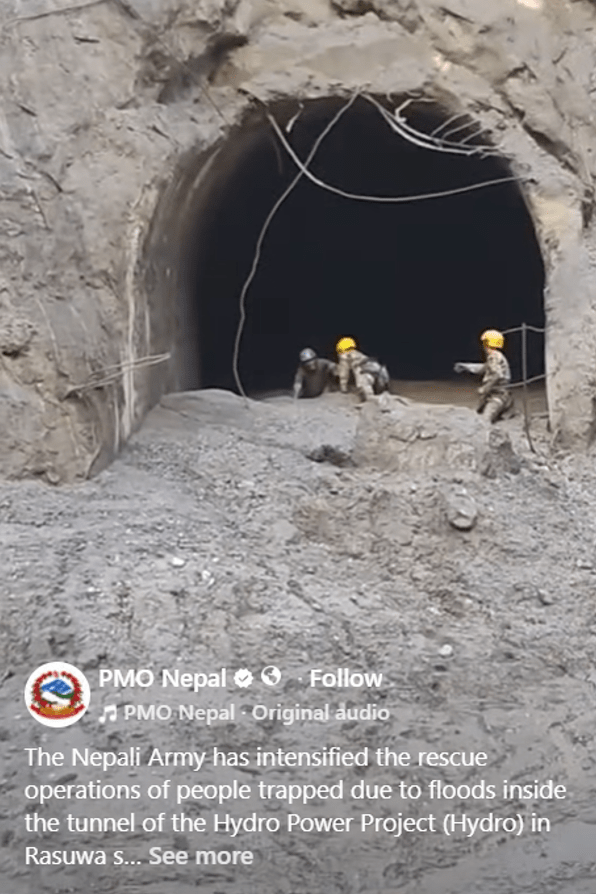
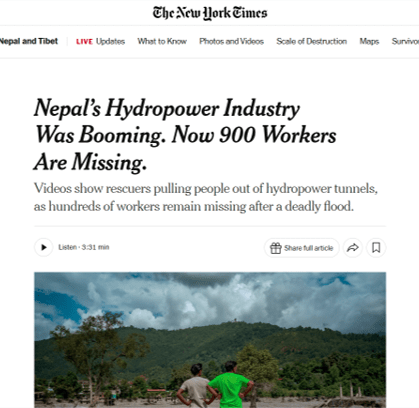
On the 28th August 2026, Nepali officials roughly doubled their tally of missing people to over 1,900, saying hydropower producers had only recently shared a count of unaccounted-for workers at projects in the devastated river valleys. It is feared that over 900 people are missing from hydropower projects.
This might be a watershed moment for the disaster-torn hydropower boom in South Asia, funded many times by International Financial Corporations and Multilateral Banks like ADB and World Bank, and also Chinese Exim bank.
Hundreds of hydropower labourers, engineers and locals are currently trapped inside tunnels of projects like Upper Trishuli 1 and Trishuli 3A, the latter funded by a loan from China’s Exim bank in the flood ravaged Nepal. More than 350 have been rescued by the valiant efforts of Nepal Army, but many more are still trapped inside the tunnel, including Indians.
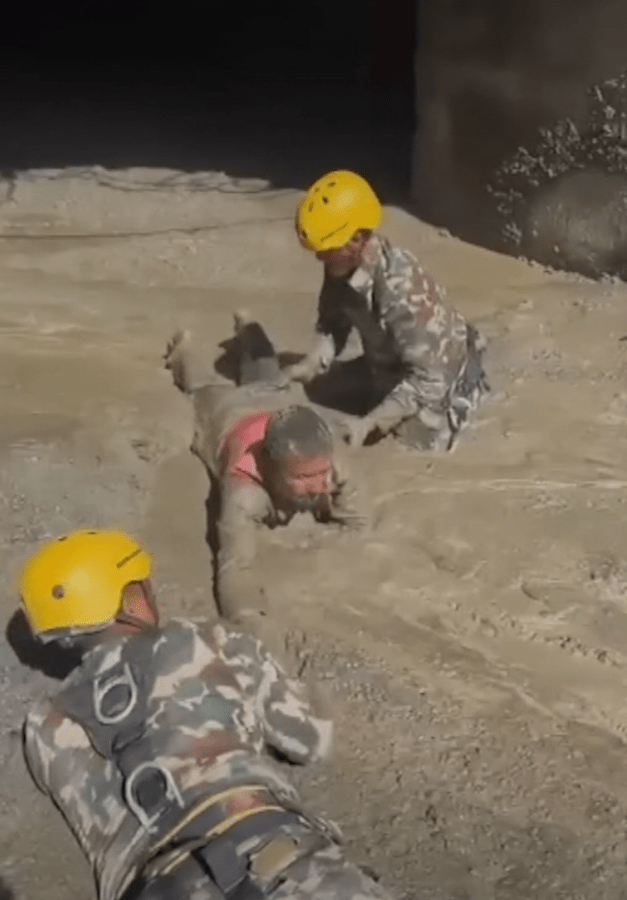
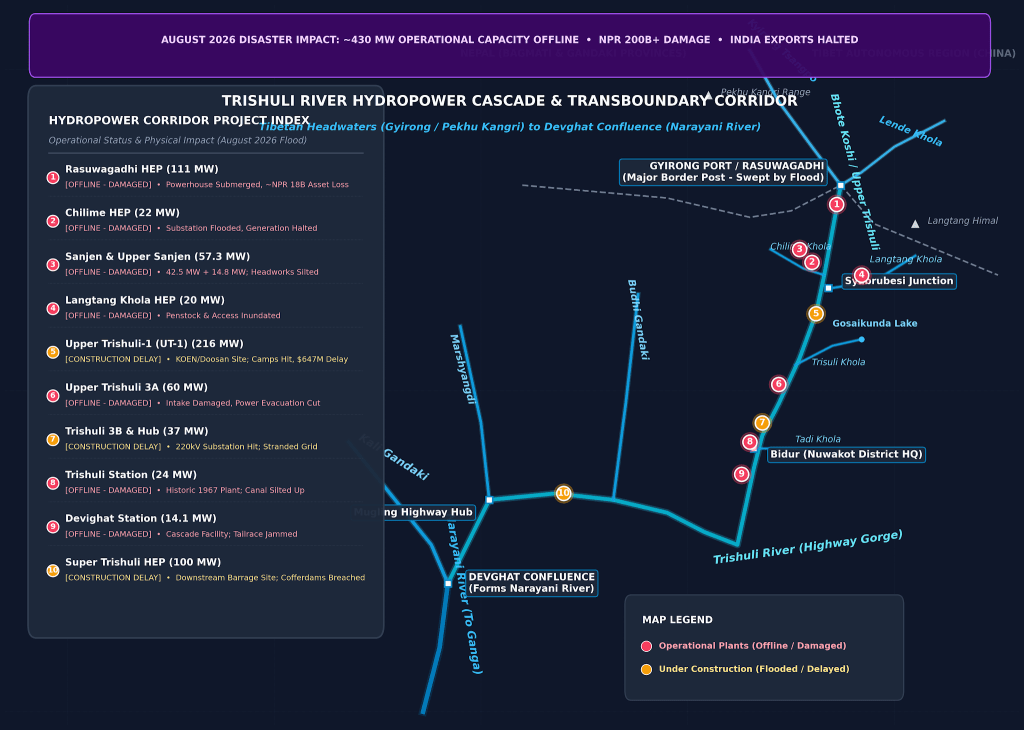
214 MW Upper Trishuli I is one of Nepal’s largest hydropower project, near-complete, which now lies all but destroyed by the sheer force and fury of the Himalayan floods. The entire Trishuli Basin has dense hydropower development with more than 36 hydropower projects.
As rescue work progresses and disturbing images arise, to some this may not seem to the time to raise the issue of Hydropower in Himalayas. But it is. Because as we will see, reports and reminders about the repeating floods in Trishuli River, like other Himalayan rivers, made no difference to the developers, builders, or the funders. Climate disasters associated with infrastructure across Himalayas have been causing deaths and destruction with a despairing regularity. They are repeatedly putting thousands of labourers, local residents and tourists in mortal danger, with very little recourse and accountability.
Multilateral Development Banks including the ADB and World Bank Group’s IFC, that financed and championed the Upper Trishuli-1 hydropower project and conducted a Cumulative Impact Assessment of Trishuli Basin were acutely aware of the extreme danger to which they were exposing thousands of laborers, officials, residents, rivers, infrastructure and landscape. Their own reports repeatedly highlighted it. But they did not take any preventive steps, did not demand stringent checks and balances, nor were they prepared for a calamity they knew could occur. Funding was sought and provided in the garb of “Climate and Disaster Resilience”. Upstream impacts from Tibet were not studied, funding did not stop.
Thousands of labourers, engineers and contractors were thus concentrated in a volatile valley which suffered had serious floods in 2024 and GLOF floods in 2025, apart from the current deluge.
International Finance and Trishuli/ Bhote Koshi Disaster
The $647.4 million Upper Trishuli-1 (UT-1) hydropower project where hundreds are trapped, is one of the largest foreign direct investments in Nepal’s history, a characterization International Finance Corporation’s (IFC) own press release uses when describing the project.
It is bankrolled and owned by a consortium of the world’s most powerful financial institutions. The IFC (the private sector arm of the World Bank) led the effort to arrange the project’s $453 million debt package and it owns a 15% equity stake in the project company, making it a co-owner. Asian Development Bank (ADB) and Asian Infrastructure Investment Bank (AIIB) put a combined $150 million in loans into the dam. The ADB drew half of its funds from Canadian Climate Fund specifically meant to “build disaster resilience”, something that sounds especially jarring today. The remainder of the debt package came from a web of development finance institutions spanning from the UK (CDC Group, now British International Investment) to South Korea (Korea Development Bank, Export-Import Bank of Korea) to the Netherlands (FMO) and the OPEC Fund.
Asian Development Bank: Warnings from its own report ignored
ADB states that the Upper Trishuli 1 project supports ADB’s strategies: “tackling climate change, building climate and disaster resilience, and enhancing environmental sustainability” [13]. Under ADB’s support, the project received a loan from the Canadian Climate Fund for the Private Sector in Asia II (CFPS II) for USD 30 million.
The ADB acknowledges: “Climate change risk assessment previously concluded that the risks of climate change impacts on the project are low; however, extreme rainfall in previous years and a glacial lake outburst flood event in 2025 resulted in damage to some project facilities while under construction and significant alteration of river morphology along the Trishuli river”.
In fact, the Independent Panel of Experts (IPoE) Report in June 2025 specifically stated: “IPoE had recommended the preparation of a Climate Resilience Assessment for the Project. This assessment has yet to be done. Following the September 2024 event, which showed that combinations of climatic and geological events can have severe consequences, we recommend expanding the scope of such climate resilience assessment to disaster risks” [14]. No such Climate Resilience Assessment is present on the dashboard.
The ADB was aware not only of the 2025 flood at the hydropower project, but a September 2024 flood also. The IPoE Report states: “The September 2024 floodwater surge close to Project headquarters threatened the stability of the Powerhouse labor camp putting workers at risk and requiring temporary doubling-up of workers.”
It points out:
“The slow implementation of a reliable early flood warning system, as discussed in the Environmental section of this report, remains a major risk to those project communities in proximity to the river, especially Mailung and Gumchet, considering the damage inflicted in the Powerhouse area by an isolated floodwater surge in September 2024.”
The IPoE Report for December 2024 outlines the September 2024 flood event that “washed away the labours camp” and mentions “The Owner’s Engineer estimates the return period of the September 28th flood to 4 years, while the EPC’s main subcontractor estimates it to 10 000 years (!)”
This was followed by a July 2025 flood event in the same ravaged Trishuli region. This flood made 10 projects defunct. The ADB Dashboard does not include any reports of this flood. There are no further updates.
However, the funding did not stop. The International Agencies involved which have the financial wherewithal and available expertise did not push for In-situ and other early warning system or a Climate Risk Assessment Plan even after repeated floods and risks. Being an international body themselves, they did not see the need to push for a trans-boundary risk assessment for this project, so close to the Tibet border.
International Finance Corporation (IFC):
The IFC published a Cumulative Impact Assessment of Trishuli Basin in 2020 to fulfill its own lending conditions. The report came out 7 years after the Uttarakhand disaster where thousands of Himalayan pilgrims died in a devastating flood triggered by a GLOF and complicated by hydropower projects. IFC CIA had the opportunity and space to address cumulative disasters, GLOFs, transboundary impacts, Compound disasters, growing footprint of a changing climate. It did nothing. While not discussing cumulative threats of GLOFs and flood disasters, it did not even attempt to look at the upstream and assess Tibetan impacts. It made no cumulative disaster plan for a basin littered with hydropower projects.
At the same time, the Independent Panel of Expert Reports which reported to ADB were also reporting to the IFC which means it was aware of the recurrent floods, GLOFs and warning about Climate Resilience Assessment and Early warning systems. Yet, nothing changed.
China’s Exim Bank
China’s Export Import or Exim Bank provided $149 Million concessional loan for Trishuli 3 A Hydropower project which is severely damaged and in whose tunnels hundreds of workers are trapped. The Contractor for the project was Chinese ‘China Gezhouba Group Company’. They have no independent, binding environmental safeguards and rely on Host Country rules or voluntary action at best! This is despite the fact that China and Nepal share some of the most fragile parts of this disaster prone trans-boundary Himalayan basin.
Recent Hydropower Disasters in Himalayas
In August 2026, 10 labourers died in flooding accident in India’s 444 MW Vishnugad Pipalkoti Project
In July 2026, 25 labourers died in Sikkim’s Teesta VI Hydropower Project
In August 2025, thousands of people were affected by floods made worse by a Ranjit Sagar hydropower Project in India
In October 2023, more than 55 people died in Teesta III collapse following a GLOF which was forecasted.
In Feb 2021, more than 50 people died, many of whom were labourers in Rishiganga HEP in India
It is with this background that communities living in Sikkim Himalayas are asking for a moratorium on hydropower projects which have led to concentration of people and impacts in the highly vulnerable Himalayas.
Multilateral Development Banks, International Climate Funds, International Finance Corporations need to appreciate the “International” nature of trans-boundary disasters and growing climate risks. It is high time international finance bodies like ADB, IFC, AIIB, Chinese Exim Bank etc., accept their role in putting people and ecosystems at risk. The migrant labors working on hydropower projects in Himalayas are some of the most tragically vulnerable sections of our society.
Himalayan rivers have been witnessing tragedy after tragedy. Let us hope that this a watershed moment where lasting change begins.
Parineeta Dandekar, Himanshu Thakkar, SANDRP
ANNEXURE: Hydropower Projects on Trishuli River, Nepal
| Hydropower Project | Capacity (MW) | Funding / Developer Details | Post-Flood Status (August 2026) | References |
| Upper Trishuli-1 (UT-1) | 216 MW | Developed by NWEDC (Nepal Water & Energy Development Co.). Owned by KOEN (South Korea, 50%), IFC (15%), Daelim (15%), and Kyeryong Construction (10%). BOOT model. | Under Construction, upto 84% complete. Heavily damaged by the transboundary flood on Aug 26, 2026. Works halted. | Chosunbiz (Aug 27, 2026); AIIB APPROVED; Power Tech. |
| Rasuwagadhi HPP | 111 MW | Developed by Rasuwagadhi Hydropower Company (an affiliate of the state-owned Nepal Electricity Authority – NEA). Funded through domestic institutions. | Operational. Powerhouse and substation reportedly destroyed on Aug 26, 2026. Entirely offline and severely crippled. | Rising Nepal Daily; NEA Spokesperson; ShareSansar. |
| Rasuwa-Bhotekoshi | 120 MW | Developed under a public-private partnership with major domestic and regional funding stakeholders. | Under Construction. The construction site was severely inundated and damaged. Access roads and local structures swept away. Construction suspended. | Rising Nepal Daily; ShareSansar (Aug 2026). |
| Sanjen Khola | 78 MW | Developed by Sanjen Jalavidhyut Company Limited (NEA subsidiary). Funded primarily by domestic financial consortiums. | Operational. Powerhouse flooded and transmission connection cut off. Offline until detailed structural assessment is completed. | Rising Nepal Daily; Ministry of Energy Report (MoEWRI). |
| Chilime HPP | 22 MW | NEA subsidiary. Considered Nepal’s flagship community-hydropower model, built with local ownership and domestic funding. | Operational. Flooded; intake/dam structures sustained damage during the high surge. Shut down and offline. | The Kathmandu Post (Aug 2026); My Republica. |
| Langtang Khola | 20 MW | Private developer-led run-of-the-river project with domestic bank consortium funding. | Operational. Infrastructure along the riverbank sustained substantial damage. Completely offline. | ShareSansar; Rising Nepal Daily (Aug 2026). |
| Upper Trishuli-3A | 60 MW | State-owned, developed and operated directly by the Nepal Electricity Authority (NEA). Built with Export-Import Bank of China concessionary loans. | Operational. Highly impacted. Substation and transmission line towers damaged, cutting the plant’s connection to the national grid. | My Republica (Aug 27, 2026); Rising Nepal Daily. |
| Upper Trishuli-3B | 37 MW | Developed jointly by NEA and Nepal Telecom. Run-of-the-river project under construction. | Under Construction. Works halted. The crucial 220 kV Hub substation linked to the project sustained major damage, stranding other regional plants. | Rising Nepal Daily; NEA Release (Aug 26, 2026). |
| Middle Trishuli Ganga | 15.6 MW | Developed by Middle Trishuli Ganga Hydropower Ltd, funded through domestic private investments and commercial banks. | Under Construction. Heavily affected by riverbank erosion and mud influx. Machinery and materials washed away. Works suspended. | Rising Nepal Daily; ShareSansar (Aug 26, 2026). |
| Trishuli Hydropower Station | 24 MW | One of Nepal’s oldest hydropower stations, built jointly by the Government of India and the Government of Nepal (completed in 1967 for INR 140 million). | Operational. Substantial damage to headworks, switchyard, and regional transmission lines. Plant offline, cutting power across Nuwakot. | Wikipedia; My Republica (Aug 27, 2026). |
| Devighat Hydropower | 14.1 MW | Owned and operated by the Nepal Electricity Authority (NEA). Built as a cascade plant to the Trishuli station. | Operational. Affected downstream in Nuwakot district. Silted up by severe mud and debris. Shut down to prevent turbine abrasion. | NEA Release; Rising Nepal Daily (Aug 27, 2026). |
| Mailung Khola | 5 MW | Developed by Mailung Khola Hydropower Co. Ltd. Funded primarily through domestic commercial banks. | Operational. Flooded and physically damaged due to its proximity to the lower banks. Plant completely offline. | Rising Nepal Daily; ShareSansar (Aug 26, 2026). |
| Super Trishuli HPP | 100 MW | Developed by Blue Energy Ltd. Located downstream across Chitawan, Dhading, and Gorkha. Estimated project cost of USD 136.1 million. | Under Construction. Warned of downstream surge risks. Silted up with mud and debris. Structural works temporarily paused as precautions are implemented. | Nepal Water Resource Portal; Power Technology; EJAtlas. |


