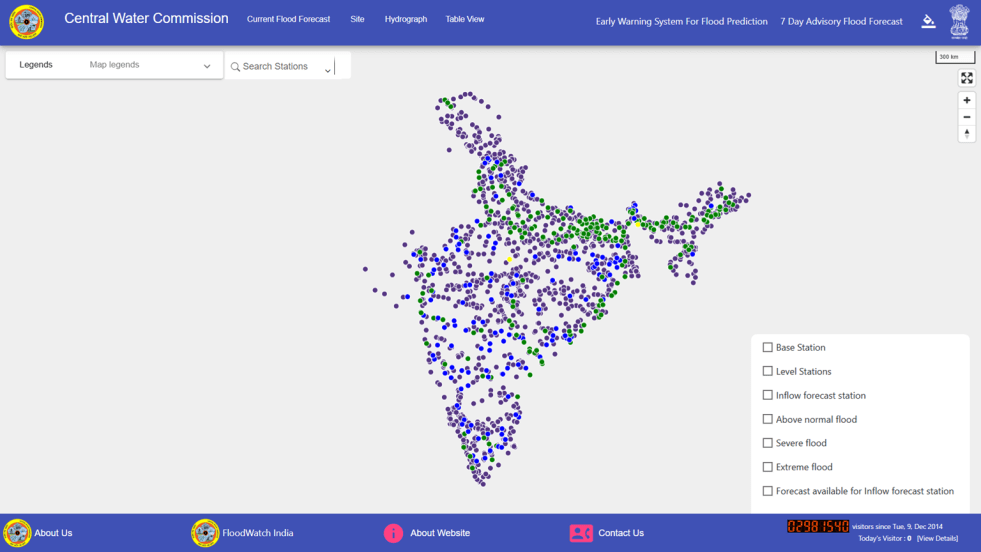
(Feature Image: Screen shot of CWC’s FF website taken on June 11, 2026)
Fundamental problems continue to plague Central Water Commission’s (CWC) flood monitoring work. In the latest such incident, its main Flood Forecast (FF) website remained inaccessible for over a week, right at the beginning of the forecast season.
As per a CWC presentation at the annual flood preparedness conference on May 2, 2026, it has a network of 1543 hydrological observation stations & 360 flood forecasting stations including 201 level forecast & 159 inflow forecast stations covering 20 river basins in 27 states & UTs.
CWC’s latest April 2026 Standard Operating Procedure (SoP) document for flood forecasting mentions about three different flood periods for various river basins including May 01 to Oct. 31 for Brahmaputra & Barak Basin, June 01 to Oct. 31 for all other basins upto Krishna basin and from June 01 to Dec. 31 for all basins South of Krishna basin.
This means that CWC is supposed to disseminate flood situation in the Northeast from May 01 and for the rest of the country from June 01 each year through its main website and social media platforms including Face Book account and X (Twitter) handle.
In fact, the agency began operations on April 28 this year by sharing a hydrograph of flood situation at Matijuri station on Katakhal river in Assam on X handle. Next day, it issued a special flood advisory for Assam and Tripura states.
While daily flood bulletins and advisories continued to be shared via PDF links, hydrographs from main FF website were posted only twice in the May 2026, including on May 01 about Buridehing river at Margherita station in Tinsukia of Assam showing flood above danger level in the river and then on May 15 showing rising trend in flood levels at Badarpurghat and Annapurnaghat stations on Barak river.
The unusual practiced continued till June 05, 2026, when CWC through X and FB posts informed about its website turning inaccessible due to an unspecified technical issue. The agency then reverted to posting its old-fashioned hydrographs without source link. CWC used to post such hydrographs about five years back before upgrading its website.
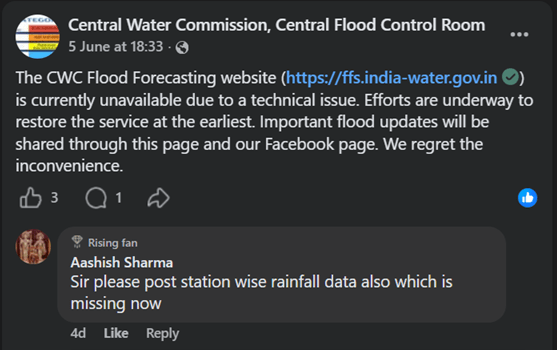
It remains unclear since exactly when the CWC website became non-functional. Notably, on May 26, 2026, the website displayed incorrect Highest Flood Level (HFL) of the Doni river in Krishna basin at Talikot site, Bijapur district as 503.475 meter attained on 26.05.2026 instead of 502.21 meter dated 15.10.2020. The river had missed breaching this mark of 502.21 m by 0.36 meter on 08.08.2025. The HFL date was later corrected by the CWC.
While CWC’s X handle often responds to reported errors, it remained unresponsive to SANDRP’s queries dated May 26 and June 08 regarding the incorrect HFL of Doni river and reason behind its FF website failure.
The FF website was partially restored on June 10, 2026. When contacted Vasantha Kumar V, Director, Flood Forecast Monitoring Department, CWC stated that the website suffered some technical glitch and concerned team worked hard for three days to resolve the problem. On the questions of slow pace and incomplete inflow and outflow data for a particular station, the Director assured that these problems would be fixed at the earliest.
Meanwhile, there have been intense rainfall spells triggering flash floods and urban flooding incidents in Guwahati, Hyderabad, Bengaluru cities and parts of other states in the country. Flash floods in Arunachal’s Upper Subansiri district on May 22, 2026 have caused severe damage, washing away key bridges, destroying houses and farmland and disrupting connectivity.
Another devastating flash flood, reportedly triggered by a cloudburst and incessant rainfall on June 4, 2026, caused widespread destruction in Chayang Tajo, the administrative headquarters of East Kameng district in Arunachal Pradesh. The flood disrupted essential services, damaged water supply and power infrastructure, and cut off surface communication in several areas. None of these floods were monitored or forecast by CWC on its FF website.
As of June 11, 2026, the FF website has resumed functioning with slow performance. However, queries emailed to the Director seeking clarifications on the duration, causes for website inaccessibility, alternative arrangements and corrective measures are still unanswered.
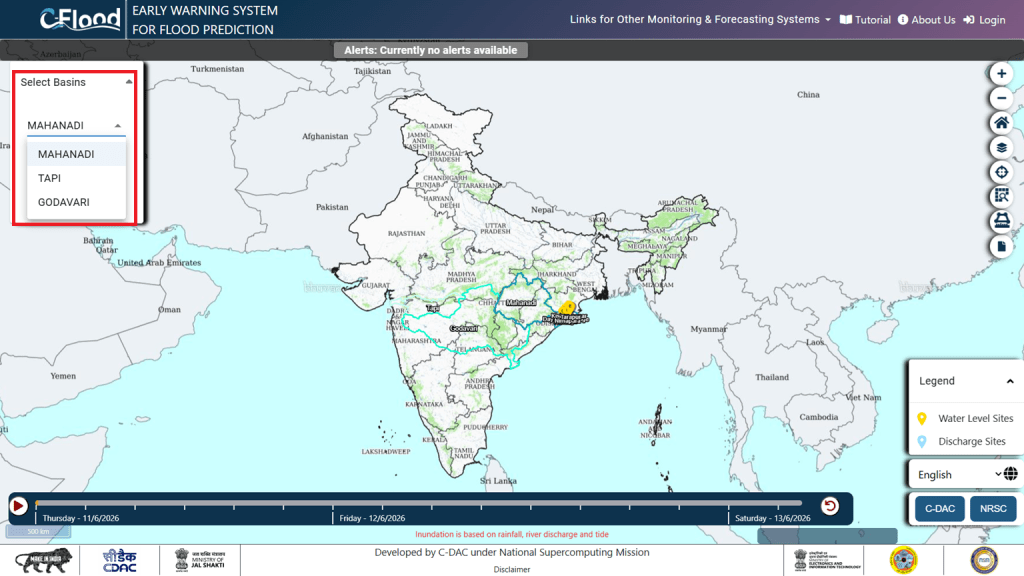
In addition to the main FF website, CWC has two more websites for dissemination of flood forecast. The C-Floods web portal (https://inf.cwc.gov.in/) functions as early warning system for flood prediction. The website currently lists only three rivers Mahanadi, Tapi and Godavari for inundation forecast.
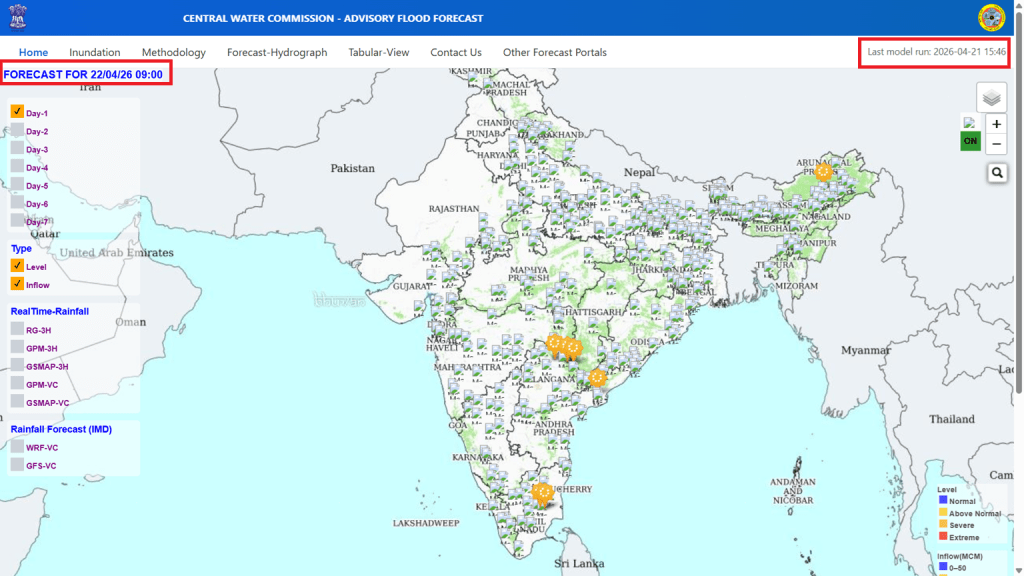
The third website for 7-day advisory flood forecast (https://aff.india-water.gov.in/) is quite slow and showing outdated forecasts from April 2026 while features like ‘forecast hydrograph’ and ‘other forecast portals’ serving no purpose.
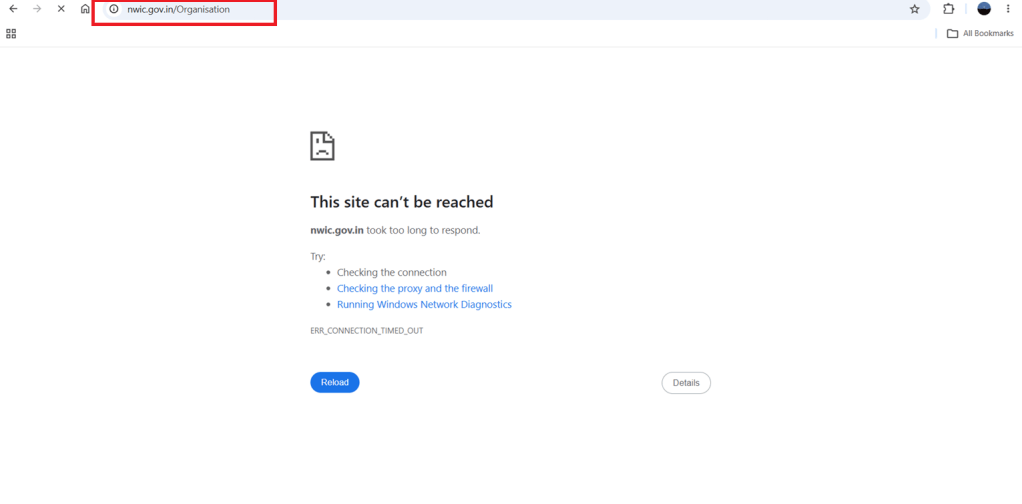
Further, we also found the website of the National Water Informatics Centre (NWIC) was not functioning on June 11, 2026. NWIC supports the CWC flood monitoring & forecast work by collecting and organizing real-time data from stations.
This is not an isolated incident. SANDRP has regularly been highlighting several systemic issues in CWC’s flood monitoring work including recurring website failures during critical periods, lack of transparency in data management, inaccurate forecasts and delay in correction of errors.
The failure of FF website at the very start of monsoon season reflects poorly on CWC’s functioning as country’s only nodal agency entrusted with the task of flood forecasting and early flood warnings. At a time when extreme rainfall events and flash floods are increasing across India, such failures can directly impact disaster preparedness, response and public safety.
This reminds us of our suggestion for many years that flood forecasting is too important a work to be handled by CWC with all the conflict of interest issues involved in its functioning and needs to be handed over to an independent agency.
The simultaneous malfunctioning of multiple platforms including NWIC points to serious flaws in information dissemination system. Its time, the government and the CWC introspect to rectify the systemic problems, otherwise the same will continue to compromise the effectiveness of its flood monitoring and forecast work.
SANDRP

 SANDRP