Guest blog by Dr. Ruchi Shree
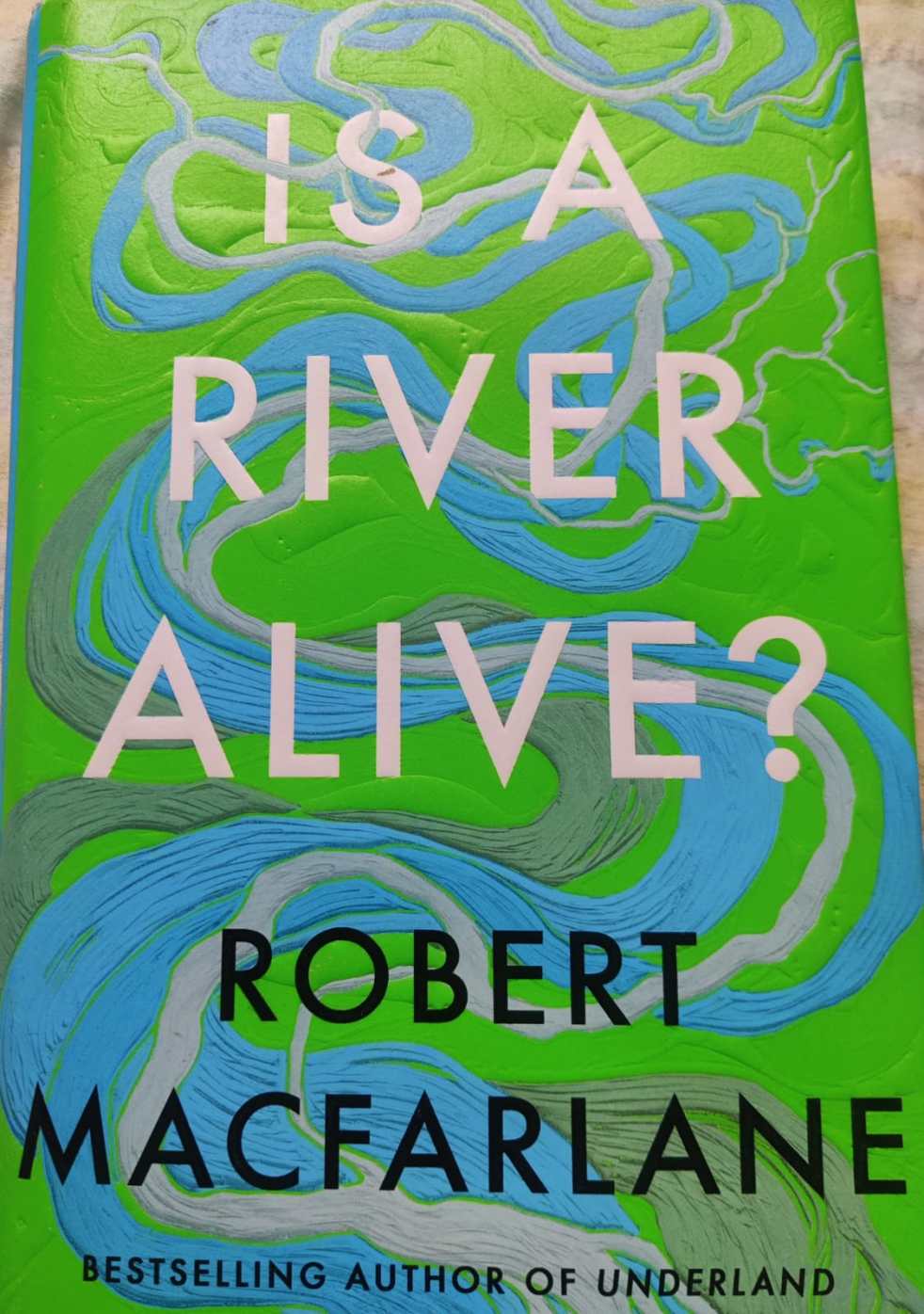
Is a River Alive? (By Robert Macfarlane, 2025, Hamish Hamilton, an imprint of Penguin, London) is a narrative of hope in despair. The author, a nature writer and Professor of Literature and the Environmental Humanities has written numerous bestselling books. Some of them are Underland, Landmarks, The Old Ways, The Wild Places and Mountains of the Mind which have been translated into many languages and won numerous prizes around the world. His writings have been widely adopted for different modes of creative expressions namely music, theatre, film, radio, and dance. Macfarlane’s this book, a detailed account his journey of three rivers across three different continents (South America, North America and Asia) is equally personal and political. This book on rivers is equally about mountains, seas, birds and all other living beings.
The first narrative is of Northern Ecuador, where a miraculous cloud-forest Los Cedros and its rivers are threatened due to destruction related to gold mining. The second story is of wounded rivers and lagoons of Chennai in southern India and a parallel battle fought by the local citizens to save these waterbodies and the surrounding ecosystems. The third case is of north-eastern Quebec, where a spectacular wild river locally named as the Mutehekau Shipu (in English, Magpie River) is being defended from damming primarily by the Innu tribe living in that area. The ongoing river rights campaigns in different parts of the world is the uniting theme of this book. The book invites its readers to join Macfarlane’s river journeys not only to imagine the rivers as living beings but also to feel that we need the rivers more than the rivers need us, the human beings.
Cloud-Forest as River-Maker (Ecuador)
The first part of the book starts with quoting Ursula K. Le Guin’s words ‘one way to stop seeing trees or rivers or hills only as ‘natural resource’ is to class them as fellow beings – kinfolk. I guess I’m trying to subjectify the universe, because look where objectifying it has gotten us. To subjectify is not necessarily to co-opt, colonize, exploit. Rather it may involve a great reach outward of the mind and imagination’[i] (p. 35). These words give a clear message from the author that we need to find a different way to engage with the nature around us. Ecuador was the first country to recognize the Rights of Nature – to exist, to regenerate, to be restored, to be respected (p. 42). Articles 71 to 74 of the Ecuadorian Constitution, known as the ‘Rights of Nature’ articles recognize the link between the good health of nature and the ‘good living’ or ‘harmonious life’ (sumak kawsay) of humans. It is the state’s obligation to restrict such activities that might lead to the extinction of species and the destruction of ecosystems. Macfarlane writes that back in 2008, Rights of Nature was not being discussed anywhere and then sumak kawsay, a phrase from Kichwa, the most widely spoken indigenous language in Ecuador became a guiding principle to think differently.
Cesar, a Colombian lawyer (one of the companions of Robert in Ecuador) teaches liberation theology with an emphasis on ‘option for the poor’. He has dedicated his life to social justice and does not differentiate between human rights and the rights of nature as they are merged with each other (p. 47). Macfarlane’s another companion was Giuliana, a mycologist (a scientist or researcher who studies fungi, which include mushrooms, molds, and yeasts). She wanted to find a new species of fungi that will be scientifically useful in further protecting Los Cedros (p. 51) or cloud-forest. Canadian firm called Cornerstone Capital Resources, in alliance with Ecuador’s state mining company ENAMI was to seek copper and gold in the Los Cedros, one of the most bio-diverse and bio-abundant places (p. 62). Josef Decoux brought the Rights of Nature case against the mining companies. Since 1980s, he moved in the forest region in order to protect it as a practitioner of radical politics (p. 71). Macfarlane has dedicated this book to Decoux who underlined the intrinsic link between the forests and the rivers. He dedicated his life to spread the message that the destruction of one will lead to death of another. What we tend to see is just one form of river on the earth but there is also the sky-river above us, the atmosphere as a water-bearing medium (p. 104).
How a city kills its waterbodies (Chennai, India)
The second part of the book is a detailed account of five degrading waterbodies in the different parts of Chennai. Out of these, three degrading rivers are Kosasthaliyar, Cooum and Adyar; and the other two waterbodies are Ennore Creek and the Pulicat Lagoon. Yuvan Aves, a teacher, naturalist, writer and water activist was the key companion of Macfarlane in Chennai. ‘Cities grow along riversides,’ writes Yuvan, ‘then slowly forget their ecological, hydrological genesis. Later they slowly collapse under their own weight – unless perhaps there is a powerful re-invocation of what birthed a city in the first place: a river’[ii] (p. 125). In 2021, he founded a trust called Palluyir (a Tamil word meaning ‘all of life’ which is dedicated to advancing ecological knowledge and practice in Tamil Nadu and beyond. Its motif is ‘a circle containing diverse images of life from four kingdoms: from child to fungus, dolphin to greenbottle fly, earthworm to beech tree’ (p. 138). Data-driven citizen science is a core part of Yuvan’s water activism (p. 145) and Macfarlane thinks that it can lead very fast to powerful change.
In the last few years, Chennai has been facing frequent floods and its water-literacy is diminishing. For thousands of years, Tamil Nadu was a profoundly water-literate area. Its rich hydroculture comprising of water-husbandry and water-reverence gets reflected in a range of water-storage structures such as eris or kammai, ilangi, kooval, kulam, kundam, kundu, kuttai, kuttam, poigei, sengai, thangal, etc. (p. 128). The eri system came into being as a response to Tamil Nadu’s climate. Venkatesh Ramakrishnan writes ‘when the rivers were tapped for drinking water in the 1800s, they began to die’[iii] and it also led to decline of Chennai’s water literacy (p. 129). The power stations are dumping fly-ash near Ennore Creek and Kosasthalaiyar River. Nityanand Jayaraman, the activist-writer forced a thousand acres of fly-ash in Ennore to be cleaned up and restored to wetland (p. 168). People living in this area are getting cancer and the fishermen have lost their source of livelihood.
Amid the crisis of numerous waterbodies, there are people like Yuvan, Arun Venkatraman and many others who call themselves as ‘Turtle Patrol’ (p. 171). They have been working tirelessly to save the sea turtles. Yuvan also organizes nature walks and takes the school children to a vast lake called Vedanthangal, fifty miles west and inland from Chennai. It is an eri, thirty hectares or so in area and the oldest waterbird sanctuary in India. Records show that as early as the 18th century, villagers local to Vedanthangal understood that the abundance of bird life is good for the waterbody. The local residents informed the author that in the last few years, Sun Pharma factory is dumping chemically polluted water in this area (p. 140). As a result, not only the waterbodies are polluted but also the biodiversity of this area is endangered. Macfarlane also narrates vivid image of a vast cumulus cloud above the cooling tower of North Chennai Thermal Power Plant which in turn affects both weather and climate (p. 164).
The Living River Magpie (Canada)
The Innu people of the little coastal township of Ekuanitshit were encouraged by the recognition of the Whanganui River (in New Zealand) as both a legal person and a living being. They also decided to realign the millennia old Innu values and relationships with modern legislative discourse. The Innu Council formed a resolution and its three key principles are – ‘first, the river is a living being and relative – at once ancestor and descendent – and, as such, sacred. Second, that each generation has a responsibility to protect the river for those who are yet to be born and those they will never meet. Third, that a continuity exists between the human and the non-human lives of the river, and that large-scale damming therefore threatens the whole riverine community, including people’ (p. 216).
Rita Mestokosho, an Innu poet and activist played an important role in the Mutehekau Shipu (the Magpie) to become the first river in Canada to be recognized as a living, right-bearing being. She sees no distinction between her poetry and activism and figures poetry itself as a river. Alarmed by the fact that out of sixteen rivers of Quebec listed officially as ‘large rivers’, fourteen were dammed by 2012, the Innu people started uniting themselves. After constructing the first dam on the Mutehekau Shipu, Hydro-Quebec began to target the river in its strategic planning to plan a multi-dam project (p. 205). This state company is the world’s fourth-largest supplier of hydro-power. Its proposed multi-dam complex will kill the forests and mountains that surround the lower river.
Macfarlane admits that this book is different from all his previous writings as he underwent a spiritual transformation while writing it. He felt deeply moved by the works of Yuvan in Chennai as his company made him remember a phrase by Siddharth Pandey, ‘Everything is alive and everything is speaking’[iv] (p. 157). Similarly, Rita Mestokosho’s role as a guardian of Innu culture and language made him learn a new way to engage with rivers. She told him, ‘When you go to the river, you must give to the river what you don’t need, and call instead on freedom’ (p. 220). She also said, ‘we have more need of her, the river, than she of us’ (p. 223). Her statement seems so relevant in Indian context also and it is so disturbing that numerous rivers are polluted and many small rivers have gradually turned into drainages. Despite numerous action plans, the plight of two major rivers Ganga and Yamuna seems to be getting worse over the years.
This interdisciplinary book is tilted towards poetic side and its political aspect stems from the fact that these rivers are under threat. The style of writing blends cultural history, philosophy and political commentary and lacks a scientific tone. The three lengthy chapters written in a travelogue form demand for patience in the reader to get into minute details of the events and surrounding. In present context, when worldwide the fate of rivers is primarily decided by the state actors, corporate actors and industrial actors, this book strongly advocates equal importance to the views of activists, writers, and artists. To my mind, rather than writing only about waterbodies in Chennai, Macfarlane could have visited some other parts of India also to bring a more comprehensive picture of rivers in India to the global audience. Similarly, though the author supports the ‘right to nature’ discourse but the text keeps mum about the ways to bring this discourse into practice.
Dr. Ruchi Shree (jnuruchi@gmail.com) is Assistant Professor (Senior) at the University Department of Political Science, Tilka Manjhi Bhagalpur University (TMBU) in Bhagalpur, Bihar.
[i] Ursula K. Le Guin (2017), Arts of Living on a Damaged Planet/ Ghosts of the Anthropocene, ed. by Anna Tsing, Elaine Gan, Heather Swanson and Nils Bubandt, Minnesota University Press, Minneapolis, pp. 15-21.
[ii] Yuvan Aves (2023), Interdial: A Coast and a Marsh Diary, Bloomsbury, London, p. 205.
[iii] Komal Gautham (2023), ‘It’s Official: Chennai’s Rivers are “Dead”’, Times of India, 18 January.
[iv] Siddharth Pandey (2020) mentioned these words in his PhD thesis submitted at Cambridge University.


