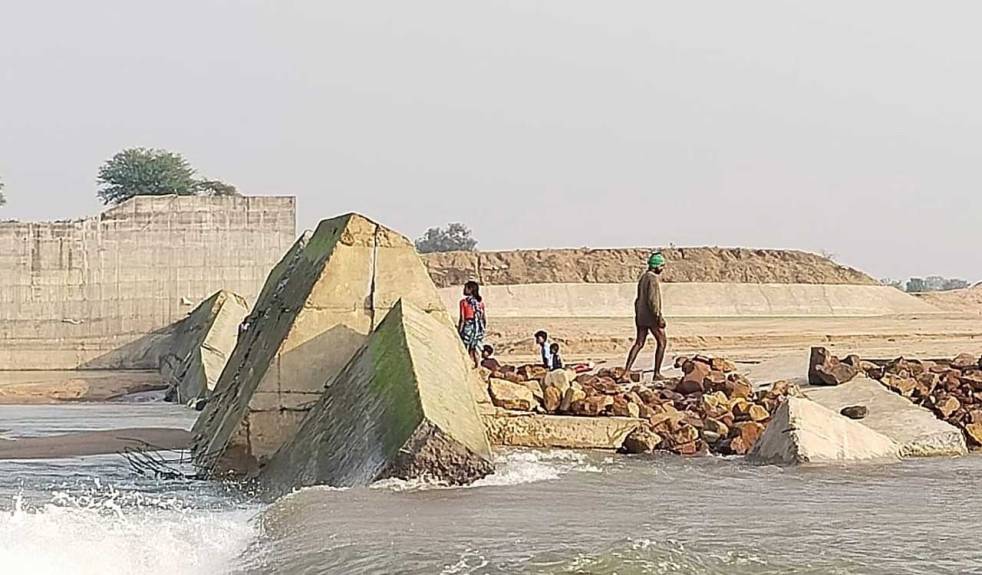
(Feature Image: Check dam on Manair river at Adavisomanpalli in damaged condition on Dec. 18, 2025. Source: DC)
Collapse of two check dams, Tanugula and Adavisomanpally, on Manair river during Nov-Dec 2025 under suspicious circumstances has raised serious concerns about the structural safety of the irrigation infrastructures in Telangana. The locals and officials suspect the role of illegal sand mining and possible use of explosives by sand miners as likely cause.
While the State govt ordered a vigilance inquiry on Dec. 22, 2025, its findings have not been made public. In contrast, an independent fact-finding committee concluded that the damage was not due to floods or construction defects but was due to deliberate attempt by sand miners to facilitate transportation of illegally mined sand. The incidents appear to be part of a broader pattern, as there are more reports linking damage to several check dams on the Manair river and across the State to illegal sand mining operations.
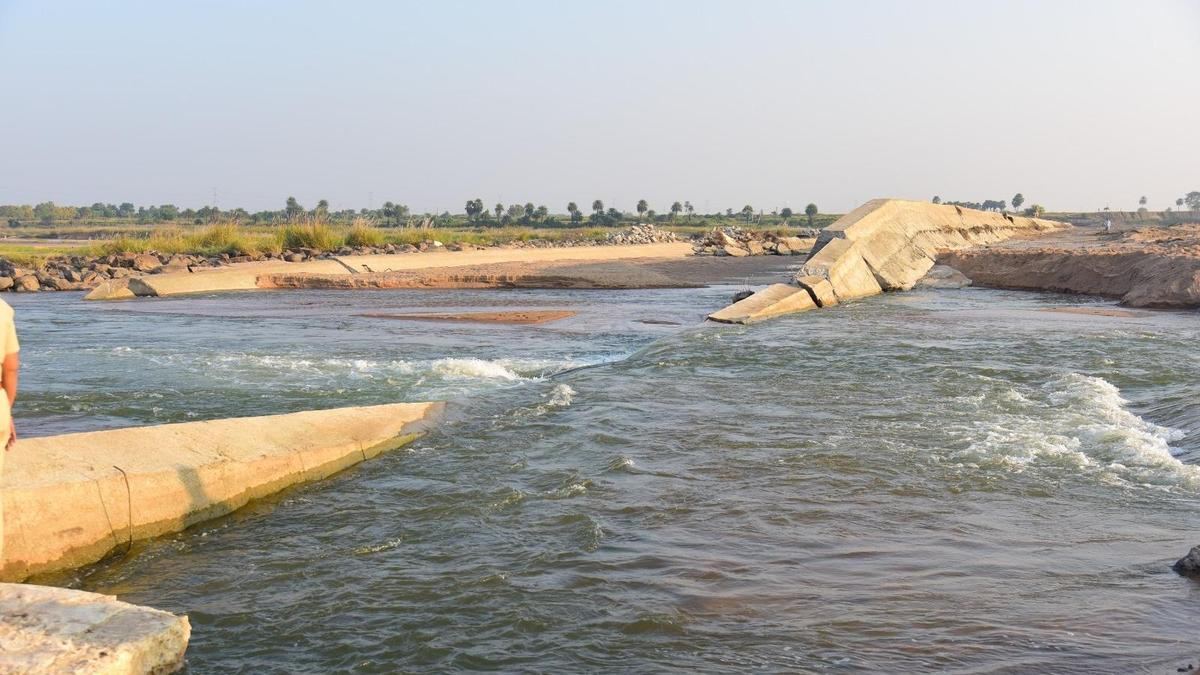
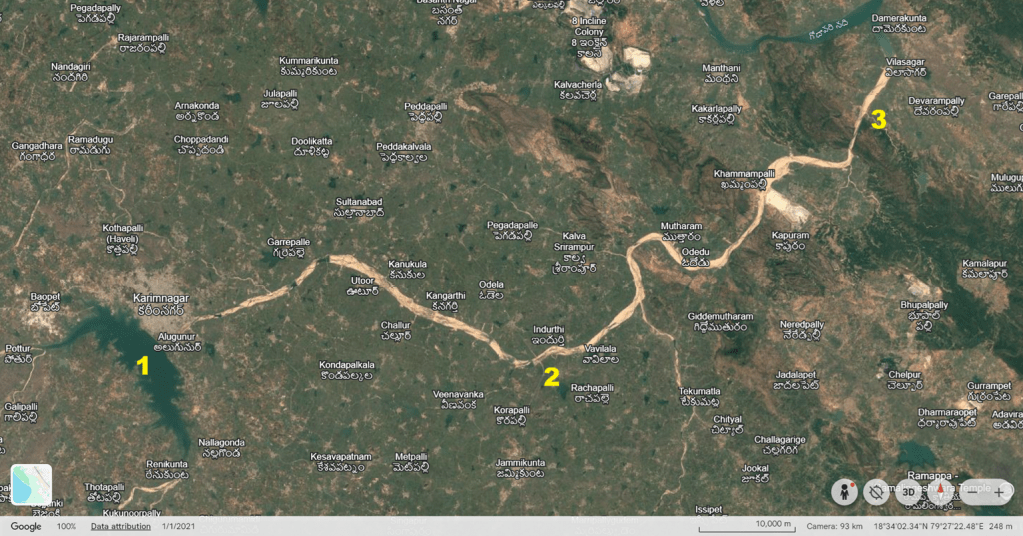
Tanugula Check Dam The first incident occurred on Nov. 21, 2025 when a new check dam on the Manair river between Gumpula of Odela mandal in Peddapalli district and Tanugula of Jammikunta mandal of Karimnagar district was suspected to have been destroyed using explosives. The check dam was built downstream of the Lower Maneru Dam in 2022 at a cost of about ₹23 crore by Raghava Constructions Limited.
When officials and villagers visited the site the next morning, the reservoir was found completely drained. As per Irrigation Department officials, the check dam suffered significant damage, about 90 metres of the structure damaged, with breaches at three locations.
On Nov 22, 2025 the Department filed a complaint with the Jammikunta Police stating that the attack was carried out using detonators or gelatin sticks, strongly suspecting involvement of sand miners. The officials said that the damage had affected the cultivation in around 40 ha in the immediate vicinity of check dam and estimated financial loss was ₹ 3 crore.
The incident sparked concerns among local farmers, who expressed doubts over the possible sabotage angle behind the check dam’s sudden collapse. They alleged that the sand mafia had blasted the check dam to clear the way for illegal sand transportation.
Amid the ongoing police probe, the affected farmers demanded its reconstruction to safeguard their interests. They feared that the damage would severely affect the ongoing rabi crop and disrupt irrigation planning for the coming agricultural season.
Following allegations from public and politicians, a forensic team inspected the site on Nov. 24 to ascertain the exact cause. The officials in the team said the collected samples would be analysed in the laboratory and that action would follow based on the findings, adding that legal proceedings would be initiated against anyone found responsible. Responding to the allegations, the Commissioner of Police (CP) said it was not possible to conclude that the structure was blasted without proper evidence and that the exact reasons would be known after the forensic report.
Adavisomanpalli Check Dam The concerns over the structural integrity of irrigation projects along the Manair river intensified following the collapse of another check dam in Karimnagar district. This time, a check dam located between Adavisomanpalli village in Manthani mandal and PV Nagar in Malhar Rao mandal was found damaged on Dec. 17 2025. The check dam was constructed in 2021 at a cost of ₹ 40 crore and its sidewalls were also constructed in 2024 following heavy floods.
The check dam was reported to be intact in morning hours but found damaged by the afternoon. Local residents noticed water flowing downstream due to the breach and alerted the officials. Though the exact cause of the damage was not known, locals suspected that the sand mafia might have deliberately damaged the structure to facilitate illegal sand transportation from upstream areas.
Locals said the structure had withstood the massive floods of 2023, when water flow touched nearly 1.2 million cusecs but collapsed despite relatively low flow of about 1,000 cusecs. Residents also claimed that cracks and holes were noticed at the site a few days earlier, raising suspicion that tools or explosives may have been used.
After visiting the spot, the irrigation officials also expressed doubts over the nature of the damage. They lodged a complaint with the Koyyur police, stating that about 120 metres of the structure had collapsed despite the absence of floods. An FIR was registered on Dec. 18.
The report also mentioned about a similar incident at Vallekunta village where a 10-metre portion of another check dam collapsed, nearly drowning two fishermen, who managed to swim to safety. However, no further information about this incident could be found.
The series of collapses sparked a political controversy. The govt also deployed heavy police force to prevent further unrest and secure sensitive stretches along the river.
Govt Orders Vigilance Inquiry
Following serious accusations, the Irrigation minister N. Uttam Kumar Reddy announced a comprehensive vigilance investigation on Dec. 22, 2025 to determine reason behind the collapses. He stated that the vigilance team would examine whether construction materials, design specifications and foundation depth adhered to safety norms and whether explosives were used to damage the structures.
During an inspection of the collapsed Adavi Somanpalli check dam, IT Minister Duddilla Sridhar Babu expressed serious concern over the repeated failure of check dams in the region. He noted that the structures had been built during the previous BRS govt and ordered a high-level Vigilance inquiry to determine whether the collapse resulted from poor construction quality, design deficiencies, or deliberate sabotage.
Before this, Union minister of state for home affairs Bandi Sanjay Kumar through an open letter to Chief Minister A. Revanth Reddy, demanded an independent inquiry into alleged corruption and poor-quality construction of check dams across Telangana, particularly after the collapse of the Tanugula–Gumpula structure in Karimnagar. In his letter, he pointed out that the Chief Minister had ordered a vigilance probe in May 2025 into the construction of 57 check dams on the Manair river, for which contractors were paid ₹ 287 crore. However, he said the progress and findings of this investigation remain unknown.
Alleging possibility of sidetracking the issue, the BRS MLAs Gangula Kamalakar and P Koushik Reddy along with other party workers submitted a representation to the district Collector Pamela Satpathy in Karimnagar on Nov. 28.
Fact Finding Committee Report
Meanwhile, a fact-finding committee formed by civil society members concluded that the collapse of two check dams was caused by deliberate use of explosions and not floods and structural defects. It cited technical evidence, blast-like damage patterns and eyewitness accounts to support its findings.
The eleven-member committee led by V Prakash, former chairman of Telangana Water Resource Development Corporation (TWRDC) along with former university vice-chancellors, retired irrigation engineers and other experts inspected the sites of both check dams on Dec. 5 and Dec. 17, 2025 respectively.
Findings on Tanugula Check Dam Collapse: After visiting the damaged structure, the committee said that the collapse was caused by gelatine sticks planted by the local sand miners to destroy the check dam and enable illegal sand transportation. They further stated that the check dam was blown up around 10 pm and villagers nearby reported loud noise. Local residents told the committee that thousands of fish were found dead in the river following the blast.
The committee observed extensive damage to the check dam’s body wall, concrete apron and cutoff wall. It found large concrete fragments were found displaced upward, indicating blast force. It rejected claims of poor construction, noting that the structures had withstood earlier floods.
The panel also noted that the explosion led to the sudden release of nearly 5 million cubic feet of stored water, leaving the reservoir completely dry. The report stated that the Tanugula structure had a total length of 737 metres, of which about 90 metres, between chainage 173 and 263, had collapsed, causing an estimated asset loss of ₹3.5 crore.
The committee said such destruction was impossible through natural causes. It pointed out that the Tanugula check dam had withstood intense floods in Oct. & Nov. 2025, when up to 66,000 cusecs of water were released from the Lower Maneru Dam during cyclonic rains.
The panel also hinted at high-level involvement and criticised leaders for blaming the collapse on poor construction quality without conducting any inquiry. It said both the quality control and vigilance wings had certified the works during construction and no structural distress was observed even during peak floods in 2024 and 2025.
Interestingly, the committee drew parallels to another incident in Jan. 2024, when farmers reportedly foiled an attempt by the sand mafia to blow up a check dam on the Hussain Miya stream in Peddapalli mandal. In that case, police recovered 11 gelatin sticks, 8 detonators and a compressor machine from the site, and an FIR was registered.

However, more than a year later, the investigation remains incomplete on that Jan 2024 incident and no one has been punished. The panel warned that this pattern of impunity was encouraging repeated attacks on public water infrastructure.
Findings on Adavisomanpally Check Dam Damage: After visiting the site, the committee released its report on Dec. 23, 2025 alleging that the manner in which large concrete blocks were hurled upwards and landed on top of the structures could not have been caused by flood pressure or erosion and was consistent only with the use of high-intensity explosives.
The committee reported that the scene at Adavisomanpally closely resembled that at Tanugula. Based on visual inspection and engineering assessment, the panel concluded that the collapse was caused by an explosion and not by hydrological stress.
The committee urged the State govt and law enforcement agencies to complete investigations into the Tanugula and Adavisomanpally incidents in a time-bound manner, crack down decisively on illegal sand mining, strictly regulate the supply and use of explosives, and ensure speedy reconstruction of the damaged check dams before the onset of the next monsoon.
It also appealed to farmers and local residents to remain vigilant and protect check dams, reservoirs and other water infrastructure from sabotage, warning that the destruction of water resources ultimately harms agriculture, rural livelihoods and future generations.
The report further noted that the National Green Tribunal (NGT) orders restricting sand mining in the Manair river were not being enforced effectively. It pointed out that the State govt’s decision to challenge the NGT order in the Supreme Court, where it was struck down, had weakened regulatory oversight, potentially emboldening illegal operators.
Threats and Damages to More Check Dams: The report placed the incidents in the larger context of Govt’s 2019 water conservation initiative under Mission Kakatiya. According to engineering assessments, more than 1,200 potential sites were identified and construction was planned in two phases.
On the Manair river alone, 22 check dams were built, including the Tanugula and Adavisomanpally. As per fact finding committee these structures had transformed rural livelihoods by raising groundwater levels and supporting fisheries income.
As per this Dec. 2025 report, as many as 7 check dams on Manair including at Bommakal, Neerukulla, Thoggarai, Madaka and Rupnarayanapeta have collapsed in recent years raising questions on construction quality and sabotage acts.
Another report from the same month claims that in the since mid-2024, more than 420 minor irrigation check dams and percolation tanks in Warangal, Khammam, Mahabubnagar, Nalgonda and Adilabad districts have faced structural issues, a majority of them were allegedly connected to rampant sand extraction.
Official sources say comparison of satellite images from Dec. 2023 with Nov. 2025 showed over 50 check dams transformed into deep sandy craters within just two years. They also said that at least 177 tanks and canal structures breached during the 2025 monsoon, many of them bearing clear signs of deliberate sabotage linked to the sand mafia.
Illegal sand mining was reportedly continuing unchecked in Rakonda Vagu, a water source connected to the Koil Sagar Dam in Mahabubnagar district. The sand mafia was allegedly operating in collusion with different agencies and was openly excavating sand in broad daylight. The illegal operations were not only depleting a critical water resource but also causing significant financial losses to the State exchequer.
In Summary As of June 10, 2026, there is no publicly available report indicating that the Telangana govt’s vigilance probe into the Tanugula and Adavisomanpally check dam incidents has been officially completed or released. The damage to these two check dams, along with similar incidents in recent past, points towards a systemic problem where illegal sand mining is increasingly threatening irrigation infrastructure across the State, but the absence of transparency and final outcomes from official investigations has meant that those responsible have not been held accountable.
To prevent such incidents in future, the govt must prioritize transparency and accountability by releasing the vigilance inquiry findings which were ordered in Nov and Dec. 2025. There is an urgent need to strictly regulate and monitor sand mining operations, especially near critical infrastructure like check dams and tighten control over use of explosives.
At the same time, authorities must focus on repairing and safeguarding damaged structures, fixing responsibility of officials for enforcement failures and involving local communities in monitoring illegal activities. These steps are essential to prevent further damage and protect irrigation infrastructure which support rural livelihoods in multiple ways.
SANDRP


