DRP News Bulletin

DRP: 23 Dec 2019: Monsoons are more powerful than Wars

A new study has shown how powerful the monsoons and their abnormalities are: It’s these abnormalities that ended reigns of multiple dynasties in medieval India, not wars. But the society does not seem to understand this basic reality today, and we are not only doing everything in our power to make the monsoon abnormal through human induced climate and natural world changes, but not even valuing the rainwater in our water policies, programs and practices. The changes we are bringing in natural world is making even the smaller monsoon abnormalities bring catastrophic impacts as the capacities of the people and societies to cope with the changes is decreasing. These studies are another wake up call, if only we were interested one.

Continue reading “DRP: 23 Dec 2019: Monsoons are more powerful than Wars”
DRP News Bulletin

DRP: 16 Dec. 2019: Why the first NGC meeting signifies Govt’s Failure on Ganga

The Prime Minister finally found time to have the first ever meeting on National Ganga Council, over three years after the Ganga Notification of Oct 7, 2016. The meeting happened at Kanpur, where the NGT recently fined the state government for continuing to release untreated effluents into the Ganga. In fact NGT in recent weeks have taken several decisions that also shows how abysmally the govt has failed on Ganga front. And now after the first NGC meeting, the Prime Minister, in an effort to divert attention from Namami Gange failure, is proposing the new slogan of Arth Ganga, which basically seems to suggest focus on Money, which is Exactly what is not going to help the cause of Ganga. The Ganga is still on the lookout for the Ganga putra that promised a clean Ganga in May 2014.

Feature image above is of first NGC meeting, source is: PIB PR: https://www.pib.gov.in/PressReleasePage.aspx?PRID=1596482&reg=3&lang=2

PS: Second meeting of NGC happened on Dec 30 2022 in Kolkata, where the PM participated through video conferencing. No further meetings have happened till date (March 5 2026).

Continue reading “DRP: 16 Dec. 2019: Why the first NGC meeting signifies Govt’s Failure on Ganga”
DRP News Bulletin

DRP: 9 Dec 2019: CITIZENS REPORT ON WHAT AILS GANGA REJUVENATION

 The Hindustan Times editorial on Nov 27, 2019 has rightly said the following about “a recently-released Rejuvenating-Ganga River – A Citizen-Report, by the India Rivers Week, a consortium of seven NGOs”.

“A key reason for the failure of the river cleaning projects (Ganga and Yamuna action plans), says a recently-released citizen’s report, Rejuvenating Ganga,by the India Rivers Week, a consortium of seven NGOs, was their single-point focus on the main stem of the river, while the Ganga basin actually has eight major rivers (Yamuna, Son, Ramganga, Gomti, Ghaghra, Gandak, Kosi and Damodar). The majority of the funds were spent on pollution-abatement measures on the main stem of the Ganga and on the upper Yamuna basin, which constitute just 20% of the Ganga basin.”

Continue reading “DRP: 9 Dec 2019: CITIZENS REPORT ON WHAT AILS GANGA REJUVENATION”
Urban Water Sector

Chandigarh: Faidan Pind Drain Shows Ugly Side of ‘City Beautiful’

Union Territory of Chandigarh enjoys ‘City Beautiful’ tag for better planned urban development. Undoubtedly the city has wide roads, abundant green patches, well planned residential sectors, public amenities, cyclist tracks etc.; however dumping of solid waste and untreated sewage around its periphery shows that the city performs poorly in managing its water and natural sources.

The story of Faidan Nizampur also known as Faidan Pind drain near Airport is an apt example showing that while city manages to get beautiful tag, the rivulets and lives of people around it have turned miserable by increasing pollution load and other issues.

Continue reading “Chandigarh: Faidan Pind Drain Shows Ugly Side of ‘City Beautiful’”

India Rivers Day

India Rivers Day 2019: Mustaqueem Mallah Awarded Bhagrirath Prayas Samman

For Mustaqueem Mallah, restoration of Katha River is sole aim of his life. And the 30 years old has been making steady and solid efforts to achieve this for past over 8 years. Belonging himself to Mallah (boatman) community, Mustaqueem has been witnessing the degradation of Yamuna river, flowing close to his village Ramra in Kairana block of Shamli district, Uttar Pradesh.

“Loving rivers is my religion”, says Mustaqueem who has formed the Kevat Mallah Ekta Samiti to raise the issues of fishermen, boatmen and riverbed farmers the river dependent communities who have been suffering adversely due to absence of flows in Yamuna river for most months of a year.

Continue reading “India Rivers Day 2019: Mustaqueem Mallah Awarded Bhagrirath Prayas Samman”

DRP News Bulletin

DRP: 25 Nov. 2019: Cauvery is calling, but do we understand her message?

Interrogating Cauvery Calling N Ram questions Jaggi Vasudev’s Cauvery Calling, asks why it shifts goal posts Speaking at Interrogating Cauvery Calling seminar in Chennai, N Ram said that various state governments and the central government that endorses the project should also be questioned.

 “Now a very serious issue that must cause concern is the raising of public interest and public money for this project. Truly mega, in terms of money involved – 242 crore trees, 11,000 crore rupees. That is the kind of money involved. Only 0.5% collected. There is still time to put checks on this and prevent this from going further,” he said. “What is the management of this money? Who oversees it? There is no transparency, no verifiable document, no clear management structure for huge amount targeted. It is a matter of great concern.”

– N Ram also said that various state governments and the central government that endorses the project should also be questioned. “As a political journalist, this is the question that occurs to me. Who gave the Isha Foundation the right, the jurisdiction to transgress on what should be the commons. And why are governments being subservient to this idea? Apart from the risks, probable negative outcomes and over simplification of solutions for Cauvery, this is what is worrying,” he concluded.  https://www.thenewsminute.com/article/n-ram-questions-jaggi-vasudevs-cauvery-calling-asks-why-it-shifts-goal-posts-112838  (24 Nov. 2019)

Continue reading “DRP: 25 Nov. 2019: Cauvery is calling, but do we understand her message?”
Yamuna River

Rampant Unsustainable Riverbed Mining in Yamuna Basin

Yamuna River in Yamuna Nagar district of Haryana is facing severe threat from mechanized and unsustainable stone and sand mining happening at large scale in sheer violation of existing mining rules and guidelines and the responsible authorities are deliberately overlooking the gravity of the issue.

During a field visit to the mining sites, we found scores of heavy trucks plying on riverbed ferrying precious sand. Poclain and JCB machines in large numbers were seen busy digging dip pits in the riverbed. The active course of the river was blocked and even changed. In fact river was nowhere in sight as its entire course was converted in deep stagnant water pools caused by non-stop mechanized mining. Machines were digging the sand and piling it on floodplain and nearby farm lands.  

Continue reading “Rampant Unsustainable Riverbed Mining in Yamuna Basin”

DRP News Bulletin

DRP: 18 Nov. 2019: River capacities are changing, but who is monitoring?

River carrying capacity is such a crucial factor in deciding if certain areas will be flooded and with what severity. This capacity is constantly changing, more so in tropical climate and high silt carrying rivers of South Asia, as new research shows. However, most models that are used in India, including by CWC, assume steady state situation. Nor are there constant and credible efforts to assess the river cross sections and river conveyance capacities and put them in public domain. The study shows how important it is that we wake up to this reality and ensure credible, consistent monitoring and assessments by credible independent agencies at the earliest. This has become even more urgent, the study underlines, since in changing climate, the rainfall patterns are changing fast. 

Continue reading “DRP: 18 Nov. 2019: River capacities are changing, but who is monitoring?”
DRP News Bulletin

DRP: 11 Nov 2019: Wetlands can help water security, help adapt to & mitigate climate change impacts

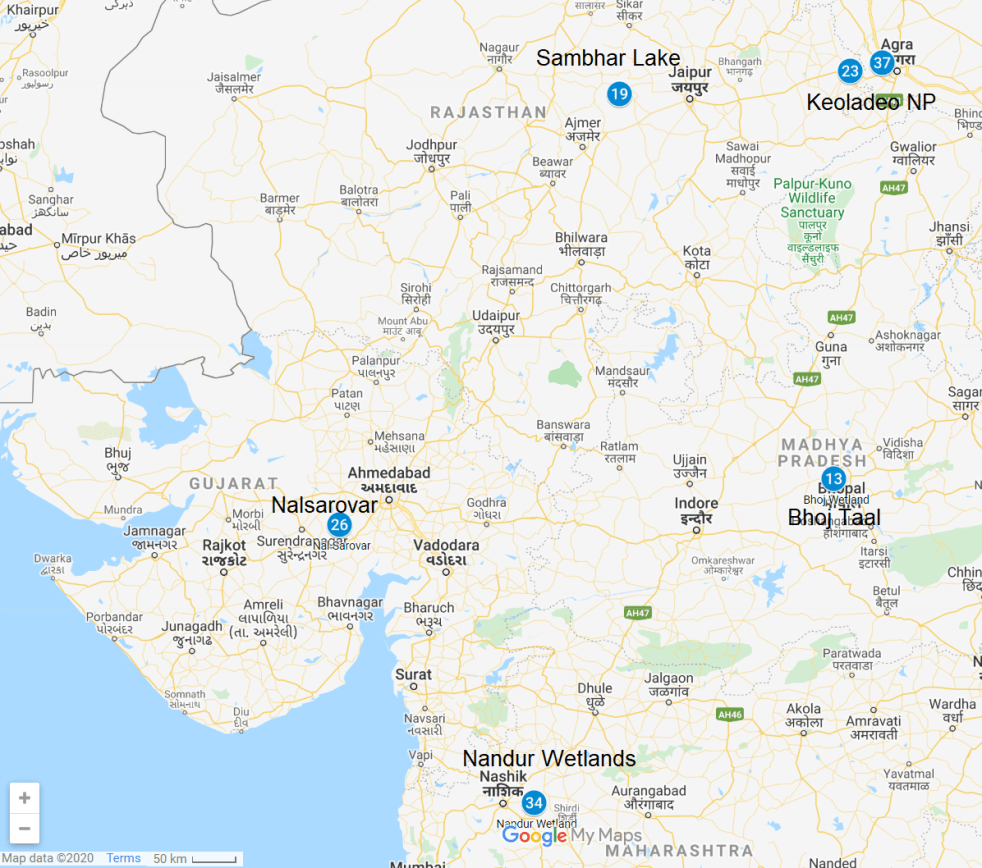
Wetlands are critical part of hydrological systems. They provide multiple ecological services to people living in proximal areas. The invisible contribution of wetlands in saturating aquifers and checking groundwater depletion is essential given the growing water scarcity. Additionally, wetlands are home to a variety of plants and animals species making them fully functional and self-sustaining eco-system. Sadly, despite the environmental significance and associated support services, wetlands have been subjected to degradation for past many decades.

Continue reading “DRP: 11 Nov 2019: Wetlands can help water security, help adapt to & mitigate climate change impacts”
Sand Mining · Yamuna River

यमुना 2019: खनन से खतरे में पड़ा नदी और लोगों का जीवन

इन दिनों हरियाणा के यमुना नगर जिले में यमुना नदी में बड़े पैमाने पर जमकर अवैज्ञानिक और अवैध तरीके से पत्थर, रेत खनन हो रहा है। जिसके कारण यमुना नदी का अस्तित्व खतरे में पड़ गया है। नदी से पत्थर-रेत निकालने के लिए भारत सरकार द्वारा बनाए गए सभी कानूनों को ताक पर रखा जा रहा है। परन्तु जिला प्रशासन और सम्बंधित विभाग मामले पर मौन साधे बैठे हैं।

हाल ही में खनन प्रभावित क्षेत्र के भ्रमण के दौरान, हमने देखा की कई बड़े वाहन नदी से भारी मात्रा में कीमती रेत ढुलान में लगे हैं। नदी की प्राकृतिक धारा को किसी जगह रोका गया है और किसी जगह पर मोड़ा गया है। बड़ी बड़ी जेसीबी और भीमकाय मशीनें बेतरतीबी से नदी तल से रेत खोदने में व्यस्त हैं। जगह जगह रेत के टीलें बने हुए हैं। कई स्थानों पर नदी में विशालकाय गढ्डे बन गए हैं। तो अन्य जगह नदी को बड़े तालाब में बदल दिया गया है। एक तरह से नदी नाम की कोई चीज देखने को नहीं मिली। नदी के स्थान पर रेत के ढ़ेर, जलकुंड और मशीनों और ट्रकों का शोर-शराबा ही देखने और सुनने को मिला। 

Continue reading “यमुना 2019: खनन से खतरे में पड़ा नदी और लोगों का जीवन”