Dams

Kerala Rivers Review 2017 : Government Efforts Fail To Protect Rivers

The fifth rivers’ review highlights status of Kerala rivers in the year 2017. 

Rivers Pollution and Government Actions

Govt mulls severe punishment for agents of water pollution The state government on Feb. 2017 signaled its intentions to zero in on agents of pollution in water resources. The Pollution Control Board and Revenue Department officers swooped down on a private resort in Chinnakkanal, Idukki, for allegedly diverting sewage into a potable water source. Water Resources Minister Mathew T Thomas stated that his department has proposed amendments to the Kerala Irrigation and Water Conservation Act, 2003, to make punishments more severe. He also said that the govt was planning to have harsher measures in place to discourage people from polluting rivers and water bodies.http://www.newindianexpress.com/states/kerala/2017/feb/14/kerala-government-mulls-severe-punishment-for-agents-of-water-pollution-1570357–1.html (The New Indian Express, 14 Feb. 2017)

The state also planned to enact strong legislation for the conservation of rivers. http://www.newindianexpress.com/cities/thiruvananthapuram/2017/sep/06/state-to-frame-strong-law-for-river-protection-1653026.html(The New Indian Express, 6 Sept. 2017)

Continue reading “Kerala Rivers Review 2017 : Government Efforts Fail To Protect Rivers”

Dams · DRP News Bulletin

DRP: 5 Mar 2018 (Will India Face An Unprecedented Water Crisis This Summer?)

Residents of Muruga Tholuvu Harijan Colony in Chennimalai Union have urged the district administration to take steps to provide them water on a regular basis. In a petition, they said that villagers have to go in search of water from other areas and transport it in bicycles regularly. They said that most of the people were labourers and their livelihood is lost when they go in search for water. They said that the situation is worse during summer season, as water is not available at nearby areas and they are unable to purchase water from the market too. http://www.thehindu.com/news/states/provide-drinking-water-villagers/article22935093.ece (The Hindu, 5 March 2018)

With the beginning of summer season, there are several news reports describing the growing water crisis in different parts of country. Here are details of various Indian states suffering from  water scarcity for industrial, irrigational and even for drinking purposes which given the due summer months could develop into grim scenario. These stories also show how the mismanagement of dam storages, exploitation of ground water resources and pollution of rivers have significant role in aggravating the situation.

Gujarat The state is staring at a water crisis this summer, with low water levels in the Narmada dam and almost all other major dams. On March 3, the CM Vijay Rupani has held a meeting with senior minister and bureaucrats to take stock of the water situation in the state and discussed ways to ensure drinking water availability. The government also has decided to allocate Rs 200 crore in special grants for augmentation of local water sources and instructed all collectors to form district committees, have weekly review meetings and start supply of water by tankers wherever required.

Continue reading “DRP: 5 Mar 2018 (Will India Face An Unprecedented Water Crisis This Summer?)”
Dams · Rivers

North India Rivers Review 2017: Pollution Poisoning Lifelines

In an effort to assess the situation of Rivers in 2017, SANDRP is presenting the compilation of key rivers related development in the country. The first part of this Rivers Review 2017 includes Northern States including Jammu and Kashmir, Punjab, Haryana, Himachal Pradesh, Uttarakhand, Uttar Pradesh and Delhi. The following parts will present separate accounts for Rivers in North East, West, East and South Zones. There will also be separate review reports on Ganga & Yamuna rivers.

Continue reading “North India Rivers Review 2017: Pollution Poisoning Lifelines”

Dams · DRP News Bulletin

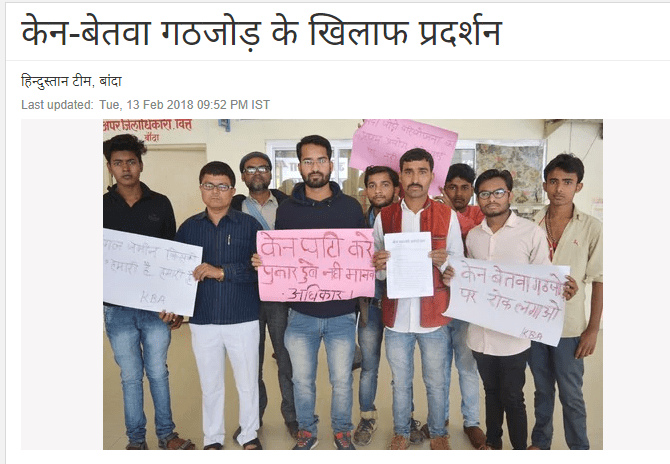
DRP: 26 Feb 2018 (Banda People Also Protest Against Ken Betwa Link)

When Central Government is trying to push Ken Betwa link project terming it as beneficial for both Madhya Pradesh and Uttar Pradesh, local people of Banda are now also protesting against it, in addition to the people of Panna that are already opposing it. On Feb. 13, 2018, the Ken Bachao Samiti comprising of farmers, citizens and social workers in Banda sat on a Dharna before district magistrate office. The group have also sent a memorandum to the President of India, demanding immediate cancelling of the project. Raising serious concerns over environmental and social of the linking project, they asked demanded proper impact assessment and public consultation and said the project wont be allowed to go forward. Indeed, as they have said, there has been no downstream impact assessment and people of Banda are likely to loose their river.  https://www.livehindustan.com/uttar-pradesh/banda/story-demonstrate-against-ken-betwa-alliance-1800951.html (Hindustan Hindi,13 Feb. 2018) 

Continue reading “DRP: 26 Feb 2018 (Banda People Also Protest Against Ken Betwa Link)”
Dams · DRP News Bulletin

DRP: 19 Feb 2018 (How Are We Treating Our Urban Rivers?)

In this comprehensive article Mumbai-based author Vaishnavi Chandrashekhar throws the light on the plight of Uraban Rivers. “Rivers and streams have borne the brunt of the recent urban explosion in India, a nation whose population has nearly doubled in the last 40 years to 1.35 billion. Unplanned growth has led to the use of water bodies as dumping grounds for sewage and industrial effluent. According to CPCB, 63 % of the urban sewage flowing into rivers (some 62 billion liters a day) is untreated.

In addition, riverbanks, wetlands, and floodplains have been claimed over time by infrastructure, slums, offices, and housing developments – all of which has narrowed natural river channels and distorted flow, greatly reducing the ability of India’s rivers to buffer flooding. It also has taken a toll on biodiversity. http://e360.yale.edu/features/dying-waters-india-struggles-to-clean-up-its-polluted-urban-rivers (Yale Environment 360, 15 Feb. 2018) 

Continue reading “DRP: 19 Feb 2018 (How Are We Treating Our Urban Rivers?)”
Dams · DRP News Bulletin

DRP: 8 Jan 2018  (“THIS IS RIVER, NOT LAND” Chennai Fisherfolks Fight To Save Ennore river)

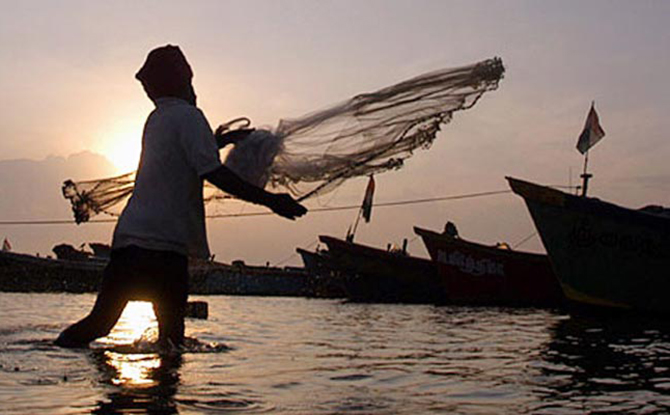
In a remarkable protest echoing urgent need for protection of rivers, fisherfolk of Kosasthalai River on 03 January 2018, launched a ‘Jal Satyagraha’ against Kamarajar Port project. The proposal would divert 1000 acres of creek area. It mainly comprises of river, wetlands, marshy areas on which fisher community depend for livelihood.

Raising their voices against the project with holding play cards that read “This is River, Not Land” they stood in waist-deep in waters to save Ennore Creek. Joining the protest, hundreds of residents also demanded the withdrawal of alleged fraudulent maps denying the existence of the Ennore Creek. The community has been fighting a lonely battle against the Tamil Nadu government accusing it of turning wetlands illegally into industrial real estate corridors.

– “Fishing economy has been hit massively. Shrinking of water body means less space for fish. Shrinking has happened in terms of surface spread as well as depth thanks to the dumping of dredged sand from the sea, silting the waterbody. The larger concern is fly ash and heavy metals from the industries polluting the environment causing health hazards,” said Nityanand Jayaraman, Environmental activist and researcher who was part of the protest. https://www.oneindia.com/india/chennai-fisherfolk-stage-jal-satyagraha-to-save-ennore-creek-2613088.html (One India, 04 January 2018)

Continue reading “DRP: 8 Jan 2018  (“THIS IS RIVER, NOT LAND” Chennai Fisherfolks Fight To Save Ennore river)”
Dams

World Fisheries Day 2017: Dams, Rivers & Fisheries in India

Every year, November 21 is celebrated as World Fisheries day across the world. Fisherfolk communities organize rallies, workshops, public meetings, cultural programs, dramas, exhibition, music show, and demonstrations to highlight the importance of maintaining the world’s fisheries.

As per a recent United Nations study, more than two-thirds of the world’s fisheries have been overfished or are fully harvested and more than one third are in a state of decline because of factors such as the loss of essential fish habitats, pollution, and global warming. The World Fisheries Day helps in highlighting these problems, and moves towards finding solutions to the increasingly inter-connected problems, and in the longer term, to sustainable means of maintaining fish stocks. https://www.gdrc.org/doyourbit/21_11-fisheries-day.html

In an attempt to understand the significance of the issue, SANDRP with the help of selective media report, presents an overview of key developments and problems affecting fisheries and fisher folks at India and South Asia level.

Continue reading “World Fisheries Day 2017: Dams, Rivers & Fisheries in India”

Rivers

Will this ‘Rally’ help the rivers?

PRESS RELEASE From India Rivers Week Organising Committee on Sept 13, 2017

We are concerned about the increasing superficial optics around saving rivers, with little or no effort to address fundamental issues which are causing their demise.

The high profile rally initiative to save India’s rivers taken up by well respected religious guru Sadguru and his followers is noteworthy, and the most recent case in point. It is striking that so many film stars, politicians, governments, and public personalities, are joining the call. Lakhs of children are expected to join in the program. While we welcome such an outpouring of good intentions and good will as a demonstration of the positive energy all around, unfortunately, we have seen no evidence either from the rally organisers, on their website[i] or their messaging, that they understand or plan to address the real threats faced by our rivers and their sorry state. Continue reading “Will this ‘Rally’ help the rivers?”

Dams

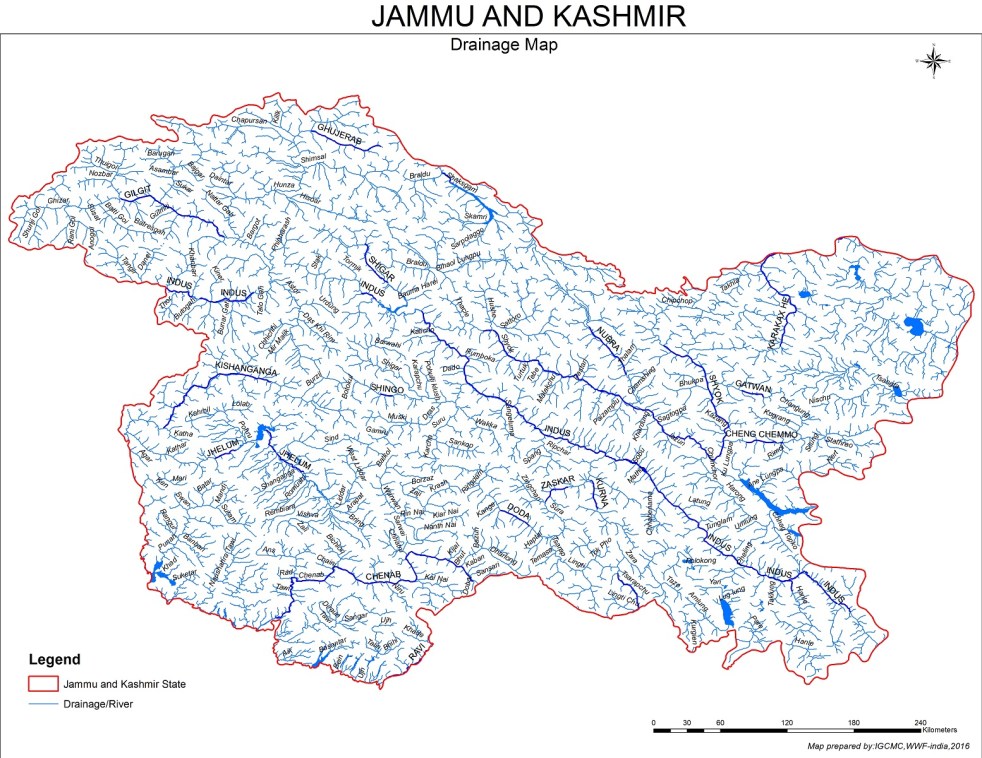
Jammu and Kashmir Rivers Profile (Jhelum and Chenab Basins)

This report discusses a few of the significant issues in the Jhelum and Chenab basin two of the main tributaries of the Indus and provides the readers a snapshot of the issues confronting the water resources development in the basins. On the basis of these factors, the health and status of the Jhelum and Chenab basins is determined using an assessment matrix providing qualitative weights to each of the indicators and influencing factors to arrive at the overall score of the river categorizing a riverscape as healthy, sick and dying.

Continue reading “Jammu and Kashmir Rivers Profile (Jhelum and Chenab Basins)”

Dams

Uttarakhand Rivers Profile

About Uttarakhand 

Geographical Location- North India largely mountainous with two plains and two partly mountain districts in  the south; Area- 53483 sqkm; Population- 10.12 million; River basins- 4 River basins (R. Ganga‘s basin is subdivided in the map below into R. Bhagirathi, R, Alaknanda and R. Ganga sub-basins); Districts-13; Climate- Sub-tropical to tundra 

About Uttarakhand Rivers

Uttarakhand_Drainage_map

The water quality of Uttarakhand‘s rivers is basically good, especially in the upper reaches. Downstream of some large settlements and in the lower reaches in the Himalayan foot hills the water quality suffers due to the release of untreated sewage and industrial effluents. But the state‘s ambitious program to build 450 hydro power projects threatens the survival of the river ecosystems and the lives and livelihoods of people who live  in these river valleys.

Continue reading “Uttarakhand Rivers Profile”