Two interesting orders from National Green Tribunal (NGT) marked important developments on water-environment issues this week. NGT asking for PERFORMANCE AUDIT of pollution Control Mechanism is indeed long overdue necessity, considering the complete, abject failure of the pollution control mechanism in India. The hopes of effective action, like in the past, however, were dashed since CPCB, which is PART OF THE PROBLEM has been asked to do the audit. An independent audit, in addition to one possibly by CAG may have helped. https://www.thehindu.com/news/cities/Delhi/ngt-slams-state-pollution-bodies/article26008687.ece (17 Jan. 2019)
Whatever positive signs were available by this order were further dashed by another NGT order in which it declared that EIAs (Environmental Impact Assessment) reports are already taking climate change into account, while the tribunal dismissed a petition asking that all development activities be screened/ regulated keeping climate change in mind.
This is totally WRONG contention. Just to illustrate, SANDRP has been pointing out to the EAC, MoEF and the developers how the EIAs of dams and hydropower projects are ignoring the climate change related issues and impacts. In response the consultants and developers have responded, approved by the silent or spoken nods by the EAC and MoEF that these were not even part of their TORs! One only wishes NGT was most discerning before making such claims and would have gone through a few EIAs to see if at all EIAs are dealing with these issues with any rigour or credibility. https://www.business-standard.com/article/pti-stories/climate-change-already-covered-under-environment-impact-assessment-ngt-119011600897_1.html (16 Jan. 2019)
Good to see NGT rejecting the flawed Groundwater notification dated Dec 12, 2018 from CGWA that was also critiqued by SANDRP: https://sandrp.in/2018/12/31/groundwater-governance-why-dec-12-2018-cgwa-notification-would-be-disastrous/. However, NGT should have asked an independent panel to formulate the policy for sustainable groundwater use, rather than a committee of the same government persons. Besides, there is also need for restructuring of currently totally ineffective CGWA and make it COMPLETELY INDEPENDENT of government.
In a shocking revelation, Jay Mazoomaar in this Indian Express report exposes how Wildlife Institute of India not only accepted consultancies from hydropower companies, but also diluted the mandate for the studies for given by statutory bodies like NGT, NBWL and FAC, but also provided compromised reports catering to the interests of the hydropower developers, thus trying to clear the way for the two controversial mega hydropower projects, one each in Dibang and Lohit river basins in Arunachal Pradesh. https://indianexpress.com/article/north-east-india/arunachal-pradesh/wildlife-institute-all-for-hydel-projects-in-arunachal-pradeshs-tiger-zone-5499656/
In case of the 3097 MW Etalin project being developed by Jindal and Arunachal Pradesh govt, the IE report says: “the WII was asked by the Ministry (MoEF) to assess the feasibility of the plan that requires 1,166 hectares of forestland in the valley. The Ministry’s move followed a recommendation from its Forest Advisory Committee (FAC) to conduct an environment impact assessment study. Instead, the WII initiated a study to find how the project’s impact on wildlife can be minimised”. Thus instead of doing the mandated scientific impact assessment, the WII initiated a study to minimise the project’s impact.
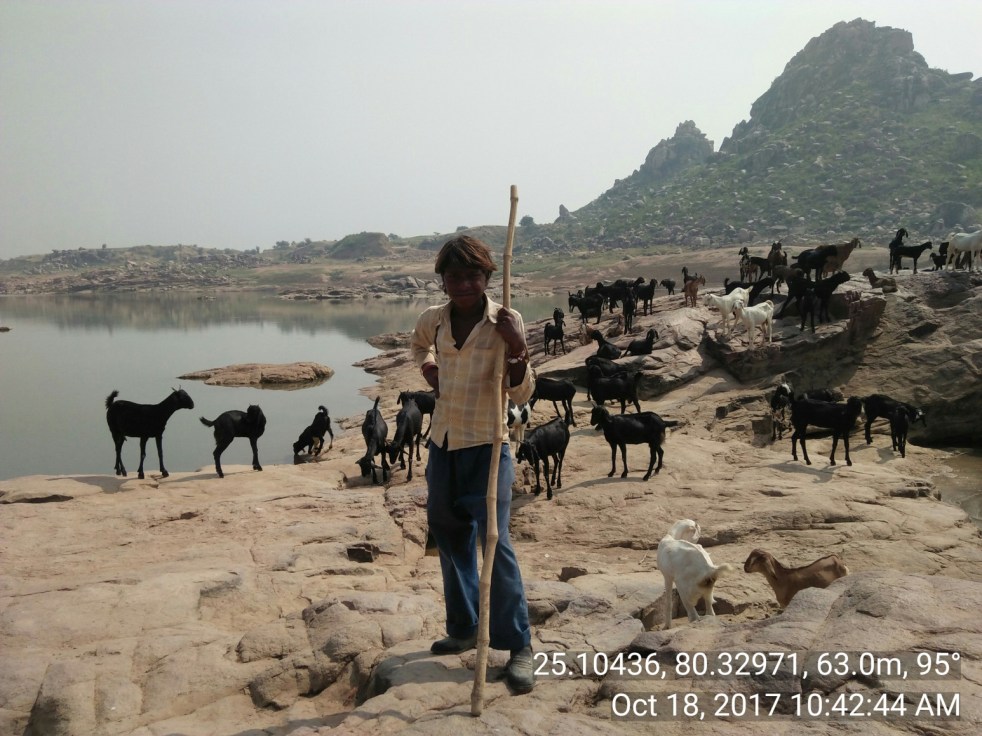
This multi-media report by Siddharth Agarwal based on a walk along the majestic Ken River in central India, now part of a contentious river-linking project, shows how essential it is to the communities living around it.
The idea of walking along a river has many key reasons, but the most important of them is to interact, discuss with and document the life of the actual stakeholders of this natural system. Traversing flood plains and riverbanks on foot takes us right where the story is, not in a far removed space, where even a few kilometres away from it can be a major shift. Location plays a wonderful role in rejigging memory and helps people imagine past situations. The discussions on the scale of the importance of a river suddenly have a realism and depth.
Further speaking to various regional media, Madhav Gadgil has said that irresponsible environmental policy is to blame for the recent floods and landslides in Kerala. He also called it a “manmade calamity”. He said that the committee report had recommended to protect the resources with the cooperation of local self-govt and people, but those recommendations were rejected.
Dams should never be filled before the end of the monsoons. Because then one doesn’t have any solution but to release the water in the surrounding areas: Himanshu Thakkar, SANDRP says as one of panellist discussing role of dams in aggravating Kerala floods.
Here is admission about sudden, excessive releases and not foreseeing the coming disaster. The Kerala crisis could have been contained had the state “gradually released” waters from at least 30 dams, officials said, adding that the local authorities failed to foresee the imminent danger with high rain prediction. “Such floods have probably recurred after 100 years, exposing the state’s unprofessionally run reservoir management system and unpreparedness on disaster mitigation and disaster resilience, an official pointed out. https://timesofindia.indiatimes.com/city/kochi/gradual-dam-water-release-could-have-contained-crisis/articleshow/65436339.cms (17 Aug. 2018)
The release of around 1.31 lakh cusecs of water in Yamuna from Hathnikund barrage at 09:00 hours on July 26, 2018, was certainly first surge of flood this monsoon in the river. But no one expected, most are still in the dark that the release would multiply by over five times in just two days! It is almost a month after the Southwest monsoon arrived. By this time the river usually floods couples of times.
Looking at the lack of significant rainfall in the catchment area over past weeks, the flood is unexpected and has taken many by surprise. The Irrigation and Flood Control Department, Delhi Government has issued warning for flood plain farmers and human settlements close to river banks, but the warning does not seem to commensurate with the flood peak that is likely to hit the capital in next day or two.
Bar chart by Irrigation & Flood Control Dept, Delhi showing history of floods in Yamuna river since 1963.
Yamuna has already crossed warning (204 m) and danger level (204.83) at Old Delhi Railway Bridge (ORB), Delhi. The High Flood Level is 207.49 meters, reached on Sept 6,1978 after around 7 lakh cusecs (cubic feet per second) water was released in Yamuna on 3rd Sept 1978 at 04:00 hrs from Tajewala barrage, that was decommissioned and replaced by Hathnikund barrage in early 1990s. The flood monitoring of River Yamuna began in 1963.
Since then, the river has seen high floods in 1988, 1995, 2010 and 2013. The 2010 and 2013 floods also crossed 207 metres mark but fell short of 1978 level.
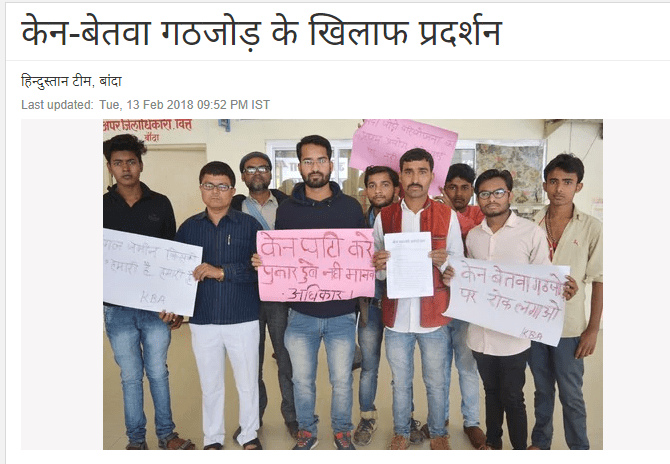
When Central Government is trying to push Ken Betwa link project terming it as beneficial for both Madhya Pradesh and Uttar Pradesh, local people of Banda are now also protesting against it, in addition to the people of Panna that are already opposing it. On Feb. 13, 2018, the Ken Bachao Samiti comprising of farmers, citizens and social workers in Banda sat on a Dharna before district magistrate office. The group have also sent a memorandum to the President of India, demanding immediate cancelling of the project. Raising serious concerns over environmental and social of the linking project, they asked demanded proper impact assessment and public consultation and said the project wont be allowed to go forward. Indeed, as they have said, there has been no downstream impact assessment and people of Banda are likely to loose their river. https://www.livehindustan.com/uttar-pradesh/banda/story-demonstrate-against-ken-betwa-alliance-1800951.html (Hindustan Hindi,13 Feb. 2018)
There have been many positive developments on agriculture, groundwater and environment round the week. In the first positive development, data from the first impact study of Paramparagat Krishi Vikas Yojana (PKVY) shows that small and marginal farmers, who can’t afford costly agricultural inputs, are turning a new leaf by going organic because of lower costs and higher margins. The study conducted by the National Institute of Agriculture Extension Management, has also revealed that Net Returns of organic farmers were higher for all the three crops studied, namely wheat, paddy and soybean, by 15.8%, 36.7% and 50% respectively.
This was based on study of 690 organic clusters in 25 states, out of some 6211 clusters comprising of 2.25 lakh farmers in a PKVY (each ha getting Rs 50 000 as aid) scheme launched in 2015, comprising of 52.3% small farmers. The average cluster size was 69 acres, in each there were 54.6 farmers on average. Maharashtra had the highest number of clusters at 1043 and MP had the highest area under clusters. The funding however remained irregular. India’s domestic organic food market is expected to show Compound Annual Growth rate of 25%, says the study. https://www.hindustantimes.com/india-news/small-farmers-go-big-with-organic-farming/story-nlyQQVUnoewHgeJyvaAnJI.html (Hindustan Times, 29 January 2018)
Another positive news report, have disclosed that how a simple groundwater recharge technique is transforming farmlands in Gujarat. The simple pit and pipe system simply and expertly captures standing water during rains, thus freeing arable land from water logging while recharging groundwater to use for irrigation during the lean season. This is essentially a simple groundwater recharge scheme but appears to last long. As per report about 3000 such units have already been installed in Gujarat and several other states. http://www.thehindu.com/society/this-simple-technology-has-transformed-gujarat-farmlands-into-an-oasis/article22529034.ece (The Hindu, 27 January 2018)
The third positive news have come from Central Government which has prepared a Rs 6000 crore plan to recharge ground water. The scheme is yet to be cleared by the Expenditure Finance Committee and the Cabinet.
As per report, the new 5-yr long scheme will be funded 50: 50 by the World Bank and centre, to be implemented in Gujarat, Maharashtra, Madhya Pradesh, Uttar Pradesh, Karnataka, Haryana and Rajasthan, covering 78 districts, 193 blocks and 8300 gram panchayats.