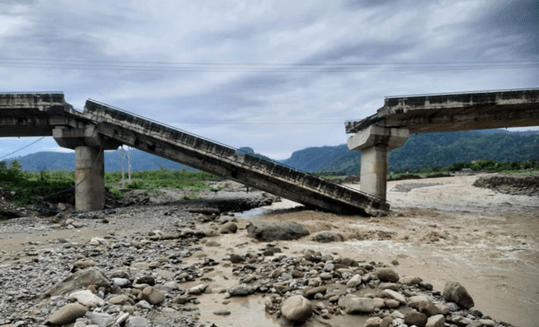
(Feature Image: Damaged bridge on Malan river in Kotdwar, Uttarakhand in July 2023. Source: Amar Ujala)
Unscientific mining of riverbed minerals has emerged as a major geomorphic and disaster risk driver in Uttarakhand and Himachal Pradesh as per reports from past few years. Recent studies sharing examples of Ganga and Gaula rivers reveal broader pattern of how excessive riverbed extraction have been changing the very shape and behaviour of Himalayan rivers. The studies find that such mining is resulting in deepening of riverbeds, narrowing down of water channel thus disturbing the natural balance of riverbed minerals.
The hungry water effect created in the process has been triggering aggressive erosion of river beds and banks over long distances. Researchers warn that these changes are long-lasting and dangerous, often leading to irreversible instability.
The impact is clearly visible on river infrastructure in the both States. The collapse of the Malan river bridge in Aug. 2023 is a major example. In Himachal Pradesh, the Paonta bridge on the Yamuna and the Bangran bridge on the Giri river continue to face risks due to ongoing mining. The reports underline how removal of gravels and boulders around bridge exposes the foundation of pillars making them vulnerable during floods.
Uttarakhand
Mining Impacting River’s Geomorphology: Oct. 2025: A scientific study titled River Sand Mining: A Developing Geohazard in the Himalaya published by Springer and led by researchers from IIT Kanpur warns that rampant, unregulated sand mining is placing Himalayan rivers under severe stress and creating a rapidly intensifying geohazard. Excessive extraction is disrupting natural sediment flows, causing major geomorphic changes such as riverbed deepening (incision), channel narrowing, bank erosion, and loss of biodiversity-supporting sandbars. These changes increase river velocity & trigger the “hungry water” effect, where sediment-starved rivers erode their beds and banks aggressively over long distances.
A detailed case study of a 32-km stretch of the Upper Ganga in Uttarakhand shows that heavy mining has transformed once-braided channels into narrow, degraded single-thread rivers, with long-lasting impacts even after restrictions. The study estimates that over 60% of surveyed Indian river stretches already show mining pressure.
The researchers stress that Himalayan rivers may be nearing irreversible tipping points, with rising flood risks and ecological decline. They recommend science-based sediment management, including limiting mining to replenishment rates, avoiding sensitive zones, and improving monitoring systems, which currently lack sufficient sediment data.
Feb 2025: This study explores how in-channel riverbed mining has affected the Gaula river in Haldwani. It shows that removing sand directly from the riverbed disrupts natural sediment flow & channel structure, leading to rapid, significant changes. Because the Gaula river carries high sediment loads & flows mainly during monsoon, it is sensitive to such disturbances.
Using satellite data from 1976 to 2021, the researchers found that sand mining has caused the river channel to narrow and deepen, fixed its main flow path, hardened the riverbed and reduced its geomorphic diversity. Over time, the river has shifted from a wide, dynamic system to an “underfit” channel, where a smaller, incised river flows within a much larger valley. The study concludes that sand mining triggers a positive feedback process, where initial damage accelerates further degradation, leading to long-term weakening of the river system.
Malan River Bridge Damage; July 2023: A bridge on Malan river in Pauri district collapsed on July 12, 2023, amid flood surge in the river. Damage to the 300 m long bridge connecting Pauri with Kotdwar affected about 50,000 people. Locals and activists believed that the collapse was due to rampant illegal mining that had weakened the riverbed. They also reported that the riverbed mining started within 72 hours of bridge collapse. The locals were constantly reporting about illegal mining and sinking of their houses and farm land.
They claimed continuous illegal mining to the north and south of the bridge had created large pits, due to which pillars number 9 and 10 were facing constant erosion. A week earlier, channelisation work had been started to control the river flow, but no attention was given to pillars 9 and 10. The shifting soil had weakened the foundations of these pillars. This 325-metre-span double-lane motor bridge at Motadhank was completed on May 24, 2010 at a cost of ₹12.35 crore, following long-standing demands of local residents. Before the bridge was built, people used a low-water crossing (rapta) to travel, which would become unusable during the monsoon.
Following the Malan bridge collapse, environmentalists in the state alleged that indiscriminate and unchecked mining across riverbeds was contributing to the weakening of infrastructure. A government order from 2022 had reverted to the mining policy of 2016 which allowed mining in riverbeds at a distance of 100 metre from pillars of a bridge. Experts had said that the Raipur bridge collapse of 2021, Bhopalpani bridge collapse of 2022 on the outskirts of the capital were all examples of how riverbed mining was causing damage to the infrastructure.
Aug 2023: The Nainital High Court (HC) in Aug. 2023 directed the state govt to halt mining and submit an affidavit within 4 weeks regarding the extensive damage inflicted upon bridges spanning the Malan, Sukhro, and Kho rivers. The court also instructed the govt to prepare a comprehensive plan for restore the damaged bridges.
Akanksha Aswal, a resident of Pauri Garhwal district, had filed a petition in which she mentioned how incessant rains in the Himalayan foothills led to river swelling and weakening of the foundations of the Malan bridge in Kotdwar due to illicit mining in the riverbed, resulting in the bridge’s collapse.
Sept. 2023: As per this report, illegal sand mining significantly intensified flood damage in Uttarakhand and Himachal Pradesh in 2023 by weakening riverbeds and banks, leading to widespread infrastructure failure. In Kotdwar, all major river crossings were affected, with bridges over the Malan and Paniyali rivers collapsing and the approach road to the Khoh bridge being washed away. The excessive extraction deepened river channels and accelerated flow, causing severe erosion around bridge foundations and nearby structures.
Himachal Pradesh
Feb. 2026: Illegal sand mining in the Beas River near Indora has been severely damaging the river. Villagers reported large-scale nighttime extraction of sand and gravel, leaving behind deepened riverbeds, unstable banks and disrupted water flow. Experts warned this could lead to groundwater decline, ecological collapse and loss of livelihoods. Despite strict laws, weak enforcement and alleged political collusion have allowed mining to continue, eroding both the river’s health and public trust in authorities.
March 2025; Paonta Bridge: Describing scale of riverbed excavation, the report mentioned about how illegal mining had emerged as one of the biggest threats to the Yamuna’s survival in the Paonta Sahib region. Sand and gravel extraction, often carried out without proper environmental regulations, had severely impacted the river’s ecosystem. Large-scale mechanised mining had altered the natural flow of the river, eroded its banks and disrupted the aquatic habitat. Despite strict laws prohibiting illegal mining, the practice continued unabated, largely due to weak enforcement and political influence.
Aug. 2024: As per this report illegal sand and gravel mining continued unchecked along the Yamuna in Paonta Sahib despite repeated warnings and monsoon restrictions by authorities. Mining was especially dangerous near the Yamuna Bridge, where excavation close to its pillars had put the already weakened structure at serious risk of collapse. The act not only threatened critical infrastructure but also endangers labourers’ lives highlighting the urgent need for stricter action.
May 2024; Bangran Bridge: As per this report Illegal sand and gravel mining in Paonta Sahib is damaging rivers like the Giri and Yamuna, putting bridges – including the Bangran bridge – at risk. Continuous excavation has weakened bridge foundations and increased threats of erosion and floods. Despite some fines & enforcement actions, illegal mining continues widely.
Nov. 2025: As per this report, the unregulated riverbed mining continues to cause severe environmental damage despite bans and warnings from the Supreme Court and the NGT. Illegal extraction using heavy machinery was weakening riverbeds and hillsides, increasing risks of flash floods, erosion and biodiversity loss. Experts warned that poor enforcement and continued mining could lead to worsening ecological and community impacts.
July 2025: The NGT on July 23, 2025 disposed of a case concerning alleged unscientific mining in the Sirmaur district, after concluding that its directives had been substantially complied with. The case was originally registered in 2023 following a letter petition. The petition alleged that two mining operators were conducting illegal and unscientific mining in Banaur panchayat, leading to environmental degradation, damage to trees and cracks in nearby buildings.
SANDRP

 SANDRP