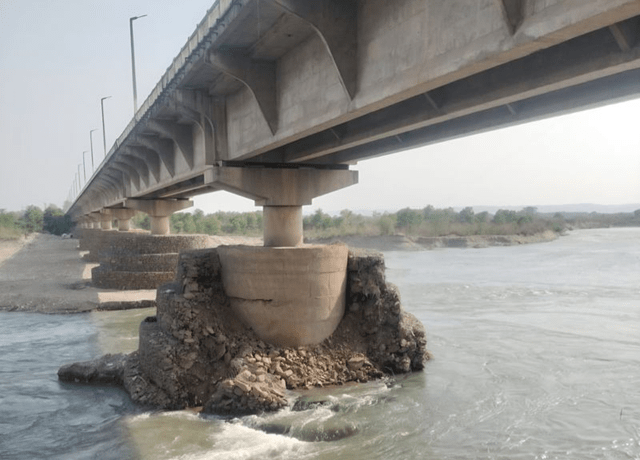
(Feature Image: The flood protection work around the pillars of already mining threatened Agampur bridge over the Sutlej river in Ropar district was damaged following discharges from Bhakra dam on June 15, 2026 night. Source: The Tribune)
This report attempts to document the impact of excessive mining activities on river infrastructure in Punjab and Haryana between 2023 and 2026. Our previous nationwide analysis on the subject can be seen here for 2023 and 2022.
Based on the available reports, at least three bridges have been impacted by riverbed mining operations in Punjab during past three years. This includes the Algran bridge on Swan river, which suffered severe damage during the 2023 floods. The bridge has remained shut since Dec. 2023 affecting connectivity for scores of villages.
Similarly, the Agampur–Anandpur Sahib bridge on Satluj river has come under increasing stress due to mining activities over the past three years. The judiciary has taken note of damaged pillars, exposed foundations and risk of collapse ahead of monsoon. The Chakki river railway bridge, connecting Pathankot with Kangra (HP), was also severely damaged during the August 2023 floods, with reports linking the collapse with prolonged riverbed mining that destabilized the river channel.
All three cases of Punjab show that the judiciary has increasingly been treating riverbed mining as a public safety and infrastructure risk and not just an environmental violation. However, these interventions have largely focused on investigation, monitoring and precautionary restrictions rather than resolving the underlying issue of unsustainable mining with a view to stop recurrence of such incidents.
In Haryana unregulated sand mining in the Yamuna has been found impacting river infrastructure and flood protection measures. The under-construction bridge in Yamuna Nagar is under threat from excessive mining and movement of sand laden trucks. In Sonipat, mining induced erosion has endangered ₹100-crore water project.
Farmers across Karnal, Panipat have reported severe riverbank erosion, loss of fertile land, and increased flood risks. Many have linked past flood damage and recurring embankment breaches to deep and unregulated mining, which weakens riverbanks and alters flow patterns.
Punjab: May 2026: Algran Bridge: Rampant and unregulated sand mining in the Swan riverbed severely damaged the Algran (Algara) bridge in Punjab, a fact acknowledged by the state government before the National Green Tribunal (NGT) on May 05, 2026. The bridge is located along Kamla Nangal route and has remained closed to regular traffic for nearly two years and is still undergoing repair.
The bridge, built in 2002 had been closed since Dec. 2023 after two of its 13 piers collapsed during the 2023 floods, a failure linked to indiscriminate sand mining that exposed the foundations to strong currents. The damage forced residents of around 200 villages to take a 30-km detour through Himachal Pradesh.
Aug. 2025: Cabinet Minister Harjot Singh Bains, representative of the Anandpur Sahib constituency, said that villagers informed him about further damage to the bridge after a flash flood in the Swan. He has directed the PWD to start repair work immediately. The contractor was required to complete the work by Jan. 2026.
He also directed that only one side of the bridge be dismantled during reconstruction and to keep other side open for two-wheelers to maintain connectivity during the monsoon. The decision came after residents of Algran and nearby villages raised concerns that complete closure would cut off access to Anandpur Sahib and Nurpur, affecting daily travel for students, workers, and farmers.
July 2025: The temporary bridges built near Algran village was washed away following fain induced floods in Swan river.
June 2025: The 445-metre-long, 14-span bridge began showing signs of structural distress in mid-2023. An assessment found severe scouring around several piers, with Pier P7 critically weakened, but repair work was delayed by more than a year due to tendering delays. Residents report disruptions to healthcare, education, employment and emergency services, with fears that many villages could become isolated once river flows increase.
Feb. 2025: The bridge was scheduled for repair with a ₹17.56 crore tender issued by the Public Works Department (PWD). According to this report, its restoration work was formally awarded in Oct. 2024 and was expected to be completed by July 31, 2025. The department had constructed a temporary bridge to facilitate the movement of small vehicles. While the matter was under NGT preview, residents alleged unabated illegal mining in the area.
Nov. 2024: According to local residents and officials, years of excessive and often illegal sand mining near the bridge had weakened its foundations and pillars. One pier reportedly tilted due to excavation close to the structure and the damage was worsened by the 2023 floods. Residents said they had repeatedly warned authorities about mining around the bridge, but little action was taken.
Officials noted that concerns had been raised as early as 2014, when only one pillar was affected; by 2024, three pillars had tilted, substantially increasing repair costs. The report also mentioned that the bridge became the subject of scrutiny by the NGT after media reports prompted a study by the Central Pollution Control Board (CPCB). The CPCB did not rule out illegal mining as a contributing factor to the damage.
Dec. 2023: Authorities closed the Algran bridge to traffic two days after a damage assessment by PWD Chief Engineer Anil Kumar Gupta, as a safety audit by a private agency declared the structure unsafe. The nearly 30-year-old bridge was reportedly on the verge of collapse due to prolonged illegal mining which had exposed most of its 13 piers up to a depth of about 8 metres, with one pier already tilted and key structural components damaged, increasing gaps between bridge slabs.
Agampur (Anandpur Sahib) Bridge; June 2026: The Punjab and Haryana High Court (HC), while hearing a petition on illegal mining near the Agampur (Anandpur Sahib) bridge over the Satluj River in Ropar district, issued strict directions on June 17, 2026 to prevent further damage.
On June 8, 2026, the HChad initially stayed mining and desilting activities after allegations that rampant illegal mining was destroying river ecology and threatening the bridge. The court also highlighted serious safety concerns, noting that one bridge pillar (gate no. 1) was in a dilapidated condition while sediment accumulation upstream (gates 3–7) was restricting water flow.
Given the incoming 2026 monsoon, the HC warned of flooding and possible structure failure risks if water pressure increased. It permitted urgent repair of the damaged pillar and allowed limited desilting only up to June 30, 2026, restricted to 35–50 metres upstream in specified areas, directing that any further activity requiring court approval. The State was also directed to comply with NGT guidelines. The matter was adjourned to July 2, 2026, with directions for inspection and submission of a compliance report.
On Jun 16, 2026, the HC adjourned the hearing till Jun 17 after the Punjab govt denied any unauthorised extraction maintaining that only desilting for flood mitigation was being done.
The govt stated desilting had been prohibited within 300 metres downstream of the bridge to protect its structural integrity, while excavation upstream was restricted to 30 to 50 metres in length and 5 metres in depth below the well cap. It also sought setting aside of the interim order of June 8, which temporarily halted desilting activities at the site.
The petitioner alleged that mining was being carried out under the guise of desilting, resulting in damage to the Satluj–Swan confluence, destruction of wetlands, river diversion and disruption of local hydrology.
June 15 2026 The 1-km-long and 7.5-m-wide bridge, built in 1986 at an estimated cost of Rs 70 cr – has been under increasing stress due to extensive riverbed extraction. Over two years ago, officials reported that several piers were left exposed because scouring had severely affected their foundations. The PWD later sought funds for repair and protective measures.
Just ahead of monsoon, the bridge is again facing safety concerns due to damage to its pier-protection structures. Parts of the protective works, including gabion crates, have deteriorated, raising fears about the bridge’s stability, especially with increased water releases from Bhakra Dam. The newly built flood-protection works around the bridge were damaged when about 4,600 cusecs of water flowed through the river due to releases from the Bhakra Dam.
Residents attributed the damage to large-scale desilting, alleging that excessive removal of sand and gravel altered the river’s natural course and diverted stronger currents toward bridge pillars weakening protection works. They claimed that thousands of truckloads were removed under the guise of desilting.
The PWD stated that the protection work was still ongoing and that the contractor would repair the damage at its own cost. The incident intensified scrutiny as the Punjab & Haryana HC had stayed certain desilting activities on June 8, 2026 and the NGT has restricted commercial dredging without required environmental clearances.
June 1 2026 Taking serious not of allegation of illegal mining near the bridge, the HC directed the Ropar Deputy Commissioner (DC) to inspect the site and submit a detailed affidavit. The court warned that the officials would be held personally accountable if illegal mining is found.
Jan. 2026: Tensions escalated in Ropar district following allegations of rampant illegal sand mining in the Sutlej riverbed, with authorities warning that continued excavation poses a serious threat to the bridge’s structural safety and nearby villages.
Nov. 2023: An expert inspection in 2022 found that the well foundations of 14 piers had been exposed up to 14 metres (from 6 metres earlier) due to intense scouring, significantly weakening the structure and causing vibrations during vehicle movement. The situation worsened after floods in August damaged a nearby guide bund, which normally helps regulate river flow and protect the bridge.
PWD officials sought over ₹44 crore (₹33.52 crore for foundation restoration and ₹10.62 crore for the guide bund), but no repair work has begun yet due to lack of funds, leaving the bridge in a highly vulnerable condition.
Questions on Desilting-Feb 14, 2026: The NGT ordered a statewide halt on mining & desilting activities at 85 identified sites in Punjab. It ruled that while the tender process may continue, no desilting work could begin without prior approval and environment safeguards. The tribunal also stayed desilting in parts of the Ravi river. Next hearing was on May 14, 2026.
The case was filed by the panchayat of Gahlri village in Gurdaspur, which challenged auction notices issued between Dec 2025 & Jan 2026 for riverbed material extraction. Villagers argued that the proposed desilting was commercial in nature and required environmental clearances, warning it could harm downstream land. The order gained importance as floods in Aug-Sep 2025 had already caused widespread damage, which was worsened by illegal mining.
2025 Floods & Mining: Sept. 04, 2025: During a visit to flood-affected areas of Punjab, Union Agriculture Minister Shivraj Singh Chouhan attributed part of the flood disaster to illegal sand mining, saying it had weakened embankments (dhusi bunds) along the Sutlej, Beas, Ravi & Ghaggar River. According to him, these flood-protection structures had been strengthened in earlier years but prolonged illegal mining weakened them, allowing floodwaters to breach defenses and inundate villages.
However next day, Punjab Water Resources Minister Barinder Kumar Goyal rejected this, stating that record rainfall and unprecedented river discharge were the main causes. He added that embankments had been strengthened and mining is either banned or regulated near major rivers and flood structures.
Punjab- Himachal Pradesh
Chakki River Railway Bridge; June 2026: After four years of disruption, train service on the historic Pathankot–Joginder Nagar narrow gauge railway line resumed on June 02, 2026 following the completion of a new railway bridge over the Chakki river costing around ₹70 crore. The old bridge was severely damaged during Aug. 2023 floods. The floods also damaged the adjacent highway bridge.
Subsequent reports, petitions before the NGT and statements by local residents and environmental activists linked the damage to years of rampant and often illegal riverbed sand and gravel mining in the Chakki river. They argued that excessive extraction had deepened and destabilised the riverbed, increased scouring around bridge foundations, altered river flow patterns and weakened the structural stability of both railway and road bridges.
Nov. 2025: The NGT has been examining illegal mining case on the Chakki River in Nurpur, Himachal Pradesh. In response, the state industries dept told the tribunal that remote sensing (satellite monitoring) will not be used, calling it impractical, costly and ineffective because it cannot distinguish legal vs illegal mining, track vehicles or detect small-scale operations.
The issue stems from a Nov. 2024 NGT order, which formed a joint committee after complaints of illegal mining and recommended better monitoring, including satellite use. The department instead highlighted challenges such as washed-away boundary markers during monsoons and ongoing boundary disputes with Punjab along the Kandwal–Lodhwan–Tipri belt, which make the area prone to illegal mining.
July 2025: A major railway accident was narrowly averted on July 22, 2025 when a passenger train crossed a bridge over the Chakki River near Dhangu in Kangra, just moments before part of the bridge’s retaining wall and foundation collapsed due to heavy flooding. The incident triggered widespread concern about railway safety and the condition of infrastructure. The report noted that locals had repeatedly raised concerns about mining-related degradation of the river channel and nearby infrastructure.
March 2025: A joint committee of the NGT in March 2025 found serious lapses in regulation of mining along the Chakki River in Kangra, Himachal Pradesh. The NGT had ordered the committee’s formation on Nov. 7, 2024. During inspections on March 4–5, 2025, the panel reported that 6 out of 11 leased mining sites had no clearly defined boundaries, enabling illegal mining. The report also highlighted that mining operators failed to construct required retaining structures and did not conduct replenishment studies to assess sustainable extraction levels. The report warned that illegal mining has caused severe riverbed erosion, increasing flood damage during monsoons. It also linked mining to major infrastructure impacts.
Dec. 2024: The NGT ordered the Kangra deputy commissioner, the superintendent of police, and the director, mining and geology dept, to ensure that no illegal mining was carried out along the Chakki river in the district. The NGT has also granted the joint committee 8 weeks’ time to submit its final report while observing that “no further time will be granted”.
Haryana: Nangli-Jathlana Bridge: March 2024: Heavy vehicles carrying sand and other mining materials were reportedly passing illegally beneath an under-construction Yamuna bridge near Jathlana village close to Nangli Ghat in Yamuna Nagar. The PWD warned that such activitiy could damage the bridge and compromise its structural safety. The PWD also asked the Mining Department to act against violators. The issue was raised after a complaint by Advocate Waryam Singh, who alleged that despite official warnings, such movement continued, highlighting weak enforcement on the ground.
Oct. 2023: Advocate Waryam Singh repeatedly alleged that illegal sand mining near the under-construction bridge at Nangli Ghat was diverting the river’s flow, eroding riverbanks, damaging guide bunds and threatening the bridge’s structural safety. He also raised concerns about overloaded mining trucks operating beneath the bridge. Despite administrative action &rr enforcement measures, complaints of illegal mining in the Jathlana area continued into 2025.
Mining Threat to ₹100 Cr Ranney Well, April 2026: Illegal sand mining in Baghpat side of Uttar Pradesh altered the natural course of the Yamuna river diverting its flow toward Jajal village in Sonipat, Haryana. The diverted river was about two acres away from the ₹100-crore Jajal Ranney well project, a major drinking water source for the city, putting it at serious risk.
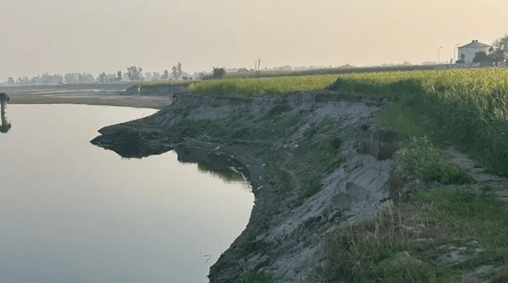
Riverbed mining induced erosion along Yamuna river near Jajal village and the Ranney well can be seen a short distance away. Dainik Jagran
Mining operators allegedly violated rules by creating temporary paths and embankments inside the river channel, which changed the river’s flow and triggered rapid bank erosion. The river was cutting through nearby agricultural land, damaging farms in Jajal and Garh Mirakpur villages and threatening local livelihoods.
On April 3, 2026, Irrigation Department warned the Baghpat administration that continued mining could worsen the situation. However, no protective measures such as anti-erosion structures were put in place. Officials warned that if the river breaches the project area, Sonipat’s drinking water supply could collapse.
Before this, M/s Jelkova Buildcon Private Limited a licensed company was in May 2025 found illegally mined sand in the Yamuna river near Asadpur village, Sonipat, violating rules and NGT guidelines by using heavy machinery. The mining created large sand mounds and unauthorised paths inside the river, which diverted its natural flow. Similarly, finding gross violations of mining norms which had severely damaged the Yamuna river eco-system, the NGT in July 2023, had ordered strict action against Ultimate Group in Sonipat.
Mining & Flood Impact- May 2026: Farmers from five villages in Panipat district protested against alleged illegal sand mining in the Yamuna river region, accusing authorities of failing to stop the activity. The protesters claimed illegal mining over the years has led to severe riverbank erosion, with hundreds of acres of farmland reportedly lost to the Yamuna River.
They also alleged that despite repeated complaints, the mining mafia continued to operate openly due to administrative inaction. Villagers demanded immediate action to stop the mining, continued excavation could worsen flooding and erosion in the area.
Jan. 2026: Congress MP Randeep Singh Surjewala alleged that rampant illegal sand mining along the Yamuna river was increasing flood risk and harming local communities.
July 2024: Farmers in Karnal raised concerns that illegal and excessive sand mining is increasing the risk of floods ahead of the monsoon. Villages such as Chandrao, Chaugama, Garhpur, Kalsora, Japti Chapra and Samaspur feared that continuous mining had weakened river embankments, making them vulnerable to breaches. Farmers said similar breaches during the 2023 monsoon had already submerged crops and homes, causing heavy losses. They also alleged that deep mining (over 10 feet) and frequent movement of heavy vehicles were damaging roads and increasing risks.
Uttar Pradesh; Bundelkhand Expressway Bridge: As per this June 2026 report Illegal sand mining is being carried out near a bridge on the Bundelkhand Expressway in Banda, just 200 meters from the structure, violating safety rules. Villagers warn that continuous extraction could alter the river flow and weaken the bridge’s foundation, posing a future risk. Despite complaints, authorities have taken little action, raising concerns over enforcement. They also accuse local authorities and police of inaction, allowing mining mafias to operate unchecked. Villagers have demanded urgent intervention, stressing that failure to act could put the bridge and nearby communities at serious risk in the future.
SANDRP


