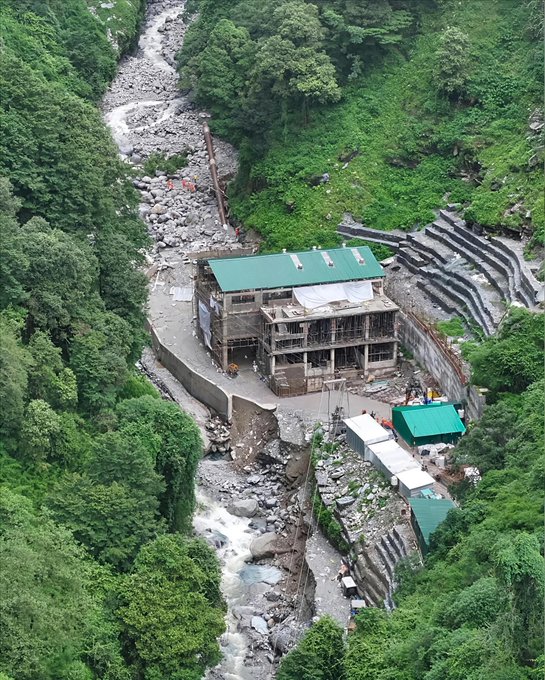
(Feature Image: Flood ravaged Priyadarshini HEP in Manuni khad in Dharamshala, Kangra. Source: Social Media)
Hydropower obsession, Himalayan failure The massive hydropower push, another legacy of post-1990s liberalisation, has amplified vulnerability. Dams have mushroomed across river basins in Kinnaur, Lahaul-Spiti, Chamba, and Kullu — with scant regard for ecological thresholds. Muck from these construction sites is routinely dumped into riverbeds, narrowing channels and raising riverbeds. When the rains arrive, this loose muck turns into a lethal force, taking down everything in its path. The hydropower model — built on the assumption of perpetual revenue — has neither delivered long-term employment nor sustainable energy. Instead, it has left behind ecological scars, displaced communities, and made vast swathes of the state more disaster-prone.
Why a Commission of Inquiry & why now In the aftermath of the 2023 monsoon, the state pegged damages at over Rs 14,000 crore. But who is accountable? Why were homes built on unsafe slopes? Why did no agency question the dumping of muck into rivers? Why are geological reports ignored? A Commission of Inquiry, headed by a retired Supreme Court judge — ideally someone with an understanding of the region — is urgently needed. But it must not be limited to a post-mortem of damage. It should serve as a platform for a collective reimagining of development. (Tikender Singh Panwar)
Debunking the myth of natural disaster: Flash floods, cloudbursts, landslides have become an ugly pattern – a déjà vu moment over and over again. To add to it, is the disturbingly deliberate apathy. A twist of sad irony is palpable on the website of the HP State Disaster Management Authority which has for long been proclaiming a pretentious advice on the home page, “If we don’t learn from the tragedies of the past, we are cursed to repeat them in the future.” (Tarun Shridhar)
Must Not Ignore Lessons: In just one week, critical infrastructure crumbled: the Manali-Leh highway was blocked for over 15 hours, the historic Kangra Valley Railway was suspended again due to landslides and in Shimla’s Dhalli area, a collapsing retaining wall endangered five buildings. They reflect a long-brewing crisis rooted in unscientific development, poor disaster planning and a neglect of ecological wisdom.
Flash Flood Destroys Patikari Hydro Project The project has suffered flash flood and landslides damages in 2010, 2015, 2017 and 2023. The Google Earth imagery also suggests hills around the project site are prone to landslides.
Death toll till July 06, 2025 has increased to 74 and over 3 dozen are still missing. Between June 20 and July 5, the hill state has suffered an estimated loss of over ₹566.87 crore, with 115 people injured, according to official data. In addition to 45 monsoon-related deaths, 30 accidental fatalities were also reported, including those caused by road accidents, electrocution, and gas explosions. The SEOC confirmed that 20 deaths occurred in Mandi and 13 in Kangra, with 37 people still missing across the state.
The state has witnessed significant damage to human lives and properties after multiple cloudburst incidents on June 30 night in Mandi district. Mandi alone recorded an exceptionally high rainfall of 253.8 mm since June 30 evening. Mandi was most affected districts by the disaster. As per the SEOC’s report on July 2, the state has experienced 16 cloudbursts and three flash floods, mostly concentrated in Mandi, causing widespread devastation. Over the past 11 days, the state has suffered a cumulative loss of Rs 356.67 crore as a result of heavy rainfall.
HYDRO POWER PROJECTS
Subansiri Lower HEP NHPC on June 30 said that it is waiting for a clearance from the National Dam Safety Authority (NDSA) to start the process of commissioning 3 units (250 Mw each) of the Subansiri Lower Hydroelectric Project in June. The remaining 5 units of 250 MW each are expected to be completed by May 2026 in a phased manner.
Andhra Pradesh Tribals oppose PSPs in Vishakhapatnam The Tribals of Ananthagiri mandal in Alluri Sitarama Raju district on July 2 demanded the immediate cancellation of the govt order which permits the construction of hydro power plants in Pedakota area. They expressed anger over the decision by the New & Renewable Energy Development Corporation of Andhra Pradesh Ltd (NREDCAP) to increase the project capacity in the Pedakota area from 800 MW to 1800 MW. They said that between 2019 and 2025, the state govts approved several pumped storage power projects with a capacity of 900 MW in areas between Rayavada, Chintalapudi, and Marika in Pedakota region of Raghavapalem area.
Maharashtra Kolhapur Cooperative to set up PSP at Tillari Dam The govt and Shri Tatyasaheb Kore Warana Cooperative Navshakti Nirman Sanstha signed a memorandum of understanding to set up a Rs 1008 Cr, 240 MW pumped storage hydropower project at Tillari dam in Sindhudurg district. This agreement is the first with a cooperative among the 16 MoUs signed to date for PSPs in Maharashtra. The total value of contracts signed with firms for pumped storage projects amount to Rs 3.4 lakh crore, with installed capacity of 62,125 MW.
MoEF Agenda of EAC meeting on July 11 The agenda of MoEF’s Expert Appraisal Committee meeting to be held on July 11 2025:
1. Kadambari PSP closed-loop pumped storage project (1560 MW) in 286.1 ha at Village Kakdara & Kothar etc., Sub-dist –Bali & Pindwara Dist Pali & Sirohi, Rajasthan by Avaada Aqua Batteries Private Limited – Terms of References
2. Khadkhai Medium Irrigation Project (Phase – II) on Khadkhai river with Culturable Command Area of 5,394 ha and Submergence Area of 77.50 ha located in Village Murgaghutu, Block Rairangpur, Dist Mayurbhanj, Odisha – Terms of References
3. Koyna-Nivakane (Closed loop) Pumped Storage Project (2450 MW) in 312.84 ha at Village Marathwadi, Tehsil Patan, Dist Satara, Mah by Adani Green Energy Ltd – Amendment in Terms of Reference
4. Renukaji Dam Project (40 MW) in 1988.27 ha at Village Dadahu, Dist Nahan, Himachal Pradesh by HP Power Corp Ltd – Validity Extension of Environmental Clearance
Decisions of EAC meeting held on June 17 2025 1. Polavaram Banakacherla Link Project: EAC returned the proposal, asking Andhra Pradesh to get CWC approval including from inter-state aspects before applying for TOR.
2. Kandhaura Pumped Storage Project (1680 MW) in 584.57 Ha in Village Sasnai,
Markuri & Cherue, Sub Dist Robertsganj, Dist Sonbhadra, Uttar Pradesh by JSW Energy PSP Six Ltd – Amendment in Terms of Reference: Approved
3. 1200 MW Kalai II Hydro Electric Project in 1100 Ha at Village Kamdi, Tehsil Hawai Town, Dist Anjaw, Arunachal Pradesh by THDC India Ltd–Amendment in Terms of Reference: Approved.
4. Cumulative Impact Assessment and Carrying Capacity Study of Yamuna River Basin in Uttarakhand by Indian Council of Forestry Research and Education (ICFRE), Dehradun: Approved.
Relevant decisions of FAC meeting held on June 24 2025:– Diversion of 847.17 ha. of Reserved Forest and Jungle-jhari land for Sawalkot HEP (1856 MW) within the jurisdiction of Udhampur, Mahore, Batote and Ramban Forest Divisions, Districts-Udhampur, Reasi and Ramban, Jammu & Kashmir: Approved
DAMS
Srisailam Dam Gate-10 leakage raises dam safety issues Three of the 12 gates of the Srisailam dam have sprung leaks, with the worst leakage occurring from Gate No. 10 on July 5, giving no let up to the dam on whose safety the National Dam Safety Authority has expressed serious misgivings. Each of the dam gates stands 55 feet in height and has a width of 60 feet which means in terms of height, 47 feet of the dam’s gates are already under the water line.
It was not just the Gate 10 from where water was leaking on Saturday, but also from Gates 5 and 6, though not with the same force. Though the leak from Gate 10, was described as ‘substantial’ by an official who evaluated the images of the leak, Srisailam dam superintending engineer P. Sreeramachandra Murthy was firm in saying there were absolutely no leaks from the gates.
In its report submitted to the dam authorities this April, the NDSA flagged several critical safety issues dam, declaring unequivocally that the problems at the dam are “serious” and have the “potential to compromise the dam’s safety.” Gates 5 and 6, where leakages were observed on July 5, were also flagged by the NDSA which called on the dam authorities to “minimise operation of gates 5 and 6” to prevent further damage to temporary protection structures in the form of huge steel cylinders erected just after the spillway. These cylinders were put in place to protect the dam and prevent further damage to it from severe and serious erosion with underground cracks extending under the dam’s foundations. These cracks are part of a huge plunge pool that formed as a result of water cascading from the dam when its gates are opened. The NDSA had said that the plunge pool situation must also be attended to without any delays.
Priyadarshini Jurala Dam: NDSA Warnings Many of the issues that the Telangana dam has been facing stem from neglect and ignored safety alerts from the National Dam Safety Authority (NDSA). One of the most critical concerns flagged by the NDSA is the continued use of the dam structure as a roadway. Despite warnings that heavy vehicular movement could undermine the dam’s integrity, traffic, including sand tippers, lorries, and RTC buses, continues to ply across it.
A proposal to construct a bridge downstream at a cost of Rs 120 crore has made no progress, leaving the dam exposed. Erosion and potholes along the left bank road, worsened by stagnant rainwater, have further weakened the embankment. At least 12 out of the 62 crest gates are now leaking. Malfunctioning ropeway systems, worn-out rubber seals, and rusted components have made the situation worse. The ropes of crest gates 9 and 12 recently failed, prompting emergency repairs. However, the project has only one gantry crane available for maintenance, and its operation is hampered by frequent overheating. The lack of a second crane, proposed long ago, has left the system vulnerable to failure during floods.
Manjeera Dam Safety issues The Hyderabad Metropolitan Water Supply and Sewerage Board (HMWS&SB) has earmarked ₹3.52 crore for urgent repair works on Manjeera barrage, including replacement of gates, ropes and components. HMWSSB MD K Ashok Reddy said that the State Dam Safety Authority has submitted its assessment on Friday, and no structural threat to Manjeera barrage was found. Mr. Reddy, who inspected the barrage gates, pillars and pump houses, also instructed the construction agency for repair works to check leakage from gate two. It was stated that about 45 days would be required to carry out the work for gate replacement, during which time the water level will be kept below the minimum drawdown level.
Maharashtra Does Mumbai need the destructive Gargai dam? The Gargai proposal, scrapped by Maha Vikas Aghadi govt in 2022 as it requires cutting an estimated three lakh trees, has been revived by Mahayuti govt. In fact, three lakh trees will be cut for dam construction and another three lakh needs to be cleared to resettle villages affected by submergence. Kedar Gore of the Corbett Foundation pointed out that the forest sought to be cut is dense and teeming with wildlife. “All of this will be submerged by the dam,” he said. “Will Mumbaikars who fought on the roads and went right up to the Supreme Court to save over 2,000 trees in Aarey Colony come out in defence of these six lakh trees?” asked a forest official.
INTERLINKING OF RIVERS
Polaravam-Banakacherla Link Another Kaleshwaram in the making? The Andhra Pradesh’s proposed Polavaram Banakacherla Link Project (PBLP) to transfer Godavari flood waters to Rayalseema region through massively power consuming multi stage lift irrigation projects has all the signs like the ill-fated and controversial Kaleshwaram project of neighbouring Telangana. MoEF’s Expert Appraisal Committee on River Valley Projects have declined to give stage I clearance (Terms of Reference for EIA) for the project.
IRRIGATION
Tamil Nadu Farmers have requested that water be released from the Parambikulam-Aliyar Project (PAP) to the Vattamalai dam to alleviate the drought conditions they are currently facing.
URBAN RIVERS
Panchkula Rivers not fit for a dip As per SPCB February report the water bodies across the district are facing grave environmental crisis, with pollution levels soaring far beyond permissible limits. Kaushalya, Jhajjra, Ghaggar rivers and drains in the region have become dangerously contaminated. Drains feeding into these rivers are in a far more critical state.
RIVERS
Jammu & Kashmir Jhelum rivers drying up Due to record rise in temperatures, lack of rainfall the Jhelum and its tributaries in Kashmir have started to recede at an alarming rate, with the water level at Sangam recorded at just 0.57 feet. The low flows in rivers are unusual for early July, when snowmelt and light monsoon activity generally help maintain healthier flows.
Protest against diversion of Firozpora nullah The people of north Kashmir, led by J&K Civil Society Forum (JKCSF) Chairman Abdul Qayoom Wani, have protested again against the unauthorized diversion of Nallah Ferozpora, the lone perennial water body in the region.
YAMUNA Delhi River deteriorating upstream Meanwhile, experts warn against the prevailing perception that Yamuna remains clean upstream of the Wazirabad barrage and get polluted only afterward. Bhim Singh Rawat, Associate Coordinator at the South Asia Network on Dams, Rivers and People (SANDRP), called this belief “illusionary.” “In reality, the government’s own water quality reports and incidents of Delhi’s water treatment plants getting disrupted due to increased pollution indicate that the river’s health has deteriorated even upstream of the barrage over recent years,” he said. Rawat further explained that the discharge of industrial and domestic effluents from Haryana’s Sonipat, Panipat, Karnal, and Yamuna Nagar districts into the river via Drain Numbers 8, 2 and Dhanaura Escape is accelerating the degradation.
“The idea that Yamuna’s problems begin only in Delhi is misleading. The continued degradation in the city is the end result of unchecked destructive activities upstream — including dam construction in the Himalayas and diversion of river flows for irrigation, drinking, and industrial use in the plains,” Rawat said. He stressed that all basin states are equally responsible for exploiting the Yamuna’s water, minerals, and ecological resources.
“Rampant and unsustainable sand mining in Haryana and Uttar Pradesh has disrupted the river’s essential lean season flow. This reduced flow means the river no longer has the capacity to dilute pollution once it enters Delhi,” he added. Rawat also criticised the new government in Delhi for following the same “failed model” of cleaning the river, rather than focusing on reviving it.
“The increasing pollution in Delhi, including the frothing problem at the Okhla barrage this year, highlights the collective failure of pollution control boards in Haryana, Delhi, the Central Pollution Control Board (CPCB), and the National Mission for Clean Ganga (NMCG),” he said. He stressed that Delhi alone cannot revive the Yamuna and called for the central government to implement a holistic river revival plan. “There must be a united effort with Yamuna basin states to restore environmental flows. Pollution control systems must be made effective and accountable. Otherwise, the river faces a bleak future,” Rawat warned.
RIVERS BIODIVERSITY
Odisha Bridge project near Satkosia TR sparks protests The state govt has floated a tender for the construction of a high-level bridge over Mahanadi river near the ecologically-sensitive Satkosia tiger reserve, drawing strong objections from environmentalists and wildlife experts. They pointed out that the project does not cater to any significant commercial, industrial or highway traffic. There is already an existing bridge across Mahanadi at Siddhamula-Ekadala, located around 22 km downstream which serves the very purpose of vehicular movement.
FISH, FISHERIES, FISHERFOLKS
Mapping Bengal’s Hilsa heritage From the Padma to the Rupnarayan, food anthropologist Amrita Bhattacharya traces the journey of Bengal’s most beloved ‘silver crop’.
SAND MINING
Haryana Sand mining trucks, machines were stuck in Yamuna after rise in river water level in Dhakwala area of Karnal on July 01. This clearly shows violation of prohibition on river bed mining during monsoon months. The miner claimed that earlier flood warnings were issued by irrigation department for such situation but this time the company did not get any alert from the department.
URBAN LAKES, WETLANDS
Chennai ₹5 lakh fine for letting sewage into stormwater drain Following a direction from the Madras High Court to implement penalties for illegal sewage connections into stormwater drains in 2017, the GCC had fixed penalties at Rs 5,000 to Rs 10,000 for ordinary buildings, Rs 25,000 to Rs 50,000 for ordinary commercial buildings, and Rs 1 lakh to Rs 2 lakh for multi-storey buildings. The corporation council has now adopted a resolution on June 30 to increase this as Rs 10,000 to Rs 25,000 for ordinary buildings, Rs 50,000 to Rs 1 lakh for ordinary commercial buildings, and Rs 2 lakh to Rs 5 lakh for multi-storey buildings. This is as per Section 161 of the Tamil Nadu Urban Local Bodies Act 1998, said the resolution, which prohibits any individual from discharging refuse, trade effluents or waste into water sources or drains maintained by the municipal corporations.
Mumbai Citizens, environmentalists slam CIDCO for ignoring illegal debris dumping in Lotus Lake Wetland despite 4 weeks of protests.
URBAN WATER
Hyderabad HYDRAA on June 30 launched a crackdown at Sunnam Cheruvu, cleared illegal structures within the lake’s Full Tank Level (FTL) limits and halted the sale of contaminated groundwater. HYDRAA has lodged complaints against individuals involved. Madhapur police on June 29 arrested Venkatesh, who has been running a syndicate of water tankers by digging borewells inside the lake, and supplying polluted water containing metals like cadmium and nickel to hostels and apartments in the nearby areas. The police also seized lakhs from the shed built illegally by Venkatesh inside the FTL, where he allegedly organised alcohol parties for the locals for Rs 70,000.
AGRICULTURE
Soils in India losing carbon alarmingly According to the FAO’s 2024 report, nearly 32 per cent of India’s total land is now degraded, and 25 per cent faces desertification. Soil Organic Carbon (SOC)—essential for nutrient cycling, water retention, and soil life—has dropped from around 2–3 per cent to just 0.4–0.7 per cent in large areas over the last seven decades. This sharp decline in soil health is silently undermining crop yields, farmer incomes, and our ability to adapt to climate shocks. If left unaddressed, it could disrupt the country’s food security and weaken rural resilience for years to come. In 2019–20, approximately 44 per cent of India’s soils were found deficient in organic carbon.
MONSOON 2025
June 2025: District wise rainfall In the just concluded month June 2025, the first month of India’s South West 2025 monsoon, India received 180 mm rainfall, 8.89% above the normal June rainfall of 165.3 mm as per India Meteorological department. This article gives state wise maps depicting the rainfall category for each district of respective states.
June 2025: High Rainfall district days An analysis of the daily district wise rainfall data from India Meteorological Department (IMD) for June 2025 shows that there were 415 instances when district rainfall of a day was above 50 mm. In 6 of these instances, rainfall in a day in a district was over 200 mm, in 14 it was 150-200 mm, in 59 it was 100-150 mm and in 346 instances the rainfall was 50-100 mm in a district in a day.
IMD expects ‘above normal’ rainfall in July but states in northeast, east and parts of south likely to face lack.
Haryana recorded rainfall at 71.7mm this June, 30% higher than the average considered normal for this month. Data from the IMD shows a skewed pattern of district-wise rainfall over the month. Gurgaon recorded a marginal surplus of 3% for now. The city logged rainfall at 48.6mm till June 30 afternoon, slightly higher than 47.1mm considered normal for June. In neighbouring districts, Nuh (97.8mm, +99%) and Rewari (94.9 mm, +89%) received abundant rain, but Faridabad (-43%), Kaithal (-42%) and Panipat (-38%) posted deficits. Yamunanagar topped the chart, with 299.8mm of rainfall, more than double the normal level for the month. Chandigarh (213mm) and Kurukshetra (174.7mm) followed close behind, and other south Haryana districts — Mahendergarh (+104%) and Hisar (+74%) also saw higher than usual rainfall.
Monsoon in central and eastern Haryana districts appeared to be weaker. Experts said rainfall disparities were too early to call for the state as monsoon normally covers all of Haryana by the end of June. Still, erratic rainfall patterns year after year can indicate effects of climate crisis.
Chandigarh The city on June 29 got 119.5mm downpour and was lashed by another spell of 70.7mm rain coupled on June 30. The weathermen confirmed that it was the heaviest in Punjab and Haryana for the second day in a row. With this, Chandigarh received 213mm rainfall during this month, the highest in the past decade and 37% more than the normal precipitation. With 119.5 mm rain recorded till June 29, Chandigarh saw its wettest June day since 1973. As per the IMD, which started keeping records for the city in 1954, Chandigarh’s wettest day ever was on June 18, 1974, when 146.4 mm rain was recorded.
FLOOD 2025
Karnataka KRS Dam fills to brim in June for the first time in 93 years.
URBAN FLOODS
Why Cities flood so quickly and frequently in India It isn’t just low-income neighbourhoods like Tigri in Delhi that are affected by waterlogging due to clogged drainage. During the monsoon last year, rainwater also stagnated in Defence Colony, an upscale residential colony around eight kilometres north. The story is a familiar one across Indian cities and towns, most of whose stormwater drains are proving inadequate for increasing bouts of heavy rainfall.
Barapullah has a vast catchment area – it covers 91% of South Delhi and 95% of Central Delhi. Other stormwater drains carry out similar functions in other parts of the city – Najafgarh drains out West Delhi, while across the Yamuna, the Shahdara and Ghazipur drains carry out the same function. In all, 201 natural drains flow through Delhi.
A major impediment to tackling this problem is the fact that administrative authority over stormwater drains is currently spread out between ten institutions, including the flood and irrigation department, the Delhi Jal Board, municipal corporations and public works department. Indeed, in the master plan, IIT-Delhi team created simulations based on the data of slopes and drains they collected, to see if waterbodies in Delhi could naturally absorb the rainwater run-off. After mapping existing lakes and ponds in the three major drainage basins – Najafgarh, Barapullah, and Trans Yamuna – they found that waterbodies “could store a considerable volume” of water. But the water bodies are increasingly encroached, filled up, including by Delhi Govt bodies.
Panchkula Rain lays bare poor drainage, blocked gullies & MC’s tall claims.
CLOUD BURSTS
Uttarakhand Some workers went missing after a cloudburst incident on Yamnotri highway in Uttarkashi district on June 29.
CLIMATE CHANGE
Study about Lindur village subsidence (Lahaul-HP) ABSTRACT: This study investigates the first case of permafrost thaw-induced subsidence in the Lindur Village of Lahaul & Spiti district of Himachal Pradesh using MT-InSAR method. The study used 15 Sentinel-1 single-look complex images acquired from April 2022 to September 2022 along the ascending orbit track and used the SBAS technique to monitor the subsidence in the village. The results revealed significant land subsidence rates ranging from 7.9 to −6.8 cm/year. The cumulative land subsidence of 16 cm was observed over the northeast direction of the village. The analysis of historical temperature and precipitation data from 1950 to 2024 shows a significant rise in temperature at a rate of 0.02 °C/year and a shift in precipitation pattern over the village. From the field observations, the study found that the local geology and existing rock glaciers exacerbate the rate of subsidence leading to the development of cracks in the region. This is the first study that provides a detailed insight into the interaction of climatic, geological, and hydrological factors that drive permafrost thaw causing land subsidence in the Indian Tethyan Himalayas. The quantified deformation rates provide crucial information for developing targeted mitigation strategies and early warning systems.
SOUTH ASIA
IWT Battling politics & climate change Environmentalist Himanshu Thakkar, SANDRP and water affairs expert Dr. Hassan Abbas explain IWT’s historical context and the ongoing dispute surrounding the treaty.
EUROPE
The River Seine in Paris has reopened publicly to swimmers for the first time since 1923 after a century-long ban. The seasonal opening of the Seine for swimming is viewed as a key legacy of the Paris 2024 Olympics, when open water swimmers and triathletes competed in its waters which were specially cleaned for the event.
UK Catchment restoration can minimise drought and flood risks To avoid routine hosepipe bans, protect biodiversity and secure food and water supply into the future, land needs to be at the centre of the drought strategy. Restoring bogs, woodlands and soils is not a luxury. It is essential infrastructure in a changing climate.
SANDRP


