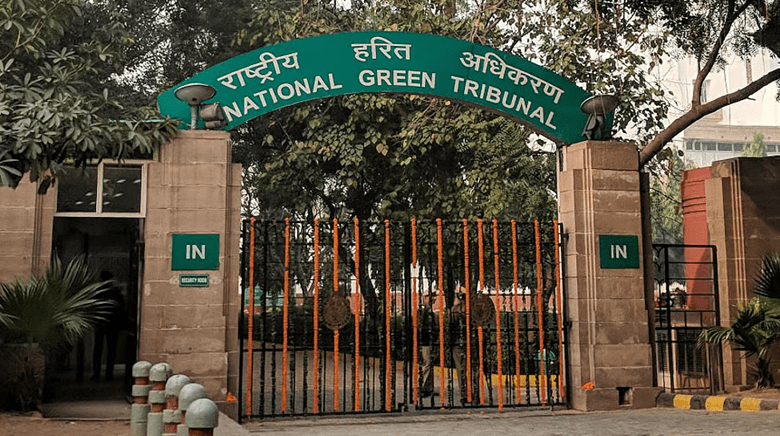
(Feature Image: Entry gate of NGT’s principal bench in New Delhi: Source: Bar & Bench)
This overview looks at how the judiciary particularly; the National Green Tribunal (NGT) has tried to address the urban groundwater depletion and governance crisis during 2025. Cases from Delhi, Gurugram, Faridabad and other cities indicate a common problem of weak regulation, poor coordination among concerned agencies and slow enforcement of court orders, allowing illegal groundwater extraction to continue. Many cases have been going on for years without clear results.
The tribunal has enforced several steps like sealing illegal borewells, imposing fines and given directions for improvements in monitoring to hold authorities accountable. However, the situation on the ground has largely remained unchanged due to the lack of a clear and strong institutional framework for groundwater governance in urban areas. Overall, the trend suggests that without effective governance, better coordination, stronger enforcement and integrated approach, groundwater stress in Indian cities will continue to worsen.
Delhi: Illegal Groundwater Extraction by Hotels Govt finalizing policy to curb illegal extraction: DJB to NGT The announcement was made in a fresh status report submitted to the tribunal on Dec. 1, 2025 while responding to directions on unchecked groundwater extraction by Paharganj guesthouses for nearly a decade. Delhi Jal Board (DJB) said that it has no statutory powers to penalise violators, but has collected ₹6.36 crore as water cess & sewerage charges. DJB added that the Voluntary Disclosure Scheme, cited by hotels and guest houses to justify groundwater extraction, never had any legal standing. It said the scheme was operationalized only through a 2014 public notice & never through any formal notification.
As per the submission, the NGT merely discussed the idea of a voluntary disclosure mechanism in 2013, followed by an advertisement, without creating a binding legal framework. DJB said that even though around 11,000 registrations were received, it did not have the legal authority to process applications, impose penalties or regulate extraction. “Consequently, no penalty was officially imposed or collected from any registrant,” the report stated.
DJB said groundwater regulation is the mandate of the Department of Environment, district level advisory committee (DLAC), district magistrates and the Central Ground Water Authority (CGWA). Under the 2010 notification, DJB said its role is limited to receiving applications and functioning as the DLAC secretariat without any authority to impose penalties.
NGT fines DJB over repeated adjournments The NGT rapped the DJB and imposed a cost of ₹50,000 for repeatedly seeking adjournments in a case related to illegal groundwater extraction by hotels in the Capital. In an order dated July 07, 2025, a bench headed by NGT chairperson Justice Prakash Shrivastava described the water utility’s conduct to be “not bonafide” and said the cost of ₹50,000 be used to purchase environmental books for the NGT Bar room. The tribunal was hearing an execution application filed to ensure compliance of a 2018 order, passed in a case filed by activist Shailesh Singh, alleging that several hotels, including a well-known five-star hotel in New Friends Colony, illegally draw groundwater.
Finding merit in the applicant’s claim that the DJB was deliberately delaying proceedings, the bench observed that the board’s conduct was obstructing justice and directed the DJB CEO to appear before it in person in the next hearing on Aug 12, 2025. “The conduct of the DJB in such a matter where the execution of the order passed almost seven years back has been sought cannot be appreciated. Thus, we require the CEO, DJB, to appear on the next date of hearing to assist the tribunal,” the bench said.
Illegal groundwater extraction in 3 hotels; NGT reprimands DJB, NDMC The NGT has taken a tough stand against Delhi’s prominent hotels, The Surya, Siddharth, and Lalit, in connection with illegal groundwater extraction. The NGT on Nov. 11, 2025 reprimanded the Delhi Jal Board (DJB) and the New Delhi Municipal Council (NDMC) for failing to comply fully seven years after the 2018 order, directing them to take immediate action. It also cited the non-collection of fees for groundwater extraction as a serious issue and called for further consideration. NGT Chairperson Justice Prakash Srivastava and expert member Dr. A. Senthil Vel passed this order during a hearing on an execution petition.
The applicant, Shailesh Singh, had alleged that these hotels were extracting groundwater without permission. The original order, dated August 23, 2018, directed the hotels to obtain permission from the competent authority within one month and report the extraction to the CGWA to determine environmental compensation.
The DJB report revealed that two old borewells were found at Hotel The Surya. The DLAC granted permission on Sept 2, subject to conditions. This included environmental compensation from the Pollution Control Board (DPCC). Furthermore, surprisingly, no borewells were found at Hotel Siddharth. Hotel Lalit, meanwhile, had three borewells. One has been sealed. The water needs assessment for the remaining two is pending.
DJB proposes new rules to stop groundwater contamination The DJB on Aug. 21, 2025 submitted an affidavit to NGT regarding contamination of groundwater through rainwater harvesting pits. The board proposed several suggestions, including not allowing the installation of harvesting systems in stormwater drains. On preparing fresh guidelines for setting up rainwater harvesting structures (RWH) in Delhi, the DJB stated that a joint expert committee meeting was held on July 31, 2025. It was noted that separators needed to be installed to bypass the first rain from entering them. The tribunal has been hearing a plea since Feb 2023, after a Dwarka resident alleged that rainwater harvesting pits in the sub-city were leading to groundwater contamination.
NGT seeks CS’s response on GW The Delhi environment department on May 8, 2025 informed the tribunal that a new borewell policy is being framed in consultation with the CGWA and other govt departments. In its order dated Jan 29, 2025, the tribunal asked the chief secretary to ascertain the extent of the loss to the exchequer from such unregulated withdrawal in the name of the ‘non-existing’ voluntary disclosure scheme, the extent of damage caused to the environment, and the effect of such an illegal action on the groundwater of the area. It also sought to fix responsibility upon the officers concerned who are/were responsible for such unregulated withdrawal of water.
“One action taken report was submitted under the signature of special secretary environment dated May 5, but said action taken report does not cover the issues which were flagged by the tribunal in the proceedings dated Jan 29 and response on the issues sought from the chief secretary,” said the bench headed by Justice Prakash Shrivastava in an order dated May 8.
Illegal Extraction in Residential Areas 15,962 illegal borewells sealed; 4,033 on DJB’s list not found, NGT told The district magistrates in Delhi have sealed 15,962 illegal borewells under their jurisdiction. However, 4,033 illegal borewells, the list of which was shared by DJB, were not identified on the ground, Delhi govt informed NGT in a report dated May 23, 2025.
In a petition filed in Sept 2022, Ayanagar resident Pritipal Sharma alleged multiple illegal borewells were functional in the area. In the same year, a plea was filed by Chanakya Place resident Ganesh Prasad, similarly alleging the use of illegal borewells in the area.
In Mar 2025, NGT asked all DMs in Delhi to share compliance reports of illegal borewells in their jurisdiction, detailing the action taken so far. This action was based on DJB data, which in Jan 2026 informed the tribunal there were over 20,000 illegal borewells in the city. Earlier, three district magistrates – E, NW & SE Delhi – informed the tribunal that they had sealed 12,498 illegal borewells in these districts and 3,187 borewells were never found on the ground.
However, the Delhi environment department later filed a separate report apprising the tribunal that a total of 20,297 illegal borewells were identified by DJB, of which 142 are yet to be sealed, and 160 have a court stay.
Delhi govt further said that so far an environmental compensation of nearly Rs 1.2 crore was collected, while officials were directed to collect the remaining compensation from the illegal extractors. It further stated that the NGT’s previous orders were placed before the council of ministers and the Delhi cabinet in April 2025, where the council directed the creation of a new borewell policy. It further stated that Delhi govt directed all the DMs to draft an action plan for their districts for the rejuvenation of water bodies.
22,000 illegal borewells identified: DJB tells NGT In a report dated March 19, 2025, the DJB told the tribunal that illegal borewells were to be sealed by the district magistrates, and that it was pursuing the matter with the officials. Of the 22,010 illegal borewells, the highest number — 9,128 — was found in north-west Delhi, followed by south-west Delhi that had 6,926 illegal borewells. The lowest number was in New Delhi: 85.
The report said DJB had received 2,610 applications for NOCs for borewells. Of these, 1,119 applications were granted NOC, and 900 were rejected, while the remaining are being processed. The report said the highest number of borewells to get NOCs — 455 — were in south-west Delhi, followed by 384 in New Delhi.
EC received on illegal water extraction to be used for rejuvenation of water bodies The DPCC has informed NGT that over Rs 70 crore in environmental compensation has been levied on illegal groundwater extraction in the city so far. The funds are proposed to be used for rejuvenation of water bodies across the capital. The report dated March 17, 2026 said, “The EC funds will be allocated to the restoration of waterbodies that are not restored under the Gramodaya scheme. The expenditure shall be in accordance with the area of the waterbody and in accordance with the guidelines of the govt of India”.
Groundwater Contamination in Delhi Over 20% of 2023 samples had nitrate levels above safe limit: CGWB to NGT Over 20% of groundwater samples collected across Delhi in 2023 had nitrate levels above the safe limit of 45 mg/L, the Central Groundwater Board (CGWB) told the NGT. The highest nitrate reading recorded in Delhi reached 994 mg/L, over 22 times the permissible limit. The CGWB’s 2024 annual groundwater report, which was released in December 2025, was recently presented in an ongoing case before the NGT. The report, which analysed samples collected over the previous year, showed that seven of Delhi’s 11 districts, including New Delhi, North, Northwest, South, Southeast, Southwest and West Delhi, recorded nitrate levels above the safe limit.
Groundwater Extraction from Yamuna Floodplain DJB seeks NGT permission to use borewells on floodplains The DJB has approached the NGT seeking permission to operationalise over 100 borewells installed along the Yamuna floodplains, in the Capital’s O-zone, an eco-sensitive area where construction is largely prohibited, aiming to augment water supply ahead of the peak summer months. However, with over 40% of Delhi’s groundwater already “overexploited”, experts warned against excessive reliance on GW. Officials said the proposal is currently under consideration & further action will depend on the NGT’s directions.
Illegal water business along Yamuna riverbed The NGT, on April 4, 2025, directed the authorities to file their responses to complaints regarding illegal groundwater extraction along the Yamuna riverbed in Delhi. The tribunal ordered that notices be issued to the DJB, CGWA, DPCC, Central Pollution Control Board (CPCB) and the District Magistrate (East Delhi).
The original application was registered suo motu based on a news article in ToI on April 2, 2025. A clandestine and large-scale operation of illegal borewell-based water extraction is underway during the night, involving an organised network of tankers siphoning off groundwater, according to the article. Heavy machinery such as earthmovers are used to dig these borewells, with the extracted water being sold to unauthorised buyers, it stated.
In a report dated May 2, 2025 the SDM informed NGT, “The office of SDM, Mayur Vihar, acting on the same newspaper article, already initiated action on April 3. The undersigned, along with the police staff from Mayur Vihar police station, visited the site in question and found two illegal borewells near a nursery in Yamuna Khadar. Both borewells have been sealed since.”
Haryana: Groundwater Extraction in Cities NGT asks DTCP told to give past 3 years’ violations data Haryana state pollution control board (HSPCB) has asked the department of town and country planning (DTCP) to furnish a three-year record of inspections and violations related to illegal groundwater extraction. The move follows NGT action on a TOI report highlighting that Gurgaon draws over twice its permissible limit despite being declared a ‘dark zone’ in 2008. A joint review by DTCP, HSPCB, and the irrigation dept will be held before Nov 10, 2025.
An NGT order dated Aug 20, 2025, had directed Haryana water resources authority (HWRA), CGWB, HSPCB and the Gurgaon commissioner to file responses on groundwater extraction supported by the affidavits. The tribunal had observed that Gurgaon extracted 43,262 hectare-meters (ham) of groundwater in 2024 against a sustainable limit of 20,333 ham, amounting to 212% of the permissible level.
HSPCB, authorised by the divisional commissioner, is leading the inter-departmental exercise to present the status report before NGT. DTCP has been asked to share records of enforcement drives, sealing actions and the status of water recharge structures in licensed colonies and commercial projects.
Illegal Extraction in Gurugram NGT pulls up govt for illegal groundwater use The NGT on Feb 10 2026 slammed Haryana govt for not acting against rampant illegal extraction of groundwater in the Gurugram city and ordered an inspection of construction sites, farmhouses, industrial units, educational institutions and pharma units to check for illegal drawing of GW.
NGT also said all colonies and institutions must maintain functional rainwater harvesting systems, illegal borewells must be sealed and legal users must be monitored through piezometers. It gave the state govt six months to complete the entire process. The tribunal took suo motu cognisance of a TOI report dated Aug 5, 2025. NGT’s principal bench observed that official replies by multiple depts were heavy on plans and claims, but light on enforcement.
The tribunal has given govt authorities a slew of instructions, including inspection drives, supplying water treated by STP, carrying out sealing drives and imposing environmental compensation. NGT directed a district-wide inspection drive. It also made govt responsible for supplying treated STP water to construction projects free of cost. It stressed that residential colonies, farmhouses and institutional areas must have “effectively operating RWHS” in place.
4 realtors fined Rs 5 crore Four realtors in Gurugram were fined Rs 5 crore by HWRA for unauthorised groundwater extraction following an order by NGT. Borewells and sump wells at these project sites, which are located in sectors 102, 103 and 37D, were also sealed, stated an inquiry report filed by HWRA chairperson Keshni Anand Arora to NGT. The case stems from a plea initiated in NGT in 2023 over groundwater violations in the city. A joint committee of NGT submitted its report confirming the violations in Nov 2023.
During a hearing in April 2025, the tribunal criticised the delay in enforcement by state authorities. “The latest reply, dated April 22, 2025, filed by the CEO, HWRA, only mentions that show-cause notices and a reminder notice were issued to the realtors,” the tribunal noted, adding that to ascertain if the borewells existed with due permission, only the document granting permission was required to be verified. The tribunal raised concerns over why such a basic verification exercise had taken over a year to complete and directed HWRA to identify those responsible for the delay. Next hearing on Jul 7, 2025.
Bandhwari Landfill Leachate MCG ‘lied’ about drain for leachate control: Plea in NGT MCG’s submission to the NGT that it has built a drain around the Bandhwari landfill site to stop the flow of leachate into the surrounding Aravalis was disputed by environmentalists, who said they will file a perjury application against the corporation. The objection was made after MCG on April 15, 2025 submitted a report signed by MCG additional commissioner Mahabir Parsad.
According to the report, approximately 200 KLD of leachate is produced at the Bandhwari site, and volume goes up during the rainy season. This leachate is transported to a STP in Behrampur, Gurgaon, it noted. Next hearing on Aug 14, 2025.
Faridabad 7 liquor shops told to shut for illegal groundwater use The HWRA on July 16, 2025 ordered the closure of seven liquor shops in Faridabad for illegally extracting groundwater in the district that is already an ‘over-exploited’ zone. The action stems from a probe ordered by the NGT in Dec 2024 to investigate illegal groundwater extraction by 37 commercial units in the NCR district.
None of these shops had valid NOC from the CGWA or HWRA, which are mandatory for any groundwater extraction in stressed areas like Faridabad. Officials said HWRA notices to the four remaining shops found violating the norms were undelivered but remain under review. Separately, HWRA on July 24 issued a public notice, warning commercial establishments to comply with groundwater extraction norms within 15 days or face action. The authority can seal tubewells, impose environmental compensation or prosecute violators, it said.
According to Sirohi’s petition to NGT, illegal groundwater use was adversely affecting the district. Faridabad’s water table has plummeted from a depth of 15 metres in the early 2000s to over 70 metres deep in several patches by last year. Illegal borewells continue to fuel an underground tanker economy.
Greater Noida 10 ponds set for facelift for water recharge The Gautam Budh Nagar administration has approved the renovation of 10 ponds across various villages in the district to promote groundwater recharge, said officials on June 20, 2025. The initiative is being undertaken in accordance with directives issued in 2022 by NGT. The renovation of ponds will be carried out by the Noida authority in coordination with the District Ground Water Management Council, which recently held a meeting and gave approval for the project.
Officials said that the Noida authority will soon be carrying out the required desilting, cleaning, and structural work for the rejuvenation of these water bodies. The selected ponds are located in the villages of Satharpur, Harola (Wazidpur), Roza, Shahdara, Salarpur Khadar, Jhatta, Koudli Bangar (3 ponds), Badoli Bangar & Miyapur.
Lucknow Groundwater management plan The combined interventions undertaken across all depts – including large-scale pond rejuvenation, bunding, farm-level water conservation works, micro-irrigation expansion, rooftop rainwater harvesting and extensive desilting of rivers, canals and drains – have substantially advanced the implementation of the block-wise groundwater management plan in Lucknow dist. This was stated in the action taken report by the Dist Magistrate-Lucknow, Mar 10, 2026 in compliance with the NGT order, Sept. 26, 2025.
The court wanted to know the details of water bodies falling within the jurisdiction of the Municipal Corp, Lucknow; the status of encroachments on these water bodies & their present condition. The court wanted to know the progress in implementing the block-wise groundwater management plan prepared under the National Aquifer Mapping (NAQUIM) study by CGWB.
The report stated that a series of review meetings were convened under the chairmanship of the District Magistrate, Lucknow with all concerned departments. Directions were issued to compile a comprehensive and updated report on water bodies, including progress on encroachment removal, restoration work, geo-tagging and boundary demarcation.
The report stated that the total number of ponds/Amrit Sarovars under the jurisdiction of the Municipal Corp, Lucknow is 1812, covering an area of 594.128 ha. Around 76.919 ha have been found encroached. Lucknow Municipal Corp maintains 12 ponds covering an area of 28.47 ha and there are no encroachments on them. The 12 waterbodies have been restored/ maintained by the Lucknow Municipal Corporation under the Amrit Sarovar Abhiyan.
Ludhiana Buddha Dariya concretization: NGT seeks real map The NGT in March 2026 has ordered the Ludhiana deputy commissioner to produce original revenue maps and records of the Buddha Dariya following allegations that municipal authorities are illegally narrowing the historic waterway. The DC has also been tasked with ensuring a total freeze on any further illegal construction within the drain or its buffer zone until the next hearing on April 20, 2026.
The applicants claim that on-ground measurements taken on Feb 27 reveal a significant reduction in the width of the Buddha Dariya. The environmental implications of the ongoing work include ecological loss (concretisation eliminates natural vegetation essential for groundwater recharge and water filtration), flood risk (the dumping of earth and narrowing of the natural flow channel increases the likelihood of catastrophic flooding), and regulatory breaches (a 2018 Punjab govt notification mandates a five-metre greenbelt along such water bodies. Activists claim this has been “violated blatantly”).
Bihar Plea flags drainage projects for harming groundwater recharge A petition filed in August 2025 before the NGT raised concerns that ongoing stormwater drainage and canal projects across Bihar’s urban areas are damaging groundwater recharge systems. The plea alleges that in cities such as Darbhanga, Patna and Gaya, authorities are concretising and covering natural drains, preventing rainwater from percolating into the ground and reducing aquifer recharge.
It also highlights encroachment and narrowing of drainage channels, which could increase urban flooding, waterlogging and pollution. In some cases, sewage is reportedly being discharged into stormwater drains, posing risks to both surface and groundwater quality. The petitioner argues that these works violate earlier directions of the tribunal and the Patna High Court, which mandate protection of natural drainage systems. The application seeks a halt to ongoing works, restoration of natural drains, and penalties for environmental damage.
Guwahati NGT notice over ‘illegal’ groundwater drilling A petition brought by Milan Kanti Das and others flagged unpermitted extraction in Barshapara, citing possible environmental harm and rule violations. The tribunal’s Eastern Zone Bench, with Justice Dinesh Kumar Singh and expert member Merriber Ishwar Singh, asked the authorities to respond within four weeks. A follow-up hearing on May 8.
The petitioners presented information obtained through the Right to Information Act suggesting that no formal permission was granted for groundwater use in the area. They also claimed that multiple borewells have been operating without approval, extracting water for long periods each day. Barshapara is considered a zone facing water stress, and over-extraction has reportedly caused groundwater levels to fall, affecting local water availability. The applicants added that some water is being sold commercially instead of being supplied solely for drinking, and that no strict monitoring or enforcement has been implemented.
Panaji HC issues notice in illegal borewells PIL In the PIL pertaining to unauthorised and illegal digging and construction of borewells for commercial purposes leading to water scarcity, the Bombay High Court directed that notice to be issued to the department of drinking water, returnable on Feb 17, 2026. The court sought a response from govt on the issues in the petition within two weeks.
The HC, in Nov 2025, had issued notice to govt in the PIL over illegal digging and usage of several borewells in Chimbel. When the petition came up before the division bench, the additional govt advocate stated that the department of drinking water was a necessary party in the proceedings and was not made a respondent. The court said that, considering the subject matter of the dispute in the proceedings, the department of drinking water, represented by its chief engineer, should be impleaded as a respondent.
Since 2022, WRD identified 224 illegal borewells in state From 2022 to date, the state water resources department (WRD) has identified 224 illegal borewells in Goa. A majority of 49 cases of these are in Chimbel and the matter is presently being heard by the high court. The number of illegal borewells during the 2022-25 period has almost doubled from 122 registered during 2020 to 2024.
All violators have been issued a show cause notice and the electricity department has been directed to disconnect their power supply, the WRD minister Subhash Shirodkar said in a reply tabled in the recently concluded assembly session. In many cases, either a fine of up to Rs 1 lakh has been imposed or the show cause is in the process of being heard. Of the 224, in 39 cases the illegal borewell has been sealed. And in eight of the cases, the borewells have been regularised by the department after following the required procedure.
Bengaluru Soak pits pose threat to groundwater quality: NGT The NGT in Sept. 2025 raised the alarm over the risk of groundwater contamination in parts of eastern Bengaluru, particularly in 110 villages that continue to function without an underground drainage network. NGT’s southern bench, which took up a suo motu case on pollution of the South Pennar (Thenpennai) river near Hosur in Tamil Nadu, noted that untreated sewage from Bengaluru is entering the waterbody.
Reviewing a compliance report submitted by the Bangalore Water Supply and Sewerage Board (BWSSB), the bench, observed that nearly 30,000 households in these villages still depend on individual soak pits to dispose of sewage. “The continued use of such soak pits without septic tanks requires scrutiny as they may pose a long-term threat to groundwater quality,” the bench wrote in its order last week.
SANDRP


