Like almost all urban areas, Pune’s seage management has been dismal. In a recent Public Interest Litigation (PIL) filed against Pune Municipal Corporation (PMC) in National Green Tribunal (NGT) for failing to control water pollution in Mula Mutha Rivers it was revealed that several crucial details regarding sewage generation and disposal in Pune city remain unknown even to PMC. PMC failed to furnish even the basic details like present and future generation of domestic sewage (from 2022- 2025), present handling capacity and performance of STPs for six months.[i]
Japan International Cooperation Agency (JICA) has recently agreed to extend a loan of 1000 Cr. to PMC under project ‘pollution abatement of River Mula-Mutha’.[ii] Utilizing this funding PMC has proposed to build 11 new sewage treatment plants (STPs) with treatment capacity of 396 MLD (Million Litres per Day). It is hard to imagine that PMC who celebrated the signing of the loan agreement in January 2016 was not in position to furnish even the basic details about sewage generation and treatment in May 2016.
Currently in Pune there are total ten STPs with installed capacity of 567 MLD. Five of them have been funded by PMC while the other five have been funded by JNNURM (Jawaharlal Nehru National Urban Renewal Mission) Phase I. Operation & Maintenance (O&M) of these plants has been outsourced by PMC to various contractors. Treated effluent is being discharged in the rivers Mula, Mutha Rivers. PMC recently admitted in the print media that though the installed capacity of its existing STPs was to treat 567 MLD, only 290 MLD was being treated at present.[iii] The balance – almost 50% of the sewage – is going into the river untreated. Pune’s Rivers are some of the most polluted in the country. Continue reading “My visits to Pune’s Sewage Treatment Plants: Citizens Not Allowed!”→
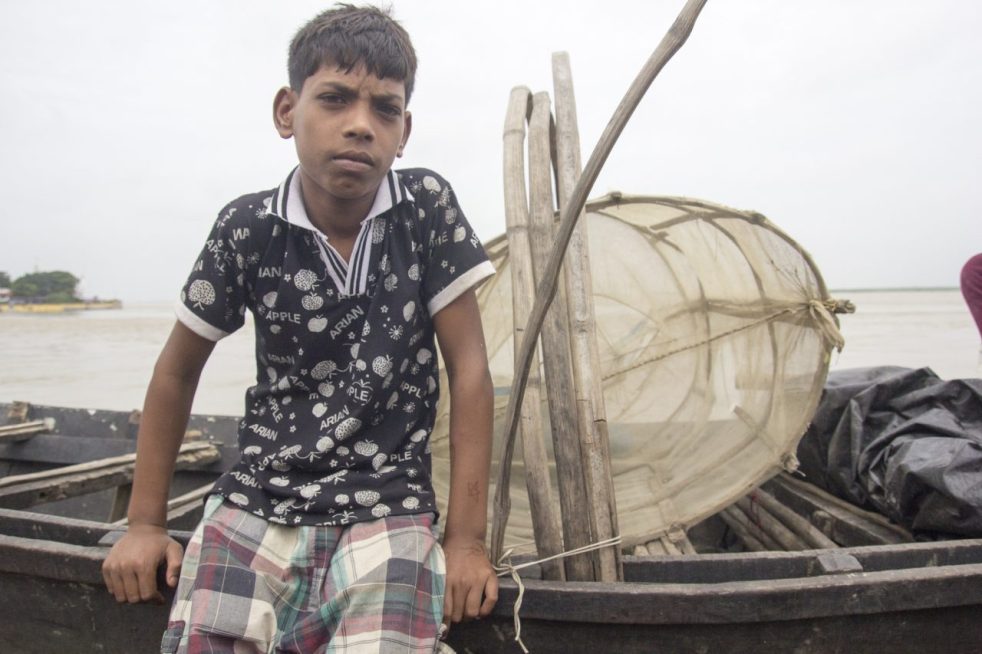
Above: Young kid from a fishing family in Kahalgaon, even the most informed communities (Ganga Mukti Andolan) are clueless about the government’s intentions (Photo by Veditum)
GUEST BLOG BY: Siddharth Agarwal
As the Ganga rises and fills streets and alleys with it’s water all along it’s course, I spend a time out at home, partially because of personal reasons and in some parts due to the rising levels of the river hindering all sorts of movement around it. Currently on a walk along the Ganga for Veditum India Foundation’s ‘Moving Upstream’ project, I’ve been able to walk a distance of about 1000 kms alongside it’s banks from Ganga Sagar till Varanasi in 50 days’ time. Some places saw me walking right next to the river while others had me maintaining my distance since it just wasn’t possible to peruse a course anywhere in the vicinity of the flooded banks.
The rising levels of the river are no surprise, an annual occurrence with variation only in ferocity. We’re surprisingly still caught off guard, every single year, with this news about floods in cities like Patna, Allahabad and Varanasi making it to national television on an almost daily basis. But what of all the places between Patna, Allahabad and Varanasi? What of all the places that are not cities and of all the people who are not urban dwellers? The major focus as I walk along the river are the people of the river and their lives, those who inhabit this space known to all as the vastly fertile Indo-Gangetic plains but unknown as a place extremely vulnerable to the forces of nature and shaky towards those man-made.
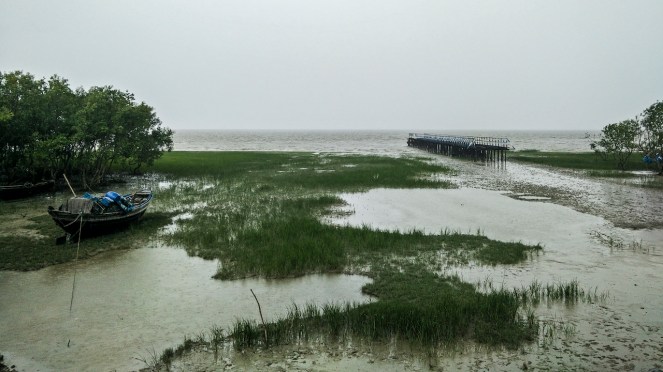
What will happen to a river that already has no fish and is way too salty. The barrages will mean doom for even the few fish that are left (Photo by Veditum)
I had been informed in advance of the situation of our fishermen by minds already working in the field of environment and rivers in our country, often mentioning that these communities were severely under-represented and very much neglected even when it came to discussions relating to them. Non-inclusiveness of communities while making decisions is not a new theme in India, but given the extent of impact that some upcoming government decisions/policies was going to have on these people, I decided to ask them a few questions as I proceeded upstream from Ganga Sagar, starting early June 2016.
Anywhere downstream of the Farakka barrage, the mention of the word barrage has a stunning effect on the people and 1975 is a year that fisher folks remember as a year of doom. For most readers and even for me before I started upon this trip, this would makes sense if one tries to put in a little effort in imagining how a barrage or dam might affect a river. But unlike how logic would dictate, this effect doesn’t exist just downstream of the barrage and similar reactions continued even further upstream, in Jharkhand and Bihar.
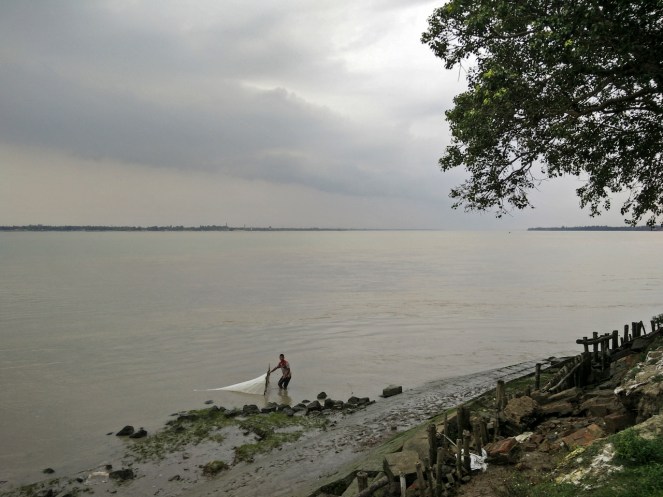
In places along the feeder canal from the Farakka Barrage, an increased frequency of ships to the Thermal Power Plants has resulted in rapid soil erosion (Photo by Veditum)
The National Mission for Clean Ganga and The National Waterways programme have been in the limelight for making grand promises of :
1.) Cleaning and maintenance of the river
2.) Economic Development and Cheaper Transportation.
Now, this is not a commentary on the efficiency and feasibility of making such proposals, simply an attempt to understand the impact of such programmes. EIA (Environmental Impact Assessment) and SIA (Social Impact Assessment) are the terms you might be looking for, something that ideally the governing authority should be taking care of. But why is any of this important or relevant to this article? It is because whatever happens in these places between Patna, Allahabad and Varanasi is very much relevant and important to discuss. These are not uninhabited spaces, but pretty well populated areas with a lot of lives at risk.
Coming back to the point of the two government programmes, firstly, the NMCG letting the Waterways programme run through protected areas and non-protected ecologically sensitive areas goes very much against the whole agenda why this mission was set up. Secondly, the waterways programme in a bid to decrease ‘transportation’ costs and utilise our river potential recently ran tests with large vessels on the Ganga.
Small country boats near Farakka. Wonder what large waves from huge vessels will do to these (Photo by Veditum)
What is surprising (or rather not) is that these test runs were without any warnings to fishermen and boatmen in said test sections, the few who were on the waters at the time of passing of these vessels had to face high waves, enough to topple a less experienced or unaware boatman. The news of these tests were flashed all over the main stream media, but failed to make it to those for whom it mattered. Not an uncommon occurrence at all, but till when will this go un-noticed? On asking these fishermen if they have any clue why this is happening, most of them responded in the negative while a few said they’ve learnt about the government’s plans to run large vessels on the river.
As this conversation extends and questions follow, it is gradually revealed that the picture is not clear and conversations have somehow trickled down in a very muzzled form. Though most fishermen laugh off the prospect of this being a constant activity because of the extreme reduction in water level that the river has seen these past years, often mentioning how large excavators and multiple tugboats have been needed anytime a large vessel has traversed these stretches in lean seasons. There’s talk of loss of fishing nets and reduced catch, difficulty in controlling small country boats in high waves, chances of accidents when transporting villagers to small ‘diars’ for agricultural work, loss of land where there’s no embankments and so on, but this also brings us to the most important part of this article.
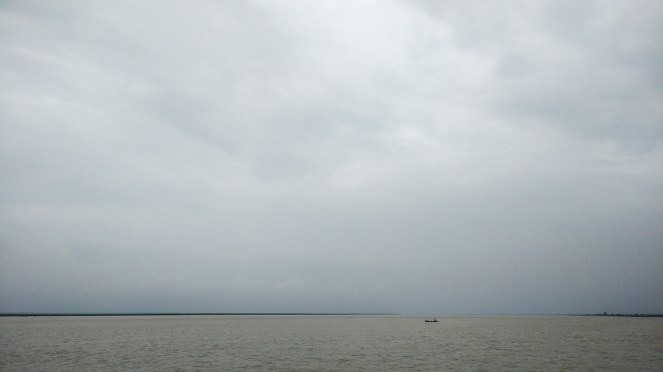
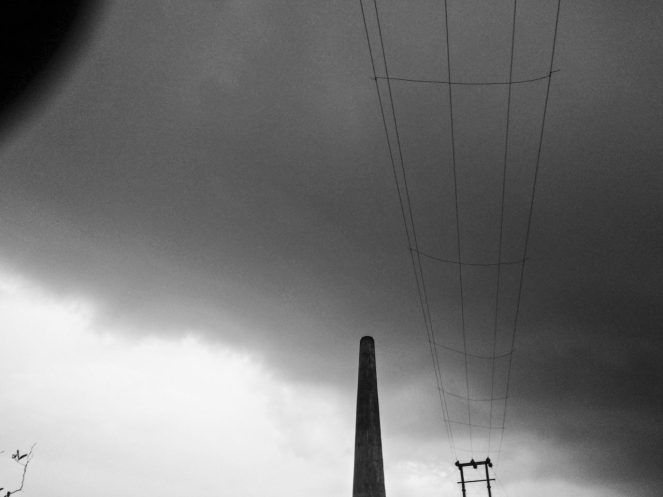
The dark clouds often linger over the heads of those not involved, not informed (Photo by Veditum)
The Water Highway programme on the Ganga has been proposed on a 1500 km stretch from Allahabad to Haldia, with barrages at about every 100 kms. Now, an avid news reader would have knowledge of this as a great policy step but the fisherman who directly depends on the river for his livelihood does not. This holds true for maybe 15-20 different fishing communities that i’ve had the chance to interact with in the first 50 days and even the mention of new barrages was way too shocking for those who have had to bear the burden of Farakka’s impacts. There are even places where locals have signed their wishfulness of a barrage near their villages without understanding consequences and only having been shown the shiny side like we see everyday in the papers, called ‘development’.
The ‘Moving Upstream’ project intends to understand and present a narrative of the river and it’s people, hoping this will lead to more meaningful conversation and inclusive action by the government. In a recent announcement by Sushri Uma Bharti Ji – Union Cabinet Minister of Water Resources, River Development & Ganga Rejuvenation, she said she will march down the length of the river to take stock of the status of various projects commissioned by her. I’m glad that cues are possibly being taken from the Moving Upstream project, but like every other government project, when will our habit of assessment (if at all) after execution stop and preparedness & understanding before implementation materialise? I hope she does her Ganga yatra before approving any projects, I hope for inclusiveness.
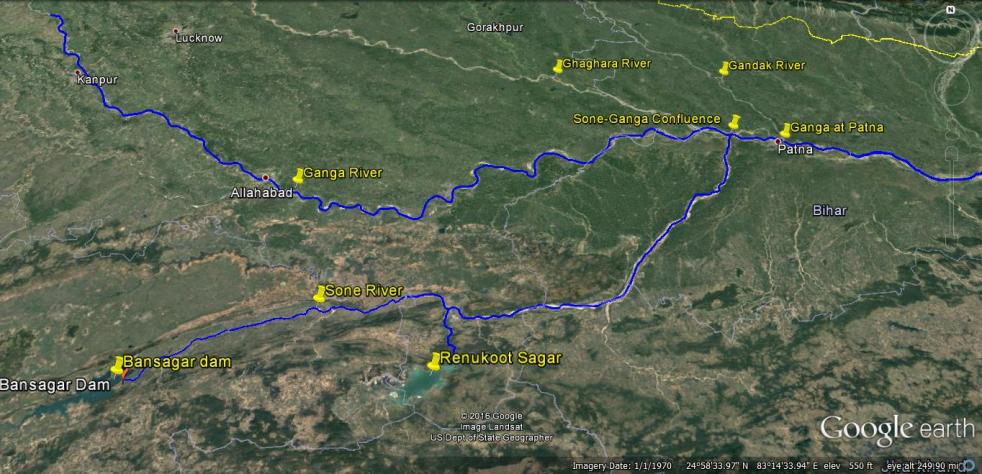
बाणसागर बाॅध, सोन नदी, गंगा नदी और पटना को दर्शाता मानचित्र
21 अगस्त 2016 की सुबह, गंगा नदी का जलस्तर लगातार बढ़ते हुए, पटना में 50.43 मीटर पर पहुॅच गया। जिससे पटना में गंगा नदी अपने पहले के उच्चतम बाढ़स्तर 50.27 मीटर से 16 सैंटीमीटर ऊपर बह रही थी। 22 अगस्त 2016 तक पानी का जलस्तर गंगा नदी के किनारे तीन अन्य स्थानों पर उच्चतम बाढ़स्तर को पार कर गया। जिसका विवरण निम्न हैः-
स्थान 22.08.2016 को उच्चतम बाढ़स्तर पुराना उच्चतम बाढ़स्तर बलिया उत्तरप्रदेश 60.30 मीटर 60.25 मीटर (14 सितंबर 2003) हाथीदाह, बिहार 43.17 मीटर 43.15 मीटर (07 अगस्त 1971) भागलपुर बिहार 34.55 मीटर 34.50 मीटर (05 सितंबर 2013)
इस तरह से हम देखते हैं कि पटना में उच्चतम बाढ़ का रिकार्ड तोडने के बाद, अब यह बाढ़ गंगा नदी के किनारे बसे बिहार और उत्तरप्रदेश के अन्य इलाकों में पहुॅच रही है। यहाॅ यह बात उल्लेखनीय है कि बिहार में अब तक वर्षा औसत से 14 प्रतिशत कम हुई है। सवाल यह उठता है कि इसके बावजूद गंगा में रिकार्ड तोडने वाली बाढ़ क्यों आयी?
Above: Map Showing the location of Bansagar Dam, Sone River, Ganga River and Patna
Water level of Ganga at Patna reached 50.43 m on Aug 21, 2016 morning with still showing rising trend. This level was already 16 cm higher than the highest ever recorded flood level (HFL) of Ganga at Patna of 50.27 m. By Aug 22, 2016, at three more sites along Ganga, the water level had already breached the highest recorded levels: Balia in Uttar Pradesh (Ganga Water level at 60.3 m, higher than the HFL of 60.25 m recorded on Sept 14, 2003), Hathidah in Bihar (Ganga water level at 43.17 m, higher than the HFL of 43.15 m recorded on Aug 7, 1971, that is 45 years back) and Bhagalpur in Bihar (Ganga water level at 34.55 m, higher than HFL of 34.5 m recorded on Sept 3, 2013). This means that the highest flood level that started at Patna is now travelling both upstream and downstream along Ganga.
Several districts of Bihar along Ganga are facing floods, with at least 10 lakh people affected and about 2 lakh people displaced. On Aug 21 alone, NDRF teams have rescued over 5300 people from Didarganj, Bakhtiyarpur, Danapur Chhapra, Vaishali and Maner. At least ten lakh people have been affected in Bihar, two lakh have been displaced and scores have been killed. It seems more like and annual natural calamity.
But that is not the case, if we look closely. Available information shows that the unprecedented floods that we are now seeing in Ganga in Bihar and UP are largely due to contribution of two dams: Bansagar Dam along Sone river in Madhya Pradesh in the upstream and Farakka Dam (misleadingly called a Barrage) on the Ganga river in West Bengal. If Bansagar Dam was operated in optimum way, than it need not have released over ten lakh cusecs of water. As pointed out by Bihar government, the high floods brought by Ganga in Patna are majorly due to the high flow contributed by Sone river upstream of Patna. Continue reading “A tale of two dams: Is Bihar’s unprecedented flood an avoidable man-made disaster?”→
A couple of years ago, we were travelling from Dehradun to Delhi and on my left was the massive Bhimgouda barrage which diverted the Ganga through Upper Ganga Canal at Haridwar. The barrage diverted the entire river, so that the downstream of the barrage, Ganga River was bone dry. Even for an agnostic like me, it was disturbing to see the mighty Ganga dried out like this so close to her origin. But just a couple of hundred meters ahead on the right were Har ki Pauri Ghats where Pilgrims were religiously performing Ganga Arati. There was a highly colored cement statue of Ganga precariously balancing on her gharial, in the middle of the canal.Continue reading “Borewell water in a concretized Ramkund: Has religion helped Rivers at all?”→
Two years is not a lot of time. Yet it is good enough to know if the right path has been taken or not?
Prime Minister Modi during his campaign and immediately on taking charge of the new government in May, 2014 raised huge expectations with his proactive call to rejuvenate river Ganga. Seemingly like a personal mission, he put Ms Uma Bharti, a well known Ganga Bhakta in charge of the renamed Ministry of Water Resources, River Development & Ganga Rejuvenation (MoWR,RD&GR). Continue reading “WHY TWO YEARS OF GANGA REJUVENATION HAS BEEN LITTLE MORE THAN NOISE?”→
Introduction: The National Waterways Bill (NWB, Bill No. 122 of 2015) was tabled by the current central government’s Minister of Transport and Shipping, Mr. Nitin Gadkari, in May 2015. This Bill plans to convert 106 rivers and creeks across India into waterway canals, purportedly for ‘eco-friendly transport’ of cargo, coal, industrial raw materials, and for tourism purposes. The primary reasons provided for this bill are that 1) inland water transport is fuel-efficient, cost-effective and eco-friendly, 2) the systematic development of waterways will create progressive economic opportunities in the country, and 3) the potential of water transport is underutilized in India. The Bill has since been examined by the Standing Committee appointed of Rajya Sabha Members and experts on the matter, who submitted their findings in Report No. 223 (Rajya Sabha Secretariat, August 2015). Recently, the Bill has been cleared by the Lok Sabha, and awaits final discussion in the Rajya Sabha within a fortnight’s time. As of now the NWB appears to enjoy support across party lines, states and political positions and agendas. There is also a belief that waterways would mean maintenance of enough water flowing in our rivers – yet the means through which this is proposed to be achieved involve capital dredging and large-scale conversion of floodplain environments and riverbanks to concrete embankments. A serious concern of observers has been that there has unfortunately been but scant debate on the high ecological and social risks the NWB poses to riverine biodiversity and local resource users through such irreversible engineering controls on our rivers. There is no discussion among politicians and administrators. Importantly, this issue appears to have barely received adequate attention even in environment and conservation circles. Problematically enough, the NWB thus emerges as a threat that may go unnoticed by conservationists and get passed without debate, deliberation or emphasis on environmental clearances to the extent required. In this article I will discuss the potentially damaging consequences of the NWB on river ecology, human life and hydrological dynamics of India’s riverscapes. My earlier article on the SANDRP blog ‘Four boats at a river crossing along Ganga’ (dated 28th December, 2015) had described https://sandrp.wordpress.com/2015/12/28/four-boats-at-a-river-crossing/) ground experiences related to the impacts of large-scale inland water transport (IWT). Continuing there I attempt to provide a point-wise discussion and critique of the NWB. Continue reading “Digging Our Rivers’ Graves?”→
Draft of India’s upcoming National Wildlife Action Plan (NWAP) has been put in open domain for comments. A perusal of this Draft indicates that although it is a detailed document, it has nothing to offer for our Rivers, which receive next to no protection, despite them supporting rich freshwater biodiversity, as well as livelihoods of millions. We hope the Final NWAP addresses this critical lacuna. If you agree, please do send in your comments to wl-mef@gov.in. Last date for comments is over ( 17th February 2016), but it may still be a good idea to push for this issue. ( Access draft here: http://envfor.nic.in/sites/default/files/NWAP%20-COMMENTS_0.pdf)
Unsustainable sand mining from riverbeds can have huge social, environmental, geomorphic and disastrous impacts for rivers. In this three part report, SANDRP is trying to provide a picture of what happened on this issue in 2015 in India.
This first part looks into 2015 putting together instances of illegal sand mining that occurred throughout the year in different Indian States. The successive blogs would make an attempt to cover all governmental measures and judicial interventions taken in 2015 to reign in uncontrolled extraction of this possibly most consumed natural resource after air and water.
Illegal mining of sand is profoundly linked to growth in construction industry that have accelerated in recent decades. Since then demand for this mineral is only going up. Today possibly there is not a single river in the country that is not ruined by sand mining. As a result, while the state of rivers has gone worse, the number of violent instances around illegal sand mining is on the increase.
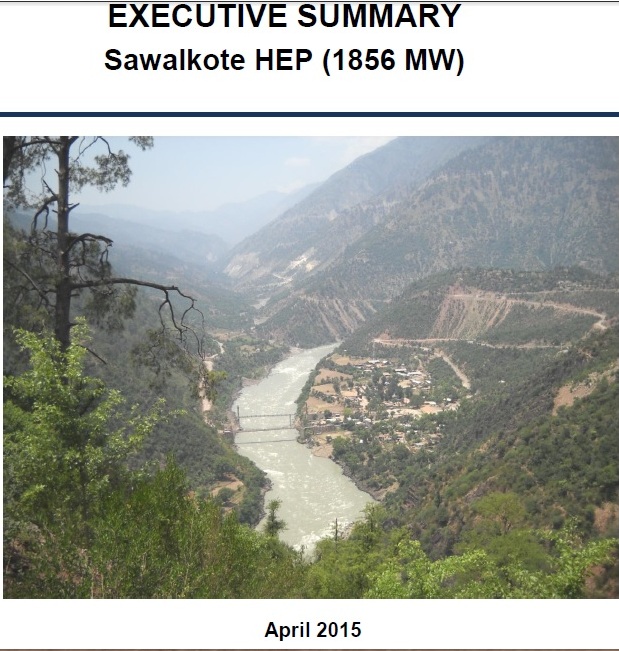
Sub: Violations in public hearing for 1856 MW Sawalkote HEP
in Ramban, Udhampur and Reasi districts in J&K
Respected Chairman, Member Secretary and Regional Director,
We understand from J&K SPCB website that the pubic hearings for the proposed 1856 MW Sawalkote Hydropower project is to be held in Udhampur (Village Panchari), Reasi (Village Mahore) and Ramban (Village Tanger) districts at 10 am on January 18, 21 and 28, 2016 respectively. However, we notice a number of problems in this context, some of the key ones include: Continue reading “Open Letter to J&KSPCB: Cancel Public Hearings for Sawalkote HEP for violations”→