Cauvery · Inter State Water Disputes · Karnataka · Tamil Nadu

Supreme Court Judgment on Cauvery Dispute: Does it change anything?

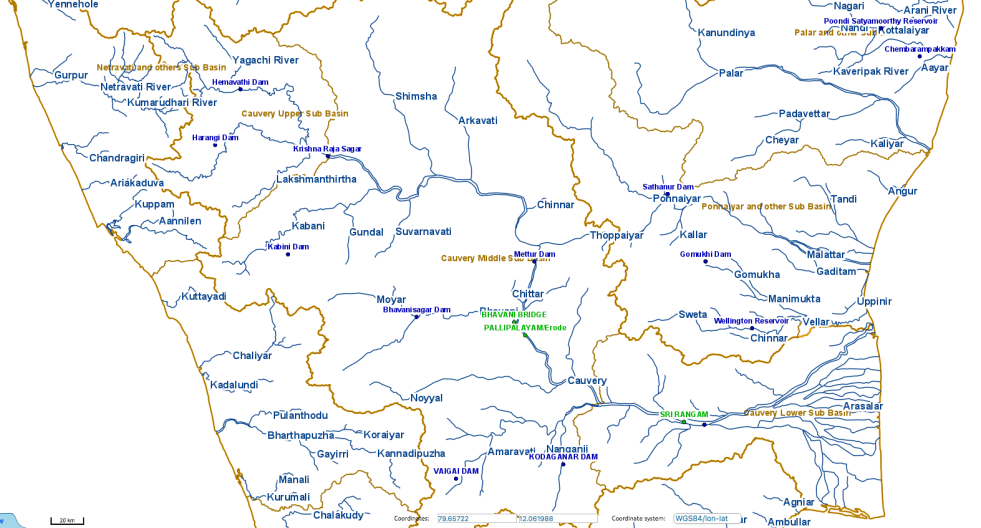
Supreme Court of India passed the much awaited 465-page Judgment on Cauvery Water Dispute on Feb 16, 2018[i]. After the Cauvery Water Disputes Tribunal declared its award on Feb 5, 2007, a number of Appeals were filed in the SC, challenging the Tribunal Award, including those by Karnataka and Tamil Nadu. By this Judgment, the SC has partially allowed the Karnataka Appeal (Civil Appeal 2453 of 2007) and disposed off all the appeals. The Award was published in gazette only in 2013, following an earlier SC order. The SC Judgment provides additional 14.75 TMC (Thousand Million Cubic Feet) of water to Karnataka and thus reduces Tamil Nadu’s share to that extent.

Continue reading “Supreme Court Judgment on Cauvery Dispute: Does it change anything?”

brahmaputra · China · Siang

Muddy Siang is sign of danger ahead, wake up call for Indian authorities

The current ongoing episode of Muddy Siang River water in Arunachal Pradesh is due to landslides in the upstream Tibet, triggered by the earthquakes starting on Nov 17, 2017 or possibly earlier. This is revealed by the satellite pictures and work of two researchers, first published in Arunachal Times on Dec 21, 2017[i]. These landslides are partly blocking the Siang flow and could lead to massive floods in the downstream Arunachal Pradesh and Assam any day.

A similar event in year 2000 led to sudden, massive floods in Siang River in Arunachal Pradesh on June 1, 2000. That episode, like the current one, started about 53 days before the floods, on April 9, 2000 due to landslides along a tributary of Yarlung Tsangpo, as Siang is known in Tibet. Continue reading “Muddy Siang is sign of danger ahead, wake up call for Indian authorities”

Dams · Environmental Flow · Fish Sanctuaries · Free flowing rivers · Ganga · Inland Waterways · Interlinking of RIvers · Karnataka · Kerala

Riverine Fisherfolk as Mascots of flowing rivers and how 4 projects treat them today

When I was documenting a tiny, free-flowing river in Maharashtra Western Ghats named Shastri, the common thread from headwaters to estuary was Fishing! It was everywhere, in all forms, including dozens of fish species and fishing practices, including everyone: men, women, children, otters, crocs, storks. Across the country, buzzing, diversified fisheries with old, complex narratives indicate a rich river. And the palette just gets more vivid, nuanced and colorful with the size of the river.

More than 10 million Indians from some of the most vulnerable groups depend on rivers for their livelihood and nutritional needs. This staggering number can be an underestimate as several riverine fisherfolk do not bring their produce to the market and our livelihood census hardly captures the intricacies of riverine fisheries sector. Despite the huge dependence and critical importance of riverine fisheries, the sector continues being ignored and abused. The reasons behind the exploitation are at the heart of a deeper, more troubling discourse: ownership and appropriation of the river as a natural resource. Continue reading “Riverine Fisherfolk as Mascots of flowing rivers and how 4 projects treat them today”

Arunachal Pradesh · Assam · brahmaputra · Dams · Lohit River

‘Banks of the Lohit will shine’: Glimpses of a free-flowing river

Above: Lohit River, Parshuram Kund on the right. Photo: Parineeta Dandekar

Assam, Arunachal and the North East India, West Bengal and Bangladesh are riverine entities in many ways. Ancient rivers flowing through this landscape have moulded not only the mountains and the silt-heavy banks, but cultural identity of the region itself.  Rivers permeate through the literature, folklore, songs, poems, cuisine, even dressing… Bhupen Hazarika, the Bard of the Brahmaputra, likened the red ripples of the Assamese Gamcha (red and white stole)  to the braided filigree of the Red River. When Guwahati University opened on the banks of Luit, Hazarika sang “Jilikabo Luiter Paar”..Banks of the Luit will Shine. Rivers stood for revolution as they stood for Love.. Jyoti Prasad Agarwal wrote “Luitar Parore Ami Deka Lora.. Moribole Bhoi Nai.” (“We are the youth from the banks of the Luit/ We are not afraid of death”). Older poets like Parvato Prasad Baruah wrote entire books full of poems of Luit and today modern poets in Assam like Jeeban Narah  link their creative processes inextricably to rivers. Continue reading “‘Banks of the Lohit will shine’: Glimpses of a free-flowing river”

Environment Impact Assessment · Ganga · Nepal · Public Hearing · Uttarakhand

Letter to MoEF’s Expert Committee: Why Pancheshwar Project should not be considered for Environment Clearance

(Above: Protest outside MoEF on Oct 24, 2017 when EAC met to consider EC for Pancheshwar Project)

Oct 23, 2017

To

Chairman and Members, Expert Appraisal Committee (River Valley Projects), Union Ministry of Environment and Forests, Jor Bagh, New Delhi

Respected Chairman and Members,

The agenda of the EAC (for RVP) to be held on Oct 24, 2017, put up on the EC website only on Oct 18, 2017, just six days before the EAC meeting includes the 5040 MW Pancheshwar Multipurpose project (PMP), India’s largest proposed hydropower projects. The agenda should be available at least ten days before the meeting, and this should also be a reason for not considering the Pancheshwar project by EAC for its meeting on Oct 24. Moreover agenda mentions 5600 MW Pancheshwar project, where as the capacity as per EIA is 5040 MW. Is MoEF just callous in mentioning wrong installed capacity or has the capacity gone up? In either case, the 5040 MW Pancheshwar project should not be on EAC agenda. Continue reading “Letter to MoEF’s Expert Committee: Why Pancheshwar Project should not be considered for Environment Clearance”

Dams · Delhi · DRP News Bulletin · Floods · Ganga · Groundwater

DRP: 16 Oct 2017: New Groundwater Guidelines threat to India’s Water Lifeline

GROUND WATER

New Draft Guidelines designed to privatise & destroy Groundwater The Ministry of Water Resources of the Union Government has on Oct 11, 2017 (see notice: http://www.wrmin.nic.in/forms/List.aspx?lid=1180&Id=6) put up draft guidelines on Groundwater management in India (see draft Guidelines: http://www.wrmin.nic.in/writereaddata/guideline-NOC-CGWA.pdf), with comment period of 60 days. The comments are to be sent to: Member Secretary, Central Ground Water Authority, West Block-2, Wing 3 (Ground Floor), Sector 1, RK Puram, New Delhi – 110066, e-mail: cgwa@nic.in.

New Draft Groundwater guidelines designed to destroy groundwater further and open floodgates for privatisation of common property resource? “Groundwater is a common property resource and should be used for greater good. But these guidelines are not doing that. Groundwater governance and management should happen in a transparent, participatory and accountable way but that too is not happening through guidelines,” Thakkar said.

Explaining, Thakkar said that the guidelines are “trying to make a system wherein state or district level authorities will be giving NOCs but whether those authorities have capacity to give NOCs after understanding the implications is the question.” “The draft guidelines also take out the need to recharge groundwater. Present regulations say that you if you take out groundwater you need to put in recharge capacity but now they are saying that’s not necessary and are only seeking charges. These things will definitely lead to further destruction of groundwater,” he added. http://www.livemint.com/Politics/irx1jFCWMFjGJk82Z8VZ2O/Govt-proposes-new-guidelines-on-groundwater-usage-by-industr.html, http://www.newindianexpress.com/nation/2017/oct/13/centre-proposes-water-conservation-fee-for-use-of-groundwater-1673480.html, http://www.newindianexpress.com/nation/2017/oct/14/townships-with-gym-club-must-pay-water-fee-1673790.htmlhttp://www.hindustantimes.com/environment/centre-proposes-nixing-recharge-requirement-for-industries-extracting-groundwater/story-kN3iPmO9m4MIoYkUX32n7I.html  

Continue reading “DRP: 16 Oct 2017: New Groundwater Guidelines threat to India’s Water Lifeline”
Rivers

Will this ‘Rally’ help the rivers?

PRESS RELEASE From India Rivers Week Organising Committee on Sept 13, 2017

We are concerned about the increasing superficial optics around saving rivers, with little or no effort to address fundamental issues which are causing their demise.

The high profile rally initiative to save India’s rivers taken up by well respected religious guru Sadguru and his followers is noteworthy, and the most recent case in point. It is striking that so many film stars, politicians, governments, and public personalities, are joining the call. Lakhs of children are expected to join in the program. While we welcome such an outpouring of good intentions and good will as a demonstration of the positive energy all around, unfortunately, we have seen no evidence either from the rally organisers, on their website[i] or their messaging, that they understand or plan to address the real threats faced by our rivers and their sorry state. Continue reading “Will this ‘Rally’ help the rivers?”

Bhagirathi · Ganga · Uttarakhand

Walking along Ganga in Uttarakhand in 2017

Above: The Bhagirathi valley has a lot of beautiful bends, comparable to the most popular scenic spots across the world. But we’re busy cutting down the mountain to make broader roads in these eco-sensitive areas. Image taken in March 2017. Photo credits: Siddharth Agarwal 

Guest Blog by Siddharth Agarwal

In the initial stages of planning the Moving Upstream project on the Ganga for Veditum, where we were going to walk along the whole length of the river, I had approached a lot of individuals to learn from their experiences about the river and the many connected stories around it. These learnings varied from science and activism to adventure and survival. Of all those who were approached, Himanshu Thakkar from SANDRP had been the most generous in extending knowledge resources and sharing contacts from the field. He even entertained a couple of my visits to their office and shared with me a copy of the SANDRP report prepared by Theo, called Headwater Extinctions (February 2014,  see: https://sandrp.wordpress.com/2014/12/16/new-publication-headwater-extinctions-impact-of-hydropower-projects-on-fish-and-river-ecosystems-in-upper-ganga-and-beas-basins/, it includes link to full report), along with a few other documents.

Headwater Extinctions looks at the role played by small and large hydropower projects in altering the fish biodiversity and river ecosystems in the Himalayan reaches of the Ganga and Beas basins. It also speaks about the perspective of local people and that of the authorities towards hydropower projects. Theo, who is an adventurer and ecologist, penned down the report with a scientific aptitude, while I will limit myself here in this revisit report to updated observations made on ground while walking along the Ganga in Uttarakhand (March 2017). This comparative observation will hopefully enable a conversation that requires continuity. Continue reading “Walking along Ganga in Uttarakhand in 2017”

Ganga

INTACH pilot project reduces Assi River Pollution in Varanasi by 70% in two months, at least cost, without any structures

Above: Map showing interventions in Assi River in Varanasi (INTACH)

REPORT TO DIVISIONAL COMMISSIONER, VARANASI

On INTACH’s Pilot Project on Assi Nadi [24th Jan/17 – 26th Feb/17]

Guest Blog by Manu Bhatnagar, INTACH

  1. INTACH is a national non-profit organization, a registered society under Society’s Act since 1984, having the Secretaries of the GoI Ministries of Environment, Forest & Ganga Rejuvenation, Ministry of Urban Development, Ministry of Culture, DG [ASI] and DG [NM] on its Governing Council with its accounts duly audited by the Office of CAG.
  2. High pollution load in holy River Ganga at Varanasi is due to domestic wastewater flowing into the river through 33 nallahs and rivulets. Sewerage systems and treatment plants are going to take several years to be in place and effective. In the meantime the river will continue to remain polluted. Based on its experience in Delhi and Agra INTACH has initiated a one month pilot project for cleaning wastewater flow in Assi Nadi using the process of bacterial bioremediation.

Continue reading “INTACH pilot project reduces Assi River Pollution in Varanasi by 70% in two months, at least cost, without any structures”

Bihar · Floods · Ganga

Ganga basin faces unprecedented floods in Aug 2017

Ganga Basin, particularly Bihar is facing unprecedented floods, starting on Aug 12, 2017. Water levels of Major tributaries of Ganga, including Kosi, Mahananda, Rapti, Ghagra, Bagmati, Gandak and Kamlabalan are close to or above the historically highest flood levels almost simultaneously. This has rarely happened in the past. The water level of Ghagra is close to HFL at Elgine Bridge in Barabanki district in Uttar Pradesh. Most other flood forecasting sites in North Bihar and East UP were shown as pink dots on CWC flood forecasting map on Aug 13-15, signifying that water level at these sites was above the danger level. This is possibly the beginning, this wave is expected to rise as it travels down towards Bihar and then W Bengal and Bangladesh. Continue reading “Ganga basin faces unprecedented floods in Aug 2017”