The Global Inland Fisheries Conference in Rome, Italy, organized by FAO and Michigan State University concluded on the 28th January 2015. The three day conference meant a lot of things: A platform to present the worth, the potential and the challenges of a chronically neglected sector, a place to learn from experiences across the world and, as the conference website says, “a cross-sectoral call to raise the profile of inland fisheries and better incorporate them in agricultural, land use, and water resource planning through development of improved assessment frameworks and value estimation.”
On this Republic Day of India, when the American President Barack Obama joined Indian Prime Minister Narendra Modi to witness the ever-inspiring Republic Day Parade, 6000 kms away in Rome I heard a Native American woman say, “With colonization, we were alienated from all that we held dear, not only our natural resources but also our legitimate place in decision-making. We are Salmon people. Revitalization and protection of our fish is our sacred duty and we will do it despite the dams.” A fisherman near Farakka Barrage who was hardly making a living due to the barrage had said something similar to me once.
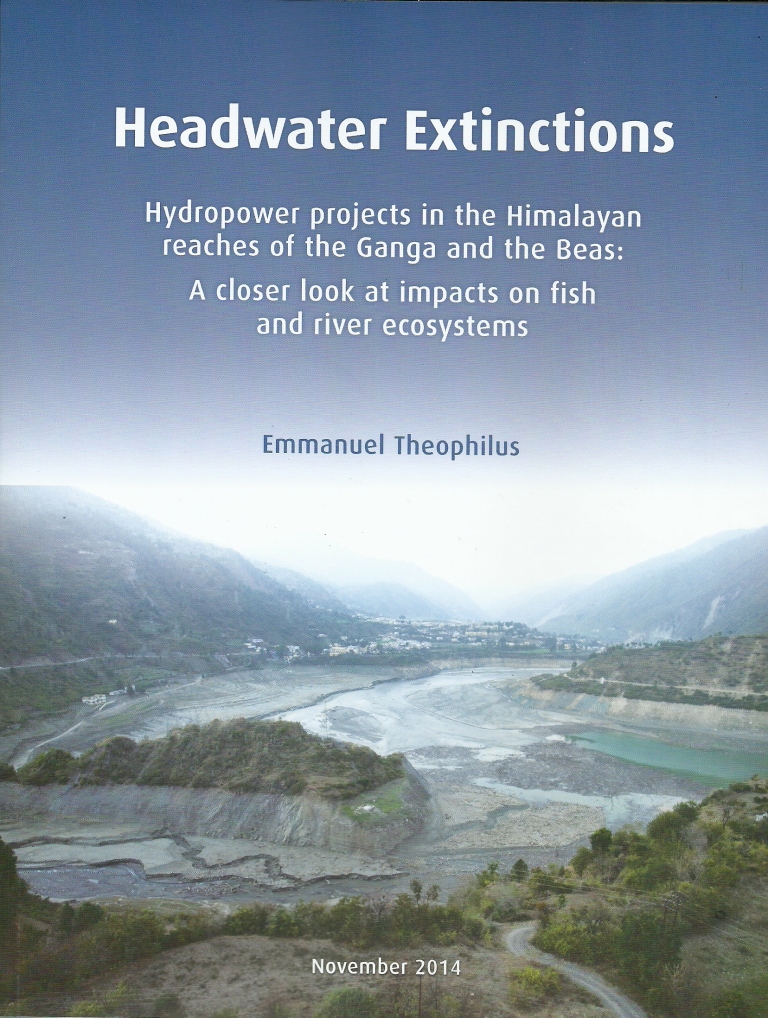
I have gone through the report Headwater extinctions: Hydropower projects in the Himalayan reaches of the Ganga and the Beas: A closer look at impacts on fish and river ecosystems by Emmanuel Theophilus[1], published by SANDRP, thanks for sending the report to me in hard and soft copy. It is indeed excellent, many more pages can be written on the beautiful portrayal. I am flagging some concerns, in context of the whole issue. Continue reading “Headwater Extinctions by Emmanuel Theophilus: SOME CONCERNS”→
Every day, Maharashtra is shaken by the news of farmer suicides in Vidarbha or Marathwada. On Dec 28, 2014 it was reported that 12 farmers in Vidarbha committed suicide in 72 hours[i].
“We deal with rivers with utmost unconcern and disrespect… India Rivers Week and India Rivers Forum is most welcome, will look forward to participate in it” says Jairam Ramesh at the India Rivers Week 2014 inauguration
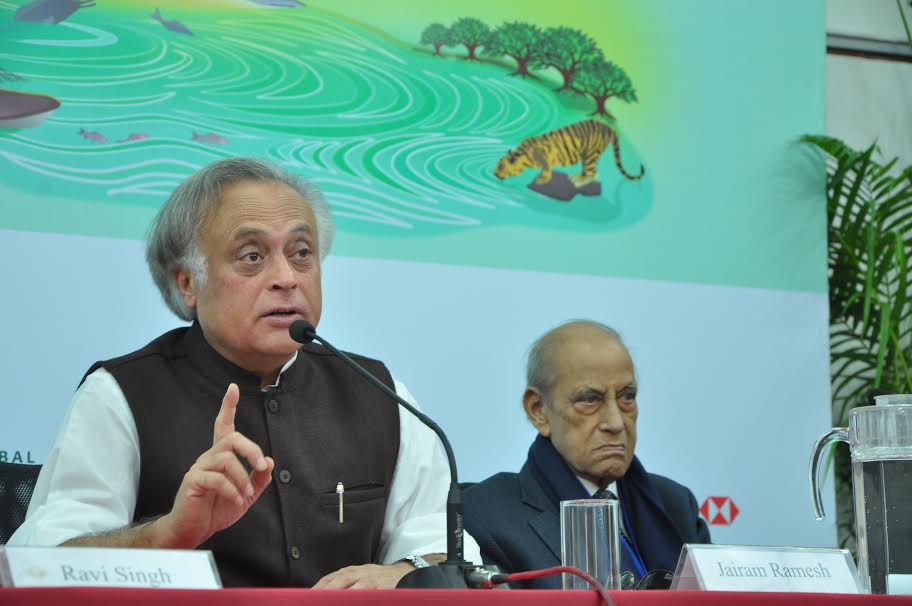
Former Union Minister Jairam Ramesh, giving the inaugural address at the first ever India Rivers week emphasized “Ours is a paradoxical society. While we show a lot of respect for rivers socially, we deal with rivers with utmost unconcern and disrespect… India Rivers Week and India Rivers Forum is most welcome, will look forward to participate in it… If we want to save our rivers, the first step is to ensure that no untreated industrial effluent or sewage finds its way into our rivers.” Speaking on development objectives and the growing energy needs of India, he clarified, “Hydro projects may be a painful choice, but we cannot close our doors to it. What we can do is ensure stricter environmental regulations & their enforcement, a cumulative assessment at ‘basin’ and not ‘project’ level and the minimum environmental flow in the river itself.” He was critical of the current dispensation to dismantle all environmental regulations.
Former Union Minister Jairam Ramesh speaking at the India Rivers Week-2014
Ramaswamy R Iyer, former Secretary to the Government of India stressed in his keynote said that rivers are, ”more than just water, and an integral part of our social, historical and cultural fabric.” He spoke on how we obstruct river flow, encroach flood plains, inflict pollution, and hold a economical, cavalier attitude towards it. In other words, “As an American engineer rightly said, we enjoy pushing rivers around,” he added.
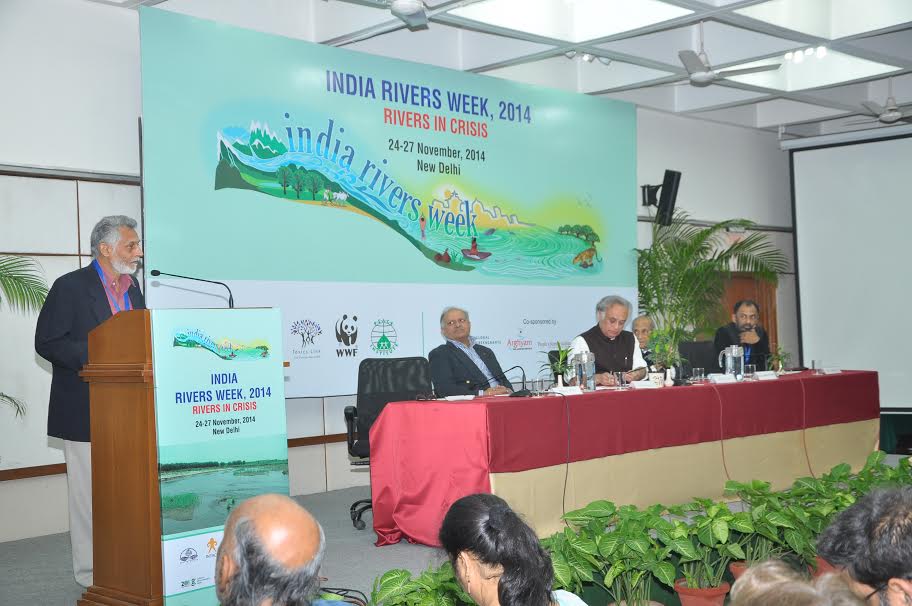
Over 125 River experts, planners, researchers, artists, enthusiasts and activists from different parts of the country have congregated at first ever India Rivers Week being held in Delhi during 24-27 November to discuss, deliberate and exchange their experiences and ideas aimed at the conserving, rejuvenation, restoration of rivers in the country. The event is being organized by a consortium of NGOs including WWF India, INTACH, SANDRP, Toxics Link and PEACE Institute Charitable Trust, with additional support from Arghyam (Bengaluru), International Rivers (Mumbai office), and Peoples Science Institute, Dehradun.
Recently the Union Finance Minister Arun Jaitley during his budget presentation pitched for inter-linking of rivers saying the move can yield “rich dividend”. Jairam Ramesh, former Minister, MOEF however stated “We seem to be indulging in the romance of ILR. We need to be more cautious in hurrying up the proposed Inter Linking Rivers projects,” he said, “and understand their ecological and environmental consequences better.” He urged for more debates on water agreement treatise and better co operation within states and also between the neighboring countries.
“Not only are our rivers misunderstood but mistreated and thoroughly abused”, said Manoj Misra, Yamuna Jiye Abhiyaan. “We need to move beyond the understanding a river simply in terms of water.” What makes this event significant is that the practitioners gathered here, through their experience sharing session and discussions, “will generate, adopt and present a Nation River Charter at the end of the meeting.”
Manoj Mishra, PEACE Institute, at the India Rivers Week-2014
This is the first of conclave to enable learning and promote river restoration skills and actions from sharing and exchange of ideas, experiences and practices. “There has been 76% reduction in aquatic biodiversity over the years. That figure is higher than the loss of terrestrial or marine biodiversity, showing the crisis rivers are facing and we need to act fast to address this crisis”, added Ravi Singh CEO, WWF in his welcoming opening remarks.
Lack of true understanding and appreciation – amongst planners, decision makers, various government departments as well as the common man – of rivers as ecological systems that provide a number of ecological and economic services is a major reason for the sorry state of our rivers. No wonder, there exists no national policy or law that could provide our rivers security from death, degradation and unsustainable and unfair exploitation.
Ravi Agarwal, Toxics link, reiterated, “Rivers are diverse eco systems, where water is just a common defining system”, and hoped this ‘unique meeting’ would debate thoroughly on this complex issue.
A recent appraisal has found that there is no river in any of the top 50 cities in the country that is not sick or dying with river Yamuna in Delhi-Mathura-Agra and Ganga in Kanpur-Varanasi-Patna leading the list. Widespread devastations in Uttarakhand (June 2013) and J&K (Sept 2014) and Assam-Meghalaya in North East (September 2014) bring home the fact that disturbed rivers can become dangerous and highly devastating.
Dams, diversions, bumper-to-bumper hydro projects, diverted natural flows, encroached flood plains, embanked river channels, degraded catchments, destruction of local water systems and pollution of various kinds are causing this. Climate change uncertainties are expected to further compromise the integrity of our rivers.
Ramaswamy Iyer observed, “Disputes rarely come in question when a river is free flowing. Only when water distribution come into play, as in the case of large projects, and issues of power crop in, do conflicts increase.” Speaking strongly against the ‘run of the river hydro projects’, and their ‘green’ tag , he wondered “Can we survive the death of our rivers?”
Rivers have been dammed, diverted, channelized, encroached and polluted no end. Rivers, as ecosystems, have been poorly appreciated. With ‘Rivers in crisis’ as the theme, the Conference endeavors to devise an India Charter for Rivers and initiate an India Rivers Forum for Restoration of Rivers.
The compilation ‘My River Journey’, containing river journey accounts of 47 of the participants has been prepared, published and distributed at the IRW-2014, conclave on 24 Nov, 2014.
Reliable data and information that is both correct and validated on ground, is a pre requisite to understand any feature or activity. And for a river, a constantly evolving and truly complex entity, it becomes even more crucial. The wellness quotient of rivers, their present health status, all these and more can only be understood, once we have the rudimentary knowledge of the river and the basins that they form.
A step in this direction has been taken up by the India WRIS (Water Resources Information System) project (A joint venture between Central Water Commission and Indian Space Research Organisation), that aims “to provide a ‘Single Window Solution’ for water resources data & information in a standardized national GIS framework”[i]. This project has generated 20 basin level reports that share important information on the salient features of the basin, their division into sub basins, the river systems that flow through it and the water resource structures, such as irrigation & hydro electric projects in the basin. Another crucial inclusion is the length of major rivers in each basin, which have been GIS calculated (Geographic information system)[ii] and in a few reports the place of origin of the rivers too is mentioned. (Ganga Basin Report). This is an improvement over the earlier documented river lengths that included the canal length along with the river lengths, in earlier CWC documents (e.g. water and related statistics)!
The Basin reports include basin level maps which also show the proposed inter basin transfer links and the major water resource structures & projects. Individual maps at the sub basin level mark the rivers & their watersheds. The report gives details on the topography, climate, the land use / land cover area , and also the information on hydro meteorological stations like groundwater observation cells, flood forecasting sites and even water tourism sites.
These reports can be downloaded from the WRIS site.[iii]
The reports are an attempt to document the water resources data & information for a better and more integrated planning, at the basin level. A table below tabulates some important parameters from the 20 basin reports.
Missing Dams! It can be seen from table on next page that total number of dams in all the 20 basins come to 4572. Assuming that this includes all the completed large dams in India by Dec 2013 (WRIS report is dated March 2014), if we look at the number of large dams in India as in Dec 2013 in the National Register of Large Dams (NRLD), the figure is 4845. This leaves a difference of 273 large dams, which are missing from the WRIS list! This seems like a big descripancy. Unfortunately, since NRLD gives only statewise list and does not provide river basin wise list and since WRIS list provides only river basin wise list and does not provide the names of districts and states, it is not possible to check which are the missing dams, but WRIS need to answer that.
Sub Basins These 20 basins have been further delineated into a number of sub basins. The sub basins details include the geographical extent of the sub basin, the rivers flowing in it, the states that they travel through, number and size range of watersheds and also the details of dams, weirs, barrages, anicuts, lifts & power houses, accompanied by maps at this level. The irrigation and hydro electric projects in the area are detailed and mapped for greater convenience. The sub basin list is given here to get a detailed picure.
Indus Basin Sub-basins:
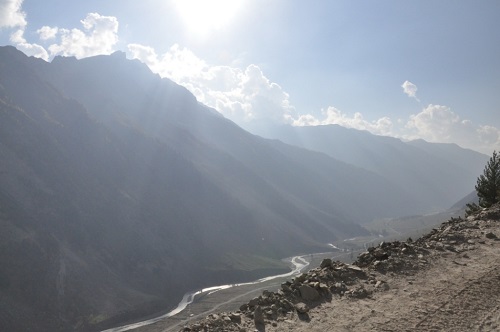
River Dras in Indus Basin in Jammu and Kashmir (Photo by Sabita Kaushal)
Beas Sub Basin
Chenab Sub Basin
Ghaghar and others Sub Basin
Gilgit Sub Basin
Jhelum Sub Basin
Lower Indus Sub Basin
Ravi Sub Basin
Shyok Sub Basin
Satluj Lower Sub Basin
Satluj Upper Sub Basin
Upper Indus Sub Basin
S. No
River Basin
Major river
No. of sub basins
No. of watersheds
No. of water resource structures
No. of water resource projects
Irrigation
Hydro Electric
Dams
Barrages
Weirs
Anicuts
Lifts
Power Houses
Major
Medium
ERM*
1
Indus (Upto border)
Indus (India)
11
497
39
13
18
0
45
59
30
40
21
55
2a
Ganga
Ganga
19
980
784
66
92
1
45
56
144
334
63
39
b
Brahmaputra
Brahmaputra (India)
2
180
16
17
5
0
4
21
9
13
3
17
c
Barak & others basin
Barak
3
77
4
3
0
0
0
3
0
6
3
3
3
Godavari
Godavari
8
466
921
28
18
1
62
16
70
216
6
14
4
Krishna
Krishna
7
391
660
12
58
6
119
35
76
135
10
30
5
Cauvery
Cauvery
3
132
96
10
16
9
24
16
42
3
15
6
Subernarekha
Subernarekha & Burhabalang
1
45
38
4
12
0
0
3
5
34
0
1
7
Brahmani & Baitarni
Brahmani & Baitarni
2
79
61
5
4
1
0
1
8
35
4
1
8
Mahanadi
Mahanadi
3
227
253
14
13
0
1
6
24
50
16
5
9
Pennar
Pennar
2
90
58
0
1
2
0
1
7
14
0
1
10
Mahi
Mahi
2
63
134
0
4
0
0
3
10
29
3
2
11
Sabarmati
Sabarmati
2
51
50
2
10
0
0
0
9
11
4
–
12
Narmada
Narmada
3
150
277
2
2
0
4
9
21
23
1
6
13
Tapi
Tapi
3
100
356
8
11
0
13
2
13
68
2
1
14
WFR Tapi to Tadri
Many independent rivers flowing
2
96
219
0
3
0
1
18
13
15
1
12
15
WFR Tadri to Kanyakumari
3
92
69
6
6
4
0
29
19
12
7
21
16
EFR Mahanadi_ Pennar
4
132
64
5
12
12
0
0
12
46
10
0
17
EFR Pennar _ Kanyakumari
4
165
61
2
2
11
0
6
13
33
4
5
18
WFR Kutch _ Saurashtra
Luni
6
268
408
1
10
0
0
0
8
100
4
15
19
Area of inland drainage in Rajasthan
Many independent rivers flowing
–
–
1
0
0
0
48
0
11
1
1
0
20
Minor rivers draining into Myanmar(Burma) & Bangladesh
Many independent rivers flowing
4
54
3
5
0
0
3
–
3
4
1
–
Total
94
4335
4572
203
335
* Extension, Renovation and Modernization ** Data has been accumulated from the individual Basin Reports from India WRIS[iv]
Ganga Basin
Yamuna Lower
Yamuna Middle
Yamuna Upper
Chambal Upper
Chambal Lower
Tons
Kosi
Sone
Ramganga
Gomti
Ghaghara
Ghaghara confluence to Gomti confluence
Gandak & others
Damodar
Above Ramganaga Confluence
Banas
Bhagirathi & others ( Ganga Lower)
Upstream of Gomti confluence to Muzaffarnagar
Kali Sindh and others up to Confluence with Parbati
Brahmaputra Basin It is strange to see that the profile divides this huge basin into just two sub basins, when it could have easily divided into many others like: Lohit, Kameng, Siang, Subansiri, Tawang, Pare, Teesta, Manas, Sankosh, among others.
Brahmaputra Lower
Brahmaputra Upper
Barak & Others Basin
Barak and Others
Kynchiang & Other south flowing rivers
Naochchara & Others
Godavri Basin
Wardha
Weinganga
Godavari Lower
Godavari Middle
Godavari Upper
Indravati
Manjra
Pranhita and others
Krishna Basin
Bhima Lower Sub-basin
Bhima Upper Sub-basin
Krishna Lower Sub-basin
Krishna Middle Sub-basin
Krishna Upper Sub-basin
Tungabhadra Lower Sub-basin
Tungabhadra upper Sub-basin
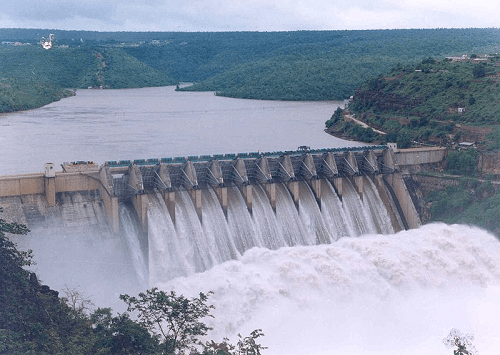
Srisailam Dam on Krishna River (Source: Wikipedia)
Cauvery Basin
Cauvery upper
Cauvery middle
Cauvery lower
Subernarekha Basin No sub-basins.
Brahmani & Baitarani Basin
Brahmani
Baitarani
Mahanadi Basin
Mahanadi Upper Sub- basin
Mahanadi Middle Sub- basin
Mahanadi Lower Sub- basin
Pennar Basin
Pennar Upper Sub-basin
Pennar Lower Sub-basin
Mahi Basin
Mahi Upper Sub-basin
Mahi Lower Sub-basin
Sabarmati Basin
Sabarmati Upper Sub- basin
Sabarmati Lower Sub-basin
Narmada Basin
Narmada Upper Sub-basin
Narmada Middle Sub-basin
Narmada Lower Sub-basin
Tapi Basin
Upper Tapi Sub- Basin
Middle Tapi Sub- Basin
Lower Tapi Sub- Basin
West flowing rivers from Tapi to Tadri Basin
Bhastol & other Sub- basin
Vasisthi & other Sub- basin
West flowing rivers from Tadri to Kanyakumari Basin
Netravati and others Sub- basin
Varrar and others Sub- basin
Periyar and others Sub- basin
East flowing rivers between Mahanadi & Pennar Basin
Vamsadhara & other Sub- basin
Nagvati & other Sub- basin
East Flowing River between Godavari and Krishna Sub- basin
East flowing River between Krishna and Pennar Sub- basin
East flowing rivers between Pennar and Kanyakumari Basin
Palar and other Sub-basin
Ponnaiyar and other Sub-basin
Vaippar and other Sub-basin
Pamba and other Sub-basin
West Flowing Rivers of Kutch and Saurashtra including Luni Basin
Luni Upper Sub-basin
Luni Lower Sub-basin
Saraswati Sub-basin
Drainage of Rann Sub-basin
Bhadar and other West Flowing Rivers
Shetrunji and other East Flowing Rivers Sub-basin
Area of inland drainage in Rajasthan Due to very flat terrain and non-existence of permanent drainage network, this basin has not been further sub divided.
Minor rivers draining into Myanmar and Bangladesh
Imphal and Others sub basin
Karnaphuli and Others sub basin
Mangpui Lui and Others sub basin
Muhury and Others sub basin
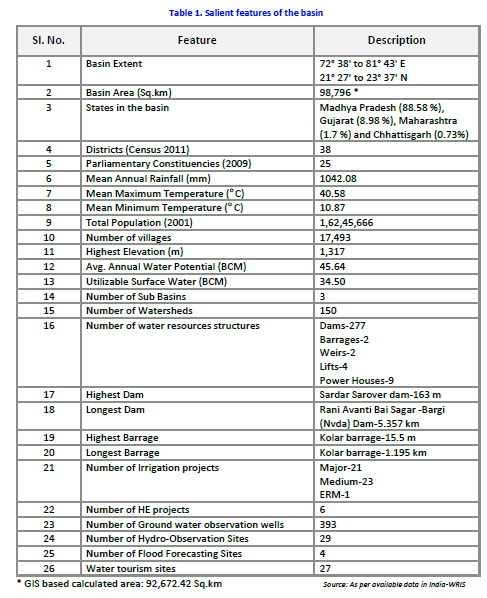
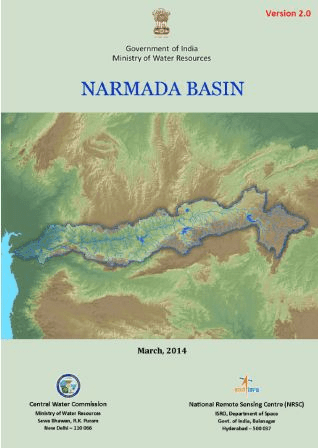
Narmada Basin: Some details To understand the compiled information at the basin level, we take a look at the one of the basin level reports, the Narmada Basin Report[v] (dated March 2014) as an illustrative example. An overview of the basin area right at the beginning, gives its geographical location, shape, size, topography, climate & population. This basic relevant information is tabulated in a concise table for easy access, as given below:
Salient Features of Narmada Basin from WRIS Basin Report
River information The major river flowing in the basin, the Narmada River (also called Rewa) that flows through the 3 states of Madhya Pradesh, Maharashtra & Gujarat, its length (1333 km) and the length of its 19 major tributaries out of a total of 41 is given, based on GIS calculations. There is also a clear river network map of the Narmada basin that demarcates the 3 sub basins along with the watersheds, and shows the dams / weirs /barrages and the rivers in the basin.
Narmada Basin Report Cover Page (Source: WRIS)
Narmada Upper Sub-Basin, with 16 watersheds
Narmada Middle Sub-Basin, having 63 watersheds
Narmada Lower Sub-Basin, with 71 watersheds
The surface water bodies details include the size (less than 25 ha to more than 2500 ha) and type (Tanks, lakes, reservoirs, abandoned quarries or ponds) of existing bodies. Nearly 91.8% of these are tanks.
Irrigation Projects The water resource projects in the basin are as follows:
21 Major Irrigation Projects
23 Medium Irrigation Projects
1 ERM Project
6 Hydro-Electric Projects
Interestingly description is only of the major and medium irrigation projects, information on minor projects is completely absent. An attempt to include the details of minor irrigation projects would have made the report more useful. The reports seem to not understand the significance of the smaller projects and their importance for the people and in the conext of the River Basin too.
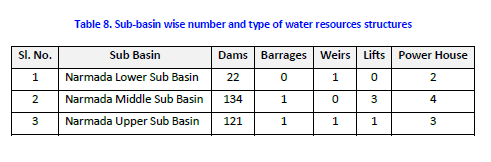
Water resource structures The number and type of big manmade structures in the basin is given. These are a total of 277 dams, 2 barrages, 2 weirs and 4 lifts, of which again the major structures are marked on a map, and details given as in table below. Dams are classified on the basis of storage and purpose they are used for, and the dam numbers are available at sub basin level.
Narmada Sub Basin details from WRIS Basin Report
The report gives tabulated data for each of the dams, which is supposed to have name of the river, height, length, purpose, year of commissioning, etc. Since GIS is the strength of ISRO, they could have easily given latitude and longitudes of each dam, but they have not. Shockingly, in case of 186 of the dams, name of the river on which it is built is given as ‘Local Nallah’, and in case of 10 they have left the column blank. This means for nearly 71% (196 out of 277) of the dams they do not even know the name of the river they are build on. This is actually an improvement over the performance of CWC. The CWC’s National Register of Large Dams[vi], we just checked, mentions Narmada only 13 times (for 12 dams of Gujarat and 1 dam of Madhya Pradesh).[vii]
It is well known that Narmada Basin is the theatre of India’s longest and most famous anti dam movement, Narmada Bachao Andolan. The movement involves opposition to Sardar Sarovar, Indira Sagar, Omkareshwar, Maheshwar, Jobat dams, among others. Such social aspects should also form part of any river basin report.
Surface water quality There are 19 surface water quality observation sites in the basin, that collect water data and the report spells out , “As compared to the other rivers, the quality of Narmada water is quite good. Even near the point of origin, the quality of river water was in class ‘C’ in the year 2001 while it was in class ‘B’ in earlier years. As was observed for most other rivers, in case of Narmada also, BOD and Total Coliform are critical parameters.” This shows that even in Narmada Basin, water quality is deteriorating. The statement also remains vague in absence of specifics.
Inter basin transfer links Details of the Par-Tapi-Narmada Link, which is a 401 km long gravity canal and its proposal to transfer 1,350 MCM (Million Cubic metre) of water from ‘surplus rivers’ to ‘water deficit’ areas is given, along with a map. How has the conclusion of surplus or deficit been reached? Does the assessment exhaust all the options including rainwater harvesting, watershed development, groundwater recharge, better cropping patterns and methods, demand side management, optimising use of existing infrastructure, etc? Is this is the least cost option? Does the water balance include groundwater? Who all will be affected by this or even how much land area will be affected by this proposal, there is absolutely no talk of this? No answers in the report.
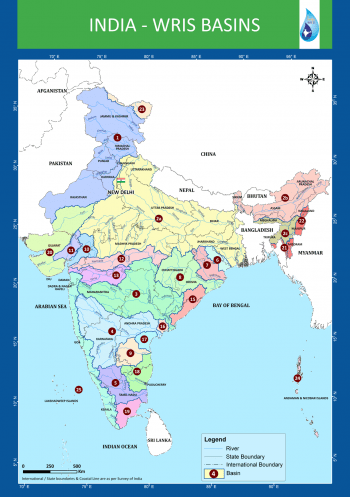
India River Basins Map (Source – WRIS)
There’s more to a river There is no information in basin reports on the regulating or statutory bodies that have a say in the basin in the report. However, some information on the existing organisations and inter-state agreements at the various basin level is given at another WRIS location.[viii]
The Basin reports for 20 basins are clearly an asset for understanding and analysing water resource situation. However, there is no mention of the numerous ecological, social and environmental services these rivers provide us with. The demographic details of the basin are available, but there is no information on the flora and fauna, who also need and thrive on the river waters. A good navigation tool for water resource information and river management projects at basin level, nevertheless, for a broader and more comprehensive outlook these reports should have included the following essential aspects too:
River status: The present water quality & pollution level of the major rivers as well as their tributaries
River governance: The local committees, civil bodies and institutions that play a role in river basin development
River safety measures: Effect of the existing and planned river management projects on the state of the river, people and society.
River ecology: Status of biodiversity, and other ecological aspects of the rivers
By law, rivers in India belong to the government, however, government has no particular agency that governs our rivers. Our constitution or law does not provide any direct protection to rivers. A large number of entities at centre and state level take decisions that affect our rivers but they do not even seem aware of such impacts. That the decisions and working of a large number of agencies affect the rivers is expected considering the landscape level existence of rivers and society’s wide ranging needs for water and other services provided by the rivers. But the complete neglect of the rivers is certainly not expected. More importantly, people seem to have no role in governance of our rivers! There seems to be neither an understanding nor a recognition that lives and livelihoods of so many people depend on rivers. Nor an understanding as to what is a river and what are its role in the ecosystem, in current and future well being of the society. These blindspots about our understanding of rivers get reflected in our governance of rivers.
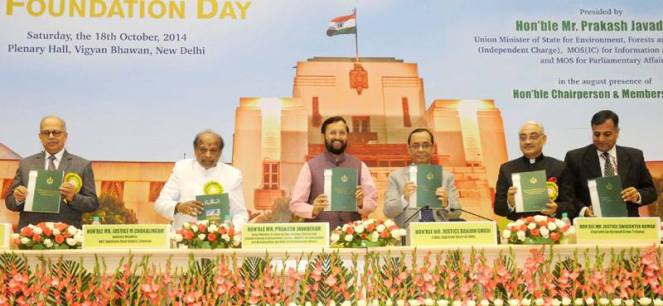
Environment Minister Prakash Javdekar at NGT Foundation Function on Oct 18, 2014 (Source: FB page of Information and Broadcasting Ministry)
India remains an agrarian country, and our water use practices have prioritised use of water for irrigation. Archaic water laws during the British rule looked at water as a resource to be exploited under the jurisdiction of the government. The 1873 Northern India Canal and Drainage Act, stated ‘use and control for public purposes the water of all rivers and streams flowing in natural channels’ as a right of the Government, without any credible and democratic way of deciding what is public purpose.[1] In the same vein the Madhya Pradesh Irrigation Act of 1931 asserted direct state control over water, which find an echo even today in the Bihar Irrigation Act, of 1997 that stresses that all rights in surface water vest with the Government.[2] In fact post colonial water governance did not see any break from the past and essentially the same paradigm prevalant during colonial times continued after independence.
Water in India, as per our constitution is a state (government) subject, and by the same logic water laws in the country too are mostly state based. Thus the state has the constitutional power to make laws, to implement & regulate water supplies, irrigation and canals, drainage and embankments, water storage & hydropower. However, there is nothing in the constitution or law that shows an understanding of what is a river, what services it provides or if there is anything worth conserving in rivers. There is no legal protection for rivers in India.
Moreover as most of the rivers flow through more than one states, the rivers become cause of major interstate disputes when they are seen as sites of big dams. Smaller projects are rarely the reason for intractable interstate disputes. Unfortunately, in post-indepednence India, politicians love big dams and they are seen as most important, if not the only saleable development projects.
The centre can intervene for any interstate differences by constituting a Water Dispute Tribunal for the mediation of the water dispute, but only if invited to do so by the state government. It is within the Central Government powers to regulate and develop inter-State rivers under entry 56 of the constitution, but these powers are rarely used. Entry 56 reads: “Regulation and development of inter-State rivers and river valleys to the extent to which such regulation and development under the control of the Union is declared by Parliament by law to be expedient in the public interest.”
Instead many different regulatory mechanisms have been harnessed and committees formed under various ministries for water management in inter state river basins.
Let’s take a tour of the various agencies involved in governance of rivers in India.
AT THE CENTRE:
Ministry for Water Resources, River Development and Ganga Rejuvenation
It is the apex body[3] at the union level responsible for the country’s water resources and its functions from the river perspective are:
Rejuvenation of Ganga River and also National Ganga River Basin Authority
To resolve differences relating to inter-state rivers
To oversee implementation of inter-state projects occasionally
To manage, monitor and sanction funds for centrally funded schemes like Accelerated Irrigation Benefits Program, Command Area Development, Rehabilitation of Water Bodies, Bharat Nirman, etc.
Operation of central network for flood forecasting and warning on inter-state rivers (CWC task)
Preparation of flood control master plans for the Ganga and the Brahmaputra
Talks and negotiations on river waters with neighbouring countries
Operation of the Indus Water Treaty with Pakistan, Ganga Water Treaty with Bangladesh, Mahakali, Kosi, Gandak and other treaties with Nepal, Water Cooperation with Bhutan, Exchange of Data with China under MoU, etc.
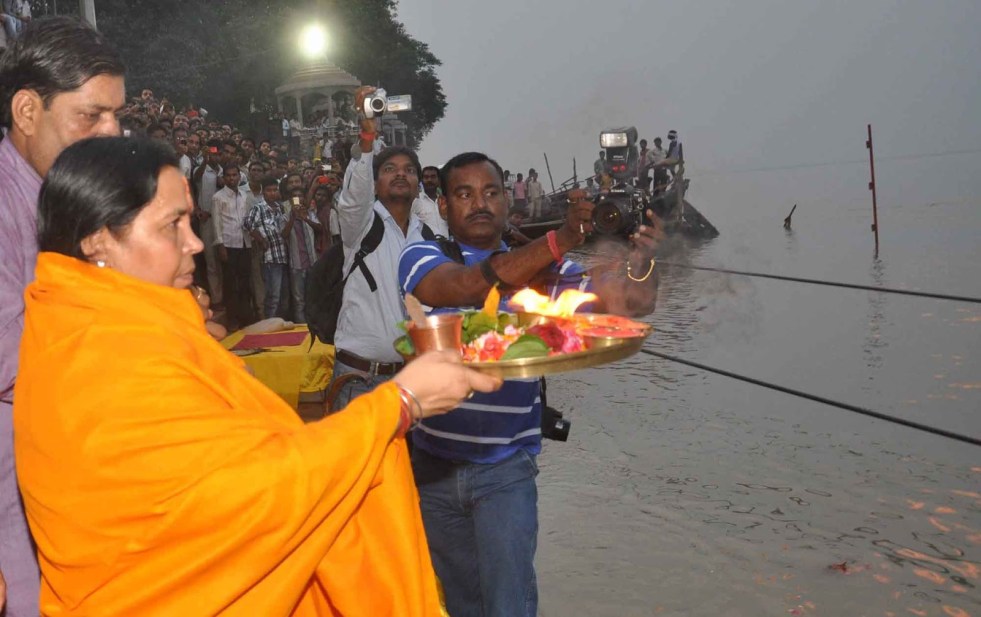
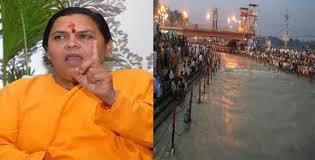
Sushri Uma Bharati, the current Minister, Ministry of Water Resources, River Development and Ganga Rejuvenation. Photo from : Jagran Post
There are a plethora of offices/bodies under the water resource ministry, who work under their control. These include the following:
Central Water Commission (CWC) Supposed to be a premier Technical Organization, the CWC[4] is responsible for schemes for control, conservation and utilization of all water resources for various purposes, which includes flood control & irrigation, and overall planning& development of river basins. It also monitors the river water quality at 396 stations located in all the major river basins of India.[5] It is also responsible for co-ordination with states for establishing River Basin Organisations [6], like
This gives a misleading picture that for practically every river basin there is a basin organisation. In reality, review of CWC annual reports show that there is hardly any activity of these organisations, they in any case do not work to protect the rivers.
A multidisciplinary scientific organization for the scientific & sustainable development and management of India’s ground water resources. A Central Ground Water Authority has been in 1996 through a Supreme Court order with powers under Environment Protection Act, 1986. On the face of it, CGWB and CGWA may not have any direct role in governance of rivers, the fact is they have a huge role. Firstly, destruction of rivers mean that the groundwater recharge that happens by flowing rivers would stop. CGWB and CGWA should be concerned about this, but have shown no such concern. Secondly, when there is over exploitation of groundwater, it has impact on flow of downstream rivers, particularly in lean season and in low rainfall areas.
Central Water and Power Research Station (CWPRS): A principal central agency that provides R&D, and deals with research, services and support pertaining to projects on water resources, energy & water borne transport including those related to rivers.
Central Soil and Materials Research Station (CMRS): It deals with field explorations, laboratory investigations and research in the field of geotechnical engineering and civil engineering materials, particularly for construction of river valley projects and safety evaluation of existing dams.
Set up in 1981-82, the main task of this organisation is to do studies related to inter-linking of rivers. In that sense, it is an anti-river organisation! An autonomous society, some of NWDA’s[8] river related functions include to:
Carry out detailed surveys about the quantum of water that can be transferred to other basins/States
Prepare feasibility report of the various components of the scheme relating to Peninsular Rivers development and Himalayan Rivers development
Prepare detailed project report of river link proposals
Prepare pre-feasibility/feasibility report of the intra-state links
NWDA has not been confident enough to put any of its work in public domain. Some feasibility reports are out following repeated Supreme Court orders in 2002. A perusal of some of these studies shows that it has no concern for the rivers or the services provided by the rivers. It sees all water flowing to the sea as a waste! Which means rivers are a wasteful resource! In its environment impact assessments or in its cost benefit analysis there is no accounting of the services of rivers that would be destroyed if the proposed project go ahead!
National Institute of Hydrology (NIH)
A “premier” Institute in the area of hydrology and water resources, it aids, promotes & coordinates work in the field of hydrology and water resources development.[9] However, it is not known to stand up or speak up for rivers. Its classification of rivers, as mentioned in an earlier blog[10], leaves a lot to be desired. The non participatory tendencies of NIH was apparent in the way it organised a workshop on Environment Flows in Oct 2013[11]. NIH did not find it necessary to invite even the Union Ministry of Environment and Forests for the workshop! NIH also parterned with CIFRI for a flawed assessment of e-flows for Teesta IV project, among other such studies[12].
Farakka Barrage Authority It is responsible for the operation and maintenance of the Farakka Barrage Project, (FBP), which regulate the flow of water to the Bhagirathi-Hooghly through the feeder canal to maintain navigability of the Kolkata Port.
National Water Academy Earlier known as Central Training Unit, it has been established to impart in house training to water resources personnel from government organisations. Its curriculum includes watershed management, flood forecast &management, environmental management for river valley projects and workshop on River Basin Organisations.
Technical Advisory Committee (TAC) The techno-economic appraisal of irrigation, flood control and multipurpose projects proposed by the State/ Central Governments or other organisations is done by TAC of Ministry for Water Resources, River Development and Ganga Rejuvenation, for Irrigation, Flood Control and Multipurpose Projects and thereafter make appropriate recommendation. Once found acceptable by the TAC, it is recommended for investment clearance by the Planning Commission and inclusion in the Five Year Plan/Annual Plan.[13] In the functioning of TAC, lack of transparency, participatory governance is the norm[14]. TAC has no member from outside the government, nor does it put up its agenda or minutes of the meeings in public domain. At the initiative of SANDRP, following a letter written to the government in April 2011[15], minutes of some of the TAC meetings were for the first time put up in public domain, but even that has stopped since July 2012[16].
Interstate River Basin Boards For several Inter State Basins, Boards have been set up for co-ordination and implementation and to deal with individual basins/ projects/ interstate disputes. Some of them are listed here.
Bansagar Control Board for execution of Bansagar Dam on Sone river and connected works
Betwa River Board for the execution of the Rajghat Dam Project
Upper Yamuna River Board (UYRB), which refers to the reach of Yamuna from its origin at Yamunotri to Okhla Barrage at Delhi and includes all the states in this basin.
The Brahmaputra Board: Its objective is planning & integrated implementation of measures for control of floods and bank erosion in Brahmaputra and for matters connected therewith
Narmada Control Authority (NCA): For proper implementation of the decisions & directions of the Narmada Water Disputes Tribunal. There are number of supporting statutory mechanisms: Environment Sub Group of NCA, Rehabilitation Sub Group of NCA, Review Committee of NCA and Sardar Sarovar Construction Advisory Committee.
The Tungabhadra Board: Regulates water for irrigation, hydro-power generation and other uses from the Tungabhadra reservoir
Ganga Flood Conrol Commission has been set up for specific tasks related to floods in the Ganga basin, including coordination with upstream Nepal.
Public Sector Enterprises under Union Ministry of Water Resources:
Water and Power Consultancy Services (WAPCOS) Limited: Provides consultancy services in Water Resources, Power and Infrastructure Sectors. The shoddy work of WAPCOS in doing environmental impact assessment and cumulative basin level impact assessment has been repeatedly highlighted by SANDRP[17]. WAPCOS is also involved in Water projects that India funds abroad including in Afghanistan, Bhutan, etc. During a recent visit to Bhutan, SANDRP heard similar complaints about shoddy EIAs and over charging by WAPCOS and also about Bhutan government having no option, but to give the work to WAPCOS, since India as a funder was dictating the terms.
National Projects Construction Corporation Limited (NPCC): Carries out infrastructure work and other related activities for development of the nation that includes dam construction
Ministry of Environment, Forest and Climate Change (MoEF & CC)
The nodal agency that plans, promotes, co-ordinates and oversees the implementation of the country’s environmental & forestry policies and programmes, its primary concern is implementation of policies and programmes relating to conserve our natural resources that includes rivers.[18]
The ministry also accords environment and forest clearance to hydropower projects and dams all over India. The Environment Clearnace is given by the ministry for hydropower projects above 50 MW and for irrigation projects with command area above 10 000 ha. For the environment appraisal of these projects, the ministry has set up Expert Appraisal Committee on River Valley and Hydropower Projects. The functioning of the ministry and EAC on this score is most shoddy, inadequate, inconsistent and far from any concern for rivers[19]. In fact if you pick up Environmental Impact Assessment of any project cleared by the EAC and the ministry, you would not find anything about the value of rivers in any of its reports.
The Forest Department (FD) under MoEF & CC governs rivers that flow through the forests. Since a huge about 23% of land of the country or about 76 million ha of land comes under this department a very large segment of India’s rivers come under the FD. However, there is no evidence of FD taking any action to protect the rivers or aquatic biodiversity. In fact we have been reading the FD proposals for diversion of forest land that come before the Forest Advisory Committee over the years and we see absolutely no concern or even recognition of the impact of such diversions on rivers or aquatic biodiversity, the FD does not even seem to acknowledge the existence of river and aquatic biodiversity.
The Wildlife Department (WLD) under MoEF & CC has powers under the Wildlife Act of 1972 to have their say whenever any activity or development project affects the aquatic life in protected areas or even flows into or out of any protected areas. However there is little evidence to show that WLD has used these powers to protect rivers, flows & aquatic life therein even as projects are well into implementation, without even taking consent of the Chief Wildlife Warden, State Board of Wildlife or National Board of Wildlife.
The MoEF & CC has been sitting for years over a proposal to notify River Regulation Zone for protection so that riverbeds and floodplains are protected.
It is well known how important are wetlands as part of the River Basins. However, the MoEF & CC has shown little genuine action to protect wetlands. Ramsar, International Convention for Protection of wetlands, includes rivers in the definition of the wetlands. India, in spite of being signatories, has excluded rivers from the definition of wetlands. The Wetlands (Conservation and Management) Rules 2010 of MoEF & CC are not helpful in protecting our wetlands. India’s wetlands, remain in peril.
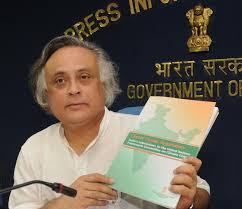
Erstwhile Environment Minister Jairam Ramesh at MoEF Photo from The Hindu
National River Conservation Directorate (NRCD) The name is misleading here, as the name suggests it works for conservation of rivers, but its only focus is pollution. So either the name is misleading or it reflects poor understanding of the government when they equate river conservation with pollution control work. It is supposed to be governed by National River Conservaion Authority, chaired by Prime Minister, but that authority has never met during the 10 years of UPA government and now almost six months of NDA government. This shows how much of a priority rivers are for the government.
Under the MoEF & CC, NRCD[20] works for conservation of rivers, lakes and wetlands through 2 central schemes:
National River Conservation Plan (NRCP) : To improve water quality of rivers through implementation of pollution abatement schemes in identified polluted stretches of rivers
National Plan for Conservation of Aquatic Eco-systems (NPCA): To conserve aquatic ecosystems (lakes and wetlands)
Central Pollution Control Board (CPCB)
A statutory organisation, under MoEF & CC, the CPCB sets standards and regulations for prevention and control of pollution. It also monitors water quality of all important water bodies located on 206 rivers of the country. CPCB, along with state pollution control boards and the whole pollution control machinery were set up following the 1974 water pollution control act. 40 years after setting up of this elaborate bureaucracy, we have not heard of a single success story where this machinery has achieved a clean river. However, there are large number of examples of its failure and the machinery being a den of corruption. The Supreme Court of India on Oct 29, 2014 said[21]: “This is an institutional failure and your story is a complete story of failure, frustration and disaster.”
National Ganga River Basin Authority (NGRBA)
Set up in 2009 through a notification under Environment Protection Act (EPA) of 1986, it’s functions include development of a Ganga River Basin Management Plan, regulation of activities aimed at prevention, control and abatement of pollution, to maintain water flow and quality and to take measures relevant to the river ecology in the Ganga basin states. So far there has been absoltely no sign of impact of functioning of this authority on the Ganga. The authority met just three times during first five years of its existence and frustated independent members twice resigned. The NDA government at the centre that took office in May 2014 reconstituted it without either public process or even public information, in fact even the earlier members did not know they have been removed!
Water Quality Assessment Authority
Established under EPA 1986 in 2001, WQAA’s[22] functions include issuing direction and taking measures on the following matters:
Investigate and carry out research on problems of water pollution
Prepare manuals, codes or guides to prevent, control and for abatement of water pollution
Direct agencies to take measures to restore water quality of the river / water bodies
Restrict water abstraction of treated sewage / trade effluent on land, rivers and other water bodies to mitigate crisis of water quality
Maintain minimum discharge for sustenance of aquatic life forms in riverine system
Utilize self-assimilation capacities at the critical river stretches to minimise cost of effluent treatment
Review the status of quality of national water resources (both surface water & ground water) and identify “Hot Spots” for taking necessary actions
It is amazing that more than 13 years after constitution of WQAA, we see no sign of its functioning either on the state of our rivers or in governance of our rivers.
Ministry of Power
MoP is primarily responsible for the development of electrical energy in the country and all matters relating to hydro-electric power (except small/mini/micro hydel projects of and below 25 MW capacity). It also deals with matters relating to these agencies:
Central Electricity Authority
CEA accords techno economic clearance to hydropower projects under Electricity Act 2003. The Section 8(2) of the Act states, “The (Central Electricity) Authority shall, before concurring in any (hydropower) scheme submitted to it under sub-section (1) have particular regard to, whether or not in its opinion,- (a) the proposed river-works will prejudice the prospects for the best ultimate development of the river or its tributaries for power generation, consistent with the requirements of drinking water, irrigation, navigation, flood-control, or other public purposes, and for this purpose the Authority shall satisfy itself, after consultation with the State Government, the Central Government, or such other agencies as it may deem appropriate, that an adequate study has been made of the optimum location of dams and other river-works”. (Emphasis added.)
This provision could have been used for the protection of rivers, since it requires the Central Electricity Authority (CEA) to give concurrence to hydro projects only after satisfying that the proposal is optimum with respect to all other uses of the rivers. Unfortunately, as the South Asia Network on Dams, Rivers and People (SANDRP) found out through applications under the Right to Information Act, while giving concurrence to hydropower schemes under this Act, the CEA consults only two organisations, namely the Geological Society of India (GSI) and the Central Water Commission (CWC). GSI and CWC evaluate the scheme from specific parameters of geology and hydrology, but do not look at basin wide issues as required under the Act. The CEA itself is not capable of ensuring basin wide optimisation that the Act requires, nor does it consult the concerned stakeholders. Thus the Act is not being followed.
The Damodar Valley Corporation
The Bhakra Beas Management Board (except matters relating to irrigation)
National Thermal Power Corporation Limited
National Hydro-electric Power Corporation Limited
North Eastern Electric Power Corporation Limited
Tehri Hydro Development Corporation
Satluj Jal Vidyut Nigam Ltd.
Power Grid Corporation of India Limited
Power Finance Corporation Limited
Centra and state electricity regulatory commissions
All of these authorities, involved in sanctioning, developing, regulating, financing and operating hydropower projects have direct impact on rivers.
Ministry of Agriculture (MoA)
Agriculture remains the biggest user of water in India. MoA is the apex body for formulation and administration of the rules,regulations and laws relating to agriculture in India, it’s portfolio also includes research on matters relating to irrigation, flood control, anti-water-logging, drainage, soil and water conservation, watershed development and anti-erosion.
This department under MoA also looks at Riverine fisheries on which more than 10 million Indians depend directly. The Department or corresponding State Fisheries Departments in respective states have absolutely no interest in welfare of rivers, despite the fact that damming and pollution is directly affecting fish yield. We looked at the way how Maharashtra Fisheries Department functions vis a vis rivers and Riverine Fisheries and we were clearly told that rivers are not a part of their jurisdiction!
Department of Agriculture And Cooperation
It focuses on sustaining the current momentum by stabilizing food grain production to ensure food security. Its water related agenda includes increased availability of irrigation water leading to increase in the irrigated area, farm productivity and crop production.
Soil and Land Use Survey of India (SLUSI), a pivotal organisation under it carries out survey and soil conservation activities for catchment of river valley projects & flood prone rivers for demarcation of watersheds.[23]
Department of Agricultural Research and Education (DARE)
It coordinates and promotes agricultural research and education.
Ministry of Rural Development
Though this nodal Ministry is mainly responsible for most of the development and welfare activities in the rural areas, water supply & sanitation schemes involve the rivers as a water source or affects rivers directly or indirectly. In some areas, projects involve rivers, as in the case of the MGNREGS (Mahatma Gandhi National Rural Employment Guarantee Scheme) in Madhya Pradesh, which was to revive a river in Khargone district, and increase surface flows.[24]
Ministry of Urban Development
The apex body for formulation and administration of the rules and regulations and laws relating to the housing and urban development, of which urban water supply & sanitation is an essential division. Increasingly, Urban areas are dependent for its water sources on rivers from farther and farther areas and they are invariably dumping mostly untreated sewage and even solid waste into the nearby rivers without any impunity[25]. Urban areas are also destroying the water bodies in the cities and encroaching on the floodplains and even riverbeds.
National Environmental Engineering Research Institute (NEERI)
NEERI conducts research and innovations in environmental science and engineering to help find solutions to environmental pollution and natural resource problems. It has 5 zonal laboratories at Chennai, Delhi, Hyderabad, Kolkata and Mumbai.[26] NEERI is also into the Environmental Impact Assessment business and some of the EIAs it has done of hydropoer projects are pretty shoddy[27].
State Level Agencies
As per India’s constitution, water remains a state subject and hence state governmnet role in the fate of rivers is also very crucial. At each state level, the involved agencies related to Rivers include the following :
Environment Department: Responsibility includes environment protection, pollution monitoring, control abatement and awareness. The department is also involved in regulating and sanctioning hydropower projects of 25-50 MW capacity and also smaller irrigation projects through State Environment Impact Assessment Agency and State Environment Appraisal Agency.
State Pollution Control Boards
SPCBs have been set up in all states under the Water Pollution Control Act of 1974. At the State level, this board is responsible for implementation of legislations relating to prevention & control of environmental pollution, and conservation of natural resources. The SPCBs are also required to give consent to establish and consent to operate for all the major projects, including dams and hydropower projects. They also conduct public hearings required under the EIA notification of Sept 2006. As mentioned earlier, we do not see a success story in functioning of any SPCB in either achieving a clean river or protection of rivers.
Water Resources (or Irrigation) Department: Aim is to regulate water resources within the State (e.g. Department of Irrigation, Government of Punjab[28]) as per State Water Policy and to facilitate & ensure judicious, equitable and sustainable management, allocation and utilization of water resources. Some special state level agencies include the Maharashtra Water Resources Regulatory Authority.[29] Besides these, there are Irrigation Development Corporations, to accelerate the completion of irrigation projects in Maharashtra State.[30] Such corporations have been set up in a number of states including Karnataka, Gujarat, among others.
Power Department: Responsible for generation, transmission, distribution and despatching of electric power supply, including hydropower, for example Energy & Power Department of Sikkim and Power & Electricity Department, Mizoram. Some states have also set up state level corporations for hydropower development (e.g. Himachal Pradesh Power Development Corporation).
Judiciary, Media, Religion, Civil Society & Society at large All these agencies also have a big role in deciding the fate of our rivers and need to play that role effectively. Unfortunately, considering the state of our rivers, we can conclude that inspite of some notable exceptions in case of all these, in general, we have not succeedded in protecting our rivers.
As far as role of political parties & leaders are concerned, we do not seem to have even any positive exceptions in terms of achieving better state of our rivers.
Some rare bright lights in this scenario, apart from community efforts at coordination, communication and governance include the WRIS (Water Resources Information System of India), a joint venture between MoWR and ISRO. The site is indeed a useful reference for information about many basins in the country (although the claimed focus is on “Water Resources” and not rivers!). It also includes Watershed Atlas, River Basin Atlas of the country and individual basin profiles which look comprehensive.
In Conclusion: Rivers are more than just a water source We have a complex network of river systems in the country. The myriad government agencies listed here majorly affect rivers, and a close co ordination and involvement between these institutions is essential to implement any river policy or project to ensure continued existence and sustenance of rivers. River management and their judicious use encompasses a whole lot of diverse characteristics and these fall under the jurisdiction of many of the above mentioned agencies, who need to work in a together in a cohesive manner. The river governance need to be democratic and communities should have a key role in informed, participatory decision making. This is certainly possible if there is a will.
Even though humans have built homes and civilisations along river banks since time immemorial, and water has been vital for life and growth, used for drinking, irrigation, transportation and energy sources, our society and governance system seem to have failed to understand the true value of our rivers. Today, these rivers that are our lifeline seem to be more often misused than used.
The fact that a large number of entities are involved in governing the fate of the rivers should not be such a problem as long as each of them is aware that their decisions are affecting the fate of the rivers and that they are involved in governing the rivers. The second major problem is that there are no river specific, legally empowered coordinating agency that will ensure that rivers continue to survive and exist in a healthy state. In effect, while the government has monoploy over rivers, it is not bothered to ensure continued and healthy existence for rivers.
We may have created these techno legal frameworks for our short sighted priorities, but what would be a first step of help for rivers is recognition of rivers, its services, need for their continued and sustained existence and legal protection for the same. A legally empowered and participatory coordination mechanism that is willing to understand and speak from the rivers perspective, for each river could also help. An agency that will understand and appreciate rivers, rather than see it as a simple linear source of water, power or transport system.
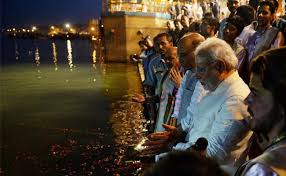
Even though the new NDA govt at the centre since May 2014 has claimed that river rejuvenation is its priority, we see that the government so far has only indulged in tokenism and symbolism. On the contrary, in terms of deeds a large of their actions are against the interest of sustained existence of rivers.
Photo from NDTV
Himanshu Thakkar, SANDRP (ht.sandrp@gmail.com), Sabita Kaushal, SANDRP (sabikaushal06@gmail.com), with inputs from Parineeta Dandekar, SANDRP (parineeta.dandekar@gmail.com)