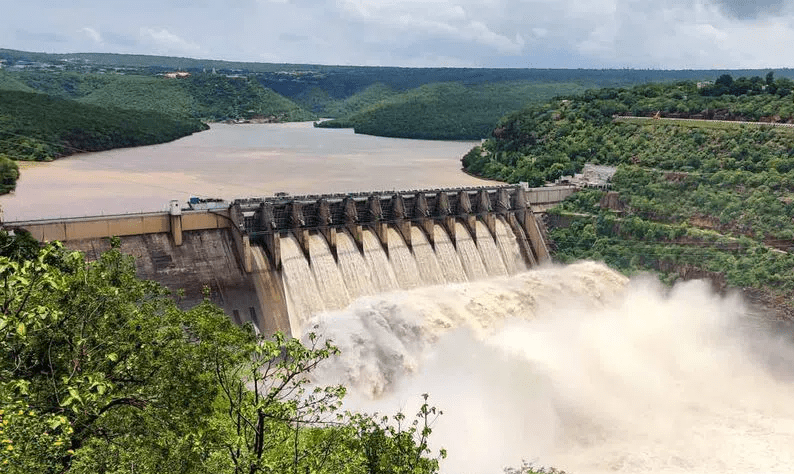
(Feature Image: Alarming situation at Srisailam Dam, says Telangana; Warns NDSA of potential catastrophe. Source: Telangana Today, Feb. 2025)
The visit of chairman of National Dam Safety Authority (NDSA) to Srisailam and Nagarjunsagar dams on Krishna River belonging to Andhra Pradesh and Telangana has brought out very worrying reports. These are two of the largest dams in India. This is symptomatic of the situation of dam safety across the country.
Srisailam dam was damaged during unprecedented floods in first week of Oct 2009 with washing away large amount of cement concrete from the apron and plunge-pool of the dam, but the repair work has still not been taken up even though there is risk to the stability of the dam. The discussion is still about source of funds and NDSA chairman has asked AP to initiate some work using AP’s own funds and get the expenses reimbursed afterwards. This is a hardly confidence inspiring situation. Any mishap on this project can start a chair reaction that can engulf all projects right upto Krishna barrage at Vijaywada.
Similarly in the context of downstream Nagarjunsagar dam that Telangana is responsible for, when the issue of dam safety was raised, Telangana tried to wash their hands off by saying that it is under CRPF control, and not their control. Telangana officials were reminded about their responsibility for the dam. This again is hardly confidence inspiring.
This situation in Andhra Pradesh and Telangana, the states that have also seen several major dam mishaps in recent years including Polavaram (AP) and Kaleshwaram (Telangana) among others, is very worrying and the approach from the NDSA chairman is also hardly confidence inspiring. We hope the situation improves soon before we face any major dam disaster in the coming monsoon.
Srisailam Project Andhra told to take up repairs immediately After going through the field level situation, the NDSA chairman asked the state govt to start the repair works immediately. He said that any delay in taking up the work will result in serious damage to the project.
The state WRD special chief secretary G Sai Prasad explained that they have submitted a proposal to the Centre for grant of Rs 284 crore under the ‘Dam Rehabilitation and Improvement Project’ (Drip) scheme for taking up repairs at the Srisailam project.
He said that the proposal was cleared by the Jal Shakti ministry and pending for final clearance from the Union finance ministry. However, NDSA chief Jain asked the state govt to start the work without waiting for the fund release from the Drip scheme. He said that there should be certain improvements in the condition before the monsoon. He said that it would not be possible to take up the work once the flow in Krishna River commenced.
He wanted that the repairs to the damaged plunge pool and apron should be taken up on a priority. He directed the state govt to complete the approach road to the apron of the project in the first phase. He had also directed the state govt to initiate work to prevent the landslide from the hillslopes abutting the Srisailam reservoir.
He also reviewed the safety measures initiated by the state govt at the other major projects in the state. NDSA identified that immediate safety measures should be taken at six projects. Jain directed the officials to take up an assessment of the projects which were considered weak and submit a report to the Centre. The state govt directed the officials to ready the proposals to invite tenders to take up some works immediately. https://timesofindia.indiatimes.com/city/vijayawada/andhra-govt-told-to-take-up-repairs-to-srisailam-reservoir-immediately/articleshowprint/120738872.cms (29 April 2025)
Use state resources to repair, AP told The irrigation department has raised concerns over the deteriorating condition of Srisailam dam, warning that if repairs are not carried out promptly, it could face a fate similar to the Medigadda barrage. The state govt has urged the National Dam Safety Authority (NDSA) to direct the Andhra Pradesh govt to address critical damage, particularly in the plunge pool area, which poses a serious risk to the dam’s stability. Telangana’s engineering-in-chief Anil Kumar met NDSA chairman Anil Jain in Hyderabad. He emphasised that repairs must be completed before the monsoon season, as the dam typically receives heavy floods from upstream areas in July.
“If the dam is breached after receiving heavy floods, it could inundate downstream areas in both Telangana and Andhra Pradesh, causing extensive damage to irrigation, power generation, and drinking water supply systems. It would also disrupt Chennai’s water supply and pose a cascading risk to Nagarjuna Sagar dam, Pulichintala dam, Prakasam barrage, and even Vijayawada,” said Anil Kumar, who also serves as chairman of the Telangana state dam safety authority. In 2009 floods, it received an unprecedented 25 lakh cusecs of water, far beyond its designed capacity of 14 lakh cusecs, which led to scouring and the formation of a large void in the plunge pool downstream of the spillway. “The inspection reports from studies conducted by the National Institute of Oceanography, commissioned by the Andhra Pradesh govt, warn that if this erosion is left unaddressed, it could pose a grave threat to the dam’s overall stability, as its maximum height stands at 143 m from the deepest foundation,” Kumar stated in a recent letter to NDSA. https://timesofindia.indiatimes.com/city/hyderabad/srisailam-woes-use-state-resources-for-repair-ap-told/articleshow/120857200.cms (03 May 2025)
Telangana urges NDSA to ensure dam safety The NDSA officials, who visited the Srisailam dam on Apr 29, reportedly assured Telangana that AP will take up the repairs, likely by filling up the plunge pool hole with tetrapods as an immediate safety measure to cut the velocity of the water when released from the dam.
The NDSA is also learnt to have told the Telangana irrigation officials to prepare emergency action plans and dam break analysis for all dams in the state, and the officials assured the NDSA that this will be done. Also discussed at the meeting was the safety of Nagarjunasagar dam with Telangana officials pointing out that the dam was not under their control as the CRPF was controlling it. However, Jain informed them as the dam belongs to Telangana, the state was responsible for taking up repairs needed to keep the dam safe. https://www.deccanchronicle.com/southern-states/telangana/telangana-urges-ndsa-to-ensure-srisailam-dam-safety-1876131 (01 May 2025)
HYDRO POWER PROJECTS
SANDRP Blog Room for optimality in Kerala summer electricity demand vs Hydro generation The share of hydroelectricity in the energy mix of Kerala has come down sharply over the last three summers from around 25-30 percent in previous summers to well below 15 percent on many days now. This is despite a sharp rise in electricity demand since 2023. SP Ravi analyses how there is a lot of room for hydro generation optimality to fulfill Kerala summer electricity demand in recent summer months including during the ongoing summer. https://sandrp.in/2025/05/03/room-for-optimality-in-kerala-summer-electricity-demand-vs-hydro-generation/ (03 May 2025)
Kerala KSEB Athirappilly power push trampling tribal rights In brazen disregard for the laws of the land and the voices of its indigenous stewards, the Kerala State Electricity Board (KSEB) has once again exhumed its long-contested proposal for the 163MW Athirappilly hydroelectric project in Chalakudy. Despite facing repeated roadblocks – legal, ecological and moral – and a definitive rejection from the tribal communities after the implementation of the Forest Rights Act, 2006, across the ecologically sensitive Vazhachal division in 2014, the KSEB appears undeterred.
-Cloaked now in the alluring guise of ‘tourism development’, the board has attempted to repackage this controversial venture as if to circumvent constitutional safeguards and public scrutiny. In a bid to sweeten the deal, the KSEB now claims that the proposed project will enhance water inflow to the Athirappilly waterfalls – promising a picture of perennial beauty even in the parched grip of summer. This appears more like a calculated charm offensive than a scientifically grounded guarantee, raising eyebrows among conservationists and tribal rights activists alike. https://english.metrovaartha.com/news/kerala/kseb-athirappilly-power-push-trampling-tribal-rights (01 May 2025)
KSEB to revive Athirappilly hydel project According to an order issued by KSEB on April 24, the Centre for Environment Architecture and Human Settlements (C-Earth) had made a presentation on the development of tourism at Malankara dam, Idukki dam and Banasurasagar dam before top officials of the board on January 17, 2025. During the meeting, a proposal was made to modify Athirappilly power project as a tourism project and to prepare a master plan for development of amenities including tribal school, tribal hamlet and primary health centre.
-The proposal was presented by the Director (Generation) before the Director Board on March 8, and the meeting of full-time directors passed a resolution on March 19 to accord sanction to remodel the Athdirappilly project. The KSEB has appointed a chief engineer to study the proposal made by C-Earth. A meeting held at the KSEB headquarters on April 28 discussed the issue.
-KSEB Chairman Biju Prabhakar, in a statement, said the KSEB is conducting a viability study on implementing the Athirappilly hydel project as the first Integrated Tourism and Power Generation Project in the state. “Based on the study, the KSEB will present the project before the Union and state governments. We are trying to explore the possibility of implementing the project by addressing the concerns raised. The aim of the study is to present the idea of implementing it through consensus with the support of all stakeholders,” he said. https://www.newindianexpress.com/states/kerala/2025/Apr/29/kseb-to-revive-athirappilly-hydel-project-2 (29 April 2025)
Tamil Nadu Sillahalla PSP in the Nilgiris put on hold Project in the Nilgiris has been put on hold, according to at least three high-level government sources. After the release of the EIA report on the project, Tamil Nadu Generation and Distribution Corp (Tangedco) started the groundwork like blasting of rocks and quarrying of earth at the project site, which falls under the Kundha taluk. “The site stability tests by blasting rocks and other activities carried out by Tangedco have been stopped,” a high-level source from the district administration said.
“The project is a public-private partnership wherein the state govt would allocate funds while the central govt would act as a regulatory authority,” the source said. “The proposed site for the hydro project has a few burial grounds and temples of tribal communities,” the source mentioned.
-The proposed hydroelectric project aims at building two dams and connecting them with a 10km tunnel. It would be developed in the middle of around 25 villages. The past months saw several protests by the villagers and environmentalists against the project. Several petitions were sent to the govt and chief minister M K Stalin by the Save Sillahalla Movement and environmentalists.
-The Tamil Nadu Pollution Control Board (TNPCB) indefinitely postponed a public hearing on the project scheduled on March 20 at EB office in Kundha. According to a source in Chennai, the hydro project, a public-private partnership, is yet to be sanctioned. The project is yet to get NOCs from various authorities like MoEF at the Centre and environment clearance at the state level, besides a NOC from the forest department. None of the procedures has taken off. A source in the forest department said, “There has been no communication seeking NOC for the project”.
-People in the Nilgiris are upset over the EIA report, which is silent on the cultural significance of the indigenous people of badagas and tribes such as todas, irulas, kotas and others who inhabit the proposed area for the hydro project. Kundah Pumped Storage Hydro Electric Project, which is underway in the Nilgiris, is likely to be operational next year. https://timesofindia.indiatimes.com/city/coimbatore/sillahalla-pumped-storage-hydroelectric-project-in-the-nilgiris-put-on-hold/articleshowprint/120730549.cms (29 April 2025)
Report CEA approval of 6 PSPs disregards ecological impacts Power and climate policy analyst Shankar Sharma has written to the Chairperson of NITI Aayog and the Prime Minister, expressing deep concerns over recent energy sector decisions. In his letter, Sharma criticized the Central Electricity Authority’s (CEA) approval of six hydro pumped storage projects (PSPs) totaling 7.5 GW in FY25, and the Principal Scientific Advisor’s advocacy for nuclear energy.
Sharma argues that the CEA’s approval of hydro PSPs demonstrates a disregard for ecological impacts, particularly in biodiversity hotspots like the Western Ghats and Himalayas. He asserts that no comprehensive public policy paper addresses the significant environmental costs associated with these projects. “It is highly unlikely that scores of such hydro pumped storage project proposals, which are all likely to be in the river valleys, have even been considered from the perspective of the huge ecological damages on the associated biodiversity and on the riverine ecology,” he stated. https://www.counterview.in/2025/05/cea-approval-of-six-hydro-pumped.html (05 May 2025)
PSP: Brainstorming session concludes The session witnessed the participation of over 300 distinguished delegates including top government officials, policymakers, developers, environmental experts, regulators, and senior representatives from the public and private sectors from near about 95 organisations and institutions from all around the country. The day-long event focused on the growing role of Pumped Storage Projects (PSPs) in supporting India’s renewable energy transition and achieving the national target of net zero emissions by 2070.
-The event featured four focused panel discussions that covered critical themes, including the “Policy, Planning, and Regulatory Framework for Pumped Storage Projects (PSPs)”, “Geological, Civil, and Material Considerations in PSP Development”, “Environmental and Forest Clearance Framework- Challenges & Streamlining”, and “Implementation Challenges & Way Forward for PSPs in India”. These discussions provided valuable insights into the complexities and opportunities within each area, fostering a productive dialogue among policymakers, developers, technical experts, and environmental professionals.
-Shri M.G. Gokhale, Member (Hydro), CEA highlighted the vast potential of Pumped Storage Projects (PSPs) in India, emphasizing their critical role in achieving the country’s Net Zero targets through reliable energy storage. He noted that, around 3 GW of PSP capacity is expected to be added in 2025-26, including the commissioning of the 1000 MW Tehri PSP in the coming months. https://pib.gov.in/PressReleseDetail.aspx?PRID=2125872®=3&lang=1 (02 May 2025) https://www.newsip.in/pumped-storage-projects-poised-to-power-indias-renewable-push-high-level-brainstorming-session-concludes-in-new-delhi/ (02 May 2025)
Sikkim Will Teesta ever speak for herself? This author had a chance to discuss these issues with the representatives of the Lepcha community following the screening of “Voices of Teesta” – a documentary, directed by Minket Lepcha, showing the struggle of the indigenous people in Sikkim against the dam construction in the Teesta River.
The screening was held at the Bangalore International Centre on February 23, 2024. Neethi Mahesh, a wildlife ecologist now focused on a river restoration project for the Cauvery in the Coorg district, was one of the panellists who was present with me. Other panellists included Mayalmit Lepcha and Winona Lepcha from Sikkim and Parineeta Dandekar from South Asia Network on Dams, Rivers and People (SANDRP). (C P Rajendran) https://www.etvbharat.com/en/!opinion/a-river-must-flow-will-teesta-ever-speak-for-herself-enn25050302787 (03 May 2025)
Arunachal Pradesh SUMP Sparks Ecological Emergency in Siang Valley The Siang Upper Multipurpose Project (SUMP) has sparked widespread unrest and resistance across Arunachal Pradesh, especially among the Adi tribal community who call this biodiverse region their ancestral home. The project threatens the ecological integrity of the Siang Valley and the survival of indigenous cultures intricately tied to this land. https://internationalnewsandviews.com/arunachal-sump-dam-threatens-tribes-forests-biodiversity-siang-valley-mega-dam-protest-adi-tribe-displacement-386191-2/ (01 May 2025)
Himachal Pradesh Baira Siul HEP: HC stays take over, issues notice on NHPC plea Himachal Pradesh high court, as an interim relief to National Hydroelectric Power Corporation (NHPC), has stayed the move of the state government to take over 180 MW Baira Siul Hydro Power Project. Commissioned in 1980-81, the project was to return to HP GOvt after 40 years. But NHPC now claims it was refurbished in 2021 and hence it should remain with it. NHPC filed a petition following HP Govt letter dated March 26. Next date of hearing May 26. https://www.hindustantimes.com/cities/chandigarh-news/baira-siul-hydro-power-project-hc-stays-take-over-issues-notice-on-nhpc-plea-101745770530624.html (27 April 2025)
DVC Deal with SJVN to meet renewable mandates The Damodar Valley Corporation (DVC) has signed power purchase agreements with state-owned SJVN Ltd to procure hydropower from two under-construction projects in Himachal Pradesh, as part of its strategy to meet renewable purchase obligations (RPOs) and manage rising industrial demand in its command area. Hydropower will be sourced from SJVN’s Sunni Dam and Luhri Stage-I projects. https://apacnewsnetwork.com/2025/04/dvc-signs-hydropower-deals-with-sjvn-to-meet-renewable-mandates/ (30 April 2025)
MoEF Agenda of EAC meeting on River Valley Projects: 1. Bhavali Pumped Storage Project (1500 MW) in 278.92 Ha in Village Kalbhonde, Kothale and Jamunde Sub Dist Shahapur and Igatpuri, DistThane and Nashik, Mah by JSW Energy PSP Two Ltd: Environmental Clearance
2. Expansion of Tembhu Lift Irrigation Project in 2284.601 ha at Village Tembhu, Ranad, Govare and etc, Sub Dist Khatav, Atpadi, Karad; Dist Satara, Sangli and Solapur, Mah – Env Clearance
3. Extension, Renovation & Modernization of Kamla Irrigation Project (CCA: 23,419 ha + 4,965.05 ha) in 26.7 Ha (additional) at Sub Dist Jainagar, Basopatti, Khajauli etc, Dist Madhubani, Bihar – Terms of Reference https://parivesh.nic.in/utildoc/125434965_1745395749800.pdf (Apr 2025)
Relevant decisions of FAC meeting held on Apr 16, 2025: 1. Proposal of HPPCL for non-forestry use of 909 ha (Original proposed 901.00 ha) of forest land for Renukaji Dam Project in Sirmour District in Himachal Pradesh: Approved change in conditions of stage I FC. https://forestsclearance.nic.in/writereaddata/FAC_Minutes/4112812012141ApprovedACMolM.pdf (May 2025)
DAMS
Kaleshwaram Project Telangana forms expert panel to examine NDSA report The Telangana government has set up a committee of five top irrigation officials to examine the National Dam Safety Authority report on Sundilla, Annaram and Medigadda barrages of the Kaleshwaram lift irrigation scheme (KLIS) and submit proposals for safeguarding the barrages. The committee will comprise the irrigation department’s engineers-in-chief, general and operations & and maintenance, chief engineers of Ramagundam, Central Designs Organisation, and quality control. In a memo on April 30, the principal secretary, irrigation, Rahul Bojja, announcing the formation of the group, said it was “directed to examine the detailed (NDSA) report thoroughly.” Though no timeline has been set, the committee has been told to submit its proposals for taking “necessary measures to safeguard the structural integrity of the barrages and to protect lives and livelihood of dependent communities,” to the government for further action. https://www.deccanchronicle.com/southern-states/telangana/telangana-forms-expert-panel-to-examine-ndsa-report-on-kaleshwaram-barrages-1876518 (02 May 2025)
‘Medigadda collapse biggest man-made disaster in India’ Irrigation minister N Uttam Kumar Reddy on Apr 29 described the collapse of block 7 of the Medigadda barrage as “the biggest man-made disaster since Independence” and “the most expensive engineering failure by any state govt in India.” Citing the National Dam Safety Authority (NDSA) report, the minister accused the previous BRS regime of systemic failures—from flawed design to financial mismanagement—throughout the project. https://timesofindia.indiatimes.com/city/hyderabad/medigadda-collapse-biggest-man-made-disaster-in-india/articleshowprint/120740313.cms (29 April 2025)
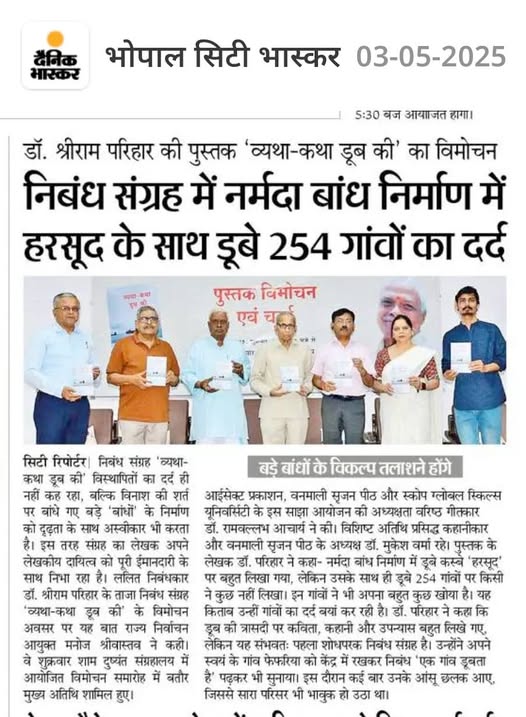
Madhya Pradesh This essay collection narrates the sad stories of displacement due to Indira Sagar Dam. Bhaskar May 3 2025 https://www.facebook.com/share/p/1DNsmegDYk/
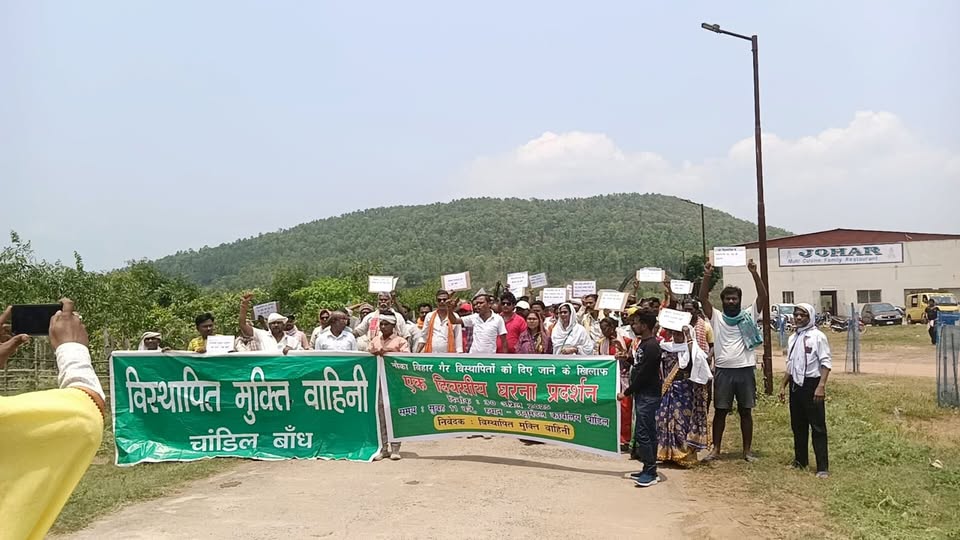
Jharkhand One day protest against the displacement due to the Chandil Dam in Jharkhand on Apr 30 2025. https://www.facebook.com/share/p/1BTUE5WDxE/
Odisha WB team holds discussion on dam safety with govt The team also appreciated the state’s initiative in preparing emergency action plans (EAPs) for 25 dams. They emphasised the importance of integrating the EAPs into the state disaster management plan. Initially, the EAP will be implemented on a pilot basis in one or two districts, followed by expansion to all districts across the state. “Odisha’s initiative is expected to serve as a model for other states in the country,” said Singh. A budgetary provision of Rs 200 crore has been made for the scheme, which aims at rehabilitating other distressed dams within the state, further strengthening dam safety and resilience. https://www.newindianexpress.com/states/odisha/2025/May/03/world-bank-team-holds-discussion-on-dam-safety-with-odisha-government (03 May 2025)
INTERLINKING OF RIVERS
Ken-Betwa Link The Wednesdays.for.Water session on, ‘The decision-making process of the Ken- Betwa Link Project’, focus is on the nuances of the policy and the decision-making process, including the local people’s perspective, that were involved to arrive to the commencement of the project.
The speakers of the session are Himanshu Thakkar (of SANDRP) and Nikita D’cruz. The session provides an understanding of the geopolitical-social-ecological aspects that shape and impact and will do so to the future of the linking rivers and the served population in India. https://www.youtube.com/watch?v=TxKnf9zza98&t=1538s (04 May 2025)
Shocking statement from UP’s Jal Shakti Minister, saying Bundelkhand is prosperous due to Ken Betwa Project!: Jal Shakti minister Swatantra Dev Singh said rivers are the foundation of prosperity and several projects are being implemented to check pollution and improve their flow. “Through the Ken Betwa River Link project, there is prosperity in Bundelkhand now. Though the third world war will be for water, but with PM Modi and CM Yogi at the helm of affairs, India and UP will remain unaffected,” Singh said. https://timesofindia.indiatimes.com/city/lucknow/rivers-are-foundation-of-prosperity-minister-swatantra-dev-singh/articleshowprint/120708124.cms (29 April 2025)
INTERSTATE WATER DISPUTES
BBMB Punjab police deployed at Bhakra, Nangal dams Amid an escalating water war between Punjab and Haryana, the Punjab Police have taken control of the regulator gates at the Bhakra Nangal dam and have deployed its personnel there. The incident comes despite the Union Home Secretary Govind Mohan asking the state government to withdraw it’s police personnel. The BBMB chairman reportedly wrote of a letter to the Ministry of Home Affairs (MHA) to deploy Central Industrial Security Force (CISF) personnel to guard the dam.
Sources claimed that approximately two dozen police personnel are presently deployed at the dam, and two DSP rank officers have been stationed there. A tent has been pitched by the local cadre of AAP on the side of the canal as they are holding an indefinite dharna against the BBMB. Before the controversy, only five police personnel were deployed. Sources further said that the police personnel were deployed at the Nagal Dam on May 1 as CM Bhagwant Mann visited the dam. https://www.newindianexpress.com/nation/2025/May/04/punjab-police-deployed-at-bhakra-nangal-dam-despite-union-home-secretary-asking-to-withdraw-force (04 May 2025)
Punjab boycotts BBMB meeting Punjab government officials will not attend a meeting of the BBMB being convened on Saturday (May 03) to decide on additional 4,500 cusecs of water to be given to Haryana, because it was called without following a seven-day notice rule. An official source told The Indian Express that the government had written to BBMB that the meeting should be postponed. https://indianexpress.com/article/cities/chandigarh/punjab-boycotts-bbmb-meeting-water-haryana-notice-rule-9980886/ (03 May 2025)
‘Never had surplus water after ‘unjust’ Indus treaty’ Political parties on Friday (May 03) contended that the Centre had “wrongfully” shared Punjab waters with neighbouring states, from where the three rivers didn’t flow, as it felt that the state had surplus supply despite an “unjust” Indus Waters Treaty.
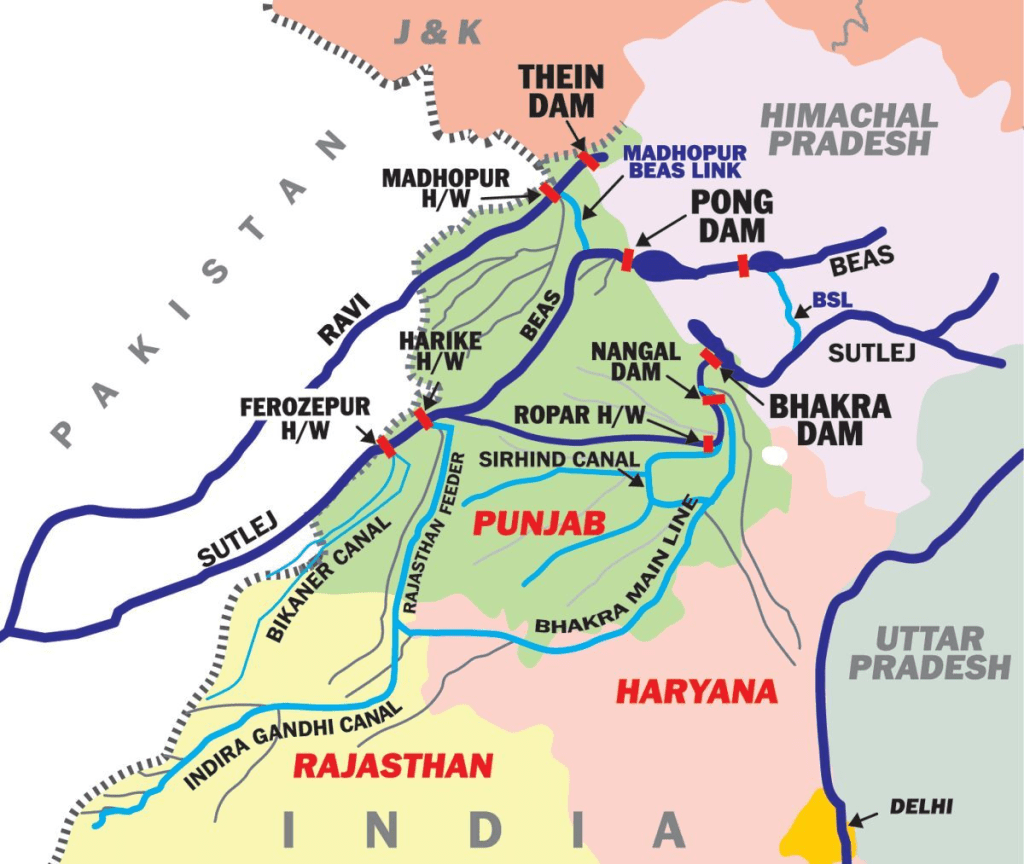
The views were shared during an all-party meeting chaired by CM Bhagwant Mann to prepare a strategy to “protect” the state’s right over its river waters. https://www.tribuneindia.com/news/punjab/never-had-surplus-water-after-unjust-indus-treaty-say-parties/ (03 May 2025)
BJP navigates treacherous waters BJP insiders said Punjab had released excess water to Haryana in the last three years as well after Haryana exhausted its allocated share, and the same water flowed towards Delhi. “During those years, Delhi also had an AAP government and the AAP did not politicise the issue. However, now that the BJP rules Delhi, the Punjab CM has suddenly taken a stand for the state,” said a senior BJP leader. https://indianexpress.com/article/political-pulse/in-punjab-haryana-delhi-wars-bjp-navigates-treacherous-waters-9979617/ (03 May 2025)
2 states, 2 dams & a political slugfest The ongoing water sharing dispute between Punjab and Haryana escalated Thursday (May 01) when workers of Punjab’s ruling Aam Aadmi Party (AAP) led by cabinet minister Harjot Bains “took control” of the regulatory room at Nangal dam in the state to stop the flow of water from the Bhakra-Nangal dam system to neighbouring Haryana.
-Nangal dam is located in Ropar in Punjab on the border with Himachal Pradesh, downstream from the Bhakra dam which is in Himachal Pradesh. The two dams together form the Bhakra-Nangal dam system that stores and distributes the water of Satluj river.
The physical takeover of the Nangal dam—which is controlled by the centrally-run Bhakra Beas Management Board (BBMB) that regulates the distribution of water to Punjab, Haryana, Himachal Pradesh, Rajasthan and Delhi—was meant to protest against the board’s decision to give additional water to Haryana from what Punjab claims is its share. Nangal dam feeds the Bhakra main line, from which water is distributed through a network of canals downstream, including to Haryana.
Following Punjab’s “takeover” of the Nangal dam, the Haryana government raised the issue with the Centre, it is learnt. On May 2, Union Home Secretary Govind Mohan convened a meeting of the chief secretaries of Punjab, Haryana, Himachal Pradesh and Rajasthan in New Delhi to resolve the matter. https://theprint.in/statedraft/2-states-1-dam-a-political-slugfest-the-nangal-water-sharing-dispute-between-punjab-haryana/2612232/ (02 May 2025)
Centre calls meeting of BBMB partner states As the Punjab Govt on May 1 refused to release additional water to Haryana from the Bhakra dam, Union Home Secretary Govind Mohan convened an emergency meeting of the Chief Secretaries of Bhakra Beas Management Board partner states in Delhi at 11 am on May 2.
Interestingly, several farmer unions also said they would protest any move to allocate additional water to Haryana. While the BBMB had last night ordered Punjab to immediately release more water, the Punjab Government, which places indent for the release of water to the Director of Water Regulation, refused to do so, citing the regulation manual of the Bhakra dam, said sources.
Though the BBMB replaced the Punjab-cadre Director of Water Regulation with the Haryana-cadre officer, water could not be released because of a technical glitch. Sanjeev Kumar had to give his joining report to Chief Engineer Charanpreet Singh in Nangal. He, however, joined at the BBMB office in Chandigarh. On this ground, Charanpreet refused to abide by his orders to release water and he also did not relieve Akashdeep. https://www.tribuneindia.com/news/punjab/centre-calls-meeting-of-bbmb-partner-states-as-punjab-refuses-water-to-haryana/ (02 May 2025)
Centre directs Punjab to release 4,500 cusecs of water The Centre directed the Punjab Government to implement the BBMB decision to release an additional 4,500 cusecs of water from Bhakra dam to Haryana for the next eight days to meet its urgent water requirements. This decision was made during a high-level meeting led by Union Home Secretary Govind Mohan, attended by top officials from the four partner states of BBMB — Punjab, Haryana, Himachal Pradesh, and Rajasthan — as well as BBMB representatives.
-It was also agreed that during the dam-filling period, BBMB would provide excess water to Punjab to fulfil any additional requirements, according to official sources. The meeting was necessitated after Punjab had consistently refused to release water to Haryana, prompting the Centre’s intervention. https://www.tribuneindia.com/news/haryana/centre-directs-punjab-to-release-4500-cusecs-of-water-to-haryana-for-next-8-days/ (02 May 2025)
AAP calls special assembly session on May 5 With the dispute over sharing additional water with Haryana escalating, CM Bhagwant Mann on Thursday (April 29) convened an all-party meeting at 10am on Friday (May 02) and a special session of the Punjab assembly on May 5. The state govt will bring a special resolution on the water issue during the special session. The CM also gave a clarion call to all parties to unite and fight for safeguarding the interests of Punjab and Punjabis. Representatives of all prominent political parties of the state will be invited. https://timesofindia.indiatimes.com/city/chandigarh/aap-calls-special-assembly-session-on-may-5-all-party-meet-on-water-dispute-today/articleshowprint/120802755.cms (02 May 2025)
BBMB water release order sparks controversy Interestingly, the transfer orders of the two officers who have swapped places mention that the transfer is being made at the request of Akashdeep Singh. The latter has now also sent a letter to BBMB denying having made any such request.
Even as the Punjab government has started exploring its legal options, the Chief Engineer of Punjab has written a letter to BBMB stating that the newly posted Director of Water Regulation, Sanjeev Kumar, has experience only in dam safety and has no experience in water regulation. The state government has demanded that this transfer be revoked immediately.
Later in the day, as the AAP led the protests, BBMB also transferred the Secretary of the Board, Surinder Singh Mittal, who hails from Haryana. The Punjab government officials had alleged that he played a pivotal role on the issue of giving extra water to Haryana.
BBMB has now given Rajasthan engineer Balbir Singh the additional charge of Director (Security) as well as Secretary of BBMB. Similarly, Punjab engineer Rajiv Saini has been appointed OSD (Technical) to BBMB Chairman. https://www.tribuneindia.com/news/punjab/bbmb-water-release-order-to-haryana-sparks-controversy-punjab-officer-transferred/ (01 May 2025)
More Bhakra water for Hry, Punjab fumes The BBMB has decided to release 8,500 cusecs water to Haryana from the Bhakra Dam with immediate effect. The decision was taken at a meeting of the technical panel of the board, presided over by BBMB Chairman Manoj Tripathi.
Although the Punjab Government objected to the decision, stating there was no surplus water to spare for Haryana, it found itself cornered as the three BJP-ruled partner states in the BBMB (Haryana, Rajasthan and Delhi) reportedly joined hands to press for the demand. Congress-ruled Himachal Pradesh, the other partner state, remained neutral.
Sources in the BBMB said the additional water was being released to Haryana on “humanitarian grounds” to meet its drinking water and domestic needs. Haryana has been claiming a severe water shortage, particularly in Hisar, Sirsa, and Fatehabad districts.
Officials from the Punjab Government reportedly stated at the meeting that the water level in the Pong Dam was 31.87 per cent lower than last year, while the Ranjit Sagar Dam saw a 16.90 per cent dip. Even in the Bhakra Dam, the water level was over 10 per cent lower compared to last year. They warned that releasing additional water to Haryana would reduce Bhakra’s water level by 15 ft before the monsoon arrives. With maintenance work ongoing at the Pong Dam, Punjab would have to rely more on Bhakra Dam water or extract additional groundwater to meet demand during the paddy season, they said.
-Punjab officials, led by Principal Secretary Krishan Kumar, also raised concerns that the Bhakra Dam regulation manual required Punjab to first place an indent to Bhakra Dam officials for releasing additional water. In response, the officials decided to waive this provision as a special exception this time. https://www.tribuneindia.com/news/punjab/more-bhakra-water-for-hry-punjab-fumes/ (01 May 2025)
EDIT Share, not fight over, the rivers Water is an emotional issue in Punjab and Haryana since these rain-deficit states are dependent on agriculture, and ironically, paddy and wheat. Both states make up the spine of India’s food security program, but the larger question is whether these water-intensive crops should be promoted in Punjab and Haryana (In Punjab, paddy is cultivated over 3 million hectares and Haryana grows the crop over 1.6 million hectares). Both states are witnessing a drop in subsoil water levels, increasing the dependence on canal water. While the immediate goal is to lower inter-state tensions, the need to plan for long-term contingencies should not be forgotten. https://www.hindustantimes.com/editorials/share-not-fight-over-the-rivers-101746201049365.html (02 May 2025)
RIVERS AS NATIONAL WATERWAYS
GANGA Bihar MP seeks probe dredging ‘scam’, Accuses IWAI official of favoritism Rajesh Verma, a Lok Sabha MP from the Lok Janshakti Party (Ram Vilas), a key constituent of the ruling NDA alliance, has levelled serious allegations against Sunil Kumar Singh, the Vice Chairman of the Inland Waterways Authority of India (IWAI). In a letter to the Prime Minister’s Office (PMO) and the Central Vigilance Commission (CVC), Verma has demanded a thorough investigation into what he describes as a clear case of favoritism and irregularities in the awarding of dredging contracts for the Ganga River.
According to Verma, a Mumbai-based firm – Knowledge Marine & Engineering Works Ltd – received preferential treatment in multiple tenders related to the Ganga dredging project. He claimed that the company was awarded the contract for the sensitive flood-prone Digha stretch of the river but failed to deploy the required dredgers on time. While other contractors were penalized for delays, Knowledge Marine was allegedly spared any show-cause notice, reportedly due to Singh’s intervention.
Verma further alleged that the same company was paid for work in another section of the Ganga despite not deploying the necessary equipment on-site, in violation of contract conditions. He pointed out that while Knowledge Marine held only 33% of the total dredging contracts, it received more than 60% of IWAI’s total payments — a disproportionate share that, he claims, signals financial bias. He also questioned the monitoring process, stating that Singh appointed officials who were “convenient” to the company, thus compromising transparency and accountability. https://www.timesnownews.com/india/nda-mp-seeks-probe-into-ganga-dredging-scam-accuses-iwai-official-of-favoritism-article-151525093 (28 April 2025)
URBAN RIVERS
Swaran Rekha; Gwalior HC pushes for ‘Social Audit’ in river revival PIL In a significant push to revive Gwalior’s historic Swaran Rekha river, the Madhya Pradesh High Court has emphasised the implementation of “Social Audit” and called for a panel of experts from diverse fields to oversee the river’s rejuvenation and associated urban development efforts. A division bench of the MP High Court at Gwalior, comprising Justice Anand Pathak and Justice Hirdesh, while hearing a public interest litigation (PIL), filed by Advocate Vishwajeet Ratoniya in 2019, noted that despite earlier directives, substantial progress is still lacking. Citing Sections 5(54-a) and 130-B of the Madhya Pradesh Municipal Corporation Act, 1956, the court emphasised the need for civic engagement through the “Social Audit” model, allowing residents to assess urban development policies and their effectiveness. Next hearing on May 7 2025.
“The river once flowed freely in its natural, unpaved form, allowing continuous water movement and playing a crucial role in recharging the city’s groundwater,” the petitioner, Ratoniya, told The Sun Today. “But ever since the riverbed was cemented, this natural recharge process has been disrupted. Rainwater now simply runs off without seeping into the ground, causing a gradual yet alarming drop in Gwalior’s water table,” he said.
The court proposed forming a panel of professionals — retired professors, engineers, administrators, judges, and doctors — to serve as independent ‘social auditors’. These individuals must be “men of integrity” and work without “fear or favour,” the court added, stressing their role as crucial in guiding urban policy. https://www.thesuntoday.in/madhya-pradesh-high-court-pushes-for-social-audit-in-gwalior-swarn-rekha-river-revival-pil-seeks-expert-panel/ (4 May 2025)
Mula-Mutha; Pune RFD or Ruin? ₹5,000 Cr gamble faces growing backlash What began as a vision for beautification has become a battleground between development and ecology. The Riverfront Development (RFD) project, proposed in 2016 and launched in 2022, now faces an ever-expanding chorus of environmentalists, citizens, and experts raising the alarm. With the cost ballooning to Rs 5000 cr, critics argue the project is financially unsound & ecologically disastrous.
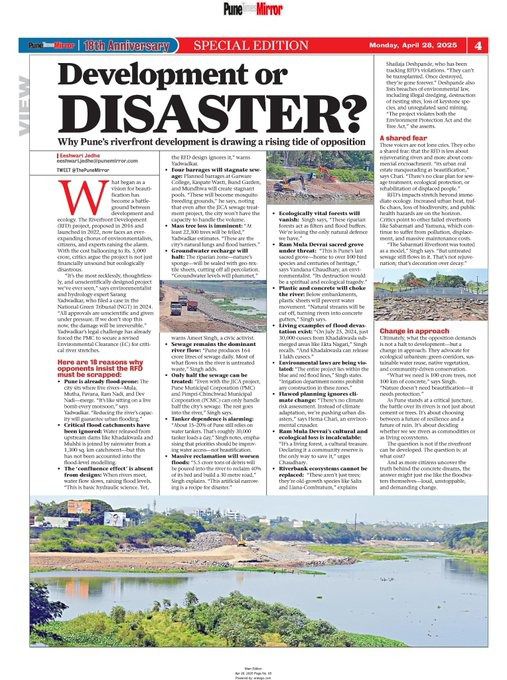
“It’s the most recklessly, thoughtlessly, and unscientifically designed project we’ve ever seen,” says environmentalist and hydrology expert Sarang Yadwadkar, who filed a case in the National Green Tribunal (NGT) in 2024. “All approvals are unscientific and given under pressure. If we don’t stop this now, the damage will be irreversible.” Yadwadkar’s legal challenge has already forced the PMC to secure a revised Environmental Clearance (EC) for critical river stretches. Here are 18 reasons why opponents insist the RFD must be scrapped. https://punemirror.com/pune/civic/riverfront-or-ruin-pune-s-rs-5-000-crore-gamble-faces-growing-backlash/cid1745928267.htm (29 April 2025)
Wildlife warden seeks halt on RFD The honorary wildlife warden of Pune district, Aditya Paranjape, on Ap 29 urged the Pimpri Chinchwad municipal commissioner to halt all development work on the Mula riverbank opposite Ramnadi-Mula confluence because of the harm it inflicted on wildlife. Paranjape, in his letter, stated that the development work as part of the Mula-Mutha riverfront development project is leading to significant tree felling and disturbance to wildlife in the area. This was in reference to the grievance raised by citizen Vandana Chaudhary to declare the region as a community reserve, which prompted Centre to seek a report from the state forest dept.
Based on complaints received from local citizens and the warden’s observations, it was concluded that there were multiple endangered species of animals and other forms of wildlife in the area that are likely to be affected by the encroachments on the river, he said. “In light of these findings, we urge you to immediately stop the encroachment in the Mula river where the current work is ongoing. We also request that the encroachments be removed to restore the wildlife. We await a formal ‘action-taken report’ as per the directions of the ministry of environment, forest and climate change,” the letter said. https://timesofindia.indiatimes.com/city/pune/pune-districts-wildlife-warden-seeks-halt-on-riverfront-development-project-at-mula/articleshowprint/120741322.cms (30 April 2025)
Stop RFD work immediately: Anna Bansode Deputy Speaker Anna Bansode visited the protest site, discussed the issue with environmentalists, and inspected the riverbed. He stated that the illegal tree felling under the guise of the river front development project is wrong and that the riverbed is being narrowed due to the filling of earth. Consequently, Bansode instructed the Pune and Pimpri-Chinchwad Municipal Commissioners to immediately stop the river improvement project work. Bansode assured that an inquiry into the matter would be conducted, and discussions would be held with the CM and Deputy CMs before making a decision on the river front development project. https://www.punekarnews.in/stop-river-improvement-project-work-immediately-anna-bansode-to-pune-and-pcmc-municipal-commissioners/ (April 2024)
Citizens’ movement gains momentum Prajkta Mahajan of the Pune River Revival group said the protest was a culmination of month-long citizen efforts. “We met multiple leaders, submitted memoranda, and held chain protests across the city. Around 3,000 people gathered demanding a complete halt to tree cutting, untreated sewage discharge, and riverbank destruction. The public response has been overwhelming, and we will continue our fight,” she said. https://www.hindustantimes.com/cities/pune-news/pune-citizens-movement-against-rfd-gains-momentum-amid-pmc-pcmc-talks-of-revising-plan-101745779948292.html (28 April 2025)
Short march with a loud message The message, “Stop the Riverfront Development”, went out to the PMC and PCMC in multiple ways on Apr 27 morning from a protest march, Nadi Sathi Nadi Kathi. Marchers inked “Stop RFD” on cheeks, screamed it from banners, sang it, chanted it, and even presented a skit on it. Regular citizens, representatives of environmental groups, children, and political figures marched shoulder to shoulder from Shahid Ashok Kamthe, a Pimpri-Chinchwad Municipal Corporation (PCMC) park, to the Mula riverside near Dada Ghat Shamshan Bhumi in Pimple Nilakh under a blazing morning sun to make a point. https://indianexpress.com/article/cities/pune/protest-against-riverfront-development-project-in-pimpri-chinchwad-9968548/ (27 April 2025)
Pune PCMC commissioner vows to continue work on RFD project despite protests “The RFD will not be stopped. Work is ongoing, and there is no immediate reason to halt it. The project has received clearance from the NGT, and the Bombay High Court has dismissed the petition by environmentalists,” municipal commissioner Shekhar Singh said while addressing the media on Monday (April 28). https://www.hindustantimes.com/cities/pune-news/pcmc-commissioner-vows-to-continue-work-on-rfd-project-despite-protests-101745866258078.html (29 April 2025)
Students learn about river conservation How much water does the mobile phone consume? Can swapping toothpaste with other alternatives make a difference in reducing river toxins? And what’s the history of Mula-Mutha rivers that we cross daily in the city? These thought-provoking questions are at the heart of river curriculum project — a hands-on educational initiative by Jeevitnadi Living River Foundation.
Since 2023, this non-profit programme has been running in three local schools, with plans to expand to four more in the upcoming academic year. Students in grades VI-VIII explore the history and health of local rivers, the human impact on these ecosystems, and what we can do as urban citizens to protect them. The year-long project culminates in students adopting a 500-metre stretch of river for another year, where they clean the banks, map the trees, study the fragile ecosystem, and test the water quality — all while learning to become better guardians of their environment. https://timesofindia.indiatimes.com/city/pune/students-learn-about-river-conservation-through-hands-on-project-in-schools/articleshow/120833893.cms (3 May 2025)
Indrayani Activists Unite to Protect Indrayani River Following protests along the Mula River, environmental activists are now turning their attention to the Indrayani River. In opposition to river beautification projects under the guise of the River Improvement Project, a human chain protest is being organised on the banks of the Indrayani River on Sunday, May 4 from 8 to 10 am. The event aims to raise awareness about pollution and protest the degradation of sacred rivers with the slogan: “Let’s unite at Indrayani’s shore; for the survival of our sacred rivers.”
The PCMC has started work along the banks of the Mula River near Pimple Nilakh under its River Improvement Project. Trees along the riverbanks have been cut down, and debris has been dumped into the river, narrowing its flow. As a result, the river has become increasingly polluted. The destruction of biodiversity has also impacted the habitats of aquatic and wild animals in the region.
In response, several organisations, including the River Rejuvenation Committee of Pune and Pimpri Chinchwad, the River Protection Action Committee, and over 110 social groups, have launched a public movement. They previously held a protest march against the river project. Now, in the second phase of their campaign, these environmental groups are organising a human chain along the Indrayani River to raise public awareness and protest its ongoing pollution. The organisers have called on all city residents to join the protest and support the cause. https://punemirror.com/PCMC/activists-unite-to-protect-indrayani-river/cid1746346590.htm (04 May 2025)
Kohima Stop dumping waste in rivers Formed in Feb 2025, the Committee held its first meeting and thereafter resolved to inspect rivers in Kohima as part of its mission to promote cleanliness and environmental stewardship. “We must keep our river clean,” Kikon reiterated, calling upon all citizens to actively participate in cleaning and preserving rivers. He further appealed to residents of Kohima not to throw waste into rivers “from today onwards” and urged people not to discharge septic tank effluent directly into rivers.
Advisor for Urban Development and Municipal Affairs, Zhaleo Rio, who is also a member of the Committee, said the department will soon be undertaking four projects in Kohima under the directive of the NGT. These projects aim to intercept and divert polluted and contaminated water. “Four projects are coming up on each direction—West, East, North, South,” he said, adding that water can be treated and clean water released back into the river. For Kohima, the total project cost is estimated to be around Rs. 20 crore. Rio also mentioned that similar projects will be initiated in Dimapur and other districts across the state. https://morungexpress.com/stop-dumping-into-rivers (01 May 2025)
Itanagar 17 Tons Waste Cleared from Yagamso River YMCR and Students of Environmental Science Department, Rajiv Gandhi University came together to clean the Yagamso river at the Chandranagar stretch on May 3, 2025.
https://www.youtube.com/watch?v=b2RY_ieW0p0&t=6s (04 May 2025)
RIVERS
Interview ‘Himalayas & monsoons, creating the Indus 50 million years ago’ FASCINATING glimpses of evolution of Indus River and Himalayas from 66 million years ago to today, including story of Harappans, the Ghaggar bank communities, how Yamuna was earlier joining Sutlej and Beas some thousand years ago and how the synergy between monsoon, tectonics and mountains shaped this evolution. https://timesofindia.indiatimes.com/articleshowprint/120839615.cms (3 May 2025)
Study Global increases of salt intrusion in estuaries Abstract: In recent years, increased salt intrusion in surface waters has threatened freshwater availability in coastal regions worldwide. Yet, current future projections of salt intrusion are limited to local regions or changes to single forcing agents. Here, we quantify compounding contributions from changes in river discharge and relative sea level to changing future salt intrusion under a high-emission scenario (Shared Socioeconomic Pathway, SSP3-7.0) for 18 estuaries around the world. We find that the annual 90th percentile future salt intrusion is projected to increase between 1.3% and 18.2% (median 9.1%) in 89% of the studied estuaries worldwide. Our analysis also indicates that, on average, sea-level rise contributes approximately two times more to increasing future salt intrusion than reduced river discharge. We further show that the return levels of present-day 100-year salt intrusion events are projected to increase between 3.2% and 25.2% (median 10.2%) in 83% of the studied estuaries. https://www.nature.com/articles/s41467-025-58783-6 (15 April 2025)
Report Low snow levels in Hindu Kush region Snow mass and glaciers play a crucial role in regulating a river’s hydrological regime. The depletion of glaciers is leading to a significant decline in streamflows, especially in summer. Some scientists note that summer streamflows in some rivers increased until the mid-nineties due to increased melting, but have since reduced after reaching a tipping point. This suggests that many of the Himalayan perennial rivers are at risk of becoming seasonal in the future.
-Moreover, changes in river flow – quantity of water, the intensity of the stream, route of the flow – will drastically impact the nearby biodiversity, human activities dependent on river water and other ecological components such as soil fertility, forest cover and availability of water downstream.
-Hydro-electricity projects across the Hindu Kush Himalaya are expanding, making it one of the world’s most dam-dense regions due to its abundant water resources and ideal topography. However, disruptions in the speed, quantity and direction of streamflow could affect existing and upcoming hydroelectric projects. In this context, declining snow cover and shrinking glaciers in the HKH could severely affect renewable energy generation and pose challenges to India’s energy security goals.
-To sum up, snow remains one of the least understood components of the HKH region. It governs the stability of the region and has far-reaching global consequences. As a result, snow assessments such as the recent report by ICIMOD, play a crucial role in promoting scientific, pragmatic, evidence-backed decision-making. https://indianexpress.com/article/upsc-current-affairs/upsc-essentials/water-and-climate-security-at-risk-due-to-low-snow-levels-in-hindu-kush-9972924/ (29 April 2025)
EDIT Snow recedes, raising water worries The Hindu Kush region calls for special attention because it is ecologically sensitive and is among the first to be seriously impacted by climate change. The report suggests that apart from emissions mitigation for long-term food, water, and energy security, countries of the region should adopt science-based, forward-looking policies for basin management and go in for transboundary water governance and regional cooperation. It also suggests building micro-irrigation systems and promotion of climate-resilient crops. The ICIMOD report is another reminder of the need to take climate change more seriously than we have done till now. https://www.deccanherald.com/opinion/editorial/snow-recedes-raising-water-worries-3517005 (30 April 2025)
Yettinahole Project Centre red-flags forest law violations The regional office of the Ministry of Environment, Forest and Climate Change (MoEF&CC), Bengaluru, has flagged serious violations, unauthorised forest land use, and environmental mismanagement, by the State government with regard to implementation of Yettinahole drinking water project.
A site inspection conducted from April 7 to April 9, 2025 – by the Deputy Inspector-General of Forests, Praneetha Paul, revealed that out of 173.3 ha of forests proposed for diversion, a staggering 107.97 ha of forest land in Hassan division have already been used without mandatory clearances, in blatant violation of the Forest (Conservation) Act, 1980. The DIGF stated that the environmental clearance under Environment Protection Act, 1986, has not been obtained nor the cost-benefit ratio calculated for the project. This apart, it stated that the project implementing agency – Visvesvaraya Jala Nigam Limited – has started the construction of the canal before obtaining necessary clearances.
Shockingly, officials noted that the project had already defaulted on compliance conditions linked to an earlier diversion of 13.93 hectares in Sakleshpur taluk and had not taken any corrective actions, thus compounding the severity of the current violations. The report said that the updated information on the cumulative ecological impacts of the project on the Western Ghats, was not in place. Besides, other compliances of the monitoring committee constituted by the National Greens Tribunal and its directions dated June 23, 2023, had not been fulfilled.
The project’s alignment planning also drew flak as cost-cutting was prioritised over environmental safeguards, and out of 173.3078 hectares of forests sought to be diverted, a total of 103.53 hectares is for dumping of muck generated during construction activity, as per the report. https://www.thehindu.com/news/national/karnataka/centre-red-flags-forest-law-violations-in-yettinahole-drinking-water-project/article69497517.ece (27 April 2025)
Punjab Contaminated water crisis persists in Malwa canals While the Govt claimed the amendment was intended to simplify legal compliance and facilitate ease of doing business, environmentalists and Opposition leaders have argued that it has weakened enforcement against water pollution. They fear industries may simply “pay and continue”, causing harm to Punjab’s rivers and groundwater.
-Meanwhile, sources in the Punjab Pollution Control Board revealed that water samples have been taken twice in the past week from the canals, but the test results have not been made public yet. Officials admitted that the water appeared foul-smelling and brackish in colour. https://indianexpress.com/article/cities/chandigarh/contaminated-water-crisis-persists-in-malwa-canals-abohar-9970836/ (28 April 2025)
Why Malwa is facing polluted water crisis Canals across Ferozepur, Faridkot, Muktsar and Fazilka districts in the southwestern part of Punjab have been witnessing the inflow of contaminated water for about a month now. Residents, especially farmers, have been raising an alarm about the foul smell and polluted water. A number of waterworks in these districts have stopped using canal water and are providing underground water to consumers. However, some rural waterworks are still relying on contaminated water.
-The situation has arisen owing to contaminated water flowing into the Sirhind Feeder Canal from the Harike Barrage. The barrage is situated at the confluence of the Sutlej and Beas rivers. The Sutlej is polluted by Buddha Nullah, which flows through the industrial town of Ludhiana and carries untreated waste-water. The Beas carries comparatively cleaner water, which merges with the Sutlej at Harike. However, this time, the reduced water level in the Beas is considered to be a major reason why pollutants are more pronounced.
-The Rajasthan Feeder is currently closed, but water is still flowing through the Sirhind Feeder canal. Officials say reduced supply downstream led to stagnation of water at the Harike reservoir. As a result, pollutants and contamination have become more visible. Usually, the Sirhind Feeder is shut at the same time as the Rajasthan Feeder.
-Farmers argue that the crisis was exacerbated by the AAP government’s decision to enact the Water (Prevention and Control of Pollution) Amendment Act, 2024, in the state, “allowing industries to discharge pollutants into water bodies in exchange for financial penalties ranging from Rs 10,000 to Rs 15 lakh”. Earlier, violations under water pollution laws could lead to imprisonment for up to six years. https://www.tribuneindia.com/news/punjab/explainer-why-malwa-is-facing-polluted-water-crisis/ (29 April 2025)
Rajasthan लूनी नदी के आस–पास ट्यूबवैल खोदकर लाइनें बिछा करते हैं सप्लाई बालोतरा लूनी नदी किनारे सैकड़ों ट्यूबवैल खोदकर अंधाधुंध जलदोहन कर खेती व पेयजल का पानी अवैध रूप से फैक्ट्रियों व रिफाइनरी क्षेत्र में सप्लाई किया जा रहा है। जल माफिया का यह खेल लंबे समय से चल रहा है, मगर जिम्मेदार आंखें मूंदे बैठे हैं। बालोतरा, बीठूजा व जसोल औद्योगिक क्षेत्र में चल रही फैक्ट्रियों में प्रतिदिन करीब 55 एमएलडी (55 लाख लीटर) पानी की खपत हो रही है, वो भी अवैध तौर से जलदोहन कर सप्लाई की जा रही है। कृषि उपयोग के नाम पर एनओसी लेकर ट्यूबवैल खोदने के बाद इस पानी को व्यवसायिक तौर पर फैक्ट्रियों में बेचा जा रहा है। ऐसे में लगातार पैंदे बैठ रहे जलस्तर पर क्षेत्र के किसानों को आगामी दिनों में सूखे के हालात अब से डराने लगे हैं।
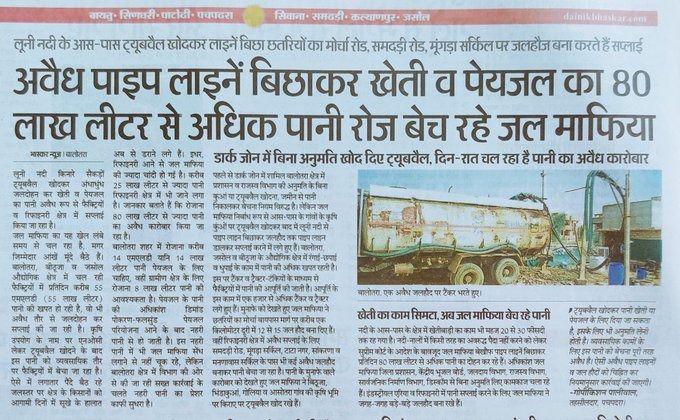
इधर, रिफाइनरी आने से जल माफिया की ज्यादा चांदी हो गई है। करीब 25 लाख लीटर से ज्यादा पानी रिफाइनरी क्षेत्र में भी जाने लगा है। जानकार बताते हैं कि रोजाना 80 लाख लीटर से ज्यादा पानी का अवैध कारोबार किया जा रहा है। बालोतरा शहर में रोजाना करीब 14 एमएलडी यानि 14 लाख लीटर पानी पेयजल के लिए चाहिए, वहीं ग्रामीण क्षेत्र के लिए रोजाना 8 लाख लीटर पानी की आवश्यकता है। पेयजल के पानी की अधिकांश डिमांड पोकरण-फलसुंड पेयजल परियोजना आने के बाद नहरी पानी से हो जाती है। इस नहरी पानी में भी जल माफिया सेंध लगाने से नहीं चूक रहे, लेकिन बालोतरा क्षेत्र में विभाग की ओर से की जा रही सख्त कार्रवाई के चलते नहरी पानी का प्रेशर काफी सुधरा है। बालोतरा. एक अवैध जलहौद पर टैंकर भरते हुए। https://www.bhaskar.com/local/rajasthan/barmer/balotra/news/tube-wells-are-dug-around-the-luni-river-and-lines-are-laid-water-supply-is-done-by-constructing-water-tanks-on-chhatriyon-ka-morcha-road-samdari-road-mungra-circle-134953548.html (03 May 2025)
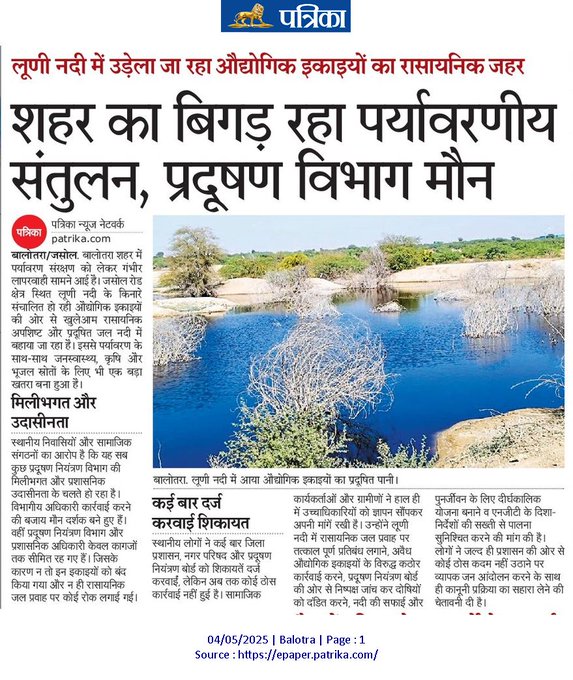
“बालोतरा में सीईटीपी, रीको और प्रशासन — ये अब विकास नहीं, विनाश का गठजोड़ बन चुके हैं!” यह कोई अकेली गलती नहीं, यह एक संगठित अपराध है। CETP (Common Effluent Treatment Plant) का काम था — गंदे रासायनिक पानी को साफ करना। लेकिन हुआ क्या? उल्टा वही ज़हर लूनी नदी में बहा दिया गया। RIICO (रीको) के अधिकारी, जो उद्योगों को नियंत्रित करने वाले थे, अब खुद प्रदूषण को संरक्षण दे रहे हैं। प्रशासन और प्रदूषण नियंत्रण बोर्ड के अधिकारी, जिनका कर्तव्य था पर्यावरण की रक्षा — वो अब इस भ्रष्ट तंत्र के रक्षक बन बैठे हैं। यह कोई लापरवाही नहीं, यह मिलीभगत है। यह सिस्टम नहीं, “सिंडिकेट” बन गया है — जिसका नुकसान किसान, पशु, और आम जनता भुगत रही है। https://x.com/BhatiSaval/status/1918905865110728961 (04 May 2025)
GANGA SANDRP Guest Blog Relevance of Ganga Mukti Andolan: Then and Now On 22-23 February, 2025, Ganga Mukti Andolan (GMA) celebrated its 43rd anniversary in Kahalgaon (Bhagalpur, Bihar). In these two days celebration, social activists from different parts of the country participated to underline the problems faced by river Ganga and the fisherfolk community of this region. Its slogan ‘Ganga ko aviral bahne do’ (let the Ganga flow freely) which united the different sections of the society to come together in the 1980s seems to be so relevant even today. For a movement to survive for four decades undoubtedly marks its relevance. However, during this long span of time, the movement has undergone several changes. But at the same time, it also marks a continuity and this essay is an attempt to understand the nuances and significance of this struggle. (Dr. Ruchi Shree) https://sandrp.in/2025/04/29/relevance-of-ganga-mukti-andolan-then-and-now/ (29 April 2025)
Bihar अगर मैं कोशी तटबंध के बीच के गांव नहीं जाता तो कोशी को नहीं समझ पाता : राहुल यादुका ब्रिटेन के लंदन विश्वविद्यालय में दक्षिण एशियाई देशों के नदी और पानी के विषय पर एक शोधार्थी के रूप में चयनित डॉ राहुल यादुका का सुपौल में कोशी नवनिर्माण मंच के कार्यकर्ताओं की पहल पर 28 अप्रैल 2025 को एक व्याख्यान आयोजित किया गया। बीएसएस कॉलेज परिसर में आयोजित इस व्याख्यान में डॉ राहुल ने कोशी से जुड़े अपने अनुभव, समझ व नजरिये को साझा किया। वे बीते कुछ सालों से कोशी व वहां के लोगों से अपने रिसर्च को लेकर गहरे जुड़े रहे हैं।
-डॉ राहुल यादुका ने अपने व्याख्यान में कहा कि जब उन्होंने कोशी को अपने शोध के विषय के रूप में चुना तो पटना के अनेक वरिष्ठ अधिकारियों ने इसे अप्रासंगिक विषय बताया, यहां तक कि कोशी क्षेत्र के अफसरों के लिए भी कोशी के भीतर के सवाल महत्वपूर्ण नहीं थे, बल्कि उनका नजरिया यह था कि सबकुछ ठीक है। डॉ राहुल ने कहा कि अगर संगठन के लोग नहीं होते तो वे भी कोशी तटबंध पर घूमकर यह निष्कर्ष निकालते कि सबकुछ ठीक है। लेकिन, वास्तविकता यह है कि कोशी तटबंध के भीतर के लाखों लोगों का जीवन और उनके सवाल अहम हैं।
-डॉ राहुल ने कहा कि सिर्फ 1954 में तटबंध बना कर उनलोगों को नदी के बीच नहीं छोड़ा गया बल्कि सुरक्षा बांध और गाइड बांध बनाकर लगातार नदी की चौड़ाई घटाई गई है, नदी का तल ऊंचा हुआ है और ग्लोबल वार्मिंग का संकट बढ़ा है। इसलिए कोशी नदी के समाधान की बात कोशी मेची नदी जोड़ परियोजनाओं के बजाय नए तरीके से तलाशनी है। वहां के लोगों के शिक्षा, स्वास्थ्य, पुनर्वास, अधिकार आदि तात्कालिक सवालों को हल करना होगा। यह तभी होगा जब तटबंध के बाहर के लोग भी संवेदना के साथ भीतर के लोगों की पीड़ा के साथ खड़ा होंगे। उन्होंने शोध के निष्कर्षों और अंतराष्ट्रीय समुदाय के बीच कोशी की स्थिति को बताते हुए क्षेत्र के लोगों और संगठन के सहयोग के लिए आभार व्यक्त किया https://climateeast.in/villages-between-the-kosi-embankments-and-there-porblems-by-rahul-yaduka/ (29 April 2025)
YAMUNA Delhi What Yamuna plan does & doesn’t In the long run, Delhi needs to find better ways to use rainwater. One of the shortcomings of the new Yamuna plan is that it does not connect the dots between rainwater harvesting and reducing the city’s dependence on the Yamuna. The plan does have a floodplain component. However, much of the focus seems to be on removing floodplain encroachments. Delhi will also have to find ways to refurbish its wetlands and catchment areas. The new plan is a beginning. Much more needs to be done. https://indianexpress.com/article/opinion/editorials/what-delhis-yamuna-plan-does-and-doesnt-9979540/ (03 May 2025)
Will develop Sabarmati like RFD: HM Union home minister Amit Shah on May 1 said Yamuna’s “purification” is of utmost importance not only for the people of Delhi and its neighbouring states but also for all Indians who worship lord Krishna and Yamuna. The Yamuna riverfront project in the national capital will be developed along the lines of the Sabarmati riverfront in Gujarat, and completed within a set timeline, he said. https://timesofindia.indiatimes.com/city/delhi/yamunas-purification-is-of-utmost-importance-shah/articleshow/120800715.cms (01 May 2025)
PWD seeks a unified RFD akin to Sabarmati The public works department (PWD) has asked the Delhi Development Authority (DDA) to integrate all 11 of its ongoing floodplain projects along the Yamuna river into a single, continuous riverfront stretch, officials said on Wednesday. The directive follows a high-level meeting last week and aligns with the Delhi government’s broader plan to replicate Gujarat’s Sabarmati riverfront model in the capital.
-The proposed stretch spans approximately 22 kilometres—from Palla in the north to Okhla in the south—and covers over 1,500 hectares owned by the DDA. Since 2021, the land has been developed under individual projects as biodiversity parks, ghats, eco-tourism sites, and heritage zones. The PWD is now pushing for a cohesive layout. https://www.hindustantimes.com/cities/delhi-news/pwd-seeks-a-unified-yamuna-riverfront-in-delhi-akin-to-sabarmati-101746038112935.html (01 May 2025)
Floodplain parks set to be interconnected: DDA The new parks along the Yamuna floodplain will be now interconnected to the cycle tracks and footpaths, DDA plans. PWD Minister Parvesh Verma said that a meeting was recently held with D officials regarding the Yamuna riverfront project during which linking all parks and public spaces for the convenience of visitors was discussed. “Currently, the DDA has developed several big parks like Bansera and Asita on the floodplain, and many other projects are coming up. But these are not connected to each other. So, the idea is that once visitors enter from one end, for example, Asita at ITO, they can access other parks on the floodplain,” said Verma.
Officials have stated that work is in progress on the development of Mayur Nature Park near the Mayur Vihar area, along with a major Yamuna Riverfront project near Sarai Kale Khan. Verma has instructed DDA officials to prepare a proposal for constructing footpaths and cycle tracks connecting these parks. “As per the guidelines, construction is not allowed on the Yamuna floodplain, so we are figuring out a way of making walkways and cycle tracks that do not violate the rules, but still the goal is achieved,” said Verma.
The DDA has been tasked with preparing a detailed project report. Recently, LG V K Saxena reviewed the progress of jute-based pathway construction at Asita Park on the Yamuna floodplain, developed by the DDA. He has directed that similar pathway be implemented along the tracks in the northern ridge, where restoration efforts recently began following his visit. https://www.indiatvnews.com/delhi/yamuna-floodplain-parks-set-to-be-interconnected-with-cycle-tracks-footpaths-dda-2025-05-01-988110 (01 May 2025)
Sonipat 113 Barhi units put on notice over effluent treatment violations The HSPCB has issued show-cause notices to 113 industrial units in HSIIDC Barhi, directing them to submit structural adequacy reports for their primary effluent treatment plants (PETPs). The reports must be prepared and vetted by government technical institutions approved by the CPCB and submitted within seven days. The action follows directions from the NGT in response to a petition filed by Delhi-based environmentalist Varun Gulati. Gulati had alleged that several units in the Barhi industrial area were flouting pollution control norms, and that the CETP installed there was not being properly maintained. He claimed that untreated industrial effluents were being discharged into Drain No. 6, which eventually flows into the Yamuna, thereby polluting the river. https://www.tribuneindia.com/news/haryana/113-barhi-units-put-on-notice-over-effluent-treatment-violations/ (03 May 2025)
Barhi CETPs fail tests again; HSIIDC fined Rs 2.5 cr In a recurring environmental lapse, both CETPs at the Barhi industrial area have once again failed to meet pollution control standards. Recent laboratory tests confirmed that all critical parameters of the treated effluent exceeded the permissible limits, raising serious concerns about unchecked industrial pollution entering the Yamuna river system. The HSPCB reported that industries in the Barhi zone were bypassing the treatment plants by discharging untreated effluent directly into storm water drains. These drains eventually feed into Drain No. 6, which empties into the Yamuna.
Barhi’s industrial hub, which houses over 900 units, is equipped with two CETPs — one with a 16 MLD capacity and the other with 10 MLD. However, both facilities have consistently failed environmental tests for the past three years. According to sources, HSPCB teams have been collecting monthly samples from the CETPs, and each time, the samples have failed to comply with mandated pollution norms. In response to these repeated violations, the HSPCB has imposed an environmental compensation penalty of over Rs 2.5 crore on the Haryana State Industrial and Infrastructure Development Corporation (HSIIDC). The board has also initiated legal proceedings against HSIIDC officials and contractors responsible for CETP maintenance. The matter escalated after environmentalist Varun Gulati filed a complaint, prompting a joint inspection by the HSPCB and the CPCB. https://www.tribuneindia.com/news/haryana/barhi-effluent-treatment-plants-fail-tests-again-hsiidc-fined-2-5-cr/ (25 April 2025)
Panipat Illegal units, untreated sewage poison Yamuna: HSPCB Water samples collected from Panipat’s Drain No. 2 at Khojkipur — where the drain merges with the Yamuna — have failed multiple laboratory tests, revealing severe pollution levels. According to a HSPCB report, critical parameters like BOD and TDS were found far beyond permissible limits. The HSPCB report highlights alarming data: BOD at the sampling point was recorded at 60 mg/l, far above the prescribed limit of less than 3 mg/l. The COD, ideally zero, was found at 300 mg/l, and the TDS crossed 2000 mg/l, against a safe limit of 650 mg/l. Additionally, water conductivity exceeded 2870, and oil and grease content stood at 42.5, whereas the permissible CPCB limit is 10. “These findings clearly show that Drain-2 is heavily polluted,” said an HSPCB official.
Panipat has a combined STP capacity of 168.5 MLD, while the city generates around 100 MLD of sewage. Of this, only 78 MLD is treated; the remaining 21 MLD (2.10 crore litres) is discharged directly into Drain No. 1 and Drain No. 2, according to the HSPCB official. Environmentalists attribute this pollution to illegal practices. “Scores of unauthorised dyeing units discharge untreated chemical effluents into Drain-2. Moreover, nearly 2 crore litres of untreated sewage flow daily into this drain,” said Varun Gulati, a Delhi-based environmentalist. “Some industries are even releasing effluents via tankers into the drain. The recent test results clearly confirm the high level of contamination. One look at the foul smell and discolored water is enough to grasp the pollution severity,” Gulati added. https://www.tribuneindia.com/news/haryana/illegal-units-untreated-sewage-poison-yamuna-in-panipat-pollution-board/ (21 April 2025)
RIVERS BIODIVERSITY
Uttar Pradesh Endangered turtle species released in Ganga The state govt, in coordination with the Namami Gange program and in collaboration with the Indian Turtle Conservation Program (ITCP), has reintroduced the ‘batagur kachhua’ (red-crowned roofed turtle), a freshwater species once considered one of Asia’s most endangered into the river Ganga. 10 male and 10 female turtles, aged between two and three years, were released at two ecologically crucial sites: upstream in the Haiderpur Wetland and downstream in the Hastinapur Wildlife Sanctuary during the early hours of April 26, 2025.
To monitor the animals, each turtle has been fitted with a sonic transmitter attached to its shell, enabling conservationists to track their movements and behaviour in real time. The data collected will help researchers understand the turtles’ behavioural patterns, adaptation to the new environment, and the challenges they may encounter.
Once widespread across the Ganga and Brahmaputra river systems, the red-crowned roofed turtle now survives in the wild only in the Chambal River, where fewer than 300 individuals are believed to remain. The species is listed as “Critically Endangered” on the IUCN Red List and is also recognised among the Top 50 Most Endangered Tortoises and Freshwater Turtles in Asia. https://www.newindianexpress.com/amp/story/nation/2025/May/03/asias-most-endangered-turtle-species-returns-to-ganga-in-landmark-conservation-effort (03 May 2025)
Telangana World’s smallest wild cat in Kewal Tiger reserve Declared a tiger reserve in 2012, Kawal spans 893 sq. km and features both core and buffer zones, ensuring the protection of various species. The reserve boasts a mix of dry deciduous forests, seasonal rivers, and rich biodiversity, making it a paradise for nature lovers and conservationists alike. While Kawal is home to formidable predators like tigers, leopards, wild dogs, and sloth bears, its true gem is the elusive Rusty-Spotted Cat—the smallest wild feline in the world. Weighing merely 1 to 1.6 kg, this secretive hunter blends seamlessly into its surroundings, making sightings rare but significant. https://pragativadi.com/kawal-tiger-reserve-biodiversity/ (04 May 2025)
Rajasthan A caracal captured on a camera trap For crafting effective conservation strategies, experts call for more in-depth studies of the caracal, with a focus beyond protected areas too. https://india.mongabay.com/2025/04/a-caracal-captured-on-a-camera-trap-renews-conservation-efforts/ (24 April 2025)
FISH, FISHERIES, FISHERFOLKS
Sardar Sarovar Dam Indigenous fish varieties in River Narmada before SSP This clip provides a list of traditional varieties of fish in the river Narmada before it turned into a reservoir of stagnant water due to the building of the massive Sardar Sarovar Dam. This listing is narrated by Girdhar Guruji, founding member of Narmada Jeevanshalas/ schools and an adivasi leader of the NBA.
It is important that there is a record of the traditional varieties of fish, as per the memory of the people, particularly since the Sardar Sarovar Dam has had a huge adverse impact on the freshwater fish once available in abundance in the free-flowing Narmada. This listing is also important because the government has failed in conducting proper and detailed studies of fisheries/ the fish available in Narmada and the impact the building of a series of dams on the river has had on them. https://www.youtube.com/watch?v=LbpSxg_NUAI (17 April 2025) https://oralhistorynarmada.in/girdhar-guruji-pawara-about-fish/
Study Scientists raise red flag while studying fish: ‘Significant abnormalities’ The presence of polystyrene microplastics in one of Asia’s most important species of freshwater fish can cause severe complications in its overall health. In a study published in the journal Agricultural and Biological Sciences, a team of researchers revealed that the development of the Labeo rohita, or Rohu, can be greatly impacted by microplastic pollution.
-According to the research, Rohu fingerlings that were given food with 2.5% polystyrene microplastic contamination saw a “notable decline in growth and feed consumption.” While taking a closer look with a microscopic inspection, researchers found that the gut of these fish revealed “significant abnormalities in their intestines, including villi structure disruption and increased mucus cell proliferation.” As a result, the researchers concluded that “long-term polystyrene microplastic exposure may compromise fish well-being and nutritional uptake.”
-The Rohu fish is a very important fish in many Asian countries due to its nutritional value, economic significance, and cultural relevance. As noted by the polystyrene microplastic exposure in the Rohu, microplastic pollution can have detrimental impacts on the food chain. This can disrupt vulnerable ecosystems and ultimately harm biodiversity. https://www.thecooldown.com/outdoors/rohu-fish-microplastic-pollution-asia/ (27 April 2025)
Human land use and non-native fish species erode ecosystem services Abstract: -Combining 21 years of fish size spectrum data and fishery potential (fishery monetary value in the Upper Paraná River Floodplain, Brazil), we demonstrate that the size spectrum exponent of native species has become more negative over time, indicating a relative decrease in the biomass of large versus small individuals. Conversely, the size spectrum exponent of non-native species has become less negative over time owing to the increased abundance of large species. Overall, fishery potential declined by more than 50% over time. Human land use replaced the coverage of natural environments, indirectly reducing native richness. This scenario decreased the exponent of the native size spectrum, indirectly reducing fishery potential. Our study illustrates how intensification of human land use alters the size structure of communities, favouring non-native individuals and suppressing ecosystem services. https://www.nature.com/articles/s41559-025-02696-6 (29 April 2025)
SAND MINING
Arunachal Pradesh ITI Balinong facing existential threat due to severe riverbank erosion Between April & Aug 2024, widespread flooding in the downstream areas of the Noa-Dehing River (upstream of the Burhi Dehing) caused extensive damage across Kharsang, Bordumsa, Diyun, and Namsai. Recorded as the worst flooding in a decade, it significantly affected ITI Balinong.
-Over 10,000 square-metres of land were eroded, resulting in complete destruction of one Type-III staff quarters and two Type-II quarters. Another staff building remains at risk, its foundation exposed as the soil beneath it continues to recede.
-This year, as the monsoon arrived unusually early, with heavy rains beginning in March, rivers have swelled beyond danger levels, and erosion has already begun to affect critical infrastructure.The boys’ hostel has now been partially vacated, forcing trainees to relocate for their safety.
-While riverbank erosion is largely a natural phenomenon, one of the major and often overlooked aggravating factors is the rampant illegal sand and boulder mining along the Burhi Dehing riverbanks. This activity extends from Jagun Ghat in downstream Assam to the M’pen area near the Namdapha National Park in Miao.
-With the expansion of urban settlements and infrastructure projects, at least eight crusher mills, with a combined annual capacity of 3,80,250 cubic metres, have been established along the banks of the Burhi Dehing River since 2017.
The insatiable demand for minor minerals has led to aggressive extraction from the riverbed. As the limited reserves of notified quarries fail to meet demand, unregulated and illegal mining continues unabated, accelerating the river’s ecological degradation & increasing its erosive force.
Despite multiple appeals from stakeholders, no substantial flood protection measures have yet been implemented. The urgency of the situation calls for immediate and comprehensive intervention. https://arunachaltimes.in/index.php/2025/04/30/iti-balinong-facing-existential-threat-due-to-severe-riverbank-erosion/ (30 April 2025)
Madhya Pradesh नर्मदा नदी के अस्तित्व को खत्म कर रहे हैं खनन कारोबारी नर्मदा घाटी में बॉक्साइट जैसे खनिजों की मौजूदगी भी नर्मदा के लिए संकटों की वज़ह बनी है। नर्मदा के उदगम वाले क्षेत्रों में 1975 में बॉक्साइट का खनन शुरू हुआ था। जिसके कारण वनों की अंधाधुंध कटाई हुई। जहां बालको कम्पनी ने 920 हैक्टर क्षेत्र में खुदाई कर डाली है वहीं हिंडालको ने 106 एकड़ क्षेत्र में खनन किया था। अब खनन कार्य पर रोक लगा दी गई है परन्तु तबतक पर्यावरण को काफी क्षति पहुंच चुकी थी। दिसंबर 2016 में डिंडोरी जिले में बॉक्साइट के बङे भंडार का पता चला था। इसका पता लगते ही भौमिकी एवं खनकर्म विभाग ने जिले के दो तहसीलों में बॉक्साइट की खोज अभियान शुरू कर दिया था। इस खनन का विरोध होने के कारण मामला शांत है।अपर नर्मदा बेसिन के डिंडोरी और मंडला जिले में वनस्पति और जानवरों का जीवाश्म बहुतायत में पाये जाते हैं। https://www.humsamvet.com/opinion-feature/mining-mafias-are-destroying-the-existence-of-narmada-river-33498 (04 May 2025)
खनन कारोबारी नर्मदा का अस्तित्व समाप्त कर रहे https://www.facebook.com/share/p/1AWPNW4V6L/ (05 May 2025)
पत्रकारों को चप्पलों से पीटा, अब दे रहे हैं धमकी विश्व प्रेस स्वतंत्रता दिवस पर एमपी पुलिस ने पत्रकारों के साथ जमकर मारपीट की है। भिंड एसपी के चैंबर में पत्रकारों को सिर्फ इसलिए पीटा गया क्योंकि उन्होंने पुलिस के खिलाफ अवैध रेत खनन और वसूली की खबरें प्रकाशित की थीं। इस घटना के बाद से पत्रकारों में डर का माहौल है। कई पत्रकारों ने तो भिंड जिला ही छोड़ दिया है। https://navbharattimes.indiatimes.com/state/madhya-pradesh/bhind/bhind-sp-got-angry-for-writing-news-against-police-called-journalists-in-his-chamber-and-beat-them-with-slippers/articleshow/120854544.cms (03 May 2025)
Uttar Pradesh बाँदा। मौरम खदानों से ओवरलोडिंग परिवहन पर नियंत्रण एवं परिवहन टैक्स के रूप मे ज़िला पंचायत तहबाजारी करती है। इसके लिए वार्षिक टेंडर होते है और किसी न किसी सत्तारूढ़ करीबी को ठेका मिल जाता है। या यूं कहिये सपा-बीजेपी-कांग्रेस के स्थानीय नेताओं का परोक्ष रुपया इसमे निवेश होता है। जिसका जितना रुपया वो उतना बड़ा हिस्सेदार बनता है। जैसे मौरम खदान अब ग्रुप अथवा कम्पनी बनाकर चलती है। ठीक वैसे यह तहबाजारी भी होती है। शहर के कुछ नामचीन नेताओं की इसमे हमेशा हिस्सेदारी रहती है वे सरकार मे रहें या नही। बाँदा मे इस वक्त लगभग 15 मौरम खण्ड संचालित है। इनमे से मौरम निकासी करते परिवहन / ओवरलोड ट्रक, डंफर आदि को 200 रुपया तहबाजारी रसीद का देना होता है। इसके लिए बाकायदा गांव के एंट्री क्षेत्र मे बैरियर लगता है। वहीं तहबाजारी वसूली वाले इत्मीनान से यह काम करते है। लेकिन 200 रुपया निर्धारित शुल्क की जगह बाँदा मे 400 रुपया वसूली की गई। ज़िला पंचायत अध्यक्ष व सदर विधायक की आपसी तनातनी मे यह विवाद ऐसा उलझा कि आज तक राजनैतिक रार है। https://soochanasansar.in/the-contract-for-tehbazari-is-rs-200-but-rs-400-is-collected-the-roads-of-the-district-banda-rural-village-are-bad/ (02 May 2025)
Uttarakhand विकासनगर विधायक मुन्ना सिंह चौहान ने रविवार (April 27) को दोपहर बाद रास्ते में खुद खनन से ओवरलोड ट्रैक्टर ट्रॉली पकड़ी. विधायक चौहान ने थाना पुलिस और कोतवाल को फोन किया. विधायक चौहान के मानें तो कोतवाल ने अपना फोन किसी अन्य व्यक्ति को दे रखा था, जिससे उनकी कोतवाल से बात नहीं हो पाई. इसके बाद करीब 35 मिनट बाद चीता पुलिस मौके पर पहुंची तो विधायक चौहान गुस्से से लाल हो गए और मौके पर ही चीता पुलिसकर्मियों को जमकर खरी खोटी सुना दी. विधायक ने पुलिस कर्मियों से ये तक कह दिया कि, ‘क्यों नहीं आते हो, सबसे मंथली लेते हो क्या?’ https://www.etvbharat.com/hi/!state/dehradun-ssp-suspended-3-police-personnel-including-in-charge-of-bazaar-chowki-for-negligence-uttarakhand-news-uts25042704628 (27 April 2025)
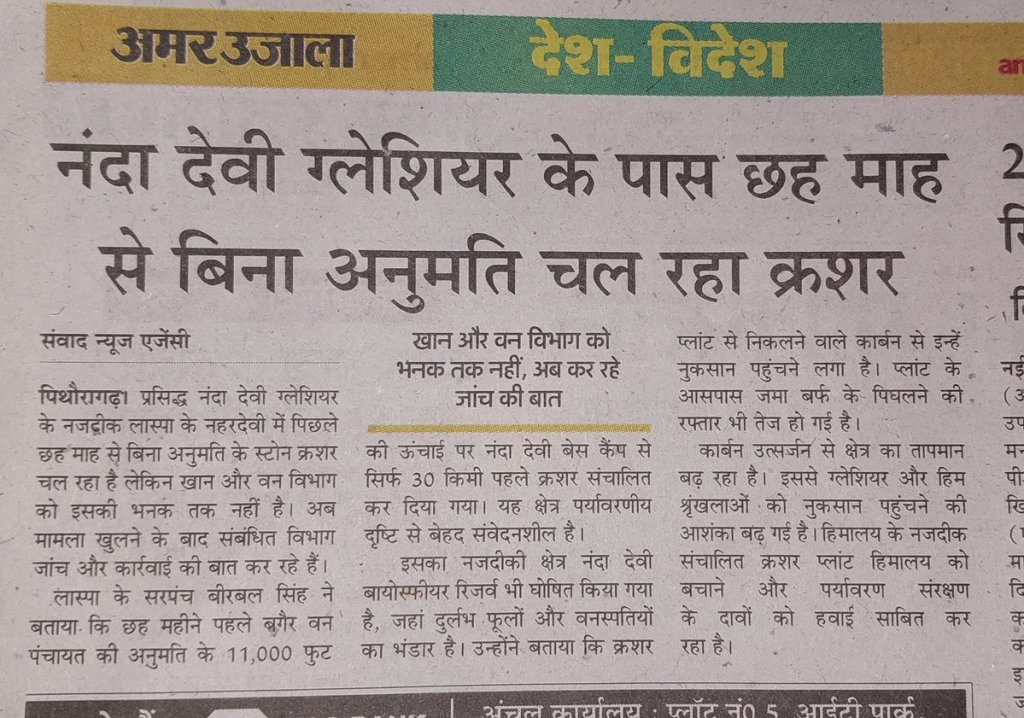
नंदा देवी ग्लेशियर जैसे संवेदनशील पर्यावरणीय क्षेत्र में पिछले छह महीने से एक स्टोन क्रशर अवैध रूप से चल रहा है। न तो खनन विभाग को पता चला, न वन विभाग को—अब जब मामला खुला है, तो “जांच की बात” की जा रही है। https://x.com/KumaonJagran/status/1917871528785678440 (01 May 2025)
Bihar Bhojpur tops in earning revenue through fines against illegal mining About 18% of the total revenue earned by the state through the mines and geology dept in 2024-25 came from Bhojpur, which earned over Rs 200 crore more than the target fixed for the district, according to a press release issued on Monday night (March 31). Furthermore, the Bhojpur district also topped all the districts in earning revenue through imposing fines for illegal sand mining in 2024-25.
“As against the target of Rs 448.84 crore revenue fixed by the state mines and geology, and finance departments for Bhojpur in 2024-25, it earned Rs 652.4 crore, thus earning about 145% more than the fixed target in the FY,” said the press release from the DM office issued. A district official said Bhojpur has also generated Rs 23.59 crore, the highest revenue in the state through imposing fines against illegal sand mining.
In 2024-25, 1,774 raids were conducted against illegal sand mining across Bhojpur, 268 FIRs lodged, and 118 accused arrested and 1,111 vehicles were seized, according to a joint statement by the mining department, district administration and police. The district administration has given permits and licences for mining activities for a total of 38 sand ghats. Out of the Rs 652.4 crore revenue earned by the Bhojpur district, Rs 607 crore has been earned as royalties on sand mining. Besides this, the district mining department got Rs 3.5 crore revenue through public auctions of the vehicles seized for indulging in illegal transportation of sand. https://timesofindia.indiatimes.com/city/patna/bhojpur-tops-in-earning-revenue-through-fines-against-illegal-sand-mining/articleshow/119866235.cms (01 April 2025)
Rajasthan MLA arrested for allegedly accepting ₹20 lakh bribe from mine owner Anti-Corruption Bureau (ACB) on May 4 arrested a legislative assembly member from Bharat Adivasi Party (BAP), Jaikrishn Patel, for allegedly accepting ₹20 Lakh bribe from a mine owner at his official residence, officials said. The Director General of the ACB, Ravi Prakash Meharda, said, “The MLA had been under our radar since April 4 following a complaint lodged by a mine owner, Ravindra Singh. On Sunday, ACB laid a trap and caught the MLA red-handed.” “It is the first time in Rajasthan that a sitting MLA has been caught red-handed while accepting a bribe,” he added.
According to officials, Patel demanded ₹10 crore from the complainant to drop three questions regarding mining in Todabhim constituency in Karauli district, which were listed in the last assembly session. “The questions were regarding some mining leases. After submitting the questions, Patel approached Singh and asked him to pay ₹10 crore bribe to drop them. Later, the bribe was finalised for ₹2 crore after a negotiation, and this was decided to be paid in some instalments. Singh had earlier paid ₹1 lakh by visiting him in Banswara,” said Meharda. It was the second instalment that the complainant went to pay on Sunday when the agency arrested Patel red-handed from his MLA quarter in Jaipur’s Jyoti Nagar. https://www.hindustantimes.com/cities/jaipur-news/rajasthan-mla-arrested-for-allegedly-accepting-rs-20-lakh-bribe-from-mine-owner-101746367085814.html (04 May 2025)
Jammu & Kashmir Karewas now looted to excavate sand ? Sand and clay is much required for construction purposes but authorities need to streamline it so that there is no loss to state exchequer or environment? How can any person come and start excavating sand and clay from karewas or mountain zones for weeks and months and sell that @Rs 10,000 per truck in open market? Who has given such people this right? How can Govt officials remain silent when they are paid to uphold the law? Govt must come up with a policy or law so that sand and clay excavation is done in a sustainable way with no loss to state exchequer. The amount of money the criminals have earned from sale of sand or clay should be realised and deposited into the state exchequer. The J&K Anti Corruption Bureau-ACB can play a good role in exposing this nexus. (Dr Raja Muzaffar Bhat) https://www.greaterkashmir.com/opinion/karewas-now-looted-to-excavate-sand/ (02 May 2025)
Tamil Nadu SC stays CBI probe While allowing the plea of V V Mineral, which sought a stay on the CBI probe and departmental inquiries, the Supreme Court also issued notice to the respondents and directed all parties to maintain the status quo regarding the Madras HC order passed on February 17, 2025. https://www.newindianexpress.com/nation/2025/Apr/30/rs-5832-crore-beach-sand-mining-scam-in-tn-sc-stays-cbi-probe (30 April 2025)
WETLANDS, LAKES, WATER BODIES
Jammu & Kashmir NGT panel to probe illegal waste dumping near wetland The NGT took suo motu cognisance of the unscientific dumping of municipal solid waste (MSW) and the establishment of a waste management plant in a wetland and grazing area in Central Kashmir’s Ganderbal district. The area also served as a seasonal playground for local youth. The issue came to light after Nighat Mir, a resident of Srinagar, alerted the NGT in December 2024. Mir, who owned a small piece of agricultural land near the site in Tulmulla village, alleged that the dumping was affecting her land. Her letter dated December 22, 2024 was treated as a petition by the three-member principal bench of the NGT, comprising judicial members Justice Sudhir Agarwal and Justice Arun Kumar Tyagi and expert member Senthil Veil. (Raja Muzaffar Bhat) https://www.downtoearth.org.in/waste/ngt-panel-to-probe-illegal-waste-dumping-near-kashmir-wetland (02 May 2025)
WATER OPTIONS
India lacks water management, not water resources: Jal Shakti minister “We do not have a water problem, but there is no water management. No one paid attention to this. Our country receives about 4000 BCM (billion cubic metres) of rainfall. Our requirement is only 1120 BCM, and we will need only 1180 BCM by 2050. But we were never able to manage it properly… After Dec, we get to know that there is a scarcity of water,” Patil stated. https://www.business-standard.com/india-news/india-lacks-water-management-not-water-resources-jal-shakti-minister-125042700138_1.html (27 Apr 2025)
GROUNDWATER
Report ‘Groundwater extraction moved Earth’s axis — tubewells changed the planet’ What is the core of your research?: My work centres on the ways in which water — and how people use it — has reshaped landscapes. I spent a decade mapping the Ganga by foot and boat, looking at the transformation of this river basin. Today, my research focuses on groundwater — I study how India, being the largest consumer on Earth of this, has used groundwater to radically reshape its landscape.
-You say the tubewell has transformed the world — why?: -The tubewell is a fascinating — even a fantastic — technology because it transforms groundwater quite literally into infrastructure or a substrate for us to survive. You might not have a river or lake nearby but a tubewell allows you to drill into the ground and use a pump to get water out. It lets people make an oasis — and because it’s so often highly privatised, it also creates a false sense of security as when millions tap into an aquifer, massive urban growth takes place, alongside sharp disparities of access to water. https://timesofindia.indiatimes.com/groundwater-extraction-moved-earths-axis-tubewells-changed-the-planet/articleshowprint/120839225.cms (03 May 2025)
Karnataka Groundwater exploitation in rural Bengaluru threat to drinking water systems A recent study by researchers at Water, Environment, Land and Livelihoods (WELL) Labs and Ashoka Trust for Research in Ecology and the Environment (ATREE) shows groundwater exploitation in the Upper Arkavathy watershed in Bengaluru Rural district posing a major threat to rural drinking water systems.
-Based on data collected from Doddathumakuru and Aralumallige gram panchayats in the Aralumallige sub watershed, the research report identifies that the problem is largely driven by the free supply of electricity to farmers for irrigation borewells, which promotes the over-abstraction of groundwater and imposes an ‘electricity debt’ on the gram panchayats. https://www.thehindu.com/news/cities/bangalore/groundwater-exploitation-in-rural-bengaluru-threat-to-drinking-water-systems-study/article69521543.ece (04 May 2025)
Punjab Farmers demand hybrid paddy cultivation amid gw concerns As most farmers have harvested their wheat crop, they are now waging a campaign demanding permission from the state government to grow hybrid paddy varieties in waterlogging affected areas, where they claim traditional varieties have repeatedly failed. Notably, the state government has banned hybrid paddy cultivation citing groundwater depletion concerns and alleged poor milling recovery.
-The farmers further argued that the government had already let them down by failing to provide high quality cotton seeds, forcing them to switch to paddy. The farmers demanded that soil and water samples from waterlogging affected areas be sent to the state government and that exemptions be granted for hybrid paddy cultivation. https://www.tribuneindia.com/news/punjab/punjab-farmers-demand-hybrid-paddy-cultivation-amid-groundwater-concerns/ (01 May 2025)
NGT disposes of plea against advancing paddy transplantation date A bench comprising NGT chairperson Justice Prakash Shrivastava and expert member A Senthil Vel ruled that the petition lacked substantive evidence to support claims of environmental damage. The tribunal noted that Arora, not being an environmental expert, had failed to provide credible material demonstrating adverse impacts from the date change. The tribunal added that any future representation, if filed with adequate backing, would be duly considered by the authority concerned in accordance with statutory provisions. https://timesofindia.indiatimes.com/city/chandigarh/ngt-disposes-of-plea-against-advancing-paddy-transplantation-date/articleshowprint/120833860.cms (03 May 2025)
Opinion Rethinking subsidies to drive sustainable farming Repurposing govt expenditure on paddy production and procurement or creating new incentives for millet production could encourage farmers to switch. https://www.financialexpress.com/opinion/the-paddy-pivot-rethinking-subsidies-to-drive-sustainable-farming/3832491/ (05 May 2025)
URBAN LAKES, WETLANDS
Mumbai T S Chanakya & NRI wetlands are waterbodies: Mangrove cell The divisional forest office of the mangroves cell submitted a report to the government confirming that the TS Chanakya, NRI area wetlands and DPS lake are water bodies. The City Industrial and Development Corporation (CIDCO) has long contested this claim, stating that these are not natural lakes as water had accumulated in these regions over the years. https://www.hindustantimes.com/cities/mumbai-news/t-s-chanakya-and-nri-wetlands-are-waterbodies-mangrove-cell-101746213236821.html (03 May 2025)
Thane HC restores ‘protected forest’ status of 120 ha of Kanjurmarg dumping site A bench of Justices Girish S Kulkarni and Somasekhar Sundaresan passed a verdict on a plea by NGO Vanashakti filed in 2013 which claimed the Kanjurmarg landfill falls under Coastal Regulation Zone (CRZ) and causes health hazards. The HC order is likely to be challenged in the Supreme Court. The NGO had challenged the denotification of 119.91 ha in Kanjurmarg on the coast of Thane Creek for dumping ground/landfill of nearly 141.77 ha created by BMC, which was earlier classified as ‘protected forest’.
The HC noted that the subject land was salt pan land and over the time witnessed growth of mangroves. It added that the lease for such land for production of salt expired around 2003 and thereafter, under the Coastal Regulation Zone (CRZ) Regulations and the Environment Protection Act, 1986, it was notified and classified as CRZ-1 area. https://indianexpress.com/article/cities/mumbai/hc-protected-forest-status-kanjurmarg-dumping-site-9979427/ (02 May 2025)
Bengaluru City’s dying lakes need immediate restoration In a report filed with the NGT on April 16, the CPCB highlighted that over 90% of the water bodies in Karnataka, with the majority located in Bengaluru, are in a state of neglect and fail to meet the standards prescribed by the Board. According to the report, 172 out of 187 lakes studied have unacceptable water quality. The CPCB filed the report after the NGT took sue motu cognisance of the issue, following an article on Mar 2, 2024. https://bangaloremirror.indiatimes.com/bangalore/others/citys-dying-lakes-need-immediate-restoration/articleshow/120562246.cms (24 April 2025)
Noida Water flows into Dhanauri after a month, lush wetland has gone brown Water flowed into a shrivelled Dhanauri on May 1, aerating the parched wetland after nearly a month, a dry spell that turned much of its usually lush green landscape brown and left cracks on its surface.
Dry spells are, however, not new to the wetland. In summers, there are phases when it stops naturally receiving water and needs intervention. But this year’s spell could well be the longest without water for the wetland, reducing its avian habitat to a few shallow puddles and a pond made by the forest dept for the sarus cranes, ducks & various other waders.
Environmental conservationist Vikrant Tongad has filed a complaint with the forest dept and Yamuna Expressway Industrial Development Authority seeking immediate govt intervention to restore the wetland. “What we need is a formal memorandum of understanding between relevant depts to ensure regular water supply and official notification of Dhanauri as a protected wetland under Indian environmental laws. If the Mou is not signed, such an issue will arise again,” he said.
On Oct 13, 2023, Arya had moved NGT to get the wetland declared as a Ramsar site. He argued that Dhanauri was a natural and vibrant wetland, hosted 217 bird species, and had been recognised as an important birding area by Bird Life International, fulfilling all the criteria a Ramsar tag. Akash Vashishtha, the lawyer presenting Arya in NGT, said that the Union environment ministry had sought a proposal from the state to declare Dhanauri a Ramsar site. “Meanwhile, the state has to declare the site as a bird sanctuary/wetland,” he said. The matter is listed for hearing in NGT again on May 5. https://timesofindia.indiatimes.com/city/noida/water-flows-into-dhanauri-after-a-month-lush-wetland-has-gone-brown/articleshowprint/120802342.cms (02 May 2025)
Activists cry foul over water diversion from Dhanauri wetland for airport Thousands of birds are at risk as Dhanauri wetland, a crucial habitat for migratory birds and the state bird of Uttar Pradesh, the Sarus crane, faces a severe water shortage. Activists alleged that the cause of the crisis is the diversion of a canal that previously supplied water to the wetland. The water supply disruption has been ongoing for almost a month, they alleged.
The Gautam Budh Nagar forest department, however, has stepped in to mitigate the situation. It has created an artificial pond within the wetland to ensure the birds do not face a water scarcity. Department officials assured that the water issue will soon be resolved, with the divisional officer of the forest department stating that the disruption occurred after the Upper Ganga Canal’s Dadri-Kalaunda water channel was cut off due to the airport’s construction at Jewar. https://www.hindustantimes.com/cities/noida-news/activists-cry-foul-over-water-diversion-from-dhanauri-wetland-for-airport-101745779653174.html (28 April 2025)
URBAN WATER
Carbon Copy Can urban India turn the tide on its water crisis? “A river’s health depends largely on how quickly rainwater flows into it from its catchment area. The slower the flow, the better the river’s condition; rapid runoff, on the other hand, leads to poor river health. Forests, wetlands, local water bodies, and carbon-rich agricultural fields help absorb and gradually release rainwater, supporting year-round river flow and protecting against both floods and droughts,” says Himanshu Thakkar, Coordinator of South Asia Network on Dams, Rivers and People (SANDRP).
Thakkar says there’s no real policy for urban water management. Instead of optimally using local sources like rainwater, ponds, or rivers, cities rely on long-distance transfers, according to him. “We have smart city projects, but there is no definition of a water-smart city. The city should be able to manage and use its local water resources optimally.” Thakkar recalled that during his time on the working group for the 12th Five Year Plan (2012–17), it was recommended that cities should only be allowed to draw water from external sources if they could first demonstrate optimal use of all local water resources. https://carboncopy.info/from-waste-to-resource-can-urban-india-turn-the-tide-on-its-water-crisis/ (30 April 2025) How sewage can be used to make drinking water. https://www.youtube.com/watch?v=witvB1XLWXI (05 May 2025)
Hyderabad Water crisis deepens The demand for private water tankers in Hyderabad has gone up sharply as the city is facing an intense water crisis this summer. This is happening despite the Hyderabad Metropolitan Water Supply and Sewerage Board (HMWS&SB) already running 10,000 tankers across the city. Private tanker operators say they are now delivering at least five to six tankers daily, often in multiple shifts. According to the HMWS&SB, water tanker requests in the city have already crossed 8 lakh in the first four months of 2025. That’s a 30 per cent increase compared to last year. https://www.moneycontrol.com/city/hyderabad-water-crisis-deepens-families-spending-rs-2-500-a-week-just-on-water-article-13011210.html (02 May 2025)
Pune PMC to start water cuts With water reserves running low, the Pune Municipal Corporation (PMC) has announced a water cut across several parts of the city, starting Monday, May 5. The decision impacts neighbourhoods under the Vadgaon Water Purification Project Zone, including areas in Dhayari, Suncity, Vadgaon Budruk, Hingane, Sahakarnagar, Dhankawadi, Balajinagar, Ambegaon Plateau, Katraj and Kondhwa.
The PMC’s Information and Public Relations Office issued a detailed schedule outlining day-wise suspension of water supply in affected areas. Authorities cited reduced water availability due to delayed summer rains and increased consumption as key reasons behind the move. PMC takes over 1.5 TMC of water from Khadakwasla on a monthly basis. For the next two months, it will require more than 3 TMC of water from Khadakwasla. The Khadakwasla dam system currently holds over 8.32 TMC of water. The allocated water quota for Pune is 14.61 TMC for the year 2024-25, which should suffice for the city’s needs until mid-year. This storage level is higher than the previous year, providing relief against water shortages. https://www.freepressjournal.in/pune/khadakwasla-cluster-at-2852-water-level-pune-starts-water-cuts-amid-depleting-reservoirs (05 May 2025)
Panchkula Pkl authorities sitting over Rs 10cr compensation for Jhuriwala land restoration The tribunal was hearing a petition against illegal and unscientific dumping of garbage at the waste facility in Jhuriwala village, which continued despite the tribunal’s earlier order. As the site is around 140 metres away from the wildlife sanctuary, safeguards are necessary to avoid the negative impact of the landfill on the groundwater, the petition said.
-According to the corporation, no material recovery facility (MRF) exists at the Jhuriwala site at present, and the daily 200 metric tonnes of garbage brought there is cleared the same day. However, area residents dispute this claim, stating the garbage is not being lifted the same day and causes a foul smell. The MC said it cleared the Jhuriwala site of garbage dump, and about 1.70 lakh metric tonnes of dump is left only at the Sector 23 dumping ground. https://timesofindia.indiatimes.com/city/chandigarh/pkl-authorities-sitting-over-rs-10cr-compensation-for-jhuriwala-land-restoration/articleshowprint/120740466.cms (30 April 2025)
JJM/ RURAL WATER SUPPLY
Centre utilised over 98% of water resources funds in FY25 The Jal Shakti ministry has utilised nearly the entire Central allocation for water resources schemes in the last fiscal, with 98.39 per cent of funds spent by the end of March, according to document titled ‘Report on Availability and Utilisation of Scheme Funds for 2024-2025. https://www.business-standard.com/india-news/centre-utilised-over-98-of-water-resources-funds-in-fy25-shows-data-125042700345_1.html (27 April 2025)
MONSOON
Delhi IMD again fails to gauge intensity IMD failed to gauge the strength of the storm and rain in advance. As late as 2.30am Friday (May 02), IMD’s nowcast for the subsequent 3 hours predicted ‘light rain/thunderstorm/dust storm’ in most areas of Delhi/NCR. In the event, this was the severest period of the storm, with Safdarjung recording 60mm of rain during these three hours with windspeeds gusting up to 80kmph.
-With 17mm more logged in the next three hours till 8.30am, the 24-hour rainfall of 77mm was not just the second-highest for May since 1901, it was also the wettest day in the capital in over eight months since 77.1mm was recorded on Aug 29, 2024, during the monsoon season. “We had forecast the rain spell in the region a few days in advance but we couldn’t predict the intensity of the storm that struck Delhi-NCR on Friday (May 02) morning,” admitted IMD chief Mrutyunjay Mohapatra. https://timesofindia.indiatimes.com/city/delhi/delhi-ncr-rain-why-weatherman-failed-to-predict-intensity-of-storm/articleshowprint/120839380.cms (03 May 2025)
Pre-monsoon time to blame: IMD If one were to follow the IMD’s forecasts from Wednesday (April 30) onward, Delhi seemed in for a relatively mild spell of rain: a moderate thunderstorm on Thursday (May 01) evening, followed by light rain or drizzle and winds up to 50 km/hr on Friday (May 02). But what unfolded on Friday (May 02) morning was anything but mild.
-An intense thunderstorm swept across the Capital at dawn, catching the city off guard. Gusts reaching up to 80 km/hr lashed the city, accompanied by heavy rain. By the time IMD upgraded its forecast to a red alert on its website by 5am—warning of a “severe” thunderstorm and heavy rain—the storm was already in full force in parts of the city. Finally at 5.30am, IMD issued a press briefing, announcing the upgradation of its forecast to red alert.
-Safdarjung, the city’s base station, recorded 77mm of rainfall by 8:30am—Delhi’s second-highest 24-hour May rainfall in over a century. The only time this was surpassed was on May 20, 2021, when 119.3mm fell due to the remnants of Cyclone Tauktae, officials said.
-Most stations in the city logged moderate to heavy rainfall. Palam recorded 45.6mm, Ridge 59.2mm, Lodhi Road 78mm, Pragati Maidan and Pitampura 71.5mm each, Ayanagar 39.4mm, Pusa 50mm, Jafarpur 67.5mm, and Najafgarh 40mm.
-Until Friday (May 02), Safdarjung had only logged 10.2mm of rain since January 1, making this deluge an anomaly. With just this single event, Delhi surpassed its average monthly rainfall for May, which typically stands at 30.7mm.
-What Friday’s storm made clear, however, is that even in an age of advanced forecasting systems, nature still holds the power to upend the best-laid projections. https://www.hindustantimes.com/cities/delhi-news/premonsoon-time-to-blame-imd-after-mild-warning-fails-in-delhi-101746210055307.html (03 May 2025) About 200 trees came toppling down when an intense thunderstorm — strong winds reaching up to dangerous speeds of 80 kmph accompanied by 77 mm of rain — hit Delhi on Friday (May 02). As the rain, the second-highest single-day May rainfall in Delhi since 1901, swept through the city, it also brought down large branches, damaged vehicles, power lines and public infrastructure, and led to the loss of four lives. This isn’t even the first time that Delhi’s neighbourhoods and busy roads witnessed trees falling at such a large scale.
In May 2022, a ‘severe’ category storm claimed two lives and uprooted hundreds of trees across Delhi, including a total of 77 trees under the New Delhi Municipal Council (NDMC), while damaging over 50 branches. Experts said the extreme weather does play a major role. But it isn’t the only cause. Issues ranging from root damage, poor or irregular pruning, widespread concretisation around trunks, termite attacks, unscientific cabling, and a lack of updated data on tree health have all added to the problem. https://indianexpress.com/article/cities/delhi/delhi-storm-trees-collapsed-why-9981470/ (04 May 2025) A violent storm in Delhi killed five, uprooted trees, and caused severe flooding, marking the city’s second-heaviest May rainfall in 124 years. https://www.hindustantimes.com/india-news/unpredicted-storms-leave-5-dead-in-delhi-101746211498963.html (03 May 2025)
IMD revives infamous weather station, but won’t release data With data from Mungeshpur not being released through May, all of northwest Delhi is unlikely to be represented in temperature measurements; the Narela AWS, around 10km from Mungeshpur, has also been inoperational since Feb 2025. https://www.hindustantimes.com/india-news/imd-revives-infamous-weather-station-but-won-t-release-data-101746037397111.html (30 April 2025)
Haryana 31% rain deficit The state received just 6.6mm of rainfall in April, which is 31% below the normal average of 9.5mm for the month. This marks the second consecutive month with below-normal rainfall during the crucial pre-monsoon season, raising concerns about water availability across the state. Last year, rainfall in April was 4mm, while in 2023, it was 14.5mm. The Gurugram city, this year, has received 2.7mm rainfall, 65% below the normal 7.7mm.
In contrast, some districts such as Mahendragarh and Jind recorded above-normal rainfall, receiving 129% and 87% more precipitation than usual, respectively, Haryana’s April rainfall has shown considerable variability over the past 26 years. The highest recorded rainfall was in 2015, with 34.9mm, which was 374% above normal, while years like 2002 saw extreme drought conditions with just 1.1mm, representing an 84.7% deficit.
-The top five districts in Haryana with the highest rainfall deficits were Faridabad, Ambala, Kurukshetra, Jhajjar and Gurgaon, IMD data says. Faridabad experienced the most significant shortfall, receiving only 0.9mm of rainfall, which is 93% below the normal 11.6 mm. Ambala followed with 3.9mm, 74% below the normal 15.2mm. Kurukshetra recorded 2.7mm, 73% below the normal 9.9mm. Jhajjar saw 2.4mm of rainfall, 67% below the normal 7.2mm. Lastly, the city received 2.7mm, 65% below the normal 7.7 mm. https://timesofindia.indiatimes.com/city/gurgaon/pre-monsoon-blues-gurgaon-faces-65-rain-deficit-haryana-31/articleshowprint/120776383.cms (01 May 2025)
Report Climate change reshapes WDs Climate scientists have identified three major shifts driving this new pattern. First, the widening of the subtropical westerly jet, a high-altitude ribbon of fast-moving winds, now gives storms more room to “oscillate” across both the Karakoram and lower Himalayan ranges, leading to increased rain and snow, said Professor A P Dimri of JNU. Second cause is the splitting of storm tracks – the usual path of Western Disturbances now diverges, with some storms pushing north into high mountains and others dipping south over the foothills, a rare occurrence a decade ago. Third is the occurrence of heavy, short-lived downpours even on days without disturbances, due to additional moisture from the Bay of Bengal. https://timesofindia.indiatimes.com/city/dehradun/climate-change-reshapes-western-disturbances-drenching-himalayas-and-preventing-prolonged-heat-waves-in-plains/articleshowprint/120772944.cms (30 April 2025)
How rising heat and shifting WDs fuelling extreme weather The rise in the frequency of WDs has made Himalayan states more vulnerable to extreme weather events. There has also been a shift in precipitation seasonality, with peak snowfall moving from February to March by the end of the 21st century, according to experts. https://www.tribuneindia.com/news/india/how-rising-heat-and-shifting-wds-are-fuelling-extreme-weather-blurring-of-seasonal-boundaries/ (30 April 2025)
Adapt to extreme heatwaves D.S. Pai, head of Climate Research & Services at the India Meteorological Department (IMD) in Pune, said that a lot of factors are at play here. “Intense urbanisation, reducing green cover and global climatic factors. It is getting worse every year, barring a few exceptions.”
-IMD’s data shows that in 2022, India recorded an abnormally warm April, with 11 heatwave days. This year, the national capital has recorded three heatwave days in April. This is not just leading to a prolonged summer season, but is also eating into the spring season—February and March—which were historically transitional months between winter and summer.
-“In the coming years, the key would be to adapt. We will need to make our cities and our infrastructure more climate resilient. Citizens will also need to be educated and trained to respond efficiently during such periods because intense heatwaves will impact employment, agriculture, public movement and healthcare—basically every aspect of our lives,” Pai said. https://theprint.in/environment/everyone-in-north-and-central-india-must-adapt-to-extreme-heatwaves-spring-has-vanished/2611087/ (01 May 2025)
URBAN FLOODS
Delhi Summer rain spell puts monsoon prep in focus With torrential rainfall last Friday leaving several areas of the Capital grappling with waterlogging and inundation, residents questioned the early desilting work being carried out by agencies and alleged that the process was being carried out “selectively”. According to the Municipal Corporation of Delhi (MCD) data, work is going on at a slow pace, with less than 25% of the target under the first phase achieved from January till April 25, even as the deadline of May 31is less than a month away. https://www.hindustantimes.com/cities/delhi-news/delhis-summer-rain-spell-puts-monsoon-prep-in-focus-101746383051326.html (05 May 2025)
Gurugram 3 hours of rain leaves city in mayhem Despite multiple agencies sanctioning nearly Rs 100 crore over four years and over 50 review meetings, Gurugram’s stormwater drains have not been cleaned since 2023. As a result, an intense spell of rain left large parts of the city waterlogged on Friday (May 02). An early morning thunderstorm brought around 200 mm of rainfall in three hours, overwhelming city infrastructure and exposing civic bodies’ claims of monsoon preparedness. Residents woke up to flooded streets and waterlogged residential areas. Reports indicate that clogged or encroached stormwater drains were primarily to blame. https://www.tribuneindia.com/news/haryana/three-hours-of-rain-leaves-gurugram-in-mayhem/ (03 May 2025) Amidst the Friday (May 02) downpour in Gurgaon, some positive developments were witnessed in the areas through which Aravalli Creek passes. Over three years of creek restoration in an ecological manner by the NGO ‘I am Gurgaon’ (IAG) has borne fruit. The efforts ensured proper cleaning and revitalisation of the stormwater channels at Chakkarpur-Wazirabad, Sikanderpur Pahadi, Badshahpur Forest corridor and Ghata Bundh, apart from the Aravalli creeks in Sectors 42, 43 Sectors 55, 56, and 57. Throughout Friday, the stormwater collected at these areas was seamlessly diverted off the roads and residential areas, and eventually went towards recharging the groundwater table. https://indianexpress.com/article/cities/delhi/gurgaon-creek-restoration-water-rains-9981628/ (04 May 2025) Badshahpur MLA Rao Narbir Singh inspected flood-affected areas on Saturday (May 03) after rain on Friday (May 02) brought the traffic in the city to a near standstill. Accompanied by MCG, GMDA, and administrative officials, Singh’s intervention came amid mounting public frustration over the city’s recurring flooding issues. At least 20 critical waterlogging hotspots were identified during the inspection. https://timesofindia.indiatimes.com/city/gurgaon/after-rain-chaos-minister-out-to-map-areas-prone-to-floods-in-gurgaon/articleshow/120858469.cms (04 May 2025)
Ghaziabad Drain breach floods Highrise The breached drain, with an estimated capacity of 30 MLD, carries stormwater from Vijay Nagar and Pratap Vihar through Siddharth Vihar before merging into the Hindon River. Officials said multiple agencies, including the municipal corporation and UP Avas Vikas Parishad (housing board), are working on “war-footing” to plug the breach — a process expected to take another one or two days.
-Ghaziabad mayor Sunita Dayal, who visited the society, directed the Awas Vikas Parishad to file an FIR against the builder for alleged negligence after a drain wall collapse flooded a basement, and ordered immediate flood-control measures.
-The housing board acknowledged the poor condition of the drain and its contribution to the flooding. “This is a 50-year-old uncemented drain belonging to the corporation. No one has cemented it all these years. We are now building a new cemented drain at an estimated cost of ₹20 crore in our area,” said AK Mittal, superintending engineer, UP Avas Vikas.
-Meanwhile, the Prateek Group, which developed the society, blamed another private developer for blocking the drain’s flow. “The drain flows through another project where the developer allegedly altered its course and blocked it at several points, increasing water pressure on our end,” said a spokesperson. “We’ve clarified this to the district magistrate and municipal officials. Our team of 60–70 workers is pumping out water from the basement, and we’re receiving support from residents. The situation will normalise in one to two days,” the spokesperson added.
-UP Avas Vikas officials said an inquiry will follow to determine responsibility. “Apparently, the second developer did not divert the drain properly. We’ll investigate after resolving the present issue. For now, water is being flushed into nearby open fields,” said Mittal. https://www.hindustantimes.com/cities/noida-news/drain-breach-floods-ghaziabad-highrise-dozens-of-vehicles-submerged-101746294403023.html (04 May 2025)
Builder damages drain, Condo flooded Excavation for a residential project in Siddharth Vihar has ruptured a drain near the Ganga water treatment plant in Vijayanagar zone, leaving an adjacent high-rise society’s subbasement flooded with sewage water on Friday (May 03).
-In Prateek Grand City, residents of the upper floors claimed they were “trapped” in their homes as the maintenance team was forced to shut lifts as putrid water filled the subbasement. The society’s 24 towers, each with 28 floors, have nearly 3,000 residents.
Residents claimed the water supply to the society had been affected since May 3. Several of them staged a protest on May 3. On May 3, GMC and UP Jal Nigam issued notices to the builder, directing them to immediately repair the breach. The excavation, officials said also damaged a 100-metre boundary wall of Pratap Vihar water treatment plant. https://timesofindia.indiatimes.com/city/noida/builder-digs-for-basement-damages-drain-ghaziabad-condo-flooded/articleshow/120834104.cms (03 May 2025)
CLOUD BURSTS
जम्मू–कश्मीर के रामबन जिले में शुक्रवार (May 02) को एक बार फिर बादल फट गया। सेरी रामबन के ऊपरी इलाकों में बादल फटने से अचानक बाढ़ आ गई। बादल फटने के कारण रामबन जिले में चंबा सेरी के पास राष्ट्रीय राजमार्ग (NH 44) पर भूस्खलन हुआ है। नेशनल हाईवे को यातायात के लिए बंद कर दिया गया है। पुलिस अधिकारियों ने बताया कि बादल फटने से किसी के हताहत होने या घायल होने की खबर नहीं है। https://www.indiatv.in/jammu-and-kashmir/cloud-burst-in-ramban-district-landslide-disturb-road-heavy-rainfall-alert-2025-05-02-1131981 (02 May 2025)
हिमाचल प्रदेश चंबा जिले के चेली गांव के डोंडरा नाला में शनिवार (May 03) रात बादल फटने से एक 65 वर्षीय बुजुर्ग व्यक्ति की नाले में बहने से मौत हो गई। बाढ़ में 150 भेड़-बकरियां भी बह गईं। https://www.amarujala.com/photo-gallery/shimla/old-man-died-after-being-swept-away-in-a-drain-due-to-cloudburst-in-chamba-district-2025-05-04 (04 May 2025)
Uttarakhand देहरादून और मसूरी के कई इलाकों में जोरदार हुए बारिश और बादल फटने से मालदेवता स्थित सोंग नदी अचानक उफान में आ गई। मसूरी स्थित कैंपटी फॉल का जल स्तर भी तेजी से बढ़ गया है। जिसके कारण लोग चिंता में आ गए है। और चारधाम जाने वाले यात्री भी काफी परेशानी में आ गए है। बता दें की कैंपटी फॉल के जरिए आया मलबा आस- पास के दुकानों में भी घुस गया। https://www.jantatv.com/news/cloudburst-dehradun-causes-flood-tourists-water-level-kempty-falls-rises (05 May 2025) https://www.aajtak.in/programmes/video/uttarakhand-weather-heavy-rains-dehradun-cloudburst-landslide-in-rishikesh-roads-blocked-frvd-2232518-2025-05-05
DROUGHT
Study Long-term drought effects on landscape water storage and recovery under contrasting landuses Abstract: -Recent extreme droughts in Europe have highlighted the urgent need to quantify their effects on ecohydrological fluxes (evapotranspiration, groundwater recharge) and water storage (mainly soil moisture) in the landscape. In response, we combined process-based (EcH2O-iso) and machine learning (NARX) models to estimate the enduring effects of long-term drought on water fluxes and storage and to project future short-term groundwater levels and recovery potential under various precipitation scenarios. The work was undertaken at the Demnitz Mill Creek (DMC), a 70 km2 mixed land use (arable crops and forestry) catchment in northern Germany.
-Our simulations indicated that the extreme drought years of 2018 and 2022 had the most marked impacts, leading to substantial declines in groundwater recharge (>40 %), evapotranspiration (up to 16 %) and soil moisture (up to 6 %). Simulations indicated that groundwater levels may not recover in the next 15 years if recent precipitation anomalies persist. These findings underscore the urgent requirement for enhancing resilience and promoting integrated strategies in managing land and water resources to optimise water retention in landscapes and to better respond to drought. https://www.sciencedirect.com/science/article/pii/S0022169424007340 (June 2024)
ENVIRONMENT GOVERNANCE
Delhi Capital lacks EIA body: GNCTD -At present there is no State Environment Impact Assessment Authority (SEIAA) / State Level Expert Appraisal Committee (SEAC) existing in Delhi, according to a report filed by the Department of Environment, Government of National Capital Territory of Delhi (GNCTD), April 29, 2025 to the NGT.
-The tenure of the SEIAA / SEAC of Delhi expired on Sept. 5, 2024. Since then, an expert appraisal committee (EAC) of MoEF&CC has been dealing with cases related to the environmental clearances.
-Till September 5, 2024, no environmental clearance has been issued to any mining lease / mining property in Delhi. “There was no application pending before SEIAA/SEAC with regard to seeking environmental clearance of mining lease projects.” The report was in compliance with the NGT order, January 16, 2025. NGT had taken suo motu cognizance of a The Times of India article How sand miners laid road across Yamuna between Delhi and Ghaziabad dated November 30, 2024. https://www.downtoearth.org.in/environment/daily-court-digest-major-environment-orders-april-29-2025 (30 April 2025)
Uttarakhand CBI seeks prosecution of 5 officers Corbett safari scam The Central Bureau of Investigation (CBI) has submitted its investigation report to the Uttarakhand government regarding the alleged illegal felling of over 6,000 trees and unauthorised construction work carried out under the guise of a tiger safari project in the Corbett Tiger Reserve.
-In a significant development, the central agency has sought permission from the state government to initiate prosecution proceedings against five officers allegedly involved in the irregularities. The CBI had formally registered a case in the high-profile Corbett tiger safari matter in October 2023, taking over the investigation into the extensive environmental damage and rule violations. https://www.newindianexpress.com/nation/2025/Apr/29/cbi-seeks-prosecution-of-five-officers-in-uttarakhands-corbett-safari-scam (29 April 2025)
Report New construction waste rules However, experts have flagged several concerns, too. “A key gap remains in addressing small waste generators, who contribute significantly to unmanaged waste,” said Kumaraswamy. “There’s an opportunity to expand the rules’ impact by creating clearer mechanisms to engage and support them within the formal recycling ecosystem.” Stalin also pointed out that implementation could be hampered by limited staffing at pollution control boards. According to Bharati Chaturvedi of the Chintan Foundation, the rules lack clarity on EPR responsibilities. “In e-waste and plastics, brand owners are clearly accountable. But in this case, who is responsible — the house owner, the contractor, or a government body like PWD?” she asked. “We still don’t have a clear definition, and that’s a concern.” https://india.mongabay.com/2025/05/new-construction-waste-rules-push-for-producers-accountability-and-recycling/ (02 May 2025)
SOUTH ASIA
IWT How many dams India needs to deprive Pakistan of Indus waters Himanshu Thakkar, the coordinator of non-profit South Asia Network on Dams, Rivers, and People (SANDRP), says before taking up any major storage projects on the Western rivers, we need to ensure they are feasible and beneficial to our people, our landscape and our future.
-“First of all, there are no known suitable places for building storage projects Western rivers. If such storage locations are identified, the first river that may be considered is Chenab due to its geographic location. We already have the largest number of existing, under construction and planned projects in this very fragile, disaster-prone area. This is also a location where experts have warned about the major risks of landslides, floods, seismic activity and glacial lake outburst floods,” he tells India Today.
-“On Jhelum and Indus, even if we manage to store some water in our dams, what will we do with it? Dam waters are largely used for irrigation and UT’s agriculture is already supported by several streams and rivers and similar options,” he says. https://www.indiatoday.in/india/story/indus-waters-treaty-suspended-storage-dams-india-pakistan-jhelum-chenab-2716996-2025-04-29 (29 Apr 2025)
Climate crisis exposes flaws in Indus pact Recent papers have now found that western tributaries like the Indus, Kabul, Jhelum and Chenab are fed by glaciers with more stored water, while eastern tributaries including the Beas, Ravi, and Sutlej draw from significantly lower glacier stored water reserves. Crucially, the pace of glacial melt is higher in the Western Himalayas that feed eastern rivers compared to the Upper Indus basin. A 2019 science policy brief by IISc’s Divecha Centre for Climate Change predicted that due to high negative glacier mass balance and area loss, discharge for the eastern rivers (India’s allocation) is expected to peak early in 2030, compared to 2070 for the western basin.
– According to research by the Kathmandu-based International Centre for Integrated Mountain Development (ICIMOD), glacial mass balance rates vary significantly: Western Himalayan glaciers at -0.36 meter water equivalent per year since 2010, Karakoram at -0.09, and Eastern Himalayas at -0.51.
– “So far, there have been about 150 GLOF events recorded in Pakistan and 60 in India – mostly after the 1950s,” said Sher Muhammad, remote sensing Specialist at ICIMOD. “The recorded fatalities in India due to these GLOFs are over6,000, compared to 11in Pakistan.”
Himanshu Thakkar emphasised that “contribution from glaciers and snow to western rivers is higher compared to eastern rivers. Monsoonal flow also contributes to eastern rivers. Apart from conflict and geopolitics, these rivers are a source of life to people.” https://www.hindustantimes.com/india-news/climate-crisis-exposes-flaws-in-indus-pact-as-some-rivers-may-dry-up-quicker-101746211618179.html (3 May 2025)
Rivers in Pakistan aren’t drying yet Satellite data confirmed there was no significant change in river water flow at the last dams in India – Uri dam at Jhelum, Baglihar at Chenab, and Nimoo Bazgo at the Indus. Similar is the case for the first water regulating facilities on these rivers in Pakistan – Mangla, Marala and Jinnah Barrage in Kalabagh, Pakistan Punjab.
-While there has been fluctuations in the recorded flows of Chenab and Jhelum at their entry points into Pakistan, there has been no significant change that could be attributed to control exercised by India at upstream hydroelectric projects. The data recorded by Pakistani authorities is corroborated by satellite images captured by the European Space Agency (ESA) before and after the IWT suspension.
Himanshu Thakkar of SANDRP says the risks of building dams on Chenab river are too high, “We already have the largest number of existing, under construction and planned projects in this very fragile, disaster-prone area. This is also a location where experts have warned about the major risks of landslides, floods, seismic activity and glacial lake outburst floods”. https://www.indiatoday.in/india/story/rivers-in-pakistan-arent-drying-yet-here-is-why-2718197-2025-05-01 (01 May 2025)
Has IWT suspension caused a new fault line in South Asia? Legally, the unilateral suspension raises complex questions under international law. The Vienna Convention on the Law of Treaties (1969) provides that a party may suspend a treaty only under specific circumstances: fundamental breach, impossibility of performance or a radical change of circumstances (rebus sic stantibus) – none of which clearly apply here. Unilateral termination of water-sharing treaties is extremely rare. In cases like the 1978 Nile Waters dispute or the Jordan River allocations between Israel and its neighbours, even amid armed conflicts, states preferred renegotiations over abrupt annulments.
Moreover, the UN Watercourses Convention (1997) emphasises the obligation to cooperate and not to cause significant harm to downstream users. India’s move could thus be perceived internationally as a violation of customary international law principles governing shared water resources, potentially attracting diplomatic isolation or arbitration claims.
Water governance experts like Himanshu Thakkar of SANDRP caution that building the infrastructure to exercise full control over western rivers would take years and, if perceived as hostile, could invite international scrutiny. Former Indus Water Commissioner P.K. Saxena advocates for a strategic, calibrated approach: maximising rights under the Treaty, completing pending hydro projects and pursuing Treaty renegotiations without appearing aggressive. https://thewire.in/diplomacy/has-indias-suspension-of-indus-waters-treaty-caused-a-new-faultline-in-south-asia/ (01April 2025)
Beyond IWT This article extensively quotes Parineeta Dandekar’s (SANDRP) report on Climate Change & Chenab basin. https://www.counterview.net/2025/04/beyond-indus-water-treaty-suspension.html (28 April 2025)
IWT suspension deepens regional faultlines amid climate crisis A key question now is whether India must formally notify the World Bank about its decision to suspend the IWT, or whether informing only the Neutral Expert—currently examining the India-Pakistan dispute—would suffice. Michel Lino, President of the International Commission on Large Dams (ICOLD), was appointed Neutral Expert by the World Bank in 2022. New Delhi may opt to notify just him, effectively halting the Kishanganga-Ratle dispute mechanism and placing the IWT into suspension.
– Arun Kumar Bajaj, former head of India’s Central Water Commission, believes that technological advancements necessitate design changes. “In Salal, we agreed to Pakistan’s demand for high-level gates. Now the dam is 37 metres silted. We can’t flush the silt. Our power output has declined.” Bajaj argues that new projects require bottom gates for silt management—a position that Pakistan routinely objects to. “There’s no cooperation when objections are raised on everything.” Even Bajaj, however, cautions against scrapping the treaty altogether. “Revision will take a century. Supplementary protocols are the better route.”
– Yet questions linger about the legal footing of India’s suspension. Under international law, particularly the Vienna Convention on the Law of Treaties (VCLT) 1969, changes of circumstances are not recognised grounds for terminating or suspending treaties. In a landmark 1984 case, the International Court of Justice rejected the US argument that it could abandon a treaty with Nicaragua based on changed conditions.
– What is intriguing is that NHPC officials kept the voluminous Environmental Assessment of Kishanganga River, undertaken by the Centre for Inter-disciplinary Studies of Mountain and Hill Environment, close to their chest. They refused even to share it with the State government. The ecological cost of making huge dams in fragile mountains is equally worrying. Michael Kugelman warns: “These dams are in a high seismic zone. Seven major dams in close proximity amplify the risk of a major earthquake.”
– Whether the Indus becomes a bridge to cooperation or a faultline of conflict depends on choices made now. The rivers still flow. But will dialogue? The next chapter may lie not in Delhi or Islamabad, but in Kishtwar’s blasted hills, in Punjab’s thirsty fields, and in the melting glaciers that feed them all. https://frontline.thehindu.com/politics/indus-waters-treaty-suspension-india-pakistan-water-crisis-2025/article69500145.ece (28 April 2025)
IWT needs rethink Indus Waters Treaty needs a rethink’: Country’s top glaciologist warns of shrinking Indian share in river flows. India’s eastern Indus glaciers are melting faster than Pakistan’s and that will reduce water availability after mid-century, leading glaciologist at IISc Anil Kulkarni tells in an interview.
– EASTERN RIVERS: He says: “if you really look into the amount of glacial-stored water in say eastern river basins, it is only 5%, and 95 percent of glacier water is stored in the western river basins. That means, there is a fundamental difference in the total availability of water… The glaciers located on the eastern side, that means above Sutlej, Beas and Ravi River, are located at relatively lower altitude, they are losing mass at a higher rate, thus retreating faster. As you go higher, in the Karakoram mountain ranges, glaciers in Karakoram are not losing mass, they are relatively stable… This differential loss of glaciers and glacier-stored water is going to significantly affect future distribution of water across the eastern and western river basins.”
– WESTERN RIVERS: He says: “The situation, though, is different in western river basins. The glacier-stored water there is higher and their contribution on stream run-off is higher. But, the glaciers there have not started to melt significantly. This luxury, though, will only last till the middle of the century, as per modelling studies, and then a significant amount of glacial melt will start from the middle of the century. This will continue for a longer period, because the glaciers are bigger there, the store of water is higher.”
– RAINFALL & SNOWFALL: “There will be a change in precipitation. There is no clarity on how it will change… The Himalayan region is experiencing a higher rise in temperatures, compared to global mean. Another reason is the change in precipitation. The amount of solid precipitation, in the form of snow, is reducing, and the amount of liquid precipitation in the form of rain is increasing. Even though there is no significant change in a total amount of precipitation, the solid component is significantly reduced. That is the effect of climate change, and particularly so in a low altitude region, rather than high altitude. That is causing most of the glaciers to retreat.” https://indianexpress.com/article/india/indus-waters-treaty-country-top-glaciologist-shrinking-indian-share-river-flows-9981792/ (05 May 2025)
Climate, Conflict & the Indus Waters This video unpacks what it means to suspend the treaty, how climate change is intensifying water stress in South Asia, and what lies ahead for India and Pakistan as water, once a shared resource, becomes a strategic tool.
https://www.youtube.com/watch?v=fqxBSaMqaW0 (29 April 2025)
When rivers become weapons Such suspension of Indus Treaty often overlooks the dangerous precedent of turning water, an essential and shared resource, into a tool of nationalistic retaliation. K. Sahadevan examines the geopolitical risks of weaponizing vital natural resources like rivers. (The report has some inaccuracies.) https://panthi.in/when-rivers-become-weapons-part-1/ (04 May 2025)
India cuts Baglihar flow; Kishanganga next? India has restricted the flow of water through the Baglihar Dam on the Chenab River and is planning similar measures at the Kishanganga Dam on the Jhelum River, a source said. The source familiar with the matter said these hydroelectric dams — Baglihar in Ramban in Jammu and Kishanganga in north Kashmir — offer India the ability to regulate the timing of water releases. https://www.rediff.com/news/report/after-indus-treaty-suspension-india-cuts-baglihar-flow-kishanganga-next/20250504.htm (04 May 2025)
Plans afoot to create 12 Gw from Indus projects India will soon get going on plans to create nearly 12 Gw of additional hydropower from new projects on the Indus rivers, for which feasibility studies have been ordered, two people aware of the matter said. “The plans to create additional power generation include projects that will be commissioned at Sawalkot (1,856 Mw), Pakal Dul (1,000 Mw), Ratle (850 Mw) Bursar (800 Mw), Kiru (624 Mw), Kirthai 1 and 2 (1,320 Mw) hydropower projects, which will be fully synchronisable with the national grid,” a second official said.
Authorities in the Jal Shakti ministry and the NHPC are working to expedite all projects under construction, following a high-level meet chaired by Union home minister Amit Shah on April 25, the official added. Jal Shakti minister CR Patil met home minister Shah for the second time in a week on April 30 to update the latter on the current status of dams and reservoirs on the Indian side of the Indus River system, including legal aspects related the decision to pause the water-sharing pact, a person familiar with the matter said. https://www.hindustantimes.com/india-news/plans-afoot-to-create-12-gw-from-new-indus-projects-101746384196629.html (5 May 2025)
India to fast pace stalled projects The suspension of the IWT has revived hopes for the completion of the stalled Wular Barrage Storage project in Bandipora district. This project, about 2.5 km upstream of the similarly stalled Tulbul Navigation Lock Project was started by the then state government’s Irrigation and Flood Control Department in 2013 at an estimated cost of Rs 30 crore. Like the Tulbul project, this, too, was held up amid arguments from Pakistan that it violated the IWT.
With the treaty now in abeyance, the Union government is planning to hand over the project to state-owned hydropower company NHPC Ltd, which will likely pick up the construction work from where it was left off, it is learnt. Among the suggestions on the table is for the Union government to fund it. It is also learnt that the J&K govt will likely suggest the revival of the Tulbul Navigation Lock Project to the Union government, besides putting forward a request for a project that allows J&K to draw some water from Chenab to feed Jammu city. https://indianexpress.com/article/india/indus-waters-treaty-suspension-revives-hopes-for-completion-of-stalled-jk-lake-project-9982943/ (05 May 2025)
Divert Indus River water to western Raj: MLA Independent MLA from Sheo, Ravindra Singh Bhati, Tuesday (April 29) called on the Union govt to take urgent and strategic action to divert water from Indus River and its tributaries to drought-hit districts of western Rajasthan.
-Bhati demanded a reassessment of Indus Water Treaty, allowing India to reallocate water flowing into Pakistan to its own water-starved regions. “The additional water saved from not sending to Pakistan can be diverted to districts like Jodhpur, Hanumangarh, Sriganganagar, Jaisalmer and Barmer. I understand this requires resources, but both short-term and long-term planning can make this a reality,” he said. https://timesofindia.indiatimes.com/city/jaipur/divert-indus-river-water-to-western-raj-mla-to-centre/articleshowprint/120739826.cms (29 April 2025)
Rajasthan, Haryana to gain from diversion of Indus waters Rajasthan and Haryana officials met scientists in Jaipur to plan Saraswati river revival. ISRO and Denmark experts will map its ancient paleo channel to trace and restore the river’s original path. https://www.newindianexpress.com/nation/2025/Apr/29/rajasthan-haryana-to-gain-from-diversion-of-indus-waters-as-plan-to-revive-saraswati-river-gets-boost (29 April 2025)
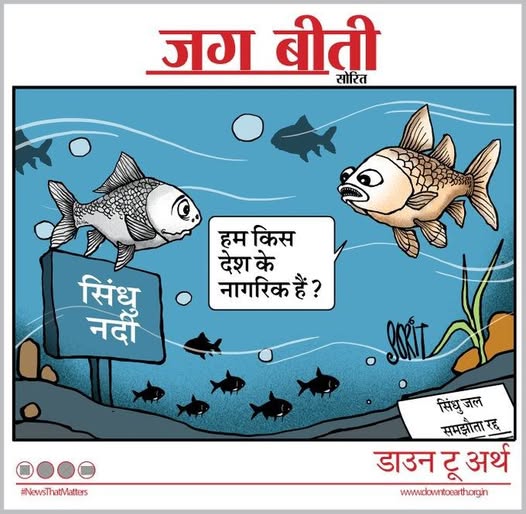
Pakistan preparing to challenge India’s suspension of water treaty, minister says Pakistan is preparing international legal action over India’s suspension of a key river water-sharing treaty, a government minister told Reuters, as tensions intensify between the neighbours following an attack on tourists in India-administered Kashmir. Aqeel Malik, the Minister of State for Law and Justice, told Reuters late on Monday that Islamabad was working on plans for at least three different legal options, including raising the issue at the World Bank – the treaty’s facilitator. It was also considering taking action at the Permanent Court of Arbitration or at the International Court of Justice in the Hague where it could allege that India has violated the 1969 Vienna Convention on the Law of Treaties, he said. “Legal strategy consultations are almost complete,” Malik said, adding the decision on which cases to pursue would be made “soon” and would likely include pursuing more than one avenue. Malik added that a fourth diplomatic option that Islamabad was considering was to raise the issue at the United Nations Security Council. https://www.reuters.com/world/asia-pacific/pakistan-preparing-challenge-indias-suspension-water-treaty-minister-says-2025-04-29/ (29 April 2025)
Question of water scarcity While political actors clash, Pakistan as a nation is losing ground in the most existential battle of our times — water security. Classified among the countries facing extremely high water stress, Pakistan withdraws more than 60pc of its available resources annually, far exceeding sustainable thresholds. A UNWater report places Central and Southern Asia, home to Pakistan, among regions with water stress above 25pc. The Global Climate Risk Index ranks Pakistan as the world’s fifth most climatevulnerable country, warning that rising temperatures and erratic monsoons threaten agriculture, livelihoods, and coastal communities.
– Pakistan’s irrigation network — the world’s largest contiguous system of canals — loses an estimated 30–40pc of diverted water to seepage and evaporation due to poor maintenance and silting. The dilapidated minor canals forced farmers to rely on costly tubewells, deepening rural poverty, by increasing financial burdens on smallholders and exacerbating environmental issues like groundwater depletion. Yet the government’s focus is on grand new projects rather than rehabilitating existing infrastructure.
– Pakistan has witnessed increasingly severe floods, prolonged droughts, and retreating glaciers. The 2022 floods affected 33m people, underscoring the increasing severity of climate change and the need for resilient solutions. By prioritising a contentious canal project, the federal government has not only alienated Sindh but also squandered political capital that could have tackled systemic issues as discussed below.
– Drip and Sprinkler Irrigation can cut water use by up to 60pc while boosting yields, and it is ripe for rapid scaleup in both Punjab and Sindh. Canal Lining and Desilting of the centuryold network could recover over 30pc of conveyance losses, improving downstream equity without new diversions. Rainwater Harvesting and Groundwater Recharge through tubewells and recharge wells in Cholistan can sustain local communities and wildlife, reducing stress on river flows. https://www.dawn.com/news/amp/1906970 (28 April 2025)
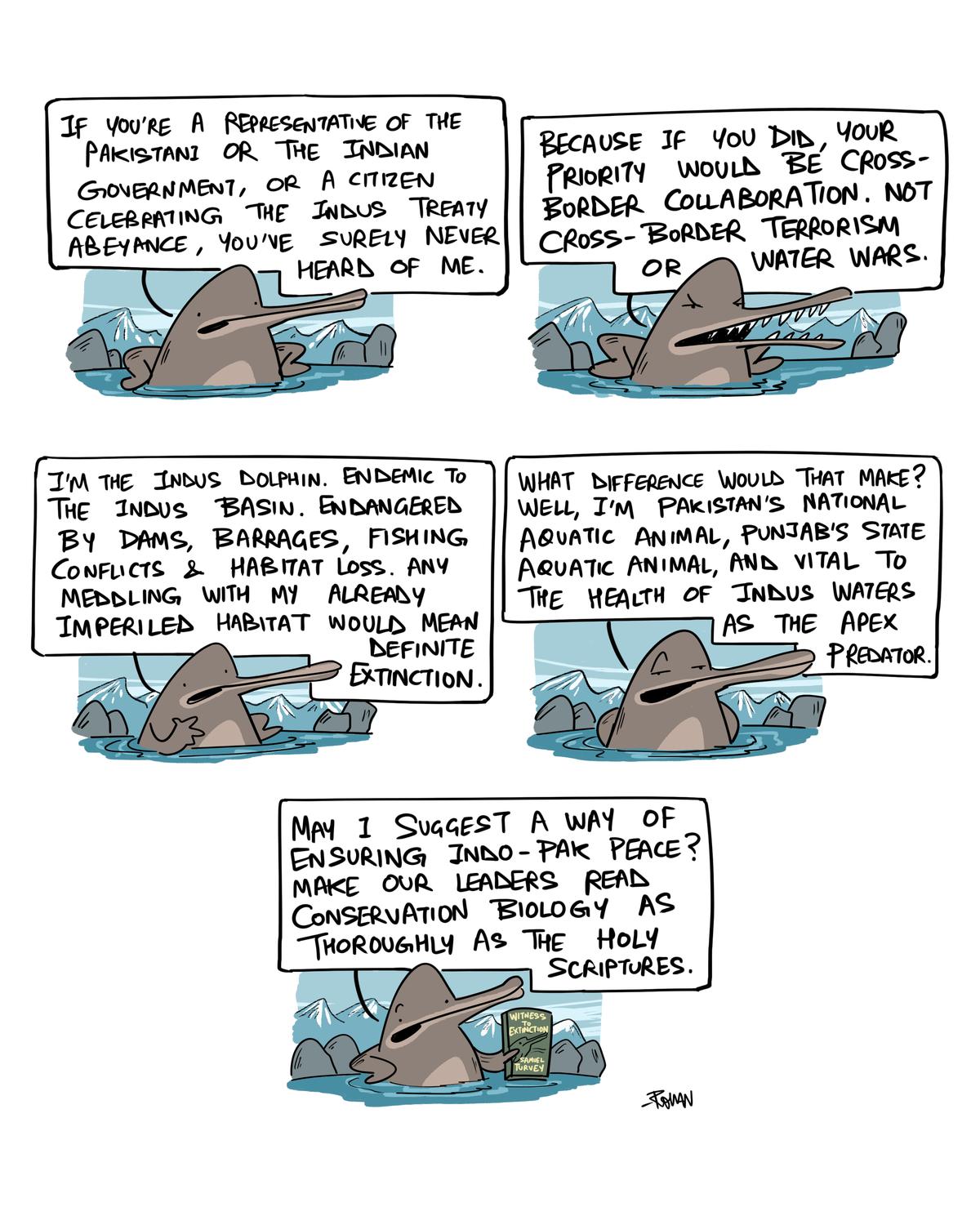
On the suspension of the IWT: Green Humour by Rohan Chakravarty https://www.thehindu.com/sci-tech/energy-and-environment/green-humour-cartoon-rohan-chakravarty-indus-water-treaty-suspension/article69509126.ece (01 May 2025)
Opinion Water as weapon If India has itself stopped Indus waters from reaching Pakistan or has flooded its neighbour, it will have a much weaker defence in front of global community when China threatens to do the same.
-While threatening to deprive Pakistan of water sounds like a reasonable response to an attack that New Delhi insists has Islamabad’s fingerprints on it, actually acting on it is a risky proposition. If India engages in a water war with Pakistan, it also creates a precedent for others in a region that has shared rivers throughout its history.
-In 1996, India and Bangladesh had struck an agreement on the sharing of Ganga waters. That treaty is up for renewal in 2026. Given the current tensions between New Delhi and Dhaka, any move by India to block Indus waters from reaching Pakistan will surely spark fears that New Delhi could do something similar to Bangladesh. Water is not easy to control. Water wars, once started, will be harder to stop. (Charu Sudan Kasturi) https://www.telegraphindia.com/opinion/water-as-weapon-indus-waters-treaty-is-a-natural-weapon-for-india-to-wield-against-pakistan-prnt/cid/2096725 (30 April 2025)
Weaponising IWT is a strategic mistake Despite public enthusiasm in India about the Indus Waters Treaty being held in abeyance, the move is strategically flawed, and will have adverse consequences for India in the region. At stake are India’s water sharing agreements with Nepal and Bangladesh. China could now gain strategic space by expanding hydrological co-operation with them. https://www.deccanherald.com/opinion/weaponising-indus-waters-treaty-is-a-strategic-mistake-3521599 (02 May 2025)
A symbolic move with long-term implications & complications Therefore, as mentioned earlier, it transforms water into a multi-front strategic challenge, where any Indian action against Pakistan risks provoking Chinese countermeasures. Ultimately, the treaty’s suspension underscores the erosion of hydrological diplomacy in an era of climate volatility and security-driven realpolitik. While Pakistan’s agriculture and energy sectors remain theoretically vulnerable – with 70% of its economy tied to the Indus basin – India’s capacity to capitalize on this hinges on infrastructure timelines and China’s countervailing actions. The coming decade will test whether water becomes a decisive tool in regional statecraft or a cascading trigger for broader ecological and geopolitical crises. https://www.indiasentinels.com/diplomacy/indias-suspension-of-indus-waters-treaty-a-symbolic-move-with-long-term-implications-and-complications-6774 (28 Apr 2025)
Impact of suspending IWT India may justify its position on suspending the Indus Waters Treaty. But this could impact Delhi’s relations with neighbouring countries. https://www.thehindu.com/opinion/op-ed/the-impact-of-suspending-a-water-treaty/article69510612.ece (01 May 2025)
India-Bangladesh Bangladesh concerned over water-sharing with India IndoBangladesh Ganga Water Treaty is set for renewal in 2026. “With the Ganga Treaty up for renewal next year, India’s suspension of the Indus Waters Treaty could cast doubts on its commitment to watersharing with Bangladesh,” noted water expert Nutan Manmohan. Importantly, the renewal is not automatic. Mutual consent requires agreement or understanding between both parties. Either side may choose not to renew the treaty if they deem it unnecessary.
Uttam Sinha of the Manohar Parrikar Institute for Defence Studies and Analyses (IDSA) added, “While India has traditionally respected water-sharing arrangements with its lower riparian neighbours including through the Ganga Treaty the success of future negotiations will largely depend on the prevailing political climate.”
On March 6, 2025, a Bangladeshi delegation visited India for the 86th Joint Committee of Technical Experts meeting— the first since Hasina’s electoral defeat. The technical teams from both nations convened in Kolkata under the Joint Rivers Commission to specifically discuss the treaty’s renewal. During the visit, the Bangladeshi delegation also inspected the joint observation station at Farakka. The discussions focused on the renewal of the Ganga Treaty and the sharing of other rivers, including the Teesta and Feni.
While political factors may influence the pace of negotiations, both nations must prioritise cooperative basin management to ensure water security, protect ecosystems, and support the livelihoods of riparian communities. https://sundayguardianlive.com/news/bangladesh-concerned-over-water-sharing-with-india# (04 May 2025)
Pakistan Fishing communities in crisis The coastal areas of Sindh – Badin, Thatta and Sujawal – have a fishing tradition. The communities residing along the bank of the Indus River and the coastline rely on fishing as their pivotal source of livelihood, besides making mats and shelters from straw and weed and selling lotus. The ongoing water crisis and its effect on biodiversity have affected the fishermen community.The coastline of Sindh, stretching over 350 kilometres, has seen a persistent crisis for the past two decades. The crisis has brought things from bad to worse. https://www.thenews.com.pk/tns/detail/1305458-fishing-communities-in-crisis (27 April 2025)
Nepal Hydro tender hit by fraud claims against Chinese firm A Chinese company has allegedly submitted fake documents in order to bag the 106 MW Jagadulla Hydroelectric Project in Dolpa dist in western Nepal, and the case has now landed at the Commission for the Investigation of Abuse of Authority and the Public Procurement Office for further investigation. Three bidders, who were in the race to develop the project, accused the authorities of qualifying a Chinese company with zero experience in hydropower construction as “substantially responsive” during the technical bid evaluation for the EPC contract”.
– One of the documents Jiangxi Construction Limited submitted to JHCL claimed that it had built a 102 MW project in China. But the photos it submitted showed a project actually built by Sinohydro in Zambia, Africa, named Kafue Gorge Lower Hydropower Plant, which has an installed capacity of 750 MW. https://kathmandupost.com/national/2025/05/02/nepal-hydro-tender-hit-by-fraud-claims-against-chinese-firm (02 May 2025)
THE REST OF THE WORLD
Book Is a River Alive? by Robert Macfarlane In Is a River Alive? Robert Macfarlane explores rivers across the world, journeying to northern Ecuador, southern India and north-eastern Quebec. In all these places rivers are under threat – but dedicated activists are battling to defend them.
In this first episode, Robert Macfarlane explores the philosophical challenge of transforming how we think about rivers: ‘I began these river-journeys in doubt and uncertainty. I knew the question to which I wanted an answer –– Is a river alive? –– to be a formidably hard one, even as I wished it to be simple. How we answer this strange, confronting question matters deeply. But even the asking of it is a first step. For our fate flows with rivers and always has.’ https://www.bbc.co.uk/programmes/m002bsz8 (05 May 2025)
SANDRP
Also see: DRP 28 April 2025 & DRP 21 April 2025
Follow us on: www.facebook.com/sandrp.in; https://twitter.com/Indian_Rivers


