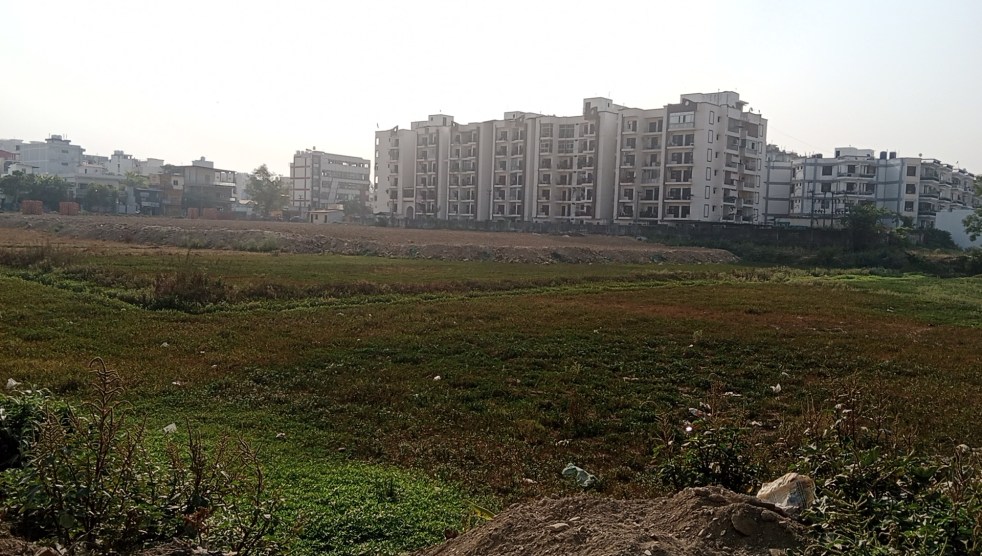
In a welcome development, the Supreme Court of India has asked, in the context of Ajmer City in Rajasthan, how can a city become smart without protecting the water bodies/ wetlands? How cities will become smarter by encroachments on the water bodies and wetlands? The Supreme Court bench threatened the Rajasthan government of contempt of court for non-compliance of order dated Dec 1 2023 as also the order of National Green Tribunal on Dec 13 2021.
The Supreme Court here has hit the nail and raised a very fundamental question that is relevant to all the cities across India as they are all guilty of allowing encroachments and destruction of local water bodies in their respective areas. This is a suicidal step as it has adverse impact on the cities in multiple ways and yet, most cities consider this smart and in fact get away with it. There is also no National Urban Water Policy guiding the cities solve the puzzle of multiple issues handled by multiple departments, including some by the local, state and central governments. This self-created mess in the cities comes handy for the various vested interests in encroaching more water bodies. The judiciary, so far has also not been effective in addressing this issue with any effectiveness.
One hopes the current case not only addresses the issue effectively for Ajmer, but also brings into ambit the way cities across India are handling these issues and also push for a National Urban Water Policy, that will also help define a water smart city.
Ajmer How a city can be smart without protecting waterbodies/wetlands: SC The Supreme Court recently expressed displeasure with the State of Rajasthan’s failure to comply with its earlier order regarding the restoration of wetlands in Ajmer City as part of the Union’s Smart City Development Mission and warned of potential contempt proceedings if the orders remain unfulfilled. “In view of non-compliance with the order dated 1 Dec 2023, before we consider of initiating action under the Contempt of Courts Act, 1971, we direct the Chief Secretary of State of Rajasthan to appear before the court through video-conferencing on March 17 2025″ said the court. “We wonder how a city can become smart without protecting the water bodies/wetlands in the city and how cities will become smarter by making encroachments on the water bodies/wetlands.”, the bench comprising Justices Abhay S Oka and Ujjal Bhuyan said after noting defiance of the Court’s order.
“If the State of Rajasthan is seriously interested in purging the contempt, we expect the Chief Secretary to file his personal affidavit reporting compliance with at least some of the directions issued under the impugned judgment as well as under the order dated 13 Dec, 2021 passed by the NGT.”, the court said. https://www.livelaw.in/top-stories/how-a-city-can-become-smart-without-protecting-water-bodieswetlands-supreme-court-summons-rajasthan-chief-secretary-284780 (24 Feb. 2025)
HYDRO POWER PROJECTS
Sikkim Govt divests stake in Teesta III project to Greenko amid questions In a Cabinet meeting held on February 2 2024, the Sikkim government decided to divest its entire 60.8 per cent stake in Sikkim Urja Ltd (SUL), the company that owns the Teesta III project, in favour of Greenko Energies Private Ltd, a private partner in the project. Sikkim Chief Minister Prem Singh Tamang justified the decision on the grounds that it was done to avoid a debt trap. The previous Sikkim Democratic Front (SDF) government had taken around Rs.3,500 crore as loan from various sources in order to fund the Teesta III project. On February 5 2024, Tamang announced in the Legislative Assembly that his government had decided to forego the stake in the company and that Sikkim had become completely debt-free with the sale of its stake in Teesta III. On February 3, 2024, exactly four months after disaster struck the project on the night of October 3-4, 2023, Sikkim’s Power Department reportedly issued a notice announcing the Cabinet decision to disinvest its entire stake in SUL. According to this notice, Greenko would take over the Sikkim government’s loan—which stood at Rs.2,895.46 crore—from Power Finance Corporation. It would also take over the principal component of another loan taken from Sikkim Bank Ltd amounting to Rs.184.28 crore.
The company had a total outstanding balance of Rs.7,897.73 crore to be paid to these two financial institutions at the end of financial year 2022-23: it had a balance outstanding of Rs.3,942.97 crore with REC Ltd while a balance of another Rs.3,954.76 crore was due to Power Finance Corporation as of March 31, 2023.
However, the decision to divest the government’s stake was taken at a time when SUL had dues of roughly Rs.3,500 crore to be recovered from power distribution companies in Punjab and Haryana. The SUL was not a loss-making company–its annual reports indicate that it had been recording a healthy profit since 2021-22. Although it had lost a net amount of Rs.212.40 crore in financial year 2020-21, as per the audited financial statements, SUL made a net profit of Rs.230.41 crore in 2021-22. The net profit increased nearly sixfold to Rs.1,270.19 crore in financial year 2022-23.
The disinvestment took place without competitive bidding or invitation of expressions of interest, which could have maximised profits for the government. https://frontline.thehindu.com/environment/teesta-iii-stake-sale-disinvestment-greenko-sikkim-urja-limited-deal-privatisation/article69243206.ece (24 Feb. 2025)
What’s behind the haste to rebuild Teesta III dam? The environmental activist Himanshu Thakkar (SANDRP) termed the recommendation for environmental clearance as “hasty” on the grounds that the proposed rebuilding project is yet to be ratified by the CWC, the country’s apex body for controlling and regulating water resources, and the CEA. Speaking to Frontline, Thakkar, who is the coordinator of the South Asia Network on Dams, Rivers and People, an informal network of organisations and individuals working on issues related to the water sector, said: “The spillway capacity of the reservoir can be determined only after finalising the probable maximum flood level. This level has not yet been decided upon. The greater the capacity of the spillway, the more impact it will have on the ecology and environment of the areas downstream of the dam.”
Thakkar added that the destruction caused in the October 2023 floods was owing to shortcomings in environmental impact assessment reports in the past that did not foresee a glacial flood of this nature. He said: “Moreover, the rebuilding project should be considered as a fresh project considering the change in height and type of the proposed dam, its construction method, the massive change in spillway capacity, and the changes in upstream and downstream conditions, including glaciers, glacier lakes, and their threats. The project requires a new environment impact assessment study and a new environment management plan, including a fresh public consultation process, given the massive impact of the Oct 2023 flood on the lives of local people.”
According to the rebuilding proposal, the catchment area of the dam (2,786.7 sqkm) and the probable maximum flood limit (7,000 cubic metres a second) remain unchanged, while the maximum height of the dam has been increased from 60 metres from the riverbed level to “118.64 metres from the deepest foundation level” and the total length of the dam at the top has been reduced from 298 metres to 279.65 metres.
Thakkar pointed out that no cognisance whatsoever had been taken of a report that was prepared in the wake of the Oct 2023 disaster by the National Committee on Dam Safety. https://frontline.thehindu.com/environment/teesta-iii-dam-sikkim-flood-2023-hydropower-project-clearance-dam-reconstruction/article69239590.ece (24 Feb 2025)
Arunachal Pradesh Deputy CM reviews small HEP projects Reviewing the status of various small hydropower projects in the state at his office here on Saturday (Feb. 22) with hydropower project developers, Mein assured to provide all support to developers to help overcome challenges and resolve local issues by engaging with the local communities. Mein, however, urged hydropower developers to expedite their work and demonstrate their commitment for timely commissioning of projects. He felicitated two power developers for timely commissioning of their projects namely, M/s Devi Energies Pvt Ltd, Andhra Pradesh for Dikshi HEP (24 Mw) in West Kameng district and M/s Raajratna Energy Holdings Pvt Ltd, Hyderabad for Khangtang HEP (7.5 MW) in Tawang district.
-Hydropower commissioner Sonam Chombay disclosed that the cumulative allocated capacity in 35 alive small hydropower projects is 570.75 Mw. These projects, after completion, he said will earn revenue in terms of free power at Rs 58.25 crore per year after commissioning. https://timesofindia.indiatimes.com/city/guwahati/arunachal-deputy-cm-mein-reviews-small-hydropower-projects/articleshowprint/118487101.cms (22 Feb. 2025)
MoEF Decisions of EAC meeting held on Feb. 14, 2025: –1. Dharoi Open loop Pumped Storage HEP (500 MW) in 146.12 Ha at Village Jorapura,Umedpura and Vaghva-Mandva, Sub Dist Danta and Satlasana, Dist Banas Kantha & Mahesana, by Gujarat State Electricity Corp Ltd – Terms of Reference: APPROVED
2. Sukhi Open loop Pumped Storage Project (500 MW) in 191.53 Ha at Village Bar, Dhanpur, Dungarvant, Raypur, Sub Dist Jetpur Pavi, District Chota Udaipur, by Guj State Electricity Corp Ltd – Terms of Reference: RETURNED: “The EAC observed that the proposed project falls within the Eco-Sensitive Zone (ESZ) of the Jambughoda Wildlife Sanctuary, as notified by the MoEF&CC vide S.O. 1316(E) dated 08.03.2019. According to this notification, the establishment of major hydro-electric projects is prohibited within the ESZ. In light of this restriction, the EAC advised the Project Proponent (PP) to reconsider the project’s location and explore alternative sites beyond the ESZ to ensure compliance with regulatory provisions.”
3. Upper Bhavani Open loop Pumped Storage Project (1000 MW) in 167.85 Ha at Village Mulligur, Sub Dist Kundah, Dist The Nilgiris, by NTPC Tamilnadu Energy Company Ltd– Terms of Reference: Deferred: “The EAC observed that though upper reservoir and lower reservoir are existing reservoirs of the Upper Bhavani dam and Avalanche-Emerald reservoir system respectively, but the project is located in the Nilgiris district, which is an ecological hotspot rich in diverse vegetation and wildlife, including elephants, tigers, and other species. Additionally, Mukurthi National Park is situated within 1 km of the project site, further raising concerns about potential ecological and environmental impacts.”
4. Pachnad Major Irrigation Scheme (CCA : 24,328 Ha) in 24328 Ha at village Sadhrapur, Sub-Dist and Dist Auraiya, Uttar Pradesh by Irrigation & Water Resource Dept, Kanpur, Uttar Pradesh – Terms of Reference: “it was opined by the EAC that PP shall submit additional details sought in EAC 18th meeting held on 05.11.2024 along with above mentioned information.” https://parivesh.nic.in/utildoc/120992208_1740481231566.pdf (Feb. 2025)
DAMS
SLBC Tunnel Collapse All 8 workers dead The week-long rescue operation ended in tragedy as all eight trapped workers were confirmed dead. The rescue teams used advanced radar and scanning equipment to locate the bodies three meters deep inside the collapsed tunnel. Officials have stated that retrieving the bodies will take additional time.
Authorities have confirmed that the process of recovering the bodies is still underway, and it may take more time due to the challenging conditions inside the tunnel. The state government is expected to announce compensation for the victims’ families and conduct a safety audit of ongoing tunnel projects to prevent future tragedies. https://munsifdaily.com/telangana-slbc-tunnel-collapse-all-workers-dead/ (28 Feb. 2025)
No sign of life The impact of the roof collapse extended up to some 100 metres. The roof soil in the affected block continues to pose a threat of further collapse despite some signs of partial stabilisation. The ground conditions are a little drier compared to what they were a day before, when the rat miners succeeded in making their way up to the last point.
The overall situation remains unpredictable, as the tunnel end is littered with massive boulders that rolled down during the landslide. Rescue operations require the use of heavy machinery to move the boulders, as human intervention alone is insufficient.
“We located the TBM. We cleared the rear section of the machine and shifted the surrounding mud and debris. We created a path for further entry. We checked under the TBM for any trapped individuals. The machine’s front end was completely damaged as the roof collapsed. Mud and water were constantly flowing from the collapsed area. We are also repairing the conveyor belt. The NDRF and SDRF teams are working alongside us,” said Muna Qureshi of the Rat Miners team. https://telanganatoday.com/slbc-mishap-rescue-teams-reach-last-point-of-tunnel-find-no-sign-of-life (27 Feb. 2025)
Hopes fade As hopes of finding the eight still trapped in the collapsed Srisailam Left Bank Canal (SLBC) alive slowly fades, a multi-agency rescue team continued Wednesday to devise a plan for the best method to cut across the slush and reach them. This comes as hundreds of tunnel workers still living in labour colonies inside the SLBC demand payment and release from work. https://indianexpress.com/article/india/telangana-tunnel-collapse-men-trapped-resuce-9858076/ (27 Feb. 2025)
Location of workers in collapsed tunnel not known yet: CM The location of eight workers trapped inside the Srisailam Left Bank Canal (SLBC) tunnel since the roof collapse on Feb 22 is not known yet, and it may take two or three more days to pinpoint the spot, CM A Revanth Reddy said after visiting the site in Domalapenta in Nagarkurnool on March 2.
After a review meeting with 11 expert agencies, the CM said that rat-hole miners had drilled where the NGRI ground-penetrating radar showed possible human remains, but they found only metals. During the meeting, Revanth and irrigation minister N Uttam Kumar Reddy, a former IAF fighter pilot, said the top priority of the Telangana govt is to find the trapped workers.
On Mar 2, the work to find the workers was in full swing, but continuous water flow along with sludge was impeding the operations. The work was expected to speed up by Mar 3 evening when the crucial conveyor belt to carry out the sludge and muck was expected to be in working condition again, the CM said after being briefed by the rescue team representatives. “They are not able to come to a full understanding of where the humans and the machinery got stuck,” he said.
“The previous BRS govt, from 2014 to 2023, did not complete even 2-3 km of work and stopped it for 10 years. The Congress govt took up the project. The work on the tunnel stopped as the previous BRS govt did not pay bills and even electricity charges to the contractor, following which power supply was cut. We paid the bills and resumed the work. The Congress govt is committed to completing the project and bringing water to fluoride-hit parts of Telangana,” Revanth said. https://timesofindia.indiatimes.com/city/hyderabad/location-of-workers-not-known-yet-cm/articleshow/118667902.cms (3 Mar 2025) “In my view, the whereabouts of four persons have been located through radar,” he told reporters at the tunnel. He expressed hope they would be extricated by Mar 2 evening. The other four appear to have been stuck beneath the Tunnel Boring Machine, he said. https://www.thehindu.com/news/national/telangana/telangana-slbc-tunnel-collapse-rescue-day-9-live-march-2-2025/article69281188.ece (02 March 2025)
Accidents in the past The incident has also triggered a heated debate on the management of the irrigation sector by the BRS during the last 10 years, and its handling by the Congress government during the last 14 months. Minister Uttam Kumar Reddy pointed out that in 2020, during the Srisailam Left Bank Power Station blast, which claimed nine lives, no BRS leader visited the site. He further noted that when the Devadula Lift Irrigation Project tunnel was flooded, resulting in the deaths of seven workers, their remains were recovered only after five years.
He alleged that the Kaleshwaram project, on which the BRS spent more than Rs 1 lakh crore, had collapsed, and that the Palamuru-Rangareddy project, which cost Rs 27,500 crore, had not irrigated a single acre. “Part of the tunnel collapsed due to the previous BRS regime stopping work on the project for the last 10 years, as they were not receiving commissions from the contractor,” said CM Revanth Reddy. Harish Rao, however, said the BRS government had initiated dewatering when the flow was 10,000 litres per minute before resuming work after the formation of Telangana. The BRS leader added that his government had excavated about 12 km of the tunnel and spent Rs 3,900 crore, compared to the Rs 3,300 crore spent by the Congress government during the 2005-14 period. https://www.thenewsminute.com/telangana/blame-game-in-telangana-over-slbc-tunnel-collapse-cm-revanth-calls-it-kcrs-sin (02 March 2025)
A broken machine & a dead end “The tunnel boring machine was 120 meters in length. It broke away during the collapse and travelled towards the tail of the tunnel for about 200 meters. Then there was the space of 40 meters where the men were believed to be trapped. So, in total, we had to traverse through about 350 meters of the most difficult terrain to reach the men,” a rescue operator told the Indian Express.
-During the last 72 hours, the rescue team of State Disaster Rescue Force (SDRF) and Singareni Collieries engineers were chipping away parts of the boring machine and desilting and dewatering through slush. “We had to stop many times because the machine parts were blocking the way. Finally, we managed to remove the machine parts for about 200 meters,” the top rescuer explained.
-The South Central Railways team also did their bit to cut through dangled wires and pipes. “They cut through 60 pipes to reach the dead-end,” the rescuer said. When there was no sight of the men despite reaching the last 100 meters, the rescuers called in the National Geophysical Research Institute (NGRI).
-The NGRI team brought in a Ground Penetrating Radar (GPR) machine which scanned the area, thick with silt. After the scan, four points where bodies of the men could be found were identified. “We dug through these points,” a rescuer said. Minister Jupally Krishna Rao, who visited the site Saturday evening, said, “We have identified the location of four people. They will be brought out by tomorrow evening as a lot of desilting is to happen.” The rest of the four can be “brought out only after two days,” Krishna Rao said.
-On Saturday (March 01) morning, however, the situation remained grim. “We knew that two people were inside the boring machine when the accident took place. So, we are cutting through more parts of the machine to find them,” the rescuer said. To speed up the digging process, two excavators were sent into the tunnel on Saturday morning. https://indianexpress.com/article/india/broken-machine-dead-end-last-stretch-telangana-tunnel-collapse-8-men-trapped-9863183/ (02 Mar. 2025)
Day 7: No Breakthrough This Saturday (March 01), it will be a week since around eight persons who were in the excavation work were trapped as a portion of the under-construction SLBC tunnel collapsed. As the experts from the National Geophysical Research Institute (NGRI) confirmed the stability, authorities decided to cut through the Tunnel Boring Machine (TBM) and also clear the concrete debris and the huge mound of mud.
Teams are now using Ground Penetrating Radar (GPR) to find the missing workers. “Removing all the soil in the tunnel could take weeks. Therefore, experts are using Ground Penetrating Radar (GPR) technology to locate the workers. By sending reflected waves through the accident site, there’s a chance to detect traces of workers if they are buried in the soil. If workers are confirmed to be in a specific location, excavations can be carried out only in that area to rescue them. In this context, it seems that traces of five people have been found in the front part of the TBM (Tunnel Boring Machine),” said a member of the rescue team.
Irrigation Minister N Uttam Kumar Reddy had on Wednesday (Feb. 26) said the TBM (tunnel boring machine) that is stuck inside will be cut into pieces by using gas cutters and removed. After this, the Army, Navy, Rat Miners, and NDRF teams will make another serious efforts to rescue the eight people who are missing without compromising their own safety. https://www.deccanherald.com/india/telangana/telangana-tunnel-collapse-rescue-ops-continues-for-seventh-day-without-any-breakthrough-3426860 (28 Feb. 2025)
Rescue Day 6: Debris completely plugged last 50 metres The rescue teams succeeded in reaching the last 50 metres from the spot of collapse on Thursday (Feb 27, 2025). However, they found that the tunnel was almost completely plugged with debris such as soil, broken parts of the supporting system of the tunnel boring machine (TBM). There was not even a half-metre gap between the debris and the roof. Since the infrared cameras could not trace the trapped persons in the debris in the last 50 metres of the tunnel, the agencies have now shifted focus to removal of the debris. The eight people trapped includes two engineers, two technical staff and four workers.
The work agency is continuously blowing fresh air into the tunnel as long as the air tube provided for the purpose is intact. Making the conveyor belt completely functional has also become imperative to bring out the debris after cutting the TBM parts into pieces with the help of gas cutters. The rescue agencies, with the help of other expert agencies are also examining whether it is safe to remove the debris to trace the trapped persons, or if it could lead to further collapse of the tunnel in the last 50 metres area as they are not aware of the cavities formed in the roof. As the water seepage in large volume is continuing, the process of dewatering was also going on continuously to ensure free and safe movement of the rescue teams inside the tunnel, particularly in the last two kilometres stretch. https://www.thehindu.com/news/national/telangana/day-6-rescue-teams-find-debris-completely-plugged-last-50-meters-of-telangana-slbc-tunnel/article69269472.ece (28 Feb. 2025)
Rescue enters Day 5 There has been no contact with the trapped persons though oxygen is being pumped into the tunnel continuously. Total 11 agencies such as Indian Army, the Marine Commando Force (MARCOS) of Navy, NDRF, SDRF, GSI, Rat Miners and Singareni Collieries Company Ltd are working round the clock to save the eight lives. The collapse might have taken place due to a slight tectonic shift and as some geological fault lines have given way. Rescue teams were able to go up to the tunnel boring machine (TBM). But, after the TBM, at a stretch of 40-50 meters, there is 4-5 meter height of sludge accumulation which was impeding further movement of the teams. https://www.moneycontrol.com/news/india/slbc-tunnel-rescue-enters-day-5-what-makes-telangana-s-operation-most-complex-and-extremely-dangerous-12950490.html (26 Feb. 2025)
Some details of how it occurred –Phoolchand Sahu, 26, a worker from Gumla district, says while he was going to work that morning, he met some workers who were returning from night duty. They warned him and several other workers that water was seeping into the tunnel. Since seepage incidents were not uncommon in the tunnel, the workers cautiously went inside.
-“We arrived at the tunnel entrance at around 7 in the morning and entered it using a locomotive as usual,” says Sahu. After an hour and a half, when the tunnel boring machine was being operated, Sahu recalls hearing a thundering noise. In an instant, cement and concrete blocks fell on the tunnel boring machine and water from the hole in the roof gushed down. “We saw that a portion of the tunnel had collapsed, burying the tunnel boring machine,” he says. “We just ran.” The tunnel had collapsed 14 km from its mouth.
-A senior State government official coordinating the rescue mission says the incident happened in phases. “It occurred on a minor scale at 8:22 a.m. and then again at 8:40 a.m.,” he says. Due to the strong water current, Sahu recalls nearly being swept away in the tunnel. “The power supply had stopped and the tunnel was engulfed in darkness. But we just kept running towards the entrance. Some people held the pipelines and some got onto the conveyor belt. We then saw the locomotive, jumped into it, and came out of the tunnel,” he says.
-It was only when Sahu and the others exited the tunnel and checked the register that they realised that eight men — two engineers, two technical staff members, and four workers — who were closest to the tunnel boring machine were missing and 13 others were injured.
-The Chairman and Managing Director of Singareni Collieries, N. Balaram, says the tunnel boring machine broke into two due to the impact of the roof collapse, which further complicated rescue efforts. The other workers remain sceptical about the possibility of the trapped labourers’ survival. “We don’t think they are alive,” says Sahu.
-The rescuers reached over 13 km inside the tunnel. However, the water and slush in the next few hundred metres have prevented them from getting to the trapped men. Since the day of the incident, 11 specialised teams from various organisations, including Jaiprakash Associates, have been involved in rescue efforts.
-Workers who are watching the rescue operations are angry. Some unskilled daily wage labourers from Jharkhand allege that they had not been paid wages for the last three months. Munna Sahu from Gumla district says the workers receive only ₹600 per day from their agency, despite the dangers posed by tunnel excavation work. “The construction company provides no additional support, such as a common kitchen facility with LPG gas,” he says. “We collect firewood from the forest to cook our meals.”
-Around 800 workers have been hired for this project. While 300 are from the region, the rest hail from Jharkhand, Odisha, Punjab, and Uttar Pradesh. The workers live in tin sheds, about 4 km away from the tunnel entrance, where they are provided with steel or iron beds, fans, and power points for charging phones. “We are forced to work for 10 hours instead of 8. Moreover, if an accident occurs inside the tunnel, there is no way out,” says another worker. Workers say they are not sure whether they want to continue working for the project once the rescue operation is completed.
-The chief engineer of the project, V. Ajay Kumar, says there was no human error involved in assessing the safety conditions of the tunnel. However, the formation of fresh cavities in the roof of the tunnel could have led to increase in seepage, leading to the collapse of the reinforced cement concrete slabs used as revetment, he explains. “The work agency took all precautions before resuming work. We arrested the seepage with cement mixed with specified chemicals for grouting. But the intensity of seepage increased all of a sudden and a few roof slabs fell on the front portion of the tunnel boring machine before those deployed there could react and come out to safety,” he says.
-“Those behind the tunnel boring machine suspected that something was wrong when they heard the noise and ran back to the mouth of the tunnel. They shouted at those positioned in front of the machine but they got no answer. They didn’t wait for them, fearing for their lives,” says an official coordinating the rescue work.
-A retired Chief Engineer of the Irrigation Department, M. Shyam Prasad Reddy, says engineers of the Irrigation Department were happy when the contract of the tunnel excavation work was given to Jaiprakash Associates, a company that was part of the prestigious Sardar Sarovar Dam project in Gujarat. Even as rescue operations are in full swing, hope is diminishing. https://www.thehindu.com/news/national/telangana/srisailam-left-bank-canal-tunnel-tragedy-looking-for-workers-at-the-end-of-the-tunnel/article69276189.ece (01 March 2025)
Dewatering biggest challenge Copious amounts of water fell with rocks and soil when a section of the tunnel caved in on the morning of February 17. “The seepage is constant, 365 days a year,” a senior irrigation department engineer said. During the rainy season, the flow can increase up to 7,000 litres per minute. “Before Covid struck, we encountered heavy flows of 10,000 litres a minute,” the official said when asked about the seepage.
-After the February 17 collapse, seepages varied between 3,200 and 5,000 litres per minute posing a challenge with the water column rising in the tunnel making it extremely difficult and hazardous for anyone to go to the 13.9 km marker in the tunnel where the collapse occurred.
-An engineer from Jaiprakash Associates, who was tasked with running the dewatering pumps, said one of the biggest challenges was that the pumps were getting jammed because of the enormous amount of very fine silt that filled a large section of the tunnel. https://www.deccanchronicle.com/southern-states/telangana/2-lakhs-to-more-than-35-lakh-buckets-of-water-pouring-into-slbc-tunnel-a-day-1864114 (28 Feb. 2025)
Mud seepage, low visibility making rescue op dangerous Rescue officials estimate that approximately 3,200 litres of water per minute is flooding the tunnel, combining with sand, rock, and debris to create more mud and slush. While this is neither unusual nor unexpected, efforts to de-water the tunnel are ongoing. However, concerns remain as the flow of slush persists.
-NDRF’s 10th Battalion Commandant Prasanna Kumar informed forces had tried to reach the trapped persons “but were not equipped for this kind of a wall of mud.” He said, “It is like a large quicksand pit. The visibility has gone to zero. We have deployed probe scopes and sonars, which revealed the presence of dangerous debris like twisted metal, concrete chucks and other materials. Anyone who ventures into it will be seriously injured. A rat hole worker has arrived, but he cannot help either because he can work only in dry conditions.”
-“Here, we are dealing with a thick wall of mud-water mix. Right now, we do not have any technology to help us make our way through this wall of slush to reach the men. We have not been able to establish contact with the trapped persons so far,” Kumar added. https://www.livemint.com/news/india/telangana-tunnel-collapse-excessive-water-and-mud-seepage-low-visibility-making-rescue-op-dangerous-what-experts-say-11740450980810.html (25 Feb. 2025)
Rescue suspended over safety concerns In a huge setback to the rescue operations at the collapsed SLBC tunnel in Nagarkurnool district, a decision is learnt to have been arrived to suspend rescue attempts until the stability of the hills above was established, especially at the 13.9-km point where the collapse had occurred on Saturday (Feb. 22). Also contributing to the decision was the finding that the levels of water and slush were rising significantly inside the tunnel. The assessment of the conditions inside the tunnel was made after teams of the NDRF, SDRF, Army, and Marcos (Marine Commando) divers from the Navy ventured inside at about 3 am on Monday (Feb. 24).
-With regard to the assessment of conditions inside the tunnel, where the collapse occurred at about 8. 30 am on Saturday, a source told Deccan Chronicle: “When the first team went in around 3 am, on Sunday, it found that there was some five metres of soil and rock slush at the visible tail end of the TBM. The team that went in just after Sunday midnight, found that just in 24 hours, around 3 am, on Monday, the slush rose to 7 metres indicating continuing pouring in of soil, and possibly rocks into the tunnel from the collapsed section. The water level too was rising and pushing towards the tunnel mouth as is the slush.”
-“This can mean two things. One, the section where the collapse occurred may have become larger, letting in more soil, rocks and water into the tunnel, or that another ‘geological event’ – a euphemism for a fresh breach in the tunnel – may have occurred. Since this may be the case, it is best that prudence and caution be the choice for the time being,” the official explained.
-Incidentally, earlier it was claimed that GSI experts had visited the tunnel site two months ago and gave the go-ahead for resumption of operations that started on February 17. However, sources confirmed that no official team from the GSI had visited the site in the recent past and if anyone had done so, it was possibly retired GSI scientists who were privately engaged by the contractor. The sources were emphatic that GSI had not sent anyone officially until Monday (Feb. 24), the day when two of its scientists were deployed to the site to assess the conditions. https://www.deccanchronicle.com/southern-states/telangana/slush-and-water-levels-constantly-rising-in-slbc-tunnel-1863279 (25 Feb. 2025)
EDIT Probe reasons behind collapse The key difference between the Silkyara episode and the one in Srisailam is the presence of water. There were 70 workers in the tunnel when a deluge of water and muck suddenly began to gush inside. Barring the eight, the rest escaped, with 13 of them sustaining injuries. However, in the subsequent days, it is the torrential flow that has proved to be a barrier to rescue operations.
-The history of tunnel-linked disasters globally shows that while rare, they can often be catastrophic. A large proportion of these accidents, studies show, are due to a rupture in aquifers (underground water channels). It is to determine such risks that extensive studies are commissioned to understand the sub-surface geology of a site.
-While the rescue of the trapped personnel at the Srisailam tunnel is paramount, there has to be a proper investigation by the authorities on the reasons for the collapse and action taken, if evidence emerges of tardy pre-tunnelling analysis. https://www.thehindu.com/opinion/editorial/water-blight-on-the-srisailam-tunnel-cave-in/article69266725.ece (27 Feb. 2025)
NHRC Report on dam safety from Centre sought The NHRC has sought an Action taken Report from the Union Ministry of Water Resources on the issue of safety of dams across India including Hirakud, Hadgad, and several other dams in Odisha. Acting on a petition filed by human rights lawyer Radhakanta Tripathy, the NHRC directed the ministry to examine the matter and submit the report expeditiously within a period of 15 days treating the matter as urgent.
– The petitioner sought for a transparent, accountable and participatory dam safety mechanism in India to prevent disasters. As per Section 31 of the Dam Safety Act 2021, every owner of a specified dam has been mandated to undertake annually, through their dam safety unit, a pre-monsoon and post- monsoon inspection in respect of each specified dam and to forward the inspection report to the concerned State Dam Safety Organization, the petition concluded. https://www.thestatesman.com/india/nhrc-seeks-report-from-centre-on-safety-of-dams-across-india-1503402235.html (26 Feb. 2025)
Kerala HC closes 2020 dam safety case The Kerala High Court has closedc its suo moto case initiated in 2020 for safety evaluation of dams, monitoring dam shutters and regulating dam water levels in the State, in light of frequent flooding. While doing so, the Division Bench of Chief Justice Nitin Jamdar and Justice S. Manu took note of various steps implemented by the State government since 2020, to ensure better management of dams… https://www.livelaw.in/high-court/kerala-high-court/kerala-high-court-monsoon-preparedness-2020-dam-water-early-disaster-warning-multi-level-meetings-flood-284557 (21 Feb. 2025)
Pune RTI reveals negligence behind flood disaster The devastating floods that hit Pune on Jul 25 2024 were not merely the result of heavy rainfall but also stemmed from the negligence of certain officials. Excess water discharged from the Khadakwasla Dam triggered extensive flooding, submerging residential neighborhoods, displacing families, and tragically claiming the lives of three young men in Pulachi Wadi. In the wake of a startling revelation obtained through the RTI Act, Republican Bahujan Aghadi president Kishor Kamble has called for the dismissal of the implicated officials and the initiation of culpable homicide charges against them.
The RTI report revealed a significant mismatch between the actual water released from the Khadakwasla Dam and the figures provided by Shweta Kurhade, the Executive Engineer of the Khadakwasla Irrigation Division. While officials and the media were told that 35,000 cusecs had been discharged, RTI data exposed that a staggering 61,178 cusecs were actually released. This misinformation misled both the authorities and the public, intensifying the severity of the flood crisis and its consequence. https://punemirror.com/pune/civic/pune-news-rti-reveals-negligence-not-rain-behind-pune-flood-disaster/cid1740454706.htm (25 Feb. 2025)
Mumbai NMMC starts feasibility study on two dams The city’s current population is estimated at 1.85 million people, for whom 450 mld of water is supplied from the Morbe Dam, its single, self-sufficient source. Kailas Shinde, municipal commissioner, said that by 2047, an estimated 1200 mld of water will be required.
The civic body has appointed Tata Consulting Engineers Ltd to study the technical and economic feasibility of the proposed Poshir dam and Shilar dam projects. Both these dams are proposed in the Karjat area of Raigad district across the Poshir and Shilar rivers in the Ulhas basin. The civic body had recently submitted proposals to embank Patalganga river to ensure Morbe dam is replete with continuous use. It had also sought to source water released from Bhira dam at Kundalika river. Bhira Hydroelectric Power Station, or Tata Powerhouse Dam, is located over 100km from Navi Mumbai in Kolad. Water from here is used for irrigation and power generation, and 800 mld flows into the Amba and Kundalika rivers. https://www.hindustantimes.com/cities/mumbai-news/nmmc-starts-feasibility-study-on-dams-101740855790797.html (02 March 2025)
INTERLINKING OF RIVERS
Ken-Betwa Link Project faces backlash But environmental experts warn that the project could have the opposite effect of what is intended. “The government has pushed the project through despite objections by experts. Instead of benefiting Bundelkhand, this project will devastate the region – destroying the tiger reserve, harming the rivers and disrupting local ecosystems,” said Himanshu Thakkar, an environmentalist and co-ordinator of the South Asia Network on Dams, Rivers and People (SANDRP). “Moreover, there is no publicly available data to support the claim that the Ken River has surplus water while the Betwa is deficient,” he said. “I was part of the Ministry of Water Resources’ expert committee on river linking, and we weren’t provided with this data either. There has been no peer review of the information.” https://www.theglobeandmail.com/world/article-bundelkhand-river-linking-project-faces-backlash/ (03 March 2025)
Good & Bad of River Linking Projects SK Sarkar, former secy, MoWR, toes the govt line on ILR without answering any questions. https://thewire.in/environment/the-good-and-bad-of-river-linking-projects/ (27 Feb. 2025)
Parvati-Kalisindh-Chambal Link Project बाणगंगा नदी में पानी बढ़ाने की बड़ी योजना जल संसाधन मंत्री सुरेश सिंह रावत ने शुक्रवार (Feb. 28) को विधानसभा में कहा कि बाण गंगा नदी में विभिन्न नदियों द्वारा पानी की आवक होती है। उन्होंने सदन को आश्वस्त किया कि बाणगंगा नदी में पानी डालने के लिए डीपीआर तैयार कर अग्रिम कार्यवाही की जाएगी । जल संसाधन मंत्री प्रश्नकाल के दौरान सदस्य द्वारा इस सम्बन्ध में पूछे गए पूरक प्रश्नों का जवाब दे रहे थे। उन्होंने कहा कि बाण गंगा नदी में जल उपलब्धता में वृद्धि के लिए संशोधित पार्वती-कालीसिंध-चम्बल लिंक परियोजना के साथ-साथ बाणगंगा एवं रूपारेल बेसिन में जल आपूर्ति के क्रम में बजट घोषणा वर्ष 2025-26 में ‘’राणा प्रताप सागर बांध-ब्राह्मणी नदी से बीसलपुर बांध में जल अपवर्तन लिंक के कार्य किए जाएंगे। इनको आगे बढ़ाते हुए बीसलपुर बांध से बाण गंगा एवं रूपारेल नदी को चरणबद्ध रूप से जोड़े जाने सम्बन्धी कार्य की डीपीआर से ‘जयपुर, दौसा, सवाई माधोपुर, करौली, भरतपुर, डीग, अलवर’ के कार्य कराए जाएंगे https://www.patrika.com/jaipur-news/big-plan-to-increase-water-in-banganga-river-government-made-a-big-announcement-19430031 (28 Feb. 2025)
INTERSTATE WATER DISPUTES
Mahadayi Water Sharing Dispute Tribunal gets another 6-month extension The Mhadei Water Disputes Tribunal, constituted in November 2010, was granted another six-month extension with effect from 16th February 2025 as it failed to resolve the issue despite being in operation for more than 14 years.
This is the seventh time, the Ministry of Jal Shakti has extended the tenure of the Tribunal after it had ended in August 2018. Initially the extension was granted for one-year except in August last year when the government extended its term for six months.
Meanwhile, the Mhadei PRAWAH will hold its fourth meeting in Mumbai on March 4 where it is likely to discuss on the Goa govt’s proposal for joint site inspection of the Kalasa Nallah project of Karnataka and also on the detailed project report (DPR) on the Virdi irrigation schemes of Mah. https://www.heraldgoa.in/goa/goa/mhadei-water-disputes-tribunal-gets-six-months-extension/420023 (27 Feb. 2025)
Karnataka farmers condem decision Farmers’ associations have condemned the Union Government for extending the term of the Mahadayi Water Disputes Tribunal (MWDT) by around six months, terming it unnecessary. “It is time the tribunal gave its final award. The tribunal was set up 15 years ago. The people of northern Karnataka have been waiting endlessly. The Central government should ensure that the tribunal releases its decision immediately, and that it is implemented as soon as possible,” Kalasa Bandori agitation committee leader Vijay Kulkarni said. https://www.thehindu.com/news/national/karnataka/farmers-in-karnataka-condemn-centres-decision-to-extend-term-of-mahadayi-tribunal/article69270002.ece (27 Feb. 2025)
RIVERS AS NATIONAL WATERWAYS
Assam Sonowal unveils ₹4,800 cr plan to transform Inland Waterways The Union Minister of Ports, Shipping and Waterways, Shri Sarbananda Sonowal announced an investment of more than ₹4,800 crore to transform the inland waterways sector of Assam at the Advantage Assam 2.0 in Guwahati, today (Feb. 26). The investment is to enable the immense potential that the complex and dynamic waterways system of the state has to offer to propel the growth and development of the region towards realising the vision of Prime Minister Shri Narendra Modi’s Viksit Bharat, Shri Sonowal asserted at the session on Assam’s Roads, Railway and Riverine Tourism on the second day of the investment summit.
-The Inland Waterways Authority of India (IWAI) is implementing projects worth ₹1,010 crore along river Brahmaputra (NW2) and river Barak (NW16) in Assam. Among the major projects, the ship repair facility is being built at Panda with an investment of ₹208 crore while an alternate road from Pandu to NH27 is being built at an investment of ₹180 crore. New Inland Waterways Terminal (IWT) at Bogibeel as well as at Jogighopa —- with more than ₹66 crore and ₹82 crore of investment —- are being developed on Brahmaputra to ‘enable possibilities meet opportunities’, Shri Sonowal added.
-An investment of more than ₹646 crore has been earmarked to construct riverine infrastructure across Brahmaputra under the Sagarmala Scheme, the flagship programme of the Ministry of Ports, Shipping and Waterways. For Barak River, the Union Minister announced procurement of Survey Vessel, procurement of THREE Amphibian Dredgers, construction of Crane Pontoon and Gangway for proving Floating Terminal facilities in Karimganj, construction of Steel Pontoon and Gangway for providing Floating Terminal facilities at Badarpur among other projects. https://pib.gov.in/PressReleseDetailm.aspx (Feb. 2025)
IWAI Plans Water Metro in 17 Cities The Inland Waterways Authority of India (IWAI) has commissioned a feasibility study to develop an Urban Water Transport System in 17 cities across 12 states. Kochi Metro Rail Limited (KMRL) has been appointed to conduct the study, exploring the potential for water metro projects either fully or partially in these cities.
The cities identified include Ayodhya, Dhubri, Goa, Guwahati, Kollam, Kolkata, Prayagraj, Patna, Srinagar, Varanasi, Mumbai, Vasai, Mangalore (Gurupura River), Gandhinagar-Ahmedabad (Sabarmati River), Alleppey, and the Lakshadweep and Andaman & Nicobar Islands, where inter-island ferry services could significantly improve connectivity. https://www.constructionworld.in/urban-infrastructure/wastewater-and-sewage-treatment/iwai-plans-water-metro-in-17-cities/69379 (25 Feb. 2025)
Madhya Pradesh नर्मदा क्रूज: 100 करोड़ रुपए के निवेश का प्रस्ताव क्रू यह क्रूज धार जिले के कुक्षी से गुजरात के स्टेच्यू ऑफ यूनिटी तक चलाया जाएगा। जिसकी लंबाई करीब 135 किलोमीटर होगी। साथ ही वॉटर स्पोर्ट्स एक्टिविटी पर करीब 70 करोड़ रुपए खर्च होने का अनुमान है। ग्लोबल इन्वेस्टर्स समिट में 6 क्रूज टूरिस्ट प्रोजेक्ट के प्रस्ताव आए हैं। जिसमें कुक्षी से स्टेच्यू ऑफ यूनिटी, सेलानी से धारा, राजघाट बेतवा से देओगढ़, बरगी से टिंडनी, गांधीसागर से संजीत और तवा से मढ़ई शामिल हैं। इनमें से किसी एक रूट पर 2 क्रूज और हाउस बोट्स चलाने का प्रस्ताव है। साथ ही 100 करोड़ रुपए के निवेश की संभावना है।
एमपी में क्रूज चलाने का प्रस्ताव देने वाली कंपनी सरयू नदी में 2 क्रूज चला रही है। यूपी में सरयू नदी पर ही ‘जटायू’ क्रूज सेवा की शुरुआत दो साल पहले हुई थी। एमपी में नर्मदा नदी में क्रूज संचालन शुरु होने से कई धार्मिक शहर जुड़ जाएंगे। एमपी में चलने वाले क्रूज और हाउस बोट्स सोलर या इलेक्ट्रिक हो सकता है। बीते सालों, एनजीटी की ओर से भोपाल के बड़ा तालाब समेत कई जगहों पर डेढ़ साल पहले रोक लगाई थी। एनजीटी की ओर से तर्क दिया गया था कि डीजल इंजन और मोटर वोट्स से पीने और सिंचाई का पानी दूषित हो जाता है। https://www.patrika.com/dhar-news/mp-news-cruise-will-be-run-from-mp-to-gujarat-proposal-for-investment-of-rs-100-crore-19429679 (28 Feb. 2025)
IRRIGATION
Rajasthan इंदिरा गांधी नहर से दो जिलों को मिलेगा 1100 क्यूसेक पानी राज्यसभा सांसद घनश्याम तिवाड़ी ने कहा कि केंद्र व राज्य सरकार से 79 हजार करोड़ रूपये की वित्तीय व प्रशासनिक स्वीकृती जारी हो गई है। राजस्थान के सीकर व झुझुंनूं जिले को अब इंदिरा गांधी नहर परियोजना से 1100 क्यूसेक पानी जल्द मिलेगा। उन्होंने यह बात कलक्ट्रेट सभागार में मीडिया से बातचीत करते हुए कही। इस दौरान उन्होंने नानी बीड के गंदे पानी से निजात के लिए भी 341 करोड़ रुपए का प्रस्ताव राज्य सरकार को भेजने व शेखावाटी को यमुना का पानी जल्द मिलने की बात भी कही। https://www.patrika.com/sikar-news/sikar-and-jhunjhunu-districts-will-soon-get-1100-cusecs-of-water-from-the-indira-gandhi-canal-project-19420375 (25 Feb. 2025)
URBAN RIVERS
Mula-Mutha; Pune PRR objects Defence Ministry allocating 17 acres land In a letter to the MoD, Prajakta Mahajan, an activist associated with PRR, said, “I am writing to formally object to the decision of allocating 17 acres of defence land to the PMC for its RFD project. While urban development is important, this particular project poses a severe threat to the natural ecosystem of the river and its riparian zone. The construction of promenades, jogging tracks and embankments under the guise of riverfront development is, in reality, an encroachment on the river’s natural floodplain. Such interventions significantly disrupt the delicate biodiversity of the riparian zone, which serves as a critical habitat for various flora and fauna.”
Mahajan, a former IT professional, further urged Prime Minister Narendra Modi and the MoD to reconsider their decision to allocate the land for this project. She has also urged fellow environmentalists from Pune to write similar letters to the MoD and express their concerns. https://www.freepressjournal.in/pune/pune-river-revival-objects-after-defence-ministry-allocates-17-acres-of-land-to-pmc-for-rfd-project (27 Feb. 2025)
Citizens raise concerns on tree felling The Pimpri Chinchwad Municipal Corporation’s (PCMC) public notice issued on February 21 regarding felling of over 439 trees and replantation of 681 for the Riverfront Development (RFD) Project phase-I on the Wakad Bridge to Sangvi stretch has attracted opposition from citizens. The civic body has asked citizens to submit suggestions and objections within seven days. Activists and environmentalists claim that the information made available online for the project is insufficient.
Many environmentalists and green activists from Pimpri-Chinchwad and Pune visited the PCMC office to check the documents of the proposed tree cutting and transplant for the RFD project. They claimed that the civic body published the notice without doing homework and relied solely on suggestions given by the project consultant. https://www.hindustantimes.com/cities/pune-news/citizens-protest-against-felling-of-trees-for-riverfront-development-plan-101740424151390.html (25 Feb. 2025)
PCMC received environmental clearance for three stretches of Mula-Mutha rejuvenation project under its jurisdiction in Nov last year along with 18 conditions set by state level environment impact assessment authority (SEIAA) to be followed by it. The environmentalists pointed out that out of these 18 conditions, which include studies to be conducted, such as aquatic biodiversity survey and discussions with forest department, none of the documents proving the conduction of these have been presented publicly. The state forest department would have to survey the riverside as it is an endemic habitat of various protected species. https://timesofindia.indiatimes.com/city/pune/citizens-oppose-pcmcs-plan-to-fell-and-transplant-trees-for-mula-river-project/articleshow/118539655.cms (25 Feb. 2025)
Mithi; Mumbai Desilting scam’: 3 contractors questioned A Special Investigation Team (SIT) of the Mumbai Police Economic Offences Wing (EOW) has expedited the Preliminary Inquiry (PE) in connection with the Rs 1,100 crore alleged Mithi river desilting scam and has questioned three contractors. A senior EOW officer on Feb 17 confirmed that the EOW SIT summoned and inquired three contractors — Rishabh Jain, Manish Kasaliwala and Shersingh Rathod — over the past one week about the allegations of scam in the Mithi river desilting works.
In Aug 2024, the State Legislative Council announced an SIT after BJP MLCs Prasad Lad and Pravin Darekar raised questions about the alleged scam. Later, an SIT headed by joint commissioner of police, EOW, DCP EOW and an ACP along with some junior officers was formed to look into the alleged manipulations in the Mithi River desilting works between 2005 and 2021.
The desilting of 11.84-km stretch of the Mithi river is under the BMC while the remaining 6.8-kilometre stretch of the river is under the Mumbai Metropolitan Region Development Authority (MMRDA). “We had sought contract documents and details of the desilting work from the BMC and MMRDA. We have received certain documents from them. Based on them, we initiated an inquiry in the case and questioned three contractors,” said an EOW officer, adding, in total 18 contractors would be probed. https://indianexpress.com/article/cities/mumbai/rs-1100-cr-mithi-river-desilting-scam-3-contractors-questioned-9842604/ (18 Feb. 2025)
‘₹90cr scam in desilting tender’ Sena (UBT) MLC Anil Parab claimed the BMC’s tender is rigged to favour a specific company and restrict others. Parab said the tender condition of having a 35m long boom for a crane for desilting favours a company as only one company manufactures this crane. Parab wrote a detailed letter to BMC chief Bhushan Gagrani, highlighting the new attempt to rig and cartelise tenders of Mithi desilting.
“The Storm Water Drains (SWD) department has added a specific condition towards the compulsory use of ‘a 35-metre long boom’ without specifying the machine/excavator and without any prior experience of the use of a 35 meter boom in the work of desilting… This has been done to accommodate a particular company, Vaibhav Hydraulics, which seems to be the only company having the qualification of having manufactured a 35-metre- long boom, making this a monopoly item,” Parab said. He further alleged that the BMC will incur a loss of Rs 90 crore if it goes ahead with the tender. “The price of such a boom with excavators is around Rs 20 crores, and a total of 6 poclains have been insisted by SWD officials in the recent Mithi desilting tenders, which amounts to Rs 120 crores worth of machines in the Rs 90 crores of desilting works. These machineries are insisted by BMC officials with an intention to rig the desilting tenders,” added Parab.
Parab also said that this has been done without any verification or departmental scrutiny, with a clear intention to favour Vaibhav Hydraulics. “This sudden newly incorporated tender condition needs a thorough investigation not just within the BMC but also by the Anti-Corruption Bureau (ACB) since it involves financial loss to BMC and criminal conspiracy,” said Parab. https://timesofindia.indiatimes.com/city/mumbai/senaubt-alleges-rs-90cr-scam-in-mumbais-mithi-desilting-tender/articleshow/118634547.cms (28 Feb. 2025)
BMC: No truth in tender rigging charge The BMC on Mar 1 claimed that there is no truth in allegations of irregularities in the Mithi river desilting tenders and noted that the tender has not been finalised yet. The BMC said in a statement, “The Mithi River bed is very wide in many places. Considering this fact, the condition of deploying a 35-meter long boom and an excavator machine with a bucket capacity of 1.5 cubic meters to remove silt from the river has been included in the tender, so that the work of removing silt from the Mithi River can be done effectively. The tender process is not finalised yet. Some bidders have filed a petition in the Bombay High Court. Therefore, the matter is sub judice. The next hearing is on Mar 4. BMC will take further action as per the orders of the HC.” https://timesofindia.indiatimes.com/city/mumbai/bmc-no-truth-in-mithi-tender-rigging-charge/articleshow/118653965.cms (02 March 2025)
Godavari; Nasik Govt considering coastal road along river On Feb 26, CM Devendra Fadnavis held a review meeting in Mumbai in preparation for the Kumbh Mela to be held in Nashik-Trimbakeshwar in 2027. During the meeting, Fadnavis instructed officials to form a separate Kumbh Authority to monitor and ensure smooth execution of plans for the festival. “The CM instructed to conduct a drone survey to explore the possibility of constructing a coastal road along the banks of the Godavari river,” a statement issued by the CM’s Office said. https://www.mid-day.com/mumbai/mumbai-news/article/maharashtra-govt-considering-coastal-road-along-banks-of-godavari-23491183 (27 Feb. 2025)
Hooghly; Kolkata Hawkers to help give ghats a makeover For those who live and work along the Hooghly — hawkers, barbers, boatmen — this isn’t just an inconvenience. It’s a daily reality. Lack of proper lighting, poor maintenance and pollution have long plagued Kolkata’s ghats. Instead of being grateful for these public spaces lining the city that are aesthetic and accessible at the same time, we have let them slip into neglect and desolation.
-Kult X is collaborating with the Living Waters Museum (LWM) and Sea Explorers Institute (SEI) to remedy this, with the River Ambassador Project. This initiative seeks to transform the ghats into cleaner, greener, and more vibrant public spaces by actively involving those who rely on them for their livelihood. Launched at Champatala Ghat on February 18, this project aims to empower locals to drive change in key areas like cleanliness and safety.
-The project has kicked off with 13 ambassadors, including tea-sellers, cleaners and a barber, who will undergo training in the history of the Hooghly, sustainability practices and life-saving techniques. To compensate these individuals for the earnings they are sacrificing under this programme, Kult X will ensure a stipend of Rs 100 per hour of training. The funds for this initiative were raised through a ticketed concert featuring Bengali urban folk music band Bhoomi, at the River Festival earlier this year.
-Over the next three years, the project will train 100 river ambassadors, equipping them with skills in environmental stewardship, waste management and disaster preparedness. By training those who are most connected to the ghats, the River Ambassador Project hopes to ensure that preservation efforts are not just a top-down initiative but a grassroots movement driven by the very people who depend on these spaces every day. https://www.telegraphindia.com/my-kolkata/events/13-hawkers-from-kolkata-riverfronts-vow-to-help-give-ghats-a-makeover/cid/2085382 (24 Feb. 2025)
RIVERS
Meghalaya Dying water resources a cause for concern Meghalaya govt last year launched the Rs 353-crore MegARISE project, aimed at protecting key water catchment areas, particularly the Umiew catchment in East Khasi Hills and the Ganol catchment in West Garo Hills. This project, alongside the state’s Water Policy — one of the most comprehensive in the country — was expected to bring tangible improvements in water conservation.
Yet, despite these efforts, Meghalaya’s water bodies continue to vanish. The implementation of rainwater harvesting remains inconsistent, deforestation continues unabated and natural springs are drying up. The disconnect between investment and impact is becoming increasingly apparent. Similarly, accounting for the water loss is also Unaccounted For Water (UFW) losses, where over 50% of water disappears through leakages and siphoning before reaching consumers. https://theshillongtimes.com/2025/02/26/dying-water-resources-in-state-a-cause-for-concern/ (26 Feb. 2025)
Drive to rejuvenate 741 drying water sources The govt has initiated efforts to rejuvenate over 741 critical water sources that are rapidly drying up due to the adverse effects of climate change. The announcement was made by Public Health Engineering (PHE) Minister Marcuise N Marak. The state is focusing on spring rejuvenation, groundwater recharge, and the implementation of rainwater harvesting strategies to mitigate the crisis. https://assamtribune.com/north-east/meghalaya-launches-drive-to-rejuvenate-741-drying-water-sources-amid-climate-change-concerns-1569412 (26 Feb. 2025)
Jammu & Kashmir Villages unite to save water bodies The movement began from Muniward village in Anantnag, where the local volunteer group Khidmat-e-Khalaq Foundation, supported by journalists Javed Dar and Sajad Dar, kick-started a cleanliness drive of Sandran, a major tributary of the Jhelum originating from Verinag. Since then, the group has been conducting weekly cleanups every Sunday, leading to a remarkable transformation along the riverbanks.
-On Monday (Feb. 18), young volunteers from Ratnipora village in Pulwama district undertook a massive cleanup drive of the Lar stream, which has become a dumping site for waste and debris, threatening the local ecosystem. Determined to restore the stream to its pristine condition, the youth of Ratnipora launched a cleanliness drive, collecting large amounts of waste, including plastic bottles, polythene bags, and other non-biodegradable materials.
-On Sunday (Feb. 16), volunteers from Checki Pehru village in Anantnag also launched a drive to clean a stream passing through their village. Prior to that, youth from Barsoo village in Awantipora initiated efforts to restore their water bodies. https://m.greaterkashmir.com/article/kashmir-villages-unite-to-save-water-bodies/373764/amp (20 Feb. 2025)
Villagers come forward to restore water bodies Until January, residents of Muniward village in south Kashmir’s Anantnag district had little idea that their initiative to clean water body in the area of filth and garbage will not only find many takers in their village but also spread across other parts of the region. Earlier this month, the initiative to clean the Sandran stream — a major tributary of the Jhelum river running through their village — turned out to be a major success as locals say that around 80 % of the river banks have been cleaned. https://www.tribuneindia.com/news/j-k/villagers-come-forward-to-restore-water-bodies/ (26 Feb 2025)
Rajasthan ₹176 cr allotted to make Jojari clean जोधपुर शहर में दो नए STP और सीवरेज ट्रंक लाइन को मजबूत कर जोजरी नदी में प्रदूषण कम करने के काम को धरातल पर उतारा जाएगा। उप मुख्यमंत्री दिया कुमारी ने विधानसभा में वाद-विवाद पर जवाब देते हुए बजट घोषणा में इसे शामिल किया है। खास बात यह है कि यह राशि व काम करीब डेढ़ साल पहले एनआरसीपी (नेशनल रिवर कंजर्वेशन प्लान) में भी घोषित हो रखा है। 176 करोड़ के बजट से जोधपुर की जोजरी नदी के जीर्णोद्धार व प्रदूषण सुधार कार्य के लिए नान्दड़ी, झालामंड में एसटीपी निर्माण कार्य करवाया जाएगा। साथ ही सीवर मुख्य ट्रंक लाइनों में सुधार भी किया जाएगा। सीवरेज पम्पिंग स्टेशन के कार्य होंगे। खास तौर पर एसटीपी में जाने वाली मुख्य पाली रोड की ट्रंक लाइन व एम्स रोड की ट्रंक लाइन को सुधारने का काम इसमें किए जाएंगे। इन्हीं कार्यों की लोकसभा चुनाव से पहले घोषणा हो रखी है। https://www.patrika.com/jodhpur-news/jojari-river-will-be-free-from-polluted-water-government-gave-176-crore-rupees-in-budget-session-19428749 (28 Feb. 2025)
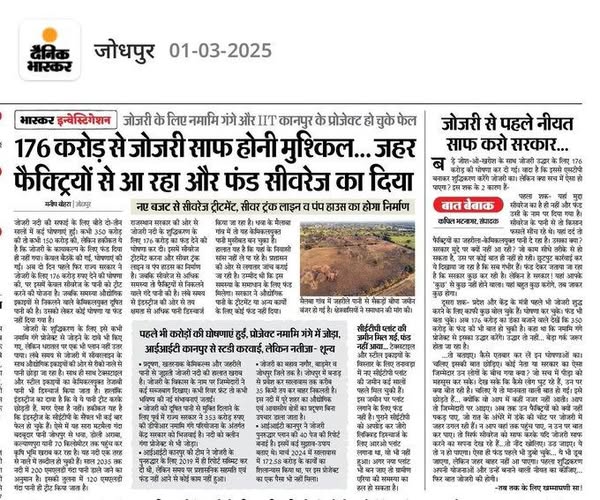
The 83-km-long seasonal river originates from the hills of Pundlu village in Nagaur district and merges into the Luni river along Khejalda village in Jodhpur district. The river is currently alarmingly polluted due to discharge of effluents from the Jodhpur industrial area. Untreated discharge from the textile mills and steel re-rolling units in the Jodhpur industrial area has been contributing to pollution in the river for long. https://www.thestatesman.com/india/rajasthan-govt-allocates-rs-176-crore-to-mitigate-pollution-in-jodhpur-divisions-jojari-river-1503402946.html (28 Feb. 2025) जोजरी नदी में फैक्ट्रियों की ओर से छोड़े जा रहे पानी से समस्या बढ़ती जा रही है। इसे लेकर भास्कर में लगातार खुलासे के बाद प्रदूषण विभाग एक्शन मोड में आ गया है। बीते तीन दिनों में तय मानक से ज्यादा पानी छोड़ने पर दो फैक्ट्रियों पर सख्त कार्रवाई की। तेजाबी पानी से मैलबा गांव के लोगों का सांस लेना ही मुश्किल होता जा रहा है। प्रदूषण विभाग ने रविवार को रीको नाले की जांच भी की। इसमें न केवल तय मानक से पीएच ज्यादा मिला, बल्कि पानी का फ्लो भी ज्यादा पाया गया। https://www.bhaskar.com/local/rajasthan/jodhpur/news/investigation-from-0-point-to-jojri-of-reiko-drain-water-ph-more-than-10-and-flow-55-mld-action-taken-on-two-factories-134528456.html (23 Feb. 2025) शहर के तालाब, नहर, वनखंड, पहाड़ों के बाद अब नदियों पर भी भू-माफिया की नजर है। जेडीए, पीडब्ल्यूडी, वन विभाग और जिला प्रशासन की अनदेखी से हर जगह अवैध निर्माण और कब्जे हो चुके हैं। अब नदी के डूब क्षेत्र में ही प्लॉट काटे जा रहे हैं। इनकी शिकायत पर भी कार्रवाई नहीं हो रही। ऐसा ही एक मामला बनाड़ में जोजरी नदी के डूब क्षेत्र में सामने आया, जहां अवैध कॉलोनी कटने और उसकी शिकायत होने पर भी कोई कार्रवाई नहीं हुई। https://www.bhaskar.com/local/rajasthan/jodhpur/news/colony-being-built-in-jojri-river-133177591.html (June 2024) The NGT has asked the state govt to prepare an action plan and stop the flow of contaminated water into the Jojari river of Jodhpur with immediate effect. Contaminated water from cities and industrial units flows into the river. The NGT had issued an order regarding this on March 19 pointing out that contaminated water was flowing directly into the Jojari river. https://firstindia.co.in/news/india/stop-flow-of-contaminated-water-into-jojari-river-ngt-to-state-govt (30 April 2024)
NARMADA Madhya Pradesh थर्मल प्लांट के राख से त्रस्त किसान और जनता बिनेकी गांव के मोहनलाल यादव, जो कभी 15 एकड़ जमीन पर खेती करते थे, ने 2016 से अपने 5 एकड़ खेत को बंजर पड़ा हुआ देखा है। उनका दावा है कि प्लांट से निकलने वाले राख युक्त पानी के लगातार प्रवाह ने उनके लिए फसल उगाना असंभव बना दिया है। स्थानीय गोंडी नाला जो एक प्राकृतिक स्रोत है और यह किसानों एवं मवेशियों के लिए महत्वपूर्ण है।यह जलस्रोत भी प्लांट से निकलने वाली राख से प्रदुषित हो गया है।गोंडी नाला टेमर नदी मिलती है और यह नर्मदा की सहायक नदी है। नर्मदा नदी के किनारे प्रस्तावित 18 थर्मल एवं परमाणु बिजली परियोजना कि स्थापित क्षमता 25 हजार 260 मेगावाट है।
प्रस्तावित थर्मल बिजली परियोजना लगने पर नर्मदा से प्रति घंटा 7 करोड़ 27लाख 25 हजार 480 लीटर प्रती घंटा पानी निकाला जाएगा।1 मेगावाट बिजली उत्पादन करने के लिये 0.7 टन कोयला के हिसाब से 15 हजार 722 टन कोयला प्रति घंटा जलेगा तो 40 प्रतिशत राख निकलेगा।अर्थात 6 हजार 289 टन राख प्रति घंटा निकलने पर इसका निपटारा करना सरल नहीं होगा।सारणी सतपुड़ा थर्मल पावर प्लांट के अनुभव से पता चलता है कि इस पवार प्लांट से निकलने वाली राखङ तवा नदी में बहाने से पानी दुधिया हो जाता है और मछलियाँ मर जाती है। राज कुमार सिन्हा | बरगी बांध विस्थापित एवं प्रभावित संघ https://www.cenfa.org/farmers-and-public-affected-by-thermal-plant-ash/ (25 Feb. 2025)
Himachal Pradesh Tourism a new threats for rivers Himachal’s beautiful and priceless rivers are facing a new threat in their ongoing battle against “development”. First it was the roads hacked out in their valleys, dumping tens of millions of tonnes of earth and debris into their waters, constricting their flows and devastating aquatic life. Then came the hydel projects, extinguishing whatever little aquatic life was left, drying up the waters, and causing floods downstream. Now there’s a new threat, ironically, the very sector and activity they nurture- Tourism.
.jpg)
Himachal’s rivers are its most precious assets, especially given the prospect of the looming water shortages in the coming decades. They should not be destroyed for commercial profits and political rent seeking.
The Tirthan in Kullu dist is perhaps the last of the relatively untouched rivers, because most of its course lies in the Great Himalayan National Park; it is also the final bastion of the endangered free roaming rainbow trout. Sadly, however, it has been discovered by Tourism and dozens of hotels and homestays have started springing up along its length below Gushaini, most of them “benami”.
Similar constructions are happening along all the rivers. After the floods of 2022-23 the govt has taken some decisions about banning constructions on the flood plains of the Beas. This is not enough. (By Avay Shukla) http://avayshukla.blogspot.com/2025/02/the-new-threat-for-himachals-rivers.html (28 Feb. 2025)
Civil Engineer of Himachal laid the foundation of Ayurvedic Hospital in Beas river in Bajaura of Kullu. Now this foundation is in the air. https://www.facebook.com/share/p/1AENXgDjBy/ (27 Feb 2025)
Plan to divert Manikaran ‘holy water’ stirs row A proposal to transfer water from the natural hot water springs at Manikaran – a site of pilgrimage for both Hindus and Sikhs – to the nearby popular tourist destination of Kasol, 4km away, in Parvati Valley of Kullu district has upset the locals. Residents have threatened mass agitation if the plan to “use the holy water for commercial purposes” is not withdrawn. https://timesofindia.indiatimes.com/india/plan-to-divert-manikaran-holy-water-in-himachal-pradesh-stirs-row/articleshowprint/118396685.cms (20 Feb. 2025)
Punjab Greens criticize ‘watered-down law’ against pollution Environmentalists have strongly criticised the state govt for adopting the Water (Prevention and Control of Pollution) Amendment Act, 2024, arguing that it undermines efforts to combat water pollution. The new law, which replaces a decades-old statute, decriminalises several violations related to water pollution and introduces financial penalties ranging from Rs 10,000 to Rs 15 lakh, rather than the previous provisions that allowed for imprisonment of up to six years.
The Punjab cabinet approved the amended Act on Feb 27, saying it was the 19th state to adopt the law. Initially passed in Feb 2024 by the central govt, the law was already in effect in Himachal Pradesh and Rajasthan, as well as UTs, with provisions for other states to adopt it. Activists argue that the shift from “criminal liability to financial penalties” will only encourage further pollution in Punjab’s already contaminated rivers and groundwater. They believe that the govt is yielding to corporate pressure at a time when activists are actively fighting against water pollution.
One of the significant changes is that the Centre now appoints adjudicating officers to determine penalties, which will be credited to the Environment Protection Fund. Appeals against penalties can be made to the NGT, provided 10% of the fine is paid in advance. Critics argue that the new law significantly reduces the state’s power to control water pollution, particularly by limiting the role of the state pollution control boards. Under the previous act, the state govt had the authority to nominate the chairperson of the board, but the amended law transfers this responsibility to the central govt, raising concerns about the erosion of federal autonomy. https://timesofindia.indiatimes.com/city/chandigarh/pbs-watered-down-law-against-pollution-draws-green-fury/articleshow/118654452.cms (02 March 2025)
GANGA Uttarakhand 100+ tourists stranded as river swells The incident occurred in Rishikesh, when the water level surged unexpectedly, cutting off the devotees from the mainland. As the situation became increasingly critical, panic spread among the stranded individuals, prompting them to cry out for help, fearing for their safety and well-being. Officials later confirmed that there were no casualties or injuries, and the prompt response of the authorities played a crucial role in preventing what could have been a major disaster. Following the incident, authorities have strongly urged visitors, pilgrims, and tourists to exercise caution while venturing near the riverbanks. They have also advised against accessing isolated areas, especially during periods of fluctuating water levels, to avoid similar emergencies in the future. https://timesofindia.indiatimes.com/city/dehradun/rishikesh-100-tourists-from-haryana-stranded-as-ganga-swells-rescued-by-police-video-goes-viral/articleshow/118621094.cms (28 Feb. 2025)
Report Slow progress in ‘Namami Gange’ project Only 69% of funds allocated to the Namami Gange Programme were utilised up to 2024-25, according to a PRS Legislative Research analysis. With more than 450 industries failing to meet pollution norms, PRS said in its Demand for Grants 2025-26 Analysis for the Union Jal Shakti ministry. Additionally, sewage treatment capacity remains a bottleneck. Of the targeted 7,000 MLD treatment capacity, only 52% has been achieved, leading to continued discharge of untreated sewage into the river.
“The NMCG targets STP capacity of 7,000 MLD around the Ganga by Dec 2026. 200 projects have been sanctioned to create STPs with a capacity of 6,217 MLD, and to lay a sewerage network of 5,282 km but, as of June 2024, 86 % of the targeted sewage network has been laid,” according to the think-tank analysis.
It found that funds allocated to the programme had been “underutilised every year since 2014-15, except two years (2020-21 and 2021-22)… ” The Public Accounts Committee (PAC) for 2024 had observed that this fund was lying largely unutilised, PRS said. “As of Mar 31, 2024, the fund had Rs 876 crore. Of this, Rs 383 crore has been sanctioned for various projects”.
The PAC had noted several lapses in project management by the NMCG. “Delays in the approval of DPRs, slow pace of implementation, and low fund utilisation were observed. Poor record maintenance was also noted,” it had said. The PAC also noted large expenditure on advertising and promotion, without proportional impact on the ground. “While the Clean Ganga Fund was set up to collect funds from non-resident Indians and corporates, 53% of the funds (as of Mar 2024) have come from public sector undertakings. The PAC recommended that the NMCG find alternate means to generate funds”. https://www.newindianexpress.com/nation/2025/Feb/25/think-tank-flags-slow-progress-in-namami-gange-project-only-69-of-funds-used (25 Feb. 2025)
Mahakumbh 2025 Science on if Ganga is really self-cleaning A British scientist first observed the anti-bacterial properties of Ganga water in 1896. Last year, a paper found that pollution in the plains is reducing this ability. (BY Pranay Lal)
In 1896, a British bacteriologist named Ernest Hankin stood on the banks of the Ganga, watching as locals filled clay pots with water. He hoped that the dreaded cholera outbreak would not occur under his watch. In his attempt to avert it, Hankin discovered something extraordinary: water drawn from the river seemed to kill the pathogen within hours. Intrigued, Hankin conducted experiments, filtering and heating the water to determine what made it so inhospitable to cholera. He hypothesised that an unseen biological agent was at work. The notion that the Ganga River could retain its self-purifying properties defied conventional wisdom. Hankin’s discovery would take another three decades to be recognised as the action of bacteriophages: viruses that prey exclusively on bacteria. It wasn’t until the 21st century that modern research tools finally confirmed what Hankin had suspected.
The presence of bacteriophages is only a small part of the Ganga story. The secret of the river’s anti-bacterial water lies in its unique geochemical properties.
The clays and sediments of each river are unique, and they entomb a variety of silicate-rich minerals. These minerals deter bacterial growth, killing them or reducing their reproduction. The river, along its course, deposits different silicate concentrations: the higher the concentration, the lower the bacterial counts.
A 2024 paper has found that the Ganga’s dissolved silicon (DSi) and silicon isotopes build up in the river but their potency reduces downstream, in the plains. At higher elevations, only some silicates bind with iron oxides and carbonates. When the river meets the Yamuna and the Gomti, more silicon gets added, from other rocks and river sands. At the place where the Gomti meets the Ganga, the silicate concentration reaches its maximum limit. As sewage gets dumped into the river, farm and industrial pollution builds up and much of the silicates get bound. By the time that the silicates reach the mid-Ganga, they’re completely sequestered. Most get bound to organic molecules like bacteria or sewage. This would not have been the case in the pre-industrial era. As cities and industries have grown, Ganga’s silicate potential has diminished. Instead of trapping CO2, it now combines with human waste.
The Ganga River is no longer the self-cleansing force it once was. Its silicate-rich water, and less so, its myriad bot-like bacteriophages, are fading as the human stain deepens. Restoring the river isn’t just a matter of environmental conservation or a public health imperative. It is critical that this ceaseless engine of carbon capture isn’t lost to modern neglect. https://theprint.in/opinion/is-ganga-self-cleaning-what-science-says/2510541/ (25 Feb. 2025)
Rivers’ natural flow keeps them clean According to the NGT 2017 judgment, the Indian govt formed a group of secretaries on June 6, 2014, to examine the Ganga rejuvenation action plan. Rivers naturally have the ability to purify themselves, absorbing and treating organic waste. However, in the present context, excessive extraction of water for drinking, irrigation, industries and power generation is deteriorating the water quality of rivers. With extreme reduction in water flow, especially in dry seasons, the flow of the Ganga has seriously decreased, the group had told NGT in an official response.
The group also mentioned that pollution signals have been seen even in the upper reaches of the Ganga, where its oxygen levels should be maximised. This suggests that water diversion for hydroelectric projects is damaging Ganga’s health. Moreover, as the Ganga enters the plains, water extraction for irrigation and drinking needs reach its peak. The river’s flow, especially between Rishikesh and Prayagraj, almost halts during winters and summers. In other words, the river’s flow stops, but wastewater (sewage) keeps flowing.
The group also identified untreated sewage and solid waste as significant contributors to the Ganga’s pollution. The NGT acknowledged that all these factors are causing severe water pollution in the Ganga, impacting its self-purification ability. “If the Ganga continues to flow and its ecosystem is restored on a large scale, it will remain clean on its own and regain those unique characteristics for which the Ganga river is worshiped in India. Joint efforts are needed for purity and uninterrupted flow,” Shashishekar, former secretary in the Ministry of Water Resources, River Development and Ganga Rejuvenation stated. https://www.downtoearth.org.in/water/maha-kumbh-2025-rivers-natural-flow-is-what-keeps-them-clean-but-is-it-enough-for-ganga-to-self-purify?556677 (25 Feb. 2025)
Drawing a line between faith & science Phages owe their existence to their bacterial hosts and can be termed “obligate parasites of bacteria” as they alter their host genomes by transferring the resistance genes. Phages destroy bacteria by entering the bacterial cell and replicating their genetic material, causing it to burst open to release new phages, killing the host cell. This life cycle is called the lytic cycle. Science thus informs that phages do eliminate E. coli not just in the Ganga River but in any river. But the river Ganga like many other waterbodies in India remains the most polluted and phages cannot match their proverbial might with the humongous quantity of human waste and industrial effluents flowing into the Ganga, despite the limited level of phages-bacterial interactions. By CP Rajendran https://www.etvbharat.com/en/!opinion/the-ganga-pollution-needs-a-reality-check-drawing-a-line-between-faith-and-science-enn25030103222 (1 Mar 2025)
Bihar River water at several places unfit for bathing: Survey The water of the Ganga river has been found unfit for bathing at several places in Bihar due to the presence of a high value of “bacteriological population”, according to Economic Survey 2024-25. This comes after the CPCB revealed that water quality at multiple locations in Prayagraj during the Maha Kumbh failed to meet primary bathing standards due to excessive faecal coliform levels. “The water quality of Ganga indicates the presence of a higher value of bacteriological population (total coliform and faecal coliform). This is mainly due to the discharge of sewage/domestic wastewater from cities located on the banks of Ganga and her tributaries,” Bihar Economic Survey report said. https://timesofindia.indiatimes.com/india/after-kumbh-ganga-water-at-several-places-in-bihar-unfit-for-bathing-says-survey/articleshow/118662108.cmsv (02 March 2025)
Ranchi Pilgrims returning with skin ailments: Doctors Dermatologists in the city are witnessing an unprecedented surge in skin-related complaints from pilgrims who have returned after taking a holy dip at Prayagraj. Doctors here have noted a significant increase in cases of skin ailments, including severe itching, rashes, and fungal infections among individuals who recently returned from the Kumbh Mela. The surge in cases has raised concerns about the environmental conditions at the religious gathering. Health experts attribute this outbreak to multiple factors: the massive gathering creating ideal conditions for bacterial and fungal growth, high humidity levels, inadequate sanitation facilities, and possible water contamination. The holy dip in the Ganges River, given its current pollution levels, may be a significant contributing factor to these infections, the experts added. https://timesofindia.indiatimes.com/city/ranchi/docs-kumbh-pilgrims-return-with-complaints-of-skin-ailments/articleshow/118459635.cms (24 Feb 2025)
Uttar Pradesh Now, CPCB data claims Sangam fit for holy dip In a development that is nothing short of a miracle, the level of sewage in water at the Sangam, the site of the ongoing Kumbh Mela was recorded at 780 units (per 100 ml) on February 17, well under the safe limit of 2,500, and far lower than the 49,000 recorded on January 20. All the measurements were by the CPCB, and it wasn’t immediately clear why there was so much variation – the number has ranged from 1.8 to 49,000. https://www.hindustantimes.com/cities/lucknow-news/now-cpcb-data-claims-sangam-fit-for-holy-dip-101740563367107.html (26 Feb. 2025)
Pics revealing scale of tent construction on floodplain and level of waste dumped in river. Also solid waste is being burnt on floodplain. https://www.hindustantimes.com/india-news/how-prayagraj-mela-grounds-look-after-maha-kumbh-2025-101740821558330.html (01 March 2025)
CPCB inspecting industries to curb pollution The Central Pollution Control Board (CPCB) February 10, 2025 filed its report on steps taken to control pollution of River Ganga in Uttar Pradesh.CPCB formed approximately 50 teams made up of its officials to carry out unannounced and random inspections of 1,370 grossly polluting industries (GPI), 36 STPs and 8 CETP / common chrome recovery unit (CCRU) located in Uttar Pradesh.
Inspections by the CPCB teams commenced on August 26, 2022 and went on till November 30, 2024. A total of 1,391 inspections have been completed, including 1,347 GPIs located in 62 districts of Uttar Pradesh, 36 STPs in 10 districts and eight CETPs / CCRU in five districts. The remaining 23 GPIs are under process for inspection.
As per the 145 inspection reports, 76 GPIs were found operational and 69 were found non-operational. Out of the 76 operational GPIs, 34 GPIs were complying to norms, 40 GPIs were non-complying and 2 were dry operational on the day of inspection. The latter were recommended for re-inspected by UPPCB since the compliance of these units could not be verified. https://www.downtoearth.org.in/environment/daily-court-digest-major-environment-orders-february-21-2025 (24 Feb. 2025)
Trees axed on Kanwar route without final approval: FSI A total of 17,607 trees have been cut in Ghaziabad, Meerut, and Muzaffarnagar districts to make way for the new 111-km Kanwar Yatra route, as per data provided by the PWD which is “not as per rules” and without “final approval”, according to a report submitted to the NGT by the Forest Survey of lndia (FSI).
The FSI was part of a four-member joint committee constituted by the NGT last year to ascertain whether trees were cut illegally for the project. The FSI’s report dated February 20 said its opinion was not included in a ‘final report’ of a joint committee submitted to the NGT by the Meerut District Magistrate (DM), one of the panel members and the coordination point person, on January 17. “Communication has been received from the MoEF confirming that final approval has not been accorded to the project, as is necessary before any commencement of tree felling operations,” the February 20 FSI report said.
The joint committee report had found no illegality in the felling of the trees. “No excess or illegal tree felling was noticed by the Joint Committee during the field visits and its enquiry thereon,” the January 17 report stated. On January 20, the NGT noted that the committee report was not signed by FSI Joint Director Meera Iyer and said she could submit a separate report in case her stand was different. Ms. Iyer’s response filed on February 20 stated that the FSI’s opinion was not incorporated by the Meerut DM in the report submitted to the green panel. https://www.thehindu.com/news/national/uttar-pradesh/trees-axed-for-kanwar-yatra-route-by-up-govt-without-final-approval-fsi-tells-ngt/article69267901.ece (27 Feb. 2025)
YAMUNA SANDRP Blog An Action Plan for Yamuna It was great to see that river figured prominently in the just concluded Delhi Assembly Elections where BJP has come to power in the state after 27 years. Prime Minister Narendra Modi assured Delhi that the BJP government will make every effort to clean Yamuna. “It may be a long haul but Mother Yamuna will surely bless our efforts,” he said. Will this help the cause of the River? https://sandrp.in/2025/02/28/an-action-plan-for-yamuna-in-delhi/ (28 Feb. 2025)
Delhi SC hopes for better coordination The Supreme Court on Feb 25 expressed optimism about better implementation of plans to clean the Yamuna, citing a “change of circumstance” in Delhi after the BJP formed the government in Delhi. Observing that a BJP government is in place in neighbouring Haryana too—from where the Yamuna flows into the Capital—a bench headed by justice Bhushan R Gavai said: “With the change of circumstance, disputes between the Haryana and Delhi governments may not arise.”
The court was hearing a suo motu petition of 2021 on remediation of polluted rivers, with a focus on cleaning the Yamuna, due to the constant refrain by the Delhi government of high ammonia content in the Yamuna that could not be processed by treatment plans that ultimately led to water shortfall in the Capital.
On Feb 25, the court asked Additional Solicitor General (ASG) Aishwarya Bhati, who was representing both the Centre and Delhi govt, whether the issue can be sent to the NGT, which has been monitoring the Yamuna pollution case since 2017. The bench, also comprising justice Augustine George Masih, said, “You (ASG) take instructions on whether any other case on Yamuna pollution is pending before this court. Consult your officials in the MoEFCC & Delhi govt with regard to the issues involved in this petition. In the changed circumstances, there will be better implementation of plans.”
Senior advocate Meenakshi Arora, assisting the court as amicus curiae along with advocate Vanshaja Shukla, told the court that prior to the top court taking up this matter suo motu in Jan 2021, the NGT had passed various orders and was monitoring the implementation of the river clean-up through a Yamuna Monitoring Committee. This committee was disbanded after Jan 2021, Arora informed the court. The court said it will examine whether the issue needs to be sent back to NGT. However, in the event there was any other matter on the Yamuna pollution pending in this court, all petitions on the issue need to be consolidated, the bench observed. https://www.hindustantimes.com/cities/delhi-news/sc-hopes-for-smoother-yamuna-clean-up-due-to-bjp-govt-in-delhi-101740507121393.html (26 Feb. 2025)
SC hopes for better implementation A bench of Justices B R Gavai and A G Masih was hearing a suo motu case, titled ‘Remediation of polluted rivers’, registered by the court in Jan 2021 regarding the pollution of water bodies by untreated sewage. An SC bench presided by the then Chief Justice of India S A Bobde had taken suo motu cognizance of the matter while hearing a plea by the Delhi Jal Board, which alleged that Haryana was dumping untreated discharge in the Yamuna, leading to a spike in ammonia levels. https://indianexpress.com/article/india/delhi-changed-circumstances-better-implementation-sc-yamuna-pollution-9856133/ (25 Feb. 2025)
NGT asks DPCC to file report on illegal dyeing units After the authorities informed NGT that they took action against dyeing units in Khyala and Meethapur village in Delhi, the applicant, an environmental activist, told NGT that more illegal units were operating in these areas. The tribunal has directed Delhi Pollution Control Committee to take action and submit status report in 4 weeks.
In the other matter, the joint committee, which inspected dyeing units in Jan, said Municipal Corporation of Delhi had served a show-cause notice to six units and sealed one in Ghoda village. The committee also observed traces of coloured effluent in drains near 10-15 units, which were found to be locked. The committee recommended that MCD also take action against these 10-15 units and asked DPCC to levy environmental compensation. https://timesofindia.indiatimes.com/city/delhi/ngt-seeks-report-from-dpcc-after-plea-claims-illegal-dyeing-units-still-operating/articleshow/118539234.cms (25 Feb. 2025)
Desilt drains by monsoon: NGT The NGT Feb 21, 2025 directed the additional chief secretary of the irrigation and flood control department (I&FCD) of Delhi to submit an undertaking by Feb 25, 2025 to complete desilting 24 drains that fall into River Yamuna within the stipulated timeline. The official was directed to appear virtually on the next date of hearing on Feb 27, 2025 to appraise the court about the details of the manner in which the timeline will be adhered to. The drains included Sonia Vihar drain, Najafgarh drain, Shahdara drain, Barapulla drain and Tuglakabad drain, among others. I&FCD submitted a report Feb 20, 2025 disclosing the status of desilting. The report also mentioned the targeted quantity of desilting. https://www.downtoearth.org.in/environment/daily-court-digest-major-environment-orders-february-21-2025 (24 Feb. 2025)
TERI shares plan to clean river in 3 years The Energy and Resources Institute (TERI) has prepared a brief action plan to clean river Yamuna. According to TERI sources, the plan outlines actions required to improve river health has been shared with Delhi govt and is awaiting a response. TERI claims that the river could be rejuvenated within three years under its 10-point action plan. https://timesofindia.indiatimes.com/city/delhi/yamuna-most-polluted-this-jan-in-5-years-dpcc-report/articleshowprint/118539242.cms (25 Feb. 2025)
MoJS consults Sabarmati RFD experts for action plan According to sources, for the ‘Yamuna Master Plan’, the Jal Shakti Ministry consulted experts who built Gujarat’s Sabarmati river front. Additionally, a few meetings have also been held by the ministry, sources said. https://www.indiatoday.in/cities/delhi/story/yamuna-cleaning-pollution-master-plan-centre-forms-pm-narendra-modi-approval-bjp-aap-2686842-2025-02-28 (28 Feb. 2025)
Plans afloat to launch river cruise Delhi Tourism & Transportation Development Corp (DTTDC) has launched an initiative to introduce ferry boats on the river. A private agency will be selected to operate a 7-8 km round-trip cruise, with modern, electric-powered, air-conditioned vessels running for approximately 270 days a year, except during the monsoon season when the river swells. DTTDC has released a request for proposals to hire a private agency with prior experience to set up the cruise service in the capital.
A private agency will be engaged by DTTDC to run the project for five years. While the ticket rates will be determined by DTTDC, the agency will share a percentage of its profit twice a year with the tourism body. The tourism body is likely to finalise the agency by mid-April, and the tourist activity may start by the end of 2025 or early 2026.
Officials said the Delhi govt’s irrigation and flood control department signed a MoU with the Inland Waterways Authority of India (IWAI) for a ferry ride or boat taxi project on the Yamuna in Sept 2024, and an expression of interest was also floated to start the facility between Sonia Vihar and Hanuman temple, near Wazirabad barrage. Sources, however, said the responsibility to run the project has now been handed over to the DTTDC, while IWAI, the irrigation and flood control department, DDA, and Delhi Jal Board will have defined roles to help in the execution.
Before this, the NCR Planning Board proposed a Yamuna Water Taxi Project with tentative stations located at Madanpur Khadar, Film City, Nizamuddin, and ITO. Before the assembly election, LG VK Saxena directed the DDA to explore the possibility of installing a ropeway or cableway that would carry passengers in cable cars across the river. https://timesofindia.indiatimes.com/city/delhi/plans-afloat-to-launch-river-cruise-on-yamuna/articleshow/118653866.cms (02 March 2025)
The plan involves developing a 6-km stretch of the Yamuna, from the Wazirabad barrage (Sonia Vihar) to Jagatpur (Shani temple), for tourist cruise operations, reported PTI. On Friday (Feb. 28), the DTTDC released a request for quotation (RFQ) to find a suitable operator for two solar or electric battery-powered cruises along the designated river stretch. Once operational, the initiative is expected to enhance river-cruise tourism, offering an eco-friendly and sustainable water transport option.
Each boat must accommodate 20-30 passengers and be capable of reaching speeds between five to seven knots. The boats must feature inboard bio-toilets (zero discharge), an announcement system, and safety jackets for passengers. The boats should be air-conditioned, leased or owned, and no older than two years. The operator must ensure at least four round trips per day, as outlined in the proposal. https://www.hindustantimes.com/india-news/delhi-government-plans-to-launch-cruise-service-on-yamuna-for-tourist-operations-101740864851011.html (02 Feb. 2025)
Will develop 48km stretch to get facelift: Verma Delhi water minister Parvesh Verma stated that the entire 48 km stretch will be redeveloped into a green zone comprising jogging path, picnic spot dotted with small eateries and stalls. He assured that rules against the river pollution will be made stricter. “The industries releasing the industrial waste into the Yamuna will be fined.” https://www.newindianexpress.com/cities/delhi/2025/Feb/28/48-km-stretch-along-yamuna-to-get-facelift (28 Feb. 2025)
Photographer wins for pollution picture Somenath Mukhopadhyay’s shot of a woman offering Chhath Puja in the Yamuna near Delhi, the river’s water white with foam, wows judges at the Nature inFocus Photography Awards. He clicked the image in November 2019.
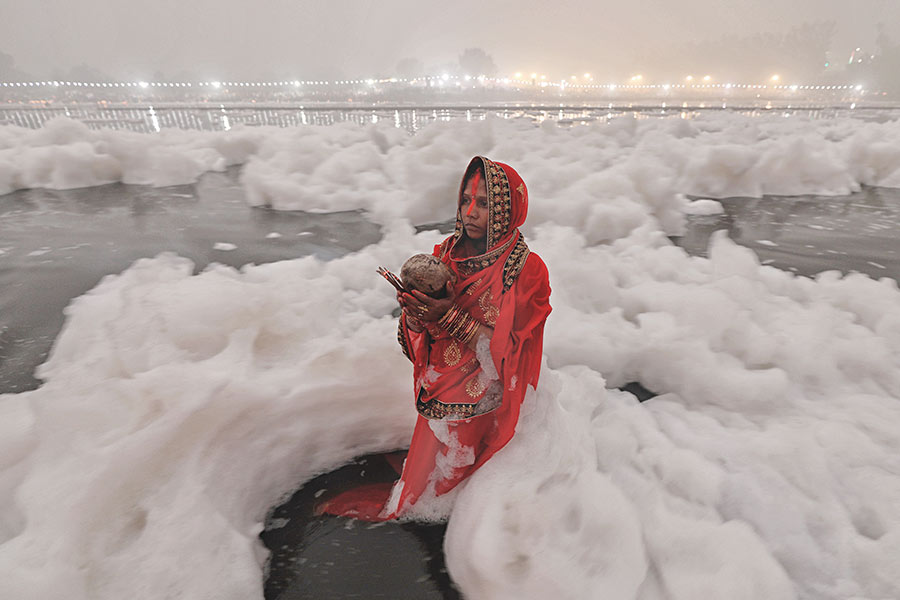
“There are several effects of this pollution on human, agricultural and aquatic health. I thought this particular image would be revealing a snapshot describing the whole effect in one particular shot. The title of my image is ‘Sinner’. Now this is a great irony as to who is the sinner over here. The person in the image who is praying and doing the rituals is she or he the sinner or are we the people who failed to protect the river? In the name of religion we are polluting our river sources. Now also, during the Khumbh Mela, the water is being polluted everywhere and all this is happening in the name of religion, worship and rituals. People think all this is divinity, but it is not so.” https://www.telegraphindia.com/gallery/bengal-photographer-wins-special-mention-for-yamuna-pollution-picture-photogallery/cid/2085373 (24 Feb. 2025)
Haryana Dainik Bhaskar report on how untreated effluents from Yamuna Nagar, Karnal, Panipat, Sonipat and Faridabad dists polluting Yamuna in addition to causing sufferings to local villagers along the polluting drains. https://www.facebook.com/share/p/1CPCeVKUjT/ (25 Feb 2025)
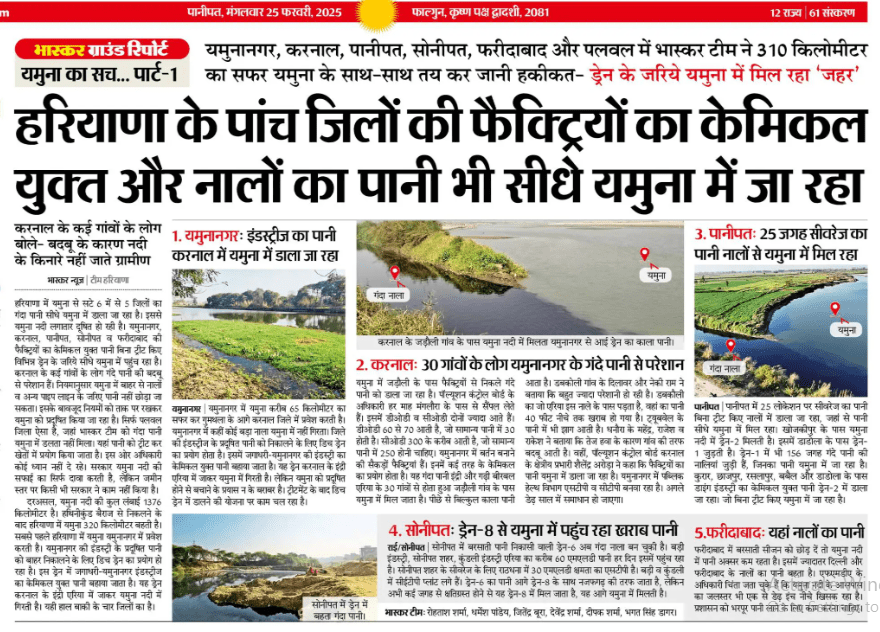
Noida Illegal construction on Hindon floodplain demolished In Jan 2025, a joint operation by Noida authority, revenue dept and police was carried out, and demolition of unauthorised buildings was carried in the area, said district administration officials. A recent inspection by Anuj Nehra, SDM, Dadri, alongside other officials, however, found that illegal reconstruction had been carried out at the same site. The district administration took immediate action and deployed JCB machines to once again demolish the unauthorised structures, officials said. https://www.hindustantimes.com/cities/noida-news/illegal-constructions-resurface-in-hindon-floodplains-5-booked-101740768578674.html (01 March 2025)
Madhya Pradesh बेतवा की कहानी, बेतवा की जुबानी This Hindi documentary by Environment Story reveals that Betwa river has dried up at its origin place due to some construction and encroachment works. Few springs fed by Kollar dam seepage are feeding the river course there. The river is further polluted by industrial waste from Mandideep area and sewage pollution from Bhopal city making its water unfit for drinking and bathing purposes. In later course too the river continues to suffer from water extraction, floodplain encraochment and mining activities. It also informs that the NGT in 2015 asked the MP govt and local administration to tap the drains polluting the river and remove encroachment from its floodplain. However, the situation has only worsen even after 10 years of the order. It summaries that the Betwa river has turned seasonal due to human activities and it is important to revive the river to achieve clean Ganaga objectives. https://www.youtube.com/watch?v=DDDK4-LROqU&t=124s (27 Feb. 2025)
Raw sewage pollutes Chandraloi river The case was initiated suo motu based on a news report titled Four endangered crocodiles found dead in the Chandraloi river in Kota; experts wonder if pollution is to blame, published in The Indian Express on Dec 6, 2024. The NGT, on Dec 19, 2024, constituted a joint committee to inspect the site, conduct biomonitoring and bioassay tests, and submit a report. The joint committee conducted site visits on Jan 24 & 25, 2025 and collected water samples from nine representative locations where crocodile deaths had been reported between Nov 30 and Dec 4, 2024.
The report highlighted that organic pollution from untreated sewage entering the Chandraloi river is a significant issue. The report acknowledged systemic issues in Kota’s sewage infrastructure, leading to raw sewage entering the Chandraloi river. The Chandraloi river is a small tributary of the Chambal river. As it flows along the outer periphery of Kota, it merges with the Kansua Nalah, which carries some of the city’s domestic sewage, treated industrial effluent, and agricultural runoff. Crocodiles inhabit the Chandraloi river along its length. https://www.downtoearth.org.in/environment/daily-court-digest-major-environment-orders-february-24-2025 (25 Feb. 2025)
RIVERS BIODIVERSITY
Kerala ‘12th fail’ lensman aces nature’s test Reji Chandran was fortunate that his home in Aryanad, Thiruvananthapuram, lay on the fringes of a reserved forest area bordering the Karamana River. His love for nature drew him closer to what would become his passion — searching for endemic species of odonates and developing a keen interest in the exquisite inhabitants of nature, from birds to reptiles.

Reji’s journeys into the Western Ghats continued. “Can you believe that there are 104 kinds of dragonflies in Aryanad panchayat alone?” he asks. “The reason for such abundance could be the geography. Until not long ago, the suburban areas of the capital towards the Western Ghats were forested tracts, and remnants of that greenery remain. Plus, the Karamana River flows in almost pristine condition through these areas.”
Odonates, such as dragonflies and damselflies, are indicators of freshwater presence in any ecosystem, he explains. Reji references international studies on dragonflies to measure freshwater content and environmental depletion. “Such studies are lacking in Kerala. Dragonflies, once integral to the land’s culture, are now seen sparingly, largely due to depleting freshwater sources,” he highlights. https://www.newindianexpress.com/states/kerala/2025/Feb/24/12th-fail-lensman-in-kerala-aces-natures-test (25 Feb. 2025)
FISH, FISHERIES, FISHERFOLKS
Karnataka Critically endangered Haragi fish released into Tunga reservoir The scientists of the Central Institute of Freshwater Aquaculture (CIFA) and Dept of Fisheries of Keladi Shivappa Nayaka University of Agricultural and Horticultural Sciences, released 50 adult pairs and 5,000 fingerlings of Haragi fish, Hypselobarbus pulchellus, a critically endangered carp, into Tunga reservoir near Shivamogga on Monday (Feb. 24). The International Union for Conservation of Nature (IUCN) classified Haragi as a critically endangered carp in 2011. Considering its conservation, the Regional Research Centre of ICAR—CIFA reared the species at its hatchery in Hesaraghatta in Bengaluru.Gangadhar Barlaya, principal scientist of RRC Bengaluru, spoke about the fish habitat and stated that it was known to consume aquatic weeds. The species was necessary in controlling aquatic vegetation in reservoirs. https://www.thehindu.com/news/national/karnataka/critically-endangered-fishlings-released-into-tunga-reservoir-in-shivamogga/article69258417.ece (24 Feb. 2025)
SAND MINING
Report Sand mining continue to pose threat to Yamuna Illegal mining in the Yamuna River, which primarily takes place in Haryana, Uttar Pradesh, Uttarakhand and Delhi, has been a growing concern for years. The situation is particularly problematic due to the extraction of sand and gravel from the riverbed, which is often done without any regulatory oversight or adherence to environmental standards.
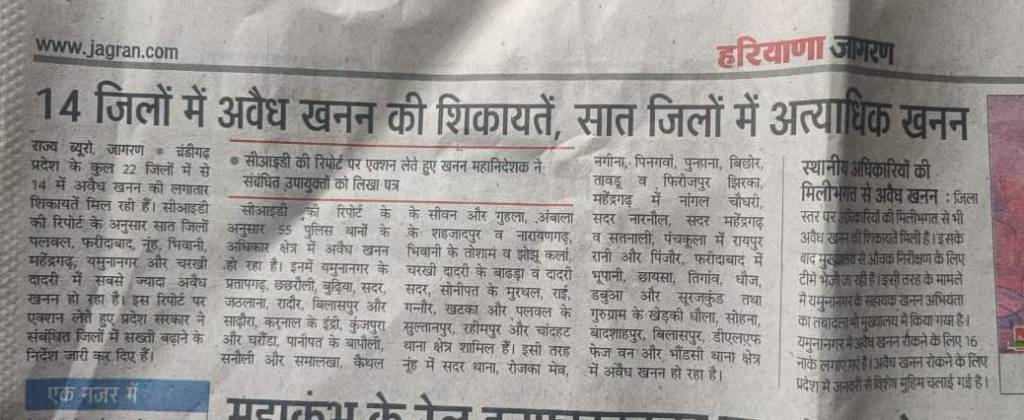
Despite various initiatives, such as increasing patrols and imposing fines, the persistence of illegal mining continues to pose a serious challenge for environmental protection and sustainable development in the region. In addition to environmental harm, illegal mining often results in adverse social consequences. The practice is frequently linked to corruption and exploitation, with workers subjected to poor working conditions and minimal pay. In some cases, illegal miners operate in regions where law enforcement and regulations are weak, further complicating efforts to address the issue. https://www.downtoearth.org.in/water/sand-mining-riverbed-erosion-continue-to-pose-existential-threat-for-yamuna (24 Feb. 2025)
Haryana; Rajasthan In just 2 days 2 more front line defenders lost their lives to sand/stone mafia operations. While overload stone dumper mowed down 40 years old home guard Devendar Singh on Feb 23 in Charkhi Dadri, Haryana; a forest ranger Kishor Kumar was killed by illegal sand carrying tractor in Pali, Rajasthan on Feb 24. https://www.facebook.com/share/p/1GY78Gc143/
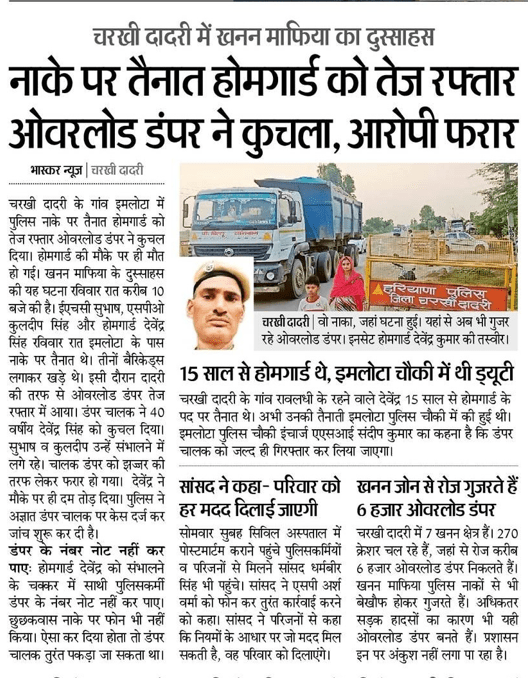
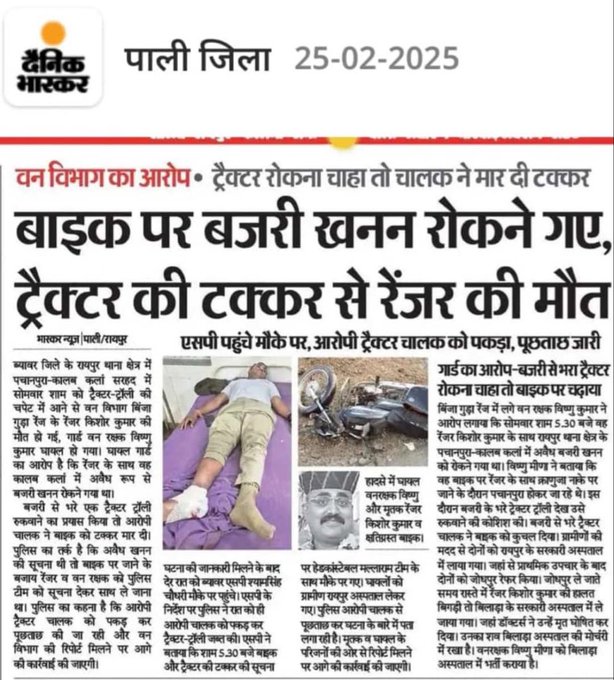
राजस्थान में बजरी माफियाओं के हौसले इतने बुलंद हैं कि अब वे सरकारी अधिकारियों को निशाना बनाने से नहीं चूक रहे। पाली जिले के रायपुर मारवाड़ में हुए सड़क हादसे में क्षेत्रीय वन अधिकारी की मौत हो गई, जबकि उनके साथ जा रहे वनरक्षक गंभीर घायल हो गए। जानकारी के अनुसार क्षेत्रीय वन अधिकारी प्रथम किशोर कुमार बींजागुड़ा रेंज अपनी बाइक पर वनरक्षक विष्णु कुमार मीणा के साथ कानूजा जा रहे थे। जब वे कालब खुर्द के पास पहुंचे, तभी सामने से आ रहे एक अवैध बजरी से भरे ट्रैक्टर ने उन्हें टक्कर मार दी। दुर्घटना के बाद घटनास्थल पर ग्रामीणों की भीड़ जुट गई। https://www.patrika.com/pali-news/regional-forest-officer-dies-after-being-hit-by-a-tractor-loaded-with-illegal-gravel-19421950 (25 Feb. 2025)
Haryana Two brothers were killed and a woman was injured when the motorcycle they were riding was allegedly hit by a tipper near Tunde Ki Tapriyan village on the Sadhaura-Ranjitpur road in Yamunanagar. https://www.tribuneindia.com/news/haryana/two-brothers-killed-in-ynagar-road-accident/ (15 Feb. 2025)
HC slams police for ‘stifling’ illegal mining investigation The Punjab and Haryana high court described the failure of the police and department of mining to arrest a single person out of the 82 mentioned by four individuals who had been previously arrested in an illegal mining case as “shocking.” The court said that from submission of the counsels, “it was apparent that senior officers of the department of mining and police are involved in the entire scam and the Haryana police is now trying to stifle the investigation, which cannot be permitted.”
Commissioner of police, Panchkula, was directed to remain present in court on the next date of hearing. The case was registered after illegal mining was reported from Pinjore, Barwala, Raipur Rani, and Chandimandir in Panchkula district. Last Nov, crime branch of Panchkula police arrested three individuals involved in illegal mining in the district. The accused were later released on bail.
-During interrogation, the accused alleged that home guard Deepak was involved in the illegal mining racket, acting as a middleman between miners and many govt officials. The home guard would allegedly receive a commission for facilitating illegal mining activities, it was alleged. Earlier, Deepak, along with two others, got interim bail from the HC. https://timesofindia.indiatimes.com/city/chandigarh/high-court-slams-haryana-police-for-stifling-illegal-mining-investigation/articleshowprint/118565326.cms (26 Feb. 2025)
Panchkula cop involved in illegal mining arrested The SIT has arrested ASI Malkit Beniwal for being involved in an illegal mining case in Panchkula. He was presented before the Panchkula court today, which sent him to Ambala jail instead of granting police remand. Beniwal, stationed at the Barwala police post, is implicated in the Barwala area mining case. The SIT, led by DCP Himadri Kaushik and ACP Vikram Nehra, sought a three-day remand, which the court rejected. The scam, discovered in December 2024 via WhatsApp groups, led to an FIR at Chandimandir police station. The investigation revealed a large network of 82 suspects; 69 have been questioned. Home guard Deepak Sharma, the alleged mastermind, is under scrutiny for facilitating deals between officials, police, and miners. https://www.hindustantimes.com/cities/chandigarh-news/panchkula-cop-involved-in-illegal-sand-mining-arrested-101740861970744.html (02 March 2025)
Calls bare police-miner nexus in Panchkula Several police officers, including of the DSP rank, are under scrutiny as the investigation into the Panchkula mining scam has revealed that hundreds of calls were exchanged between them, middlemen, and illegal miners. WhatsApp groups were allegedly used to share information about vehicle registration numbers carrying illegally mined sand, so that these could be allowed to pass without being checked.
The Punjab and Haryana High Court has not only issued strictures on the delayed investigation against police officers but has also directed the Commissioner of Police, Panchkula, to appear in person on March 3. According to an FIR, which is based on source-based information, Deepak Sharma, a Home Guard, acted as a middleman for officers at police stations and posts in the Pinjore and Chandimandir areas, collecting bribes from illegal miners on their behalf.
After the high court on Feb 19 commented that “the investigation into the present case has not made any headway and rather it appears that every attempt is being made to screen the senior police officers,” the Panchkula police arrested three low-ranking policemen — head constables Nafe Singh and Inderjeet, deputed with the Haryana State Enforcement Bureau, ASI Malkit Singh & driver Manveer of the Mining Dept. https://www.tribuneindia.com/news/haryana/calls-bare-police-miner-nexus-in-panchkula/ (2 Mar 2025)
Punjab Illegal miner earning Rs 1.5 lakh daily alarming: HC “This court is very much sanguine of the fact that rampant mining in Punjab has risen high in no time and one such instance has been reported recently wherein a resident of Moga, who was arrested by the Jalandhar Rural Police for illegal sand mining and threatening toll plaza employees at gunpoint, used to earn a profit of Rs 1.5-2 lakh daily by selling sand in the open market. Having said so, it shows the inability of the state government to combat illegal mining which if kept unchecked, would cause havoc in no time to the environment as well as the state’s security,” Justice Moudgil added.
-Taking up an anticipatory bail plea, Justice Moudgil made it clear that illegal mining had escalated at a dangerous pace, with the state failing to enforce regulatory measures. The Bench added that unplanned mining, a multi-crore industry, could cause severe ecological damage by altering the natural course of river flow, increasing the risk of floods in surrounding areas. In his detailed order, Justice Moudgil asserted that sand mining, undoubtedly being a “lucrative industry worth crores of rupees,” had become a significant problem in present times, “causing damage to the environment at large and losses to the state exchequer.” https://www.tribuneindia.com/news/punjab/illegal-miner-earning-rs-1-5-lakh-daily-alarming-high-court-to-punjab/ (20 Feb. 2025)
Karnataka Sand miners attack officials during raid in Koppal The incident occurred on Friday (Feb. 28) afternoon when three department officials, including Sachin Gauripur, raided an illegal sand mining site at Hirehalla. During their attempt to halt the unlawful activities, eight sand smugglers present at the location became aggressive and confronted them. Tension rose when officials stopped a tractor that was illegally transporting sand and instructed the driver to unload it. In a violent reaction, eight persons who were loading the sand assaulted Sachin Gauripur, inflicting injuries. He was quickly taken to the district hospital for treatment.
-Ishappa Madinur, a local leader who has faced similar challenges while trying to combat illegal sand mining, noted that such incidents are becoming increasingly frequent in the area. Following the incident, senior geologist Rasheed from the department of mines and geology decided to file a complaint at the Alawandi police station, seeking legal recourse against the perpetrators. However, department sources indicated that the police are hesitant to register the complaint, as the accused are connected to an influential person, who has close ties with a local politician. https://timesofindia.indiatimes.com/city/hubballi/sand-miners-attack-officials-during-raid-in-koppal/articleshowprint/118653303.cms (01 Mar. 2025)
Maharashtra HC junks plea against Minister’s sand mining statement The Bombay High Court on Feb 7 refused to entertain a petition filed by an activist seeking an investigation against cabinet minister Radhakrishna Vikhe Patil’s statement about sand mining. At a program in Solapur dist in Jan 2025, he said: “Solapur is famous for sand mining & crushers. I told the district collector to let the vehicles involved in it continue their business.” The statement was criticised by opposition parties & public, who accused the minister of supporting and protecting the sand mafia. Later, he clarified his remarks, stating that he has always taken a stand against illegal activity.
It was based on Vikhe Patil’s statement that Koli’s plea sought an investigation, calling the minister’s remarks an “illegal.” Choudhari submitted that the petitioner had been assaulted due to his activism against illegal sand mining and had filed multiple petitions in the High Court. https://www.indiatoday.in/india/law-news/story/bombay-high-court-junks-plea-maharashtra-minister-vikhe-patil-sand-mining-statement-2676329-2025-02-07 (07 Feb. 2025)
Madhya Pradesh राजगढ़ में जारी है अवैध रेत खनन, 5 नदियां हो रही प्रभावित अगस्त 2024 में रेत माफियाओं ने प्रशासनिक अमले को घेरा, नायब तहसीलदर को धमकी दी, और उन्हें ट्रैक्टर से टक्कर भी मारी। यह खबर बताती है कि राजगढ़ में किस तरह रेत माफिया निरंकुश हैं और अवैध खनन को रोकने के लिए बनी तमाम नीतियां ज़मीन पर कारगर नहीं हो रही हैं। ग्राउंड रिपोर्ट ने राजगढ़ में उन इलाकों का दौरा किया जहां अवैध रुप से खनन हो रहा है, और यह जानने का प्रयास किया कि यह खनन नदियों और पारिस्थितिकी तंत्र को कैसे प्रभावित कर रहा है। https://groundreport.in/ground-report-hindi/sand-mining-in-parvati-kalisindh-rivers-of-rajgadh-madhya-pradesh-8750355 (24 Feb. 2025)
WETLANDS, LAKES, WATER BODIES
Odisha ₹143cr released for 4 Ramsar wetlands: Ministry to HC The MoEF&CC informed the Orissa high court on Feb 19 that Rs 143.21 crore was released for the conservation and management of four of the six Ramsar wetlands in Odisha under the National Wetlands Conservation Programme (NWCP) and National Lake Conservation Plan (NLCP) until 2012-13.
Providing details of the funds allocated for wetlands in Odisha, Dr Mahato stated that the ministry released Rs 72.50 crore from 2021-23 for the Bhitarkanika mangroves, which was designated as a Ramsar site in 2002. Between 1989-2024, Rs 30.87 crore was provided for Chilika lake and Rs 33.40 crore for the Satkosia gorge between 2015 and 2025. Both were declared Ramsar sites in 1981 and 2021, respectively.
As for Ansupa lake, the ministry released Rs 6.44 crore between 2008 and 2021. It was recognised as a Ramsar site in 2021. In the case of two other wetlands declared Ramsar sites — Tampara lake and Hirakud reservoir — the integrated management plan (IMP) is under preparation and awaited, respectively. It was recognised as a Ramsar site in 2021.
The HC was hearing a PIL initiated suo motu by it on Jan 22 to monitor the conservation of six wetlands in the state. The proceeding was initiated following a Supreme Court order on Dec 11 last year, which called for the protection of 85 Ramsar sites across the country. Taking note of the affidavit, the two-judge bench of acting Chief Justice Arindam Sinha and Justice M S Sahoo scheduled March 5, 2025 as the next date to assess the progress of the implementation of the SC order, expecting affidavits from authorities concerned by then. https://timesofindia.indiatimes.com/city/bhubaneswar/rs-143cr-released-for-conservation-mgmt-of-4-ramsar-wetlands-in-state-ministry-to-hc/articleshowprint/118396635.cms (20 Feb. 2025)
Meghalaya HC registers suo motu PIL to ensure maintenance of wetlands The Meghalaya High Court on Thursday (February 27) registered a suo moto PIL to ensure that the Ramsar Convention wetland sites within the State are properly maintained and ensured. By an administrative order dated Feb 6, 2025, the SWA was asked to furnish a report. However, the MS, SWA by his letter dated Feb. 14, 2025 informed that there was no notified Ramsar site in the State of Meghalaya. Therefore, the Chief Justice directed to initiate a suo motu PIL to seek confirmation of the above assertion of the Wetlands authority and for other directions in compliance with the Supreme Court directive. The matter is listed again on March 12. https://www.livelaw.in/high-court/meghalaya-high-court/meghalaya-high-court-suo-moto-pil-ramsar-convention-sites-maintenance-285214 (28 Feb. 2025)
Haryana Artificial wetlands fuel 10% growth in wetlands area The total wetland area in Haryana grew from 33,649ha in 2017-18 to 36,984.5ha in 2023-24, marking an increase of 3,335.5ha, or 10%. This growth is largely due to the creation and expansion of human-made wetlands, such as artificial ponds, tanks and waterlogged areas, as per a report titled “Indian Wetlands: High Resolution Remote Sensing Assessment and Analysis” by the Space Applications Centre.
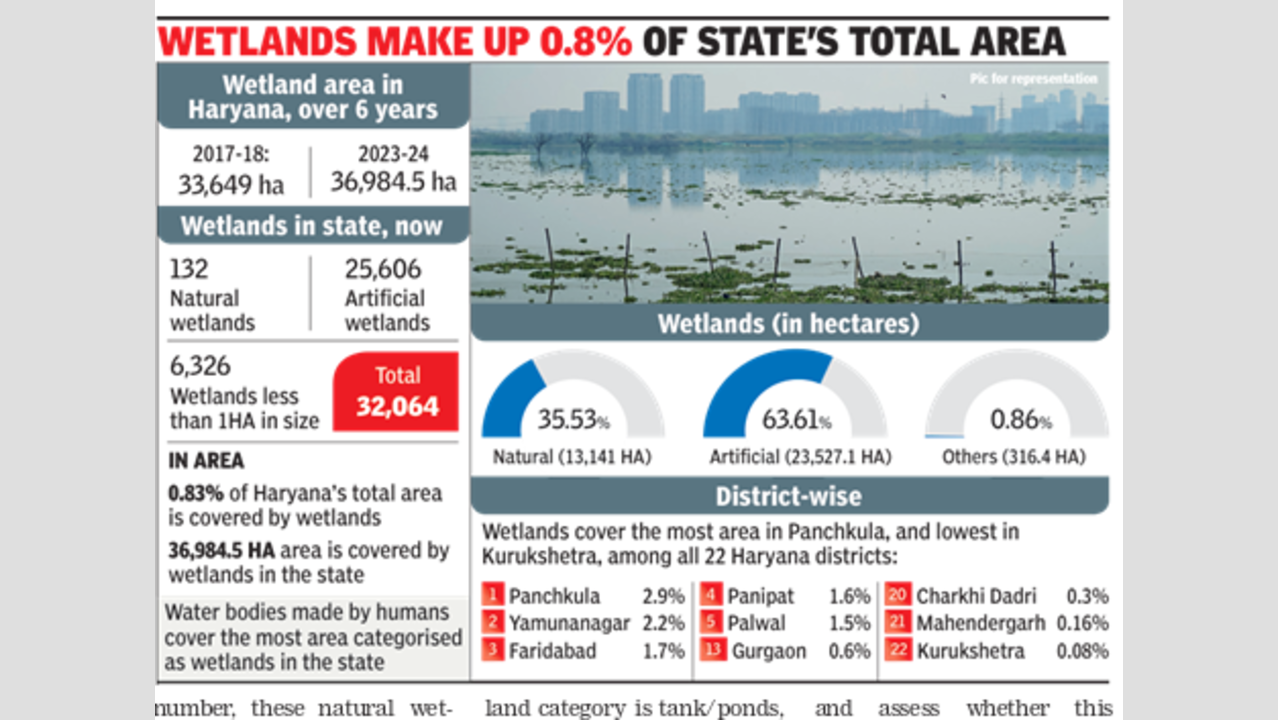
West Bengal Residents fighting to protect their waterbody In the first week of January 2025, a group of residents from Bhabadighi village attended a convention in Chinsurah, the district headquarters of Hooghly, to advocate for the protection of a 17.48-acre natural waterbody in their village, named after it. For a decade, they have been protesting against the construction of a railway line that would cut through the Bhabadighi. This railway line is part of the Tarakeswar-Bishnupur Rail Project. Local residents have raised concerns about the construction of the railway line over the waterbody, which is integral to the livelihood of approximately 150 families. https://www.downtoearth.org.in/water/residents-of-this-west-bengal-village-have-been-fighting-for-over-a-decade-to-protect-their-waterbody (27 Feb. 2025)
Kerala Waste management strategies not sustainable The study also highlighted the environmental hazards posed by 44 identified legacy waste dumps across the state, many of them located near watebodies. “This open dumping has contributed to a rise in health issues throughout the state,” the report asserted.
-The issue of plastic pollution is another cause for concern. Despite the introduction of a ban on single-use plastics in 2020, Kerala continues to be plagued by an accumulation of plastic litter along its coastline. Major water bodies, such as Vembanad and Ashtamudi Lakes, now exhibit disturbing levels of microplastic contamination, with commonly consumed fish testing positive for these particles.
-The study also warned against an over-reliance on centralised, high-cost, energy-intensive waste-to-energy plants as a silver bullet. Authorities must critically assess whether these technologies are the best available option, whether a reliable supply of waste can be guaranteed, and if effective pollution monitoring systems are in place. https://www.downtoearth.org.in/waste/keralas-waste-strategies-not-sustainable-shifting-environmental-harm-over-addressing-crisis-report (24 Feb. 2025)
Opinion The necessity of mainstreaming wetland conservation Identification of Ramsar site does not necessarily contribute to its conservation. The general trends indicate a reduction in natural wetlands and an increase in man-made wetlands across the country. The SAC study showed that natural wetlands along the coast are declining even in a short span of 2006-07 to 2017-18.
More effective and comprehensive management strategies are required in response to escalating stress from various climatic and anthropogenic factors. The present approach is insufficient to address all these issues. Wetland management warrants an innovative ecosystem-based approach, and it should be mainstreamed within the development plan, as advocated during the Ramsar COP14. (Srikumar Chattopadhyay) https://www.thehindu.com/opinion/lead/the-necessity-of-mainstreaming-wetland-conservation/article69276052.ece (01 March 2025)
WATER OPTIONS
GB Nagar Admin wants all RWH units repaired before monsoon Environmental activist Vikrant Tongad, an invited member of the committee, highlighted the poor maintenance of rainwater harvesting systems in both govt and private buildings. Following the recommendations, three development authorities of Noida, Greater Noida, and Yamuna Expressway have been directed to issue notices to allottees, commercial establishments, and metro stations, directing them to clean and repair rainwater harvesting systems before the monsoon. “Many institutions have non-functional or poorly maintained RWH structures, leading to the wastage of millions of litres of rainwater every year. Timely maintenance is crucial for improving groundwater recharge and addressing the city’s water crisis,” Tongad said. In a similar move to address groundwater depletion, the administration had last month directed the officials concerning for preparation and allocation of a detailed list of ponds to facilitate groundwater recharge in the district. https://www.hindustantimes.com/cities/noida-news/gb-nagar-admin-wants-all-rainwater-harvesting-units-repaired-before-monsoon-101740681787975.html (28 Feb. 2025)
GROUNDWATER
Uttar Pradesh सोनभद्र जिले में खनिज अयस्क बहुतायत में है। भूगर्भ जल में मानक से 5-6 गुना ज्यादा फ्लोराइड होने के कारण कोन, वभनी, म्योरपुर और दुद्धी ब्लॉक के 276 गांवों की दो लाख से अधिक की आबादी प्रभावित है। एनजीटी के आदेश के बावजूद लोग फ्लोराइड युक्त पानी पीने के लिए मजबूर हैं। इस पानी के पीने से किसी के दांत काले-पीले पड़कर सड़-गल चुके हैं। https://www.amarujala.com/uttar-pradesh/sonebhadra/fluoride-victims-two-lakh-people-in-276-villages-in-up-sonbhadra-2025-02-28 (28 Feb. 2025)
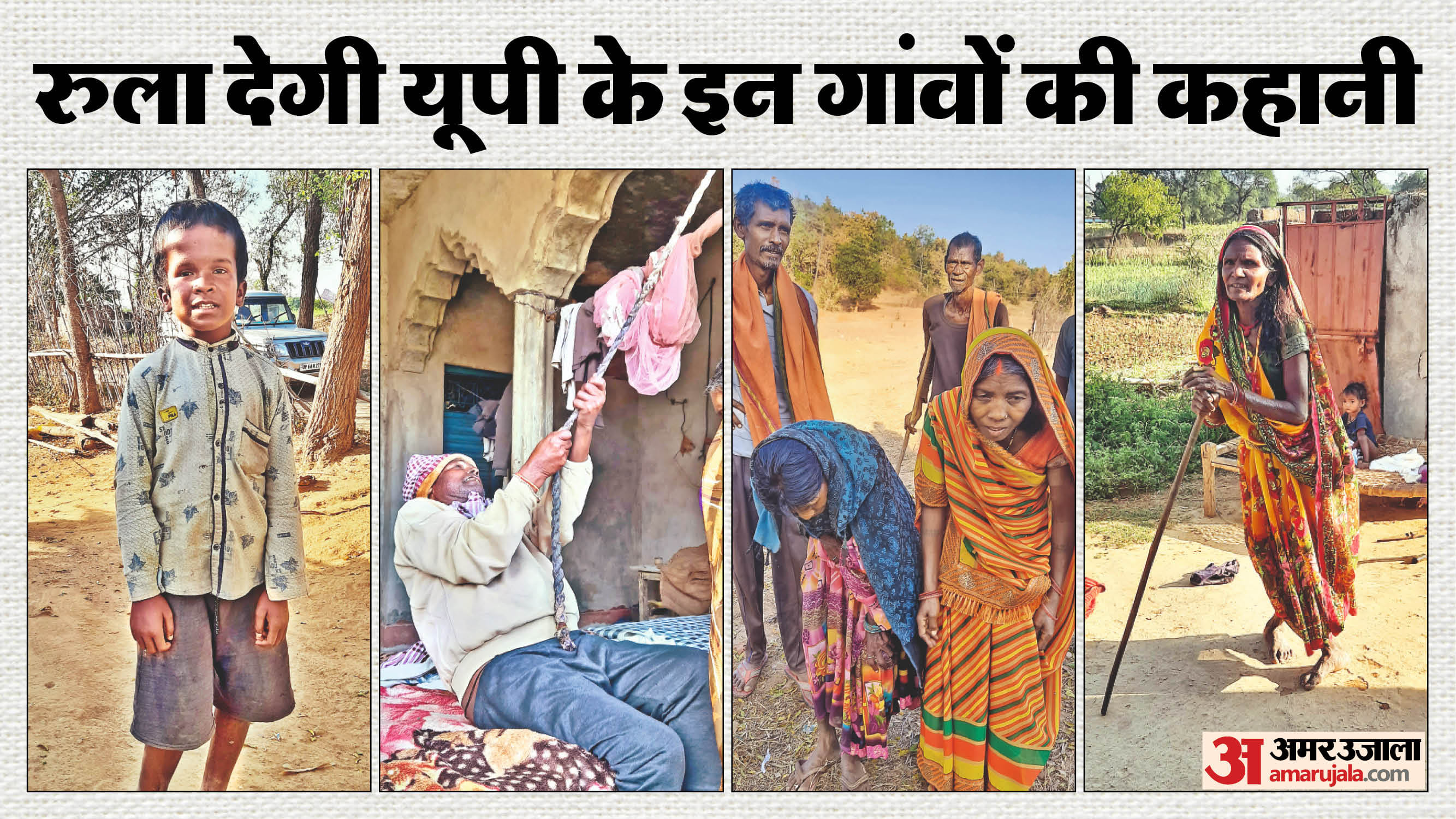
-सोनभद्र जिले में सौर ऊर्जा आधारित क्लोराइड/आयरन रिमूवल प्लांट लगाने और मिनी पेयजल योजना स्वीकृति के लिए 2022 में अधिशासी अभियंता यूनिसेफ प्रोजेक्ट यूनिट की ओर से मुख्य अभियंता ग्रामीण उप्र को पत्र लिखा गया था। पत्र के साथ राष्ट्रीय हरित प्राधिकरण के आदेश की प्रति भी भेजी गई थी। इसमें एनजीटी ने अपने आदेश में कहा था कि दो सप्ताह में पर्यवेक्षीय समिति का गठन कर लिया जाए। कोर समिति हर माह अपनी रिपोर्ट पर्यवेक्षीय समिति को देंगी।
-पर्यवेक्षीय समिति हर तीन माह में अपनी रिपोर्ट एनजीटी के समक्ष प्रस्तुत करेगी। साथ ही, फ्लोराइड प्रभावित गांवों में आरओ प्लांट लगाए जाएं। आवश्यक हो तो दो या तीन भी लगा सकते हैं। प्लांट के लिए जमीन सरकार और ग्राम पंचायतें उपलब्ध कराएंगी। उद्योगों की ओर से प्लांट की स्थापना और रखरखाव कराया जाए। तब तक प्रभावित गांवों में अंतरिम उपायों के तौर पर टैंकरों के जरिये पानी की आपूर्ति की जाए। https://www.amarujala.com/uttar-pradesh/sonebhadra/fluoride-crisis-in-sonbhadra-painful-story-of-people-falling-ill-after-drinking-fluoride-contaminated-water-2025-02-28 (28 Feb. 2025)
URBAN LAKES, WETLANDS
Mumbai Mangroves to be restored under Amazon’s $1.2 million project Amazon’s Right Now Climate Fund has announced a $1.2 million investment aimed at restoring mangrove forests and mudflats. The initiative, undertaken in partnership with Hasten Regeneration and guided by the Brihanmumbai Municipal Corporation (BMC), aims to rehabilitate key feeding sites and remove plastic waste from the creek, ideal for drawing flamingos and other migratory birds into the region.
A key aspect of the project is the installation of trash booms to prevent plastic waste from entering the Mumbai basin. These booms will trap non-biodegradable waste, particularly plastic, which will then be collected, segregated, and recycled. The initiative aims to remove at least 100 kg of plastic daily, with a target of 150 tonnes over three years, while improving bird habitats along Thane Creek. https://indianexpress.com/article/cities/mumbai/flamingo-habitat-thane-creek-restoration-amazon-fund-9863003/ (01 March 2025)
‘Mangrove cover up by 1,239 ha in last two years’ “Mah’s mangrove cover has increased by 1,239 hectares in the last two years due to programs like mangrove replanting and diligent patrolling of the bay by the Coast Guard using modern equipment,” he said on Mar 1. The Forest Dept plans to construct a mangrove wood walk at the Biodiversity Centre in Airoli, similar to the one already established in Gorai in Mumbai. He asked forest officials to develop a comprehensive plan to address the issue of plastic waste, oil slicks, and untreated water discharge into the sea. https://theprint.in/india/maharashtras-mangrove-cover-up-by-1239-hectares-in-last-two-years-ganesh-naik/2522778/ (01 March 2025)
Bengaluru Untreated sewage discharge into Mullur lake The entry of untreated sewage into Mullur Lake has sparked health concerns among residents. Located along the 100 Feet Road connecting Sarjapur Road with Gunjur-Doddakannelli Road, the lake, once considered a hidden jewel, was rediscovered after the road’s construction two years ago. However, rapid development in the area has led to sewage inflows, reportedly from buildings lacking a STPs. The situation is equally dire at Dorekere Lake near Kumaraswamy Layout, where sewage inflow and garbage dumping have led to eutrophication and poor maintenance. https://www.deccanherald.com/india/karnataka/bengaluru/untreated-sewage-discharge-into-hidden-jewel-sparks-health-concerns-among-residents-3425377 (28 Feb. 2025)
Madiwala Lake remains neglected Ever since Palike took over, lake not cleaned; officials await approval In November 2023, the Karnataka Forest Department (KFD) handed over Madiwala Lake to the Bruhat Bengaluru Mahanagara Palike (BBMP). More than a year has passed, yet the Palike has struggled to address the lake’s deteriorating condition. The water body remains in a state of neglect, almost entirely covered in water hyacinth, while facilities for walkers have been left unattended for months. https://bangaloremirror.indiatimes.com/bangalore/civic/bbmp-has-given-madiwala-lake-green-carpet-welcome/articleshow/118653017.cms
URBAN WATER
Bengaluru 1000s recharge wells may not make a summer Vishwanath Srikantaiah, popularly known as the Rain Man of Bengaluru, said that in some areas, it might take as long as 5 years to see the difference in groundwater levels. “Locations are immaterial for recharge wells. Every house, every apartment, all gated communities can have them. But they should be designed to take rainwater from a clean catchment,” he said, adding that the function of a recharge well is to place excess rainwater into the aquifer.
Shashank Palur, Senior Hydrologist at Water, Environment, Land and Livelihoods (WELL) Labs, said that ideally, recharge wells are a long-term solution for groundwater recharge and digging them during the crisis may not see immediate results. He said that an aquifer in earth’s crust is like a sponge — a mixture of soil and water, which determines the water-holding capacity of a region. “When you dig a well, you excavate that area and water starts coming out. Recharge wells are usually dug up to 20 feet. If there’s a borewell nearby, which may go up to 900 feet, you will be tapping into a different source of water. While you may think that your borewell will be recharged, it may not always be the case,” he explained.
Vishwanath said that recharge wells are one way everybody can participate in the solution space for Bengaluru’s water challenge. “It is not the only solution,” he noted. “If we build a million recharge wells and transfer one third or one half of Bengaluru’s rains to aquifers, we are better off than if we did not” he said. https://www.deccanherald.com/india/karnataka/bengaluru/1-000-recharge-wells-may-not-make-one-summer-in-bengaluru-3420043 (25 Feb. 2025)
BWSSB bans borewell drilling Alarmed by the plummeting groundwater table across Bengaluru for the third consecutive year and a red alert sounded by IISc scientists a few weeks ago, Bangalore Water Supply and Sewerage Board (BWSSB) has banned drilling of borewells in the city. While the imminent harsh summer prompted the utility to impose a ban on digging borewells, BWSSB clarified it would continue to regulate borewell digging during the rest of the year too, considering the steep fall in the groundwater table of the city. Any violation will be dealt with strict legal action by the state govt. https://timesofindia.indiatimes.com/city/bengaluru/as-groundwater-levels-plummetbwssb-bans-borewell-drilling/articleshow/118566282.cms (26 Feb. 2025) The BWSSB recently warned citizens about dropping groundwater levels in the outskirts of the city. To avoid the crisis of last year, being judicious with water usage is key. Water conservation experts share ways to use water responsibly. https://www.deccanherald.com/india/karnataka/bengaluru/plug-the-leaks-simple-tips-to-conserve-water-3421765 (26 Feb. 2025)
Oily waste clogging drains While the BWSSB often fixes the problem by replacing underground drainage pipes (UDG), the RWAs want it to address the root cause — the way restaurants dispose of their used oil. https://www.deccanherald.com/india/karnataka/bengaluru/oily-waste-from-commercial-kitchens-clogging-drains-3421779 (26 Feb. 2025)
Hyderabad Rise in water tanker demand From February 1 to 24, over 1.44 lakh water tankers were booked through Metro Customer Care (MCC), HMWSSB mobile app, IVRS (customer care) and other platforms, compared to 87,700 during the same period last year. According to official sources, the Water Board supplies around 545 MGD per day with additional water sourced from groundwater reserves. Water consumption usually rises by about 15% during summer. There are more than 966 registered tankers under HMWSSB, with the majority having a 5,000 litres capacity followed by 10,000 litres and above. https://www.newindianexpress.com/cities/hyderabad/2025/Feb/27/water-tanker-demand-in-hyderabad-rises-60-per-cent-as-summer-begins-early (27 Feb. 2025)
Faulty meters, arbitrary bills adding into woes Hyderabad faces a water crisis as 60% of households lack essential water meters resulting in arbitrary billing and unreliable supply. Residents complain of erratic charges despite inconsistent water supply. According to official figures available with the Hyderabad Metropolitan Water Supply and Sewerage Board (HMWSSB), 6 out of every 10 households in the city lack an essential water meter. To add to that is the burden of dysfunctional meters – prevalent across localities. Result: Arbitrary billing and unreliable water supply, complain residents. https://timesofindia.indiatimes.com/city/hyderabad/faulty-meters-arbitrary-bills-add-to-summer-struggles/articleshow/118610546.cms (28 Feb. 2025)
Netizen claims dirty drinking water supply in Hyderabad. https://www.siasat.com/netizen-claims-dirty-drinking-water-supply-in-hyderabad-hmwssb-responds-3186732/ (27 Feb. 2025)
Mumbai Treating wastewater In 2022, following a Rs 29.75-crore penalty from the NGT for discharging untreated sewage into water bodies, the Brihanmumbai Municipal Corporation (BMC) launched its ambitious Waste-Water Treatment Facility (WWTF) project, at an estimated cost of Rs 27,000 crore — nearly double that of the coastal road project. Under the project, 7 state-of-the-art STPs are being constructed across key locations such as Worli, Dharavi, Ghatkopar, Bhandup, Bandra, Versova, and Malad, which will play a crucial role in transforming Mumbai’s wastewater management. The project, which aims to modernize the city’s sewage treatment system, is expected to be completed by the end of 2027
-The new STPs will replace Mumbai’s outdated sewage infrastructure built in the 1980s and 1990s, which no longer meets current environmental standards. In the current budget, the BMC allocated Rs 5,545 crore for the STP initiative, which will treat 2,464 MLD of water daily. The facilities are expected to be operational by July 2026.
-Out of the 3,850 MLD of water consumed by Mumbai, approximately 3,040 MLD (78.96%) becomes wastewater that flows through the city’s intricate 2,070-km sewage network, reaching various STPs for initial processing. The operational STPs at Worli, Bandra, Versova, Malad, Bhandup, and Ghatkopar handle sewage from their respective areas. After basic treatment, the wastewater is typically discharged into the creeks and the sea.
Among the 7 proposed STPs in Mumbai, the Worli facility will be the largest, with a capacity of 500 MLD. Following Worli, the remaining plants will have capacities of 454 MLD at Malad, 418 MLD at Dharavi, 360 MLD at Bandra, 337 MLD at Ghatkopar, 215 MLD at Bhandup, and 180 MLD at Versova. Combined, these 7 plants will have a total processing capacity of 2,464 MLD.
At present, Mumbai’s water demand is 4,250 MLD, while the BMC can supply 3,850 MLD, a deficit of 400 MLD. This shortfall translates to a 15 per cent water shortage, particularly during the peak summer when delayed monsoons exacerbate the problem. The new STPs will play a pivotal role in addressing this gap. Once operational, the plants will generate 1,232 MLD of tertiary-treated water, nearly three times the city’s current water deficit. The treated water will be recycled for non-potable uses, significantly reducing the pressure on Mumbai’s potable water supply.
-The BMC is also planning to construct a water service tunnel that will transport 970 MLD of tertiary water daily from the STPs at Ghatkopar, Dharavi, and Bhandup to the BMC’s filtration complex. The BMC has allocated Rs 840 crore for this project in this year’s budget. Additionally, Rs 450 crore has been set aside for the development of a new 2,000 MLD water treatment plant at the Bhandup filtration complex. “While there is a stigma surrounding recycled treated water, particularly for drinking purposes, it’s important to recognise that the 1,232 MLD of tertiary water generated by the STPs will be equivalent to the water supplied from at least four lakes today,” said Abhijit Bangar, additional municipal commissioner (projects). “By investing in this infrastructure, we are ensuring Mumbai is prepared for its future water needs,” added Bangar
Bangar emphasised that before any tertiary-treated water is used for potable purposes, a process of public consultation will take place, allowing citizens to voice their concerns. “In countries such as Singapore, tertiary water is mixed with raw water in dams, then filtered before being supplied to houses. We will adopt a similar approach in Mumbai, which is why we are expanding the filtration capacity,” he added. https://indianexpress.com/article/cities/mumbai/mumbai-hardlook-treating-mumbais-wastewater-9852572/ (24 Feb. 2025)
STP project got lion’s share of funding In its annual civic budget for the financial year 2025-26, the BMC allocated Rs 5,545 crore, which is 12.8 per cent of the entire capital expenditure, for constructing seven STP in Mumbai. This marks a 35 per cent jump in allocation as compared to last year. With the overall cost pegged at over Rs 30,000 crore, the ground-breaking ceremony for this project was carried out by PM Narendra Modi in January 2023.
-The STP project being executed by the Mumbai Sewage Disposal Project (MSDP) department will see 7 STPs being constructed across Mumbai with a collective capacity of treating 2,464 MLD of water daily for potable usage. In addition to this, the STPs will have a combined capacity to treat 1,232 MLD of water further for non-potable use. The STPs are being constructed at 7 locations in Mumbai – Worli, Bandra, Dharavi, Versova, Malad, Ghatkopar and Bhandup. Of these 7 STPs, the largest one is located in Worli, which will have a capacity of treating 500 MLD of water, followed by Malad (454 MLD), Dharavi (418 MLD), Bandra (360 MLD), Ghatkopar (337 MLD), Bhandup (215 MLD) and Versova (180 MLD).
Of the 7 STP projects, Bhandup, Ghatkopar and Dharavi are set to be operational by July 2026, while the facilities at Bandra, Versova and Worli are set to be operational by July 2027. The Malad facility is set to become operational by 2028. According to the BMC’s budget document, the highest progress of completion of 28 per cent is recorded at Ghatkopar, followed by 26 per cent at Bhandup, 20 per cent each in Dharavi and Bandra, 18 per cent at Versova, 17 per cent at Worli and 7 per cent at Malad.
Daily, the BMC supplies 3,800 MLD of water to Mumbai which comes from 7 different lakes, 5 of which are located in the satellite districts of Thane, Palghar and Nashik. Of the total water received, around 80 % or 3,040 MLD is converted into sewage or wastewater after usage. To bridge the deficit of demand and supply, the BMC mooted the STP project so that it can recycle at least 2,464 MLD or 80 % of Mumbai’s daily sewage water and bring it back to the city for its potable usage, which in turn will bridge the deficit of daily water supply, leading to equal distribution of water. (Pratip Acharya) https://indianexpress.com/article/cities/mumbai/mumbai-stp-funding-bmc-budget-9818708/ (5 Feb 2025)
Residents up in arms to save 1208-tree Mira Road garden The Mira Bhayandar Municipal Corp (MBMC) has sparked outrage by announcing plans to remove 1208 trees from the Gyan Jyoti Savitribai Phule Udyan, a well-maintained garden on Kanakia Road visited by hundreds of joggers daily, in order to expand a sewage treatment plant (STP) adjacent to the open space.
Though the municipal corporation said that it would safely relocate the trees, officials have failed to reveal their projected survival rate. All these trees are eight years old, the MBMC is yet to look at alternative areas to replant them. Joggers, meanwhile, claim that there are around 2000 trees in the park and that all of them will be destroyed, causing an ‘environmental disaster’ at a time when air quality is at a low due to rampant construction in the area. They plan to stage a peaceful protest on Sunday. https://www.mid-day.com/mumbai/mumbai-news/article/mumbai-residents-up-in-arms-to-save-1208-tree-mira-road-garden-23492259 (01 March 2025)
Pune Surge in water tanker demand exposes PMC’s infra challenges The demand for water tankers, especially from the merged areas, has gone up amid a rise in temperatures as the Pune Municipal Corporation (PMC) recorded 40,000 trips in Jan, a jump of 4,000 from the number in Dec, reveals data provided by the civic body.
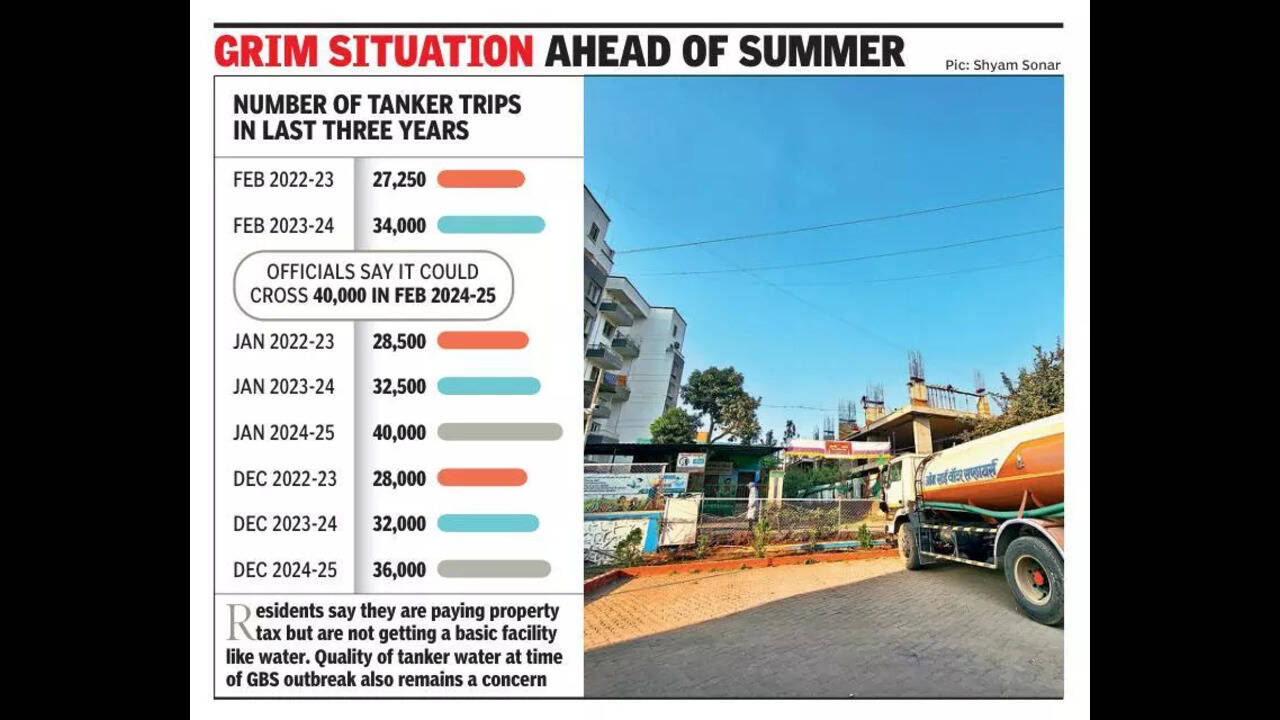
This is likely to touch 42,000 in Feb, civic officials said, adding there is no need for panic as shortage of potable water is generally reported at this time of the year. Data of private tankers is not available with the civic administration since the operators source water from private wells or borewells. On an average, around 30,000 trips are made monthly. https://timesofindia.indiatimes.com/city/pune/surge-in-water-tanker-demand-exposes-pmcs-infra-challenges/articleshow/118539855.cms (25 Feb. 2025)
Delhi Residents of DDA’s Narela flats flag poor facilities While the DDA put up close to 10,000 flats for sale in three schemes launched this year, at a 25% discount, it has been able to sell just over a quarter (2,628) of its units. Ujjwal Sharma (22), his two siblings, and parents have taken possession of their one-bedroom EWS flat, but they don’t stay there. They live in the nearby Bhorgarh village. “Paani jo aata hai vo khaara aata hai aur vo bhi kabhi kabhi hi aata hai (There is no water and even when there is supply, it is not clean),” says Ujjwal’s mother, who did not wish to be named.
On complaints by residents of lack of connectivity and water supply, the DDA spokesperson blamed “non-cooperation from the previous Delhi government”. “The DTC and Delhi Jal Board, which was under the administrative control of the previous Delhi government, were reluctant to support DDA in its endeavour to develop the sub city… Despite payments being made to DJB by the DDA, water supply was not provided as per the committed timelines by the former. https://indianexpress.com/article/cities/delhi/no-water-poor-security-lack-of-public-transport-why-dda-flats-in-narela-yet-to-find-takers-agency-pins-blame-on-aap-govt-9860365/ (28 Feb. 2025)
JJM/ RURAL WATER SUPPLY
Himachal Pradesh Fund shortage Sources say that this year, the state was to receive about Rs 900 crore under the Jal Jeevan Mission. The financial year is about to end but the Jal Shakti Department has received just one installment of Rs 130 crore under the scheme. The sources say that as the Union Government has not released funds, the liabilities of the Jal Shakti Department towards the contractors have mounted to about Rs 500 crore. In Kangra district alone, the total liabilities of the contractors have increased to about Rs 130 crore. This is also adversely affecting the execution of schemes under the Jal Jeevan Mission in the state as the contractors have refused to execute the work till their previous payments are released.
The sources say the Central Government has withheld the payments under the Jal Jeevan Mission as the state has not complied with some conditions under the scheme. The Union Government has laid a condition that water schemes developed under the mission should be handed over to the village panchayats for maintenance and execution. The state government, however, states that the proposal for handing over water schemes to village panchayats for execution and maintenance is not practically feasible. Similar experiments have failed earlier in Himachal Pradesh. https://www.tribuneindia.com/news/himachal/conditions-not-fulfilled-state-provided-only-130-crore-under-jal-jeevan-mission/ (02 March 2025)
Bihar This report from Nalanda dist exposes the claims of Jal Jeevan mission in providing Har Ghar Jal. There was no water in the tap of the sarpanch’s house that certified 100% water availability.
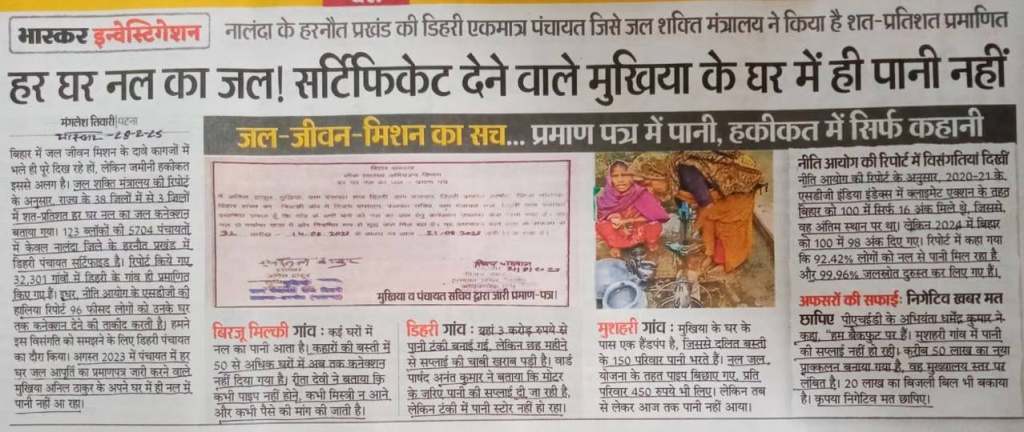
WATER
Impact of ethanol on water This report gives details of the polluting nature of water intensive ethanol factories in Andhra Pradesh, Maharashtra, Punjab and elsewhere, leading to protests by the local communities and environmental groups. https://www.thehindu.com/opinion/op-ed/the-impact-of-ethanol-on-the-environment/article69266050.ece (27 Feb. 2025)
AGRICULTURE
Report India’s agriculture education stuck in Green Revolution mindset Indian agriculture education often lags behind due to a rigid curriculum that fails to integrate contemporary issues like climate change, precision farming, and global market dynamics. Updating the curriculum to include contemporary practices can empower future agronomists with the tools to address issues like soil degradation, water management, and market access.
Blending traditional practices with modern innovations is key. Agriculture universities should promote research that refines indigenous techniques while integrating advancements in irrigation, crop genetics, and market forecasting to create a balanced, resilient agricultural system. https://theprint.in/ground-reports/indian-agriculture-education-reform/2510111/ (25 Feb. 2025)
WINTER MONSOON
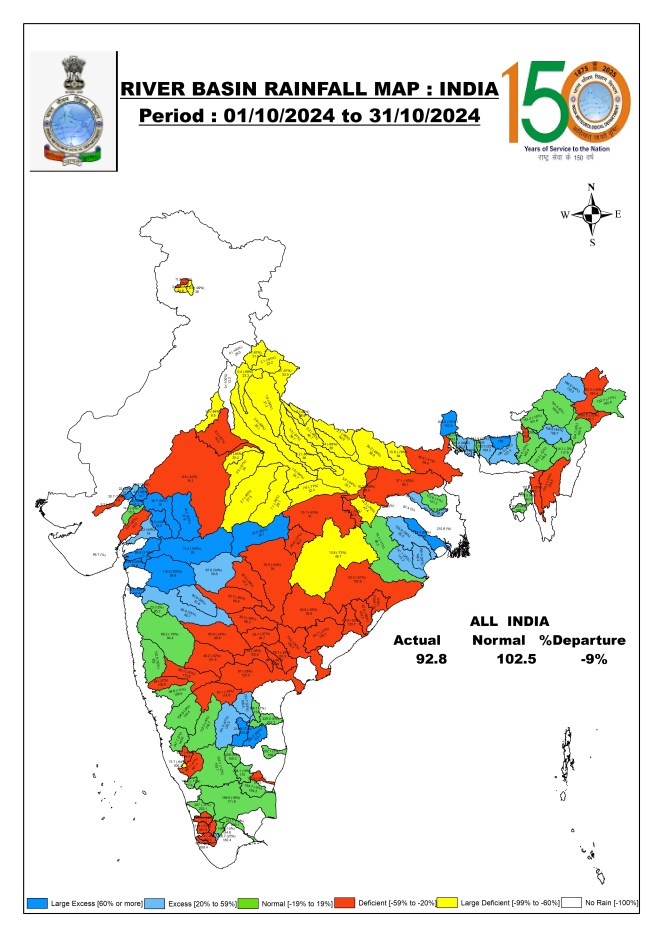
SANDRP Blog Post Monsoon 2024 District wise Rainfall in India According to India Meteorological Department, during the Post Monsoon Rainfall for 2024, that included rainfall during the three Oct-Dec 2024 months, India received 117.4 mm rainfall, 3% below normal (110.7 mm, 9% below normal in Post Monsoon 2023, 144.1 mm, 19% above normal in Post Monsoon 2022 and 177.7 mm rainfall, 43.54% above normal in Post Monsoon 2021 rainfall of 121 mm. In the same period in 2020, India received 124.6 mm rainfall, 0.64% above the normal rainfall. https://sandrp.in/2025/02/27/post-monsoon-2024-district-wise-rainfall-in-india/ (27 Feb. 2025)
While Jammu & Kashmir, Himachal Pradesh and Uttarakhand are under the severe influence of a strong western disturbance event after months, four of nine doppler radars installed in these states are not working for the past few days. https://www.facebook.com/share/p/19A5XVMJBA/ (28 Feb 2025)
Jammu & Kashmir Rains bring relief The ongoing wet spell in the Kashmir Valley due to a “mega” western disturbance has brought major relief for residents, bringing down the rainfall deficit from 80 per cent to 42 per cent, officials said on Friday (Feb. 28). According to the local weather office, the Valley witnessed above-normal precipitation between February 26 and 28. “While the normal precipitation for the period would have been 15.5 mm, Jammu Kashmir has witnessed 78.4 mm precipitation, which is 407 per cent above normal,” a weather department official said.
Apprehensions of a drought had increased among the people in Jammu Kashmir as the Union Territory experienced its driest year in five decades in 2024, with below-normal precipitation continuing for the fifth consecutive year. In 2024, the rainfall levels plunged to 870.9 mm against the normal annual average of 1,232.3 mm. The previous year recorded 1,146.6 mm of rainfall, which was seven per cent below normal precipitation. https://thekashmiriyat.co.uk/from-80-to-40-percent-kashmir-sees-major-improvement-in-rainfall-deficit/ (28 Feb. 2025)
Wet spell rejuvenates water bodies The deficit, which stood at 83 percent last week, has now dropped to 60 percent as of Thursday morning, marking a 23 percent improvement. According to meteorologists, the rainfall deficit is expected to decrease further, reaching 40 percent in Kashmir, 50 percent in Jammu, and 60 percent in Ladakh. Meteorologists said that while this wet spell has reduced the deficit, it has not completely compensated for the prolonged dry conditions. “The rainfall has helped reduce the deficit, but we still hope for more rains in March to further improve the situation,” Lotus said. https://www.greaterkashmir.com/front-page-2/wet-spell-rejuvenates-water-bodies/ (27 Feb. 2025)
While late February snow and rain have temporarily revived Kashmir’s water bodies, experts warn that rising temperatures and shorter winters pose a serious long-term threat to the region’s water supply, potentially leading to drought conditions. https://www.deccanherald.com/india/jammu-and-kashmir/kashmirs-water-security-at-risk-amid-shortened-winters-rising-temperatures-3428288 (02 March 2025)
Himachal Pradesh मात्र तीन दिन पहले तक हिमाचल प्रदेश में सूखे की स्थिति बनी हुई थी, लेकिन 27 फरवरी 2025 को अचानक मौसम ने पलटी मारी। एक ओर जहां कांगड़ा जिले में बादल फटने और भारी बारिश के कारण अचानक बाढ़ आ गई। वहीं, लाहौल के तिंदी में और किन्नौर के जंगी नाला में भारी हिमस्खलन हुआ है। कांगड़ा जिले के छोटा भंगाल घाटी में स्थित लुवाई गांव में मलबे में चार वाहन दब गए, जबकि 14 घर और एक स्थानीय मिडिल स्कूल की इमारत बुरी तरह प्रभावित हुई। https://hindi.downtoearth.org.in/climate-change/himachal-where-there-was-drought-there-was-sudden-flood-due-to-heavy-rain-huge-loss (28 Feb. 2025)
Arunachal Pradesh Weather puzzle -The contrasting weather situation is causing worry to the farming communities, while it also baffles the agriculture scientists. The unpredictable weather in the region is not only hitting the normal life of the people, but also affecting construction of road, bridges and river bunds. As per meteorology reports, the southwest monsoon, which hit the Northeastern region in May last year, was withdrawn from the region during the last week of January. But an unusual monsoon effect is still prevailing in the region as the residents face frequent rainfall with cyclones and hailstorms. https://arunachaltimes.in/index.php/2025/02/27/contrasting-weather-baffles-rural-farmers-agri-scientists/ (27 Feb. 2025)
FLOOD
Study Significant rise in flood frequency in HMA Asia since 2000 The frequency of floods in High Mountain Asia (HMA) has increased significantly since 2000 due to climate change, according to a new study. The study, conducted by a team of scientists including environment expert Sonam Wangchuk, analysed 1,015 floods since 1950. “The study confirms that flood frequency has risen, but a key additional finding is a rise in the unpredictability in the timing of floods: while most events continue to occur during monsoon, there is a marked rise in the number of floods happening outside these times,” the International Centre for Integrated Mountain Development (ICIMOD) said in a statement.
– The most common types of floods are caused by heavy rain and melting snow. Less frequent but far more sudden and destructive are GLOFs and landslide-dammed lake outburst floods (LLOFs). “The rules of floods are changing and the window for adaptation is closing,” warned Wangchuk. “We should prioritise real-time monitoring of floods in vulnerable valleys, restrict infrastructure projects in high-risk zones and strengthen data-sharing agreements between High Mountain Asia nations to address transboundary threats,” he said. https://timesofindia.indiatimes.com/home/environment/significant-rise-in-flood-frequency-in-high-mountain-asia-since-2000-due-to-climate-change-study/articleshowprint/118620833.cms (28 Feb. 2025)
CLOUD BURSTS
Himachal Pradesh Flashflood damages 14 houses at Kangra village As many as 14 houses, several vehicles and a local middle school building were damaged after a flashflood struck Chherana village, located in Chhota Bhanghal valley. The flashflood occurred this morning following a cloudburst caused by heavy rain. Additionally, due to continuous landslides from the hills, 50 houses have been vacated by local residents, who have relocated to safer areas. Reports indicate that relentless heavy rainfall over the past 48 hours has caused widespread devastation in Chhota Bhanghal, disrupting normal life in the valley. In response to the crisis, the local authorities opened the floodgates of two hydroelectric projects in the valley to manage the flashfloods in the Uhal and Lamb Dug rivers. Several camping sites along the banks of the Uhal River have also suffered significant damage. https://www.tribuneindia.com/news/himachal/flashflood-damages-14-houses-at-kangra-village/ (01 March 2025)
A flash flood threat caused panic in Tosh village in the Manikaran Valley in Kullu district due to the formation of an artificial lake in Jeera Nallah. People living downstream of the Nallah have been evacuated and shifted to safer places, officials said. https://www.tribuneindia.com/news/himachal/heavy-snowfall-in-manali-200-roads-closed-schools-shut-power-disrupted-in-himachal-pradesh/ (28 Feb. 2025)
Torrential rainfall since morning has severely affected normal life in Kullu district, triggering flash floods and widespread damage across the region. The incessant downpour led to swollen water streams, causing disruption in traffic and inundation in several areas. One of the most affected spots was Shastri Nagar, where debris from a nearby nullah blocked traffic. Several parked vehicles were partially buried in the mud, and one vehicle was overturned by the force of the water. In the Khori Ropa area, the parking lot was submerged, trapping vehicles in knee-deep water. Water has also entered homes in the Inner Akhara Bazar area of Kullu town, adding to the distress of residents. Meanwhile, power supply has been completely cut off in Kullu and Bhuntar towns since last night, causing inconvenience to people amid freezing temperatures. https://www.tribuneindia.com/news/himachal/heavy-rains-flash-floods-disrupt-life-in-kullu/ (28 Feb. 2025)
The severe weather conditions affected normal life in Kullu, Mandi and Lahaul and Spiti districts. Flashfloods, landslides and snow-related disruptions crippled transportation, power supply and daily services.
In Kullu, flashfloods triggered by heavy rain caused extensive damage. Three vehicles were damaged due to flashfloods in Pahnala and traffic movement was temporarily halted near Shastri Nagar after water and debris from a nearby nullah flowed onto the road. In the Khori Ropa area, parking lots got submerged and vehicles were stuck in knee-deep water. Mandi district also faced severe disruptions due to massive landslides and heavy rainfall. A landslide near the Jalogi tunnel on the Kiratpur-Manali highway led to roadblock, leaving long queues of vehicles on both sides. https://www.tribuneindia.com/news/himachal/heavy-rain-snowfall-wreak-havoc-in-kullu-mandi-lahaul-spiti-districts/ (01 March 2025)
After heavy rain near the Bhootnath bridge of Kullu, there was flooding in the drain, and vehicles were buried under the debris. Water entered houses in Kullu, vehicles were buried under debris, the Pandoh Dam overflowed, and a bus overturned on the Chandigarh-Manali Highway. https://www.truescoopnews.com/newsdetail/heavy-rains-wreak-havoc-himachal-landslides-flooding-dam-overflow (28 Feb. 2025)
Most rivers in Dharamsala were in spate due to heavy rainfall in the region. Flashfloods in the Charan river damaged development works at the IT park in Chaitru village near Dharamsala. An excavation machine deployed for levelling of land at the IT park was caught in a sudden surge of water in the river. The flashfloods also damaged public and private infrastructure in the region. Due to climate change and unpredictable rain patterns, questions are being raised about allowing construction along riversides in Dharamsala. About two years ago, flashfloods in the Charan river had caused extensive damage to public and private infrastructure. https://www.tribuneindia.com/news/himachal/rivers-in-spate-in-dharamsala/ (01 March 2025)
दो जगह बादल फटे, 5 हिमखंड गिरे शुक्रवार (Feb. 28) को कुल्लू के पाहनाला और कांगड़ा के छोटा भंगाल के मुल्थान में बादल फटे। भारी बारिश-बर्फबारी के चलते पंजाब के पर्यटक की मौत हो गई है, जबकि दो लोग लापता और तीन घायल हैं। पिछले 48 घंटों से बारिश-बर्फबारी के कारण जनजीवन अस्त-व्यस्त हो गया है। भूस्खलन-बाढ़ से अलग-अलग जगह 22 वाहन क्षतिग्रस्त हो गए हैं। चंबा, लाहौल और किन्नौर में पांच जगह हिमखंड गिरे हैं। हिमखंड गिरने से लाहौल में चंद्रभागा नदी का बहाव रुक गया। पांच एनएच समेत हिमाचल में 583 सड़कें बंद हो गई हैं। एचआरटीसी के 450 रूट फेल हो गए, जबकि 2,263 बिजली ट्रांसफार्मर और 279 पेयजल योजनाएं ठप हैं।
कुल्लू के पाहनाला में बादल फटने से आई बाढ़-मलबे में आठ वाहन दब गए। कांगड़ा के मुल्थान में बादल फटने से नौ वाहन क्षतिग्रस्त हो गए। पालमपुर के जिया स्थित हाइड्रो प्रोजेक्ट में भूस्खलन से एक कर्मचारी घायल हो गया, एक लापता है। धर्मशाला के समीप खनियारा की मनूनी खड्ड के बीच तीन टिपर, दो जेसीबी और एक पोकलेन तेज बहाव में फंस गई। गगल के साथ लगती मांझी खड्ड में एक पोकलेन मशीन बह गई। https://www.amarujala.com/himachal-pradesh/clouds-burst-at-two-places-in-himachal-5-icebergs-fell-one-dead-two-missing-due-to-heavy-rain-and-snowfall-2025-02-28 (28 Feb. 2025)
छोटा भंगाल के मुल्थान में बादल फटने से चार वाहन क्षतिग्रस्त हो गए। मुल्थान के पोलिंग में भूस्खलन के कारण करीब चार मकान खतरे की जद में आ गए हैं, जिन्हें अन्य जगह स्थानांतरित कर दिया गया। उपमंडल पालमपुर के जिया स्थित हाइड्रो प्रोजेक्ट में भूस्खलन से एक कर्मचारी घायल हो गया और एक कर्मचारी लापता है, जिसकी तलाश में 11 सदस्यीय एसडीआरएफ और पुलिस की टीम जुटी गई है। https://www.amarujala.com/shimla/heavy-damage-due-to-cloudburst-in-multan-four-vehicles-damaged-debris-entered-the-hospital-premises-2025-02-28 (28 Feb. 2025)
जलशक्ति विभाग की 32 पेयजल योजनाओं को नुकसान पहुंचा है। बैजनाथ विधानसभा के बरोट-मुल्थान में दो पेयजल योजनाएं बारिश के साथ बह गई। विभाग को बारिश से करीब ढाई करोड़ का नुकसान हुआ है। बीते 24 घंटों के दाैरान भुंतर में 112.2, जोत 108.8, जोगिंद्रनगर 108.0, सेऊबाग 106.0, बंजार 92.0, धर्मशाला 85.2, मनाली 82.0, बैजनाथ 78.0, पालमपुर 75.6, करसोग 68.2, रामपुर 60.0 व शिमला 25.6 मिलीमीटर बारिश दर्ज की गई। वहीं खदराला में 20.0, कोठी 15.0, निचार 5.0 व जोत में 4.0 सेंटीमीटर बर्फबारी हुई। फरवरी में प्रदेश में सामान्य से 15 फीसदी अधिक बारिश हुई। बीते बुधवार तक प्रदेश में सामान्य से 40 फीसदी कम बारिश हुई थी। दो दिनों के दौरान हुई बारिश ने फरवरी की औसत बारिश में सुधार ला दिया है। फरवरी में 117 मिलीमीटर बारिश हुई। 101 मिलीमीटर बारिश को सामान्य माना गया है। https://www.amarujala.com/himachal-pradesh/kangra/devastation-due-to-rain-32-drinking-water-schemes-and-257-transformers-stalled-vehicles-submerged-in-ravines-kangra-news-c-95-1-kng1002-167173-2025-03-01 (01 March 2025) मुल्थान के रोकारू में बादल फटने से 9 वाहन क्षतिग्रस्त हो गए। पालमपुर के शिवा जल विद्युत प्रोजेक्ट के पास एक व्यक्ति बाढ़ की चपेट में आने से लापता है, जबकि एक व्यक्ति घायल हुआ है। लापता व्यक्ति की तलाश जारी है। मुल्थान में बादल फटने के बाद 12 मकानों पर खतरा मंडरा रहा है। इन घरों में रह रहे लोगों को सुरक्षित स्थान पर शिफ्ट किया गया है। मुल्थान बाजार की दुकानों में पानी घुस गया है। कांगड़ा के ही खन्यारा की मनूनी खड्ड में पानी के तेज बहाव से 3 टिप्पर और 2 जेसीबी क्षतिग्रस्त हो गई https://www.bhaskar.com/local/himachal/kangra/dharamshala/news/kangra-news-multhan-cloud-burst-vehicles-damaged-134558335.html (28 Feb. 2025) कांगड़ा के छोटा भंगाल और कुल्लू के पहनाला खड्ड में बादल फटने से तबाही हुई है। पहनाला में बादल फटने के बाद एक दर्जन गाड़ियां नाले के बहाव में बह गई। छोटा भंगाल में दो किसानों की जमीन को नुकसान हुआ है। भरमौर और किन्नौर में दो जगह ग्लेशियर फिसलने की घटनाएं पेश आई। https://www.bhaskar.com/local/himachal/mandi/news/chandigarh-manali-four-lane-bus-accident-landslide-nh-5-closed-heavy-rain-shimla-134556221.html (28 Feb. 2025) कांगड़ा जिले के उपमंडल बैजनाथ की दुर्गम छोटा भंगाल घाटी के मुल्थान में बादल फटने से भारी नुकसान हुआ है। बादल फटने के बाद अचानक पहाड़ी से बड़ी मात्रा में मलबा व पानी आने से नाले का जलस्तर बढ़ गया। इससे मलबा रिहायशी क्षेत्र में पहुंच गया। करीब चार वाहन क्षतिग्रस्त हुए। घरों व सीएचसी बरोट में भी मलबा घुस गया। बारिश के चलते लंबाडग, ऊहल सहित बिनवा नदी उफान पर है। https://www.youtube.com/watch?v=wL_5H3s8aws (28 Feb. 2025)
लारजी डैम से पानी छोड़ा गया. बताया जा रहा है कि बरोट में डैम का गेट खोला गया है. क्योंकि बड़ा बंगाल की तरफ बादल फटा है और कुछ गाड़ियां बहीं है. मंडी के बरोट में डैम से खोलने पर उहल नदी का जलस्तर बढ़ा है और अभी तक किसी भी तरह के नुकसान की कोई खबर नहीं है.
मौसम विभाग के शिमला केंद्र ने बताया कि कुल्लू के सेऊबाग में 116.6, भुंतर में 113.2, बंजार 112.4, मंडी के जोगिदरनगर में 112.0, चंबा के सलूणी में 109.3, पालमपुर में 99.2, चंबा में 97.0, शिमला के रामपुर में 95.6, जोत 94.6, बैजनाथ 75.0, कांगड़ा और करसोग 74.0, शिमला के रोहड़ू में 70.0 एमएम बारिश हुई है. उधर, मनाली के कोठी में 5 फीट (130 सेंटीमीटर) बर्फ गिरी है. इसी तरह खदराला में 115.0, केलांग में 75.0, कल्पा 46.0, कुकुम सेरी 38.8, सांगला 23.5 सेंटीमीटर बर्फबारी देखने को मिली है. https://hindi.news18.com/news/himachal-pradesh/shimla-weather-live-updates-heavy-rain-and-snowfall-disrupt-life-in-cloud-burst-in-kullu-and-kangra-schools-closed-9065611.html (28 Feb. 2025)
DISASTERS
Uttarakhand 8 BRO workers died in avalanche Eight BRO workers died after becoming trapped under an avalanche in Chamoli, the Indian Army said on Sunday (March 02). Rescuers operating in several feet of snow evacuated 46 other workers. The workers were buried by the snow early on Friday (Feb. 28) in the village of Mana as the avalanche hit their camp site. Disaster response teams coordinated the rescue efforts under extreme weather conditions, and the work was halted several times because of incessant snowfall and rain. GPS, sniffer dogs and thermal imaging cameras were used to find the workers. IMD warned of the possibility of further avalanches in the area. https://www.nytimes.com/2025/03/02/world/asia/india-avalanche.html (02 March 2025)
Several BRO workers trapped in avalanche “A massive avalanche has occurred near the Border Roads Organisation camp in the border area of Mana in which 57 workers engaged in road construction have been trapped. Out of these workers, 10 workers have been rescued and sent to the army camp near Mana in critical condition,” Uttarakhand Police spokesperson Nilesh Anand Bharne told ANI. BRO (Border Roads Organisation) Executive Engineer CR Meena said three to four ambulances have also been sent, but due to heavy snowfall, the rescue team is facing difficulties in reaching there. https://www.newindianexpress.com/nation/2025/Feb/28/several-bro-workers-feared-trapped-in-uttarakhand-avalanche-rescue-efforts-underway (28 Feb. 2025) The incident took place near the border village of Mana, about five kilometres from the Badrinath temple. There were a total of 57 workers of which 16 have been so far rescued and sent to the army camp near Mana village in critical condition, an official said. https://www.ndtv.com/india-news/over-50-workers-feared-trapped-in-uttarakhand-avalanche-rescue-efforts-on-7814365 (28 Feb. 2025) Resuming the search operation on Day 2, the Indian Army said that 14 more personnel had been rescued “with slight respite in the weather.” 55 workers who were engaged in clearing snow to facilitate army movement in Mana, the last village on the Indo-Tibetan border, were trapped at a BRO camp at 7:15 am, burying them inside eight containers and one shed. https://www.indiatoday.in/india/story/rescue-teams-battle-snow-rain-to-save-trapped-in-badrinath-camp-avalanche-2687336-2025-03-01 (01 March 2025) Speaking to ANI the survivors shared the horrific details of the unfortunate incident. https://www.ndtv.com/video/never-seen-such-a-survivors-recall-heart-wrenching-details-909078 (02 March 2025) 60 hours, 200 jawans and a complex rescue operation. https://www.hindustantimes.com/india-news/60-hours-200-jawans-and-a-complex-rescue-operation-101740940480059.html (03 March 2025) Woke up beside dead co-worker, ate snow to survive. https://www.newindianexpress.com/nation/2025/Mar/02/woke-up-beside-dead-co-worker-ate-snow-to-survive-uttarakhand-avalanche-survivor-recalls-tragedy (02 March 2025)
Jammu & Kashmir 5 die in rain related mishaps Early Friday (Feb. 28), Shano Devi (50) and her son Raghu (25) died when a boulder rolled down and hit their two-wheeler in Moungari area of Udhampur district, officials said. Elsewhere, 12 workers were rescued from the flood fury. “Around 11 labourers were rescued from Ujh river in Rajbagh area of Kathua,” an official said, adding they were putting up a shed near a construction site when they were suddenly marooned in the flash floods. Police and SDRF teams rescued a truck driver trapped in floods in Niki Tawi area of Jammu. https://timesofindia.indiatimes.com/india/5-die-in-jammu-rains-srinagar-highway-shut/articleshow/118637189.cms (01 March 2025)
LANDSLIDES
Kerala Wayanad tunnel road project gets EC despite concerns Despite citing serious ecological issues, including the fact that the project area is under the ecologically sensitive areas close to the back to back landslide spots near Meppadi in Wayanad, the SEAC that met on Saturday gave the clearance. The SEAC has, however, listed out 25 conditions to mitigate the adverse impact of the project like setting up of four ground vibration monitoring systems and regular monitoring of the work by an environment management committee, according to the minutes of the meeting accessed by DH.
After last year’s major landslide at Mundakkai and Chooralmala there was strong protest from environmentalists in taking forward the project as it is close to the landslides spots. The SEAC also deferred its decision several times seeking additional details on the environmental impacts of the project in view of the devastating landslides.
Being one of the flagship projects of the CPM government, there seems to be pressure on the SEAC to give clearance to the project. The 8.75 km tunnel project with a total cost of Rs. 2043.74 crore has been conceived as an alternative to the popular Thamarasserry ghat road between Wayanad. The proposed tunnel road begins from Meppadi in Wayanad to Anakkampoyil in Kozhikode. https://www.deccanherald.com/india/kerala/environmental-clearance-given-for-wayanad-tunnel-road-project-citing-serious-environmental-concerns-3428494 (02 March 2025)
Uttarakhand Land subsidence triggers second survey The comprehensive assessment aims to provide insights that will inform future mitigation strategies and ensure the safety of local inhabitants. https://www.newindianexpress.com/thesundaystandard/2025/Jan/05/land-subsidence-in-uttarakhands-chamoli-triggers-second-survey (05 Jan. 2025)
ENVIRONMENT GOVERNANCE
Supreme Court Stay on order exempting green clearance for construction sites -The Supreme Court on Monday (Feb. 24) stayed a notification by the Union government that exempted building and construction projects, including industrial sheds, schools, colleges and hostels with a built-up area up to 150,000 square metres from obtaining mandatory environmental clearance (EC) prior to starting construction work.
-A bench, headed by justice Abhay S Oka, passed the order on a PIL filed by Mumbai-based NGO Vanashakti challenging the notification issued by the ministry of environment, forests and climate change (MoEFCC) on January 29 this year on the grounds that it diluted the strict regime governing construction projects. Before the notification came into force, the Environment Impact Assessment (EIA), 2006 made prior environmental clearance mandatory for all constructions with a built-up area of above 20,000 sq meters. https://www.hindustantimes.com/india-news/sc-stays-order-exempting-green-clearance-for-construction-sites-101740423794191.html (25 Feb. 2025)
Arunachal Pradesh Meet on de-reservation of reserve forest, WS Itanagar MLA Techi Kaso suggested conducting consultative meetings among the actually affected people of the villages before finalisation of the de-reservation and rationalisation proposal for the Drupang reserve forest and the Itanagar Wildlife Sanctuary during a joint consultative meeting of MLAs, DCs, administrativeofficers, Forest and Land Department officials of Papum Pare, representatives of the NES, ANSU, ANYA, APPDSU and the Aboriginal Tribal Inhabitant Villagers of Itanagar Capital Region (ATIVICR), besides panchayat leaders and officials of the Land Department at the Papum Pare DC’sconference hall here on Friday (Feb. 28). https://arunachaltimes.in/index.php/2025/03/01/consultative-meeting-on-de-reservation-of-reserve-forest-wildlife-sanctuary-held/ (01 March 2025)
Tamil Nadu SC refuses to interfere with HC order In a relief to Isha Foundation, the Supreme Court on Friday (Feb. 27) refused to interfere with a Madras High Court order quashing the notices of the SPCB over the alleged violation of environmental norms, and ordered that no coercive action should be taken against the yoga and meditation centre. A bench of Justices Surya Kant and N Kotiswar Singh upheld the Madras High Court order quashing notices of the SPCB against Jaggi Vasudev’s Isha Foundation over the alleged illegal constructions on the foothills of Velliangiri Hills in Coimbatore. The court told the foundation to comply with all environmental norms and directions of the TNPCB. https://www.newindianexpress.com/states/tamil-nadu/2025/Feb/28/sc-refuses-to-interfere-with-madras-hc-order-quashing-tn-pollution-boards-notices-against-isha-foundation (28 Feb. 2025)
Report AI has an environmental problem The environmental impact of AI arises across several stages of its value chain, including energy consumption from infrastructure, computing hardware production, cloud data centre operations, AI model training, inferencing, validation, and related processes. In terms of hardware, data centres, the backbone of AI operations, contribute 1% of global greenhouse gas emissions, according to the International Energy Agency (IEA). This figure is expected to rise significantly as electricity demand from data centres is projected to double by 2026. https://www.thehindu.com/opinion/op-ed/ai-has-an-environmental-problem/article69262476.ece (26 Feb. 2025)
CLIMATE CHANGE
Report Govt plans NGFI to meet climate goals The government is working to set up a National Green Financing Institution to support its net-zero target by 2070, as current finance flows for climate initiatives remain much lower than the desired levels, NITI Aayog has said. “A dedicated National Green Financing Institution may be envisaged to bridge the huge gap,” the Aayog said in its annual report 2024-25. https://www.business-standard.com/india-news/govt-plans-national-green-financing-institution-to-meet-climate-goals-niti-125022500674_1.html (25 Feb. 2025)
Himachal Pradesh Work begins on climate change report Himachal has taken the lead by initiating the process for the preparation of the State Development Report on Climate Change in partnership with the United Nations Development Programme (UNDP) to assess its impact. The report to be prepared by experts in consultation with local communities will assess the human impact of climate change on four key sectors of health, agriculture, including forestry and water, tourism and construction. It is based on these findings that strategies will be proposed for climate smart development in the report, which will be ready by the year end. Chief Secretary Prabodh Saxean said that the report would be helpful in analysing how changing climate patterns were affecting key human development indicators like health, agriculture and allied sectors like water and forestry. https://www.tribuneindia.com/news/himachal/work-begins-on-state-development-report-on-climate-change/ (21 Feb. 2025)
Report Plants losing appetite for carbon dioxide James Curran, the former chief executive of the Scottish Environment Protection Agency, and his son Sam analysed the ups and downs in atmospheric carbon dioxide concentration, revealing that peak carbon sequestration occurred in 2008, and since then the amount of carbon dioxide absorbed by plants has declined by an average of 0.25% a year. “The findings are very stark. Emissions now need to fall by 0.3% per year, just to stand still. That’s a tall order since they typically increase by 1.2% per year,” said James Curran, whose findings are published in the journal Weather. https://www.theguardian.com/science/2025/feb/26/plants-losing-appetite-for-carbon-dioxide-amid-effects-of-warming-climate (26 Feb. 2025)
SOUTH ASIA
India-Bangladesh Dhaka brings up renewal of Ganges Water Treaty Indian External Affairs Minister S. Jaishankar met with Bangladesh Foreign Affairs Adviser Touhid Hossain on the margins of the 8th Indian Ocean Conference in Muscat Sunday (Feb. 160, as ties between the two neighbouring countries continue to remain troubled.
Hossain underlined the importance of initiating discussions on the renewal of the Ganges Water Treaty, and also sought Jaishankar’s support in convening a meeting of the SAARC (South Asian Association for Regional Cooperation) Standing Committee, according to Bangladesh Sangbad Sangtha, the state-run news agency. https://theprint.in/diplomacy/dhaka-brings-up-renewal-of-ganges-water-treaty-during-jaishankar-hossain-meet-in-muscat/2497970/ (16 Feb. 2025)
India-Pakistan Kishanganga & Ratle HEPs: a fait accompli? The Permanent Court of Arbitration (PCA) in The Hague was scheduled to hear Pakistan’s case (No. 2023-14) on September 11-12 2024 concerning India’s construction of two major hydropower projects—the 330-MW Kishanganga and the 850-MW Ratle—on rivers originating in Jammu and Kashmir and flowing into Pakistan. Despite Pakistan’s delegation attending the proceedings, the government has yet to release any statement on the case’s status or even confirm whether the hearings were held as scheduled. This silence raises troubling questions about Pakistan’s commitment to defending its water rights. It remains unclear whether Pakistan has effectively pursued its position at the PCA or whether it has tacitly accepted India’s water projects as irreversible. https://www.brecorder.com/news/40350268/kishanganga-and-ratle-hydropower-projects-a-fait-accompli (27 Feb. 2025)
THE REST OF THE WORLD
UK River Ouse set to become first in England with legal rights – In an exciting and groundbreaking decision, Lewes District Council have agreed to recognise the Rights of the River Ouse, paving the way for the Ouse to become the first in England to have its legal rights recognised by a local authority. The decision represents a major step in the UK’s environmental movement, acknowledging the growing international trend of granting rivers legal rights. The initiative follows successful models in New Zealand, Canada and Colombia where rivers have been recognised as living entities with intrinsic rights to exist, rights to flow, thrive and be free from pollution and the appointment of guardians to act on their behalf. https://elflaw.org/news/historic-decision-sees-river-ouse-set-to-become-first-in-england-with-legal-rights/ (26 Feb. 2025)
River opened up next to Sheffield Castle site A section of the River Sheaf hidden underground for more than 100 years has been uncovered as part of work on the site of Sheffield’s former castle. The stretch of river was covered over in 1917 as part of work to create the since demolished Castle Market. The uncovering of the Sheaf is part of a project to create a new public park on the Castlegate site and an “exciting” achievement since work began a year ago.
-Simon Ogden, chair of the Sheaf and Porter Rivers Trust said: “This is the first step to bring the Sheaf back into Sheffield.” The Trust has been campaigning for several years for the river to be fully uncovered, restored and made visible and accessible. The work will also allow the “re-naturalisation” of the river, including a new rock ramp fish pass over the 5ft (1.5m) high Castle Orchard Weir, designed to restore the biodiversity of the river. https://www.bbc.com/news/articles/cx2e911gqlyo (24 Feb. 2025)
SANDRP
Also see: DRP 24 Feb. 2025 & DRP 17 Feb. 2025
Follow us on: www.facebook.com/sandrp.in; https://twitter.com/Indian_Rivers


