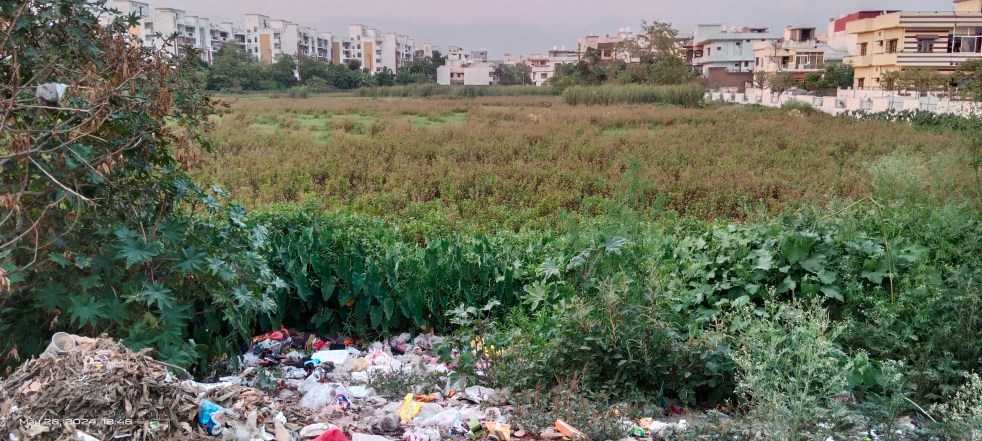
(Feature Image: Machhi Talab in Dehradun chocked by solid waste, vegetion in May 2024. BS Rawat/SANDRP)
While we celebrate World’s Wetlands Day 2025 with theme of “Protecting Wetlands for Our Common Future”, the top ten reports from 2024 show that the plight of wetlands in India remains miserable making the future of the waterbodies and dependent people uncertain. While govts continue to be lethargic in identifying and notifying the wetlands in the country, the govts initiated developmental plans, projects are further making them vulnerable to extinction. Amid this the threats from encroachment, siltation, pollution and climate change are only increasing. Also see the first part of the overview highlighting the deteriorating situation of Ramsar wetlands in India.
1. Maharashtra The case of missing 7,137 wetlands In what could be called a classic case of contradiction, the govt, in an affidavit filed in 2022 in the Bombay High Court, identified 23,055 wetlands sites in the state each with over 2.25 Ha. However, in the agreement entered with the National Centre for Sustainable Coastal Management (NCSCM) in July 2023 the number of wetlands has drastically reduced to 15,918 whereas, at the national level, the number of such wetlands has increased from 2.01 lakh to 2.31 lakh. This has prompted the environmentalists to ask how the figure of 15,918 wetlands has arrived. They also seek to know what happened to missing 7,137 wetlands and why the authorities not making a list of wetlands public?
Using data from the Space Application Centre (SAC) and the Indian Space Research Organisation (ISRO), officials identified 32,000 wetlands in Maharashtra, a decrease from the 44,714 estimated in the 2011 National Wetland Atlas. In 2018, the government initiated the first survey of wetlands in Maharashtra. The survey aimed to collect biodiversity data and support conservation efforts. This information is accessible through the ‘Wetlands of Maharashtra’ app.
“Why was the wetlands monitoring app suddenly withdrawn, wiping out district-wise data? Why spend Rs24 crore when students could have done it inexpensively? Is the govt bowing to pressure from developers denying wetland existence, ignoring reputable organisations, and jeopardizing public safety for private gain?” asked Sunil Agrawal, Founder of Navi Mumbai Environment Protection Group. Stalin Dayanand from Vanashakti said, “This deliberate act favors specific interests, ignoring court mandates to protect all wetlands. It’s a waste of public funds for the benefit of a select few.” All efforts to get in touch with state environment dept officials proved futile. https://www.freepressjournal.in/mumbai/navi-mumbai-falling-wetland-numbers-raise-concerns-environmentalists-seek-clarity-on-missing-7137-sites (12 Mar 2024)
2. Karnataka 25% of Lakes surveyed encroached upon By the end of June 2024, encroachment surveys had been completed for 28,713 out of 40,998 lakes. The surveys revealed that 10,988 lakes had been encroached upon. Of these, encroachments on 6,081 lakes have been cleared, while 4,907 lakes remain encroached. In Bengaluru, 8,599 of the 14,967 lakes were surveyed, revealing encroachments on 5,109 lakes. While encroachments on 3,042 lakes have been removed, 2,067 lakes still need to be cleared. In Mysuru, 4,436 lakes were found to have encroachments, with 2,199 cleared and 2,237 still requiring action. In Belagavi, 1,190 lakes were identified with encroachments, with 518 yet to be cleared. In Kalaburagi, 168 out of 253 lakes have been cleared,
According to the Minor Irrigation Dept, the state is home to 40,998 lakes, managed by various depts, including Water Resources, Rural Development & others. Additionally, district Deputy Commissioners and Zilla Panchayat (ZP) Chief Executive Officers (CEOs) are tasked with overseeing these lakes. Local communities are also involved through lake associations, and the govt has established the Lake Conservation and Development Authority to further safeguard these vital resources. However, despite these efforts, over 25% of the state’s lakes are encroached upon, and more than 26% have not been surveyed for encroachments. https://bangaloremirror.indiatimes.com/bangalore/cover-story/young-foot-soldiers/articleshow/117340567.cms (19 Jan. 2025)
3. Uttar Pradesh No plan to conserve Dhanauri wetland from Jewar airport, violating EC condition Even as the Noida International Airport in Jewar is set to become operational by Sept, the eco-sensitive Dhanauri wetland site, located 15 km away, is yet to be granted protection. While granting environmental clearance to the proposed airport, the MoEF had laid down a specific condition that a “conservation plan for birds and fauna, in consultation with the WII, shall be submitted within six months from the grant of clearance and be implemented in letter and spirit”. However, the UP govt has yet to make a decision in this regard. In its affidavit submitted to the NGT on Jan 20, the Ministry said: “The respondent (MoEF) has not received any proposal along with requisite documents from the State Govt of UP/UP State Wetland Authority for designating Dhanauri wetland as a Ramsar site till date.” The affidavit further said emails were sent to the state govt on Aug 30, 2022 & Oct 17, 2023.
In its report submitted to the NGT on Jan 19, the DFO of Gautam Buddha Nagar said it has written to YEIDA, the land-owning agency, to get the wetland area revised to 97.97 ha as recorded in the inventory. The DFO also said acting on its letter, the SWA has written to the UP Ministry of Environment to clarify the position of the proponent dept for declaring Dhanauri Wetland as a Ramsar site. When contacted, Dr Arun Vir Singh, YEIDA CEO, said, “When the master plan was made, the DFO was contacted. They said there is about 55 ha of wetland area. Now they are saying it is 98 ha. Plots have been allotted to people, how can they be returned? The authority will superimpose the map and will see the actual position on the ground.”
Incidentally, the NGT, in its Nov 20, 2023, order, had noted that the wetland area demarcated in the master plan appears to be lesser as compared to that in the wetlands inventory. Meanwhile, bird-watcher Anand Arya, who had filed a petition in the NGT seeking a stay on the construction till the wetland is granted protection, said: “It is complete bureaucratic apathy… You cannot change the wetland, it enjoys protection granted under a 2017 Supreme Court order.” https://indianexpress.com/article/cities/delhi/15-km-from-jewar-airport-a-wetland-awaits-protection-9144286/ (05 Feb. 2024)
4. Madhya Pradesh Judiciary helpless in front of the executive Even after 40 hearings in 31 months to implement the NGT order regarding removing encroachments from Kishore Sagar pond the result is zero. The first hearing was on 1 Nov 2021. The last hearing was on 20 May 2024. Next date is 10 Jul 2024. Date after date, the court wrote a personal letter to the head of Chhatarpur administration, Collector Sandeep G R asking for a report. The collector did not deem it appropriate to respond. An application for contempt was filed in the court but the court did not take action.
Overall, the original order by the NGT is not implemented, in clear contempt of court. Contempt of court was committed many times during the hearing, but the court is not ready to accept its contempt. The entire matter is being sent to the Chief Justice of the country, the Registrar, the Chief Justice and Registrar of Madhya Pradesh and the Sessions Judge of Chhatarpur, as to how justice gets lost & the court becomes helpless in front of the executive’s refusal to implement an order of the NGT. https://indiaclimatechange.com/2024/07/लचणिपालिक-के-सम्ना-लच/ (5 Jul 2024)
5. Goa Wetland galvanises Chimbel to oppose Unity Mall project Chimbel residents, during a gram sabha held on Aug 25, unanimously decided to resist the Goa Tourism Development Corp’s move to build a Unity Mall in the village. The gram sabha members argued that the proposed location for the mall is “a wetland area adjacent to Chimbel lake”, which is considered ecologically fragile. They said that the site must be conserved, and that no construction should be allowed. Biodiversity Management Committee chairperson Govind Shirodkar said, “We are not opposed to the Unity Mall, we are opposing the proposed location. He alleged that numerous trees have already been cut for the project. “Earlier, govt wanted to set up an IT park at the same location; this time they want a mall, we will oppose it,” he said.
Sarpanch Sandesh Shirodkar said that no application has been submitted to the panchayat by any authority seeking permission for the proposed Unity Mall project. Despite this, he pledged support to the villagers in their resistance against the project. Meanwhile, the residents also resolved that the provisional No Objection Certificate (NOC) granted to a property developer for the sub-division of plots to make way for a mega construction project near the village crematorium should be revoked. https://timesofindia.indiatimes.com/city/goa/wetland-galvanises-chimbel-to-oppose-unity-mall-project/articleshow/112787434.cms (26 Aug. 2024)
6. Assam Majuli’s shrinking wetlands & fight for survival Majuli island is dotted with an elaborate network of wetlands of varying sizes and characteristics, a marker of the island’s geological past. A large number of people have historically depended on the wetlands for food and traditional livelihoods. The wetlands also host over 250 species of resident and migratory birds. Lack of natural flood water circulation, erosion and expansion of agriculture and infrastructure is contributing to the shrinkage of water bodies.
Situated in the middle of the Brahmaputra, the landscape of Majuli is dotted with a string of beels. The variety of these wetlands is so rich that there’s an elaborate indigenous taxonomy of water bodies in Majuli. In the book, Slow Disaster: Political Ecology of Hazards and Everyday Life in the Brahmaputra Valley, Assam (2023), political ecologist Mitul Barua writes, local people in Majuli divide the wetlands into many categories depending on their size and characteristics, such as beel, jan, suti, erasuti, dubi, ghuli, hola, pitoni and so on. “A string of beels in a landscape indicates the presence of major rivers in it in the past, which may have migrated channels over time. Majuli is a classic case of that, given the elaborate network of beels found all over the island,” writes Barua. https://india.mongabay.com/2024/04/majulis-shrinking-wetlands-and-their-fight-for-survival/ (15 April 2024)
7. Jammu & Kashmir Wetlands drying up, threatens winged guests The govt’s flood mitigation plan in Kashmir to protect the Valley from the floods like the one in 2014 which left behind a trail of destruction spurring losses over USD 16 billion, filled large swatches of this wetland with earth and slit. This deluge followed encroachments and pollution which had already reduced the size of wetland from 1875.04 ha in 1969 to 1300 ha, leaving the wetland gasping for breath. The two gates with sluices, of the comprehensive flood management project are under construction from Sept 2022 at an estimated cost of over Rs 28 crore within 14 months. But the project has missed multiple deadlines stretching over 25 months. https://www.etvbharat.com/en/!bharat/kashmirs-avian-airport-dries-threatens-winged-guests-enn24110204852 (02 Nov. 2024)
Parched wetlands delay arrival of avian visitors The prolonged dry weather in the Kashmir Valley has left its wetlands parched, significantly impacting the arrival of migratory birds. As Dec approaches, bird watchers report a notable decline in the number of avian visitors compared to previous years. Experts attribute the lower bird numbers to various factors. “We’re witnessing the effects of global warming. Prolonged summers have delayed the onset of extreme winter, causing a 10-15 day delay in bird arrivals,” said a Srinagar-based bird expert. He added that local conditions, such as reduced rainfall and dry wetlands, have exacerbated the problem. “These factors combined are responsible for the fewer birds this November, but with changing weather, the numbers are expected to rise in the coming days.” https://www.tribuneindia.com/news/j-k/long-dry-spell-parched-wetlands-delay-arrival-of-avian-visitors-to-kashmir-valley/ (17 Nov. 2024)
8. Punjab Ponds reeking of sewage, but rejuvenation expensive In villages across Punjab, most of the ponds are dry or are getting contaminated due to sewage discharge. Ponds have disappeared in many villages due to encroachment. Settlements have come up in their place. Burj village in Bathinda district once had six to seven ponds. Only two are left now, and they are yearning for attention. The condition of ponds in Teona village of Bathinda block is no different. Four out of five ponds are contaminated by sewage discharge from the village households.
In Punjab, Amrit Sarovar is implemented under the name Sanjha Jal Talab. 2,133 spots have been identified in 23 dists, out of which work on 1,479 ponds started. Most of these ponds were old, and it was decided to renovate them, while the remaining ones were decided to be built on the vacant land of panchayats. Till now, 1,450 ponds have been prepared on Thapar & Seechewal models, but rainwater has not collected in them, many of them are lying empty.
However, Punjab’s Joint Development Commissioner (Integrated Rural Development) Amit Kumar said that water is present in most of the ponds: “Due to land disputes, encroachment etc., there has been obstruction in the access of water. Many cases are in courts”. Asked when can all the ponds in the state be restored, Kumar notes that this is a huge and extremely expensive task that requires much time and money. “Punjab has 17.2 lakh ponds. A pond renovation costs Rs 20-25 lakh,” he says. Considering the huge amount required, this task seems like a pipe dream because in the limited annual budget that the panchayats get from the Fifteenth Finance Commission, there is very little provision for drinking water. https://101reporters.com/article/social/Bathindas_ponds_reek_of_sewage_but_rejuvenation_cost_a_thing_to_ponder_over (11 Nov. 2024)
9. Meghalaya Umiam Lake under assault by garbage from Shillong As one draws closer to the lake at Mawlyndep, the garbage deposited by the rivers Umkhrah and Umshyrpi can be seen accumulating around the Umiam Lake. After heavy showers, when the lake fills to the brim, it belches out the garbage, which is then deposited along the banks. The garbage includes clothes, tons of thermocol discarded by fish vendors, hundreds of shoes and slippers, and polyethylene terephthalate (PET) containers for junk food sold in every shop on Sunday.
On June 5, World Environment Day, the Meghalaya Institute of Governance collaborated with Operation Clean-Up, the Union Christian College, and the Dorbar Shnong of Mawlyndep, led by Rangbah Shnong Gino Karbuki, along with the residents of the area, to clean up different sections of the Umiam Lake.
The challenge that Mawlyndep faces is that it cannot dump its garbage at Marten and lacks a scientifically managed garbage dump. All the garbage collected on June 5 has been temporarily stored in one location. The Dorbar Shnong must devise a plan to dispose of it, which can only be done by incinerating all non-biodegradable waste. Alternatively, the Shnong could dig a deep hole and dump all the garbage into it. However, both options are unsustainable and harmful to the environment.
Addressing those who had gathered to clean the Umiam Lake on June 5, the Rangbah Shnong Mawlyndep, who has been consistently encouraging the residents to clean the lake, expressed concern about the govnt’s apparent indifference to the problems faced by the people of Mawlyndep, a village where many rely on fishing for their livelihood. Kharbuki said that if the garbage flowing all the way from Shillong ends up at the Umiam Lake, then a time will come when the water will be too polluted to support riverine life. What happens to livelihoods then, Kharbuki asks.
The students also felt that World Environment Day has become merely symbolic, and people tend to forget about environmental issues afterward. They emphasized, “Every day should be considered World Environment Day. The trees we plant today require nurturing to reach their full potential.” https://theshillongtimes.com/2024/06/10/umiam-lake-under-assault-by-garbage-from-shillong/ (10 June 2024)
10. Tamil Nadu Farmers oppose govt plan to acquire agri wetlands The arrest & detention of 20 farmers from Tiruvannamalai for over 10 days for protesting against the proposed acquisition of agricultural wetlands for the MELMA SIPCOT project has drawn widespread condemnation. Social activist Aruna Roy in a statement on Nov 14, 2023 urged the authorities to immediately release the farmers and drop all charges against them.
The release said, “The farmers were engaged in a peaceful sit-in protest on their patta land for over 125 days, opposing the govt’s plan to acquire 3,200 acres of agricultural wetlands for leasing to private industries. Police arrested them from their houses in the early hours of Nov 4 based on an FIR filed in Aug. The report, among various charges, also blamed them for unlawful assembly, carrying a maximum punishment of five years. Five of these farmers have been transferred to various jails across Tamil Nadu, which is a form of harassment. The farmers also face a second FIR filed in July, which might prolong their incarceration. We urge the govt to drop all the charges, release the farmers & stop all forceful methods of land acquisition.” https://www.newindianexpress.com/states/tamil-nadu/2023/Nov/15/tamil-nadufarmers-opposing-govt-plan-to-acquire-agricultural-wetlands-for-leasing-to-private-industries-detained-for-10-days-activists-bristle-2632947.html (15 Nov 2023)
Some More Relevant Reports
IUCN Over 50% of world’s mangroves at risk due to climate change Climate change threatens 33% of the mangrove ecosystems, according to the study done using the International Union for Conservation of Nature’s (IUCN) Red List of Ecosystems — a global standard for measuring the health of ecosystems. Deforestation, development, pollution and dam construction pose a serious threat to mangroves, but the risk to these ecosystems is increasing due to sea-level rise & the increased frequency of severe storms due to climate change.
“IUCN’s Red List of Ecosystems is key to tracking progress towards the goal of halting and reversing biodiversity loss, in line with the Kunming-Montreal Global Biodiversity Framework. The first global assessment of mangrove ecosystems gives key guidance that highlights the urgent need for coordinated conservation of mangroves — crucial habitats for millions in vulnerable communities worldwide. The assessment’s findings will help us work together to restore the mangrove forests that we have lost and protect the ones we still have,” Grethel Aguilar, IUCN Director General, said.
The assessment finds that maintaining mangrove ecosystems across the globe will be key for mitigating the impacts of climate change, with healthy mangroves able to better cope with sea level rise and offering inland protection from the impacts of hurricanes, typhoons and cyclones. https://www.business-standard.com/world-news/over-50-of-world-s-mangroves-at-risk-of-due-to-climate-change-iucn-124052201236_1.html (22 May 2024)
Assam Pobitora’s biggest wetland drying up Pobitora Wildlife Sanctuary, which harbours the world’s highest density of one-horned rhinos, is facing an unprecedented situation with its biggest wetland, Tamulidoba, drying up. Lying along the western boundary of the celebrated rhino-land, Tamulidoba has been an ideal habitat for rhinos and buffaloes in particular, besides hosting wide-ranging water birds. The wetland is a major attraction for tourists, who can enjoy a panoramic view of Pobitora and its varied wildlife right from the road.
At the root of the parched-up wetland has been heavy siltation that has affected a substantial rise of its bed-so much so that the wetland now resembles a field with hardly any trace of water. The situation has forced the rhinos and the buffaloes-which need the swamp to wallow in mud-to shift to other areas of the sanctuary. And in an unprecedented development, rhinos and buffaloes were seen drinking water from the Haduk Beel, another deeper waterbody. “This has never happened before… none has ever seen rhinos drinking from this waterbody earlier. This comes with ominous portents for Pobitora’s future,” a forest official said. He added that the inlets and outlets with the Brahmaputra which submerges a major portion the sanctuary during the monsoons have undergone undesirable changes from human activities. “This is a factor worsening the ongoing situation,” he said. The annual floods are critical to replenishing the wetlands and grassland of Pobitora. https://assamtribune.com/assam/pobitoras-biggest-wetland-drying-up-1536850 (23 May 2024)
Maguri-Motapung Beel now faces extinction Once a vibrant hub of biodiversity, the Maguri-Motapung beel near Dibru-Saikhowa National Park in Tinsukia district has seen a significant decline in its ecological health following the devastating Baghjan blowout. https://www.nenow.in/north-east-news/assam/once-a-birdwatchers-paradise-assams-maguri-motapung-beel-now-faces-extinction.html (10 Dec. 2024)
Bihar Jagatpur wetland to be developed as tourist hub: DDC District development commissioner (DDC) Pradeep Singh said that the district officials’ team along with the Naugachhia subdivision officials visited Jagatpur wetland recently in order to assess the potential of ecotourism in the area, and bring the region into the world map. “Major challenge is to develop infrastructures, including bird-watching center, rest houses, and good road connectivity near the wetland for the visit and stay of tourists in a way that the biodiversity and ecosystem of the wetland and the region are not harmed and disturbed,” said the DDC, adding that it would be a milestone for the ecological conservation in accordance with the ‘Jal Jeevan Hariyali’ programme of the state govt.
Jagatpur, a freshwater lagoon situated nearly 12km north-east of Bhagalpur city, is home to migratory birds during winters to this wetland. As per reports, 169 species have been recorded from Jagatpur wetland through surveys conducted by the forest department and local birders. https://timesofindia.indiatimes.com/city/patna/jagatpur-wetland-in-bhagalpur-to-be-developed-as-a-tourist-hub-says-ddc/articleshow/117132842.cms (11 Jan. 2025)
W Bengal Chinese nets endangering wetland eco-system A fishing net, prohibited in Bangladesh for at least three years, is now being employed extensively across Bengal, endangering not only fish but also endangered turtles and diverse array of wetland birds. Bangladesh prohibited the manufacture, storage and utilisation of China Duari nets through a draft notification in 2021 because of the menace they posed to wetland faunal communities.
According to members of Human and Environment Alliance League (HEAL), the nets were mainly being used in Nadia, Malda, Murshidabad, South 24 Parganas and Cooch Behar. “China Duari nets are placed in shallow water bodies where they entrap fish that ingress through the funnel-like inlets. The mesh size is so small that even fries are incapable of escaping. Once deployed, the nets remain in wetlands for days, ensnaring not only fish but also invertebrates, frogs, snakes and birds. The potential to entrap fries and young fingerlings can lead to a significant decline in fish population over time. In fact, China Duari poses a major threat to the entire wetland animal community. These nets are also being increasingly employed for turtle poaching in Murshidabad,” said HEAL’s Suvrajyoti Chatterjee. https://timesofindia.indiatimes.com/city/kolkata/chinese-nets-endangering-turtles-and-birds-in-bengal-wetlands/articleshow/112772002.cms (25 Aug 2024)
Tamil Nadu Dispute over temple being rebuilt encroaching lake A section of residents at Thamaraikulam in the district oppose the reconstruction of a Perumal temple by a group of villagers complaining that it was encroaching upon a lake. The temple, which sources said stood on the bunds of Thamaraikulam lake for about 50 years, was razed in Jan 2023 to widen the Ariyalur-Sendurai four-lane road. A group of villagers then decided to rebuild it from scratch, about 75 feet away from the original spot. Accordingly, its construction has been under way for the past three months.
However, a section of residents opposes the temple “encroaching” upon the lake, which is said to be largely rain-fed, and even submitted petitions raising the matter at the gram sabha, and with the district collectorate, the revenue and rural development departments. T Elavarasan, who was among those who submitted the petitions, said, “The lake, spanning 15 acres, is under the rural development dept. There are encroachments at many of its spots already. Some are trying to build the temple encroaching upon it. The lake is used for drinking water purposes and also to quench cattle’s thirst. If the temple comes up, the lake will not be able to store enough water.” https://www.newindianexpress.com/states/tamil-nadu/2024/Feb/18/tamil-nadu-temple-being-rebuilt-encroaching-lake-complain-ariyalur-villagers (18 Feb. 2024)
207 wetlands outside protected areas The State-run Advanced Institute of Wildlife Conservation (AIWC) has conducted a detailed assessment and identified 207 wetlands across the State, which are located outside the protected areas, and have potential to be declared as bird sanctuaries. These wetlands were classified based on bird abundance, area size, and presence of vulnerable species, adhering to wetland assessment protocols. Among the 207 potential wetlands identified, the AIWC research team has zeroed-in on 10 top priority wetlands that needed immediate recognition. https://www.newindianexpress.com/xplore/2024/Apr/06/207-wetlands-outside-protected-areas-in-tamil-nadu-have-potential-to-be-declared-as-bird-sanctuaries (06 April 2024)
Kerala Ernakulam leads in paddy and wetland conversions Since the 2018 amendment to the Kerala Conservation of Paddy Land and Wetland Act, the state has “settled” a substantial 428,789 applications for land conversion under Forms 5, 6, 7, and 9 of the Act, as of September 30 this year. Of these, 72,050 applications were related to land in Ernakulam, accounting for 17% of all settlements statewide. Thrissur followed with 48,064 applications settled, while Idukki saw the fewest, with only 4,719 applications. However, details on the actual extent of paddy lands and wetlands converted remain unavailable. The Commissionerate’s disaster management office did not disclose specifics on land converted or reclaimed, suggesting instead that such information be requested from village offices. The high volume of applications suggests the Act’s intent is being compromised, with 288,156 more applications for land conversion pending across Kerala, including 59,985 from Ernakulam alone. https://timesofindia.indiatimes.com/city/kochi/alarming-rate-of-paddy-and-wetland-conversions-in-ernakulam-district/articleshow/114656115.cms (27 Oct. 2024)
More officers for wetland reclamation regularisation The revenue department will assign more officers to process applications for regularising reclamation of old wetlands and paddy fields. In a statement on Thursday (June 27), the department said the strength of officers will be increased from the present 27 to 71 from July 1. Taluk-based processing will be adopted, the statement said.
The statement said as per the Kerala Conservation of Paddy Land and Wetland Act, 2008, only revenue divisional officers (RDOs) can approve regularisation applications and subsequent category change of land in revenue records. The current strength of 27 officers has created a huge backlog of applications, and to resolve this, the assembly enacted an amendment to enhance the number of officers, said the statement. https://www.newindianexpress.com/states/kerala/2024/Jun/28/more-officers-for-wetland-reclamation-regularisation-in-kerala (28 June 2024)
Compiled by Bhim Singh Rawat (bhim.sandrp@gmail.com)

 SANDRP